BDR vs SDR: Key Differences and Roles Explained (2026)
BDR vs SDR confuses even seasoned sales leaders. Here's a clear breakdown of what each role owns, how pay and KPIs differ, and when to hire which in 2026.
TL;DR
- A BDR (Business Development Representative) owns outbound pipeline — cold prospecting into accounts that have never heard of you.
- An SDR (Sales Development Representative) usually owns inbound pipeline — qualifying leads who already raised a hand (demo requests, content downloads, trials).
- The titles are used interchangeably at many companies, but the function — inbound vs outbound — is what actually matters when you design comp, KPIs, and tooling.
- BDRs live and die by data quality; SDRs live and die by speed-to-lead. Both need clean contact data to hit quota.
- Hire SDRs first if inbound is already flowing; build a BDR motion when you need to manufacture pipeline in target accounts.
If you have ever stared at two job descriptions that look 90% identical and wondered why one says "BDR" and the other says "SDR," you are not alone. The short answer: both are entry-level pipeline-generation roles, but they point in opposite directions. This guide breaks down the real differences, what each role is measured on, how pay compares in 2026, and how to decide which one to hire next.
What is the core difference between a BDR and an SDR?#
Conclusion first: BDRs generate pipeline from cold, outbound prospecting; SDRs qualify warm, inbound demand. Everything else — comp, tools, scripts, KPIs — flows from that one distinction.
Think of it like fishing. An SDR works a stocked pond: marketing has already attracted the fish (leads), and the SDR's job is to land the ones worth keeping. A BDR is deep-sea fishing in open water — no one stocked the pond, so they have to find the fish, bait the hook, and reel them in from scratch.
Technically, both roles report into sales (or a blended sales-development function), both book meetings for closing Account Executives (AEs), and both sit at the top of the funnel. The divergence is the source of the conversation:
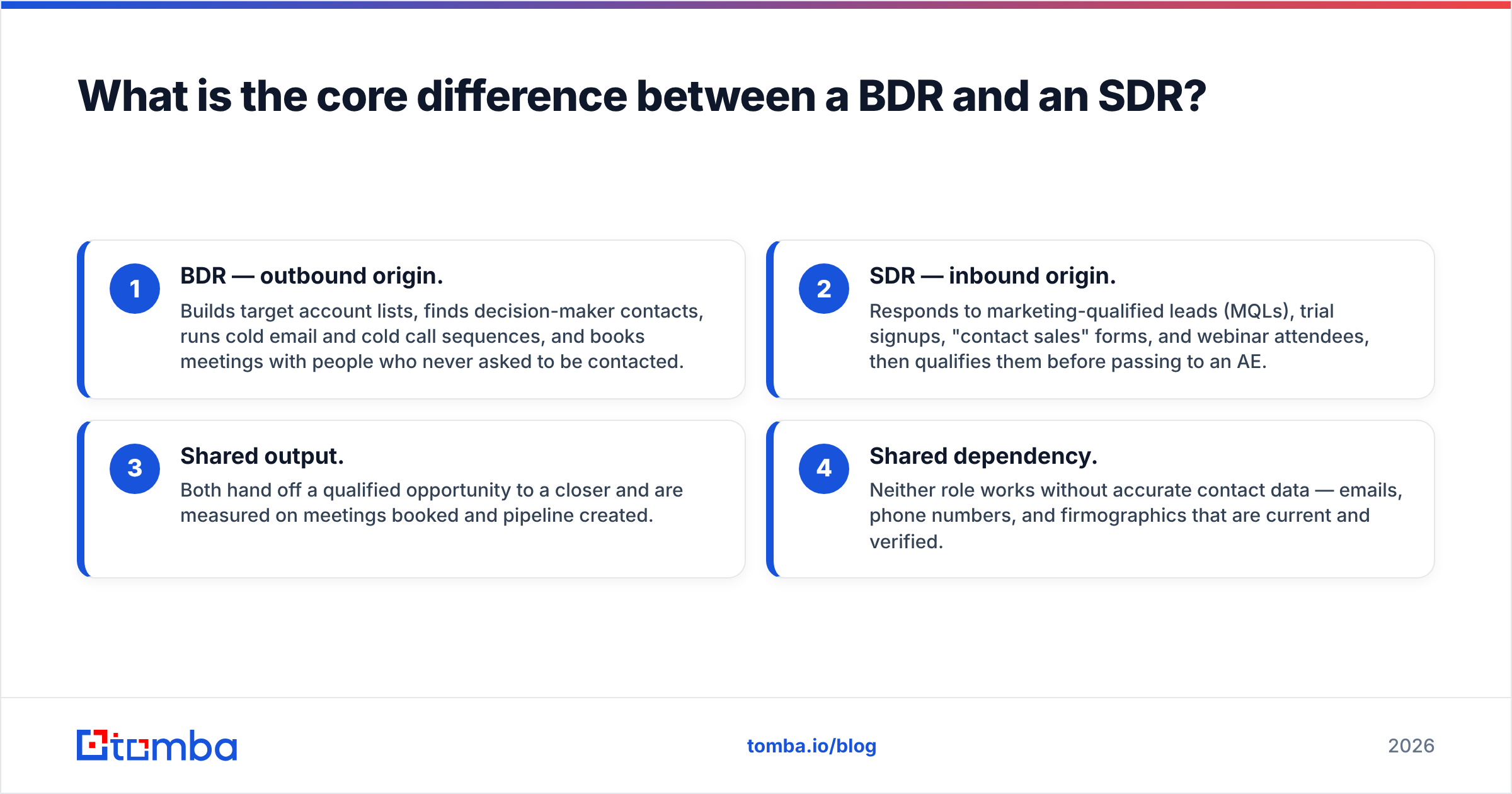
- BDR — outbound origin. Builds target account lists, finds decision-maker contacts, runs cold email and cold call sequences, and books meetings with people who never asked to be contacted.
- SDR — inbound origin. Responds to marketing-qualified leads (MQLs), trial signups, "contact sales" forms, and webinar attendees, then qualifies them before passing to an AE.
- Shared output. Both hand off a qualified opportunity to a closer and are measured on meetings booked and pipeline created.
- Shared dependency. Neither role works without accurate contact data — emails, phone numbers, and firmographics that are current and verified.
This is the framework most modern revenue teams use, popularized in part by HubSpot's sales playbooks and Salesforce's go-to-market structure. But be warned: plenty of companies flip the definitions or merge them entirely.

How do BDR and SDR responsibilities compare side by side?#
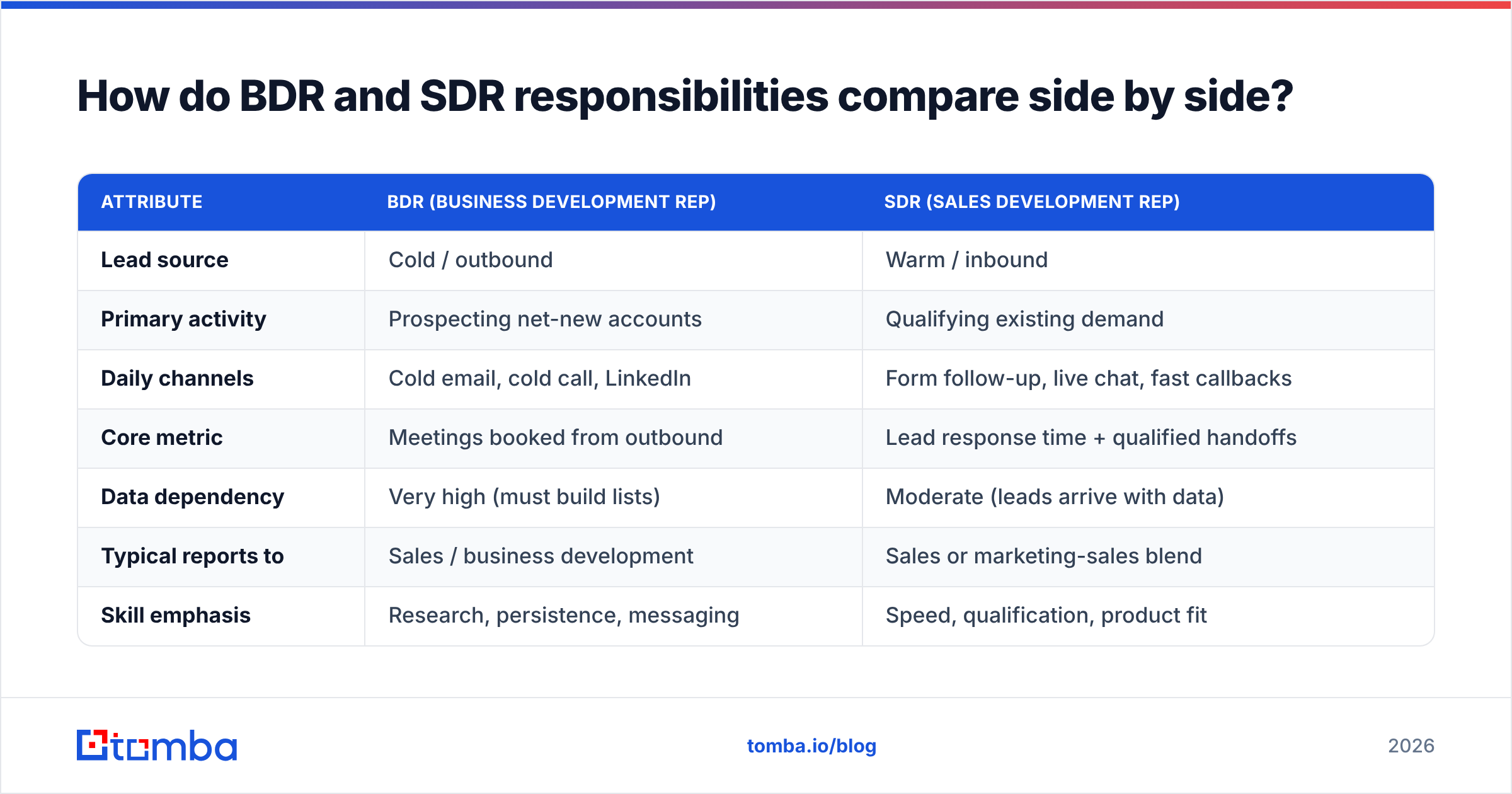
The fastest way to see it is a direct comparison. Here is how the two roles typically break down across the attributes that matter when you are hiring or org-designing.
| Attribute | BDR (Business Development Rep) | SDR (Sales Development Rep) |
|---|---|---|
| Lead source | Cold / outbound | Warm / inbound |
| Primary activity | Prospecting net-new accounts | Qualifying existing demand |
| Daily channels | Cold email, cold call, LinkedIn | Form follow-up, live chat, fast callbacks |
| Core metric | Meetings booked from outbound | Lead response time + qualified handoffs |
| Data dependency | Very high (must build lists) | Moderate (leads arrive with data) |
| Typical reports to | Sales / business development | Sales or marketing-sales blend |
| Skill emphasis | Research, persistence, messaging | Speed, qualification, product fit |
| Best when | You need to manufacture pipeline | Inbound demand already exists |
Notice the data-dependency row. A BDR who can't find verified contact details is dead in the water — they spend their morning guessing email formats instead of selling. That is why outbound teams pair their reps with an email finder and a phone finder so prospecting starts with real, reachable contacts rather than a spreadsheet of firstname@company.com guesses.
SDRs feel data pain differently: the lead already exists, but the form they filled out might have a personal Gmail and a misspelled company name. Quick data enrichment fills in the job title, company size, and direct line so the SDR can qualify in one call instead of three.
Are BDR and SDR titles actually interchangeable?#
Yes and no — and this is where most confusion comes from. The titles are frequently swapped, but the underlying job rarely is.
Here's the reality across the market:
- Some companies call everyone an SDR and split them internally into "inbound SDRs" and "outbound SDRs."
- Some call everyone a BDR and never use SDR at all.
- A growing number use BDR = outbound, SDR = inbound as a deliberate, clean split.
- A few use "business development" to mean partnerships and channel deals — a completely different job from cold prospecting.
So when you read a job posting, ignore the three-letter acronym and read the responsibilities. If it says "build target account lists and run outbound sequences," that's an outbound prospecting role regardless of whether the title says BDR or SDR. If it says "respond to inbound leads within five minutes," that's inbound qualification.
According to role data aggregated on review sites like G2, the tooling each role buys tells you more than the title: outbound-leaning teams over-index on data and sequencing tools, while inbound-leaning teams over-index on speed-to-lead and routing tools.
How does pay differ in the BDR vs SDR debate?#
Conclusion first: pay is driven by motion and market, not by the acronym. A BDR and an SDR at the same company, same tenure, usually earn within a narrow band of each other. Differences show up across industries and deal sizes, not across the two titles.
A few patterns hold in 2026:
- OTE structure is similar. Both roles typically run a 60/40 to 70/30 base-to-variable split, with on-target earnings tied to meetings booked or qualified pipeline.
- Outbound (BDR) variable can swing harder. Because outbound output is more volatile, some orgs weight the variable component higher or add SQL-acceptance bonuses.
- Enterprise pays more than SMB. A rep prospecting six-figure deals out-earns one booking $5k/month SaaS demos, BDR or SDR.
- Promotion velocity matters more than base. Both roles are usually a 12–24 month stepping stone to AE, where earnings jump significantly.
If you are negotiating or budgeting, anchor on the motion and deal size, not the letters. A "BDR" booking enterprise logos should not be benched against an "SDR" qualifying self-serve trials.
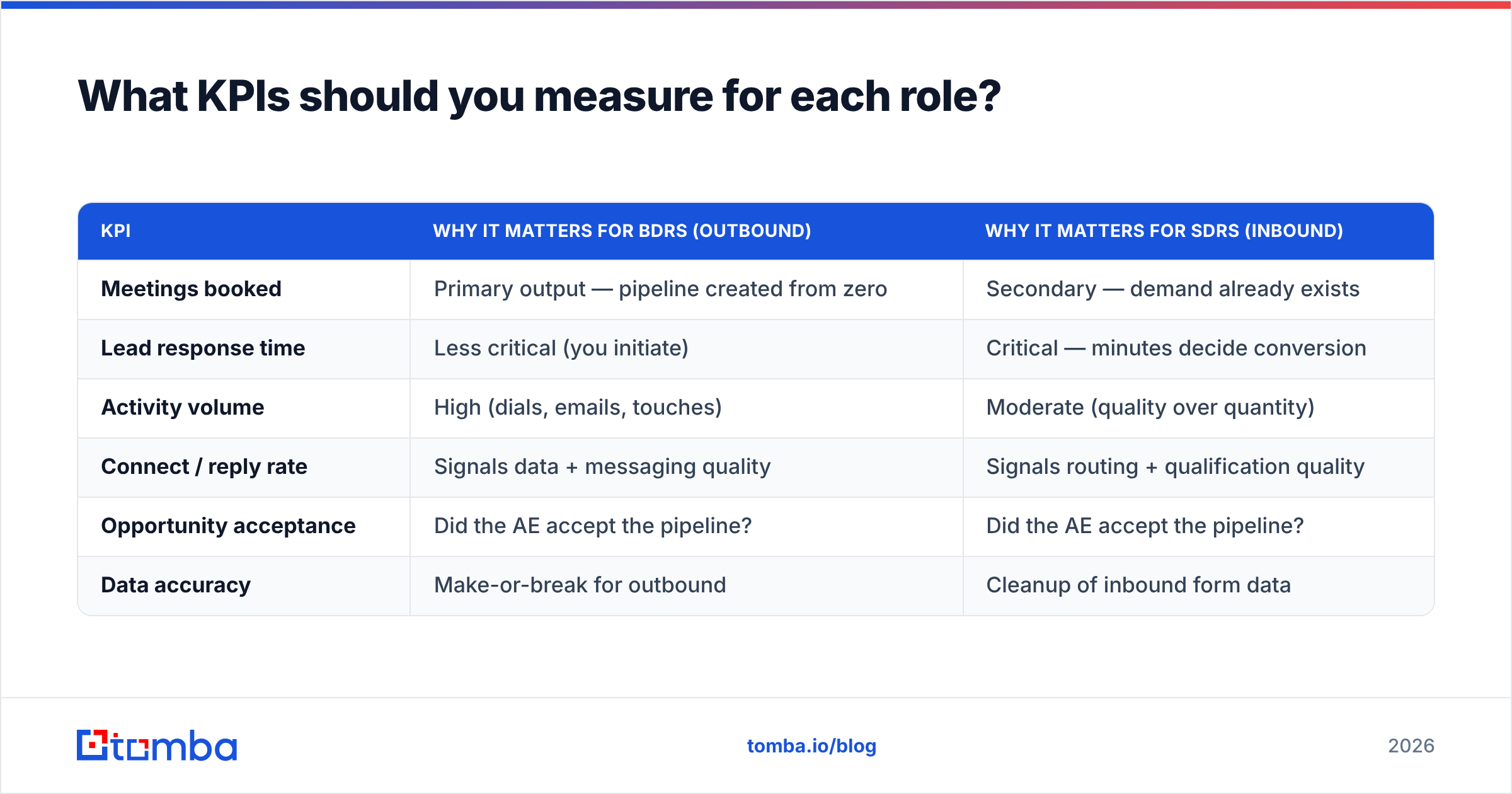
What KPIs should you measure for each role?#
Because the roles point in different directions, measuring them identically is a classic mistake. Outbound is a manufacturing problem; inbound is a logistics problem.
| KPI | Why it matters for BDRs (outbound) | Why it matters for SDRs (inbound) |
|---|---|---|
| Meetings booked | Primary output — pipeline created from zero | Secondary — demand already exists |
| Lead response time | Less critical (you initiate) | Critical — minutes decide conversion |
| Activity volume | High (dials, emails, touches) | Moderate (quality over quantity) |
| Connect / reply rate | Signals data + messaging quality | Signals routing + qualification quality |
| Opportunity acceptance | Did the AE accept the pipeline? | Did the AE accept the pipeline? |
| Data accuracy | Make-or-break for outbound | Cleanup of inbound form data |
For BDRs, the metric most teams under-watch is bounce rate and connect rate, which are pure data-quality signals. If a third of your outbound emails bounce, your rep's quota math is broken before they write a single line of copy. Verifying contacts with an email verifier before a sequence goes out protects both deliverability and your sender reputation — and it keeps reps focused on real conversations.
For SDRs, watch response rate and speed-to-lead obsessively. The difference between a five-minute and a thirty-minute callback can cut conversion in half.
When should you hire a BDR vs an SDR?#
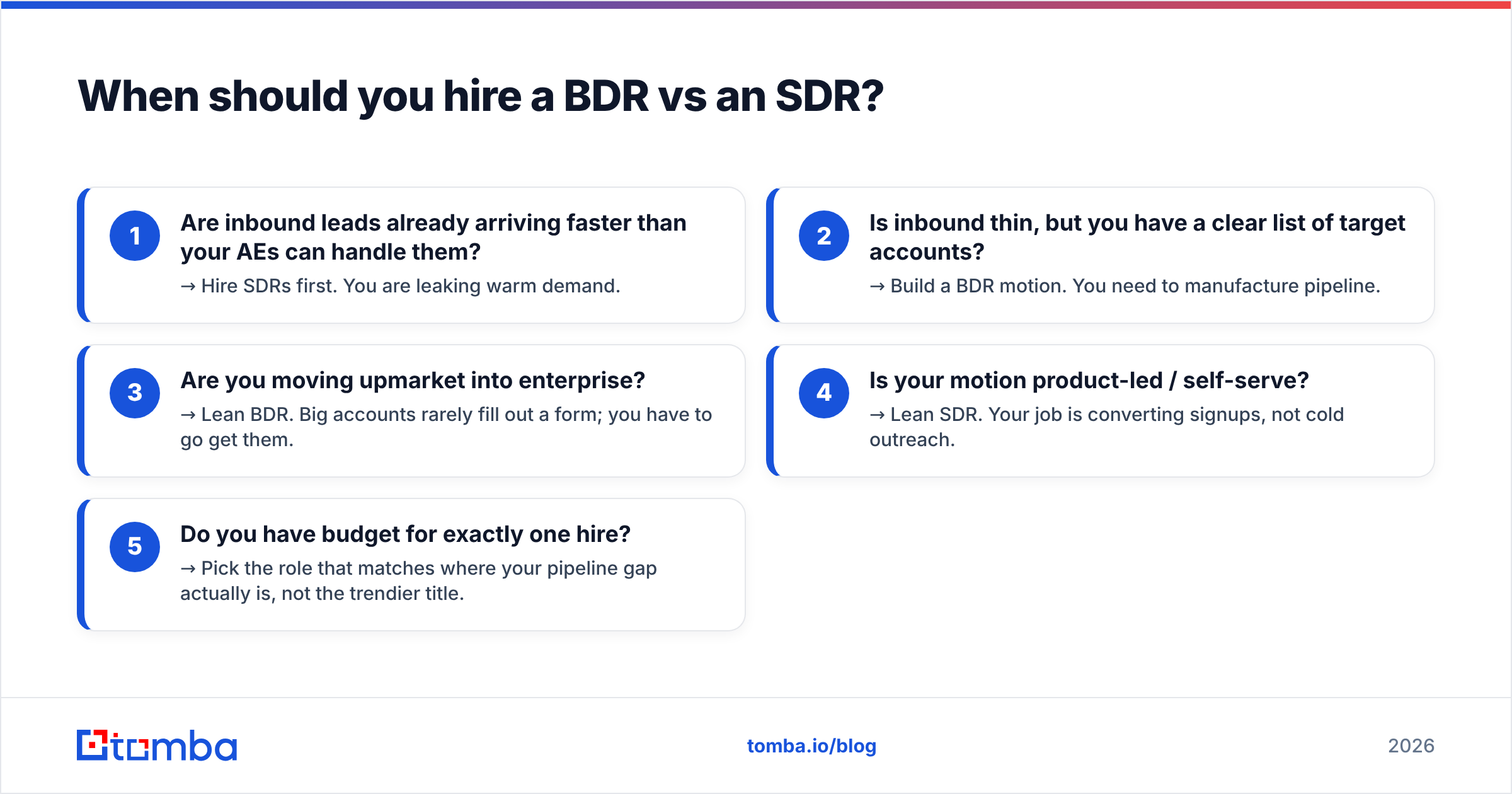
Simple decision rule: hire SDRs when you already have inbound demand to catch; build a BDR function when you need to create demand in accounts that aren't coming to you.
Walk through these questions in order:
- Are inbound leads already arriving faster than your AEs can handle them? → Hire SDRs first. You are leaking warm demand.
- Is inbound thin, but you have a clear list of target accounts? → Build a BDR motion. You need to manufacture pipeline.
- Are you moving upmarket into enterprise? → Lean BDR. Big accounts rarely fill out a form; you have to go get them.
- Is your motion product-led / self-serve? → Lean SDR. Your job is converting signups, not cold outreach.
- Do you have budget for exactly one hire? → Pick the role that matches where your pipeline gap actually is, not the trendier title.
A practical sequencing many startups follow: start with one or two SDRs to capture inbound while you find product-market fit, then layer in BDRs once you understand which accounts convert and want to scale outbound deliberately. This mirrors how teams describe building a repeatable sales process and pipeline before pouring fuel on it.
Whichever you hire, the bottleneck is almost always the same: getting reps in front of the right people. A new BDR with a great script and no verified contacts will miss quota; a fast SDR working leads with stale data will burn callbacks on disconnected numbers.
What tools do BDRs and SDRs actually need?#
Both roles share a core stack — CRM, a sequencer, and a data layer — but they weight it differently.
- CRM (Salesforce, HubSpot) — the system of record for both. See how Salesforce structures sales development for a reference model.
- Sequencer / engagement tool — heavier use for BDRs running multi-touch cold campaigns.
- Contact data + enrichment — the foundation for both. BDRs need it to find contacts; SDRs need it to complete contacts.
- Conversation / dialer tools — critical for any role doing cold calls.
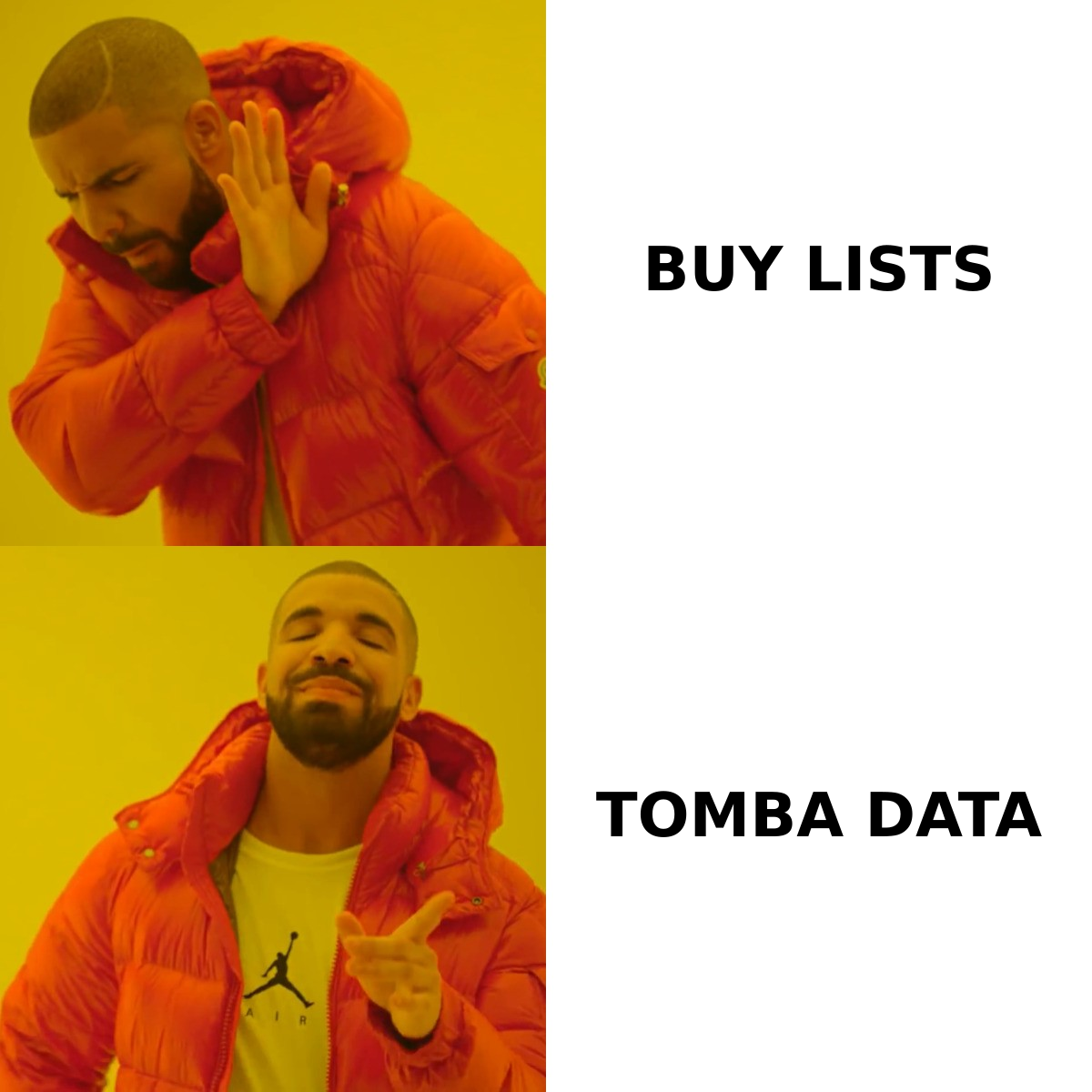
The data layer is where most teams under-invest and overpay later in wasted rep hours. Buying static contact lists feels cheap until half of them bounce. A live, queryable source is the difference between a rep who prospects and a rep who guesses. Tomba's domain search lets a BDR pull every reachable contact at a target company in seconds, while bulk verification keeps an SDR's inbound list clean before it hits the dialer. Compared with assembling this from scratch, Tomba pricing starts free (25 searches/month) and scales with the team, so you are not locked into a per-seat data contract before you know your motion.
BDR vs SDR: which one wins?#
Neither — and that's the point. Asking whether a BDR or an SDR is "better" is like asking whether your goalkeeper or striker is more important. They play different positions on the same pipeline team. The outbound rep manufactures opportunities where none existed; the inbound rep makes sure hard-won demand never slips through the cracks.
What unites them is brutally simple: both roles are only as good as the data they work from. The best script, the fastest callback, and the slickest sequence all collapse if the email bounces or the phone number is dead. Get the data layer right and both roles compound; get it wrong and you are paying salaries to dial disconnected numbers.
If you are standing up or scaling either role this year, start by fixing the foundation. Tomba's Email Finder gives your BDRs and SDRs verified, reachable contacts by domain, name, or company — so prospecting begins with real people instead of guesses. Spin up a free account, pull your first target-account list, and let your reps spend their day selling instead of scrubbing spreadsheets.
// get started
Find, verify and enrich your first contacts today
Start on the free plan with 25 searches a month, then scale when your team is ready.
Free plan · No credit card required · GDPR & CCPA
// about the author