Best AI for Automating Sales Follow-Ups: 2026 Guide
The best AI for automating sales follow-ups in 2026, compared on triggers, personalization, deliverability, and price — plus how to keep replies human.
Most deals don't die on the first email. They die in the gap between the first email and the fifth one that never got sent. The average B2B sale needs five or more touches, yet most reps stop after two — not because they're lazy, but because manual follow-up doesn't scale. That's the exact gap AI follow-up tools are built to close.
This guide ranks the best AI for automating sales follow-ups in 2026, with a hard look at what each tool actually automates, where the "AI" is real, and where it's a marketing label on a glorified mail-merge.
TL;DR#
- The best AI for automating sales follow-ups isn't one tool — it's a stack: clean contact data, an AI sequencer, and a deliverability layer that keeps your replies out of spam.
- Top picks for 2026: Smartlead and Instantly for volume sending, HubSpot Sales Hub for CRM-native teams, Salesloft and Outreach for enterprise cadences, and Lemlist for personalization.
- AI is only as good as its inputs. Feed it verified emails and enriched fields or your "personalized" follow-ups bounce and burn your domain.
- Don't fully automate the reply. Automate timing, drafting, and routing; keep a human on intent detection and the final send for anything mid-funnel.
- Start with data. A tool like the Tomba Email Finder feeds verified contacts into whichever sequencer you choose.
What does "AI for automating sales follow-ups" actually mean?#
Think of follow-up automation like a thermostat for your pipeline. You don't manually adjust the heat every hour — you set the rules, and the system reacts to conditions. AI follow-up tools do the same: they watch for triggers (no reply in 3 days, an email opened twice, a link clicked) and fire the right next touch without you babysitting the inbox.
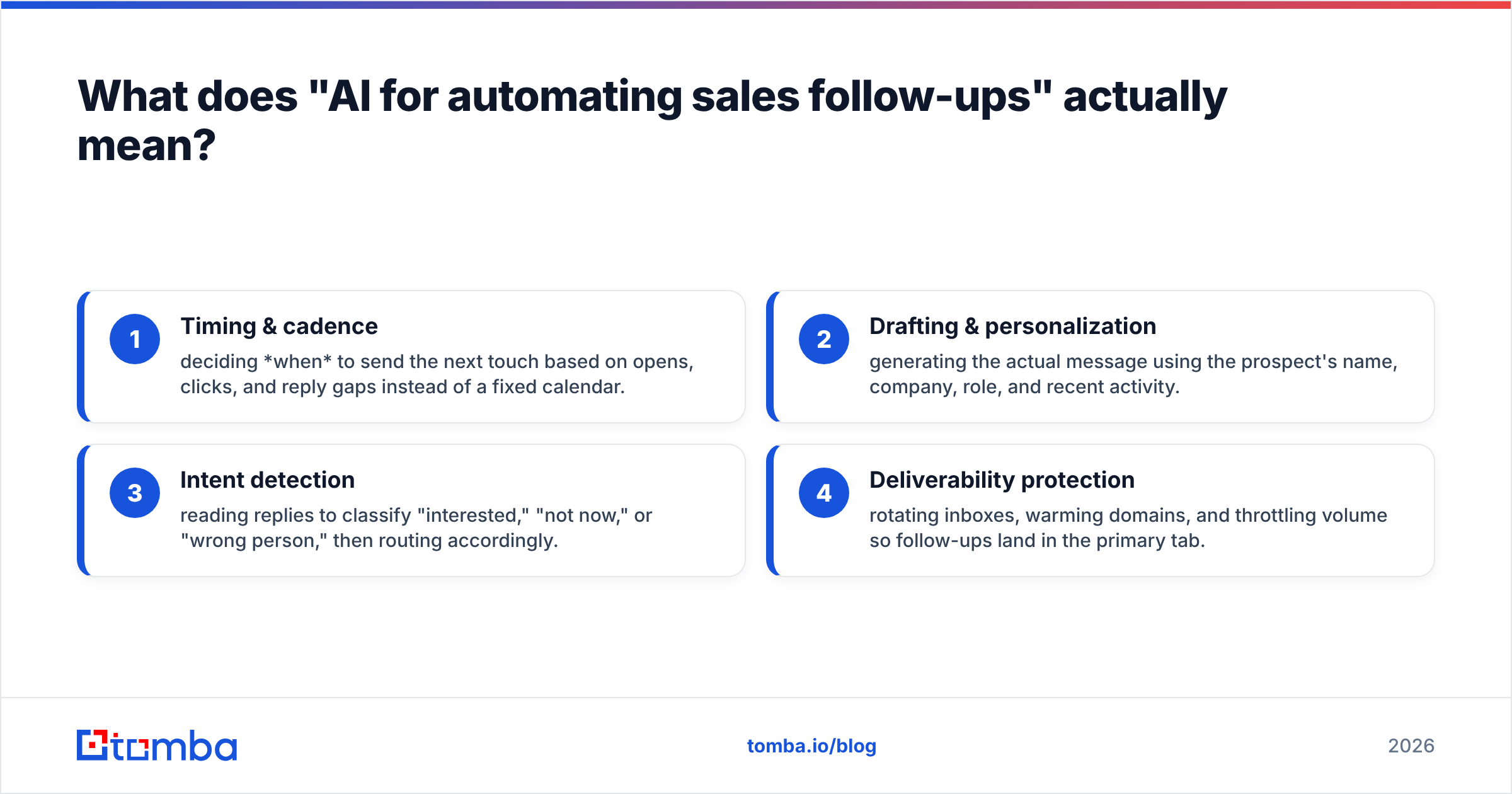
In practice, the category splits into four jobs:
- Timing & cadence — deciding when to send the next touch based on opens, clicks, and reply gaps instead of a fixed calendar.
- Drafting & personalization — generating the actual message using the prospect's name, company, role, and recent activity.
- Intent detection — reading replies to classify "interested," "not now," or "wrong person," then routing accordingly.
- Deliverability protection — rotating inboxes, warming domains, and throttling volume so follow-ups land in the primary tab.
A tool that only does #2 is a template engine. The best AI for automating sales follow-ups covers all four, and the strongest setups bolt a clean data source onto the front so the automation has accurate inputs to work with.
Which AI tools are best for automating sales follow-ups in 2026?#
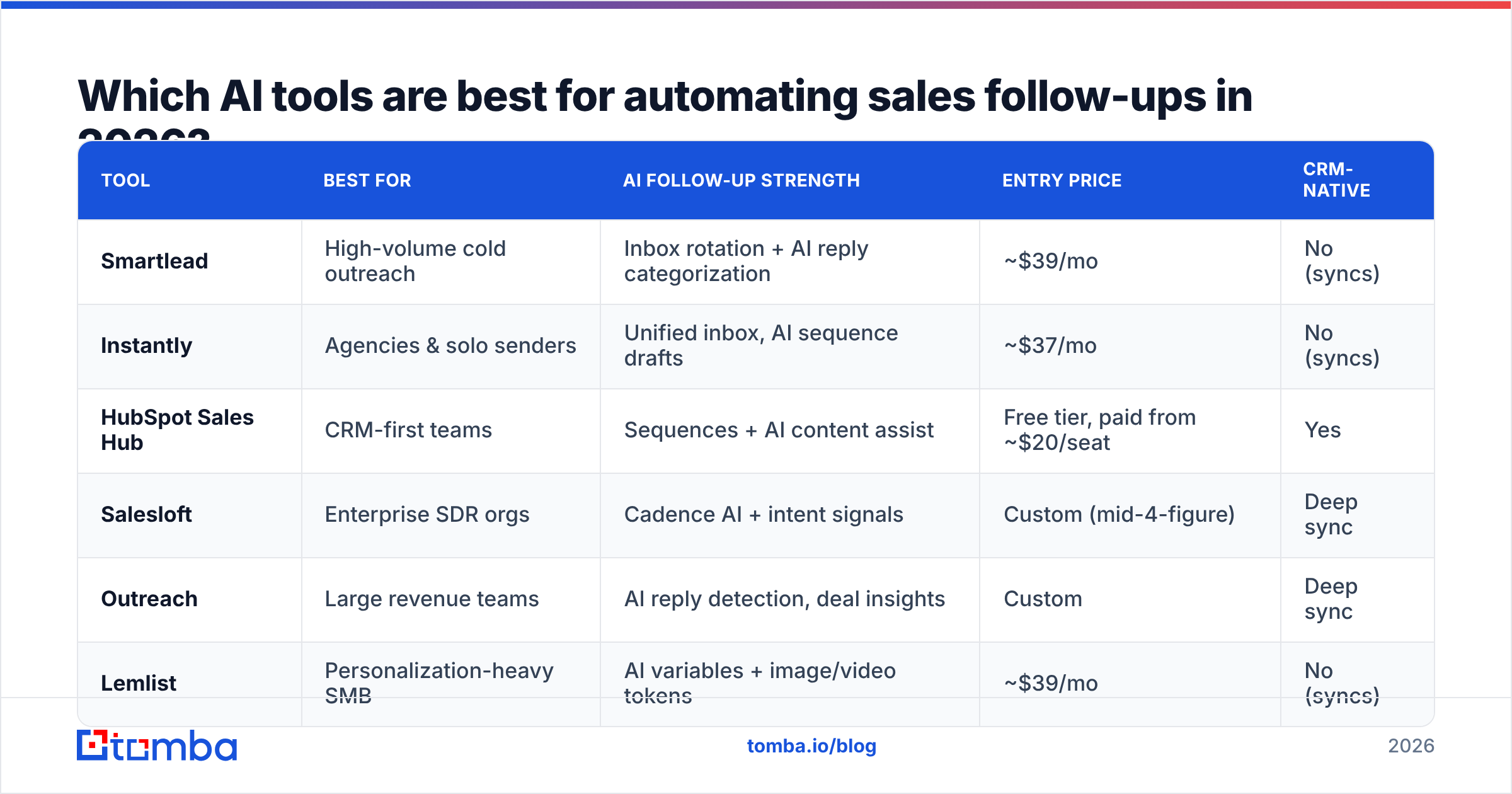
Here's the honest field guide. Pricing reflects publicly listed entry tiers as of 2026 and changes often — confirm on each vendor's site before you buy.
| Tool | Best for | AI follow-up strength | Entry price | CRM-native |
|---|---|---|---|---|
| Smartlead | High-volume cold outreach | Inbox rotation + AI reply categorization | ~$39/mo | No (syncs) |
| Instantly | Agencies & solo senders | Unified inbox, AI sequence drafts | ~$37/mo | No (syncs) |
| HubSpot Sales Hub | CRM-first teams | Sequences + AI content assist | Free tier, paid from ~$20/seat | Yes |
| Salesloft | Enterprise SDR orgs | Cadence AI + intent signals | Custom (mid-4-figure) | Deep sync |
| Outreach | Large revenue teams | AI reply detection, deal insights | Custom | Deep sync |
| Lemlist | Personalization-heavy SMB | AI variables + image/video tokens | ~$39/mo | No (syncs) |
A few notes that the table can't hold:
- Smartlead and Instantly win on deliverability mechanics — multi-inbox rotation and warmup are first-class, which matters more for follow-ups than the AI copy itself. Compare them against an Instantly alternative if you want different sending limits.
- HubSpot is the path of least resistance if your team already lives in the CRM; its sequences trigger off deal stages natively. See the HubSpot integration to pipe verified contacts straight in.
- Salesloft and Outreach are built for orgs running structured cadences across dozens of reps; overkill for a team of three. If the price stings, weigh an Outreach alternative or a Salesloft alternative.
- Lemlist leans hardest into personalization tokens, including dynamic images — great for standing out, risky if your underlying data is dirty.
For an apples-to-apples breakdown of feature depth and review volume, G2's sales engagement category is the most current third-party source.
How does AI decide when and what to follow up with?#
The "intelligence" comes down to two engines: a timing engine and a content engine.
The timing engine watches behavioral signals. If a prospect opened your email three times but never replied, that's a buying signal — a strong follow-up tool bumps that contact up the queue and may suggest a call instead of another email. If there's zero engagement after two touches, it spaces the next message further out to avoid burning the relationship (and your sender reputation).
The content engine generates the message. Modern tools pull from CRM fields and enrichment data to fill variables — role, company size, recent funding, tech stack — then draft a contextual note. This is where most "AI follow-up" tools quietly fail: if the enrichment field is blank or wrong, the AI either writes a generic line or hallucinates one. Salesforce's own research on AI in sales stresses that grounding AI in clean first-party data is the difference between useful automation and confident nonsense.
That's the unglamorous truth: the model is rarely the bottleneck. The data is.
Why does data quality decide whether AI follow-ups work?#
Because a perfect follow-up sent to a bounced address is worth zero — and worse than zero, since bounces wreck email deliverability for every other message on the domain.
Here's the chain of failure when data is bad:
- Invalid email → hard bounce → spam-folder placement for your good sends.
- Wrong contact → reply says "I don't handle this" → AI may not catch the intent and keeps sequencing.
- Missing enrichment fields → generic copy → lower reply rates → AI optimizes toward a dead end.
- Catch-all domains → uncertain validity → either skipped or risked.
The fix is to gate every contact before it enters the sequence. Run names through an email finder to source the address, then an email verifier to confirm it's deliverable, and a catch-all verifier for the ambiguous domains. Clean inputs mean the AI spends its budget on prospects who can actually receive — and answer — your follow-ups.
Should you fully automate sales follow-ups, or keep a human in the loop?#
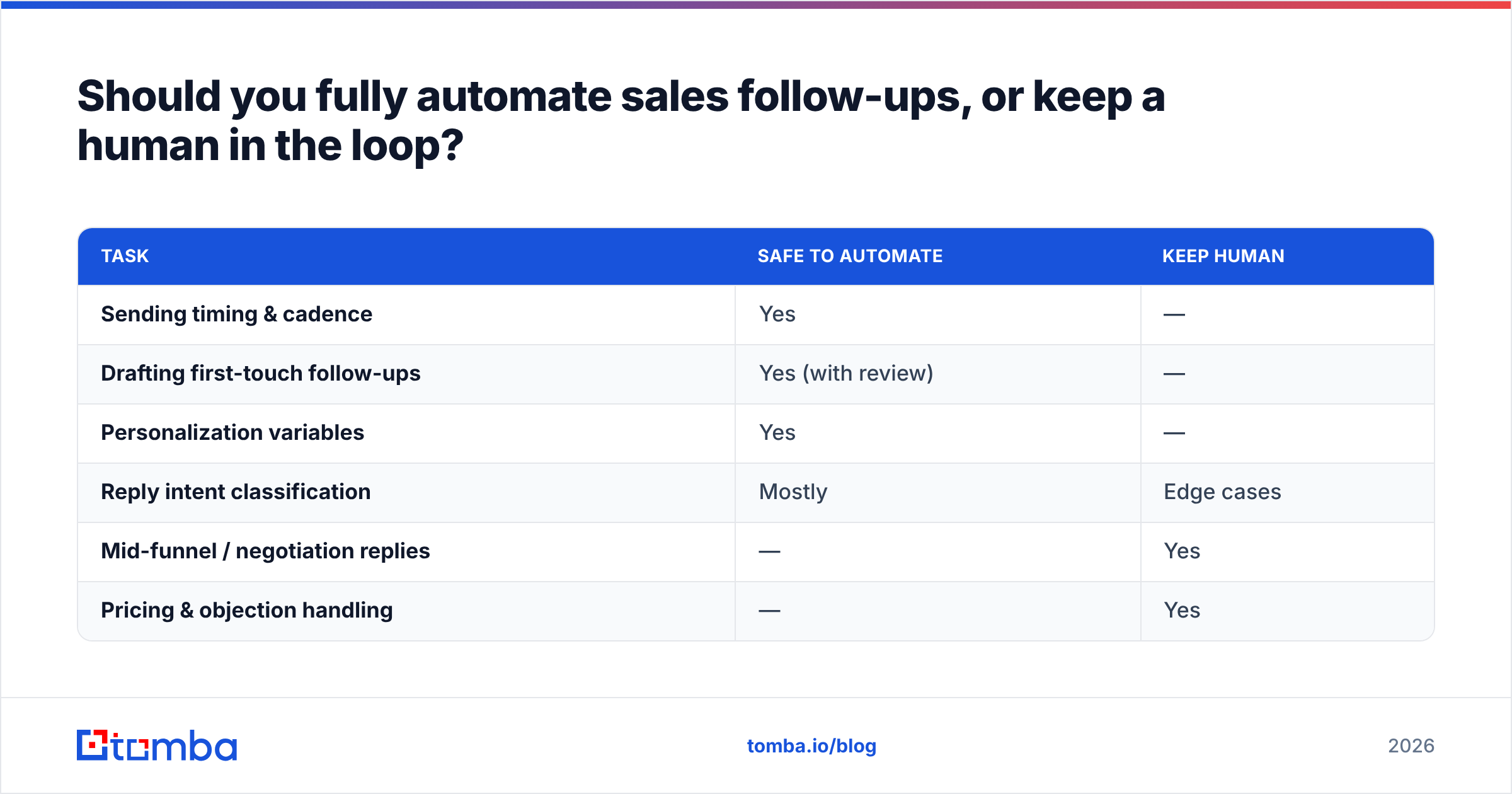
Automate the mechanics, not the judgment. The split that works in 2026:
| Task | Safe to automate | Keep human |
|---|---|---|
| Sending timing & cadence | Yes | — |
| Drafting first-touch follow-ups | Yes (with review) | — |
| Personalization variables | Yes | — |
| Reply intent classification | Mostly | Edge cases |
| Mid-funnel / negotiation replies | — | Yes |
| Pricing & objection handling | — | Yes |
The pattern: let AI handle top-of-funnel volume and timing, where a missed nuance costs little. Pull a human in the moment intent gets warm. A fully-automated reply that misreads "send me pricing next quarter" as a rejection just lost you a deal that was yours to win. Track your response rate by stage to see exactly where automation stops helping and starts hurting.
This is also where sales automation gets a bad name. Teams that automate everything see short-term volume and long-term brand damage. Teams that automate the boring 80% and reserve human attention for the valuable 20% win.
How do you build an AI follow-up stack that actually converts?#
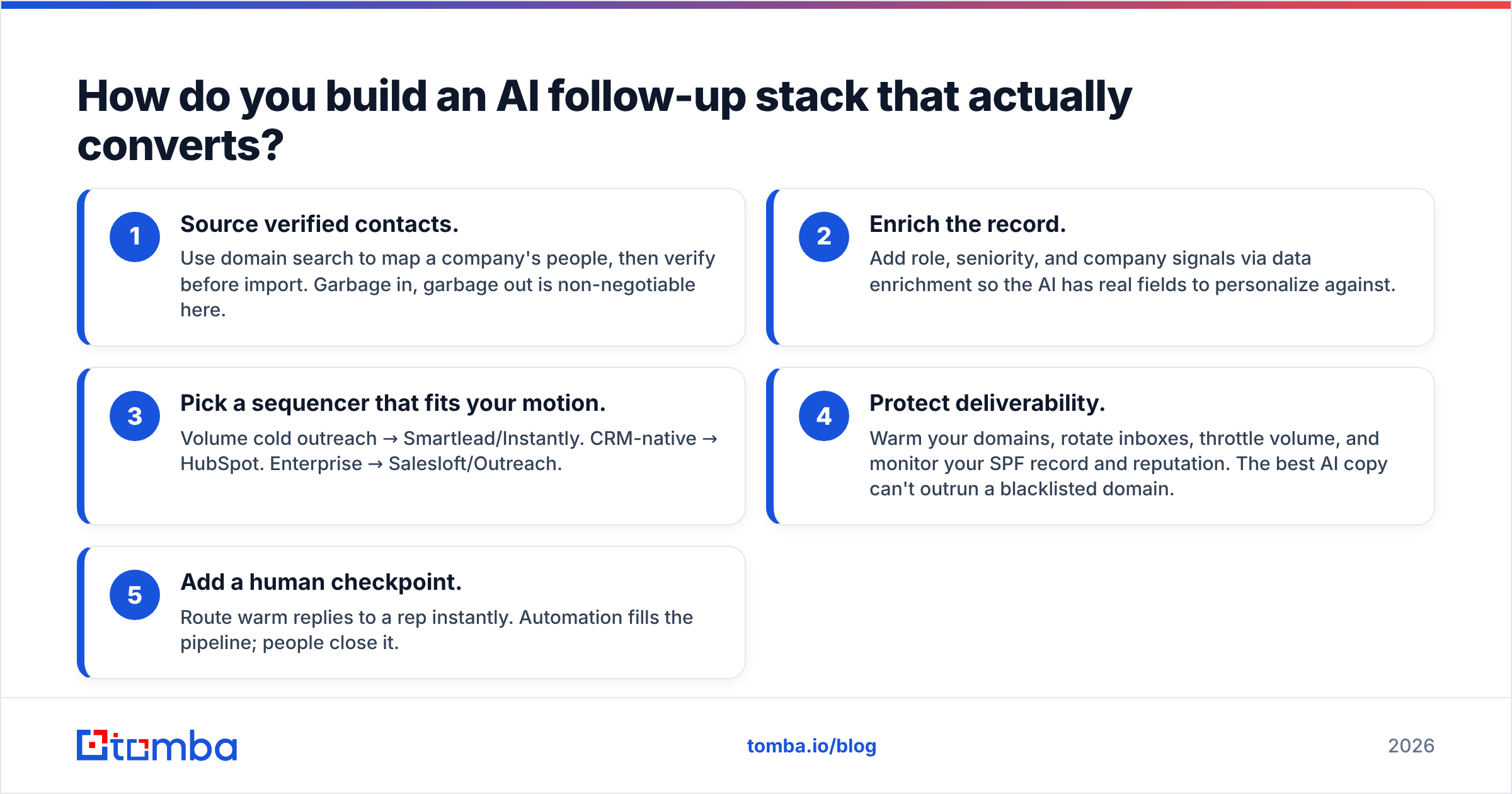
Five steps, in order:
- Source verified contacts. Use domain search to map a company's people, then verify before import. Garbage in, garbage out is non-negotiable here.
- Enrich the record. Add role, seniority, and company signals via data enrichment so the AI has real fields to personalize against.
- Pick a sequencer that fits your motion. Volume cold outreach → Smartlead/Instantly. CRM-native → HubSpot. Enterprise → Salesloft/Outreach.
- Protect deliverability. Warm your domains, rotate inboxes, throttle volume, and monitor your SPF record and reputation. The best AI copy can't outrun a blacklisted domain.
- Add a human checkpoint. Route warm replies to a rep instantly. Automation fills the pipeline; people close it.
The mistake most teams make is starting at step 3 — buying the shiny AI sequencer first — then wondering why reply rates are flat. The leverage is in steps 1 and 2. The AI is downstream of your data.
For teams scaling this, bulk email finding and verification lets you prep thousands of contacts at once, and the Tomba API wires verification directly into your sequencer so no unverified contact ever enters a cadence. Pricing scales from a free tier up through Growth and Pro plans — see current Tomba pricing for the tier that matches your send volume.
What's the biggest mistake teams make with AI follow-up automation?#
Confusing more with better. AI makes it trivial to send 10x the follow-ups — which is exactly why so many domains land on blacklists in 2026. The teams winning aren't the ones sending the most automated touches; they're the ones sending fewer, better-targeted, verified touches and letting AI handle the timing and routing around a human's judgment.
The second mistake: treating the AI tool as the strategy. It's a multiplier, not a plan. A 2x multiplier on a broken process gives you a faster broken process.
The bottom line#
The best AI for automating sales follow-ups in 2026 is a layered setup, not a single subscription: verified data on the front, a sequencer matched to your motion in the middle, deliverability protection underneath, and a human on the warm replies. Smartlead, Instantly, HubSpot, Salesloft, Outreach, and Lemlist each win a different lane — pick by your sales motion and volume, not by whoever shouts "AI" loudest.
But every one of them runs on the contacts you feed it. Before you automate a single follow-up, make sure the addresses are real. Start with the Tomba Email Finder to source verified, deliverable contacts by name, company, or domain — then let your AI sequencer do what it does best on inputs that won't bounce. Clean data is the cheapest performance upgrade in your stack, and it's the one most teams skip.
// get started
Find, verify and enrich your first contacts today
Start on the free plan with 25 searches a month, then scale when your team is ready.
Free plan · No credit card required · GDPR & CCPA
// about the author