Best AI Sales Assistant Software in 2026: Top 9 Tools Ranked
AI sales assistants promise to write emails, score leads, and book meetings for you. Here's what actually works in 2026 — and where clean data still beats clever models.
TL;DR
- "AI sales assistant" covers four different jobs: writing/replying, lead scoring, conversation intelligence, and autonomous prospecting. No single tool is best at all four.
- The flashy demos (AI SDRs that "book meetings while you sleep") only work when the underlying contact data is accurate. Garbage list in, confident garbage out.
- For most teams the winning stack is one writing assistant + one data/enrichment layer + your existing CRM — not a $1,500/mo all-in-one platform.
- Pricing ranges wildly: free Chrome extensions to $1,000+/mo per-seat platforms. Match the tier to the job, not the hype.
- Before you automate outreach, fix the input: verified emails and enriched profiles. That's where a tool like the Tomba Email Finder earns its keep.
What is AI sales assistant software?#
An AI sales assistant is software that uses machine learning and large language models to do work a sales rep would otherwise do by hand — drafting emails, summarizing calls, ranking which leads to chase first, or running outreach sequences on autopilot.
Think of it like a GPS for a road trip. It doesn't drive the car or pick the destination, but it watches the traffic, suggests the fastest route, and warns you before you miss the exit. The rep still closes the deal; the assistant removes the busywork around it.
The problem is the category has become a marketing blob. A free email-writing browser plugin and a $1,200/mo conversation-intelligence platform both call themselves "AI sales assistants." They solve completely different problems. So the first useful move is to split the category by the job to be done.
What are the main types of AI sales assistants?#
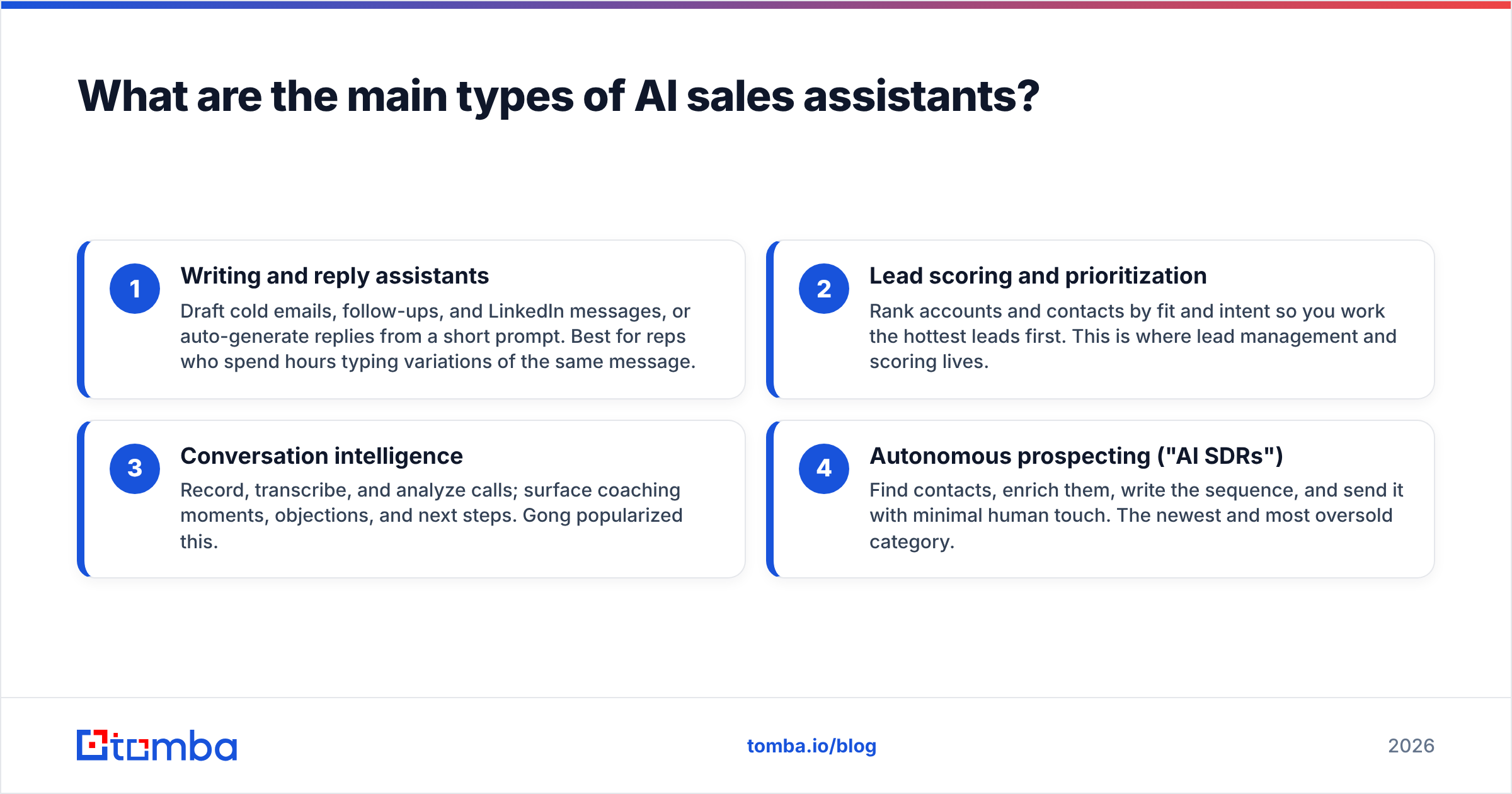
There are four distinct jobs, and most tools are strong in exactly one of them:
- Writing and reply assistants — Draft cold emails, follow-ups, and LinkedIn messages, or auto-generate replies from a short prompt. Best for reps who spend hours typing variations of the same message.
- Lead scoring and prioritization — Rank accounts and contacts by fit and intent so you work the hottest leads first. This is where lead management and scoring lives.
- Conversation intelligence — Record, transcribe, and analyze calls; surface coaching moments, objections, and next steps. Gong popularized this.
- Autonomous prospecting ("AI SDRs") — Find contacts, enrich them, write the sequence, and send it with minimal human touch. The newest and most oversold category.
A rep drowning in manual follow-ups needs job #1. A VP trying to fix a leaky pipeline needs job #2 or #3. A founder with no SDR team is tempted by job #4 — but that's also the category most dependent on clean data, which is the part the vendors quietly assume you already have.
Which is the best AI sales assistant software in 2026?#
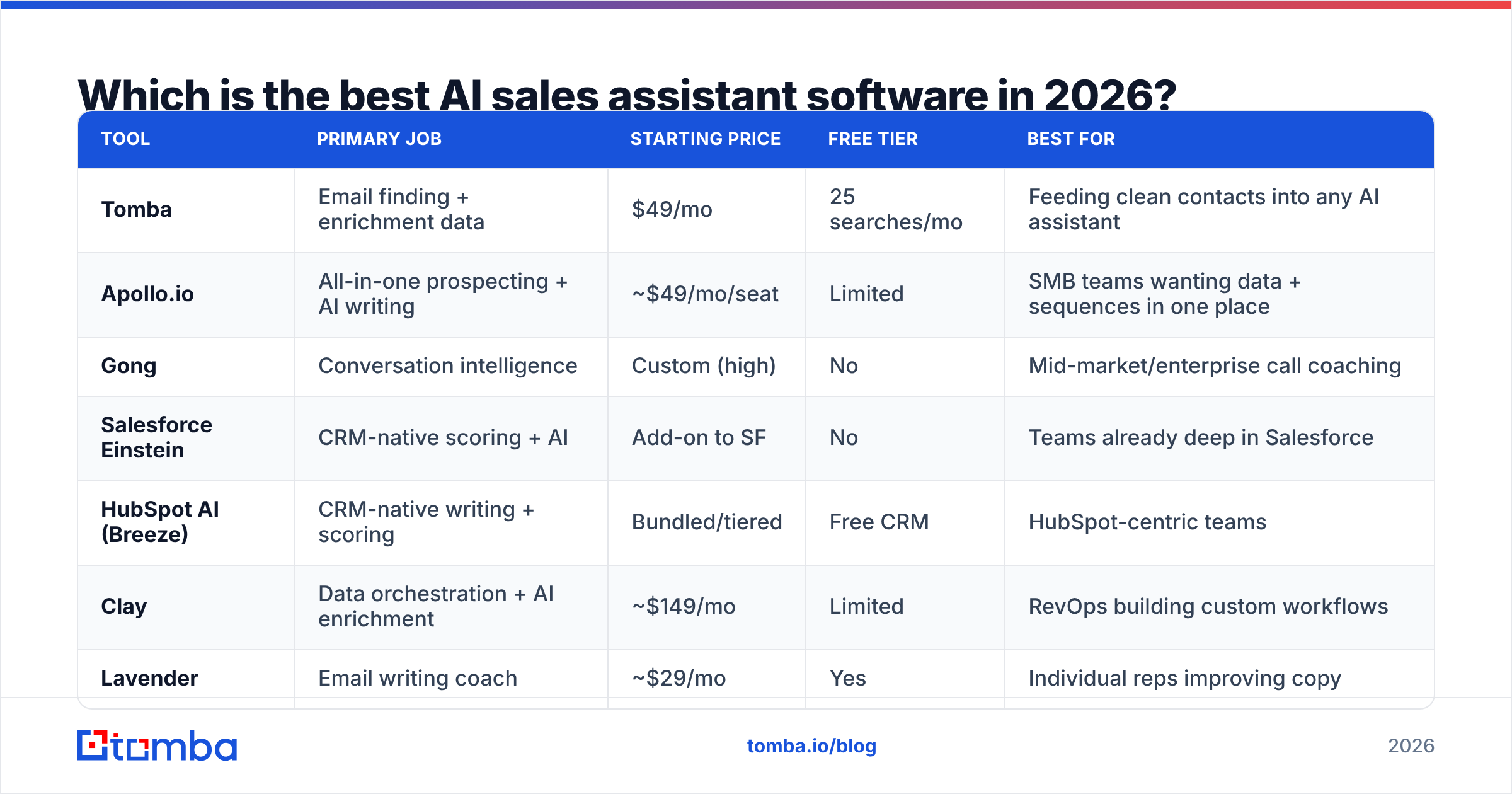
Short answer: there is no single winner, but there are clear best-in-class picks per job. Below is an honest comparison of nine tools that show up most often in real evaluations.
| Tool | Primary job | Starting price | Free tier | Best for |
|---|---|---|---|---|
| Tomba | Email finding + enrichment data | $49/mo | 25 searches/mo | Feeding clean contacts into any AI assistant |
| Apollo.io | All-in-one prospecting + AI writing | ~$49/mo/seat | Limited | SMB teams wanting data + sequences in one place |
| Gong | Conversation intelligence | Custom (high) | No | Mid-market/enterprise call coaching |
| Salesforce Einstein | CRM-native scoring + AI | Add-on to SF | No | Teams already deep in Salesforce |
| HubSpot AI (Breeze) | CRM-native writing + scoring | Bundled/tiered | Free CRM | HubSpot-centric teams |
| Clay | Data orchestration + AI enrichment | ~$149/mo | Limited | RevOps building custom workflows |
| Lavender | Email writing coach | ~$29/mo | Yes | Individual reps improving copy |
| Instantly | Sending + AI sequences | ~$37/mo | No | High-volume cold email senders |
| Regie.ai | Autonomous AI SDR | Custom | No | Teams testing fully automated outreach |
A few honest caveats on that table. Gong and Salesforce Einstein are excellent but priced for organizations, not solo reps — expect annual contracts and onboarding. Apollo bundles a lot, but its built-in data accuracy varies by region and seniority, which is exactly why many teams pair it with a dedicated email verifier. And the "autonomous AI SDR" tools demo beautifully on a curated list and fall apart on a messy one.
Do AI sales assistants actually improve results?#
Yes — but only on the parts of the funnel where the input is already good. This is the realization most buyers reach a quarter too late.
An AI writing assistant can lift reply rates by tightening your copy and personalizing at scale. Conversation intelligence genuinely improves coaching because it removes recall bias from call reviews. Lead scoring works when your CRM has enough clean history to learn from.
But every one of those gains assumes the contact is real, reachable, and correctly attributed. If your AI SDR sends a flawless, perfectly personalized sequence to an email that bounces, you didn't save time — you damaged your sender reputation. The model was confident. It was also wrong, because nobody checked the address.
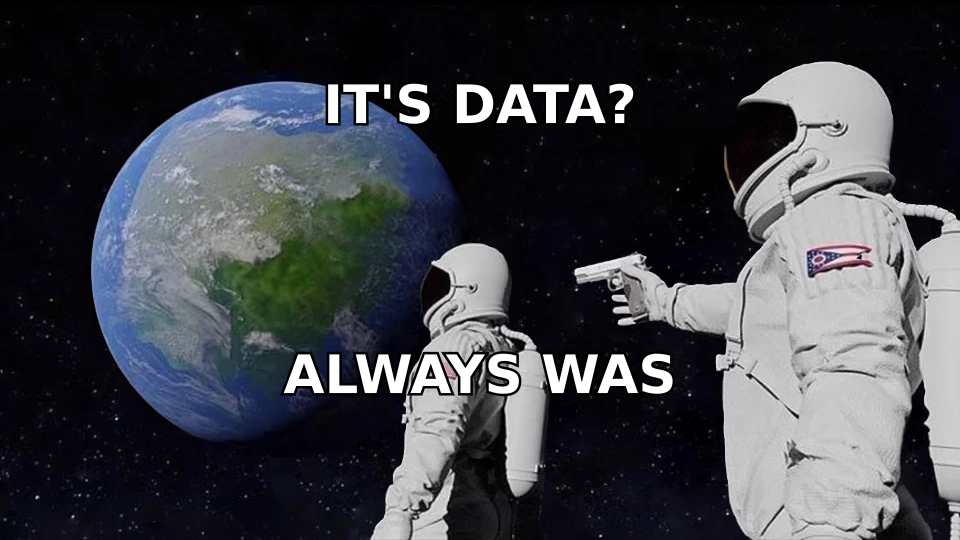
This is the uncomfortable truth the category buries: most "AI sales" failures are data-quality failures wearing an AI costume. The model is rarely the bottleneck in 2026. The list is.
How do AI sales assistants and data tools work together?#
They're layers, not competitors. The cleanest mental model is a three-layer stack:
- Data layer — Find and verify who to contact. This is where email finders, domain search, and data enrichment live. It answers "who, and how do I reach them, reliably?"
- Intelligence layer — Score and prioritize. Which of these verified contacts is worth your time first?
- Action layer — Write, send, and follow up. The AI writing assistants and sequencers.
Most teams over-invest in the action layer (shiny AI copy) and under-invest in the data layer. Flip it. A mediocre email to the right verified person outperforms a brilliant email to a guessed address every time.
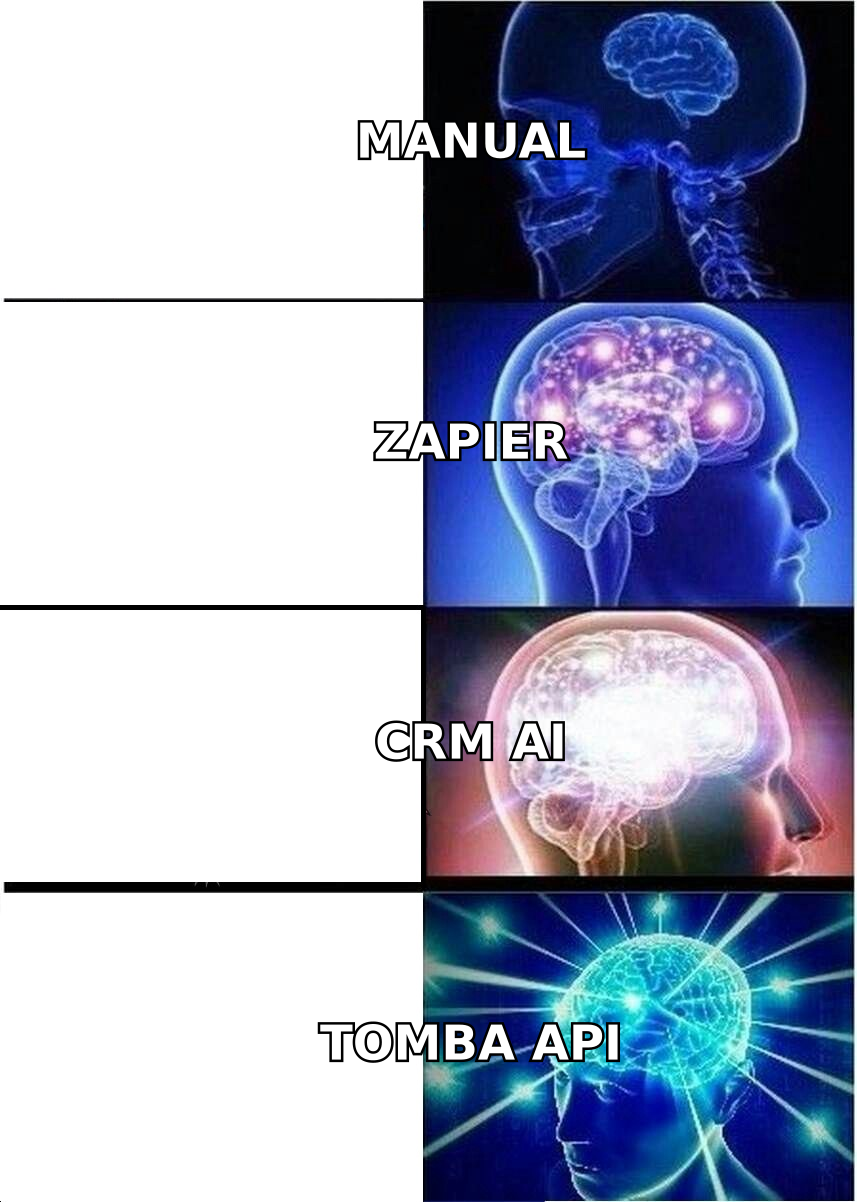
Here's how that looks in practice. You pull target companies, run a bulk email finder to get verified contacts, push those into your CRM via the HubSpot integration or Salesforce integration, let your scoring model rank them, and only then hand the top slice to your AI writing assistant. The AI tools at the end are only as good as the verified data you fed in at the start.
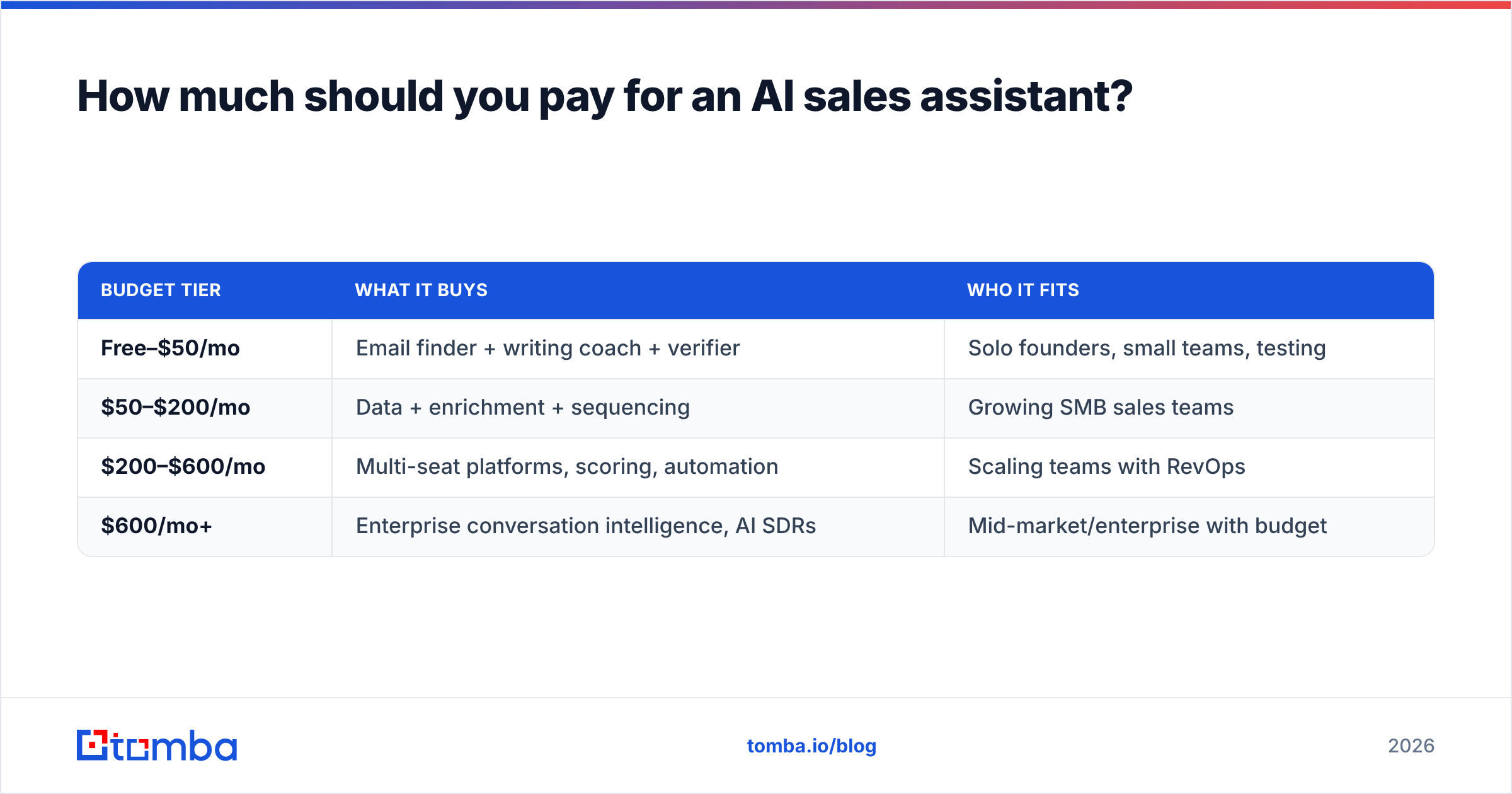
How much should you pay for an AI sales assistant?#
Match the spend to the job. Overpaying for an all-in-one platform when you needed a $29 writing coach is the most common waste in this category.
| Budget tier | What it buys | Who it fits |
|---|---|---|
| Free–$50/mo | Email finder + writing coach + verifier | Solo founders, small teams, testing |
| $50–$200/mo | Data + enrichment + sequencing | Growing SMB sales teams |
| $200–$600/mo | Multi-seat platforms, scoring, automation | Scaling teams with RevOps |
| $600/mo+ | Enterprise conversation intelligence, AI SDRs | Mid-market/enterprise with budget |
For the data layer specifically, Tomba pricing starts with a free tier of 25 searches/mo, then Starter at $49/mo, Growth at $99/mo, and Pro at $249/mo — so you can validate the workflow before committing to a four-figure platform contract.
A practical rule: spend your first dollars making your contact data trustworthy, your next dollars on the writing/sending layer, and only buy enterprise intelligence platforms once you have enough clean pipeline volume to justify them. Buying Gong before you can reliably reach prospects is buying a race-car engine for a car with no wheels.
What should you look for when choosing AI sales assistant software?#
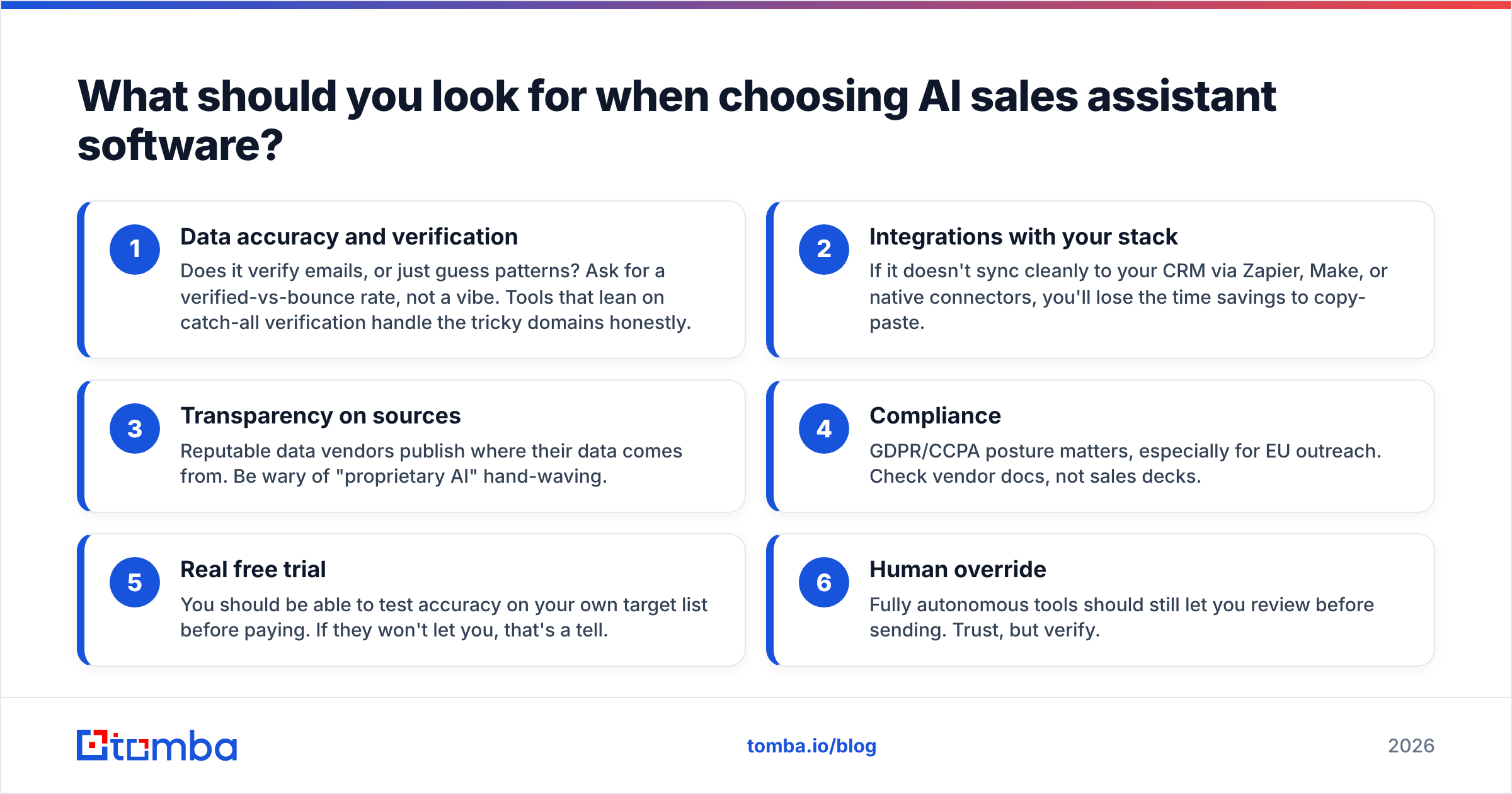
Use this checklist to cut through the demos:
- Data accuracy and verification — Does it verify emails, or just guess patterns? Ask for a verified-vs-bounce rate, not a vibe. Tools that lean on catch-all verification handle the tricky domains honestly.
- Integrations with your stack — If it doesn't sync cleanly to your CRM via Zapier, Make, or native connectors, you'll lose the time savings to copy-paste.
- Transparency on sources — Reputable data vendors publish where their data comes from. Be wary of "proprietary AI" hand-waving.
- Compliance — GDPR/CCPA posture matters, especially for EU outreach. Check vendor docs, not sales decks.
- Real free trial — You should be able to test accuracy on your own target list before paying. If they won't let you, that's a tell.
- Human override — Fully autonomous tools should still let you review before sending. Trust, but verify.
Independent review sites like G2 and Capterra are useful for cross-checking vendor claims against real user reviews — filter for reviewers who match your company size and region, since accuracy and value vary a lot by segment.
Are autonomous AI SDRs worth it in 2026?#
For most teams, not yet as a full replacement — but increasingly useful as an assist. The autonomous "AI SDR" pitch is seductive: point it at a market and it finds, writes, and books for you. In controlled conditions with a curated, verified list, the better tools genuinely book meetings.
The failure mode is volume without verification. An autonomous agent firing thousands of emails at unverified addresses will tank your deliverability faster than any human could, because it does it at machine speed. Google and Microsoft's spam filters punish the sending domain, and recovery takes weeks. The conversation about email deliverability is the one these tools most want you to skip.
If you want to experiment with autonomous outreach, do it on a small, fully verified segment first. Run the list through a bulk verify pass, cap daily volume, and watch your bounce and spam rates like a hawk. The AI handles the labor; you still own the consequences.
How do you build a practical AI sales stack on a budget?#
Here's a lean, honest stack that most teams can run for under $200/mo:
- Find and verify contacts — Use an email finder plus a verifier so every address is real before it enters a sequence.
- Enrich — Add titles, company size, and LinkedIn data with contact enrichment so your scoring and personalization have something to work with.
- Score — Let your CRM's native AI (HubSpot Breeze or Salesforce Einstein) rank the enriched list.
- Write — Use a focused writing assistant (Lavender, or your CRM's built-in AI) to tighten copy.
- Send and follow up — A sequencer like Instantly or your CRM's sequences, with conservative volume.
Notice that the AI-heavy parts sit at the end, and the data parts sit at the start. That ordering is the whole game. You can swap any single tool without breaking the stack — except the data layer, which everything downstream depends on.
The bottom line#
The best AI sales assistant software in 2026 isn't a single product — it's the right tool for each of the four jobs, assembled in the right order, fed by data you can trust. The teams getting real lift aren't the ones with the most expensive AI platform. They're the ones who fixed their input before they automated their output.
Start where the leverage is highest and the cost is lowest: clean, verified contact data. The Tomba Email Finder finds professional emails by domain, name, or company and verifies them before they ever reach your AI sequencer — so every clever AI-written message lands in a real inbox instead of a bounce folder. Spin up the free tier (25 searches/mo), test it against your own target list, and build the rest of your AI stack on top of data you've actually checked.
// get started
Find, verify and enrich your first contacts today
Start on the free plan with 25 searches a month, then scale when your team is ready.
Free plan · No credit card required · GDPR & CCPA
// about the author