Best B2B Database in 2026: Top 9 Providers Compared
Not all B2B databases are equal. Here's how the top providers stack up on data accuracy, coverage, compliance, and price — and which one actually fits your budget.
Choosing a B2B database is the single highest-leverage decision your go-to-market team makes. The wrong one quietly poisons every downstream metric: bounce rates climb, reps waste hours on dead numbers, and your CRM fills with contacts who left two jobs ago. The right one feeds clean, current records into outreach and lets sellers sell.
This guide ranks the best B2B database providers in 2026 on the attributes that actually move pipeline — accuracy, coverage, compliance, and price — so you can pick by fit instead of by marketing claim.
TL;DR — Which B2B database should you pick?#
- Best overall accuracy + price: Tomba, with real-time verification and a free tier to test before you pay.
- Best for deep firmographics + intent: ZoomInfo, if you have the budget (often $15k+/yr).
- Best all-in-one prospecting: Apollo.io, which bundles a database with a sequencer.
- Best for EU/UK GDPR coverage: Cognism, with phone-verified mobile data.
- Rule of thumb: No database is 100% accurate. Pick one with transparent verification and pay-as-you-grow pricing so you aren't locked into stale data.
What is a B2B database, and why does quality vary so much?#
A B2B database is a structured collection of business contact and company records — names, job titles, work emails, phone numbers, company size, industry, and tech stack — that sales and marketing teams use to find and reach buyers. Think of it like a library: two libraries can hold the same number of books, but one keeps them shelved, catalogued, and current while the other lets dust and misfiled volumes pile up.
That difference is why "number of contacts" is the most misleading stat in the category. A provider can advertise 700 million contacts, but if 30% of the emails bounce and half the direct dials ring a disconnected line, the usable database is far smaller. What separates a great B2B database from a mediocre one comes down to a few measurable factors:
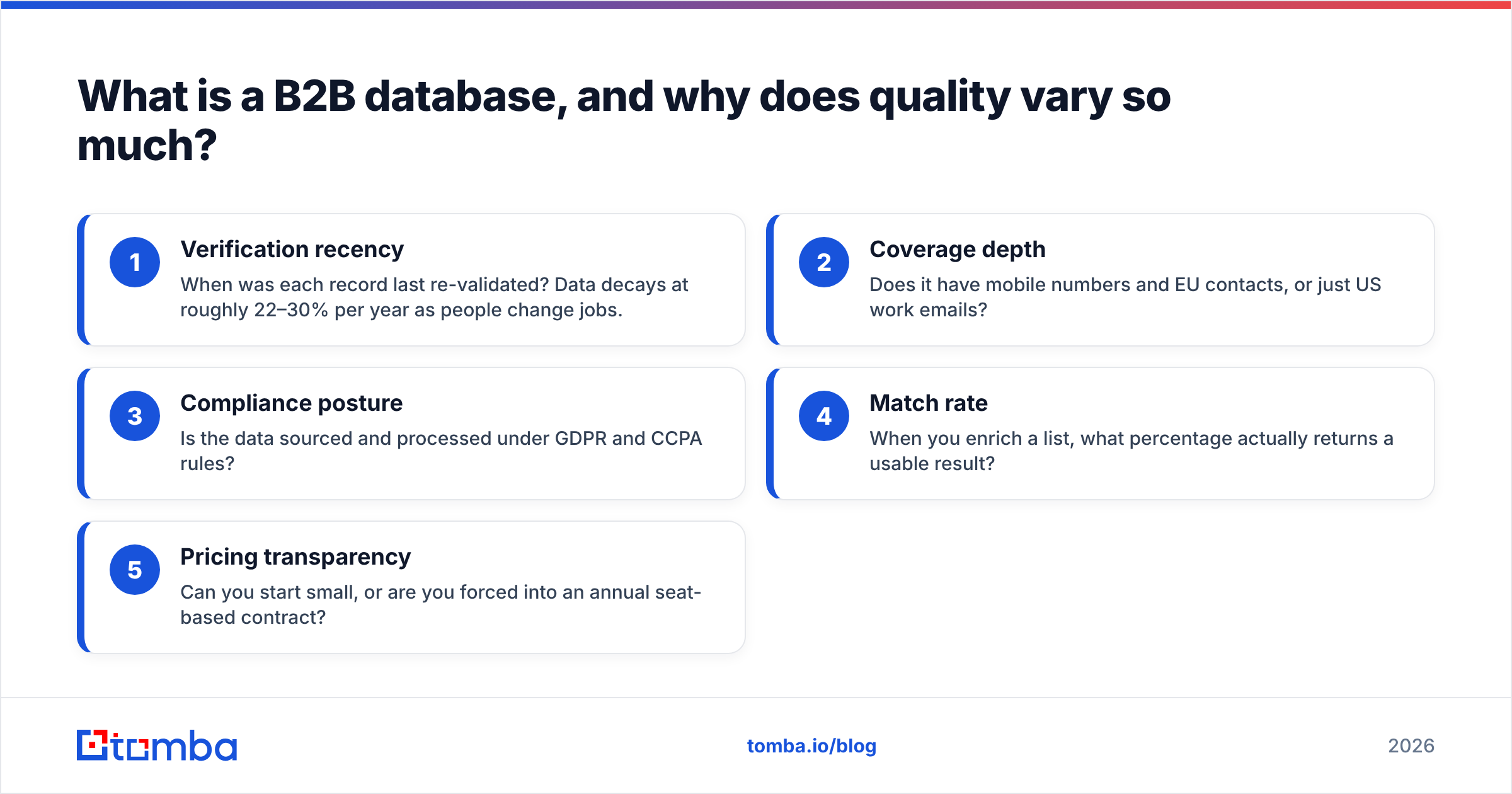
- Verification recency — When was each record last re-validated? Data decays at roughly 22–30% per year as people change jobs.
- Coverage depth — Does it have mobile numbers and EU contacts, or just US work emails?
- Compliance posture — Is the data sourced and processed under GDPR and CCPA rules?
- Match rate — When you enrich a list, what percentage actually returns a usable result?
- Pricing transparency — Can you start small, or are you forced into an annual seat-based contract?

How accurate is the data, really?#
Accuracy is where the gap between vendors is widest — and where you should spend the most scrutiny. Every provider claims "95% accuracy," but the methodology behind that number matters more than the number itself. A database that verified an email six months ago and a database that re-checks the SMTP response at the moment of export are both "verified," but only one is trustworthy on the day you hit send.

The practical test is simple: run the same list of 100 known contacts through each tool and measure bounce rate after a real send. In repeated tests, providers that pair pattern-matching with live verification — like Tomba's combination of domain search and real-time email verification — consistently beat list-resellers that ship static CSVs. If a vendor can't explain how and when they verify, treat the accuracy claim as marketing.
A quick way to protect your sender reputation regardless of vendor: always re-verify a purchased or enriched list before importing it. Even the best database benefits from a final catch-all check, which is why a standalone email verifier belongs in every workflow.
Which is the best B2B database in 2026? Full comparison#
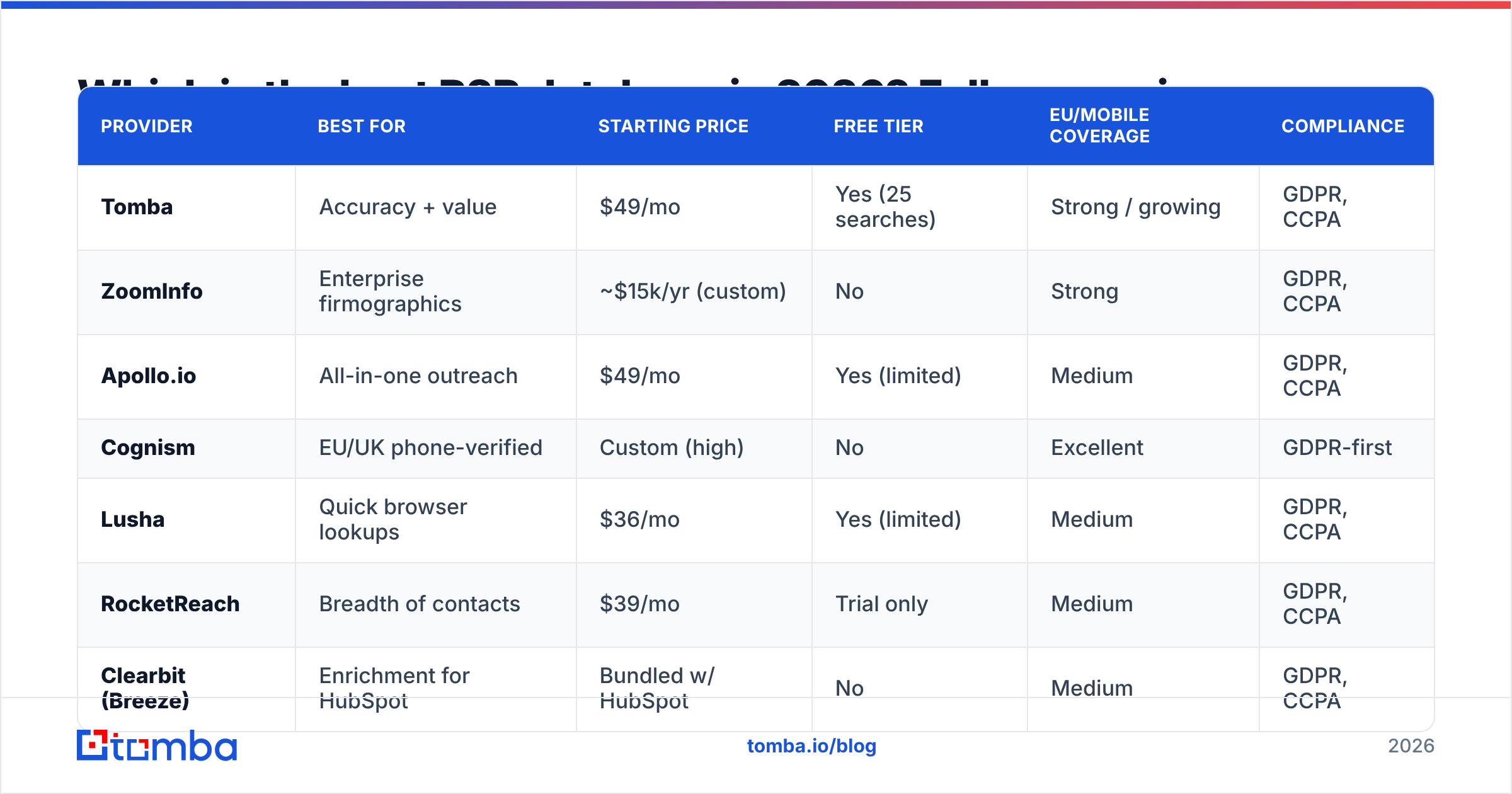
Here is how the leading providers stack up on the attributes that decide real-world ROI. Pricing reflects publicly listed entry plans as of 2026; enterprise quotes vary widely.
| Provider | Best for | Starting price | Free tier | EU/mobile coverage | Compliance |
|---|---|---|---|---|---|
| Tomba | Accuracy + value | $49/mo | Yes (25 searches) | Strong / growing | GDPR, CCPA |
| ZoomInfo | Enterprise firmographics | ~$15k/yr (custom) | No | Strong | GDPR, CCPA |
| Apollo.io | All-in-one outreach | $49/mo | Yes (limited) | Medium | GDPR, CCPA |
| Cognism | EU/UK phone-verified | Custom (high) | No | Excellent | GDPR-first |
| Lusha | Quick browser lookups | $36/mo | Yes (limited) | Medium | GDPR, CCPA |
| RocketReach | Breadth of contacts | $39/mo | Trial only | Medium | GDPR, CCPA |
| Clearbit (Breeze) | Enrichment for HubSpot | Bundled w/ HubSpot | No | Medium | GDPR, CCPA |
| Seamless.AI | Real-time search | $147/mo (annual) | Trial | Low–Medium | CCPA |
| Hunter | Simple email finding | $34/mo | Yes (25/mo) | Low | GDPR |

No single row wins every column, which is the honest takeaway. ZoomInfo's firmographic and intent depth is genuinely best-in-class — and priced accordingly. Cognism dominates if your motion is EU mobile dials. But for the largest share of teams — startups, SMBs, and lean RevOps groups who need accurate work emails without a five-figure commitment — the combination of a free tier, $49/mo entry pricing, and live verification makes Tomba the strongest value pick. You can compare the full breakdown on Tomba's pricing page and on third-party review sites like G2.
Is an enterprise database like ZoomInfo worth it?#
It depends entirely on your motion and budget. ZoomInfo is the Gartner-recognized heavyweight in revenue data, and for a 200-rep enterprise running account-based plays with intent signals, the depth justifies the cost. You're paying for scout-level firmographics, org charts, and buying-intent data you genuinely can't replicate elsewhere.
But for most teams, the answer is no — not because the data is bad, but because you're buying capacity you'll never use. ZoomInfo's seat-based annual contracts (frequently $15,000+ per year) assume you have the volume to amortize the cost. If you're sending a few thousand emails a month, you're subsidizing features for a sales org ten times your size.
The smarter play for lean teams is a pay-as-you-grow tool you can start free and scale with usage. That's also why so many buyers searching for a ZoomInfo alternative land on usage-priced finders rather than another annual platform.

What about data compliance and where the data comes from?#
Compliance is no longer optional, and it's the factor teams most often ignore until a legal review forces the conversation. A B2B database that can't tell you where its data originated is a liability, especially if you sell into the EU or UK where GDPR governs how business contact data is collected and used.
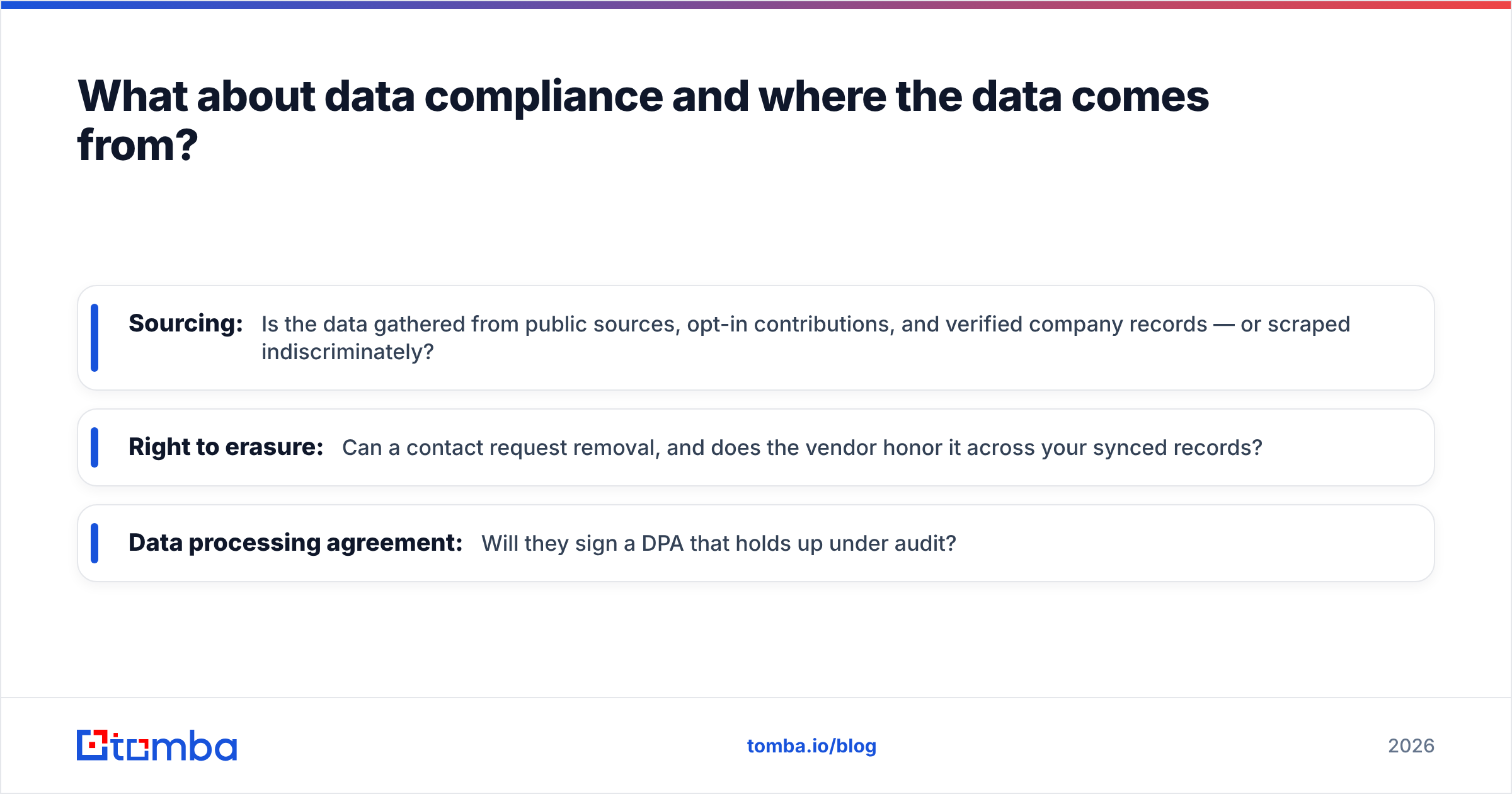
When you evaluate any provider, ask three questions:
- Sourcing: Is the data gathered from public sources, opt-in contributions, and verified company records — or scraped indiscriminately?
- Right to erasure: Can a contact request removal, and does the vendor honor it across your synced records?
- Data processing agreement: Will they sign a DPA that holds up under audit?
Transparency here is a quality signal in itself. Vendors that publish their methodology — Tomba documents where its data comes from — tend to run cleaner, more current databases because traceable sourcing forces verification discipline. Tools that stay vague about origins are often reselling aggregated lists of unknown age.
How do you actually use a B2B database day to day?#
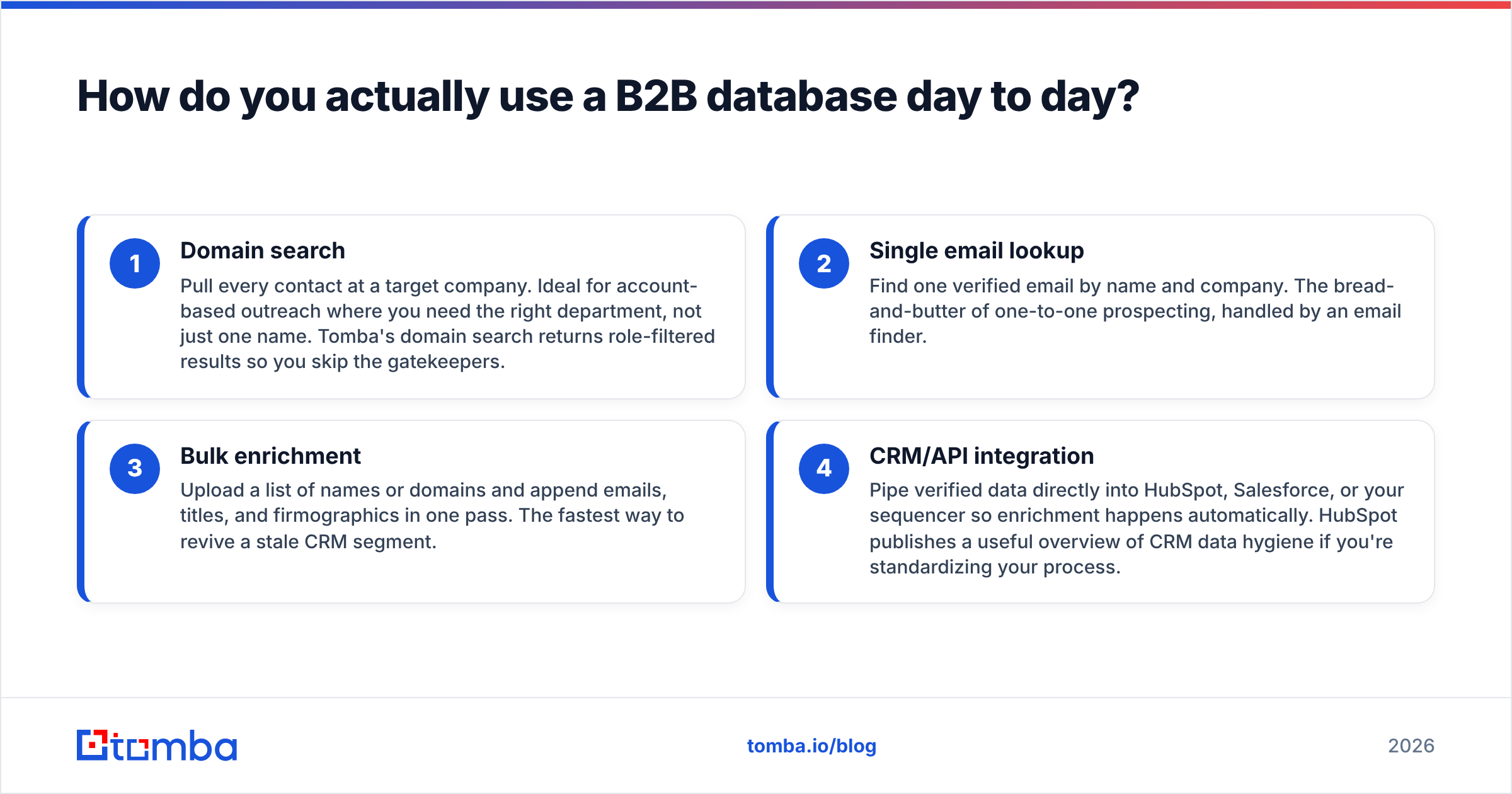
The best database is worthless if it doesn't fit your stack. In practice, teams interact with B2B data in four ways, and the provider you pick should support whichever matches your workflow:
- Domain search — Pull every contact at a target company. Ideal for account-based outreach where you need the right department, not just one name. Tomba's domain search returns role-filtered results so you skip the gatekeepers.
- Single email lookup — Find one verified email by name and company. The bread-and-butter of one-to-one prospecting, handled by an email finder.
- Bulk enrichment — Upload a list of names or domains and append emails, titles, and firmographics in one pass. The fastest way to revive a stale CRM segment.
- CRM/API integration — Pipe verified data directly into HubSpot, Salesforce, or your sequencer so enrichment happens automatically. HubSpot publishes a useful overview of CRM data hygiene if you're standardizing your process.
Match the tool to the job. A rep doing 20 targeted accounts a week needs a fast browser extension and domain search; a RevOps lead refreshing 50,000 records needs bulk enrichment and an API. The best B2B database in 2026 is the one that does your version of this without forcing a workflow you don't have.
Common mistakes when choosing a B2B database#
Even experienced buyers fall into the same traps. Avoid these and you'll pick well:
- Chasing contact counts. A "700M record" headline tells you nothing about usable, current contacts in your niche. Test coverage on your actual ICP.
- Skipping the free trial. If a vendor won't let you test on your own list before paying, that's a signal. Always validate accuracy on known contacts first.
- Ignoring re-verification. Data decays monthly. A database without ongoing verification is a snapshot, not a living source.
- Over-buying capacity. Don't sign an enterprise annual contract to send 2,000 emails a month. Usage pricing exists for a reason.
- Forgetting deliverability. Even verified emails need a warmed sender domain. Clean data and good sending hygiene work together.
Is Tomba the best B2B database for most teams?#
For the majority of go-to-market teams in 2026, yes — on a value-adjusted basis. The reasoning is straightforward: you get live-verified emails, transparent data sourcing, GDPR and CCPA compliance, and a genuinely free tier to test accuracy before spending a dollar. Paid plans start at $49/mo and scale with usage instead of locking you into seats you won't fill.
That's not to say Tomba beats every competitor on every axis — ZoomInfo wins on intent depth, Cognism wins on EU mobile dials. But if your priority is accurate, compliant, affordable B2B data that plugs into your existing stack, it's the highest-confidence default.
Start with the Tomba Email Finder to find and verify professional emails by domain, name, or company — free for your first 25 searches, no credit card. Run it against a list of contacts you already know are good, measure the match and bounce rate yourself, and let the evidence pick your database for you. That's the only test that matters.
// get started
Find, verify and enrich your first contacts today
Start on the free plan with 25 searches a month, then scale when your team is ready.
Free plan · No credit card required · GDPR & CCPA
// about the author