Best B2B Email List Providers in 2026: A Buyer's Guide
Buying a B2B email list sounds fast, but most go stale in weeks. Here is how the best B2B email list providers compare on accuracy, price, and compliance in 2026.
Buying a B2B email list feels like the fastest path to a full pipeline. You pay, you download a CSV, you start sending. The problem shows up two weeks later when 30% of those addresses bounce and your domain reputation takes the hit. Choosing among the best B2B email list providers is really a decision about data freshness, accuracy, and compliance, not about who hands you the biggest spreadsheet.
This guide breaks down how the leading providers actually compare in 2026, what separates a real data vendor from a recycled-list reseller, and when you are better off building a list on demand instead of buying one.
TL;DR#
- Static purchased lists decay fast — B2B contact data degrades roughly 2–3% per month as people change jobs, so a "verified" list is often stale before you finish importing it.
- The best B2B email list providers fall into three buckets: full data platforms (ZoomInfo, Apollo, Cognism), email-finder/enrichment tools (Tomba, RocketReach), and cheap resellers (avoid these).
- Accuracy and deliverability matter more than volume — 10,000 verified contacts beat 100,000 unverified ones every time.
- Compliance is non-negotiable — GDPR and CAN-SPAM exposure on a bought list can cost more than the list saved you.
- Build-on-demand beats buy-in-bulk for most teams: use a domain search plus an email verifier to generate fresh, targeted lists instead of renting a decaying database.
What is a B2B email list provider?#
A B2B email list provider is a company that sells or licenses access to business contact data — names, job titles, company details, and email addresses — so you can run outbound sales and marketing.
Think of it like the difference between buying bottled water and drilling your own well. A purchased list is the bottled water: convenient, sealed at a point in time, and slowly going flat on the shelf. A live data platform or finder tool is the well — you pull fresh records the moment you need them.
There are three categories worth knowing:
- Full data platforms — ZoomInfo, Apollo, Cognism. They maintain large proprietary databases with intent signals, org charts, and firmographics, and charge accordingly.
- Email-finder and enrichment tools — Tomba, RocketReach, Hunter. You search by domain, name, or company and get verified emails on demand rather than a frozen list.
- Bulk list resellers — the low-cost "5 million CMO emails for $99" vendors. These recycle scraped data, and the bounce rates will wreck your sender reputation.
The first two are legitimate. The third is where most "cheap email list" horror stories come from.
How do you judge the best B2B email list providers?#
Conclusion first: rank providers on accuracy, freshness, and compliance before you ever look at price-per-contact. A list is only as valuable as the percentage of it that reaches a real inbox.
Email contact data decays quickly. Industry estimates put B2B data decay at roughly 30% per year, driven by job changes, company restructuring, and domain migrations. That means a list "verified" six months ago can already have a double-digit bounce rate.

Use these criteria when you evaluate any provider:
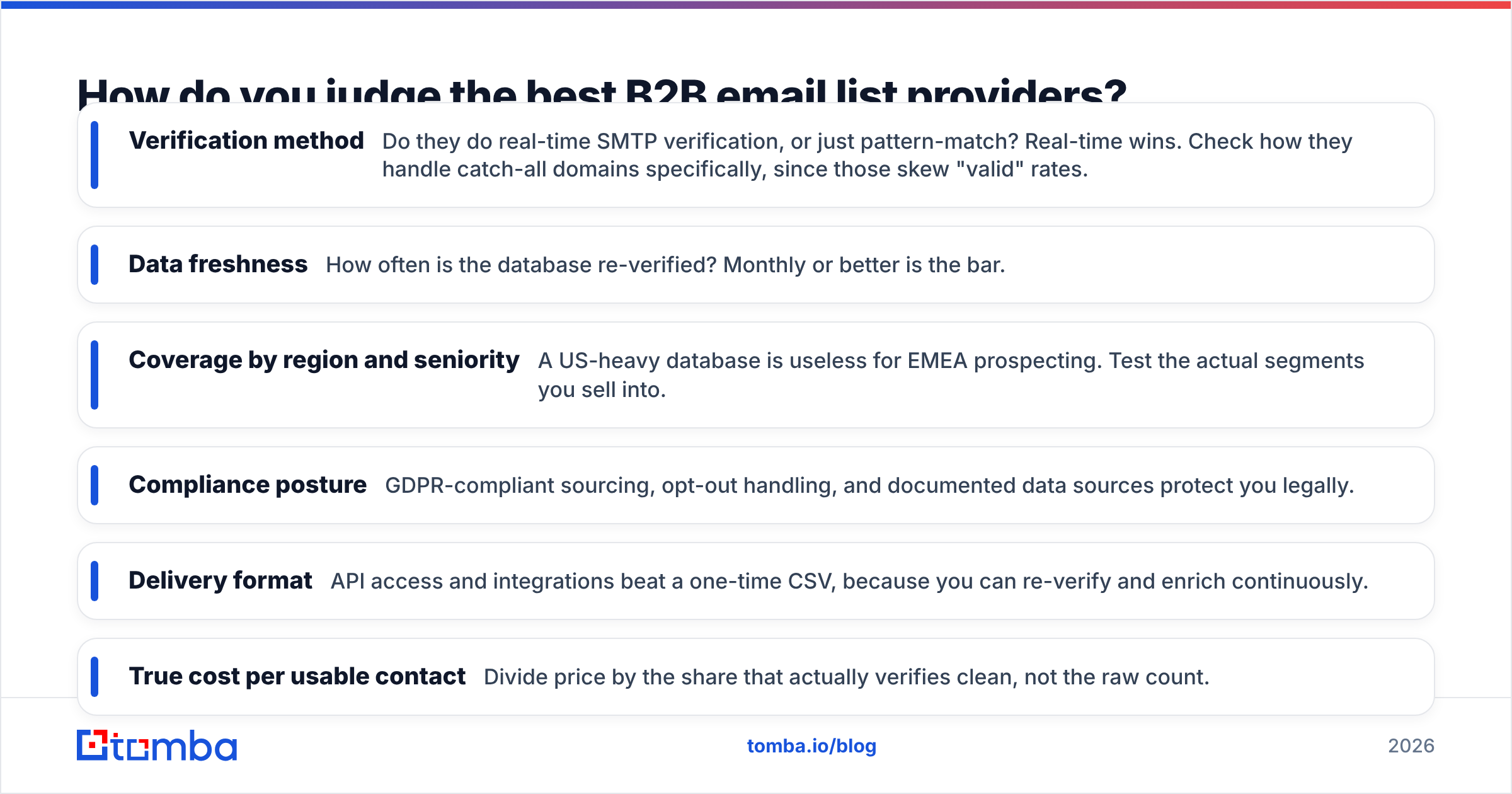
- Verification method — Do they do real-time SMTP verification, or just pattern-match? Real-time wins. Check how they handle catch-all domains specifically, since those skew "valid" rates.
- Data freshness — How often is the database re-verified? Monthly or better is the bar.
- Coverage by region and seniority — A US-heavy database is useless for EMEA prospecting. Test the actual segments you sell into.
- Compliance posture — GDPR-compliant sourcing, opt-out handling, and documented data sources protect you legally.
- Delivery format — API access and integrations beat a one-time CSV, because you can re-verify and enrich continuously.
- True cost per usable contact — Divide price by the share that actually verifies clean, not the raw count.
If a vendor cannot answer the verification and sourcing questions clearly, treat that as a red flag.
Which B2B email list providers are the best in 2026?#
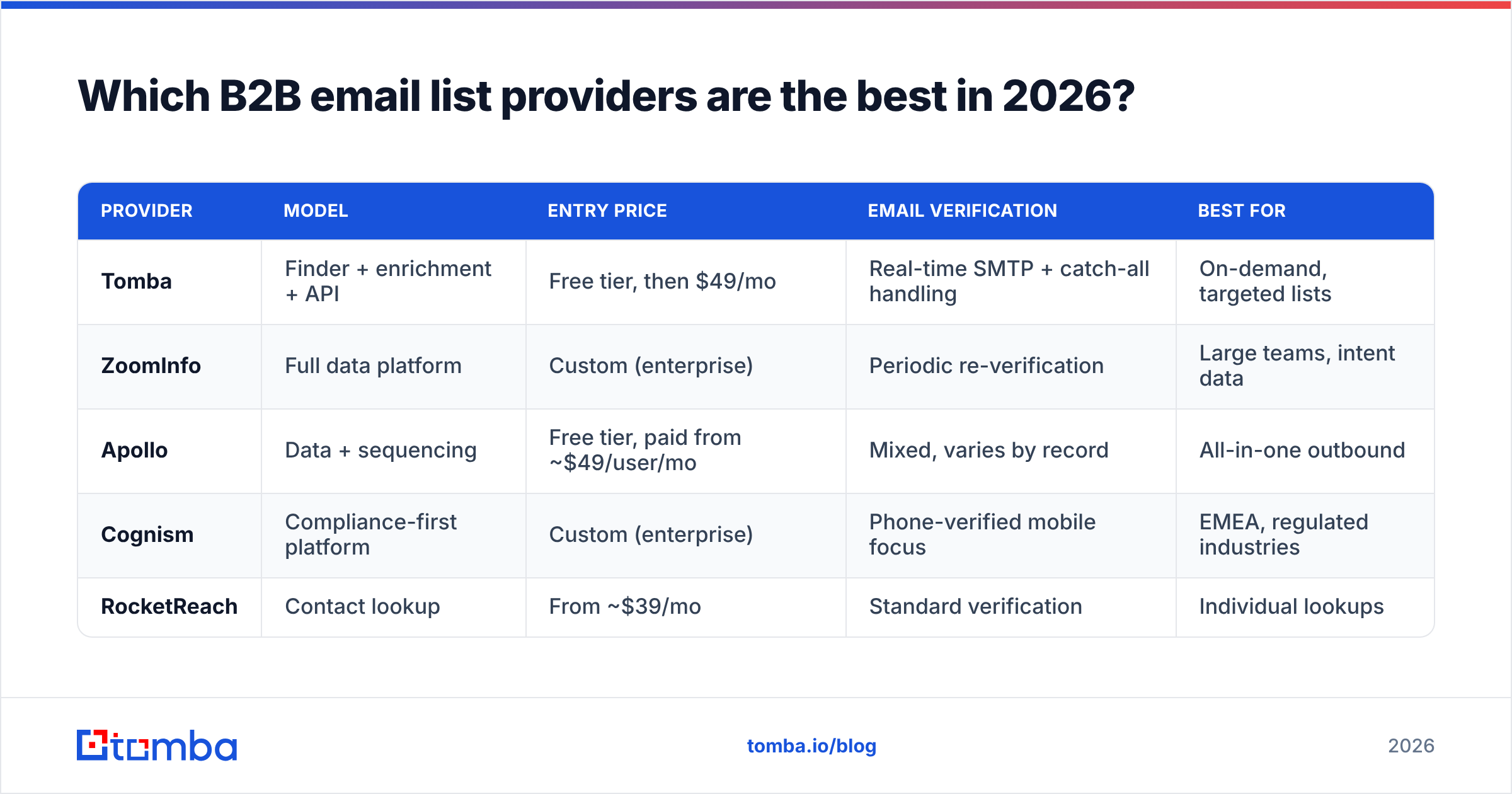
Here is how the most-used options compare across the criteria that actually predict outbound success. Pricing reflects published entry points; enterprise tiers are custom and negotiated.

| Provider | Model | Entry price | Email verification | Best for |
|---|---|---|---|---|
| Tomba | Finder + enrichment + API | Free tier, then $49/mo | Real-time SMTP + catch-all handling | On-demand, targeted lists |
| ZoomInfo | Full data platform | Custom (enterprise) | Periodic re-verification | Large teams, intent data |
| Apollo | Data + sequencing | Free tier, paid from ~$49/user/mo | Mixed, varies by record | All-in-one outbound |
| Cognism | Compliance-first platform | Custom (enterprise) | Phone-verified mobile focus | EMEA, regulated industries |
| RocketReach | Contact lookup | From ~$39/mo | Standard verification | Individual lookups |
A few honest takeaways from this table:
ZoomInfo and Cognism are powerful but priced for committed teams with five-figure annual budgets. If you are a startup or a lean sales team, the per-seat and platform minimums are hard to justify. Apollo bundles sequencing with data, which is convenient, but data quality varies more by segment than its marketing implies — always test your ICC before committing.
Tomba sits in the email-finder and enrichment lane: instead of renting a static database, you generate verified contacts on demand by domain, name, or company. For teams that prospect into specific accounts rather than blasting a generic list, that model produces cleaner data at a lower entry cost. You can review current Tomba pricing for exact tiers.
For an independent cross-section of reviews, G2's lead intelligence category and Gartner Peer Insights are useful sanity checks against any vendor's own claims.
Is buying an email list a good idea at all?#
Short answer: rarely, and never from a bulk reseller. The risk profile of a purchased static list is worse than most buyers realize.
The deliverability cost is the first problem. A list with even a 15% bounce rate can trip spam filters at Google and Microsoft, and once your domain is flagged, your legitimate emails to good contacts start landing in spam too. You are not just wasting the bad addresses — you are poisoning the good ones.
The legal cost is the second. Under GDPR, you generally need a lawful basis to email EU business contacts, and a list you bought from a third party rarely gives you documented consent. CAN-SPAM in the US is more permissive but still requires accurate headers, a physical address, and a working opt-out. A scraped list often fails these on day one.
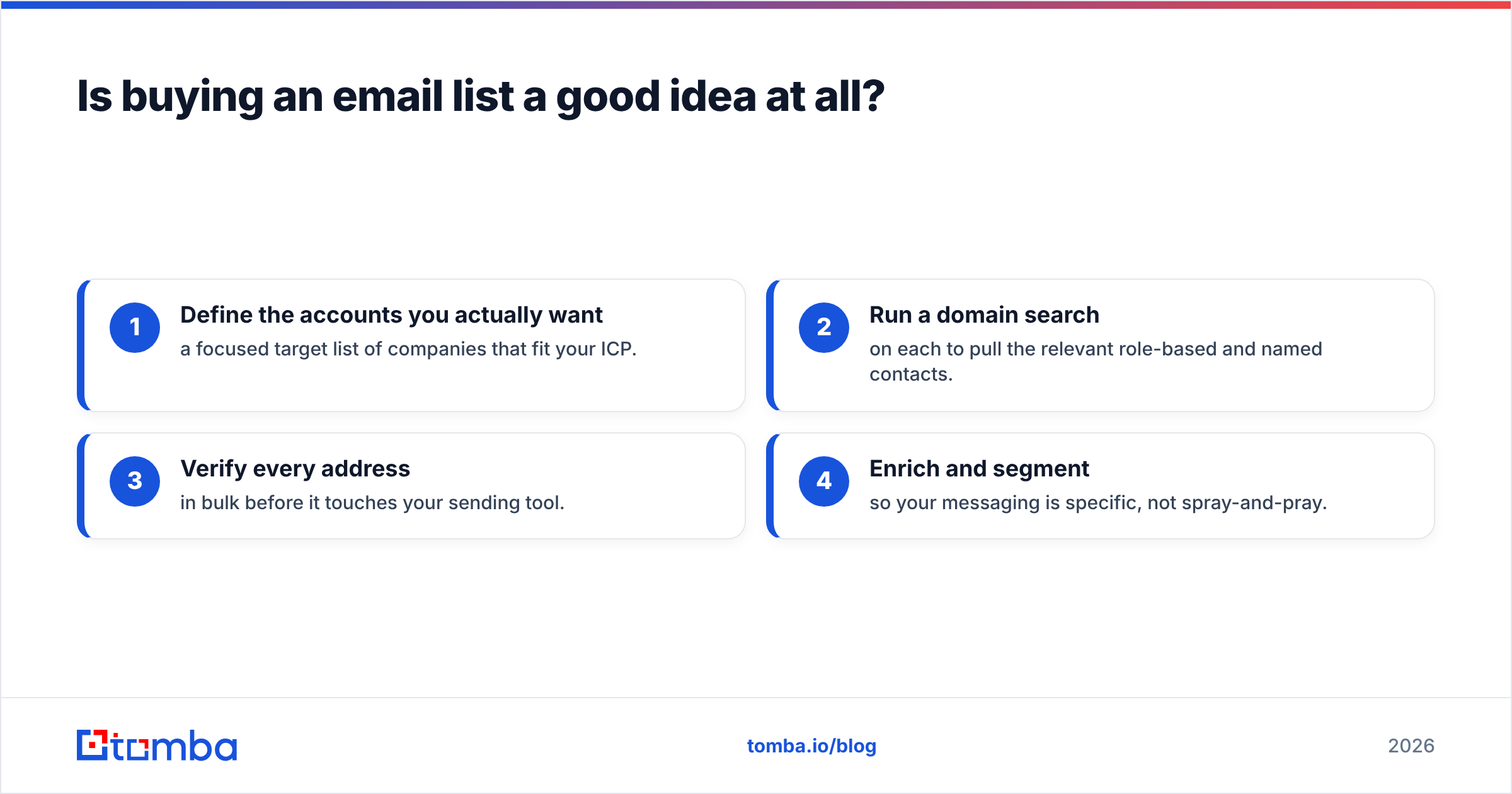
The smarter pattern is build-on-demand. Instead of buying 50,000 contacts you will never fully use, you:
- Define the accounts you actually want — a focused target list of companies that fit your ICP.
- Run a domain search on each to pull the relevant role-based and named contacts.
- Verify every address in bulk before it touches your sending tool.
- Enrich and segment so your messaging is specific, not spray-and-pray.
This produces a smaller list with a dramatically higher hit rate, and every contact is fresh as of the day you pulled it. It also keeps you on defensible compliance footing because you control and document the sourcing.
How does an email finder compare to buying a list?#
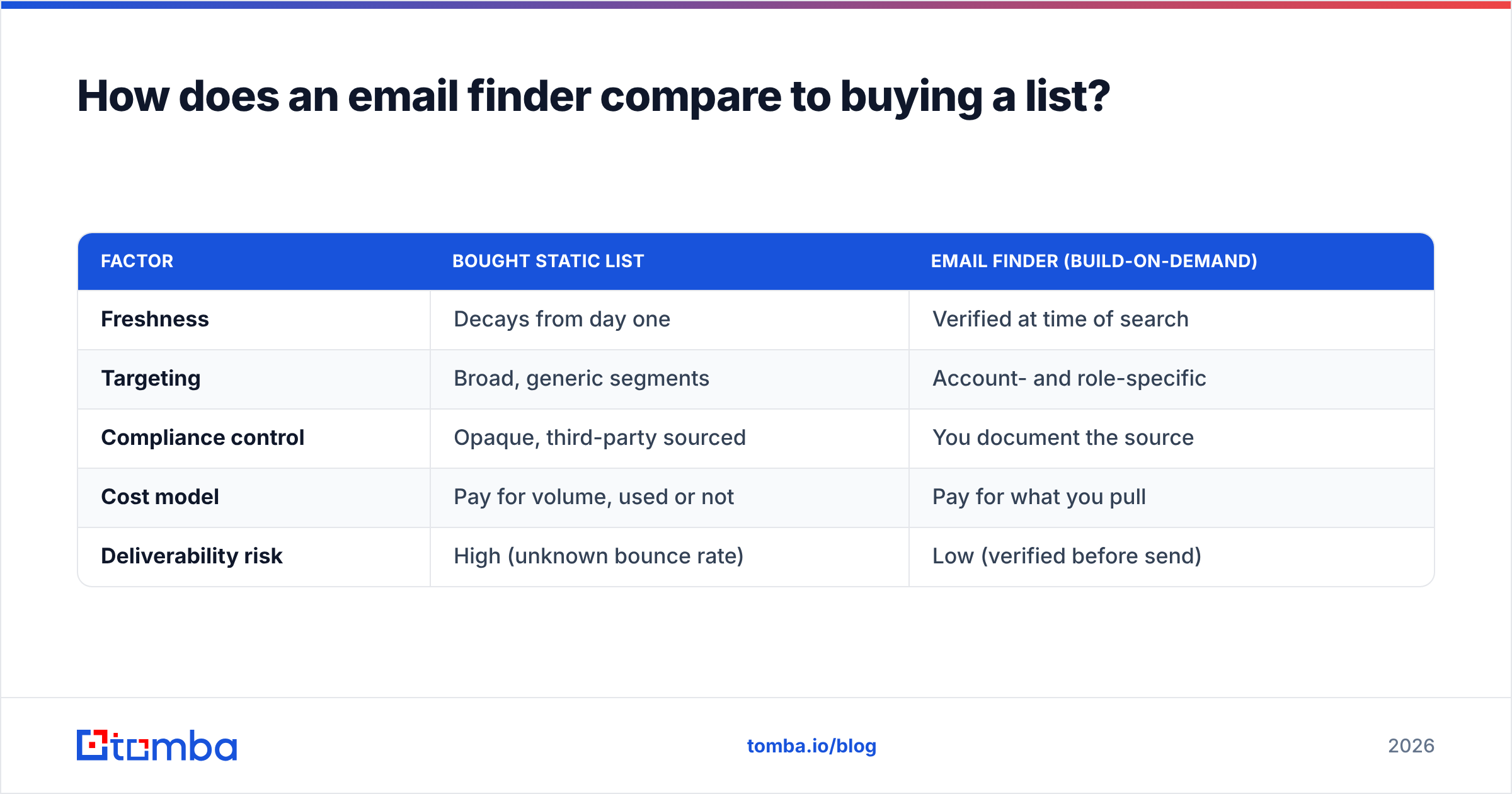
An email finder beats a bought list on freshness and targeting; a bought list only "wins" on raw upfront volume, which is the metric that matters least.
The mental model is rent versus build. A purchased list is rented data — you take a snapshot someone else maintained, and it ages the moment it leaves their hands. A finder builds the list at query time against live sources, so a record found today reflects today's reality.
| Factor | Bought static list | Email finder (build-on-demand) |
|---|---|---|
| Freshness | Decays from day one | Verified at time of search |
| Targeting | Broad, generic segments | Account- and role-specific |
| Compliance control | Opaque, third-party sourced | You document the source |
| Cost model | Pay for volume, used or not | Pay for what you pull |
| Deliverability risk | High (unknown bounce rate) | Low (verified before send) |
This is why the email-finder category has eaten so much of the traditional list-broker market. Tools like the Tomba Email Finder let you go from a target company to verified contacts in seconds, with verification built into the workflow rather than bolted on after the fact. If your motion is account-based or even moderately targeted, on-demand finding will outperform any list you can buy.
For background on why deliverability hinges on list hygiene, HubSpot's guide to email deliverability is a solid, vendor-neutral primer.
What should different team sizes choose?#
Match the tool to your motion and budget rather than chasing the biggest database.
- Solo founders and small teams — Start with a free tier and an email finder. You need targeted, verified contacts, not a 10-million-row database you will never clean. Tomba's free plan plus on-demand search covers this well.
- Growing sales teams (5–25 reps) — A finder with API access and CRM integrations, or Apollo if you want sequencing bundled. Prioritize verification and integrations over raw record count.
- Enterprise revenue orgs — This is where ZoomInfo and Cognism earn their price, especially if you need intent data, org charts, and phone-verified mobiles at scale. Just budget for the platform minimums.
- EMEA-focused or regulated industries — Lean toward compliance-first providers and, regardless of vendor, verify and document consent. Cognism is built around this; pair any choice with strict opt-out handling.
The common thread: verification is not optional at any size. Whether you build or buy, run every address through an email verifier before it enters a sending tool.
Frequently asked questions#
Are bought B2B email lists legal? It depends on jurisdiction and sourcing. CAN-SPAM permits cold B2B email with proper headers and opt-out; GDPR generally requires a lawful basis you can document, which most resold lists lack. When in doubt, build and document your own.
Why do purchased lists bounce so much? Because B2B data decays roughly 2–3% per month. A list verified even a few months ago will have a meaningful share of contacts who changed jobs or whose company changed domains.
What is the most accurate B2B email list provider? Accuracy varies by segment and verification method more than by brand. The most reliable approach is a provider that does real-time SMTP verification and handles catch-all domains explicitly, then re-verifying yourself before send.
Is a free email finder good enough? For low volume, yes. A free tier plus disciplined verification often outperforms a paid bulk list, because freshness beats volume.
The bottom line#
The best B2B email list providers in 2026 are not the ones selling the biggest databases — they are the ones giving you the freshest, most verifiable, most compliant data for the accounts you actually target. For most teams, that means skipping the static bulk list entirely and building targeted lists on demand.
If you want clean, verified contacts without renting a decaying database, start with the Tomba Email Finder. Search by domain, name, or company, verify in bulk, and push straight into your CRM — fresh data, on your terms, starting on the free tier and scaling to $49/mo when you are ready. Build the list you need instead of buying the one someone else let go stale.
// get started
Find, verify and enrich your first contacts today
Start on the free plan with 25 searches a month, then scale when your team is ready.
Free plan · No credit card required · GDPR & CCPA
// about the author