Best B2B Leads Database Providers in 2026 (Compared)
A neutral, data-first breakdown of the best B2B leads database providers in 2026 — coverage, accuracy, pricing, and which one fits your GTM motion.
Choosing a B2B leads database is really a bet on data you can't see until you've already paid for it. The logos all promise "200M+ contacts" and "95% accuracy." The difference shows up three weeks later, in your bounce rate and your reps' wasted dials.
This guide ranks the best B2B leads database providers for 2026 on the things that actually move pipeline: coverage in your territory, email and phone accuracy, data freshness, compliance, and what you really pay per usable record.
TL;DR — Which B2B Leads Database Wins?#
- Best overall coverage: ZoomInfo — deepest firmographic and intent data, but priced for enterprise and locked into annual contracts.
- Best all-in-one prospecting: Apollo.io — huge contact pool plus a sequencer, generous entry pricing, variable phone accuracy.
- Best for verified email accuracy on a budget: Tomba — pay-as-you-grow email finder and verifier with transparent pricing from a free tier up.
- Best EU/GDPR coverage: Cognism — phone-verified "Diamond Data" and strong compliance posture for European outbound.
- The real lesson: no single database is complete. The winning teams pick a primary source and verify every record before it touches a sequence.
What Is a B2B Leads Database Provider?#
A B2B leads database provider is a vendor that maintains a large, structured store of business contacts and companies — names, job titles, work emails, phone numbers, company size, industry, tech stack — and sells access to it through search, exports, enrichment, or an API.
Think of it like the difference between a phone book and a living address book. A static list you bought in 2024 is the phone book: accurate the day it was printed, slowly rotting ever since. A good database provider is the address book a diligent assistant keeps updating as people change jobs, companies get acquired, and emails go dead. People change jobs every ~3 years on average, so roughly 30% of B2B contact data decays annually — which is why "how big is the database" matters far less than "how fresh is it."
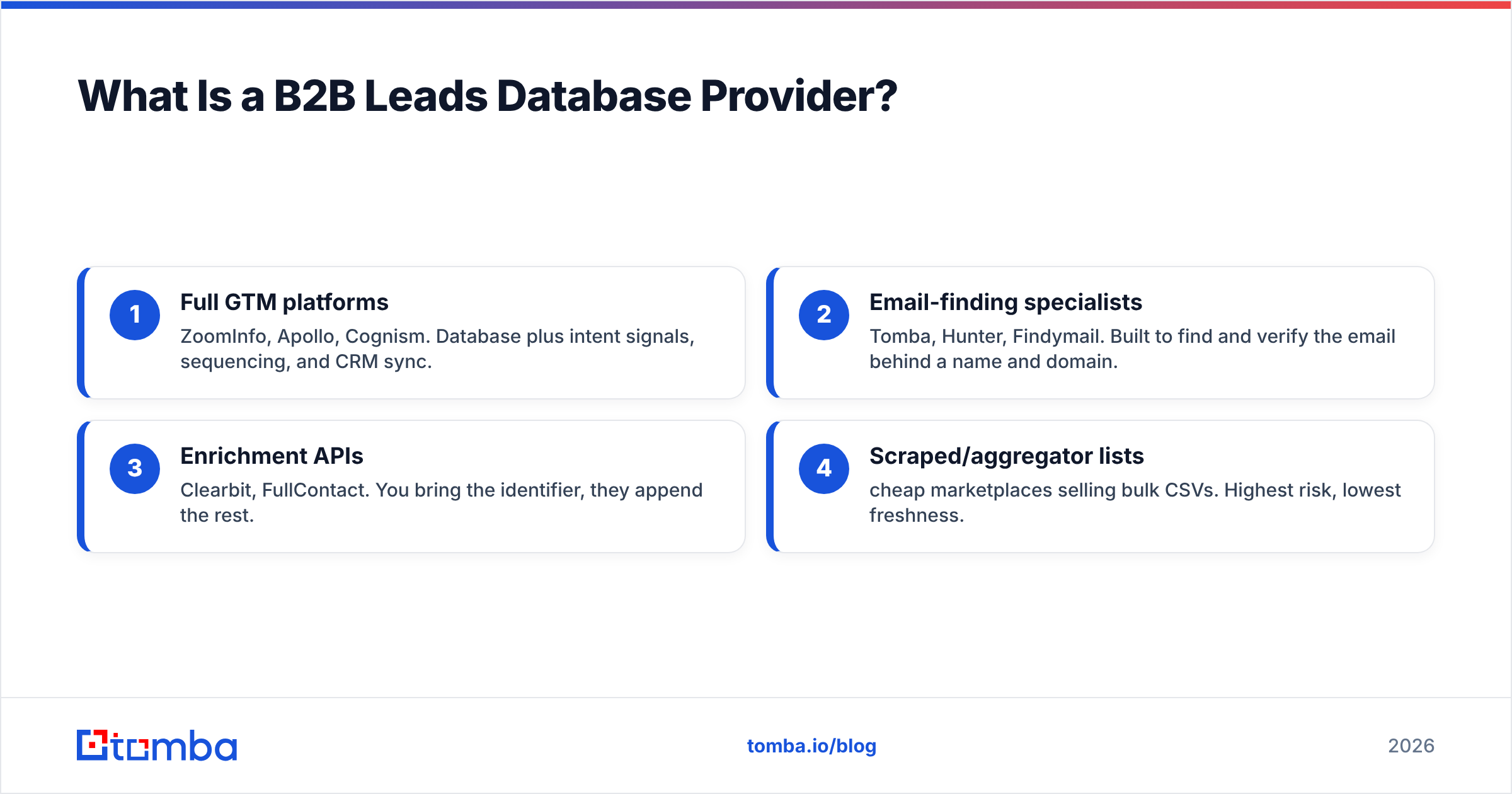
Providers generally fall into four buckets:
- Full GTM platforms — ZoomInfo, Apollo, Cognism. Database plus intent signals, sequencing, and CRM sync.
- Email-finding specialists — Tomba, Hunter, Findymail. Built to find and verify the email behind a name and domain.
- Enrichment APIs — Clearbit, FullContact. You bring the identifier, they append the rest.
- Scraped/aggregator lists — cheap marketplaces selling bulk CSVs. Highest risk, lowest freshness.

How Should You Evaluate the Best B2B Leads Database Providers?#
Don't start with the contact count. Start with these six criteria, weighted to your motion:
- Coverage in your ICP — A database with 250M global contacts is useless if it's thin on, say, mid-market DevOps leaders in DACH. Test against your target list, not the vendor's demo.
- Email accuracy & bounce rate — The single biggest driver of email deliverability. Anything above a 5% bounce rate will hurt your sender reputation fast.
- Phone accuracy — Mobile/direct-dial connect rates vary wildly. "We have a phone number" and "that number reaches the buyer" are different claims.
- Freshness & re-verification cadence — How often is the record re-checked? Monthly beats "at acquisition and never again."
- Compliance — GDPR, CCPA, and a documented opt-out process. This is a legal exposure, not a nice-to-have.
- Pricing model & true cost-per-usable-record — Credits, seats, exports, and annual lock-in all hide the real number.
A useful rule: a smaller, fresher, verified database beats a bigger stale one on every metric that ends in "revenue." You can cross-check vendor claims against real buyer reviews on G2 before you ever book a demo.
Best B2B Leads Database Providers in 2026 — Compared#
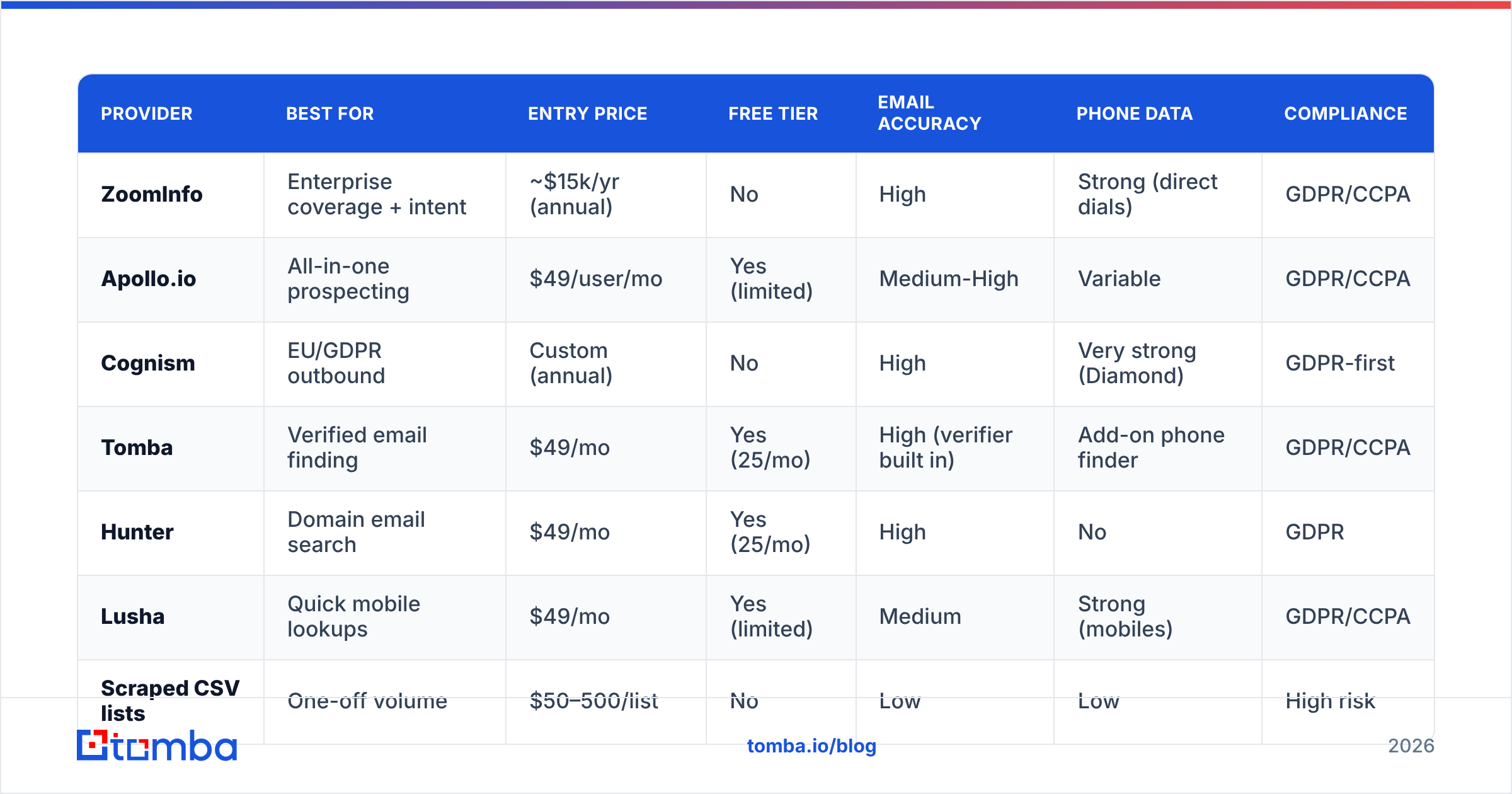
Here's how the leading providers stack up on the attributes that decide outcomes. Pricing is indicative entry-level and changes often — always confirm current terms.
| Provider | Best for | Entry price | Free tier | Email accuracy | Phone data | Compliance |
|---|---|---|---|---|---|---|
| ZoomInfo | Enterprise coverage + intent | ~$15k/yr (annual) | No | High | Strong (direct dials) | GDPR/CCPA |
| Apollo.io | All-in-one prospecting | $49/user/mo | Yes (limited) | Medium-High | Variable | GDPR/CCPA |
| Cognism | EU/GDPR outbound | Custom (annual) | No | High | Very strong (Diamond) | GDPR-first |
| Tomba | Verified email finding | $49/mo | Yes (25/mo) | High (verifier built in) | Add-on phone finder | GDPR/CCPA |
| Hunter | Domain email search | $49/mo | Yes (25/mo) | High | No | GDPR |
| Lusha | Quick mobile lookups | $49/mo | Yes (limited) | Medium | Strong (mobiles) | GDPR/CCPA |
| Scraped CSV lists | One-off volume | $50–500/list | No | Low | Low | High risk |
A few honest notes on the table:
- ZoomInfo is still the coverage benchmark in North America and the deepest on intent signals, per analyst coverage from firms like Gartner. The cost is real annual commitment and a sales cycle to match. See their own platform overview for current packaging.
- Apollo wins on bang-for-buck and is the easiest place to start because the database, the data enrichment, and the sequencer live together. Phone accuracy is the common complaint.
- Cognism is the one to shortlist if Europe is your primary market — its phone-verified records are a genuine differentiator for cold calling.
- Tomba isn't trying to be a 250M-row warehouse. It's a verified email finder and email verifier with a transparent, usage-based price — strongest when accuracy-per-dollar matters more than owning every record.
Why Does Data Accuracy Beat Database Size?#
Because you pay for the whole list but only profit from the deliverable part of it. A "100M contact" database at 80% accuracy gives you 80M usable records and 20M chances to torch your domain reputation. A 30M database at 97% accuracy gives you fewer rows and a far better outcome.

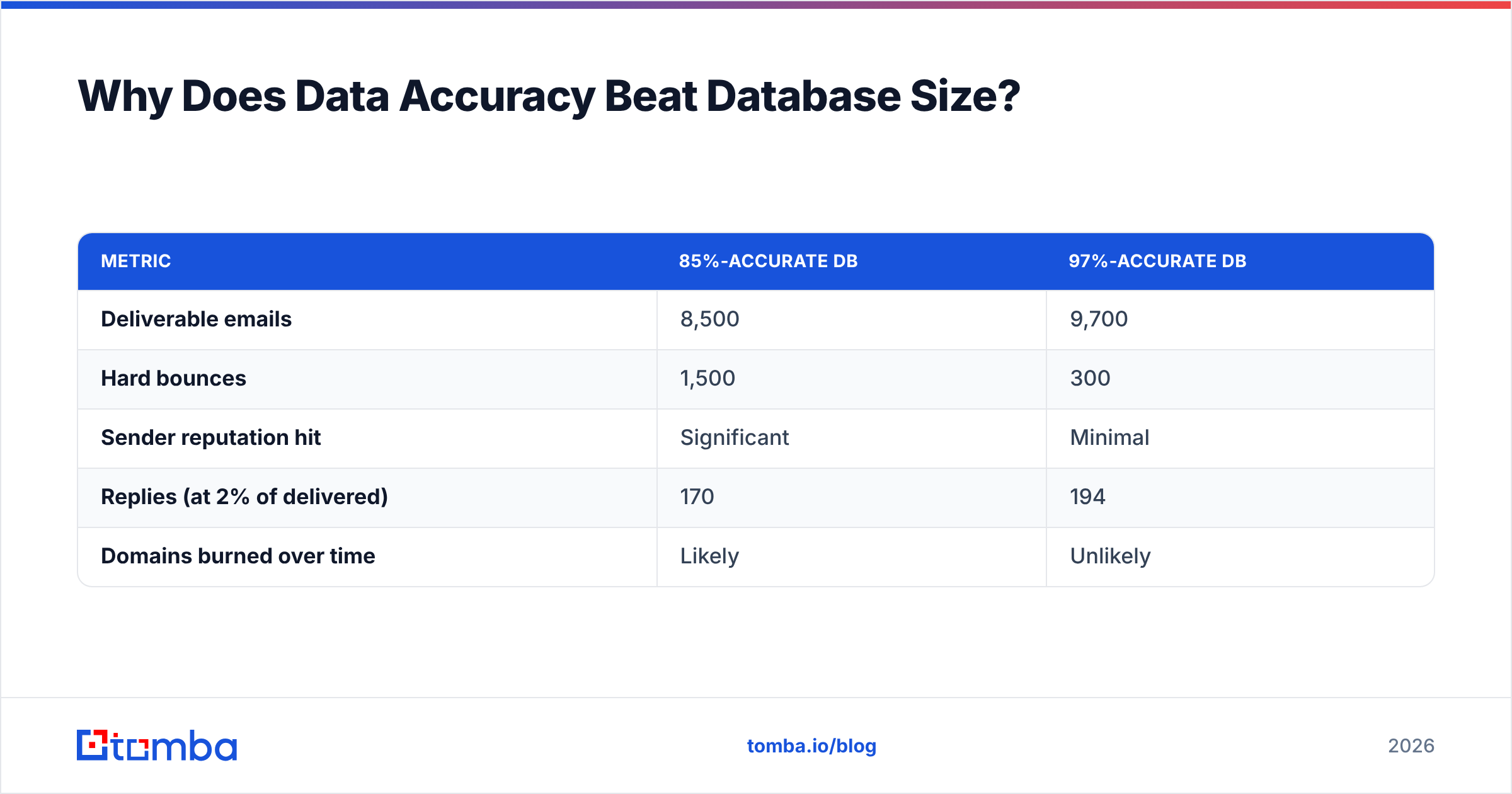
Run the math on a typical 10,000-contact campaign:
| Metric | 85%-accurate DB | 97%-accurate DB |
|---|---|---|
| Deliverable emails | 8,500 | 9,700 |
| Hard bounces | 1,500 | 300 |
| Sender reputation hit | Significant | Minimal |
| Replies (at 2% of delivered) | 170 | 194 |
| Domains burned over time | Likely | Unlikely |
The 12-point accuracy gap isn't 12% fewer replies — it's a compounding reputation problem. Once mailbox providers start throttling you, even your good emails land in spam. That's the case for treating verification as non-negotiable rather than optional. Whichever provider you pick, run exports through an independent email verification pass before the first send.

Which Provider Fits Your Use Case?#
Match the tool to the motion instead of chasing the biggest logo.
- High-volume enterprise outbound, North America: ZoomInfo or Apollo for raw coverage and intent. Budget for annual commitment.
- European or GDPR-sensitive outbound: Cognism first, for phone-verified, compliance-forward records.
- Founder-led or lean SDR team watching spend: Start with Apollo's free tier for breadth, then layer Tomba for verified email accuracy where it counts. Transparent Tomba pricing means no annual lock-in to test the waters.
- You already have a list and just need it cleaned and enriched: Skip the big platform. Use a bulk email finder and verifier to fill gaps and drop the dead rows.
- Developers building data into a product: An email finder API you can meter is worth more than a seat-based UI you'll automate around anyway.
How Do These Providers Source Their Data?#
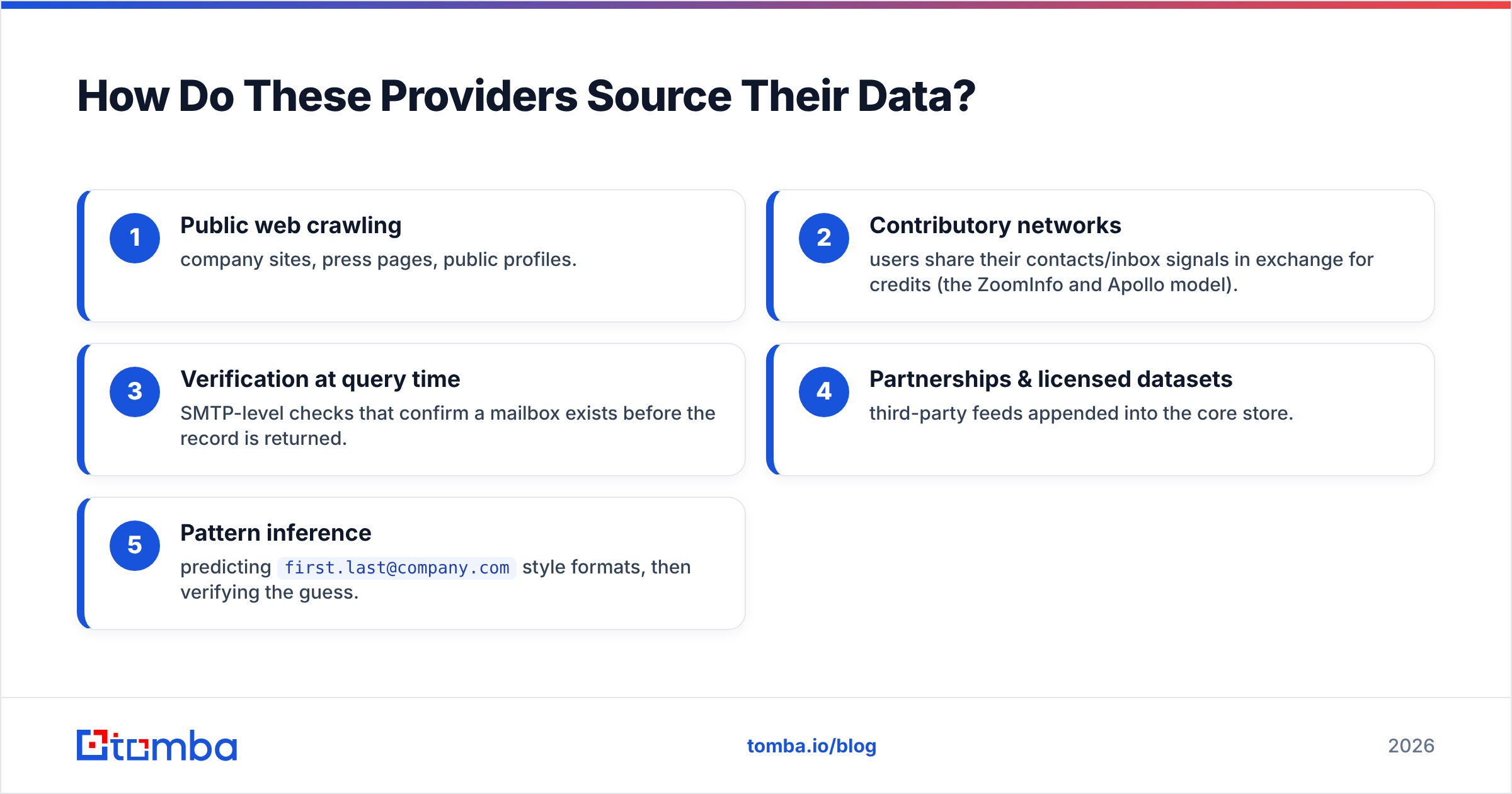
Coverage and freshness both trace back to how the database is built — so it's worth asking every vendor directly. The common sources:
- Public web crawling — company sites, press pages, public profiles.
- Contributory networks — users share their contacts/inbox signals in exchange for credits (the ZoomInfo and Apollo model).
- Verification at query time — SMTP-level checks that confirm a mailbox exists before the record is returned.
- Partnerships & licensed datasets — third-party feeds appended into the core store.
- Pattern inference — predicting
first.last@company.comstyle formats, then verifying the guess.
The providers that re-verify aggressively — rather than relying on a one-time scrape — are the ones whose data ages well. Tomba is transparent about where its data comes from, which is exactly the question you should press every vendor on before signing. If a provider can't explain its sourcing and re-verification cadence, treat the accuracy claim as marketing.
What Are the Hidden Costs to Watch?#
The sticker price is rarely the real price. Before you commit, get explicit answers on:
- Credit expiry — Do unused credits roll over, or vanish monthly? Many "cheap" plans rely on you wasting credits.
- Export caps — Some platforms throttle how many records you can actually pull per month regardless of plan.
- Seat-based pricing — Per-user costs balloon fast for growing teams; usage-based pricing scales more honestly.
- Annual lock-in — Enterprise data contracts are typically yearly with auto-renew. Read the cancellation clause.
- Re-verification fees — Will you pay again to re-check records that decayed on the provider's watch?
This is where a usage-based model earns its keep. You pay for what you find and verify, not for shelf space in a database you'll only ever query a slice of.
The Bottom Line#
The best B2B leads database provider in 2026 is the one whose data is accurate in your territory and whose pricing matches how you actually buy. ZoomInfo and Cognism win on enterprise depth and compliance; Apollo wins on all-in-one value; and for teams that care most about verified email accuracy without an annual contract, a specialist like Tomba does the one job that protects every campaign downstream — getting the address right.
Whatever your primary source, build a verification step into the workflow. Stale data is the silent tax on every outbound program, and it compounds.
Ready to put accuracy first? Try the Tomba Email Finder — find professional emails by name, domain, or company, with verification built in. Start on the free tier (25 searches/month, no card), then scale on transparent usage-based pricing from $49/mo when you're ready. Your bounce rate will thank you.
// get started
Find, verify and enrich your first contacts today
Start on the free plan with 25 searches a month, then scale when your team is ready.
Free plan · No credit card required · GDPR & CCPA
// about the author