Best B2B Sales Funnel in 2026: Stages, Metrics & Tools
A practical, no-fluff breakdown of the best B2B sales funnel for 2026 — every stage, the metrics that matter, and the tools that fill each one with real pipeline.
The "best" B2B sales funnel is not the one with the most stages or the prettiest CRM dashboard. It is the one where every stage is fed with accurate data, measured against a real benchmark, and ruthlessly trimmed where prospects leak out. This guide walks through that funnel stage by stage, shows you the conversion math, and names the tools that actually move the needle in 2026.
TL;DR#
- A B2B sales funnel has five working stages: awareness, lead capture, qualification (MQL → SQL), opportunity, and close. Each needs its own metric and its own owner.
- Data quality is the hidden bottleneck. Most funnels leak at qualification because the contact data feeding them is wrong, stale, or unverified.
- Benchmark, don't guess. Healthy B2B funnels convert roughly 13% of leads to opportunities and 6% of leads to closed-won — track against numbers, not feelings.
- Tooling matters per stage, not as one monolith. Use an email finder for capture, a verifier for hygiene, a CRM for stages, and automation for follow-up.
- The cheapest funnel fix is usually accuracy. Clean, verified contacts lift every downstream conversion rate at once.
What is a B2B sales funnel?#
A B2B sales funnel is the staged journey a business buyer takes from "never heard of you" to "signed contract." Think of it like an airport: a crowd arrives at the entrance (awareness), passes through check-in (lead capture), clears security (qualification), waits at the gate (opportunity), and finally boards (close). At every checkpoint some people drop off — and your job is to know exactly where and why.
Unlike B2C, the B2B funnel involves multiple decision-makers, longer cycles, and higher deal values. That means the cost of a leak compounds. A bad email address at the capture stage does not just lose one contact; it removes a potential champion who could have pulled an entire buying committee through.
The best B2B sales funnel makes each stage measurable and assigns clear exit criteria. A lead does not become an opportunity because a rep "feels good" about it — it advances because it meets a defined threshold.
)
What are the stages of the best B2B sales funnel?#
Here is the five-stage model that holds up across most B2B motions, with the single metric that defines each one.
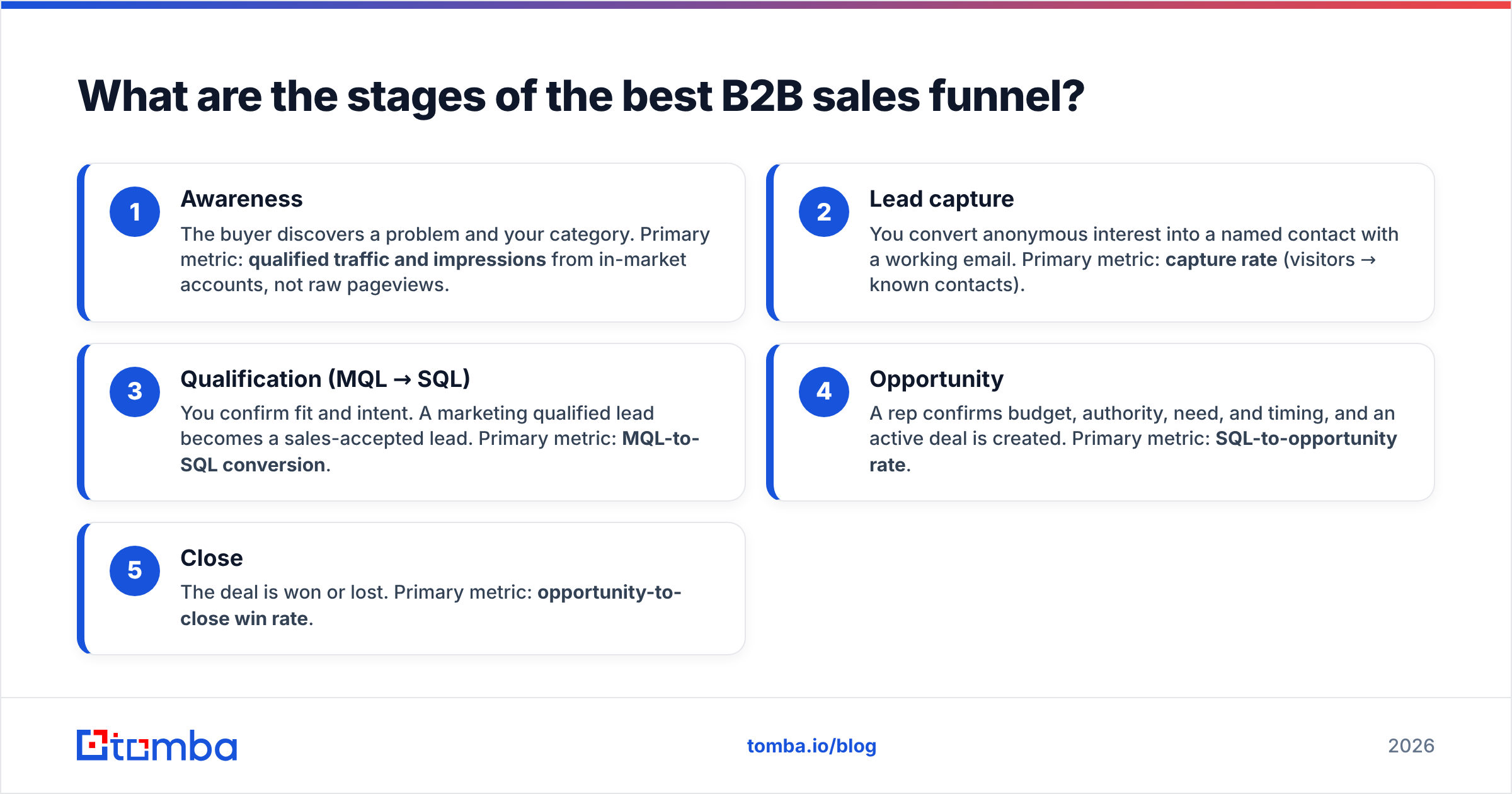
- Awareness — The buyer discovers a problem and your category. Primary metric: qualified traffic and impressions from in-market accounts, not raw pageviews.
- Lead capture — You convert anonymous interest into a named contact with a working email. Primary metric: capture rate (visitors → known contacts).
- Qualification (MQL → SQL) — You confirm fit and intent. A marketing qualified lead becomes a sales-accepted lead. Primary metric: MQL-to-SQL conversion.
- Opportunity — A rep confirms budget, authority, need, and timing, and an active deal is created. Primary metric: SQL-to-opportunity rate.
- Close — The deal is won or lost. Primary metric: opportunity-to-close win rate.
The structural mistake most teams make is collapsing stages 3 and 4. Qualification answers "should we spend time on this?" Opportunity answers "is there an active deal with a timeline?" Keeping them separate is what lets you diagnose whether you have a targeting problem or a selling problem.
What conversion rates should each stage hit?#
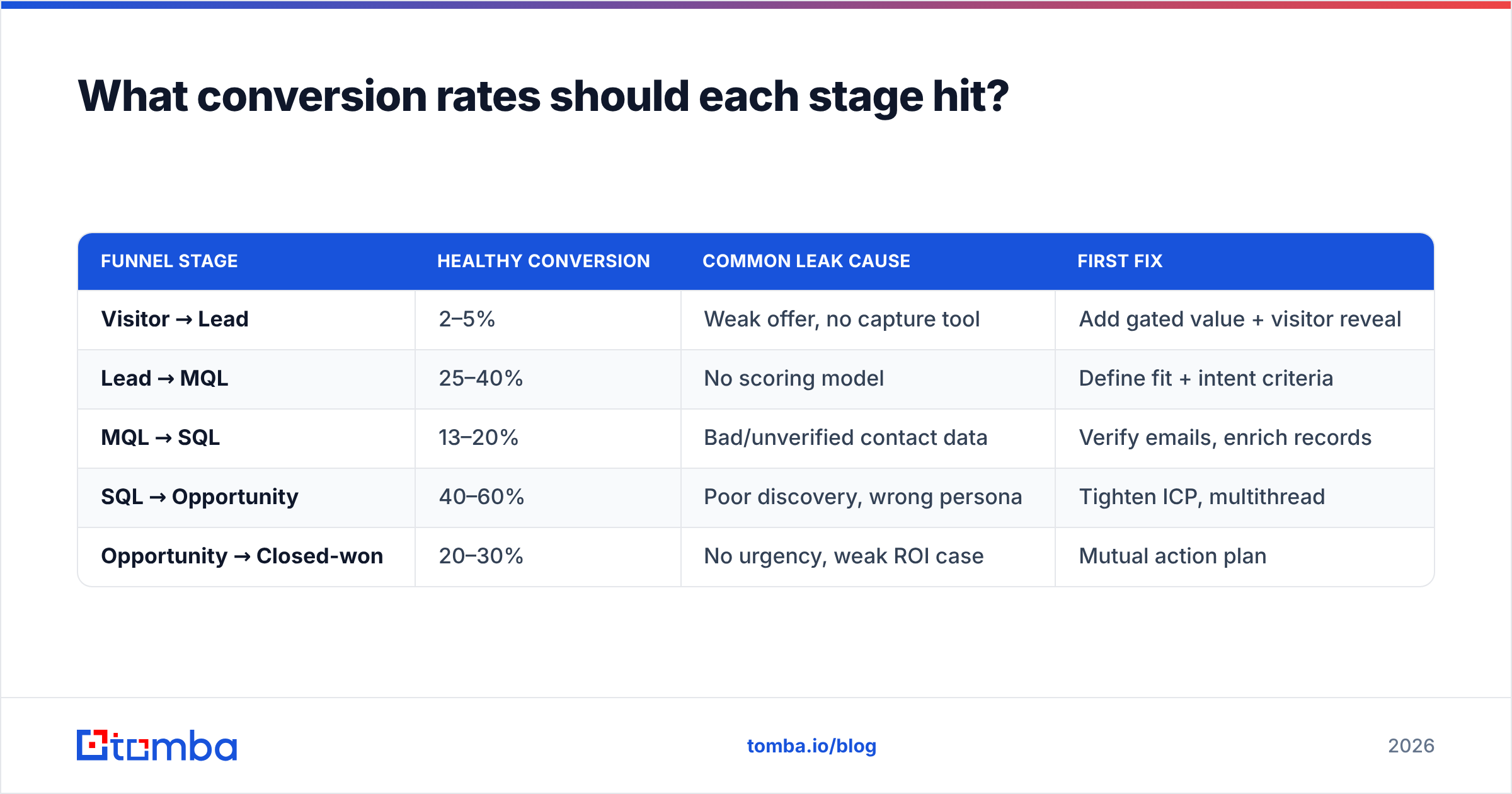
You cannot improve what you do not benchmark. The table below gives realistic 2026 ranges for a mid-market B2B SaaS motion. Treat these as a starting reference, then calibrate to your own historical data.
| Funnel stage | Healthy conversion | Common leak cause | First fix |
|---|---|---|---|
| Visitor → Lead | 2–5% | Weak offer, no capture tool | Add gated value + visitor reveal |
| Lead → MQL | 25–40% | No scoring model | Define fit + intent criteria |
| MQL → SQL | 13–20% | Bad/unverified contact data | Verify emails, enrich records |
| SQL → Opportunity | 40–60% | Poor discovery, wrong persona | Tighten ICP, multithread |
| Opportunity → Closed-won | 20–30% | No urgency, weak ROI case | Mutual action plan |
Two things jump out of this table. First, the steepest single drop is usually MQL → SQL, and the most common cause is not bad selling — it is bad data. Second, the compounding effect is brutal: at the midpoints above, 1,000 leads yield roughly 60 closed deals. Lift any one stage 20% and the bottom number moves noticeably.
Why does data quality decide which funnel wins?#
Because every stage multiplies the one before it, accuracy at the top has outsized leverage at the bottom. If 30% of the emails you capture are invalid, you are not losing 30% of one stage — you are deflating MQL volume, SQL volume, opportunities, and revenue simultaneously.
This is the realization most teams arrive at late: the funnel was never really a "messaging" problem or a "more leads" problem. It was a data problem the whole time.
)
Concretely, poor data hurts the funnel in three ways:
- Wasted rep time. Reps work bounced contacts and dead phone numbers instead of live buyers.
- Damaged sender reputation. High bounce rates from unverified lists tank your email deliverability, so even your good emails stop landing.
- Distorted reporting. When MQL counts include junk, you can't trust your conversion math, so you optimize the wrong stage.
The fix is unglamorous but decisive: find the right contacts, verify them before they enter the funnel, and enrich them so reps have context. That is a tooling decision, which brings us to the stack.
What tools fill each stage of the funnel?#
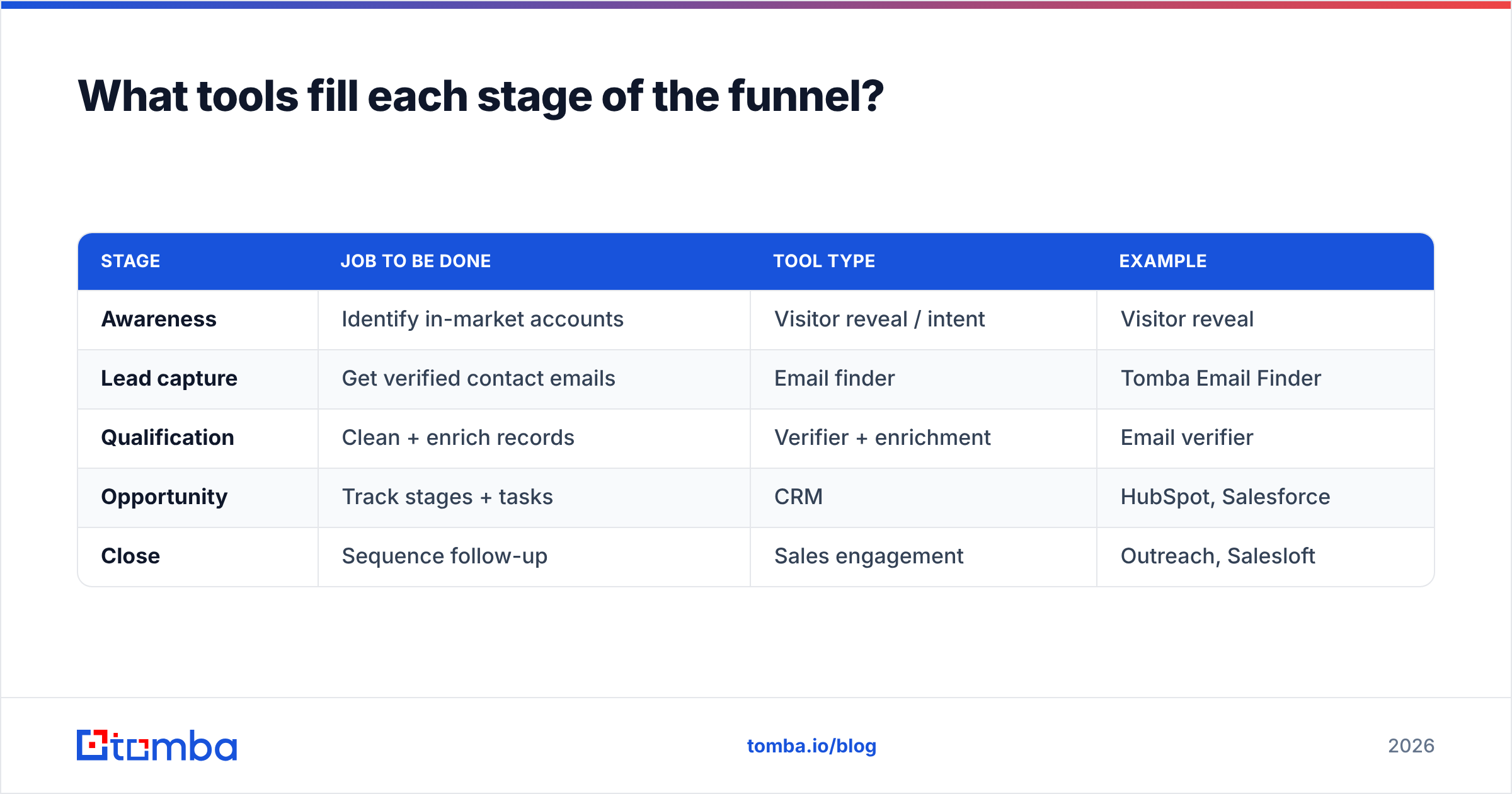
No single platform does the whole funnel well. The best B2B sales funnel is assembled from focused tools that each own a job. Here is a clean mapping.
| Stage | Job to be done | Tool type | Example |
|---|---|---|---|
| Awareness | Identify in-market accounts | Visitor reveal / intent | Visitor reveal |
| Lead capture | Get verified contact emails | Email finder | Tomba Email Finder |
| Qualification | Clean + enrich records | Verifier + enrichment | Email verifier |
| Opportunity | Track stages + tasks | CRM | HubSpot, Salesforce |
| Close | Sequence follow-up | Sales engagement | Outreach, Salesloft |
A few notes on assembling this without overspending:
- Capture and qualification should share a vendor where possible. Finding an email and verifying it in one workflow removes the handoff where data goes stale. Tomba's domain search plus its built-in verification covers both in a single pass.
- Your CRM is the system of record, not a data source. Tools like HubSpot and Salesforce store the funnel; they do not find or clean contacts for you.
- Engagement tools sit at the bottom, not the top. A sequencer amplifies whatever data you feed it — including the bad data — so verification has to come first.
For teams comparing prospecting platforms before they commit, G2's sales intelligence category is a reasonable neutral starting point for unfiltered user reviews.
How does Tomba fit into the funnel — and what does it cost?#
Tomba focuses on the two stages most teams underinvest in: capture and qualification. The email finder pulls verified professional addresses by name, domain, or company, and the integrated verifier scrubs them before they ever reach your CRM. You can run this manually, in bulk, or through the Tomba API for programmatic enrichment.
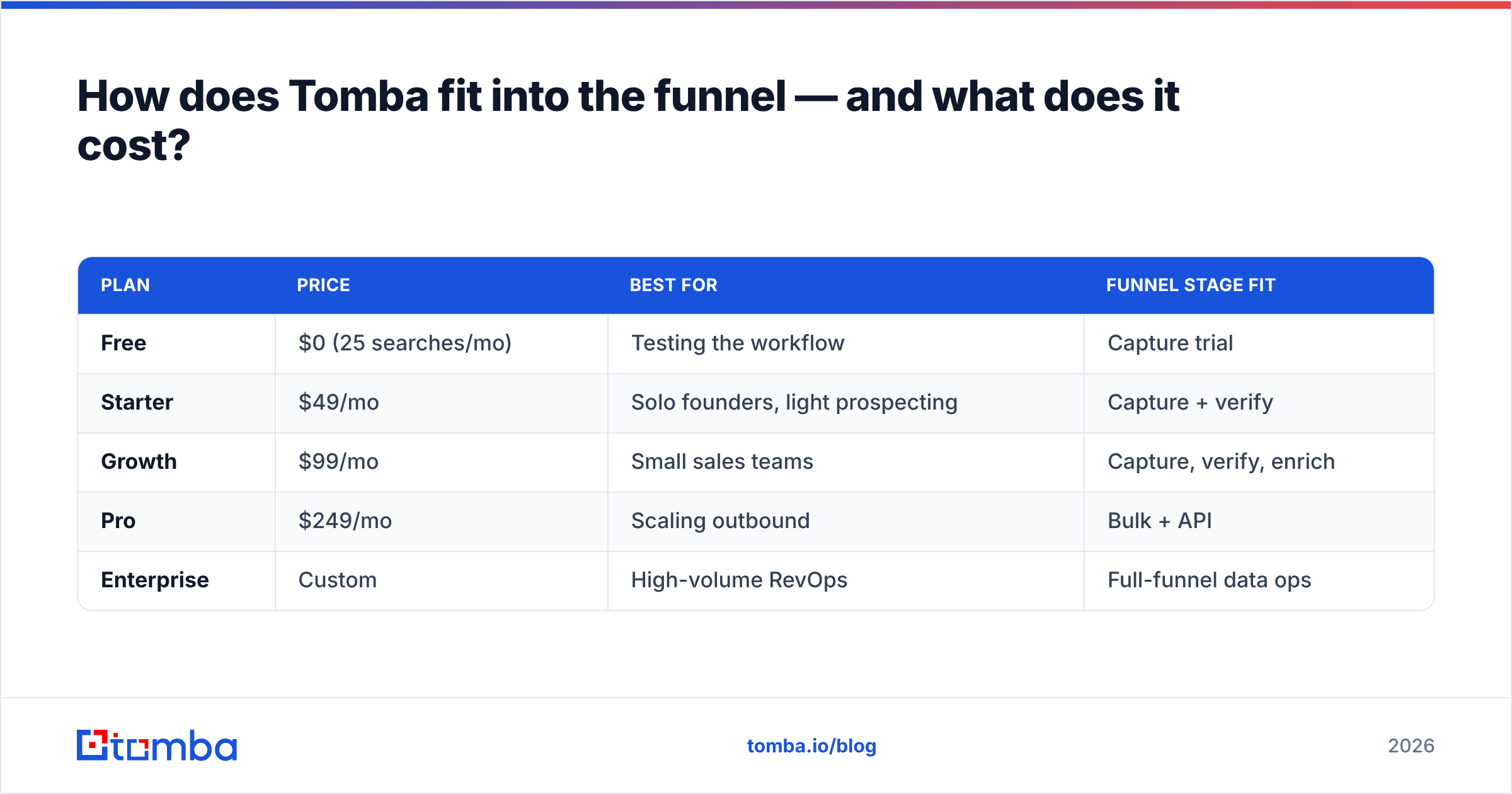
Here is how Tomba's pricing maps to funnel scale. (See full Tomba pricing for current limits.)
| Plan | Price | Best for | Funnel stage fit |
|---|---|---|---|
| Free | $0 (25 searches/mo) | Testing the workflow | Capture trial |
| Starter | $49/mo | Solo founders, light prospecting | Capture + verify |
| Growth | $99/mo | Small sales teams | Capture, verify, enrich |
| Pro | $249/mo | Scaling outbound | Bulk + API |
| Enterprise | Custom | High-volume RevOps | Full-funnel data ops |
The strategic point is not "buy Tomba." It is that the capture-and-verify layer is the cheapest place to fix funnel leakage, and it is the layer most stacks skip. A $49/mo Starter plan that cuts your bounce rate from 25% to under 3% pays for itself the first time it protects your sending domain.
How do you diagnose where your funnel is leaking?#
Run this four-step diagnostic before you spend a dollar on new leads.
- Pull stage-to-stage conversion for the last 90 days. Find the single biggest percentage drop versus the benchmark table above. That is your constraint.
- If the drop is MQL → SQL, audit your data first. Pull a sample of 100 MQLs and run them through an email verifier. If more than 5% are invalid or catch-all, data is your bottleneck — not your reps.
- If the drop is SQL → Opportunity, audit your targeting. Check whether SQLs match your ideal customer profile. Wrong-persona contacts pass qualification on paper but stall in discovery.
- If the drop is Opportunity → Close, audit your sales process. Look for missing mutual action plans, single-threaded deals, and absent ROI cases.
The discipline here is to fix one stage at a time and re-measure. Teams that "improve everything at once" never learn what actually worked.
Common mistakes that quietly kill B2B funnels#
- Buying static lists instead of finding live contacts. Purchased lists decay 25–30% per year and arrive unverified. Finding contacts on demand against current data avoids this.
- Treating the funnel as linear. Real buying committees loop back. Build for multithreading, not a single champion.
- Optimizing volume over fit. Doubling MQLs that don't match your ICP just gives reps more junk to disqualify.
- Ignoring deliverability. If you blast unverified emails, your domain reputation drops and your whole funnel narrows at the top.
- No closed-loop reporting. Without tracking which sources produce closed-won deals, you keep funding the channels that only produce MQLs.
Avoiding these five is worth more than any new tactic, because each one silently caps the ceiling of every stage below it.
Frequently asked questions#
How many stages should a B2B sales funnel have? Five working stages — awareness, capture, qualification, opportunity, and close — is the sweet spot. Fewer and you can't diagnose leaks; more and you add reporting overhead without insight.
What is the most important funnel metric? Stage-to-stage conversion rate, especially MQL-to-SQL. It exposes whether your problem is data, targeting, or selling faster than any single vanity metric.
Can one tool run the whole funnel? No tool does every stage well. Pair a focused capture-and-verify tool like Tomba with a CRM and a sequencer. Forcing one platform to do everything usually means it does the data part poorly.
How do I stop my funnel from leaking at qualification? Verify and enrich contacts before they enter the funnel. Most qualification leaks trace back to invalid emails and missing context, not weak reps.
Build your funnel on data that actually converts#
The best B2B sales funnel in 2026 is not a clever framework — it is a measured pipeline fed by accurate, verified contacts at every stage. Get the data layer right and every downstream conversion rate improves at once. Start at the capture-and-qualification layer where leakage is cheapest to fix: use the Tomba Email Finder to pull verified professional emails by name, domain, or company, then let the built-in verifier keep your funnel — and your sender reputation — clean. Try it free with 25 searches and watch your MQL-to-SQL rate climb.
// get started
Find, verify and enrich your first contacts today
Start on the free plan with 25 searches a month, then scale when your team is ready.
Free plan · No credit card required · GDPR & CCPA
// about the author