The Best Cold Call Script Ever: Proven 2026 Framework
The best cold call script ever isn't a word-for-word monologue — it's a flexible framework. Here's the exact structure top reps use to book more meetings in 2026.
Most "best cold call script ever" articles hand you a rigid monologue and wish you luck. That is exactly why they fail. The reps who actually book meetings don't read scripts — they run a framework that survives contact with a real, distracted human on the other end of the line.
This is that framework. You'll get the openers, the permission-based transition, the value pitch, the objection handling, and the close — plus a copy-paste template you can adapt to your market today.
TL;DR#
- The best cold call script ever is a framework, not a paragraph. Memorize the five beats, not the exact words.
- The first 8 seconds decide everything. A pattern-interrupt opener beats "How are you today?" by a wide margin.
- Permission earns attention. Asking "Can I have 30 seconds?" raises completion rates because it respects the prospect's time.
- Objections are signals, not stop signs. Have a calm, three-step response ready for the four objections you'll hear 90% of the time.
- Bad data kills good scripts. A perfect pitch to a wrong number is wasted; clean phone and email data is the multiplier.
What makes the best cold call script ever actually work?#
The best cold call script ever works because it controls the three things you can control: your opener, your relevance, and your ask. Everything else — the prospect's mood, their day, their budget — is noise you respond to, not script.
Think of it like a GPS. A GPS doesn't force one road; it gives you a destination and reroutes when traffic appears. A great script does the same: it points you toward "booked meeting" and gives you turn-by-turn responses when the prospect pushes back. Rigid scripts crash the moment reality diverges from the page.
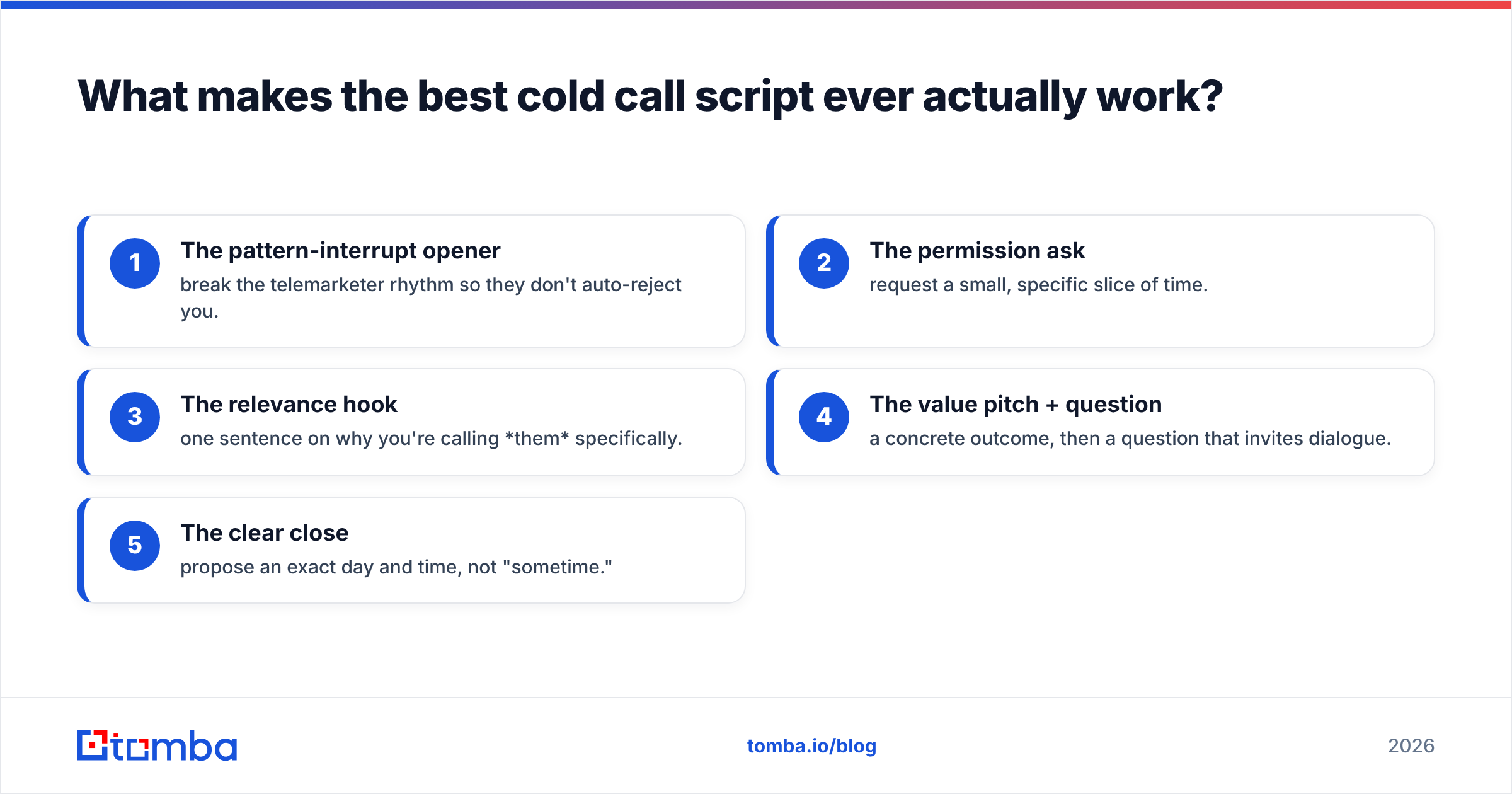
Here are the five beats every high-performing cold call follows:
- The pattern-interrupt opener — break the telemarketer rhythm so they don't auto-reject you.
- The permission ask — request a small, specific slice of time.
- The relevance hook — one sentence on why you're calling them specifically.
- The value pitch + question — a concrete outcome, then a question that invites dialogue.
- The clear close — propose an exact day and time, not "sometime."
What is the best cold call opener?#
The best cold call opener is honest, confident, and unexpected. The single highest-leverage line in 2026 is the "permission-based honesty" opener:
"Hi [Name], this is [You] from [Company]. I'll be honest — this is a cold call. Do you want to hang up, or give me 30 seconds and then decide?"
It works because it does what no robocall does: it names the elephant in the room. Prospects relax when you're transparent, and the small ask ("30 seconds") is easy to grant. Research summarized by sales teams at Gong consistently shows that openers acknowledging the cold call and offering control outperform the tired "How are you doing today?" by a meaningful margin.
Avoid these opener-killers:
- "How are you today?" — telegraphs a pitch instantly.
- "Did I catch you at a bad time?" — invites an easy "yes."
- Launching into features before earning a second of attention.
The best cold call script ever: the full template#
Here's the complete framework written out. Swap the brackets for your details and keep the rhythm.
1. Opener (pattern interrupt + permission)
"Hi [Name], it's [You] from [Company]. I know I'm calling out of the blue — can I take 30 seconds to tell you why, and you can decide if it's worth continuing?"
2. Relevance hook
"I noticed [specific trigger — a hire, funding round, tech-stack change, LinkedIn post]. That usually means [relevant problem] lands on someone like you."
3. Value pitch + open question
"We help [similar role] at [similar company] do [specific outcome with a number, e.g. 'cut prospecting time by 40%']. Out of curiosity, how are you handling [problem] right now?"
4. Objection handling (see the next section)
5. Close
"It sounds like this is worth a deeper look. I have Thursday at 10:15 or Friday at 2:30 — which works better for a quick 15-minute call?"
Notice the close offers two specific times. "Are you free sometime next week?" pushes the work onto the prospect; naming slots makes saying yes the path of least resistance.
How do you handle the four most common objections?#
You handle objections with a three-step move: acknowledge, reframe, redirect. Don't argue, don't panic, don't dump more features. Validate the concern, offer a new angle, then steer back to a small next step.
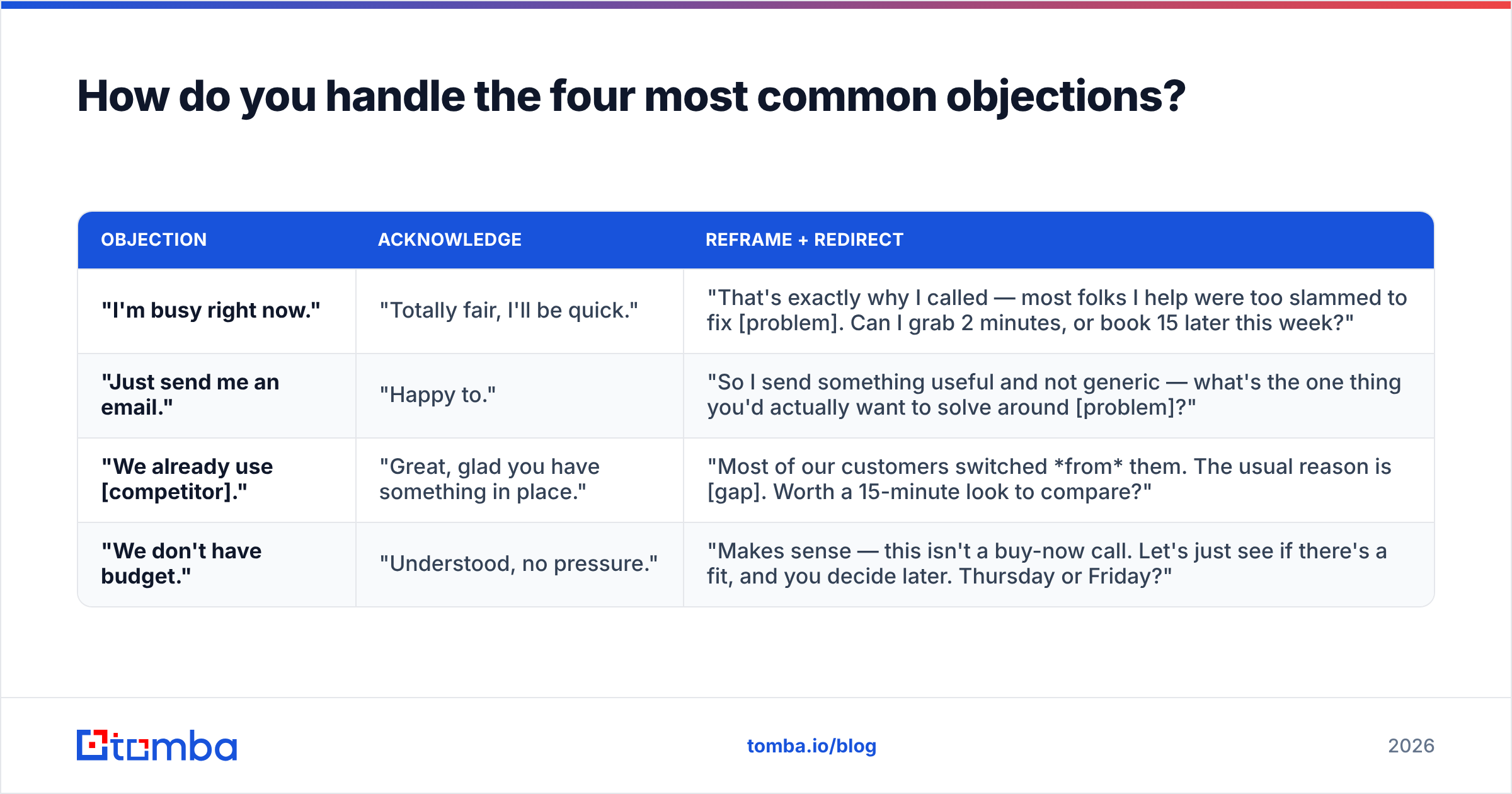
Here are the four objections you'll hear on roughly 90% of calls and a tested response for each:
| Objection | Acknowledge | Reframe + Redirect |
|---|---|---|
| "I'm busy right now." | "Totally fair, I'll be quick." | "That's exactly why I called — most folks I help were too slammed to fix [problem]. Can I grab 2 minutes, or book 15 later this week?" |
| "Just send me an email." | "Happy to." | "So I send something useful and not generic — what's the one thing you'd actually want to solve around [problem]?" |
| "We already use [competitor]." | "Great, glad you have something in place." | "Most of our customers switched from them. The usual reason is [gap]. Worth a 15-minute look to compare?" |
| "We don't have budget." | "Understood, no pressure." | "Makes sense — this isn't a buy-now call. Let's just see if there's a fit, and you decide later. Thursday or Friday?" |
The pattern is identical every time, which is why it's easy to internalize. When you stop fearing objections, your tone gets calmer, and a calm rep is a credible rep. For more on tracking how these plays land, the metric that matters most is your response rate — measure it per opener and iterate.
Cold call script vs. cold email script: when to use each?#
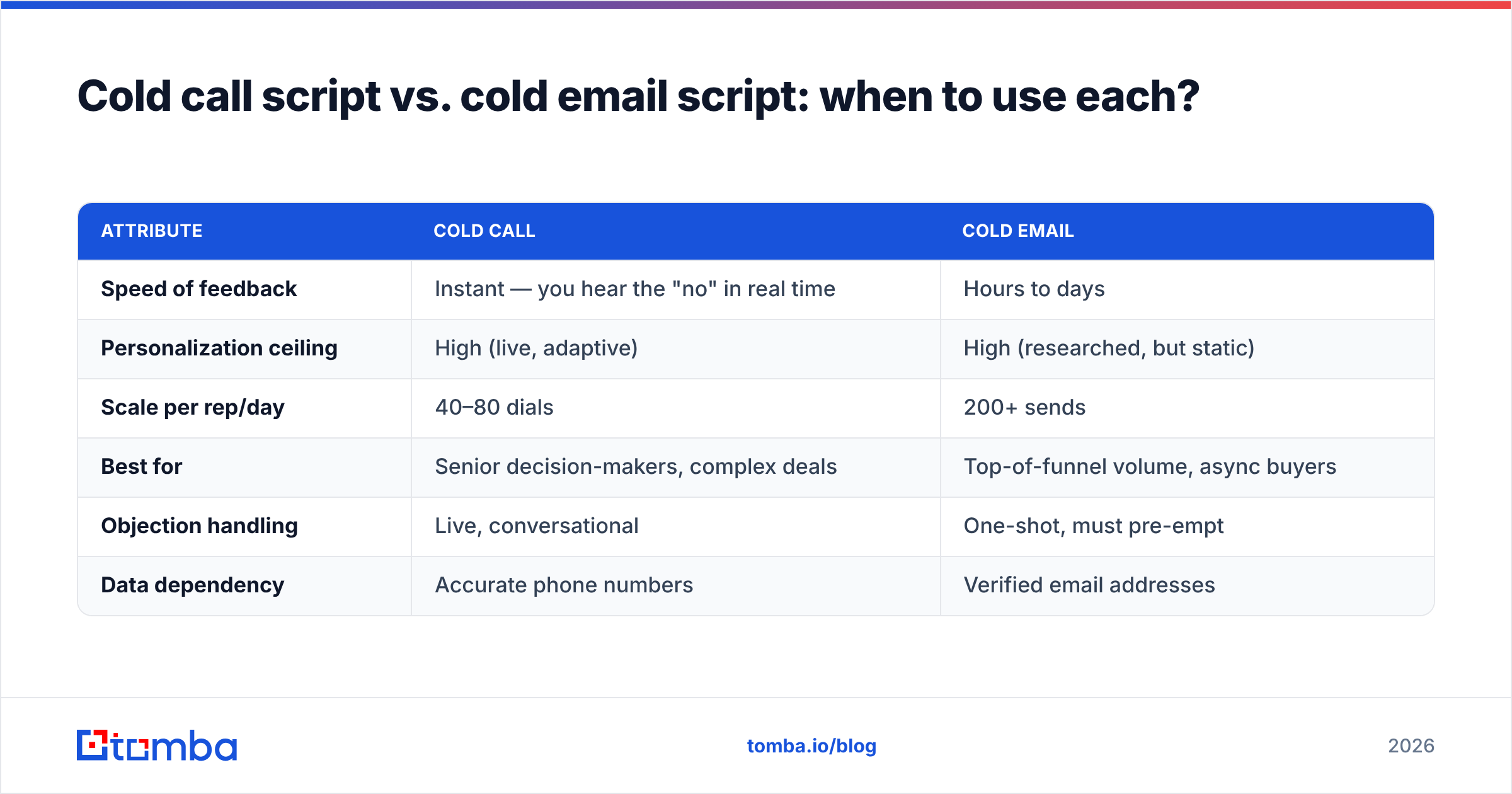
Phone and email aren't rivals; they're a relay. A multi-touch sequence that mixes calls and emails outperforms either channel alone. Here's how the two compare so you know which lever to pull.
| Attribute | Cold call | Cold email |
|---|---|---|
| Speed of feedback | Instant — you hear the "no" in real time | Hours to days |
| Personalization ceiling | High (live, adaptive) | High (researched, but static) |
| Scale per rep/day | 40–80 dials | 200+ sends |
| Best for | Senior decision-makers, complex deals | Top-of-funnel volume, async buyers |
| Objection handling | Live, conversational | One-shot, must pre-empt |
| Data dependency | Accurate phone numbers | Verified email addresses |
The honest takeaway: use calls to break through to high-value targets and email to stay top-of-mind between dials. If you're building the email half of the relay, a library of proven cold email templates keeps your follow-ups sharp without starting from scratch.
Why does data quality decide whether your script works?#
Your script can be flawless, but if you dial a disconnected number or pitch the wrong person, the call is dead before "hello." Data quality is the silent variable behind every cold-calling benchmark.
Two specific failure modes quietly drain pipelines:
- Wrong or stale phone numbers. You burn dials reaching voicemail purgatory or numbers that ring nowhere. Validating numbers before a calling block protects your most finite resource — talk time. A quick pass through a phone validator removes the dead weight.
- Right company, wrong human. You reach a real person who simply isn't the buyer. Pairing accurate contact discovery with a phone finder gets you to the actual decision-maker instead of the front desk.
Sales leaders have repeated the same lesson for years, and platforms like HubSpot build entire workflows around it: enrichment and verification aren't back-office chores, they're conversion drivers. A modest lift in connect rate compounds across thousands of dials per quarter.
This is where a stack matters. Use the email finder to map who's worth calling and to power the email touches around your dials, then verify the contact details so your reps spend their hours talking to humans who can actually say yes.
How do you practice and improve the script over time?#
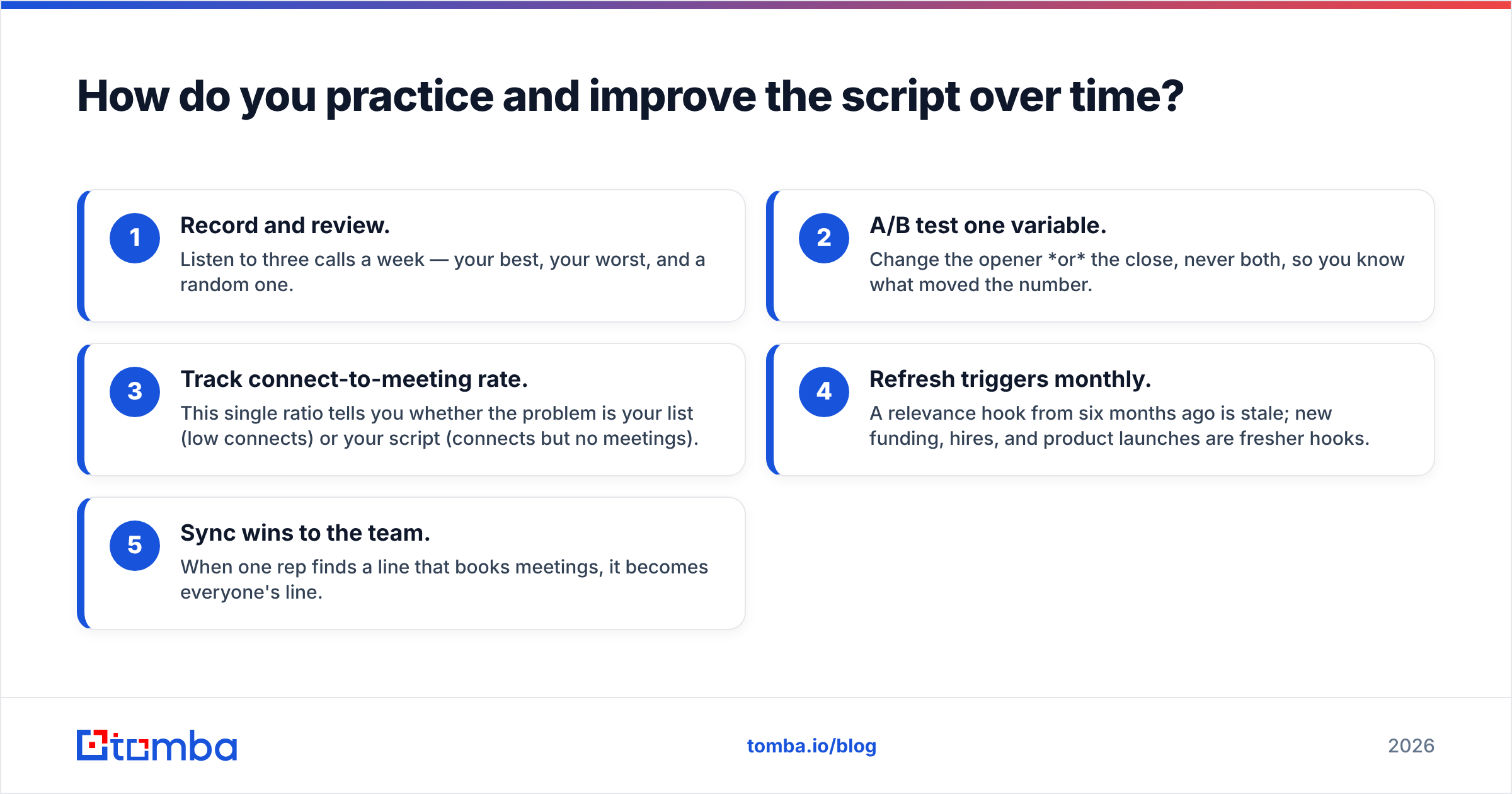
You improve the best cold call script ever the same way athletes improve: deliberate reps, recorded film, and small tweaks. A script you wrote once and never measured is a guess.
Build this weekly loop:
- Record and review. Listen to three calls a week — your best, your worst, and a random one.
- A/B test one variable. Change the opener or the close, never both, so you know what moved the number.
- Track connect-to-meeting rate. This single ratio tells you whether the problem is your list (low connects) or your script (connects but no meetings).
- Refresh triggers monthly. A relevance hook from six months ago is stale; new funding, hires, and product launches are fresher hooks.
- Sync wins to the team. When one rep finds a line that books meetings, it becomes everyone's line.
The reps who treat the script as a living document — not a stone tablet — are the ones still hitting quota when market conditions shift.
Common mistakes that kill even the best script#
- Talking too much. Top closers listen more than they speak. Your question is more valuable than your pitch.
- Monotone delivery. Energy and pace carry as much weight as words. Smile; it's audible.
- No clear ask. If you end the call without proposing a specific time, you've trained the prospect to do nothing.
- Calling without research. Thirty seconds checking a recent trigger turns a cold call warm.
- Ignoring the data layer. The best script in the world fails against a list of wrong numbers.
Frequently asked questions#
Is there really one best cold call script ever? No single set of magic words wins every time. The "best" script is a flexible framework — opener, permission, relevance, value, close — that you adapt to each prospect and refine with real call data.
How long should a cold call be? The opening pitch should fit in 30 seconds. The full call, if it goes well, runs 5–15 minutes. The goal of the first call is usually a booked meeting, not a closed deal.
What's the best time to cold call in 2026? Mid-morning (around 10–11 a.m.) and late afternoon (4–5 p.m.) in the prospect's local time tend to connect best, but your own data beats any benchmark — track your connect rates by hour.
Should I leave a voicemail? Yes, but keep it under 20 seconds and treat it as a teaser for your follow-up email, not a full pitch. Reference a specific reason you called so it feels personal.
Put the script to work#
The best cold call script ever is only as good as the list you dial. Before your next calling block, build a clean, accurate target list: use the Tomba Email Finder to identify the right decision-makers and power the email touches that pair with your calls, then verify phone numbers so every dial reaches a real human who can say yes. Start free with 25 searches a month, and scale up on the Tomba pricing Starter plan at $49/mo when your pipeline demands it. A great script plus great data is how meetings get booked.
// get started
Find, verify and enrich your first contacts today
Start on the free plan with 25 searches a month, then scale when your team is ready.
Free plan · No credit card required · GDPR & CCPA
// about the author