15 Best Cold Calling Techniques That Book Meetings in 2026
The best cold calling techniques in 2026 are about data, openers, and tone — not volume. Here are 15 tactics that turn dials into booked meetings.
Cold calling did not die. Bad cold calling did. The reps still booking meetings in 2026 are not dialing more — they are dialing smarter, with cleaner data, sharper openers, and a tone that earns the next 30 seconds. This guide breaks down the best cold calling techniques that actually move connect rates and conversion, plus the scripts and tools behind them.
TL;DR#
- Data beats volume. Accurate direct-dial numbers and verified context lift connect rates more than any script tweak. Bad numbers waste 40%+ of a rep's day.
- The first 8 seconds decide everything. A permission-based or pattern-interrupt opener outperforms "How are you today?" every time.
- Talk less, ask better. Top reps keep talk-to-listen ratios near 43:57 and use silence on purpose.
- Objections are signals, not stops. Have a rehearsed rebuttal for the five objections you hear daily.
- Follow-up is the system. One call rarely lands a meeting — a multi-touch cadence across phone, email, and LinkedIn does.
What makes a cold calling technique "work" in 2026?#
A technique works when it improves one of three numbers: connect rate (did a human answer), conversation rate (did they stay on the line past your opener), and conversion rate (did you book the next step). Everything below maps to one of those three.
The biggest shift in 2026 is that buyers screen aggressively. Spam-likely flags, AI voicemail filters, and saturated inboxes mean your number, your timing, and your first sentence carry more weight than your pitch. That is why the best programs invest in data quality before they invest in a new script.
What are the best cold calling techniques?#
Here are the 15 highest-leverage tactics, grouped by where they hit the funnel.
- Call with verified direct dials. A polished script means nothing if the number rings a dead extension. Pull current mobile and direct numbers with a phone finder and confirm they are live with a phone validator before you dial.
- Lead with a permission-based opener. "Hey Sarah, I know I'm an interruption — can I have 27 seconds to tell you why I called, then you can hang up?" Honesty disarms the screen reflex.
- Use a pattern interrupt. Skip "How are you today?" Try "Sarah, this is a cold call — do you want to hang up, or did I catch you at an okay time?" The candor buys curiosity.
- State the reason for the call fast. Buyers grant attention when they understand why you specifically called them. Reference a trigger: a hire, a funding round, a tech change.
- Anchor on a problem, not a product. "Most RevOps leaders I talk to are stitching three tools to dedupe leads" lands harder than "We're a data platform."
- Keep a 43:57 talk-to-listen ratio. Gong's analysis of sales calls found top performers listen more than they talk. Ask, then shut up.
- Use tactical silence. After a question, wait. Three seconds of silence pulls answers out of prospects who would otherwise deflect.
- Mirror and label. Repeat their last few words, then name the emotion: "Sounds like budget is the real blocker." It signals you are listening.
- Sell the meeting, not the solution. Your goal on a cold call is a 20-minute calendar slot, not a closed deal. Lower the ask.
- Give a specific time. "Does Thursday at 10:15 work?" converts better than "When are you free?" Specificity reduces decision friction.
- Pre-handle the brush-off. When you hear "send me an email," respond: "Happy to — what specifically should I put in it so it's not just noise?" That re-opens the conversation.
- Batch your calls by time zone and role. Decision-makers answer more before 9am and after 4pm. Power-hour blocks beat random dialing.
- Leave a 12-second voicemail. Name, company, one-line reason, callback number, done. Long voicemails get deleted.
- Log everything in your CRM immediately. Disposition every call so your cadence and your CRM stay accurate. Untracked calls cannot be improved.
- Follow a multi-touch cadence. Pair calls with email and LinkedIn touches. The meeting usually comes on touch 4-6, not touch 1.
How should you open a cold call?#
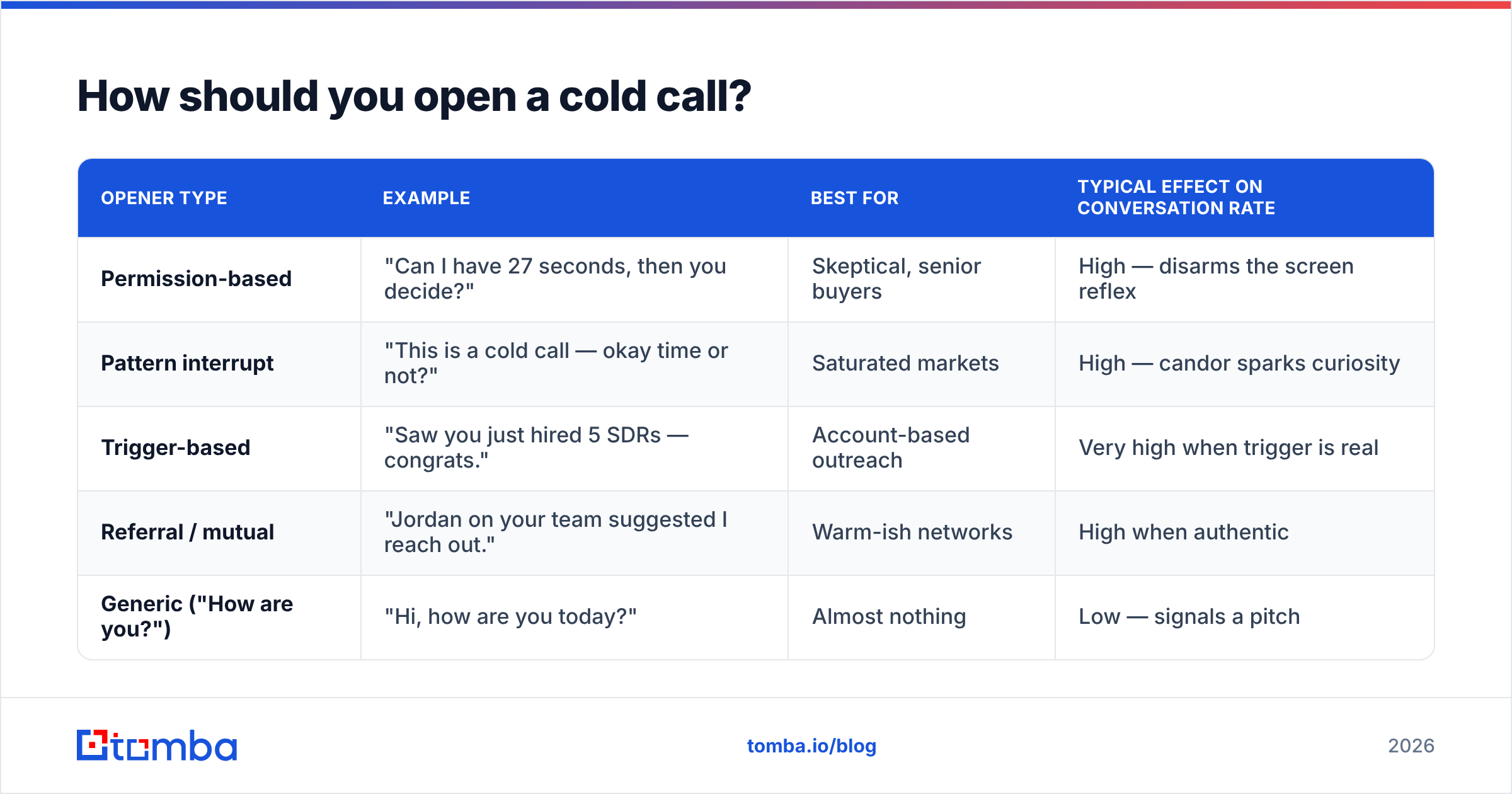
Your opener has one job: earn the next 30 seconds. The worst openers waste it on filler. The best ones are honest, specific, and short.
| Opener type | Example | Best for | Typical effect on conversation rate |
|---|---|---|---|
| Permission-based | "Can I have 27 seconds, then you decide?" | Skeptical, senior buyers | High — disarms the screen reflex |
| Pattern interrupt | "This is a cold call — okay time or not?" | Saturated markets | High — candor sparks curiosity |
| Trigger-based | "Saw you just hired 5 SDRs — congrats." | Account-based outreach | Very high when trigger is real |
| Referral / mutual | "Jordan on your team suggested I reach out." | Warm-ish networks | High when authentic |
| Generic ("How are you?") | "Hi, how are you today?" | Almost nothing | Low — signals a pitch |
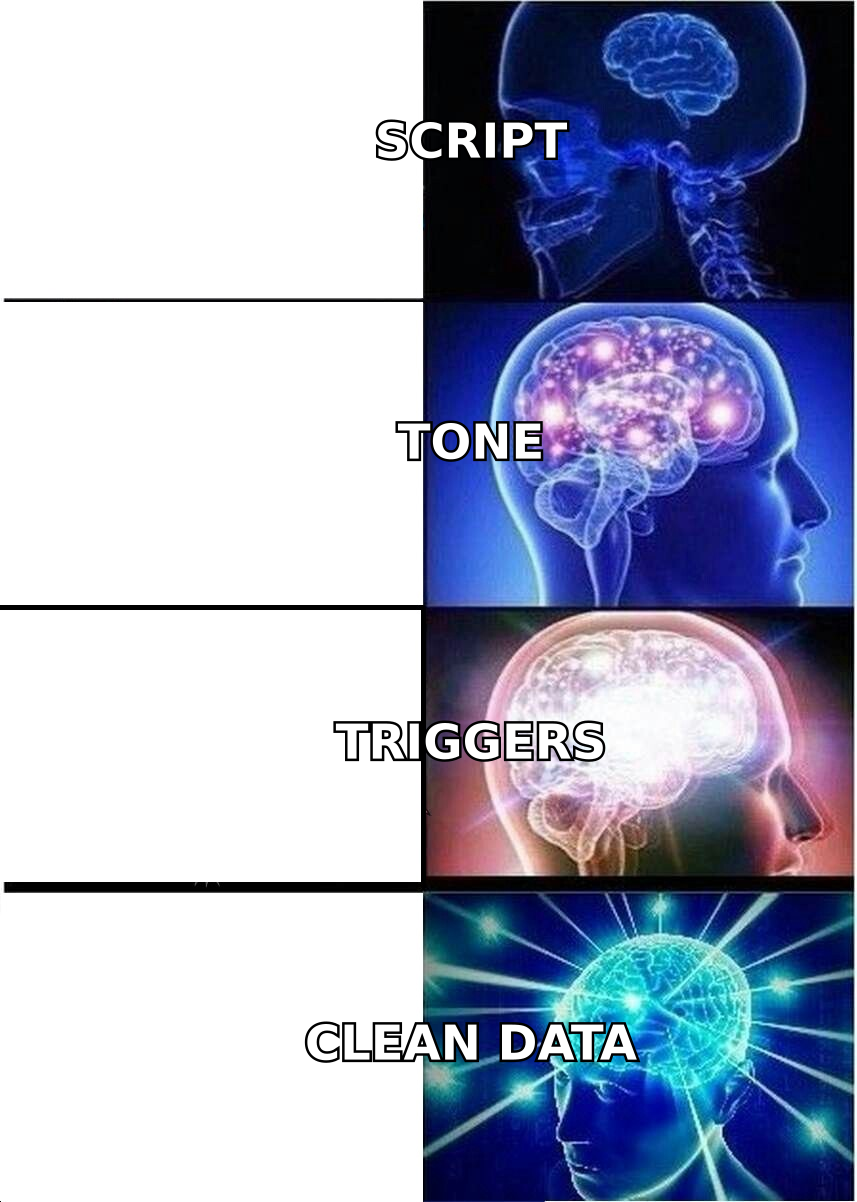
Pick based on your buyer and your data. A trigger-based opener only works if your trigger is accurate, which loops back to technique #1: clean, current data is the foundation under every script.
How do you handle the most common objections?#
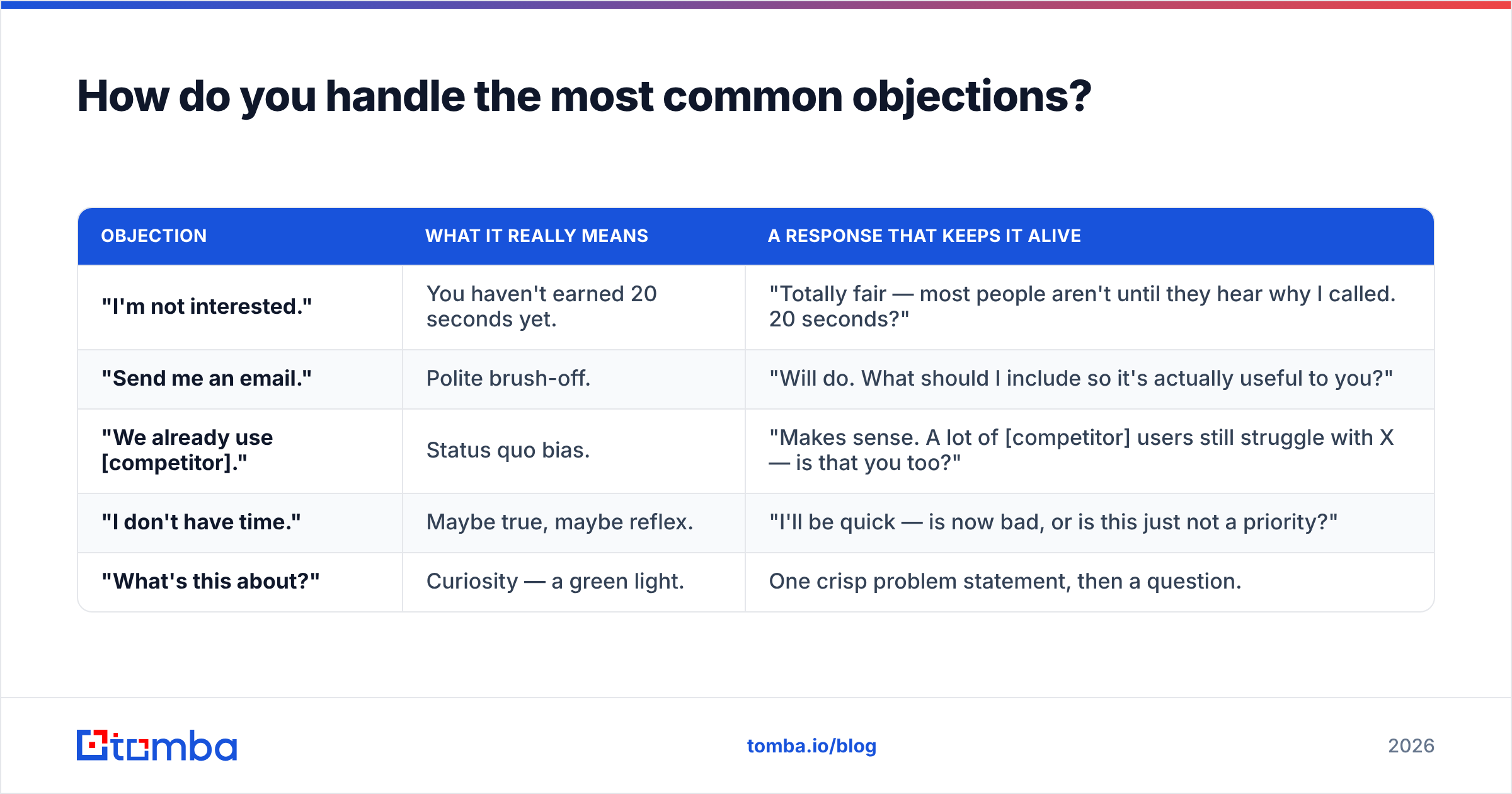
Objections are not rejection — they are the buyer telling you what stands between you and the meeting. Rehearse responses to the five you hear most so you never freeze.
| Objection | What it really means | A response that keeps it alive |
|---|---|---|
| "I'm not interested." | You haven't earned 20 seconds yet. | "Totally fair — most people aren't until they hear why I called. 20 seconds?" |
| "Send me an email." | Polite brush-off. | "Will do. What should I include so it's actually useful to you?" |
| "We already use [competitor]." | Status quo bias. | "Makes sense. A lot of [competitor] users still struggle with X — is that you too?" |
| "I don't have time." | Maybe true, maybe reflex. | "I'll be quick — is now bad, or is this just not a priority?" |
| "What's this about?" | Curiosity — a green light. | One crisp problem statement, then a question. |
Notice the pattern: every response ends by handing the conversation back with a question. You are not arguing — you are keeping the dialogue open long enough to find the meeting.
Does cold calling still beat email and LinkedIn?#
It does not beat them — it compounds with them. Channels do different jobs. The phone is your highest-intent, fastest-feedback channel; email scales reach; LinkedIn builds familiarity. The reps who win run all three as one cadence.
A realistic 10-business-day cadence looks like this:
- Day 1: Call + voicemail, then a 2-line email.
- Day 2: LinkedIn connection request, no pitch.
- Day 4: Call at a different time of day.
- Day 6: Value email — a relevant stat or case, no ask.
- Day 8: Call + voicemail.
- Day 10: Break-up email that invites a "not now."
To run this without spraying the wrong people, you need accurate contact data across every channel. Tools like a phone finder for direct dials and an email finder for verified work addresses keep the cadence pointed at real, reachable humans instead of bouncing into dead ends. For broader context on multi-channel outreach, HubSpot's sales blog and Gong's research both publish hard data on what actually converts.
What metrics should you track to improve?#
You cannot improve what you do not measure. Track these weekly and let the numbers, not your gut, tell you which technique to fix.
- Connect rate — connects ÷ dials. Low? Fix your data and call times before your script.
- Conversation rate — conversations past the opener ÷ connects. Low? Rework your opener.
- Conversion rate — meetings booked ÷ conversations. Low? Work on discovery and the ask.
- Dials to meeting — total dials ÷ meetings booked. Your efficiency north star.
- Talk-to-listen ratio — pull it from your call recorder and aim for ~43:57.
When connect rate is the bottleneck — and it usually is — the cheapest fix is better data, not more dials. A rep working a list with 30% bad numbers is donating a third of their day to dial tone.
How does data quality change your cold calling results?#
Conclusion first: clean data is the single highest-ROI lever in cold calling, because it multiplies the value of every other technique. The best opener in the world fails against a wrong number.
Here is the practical workflow most high-performing teams use:
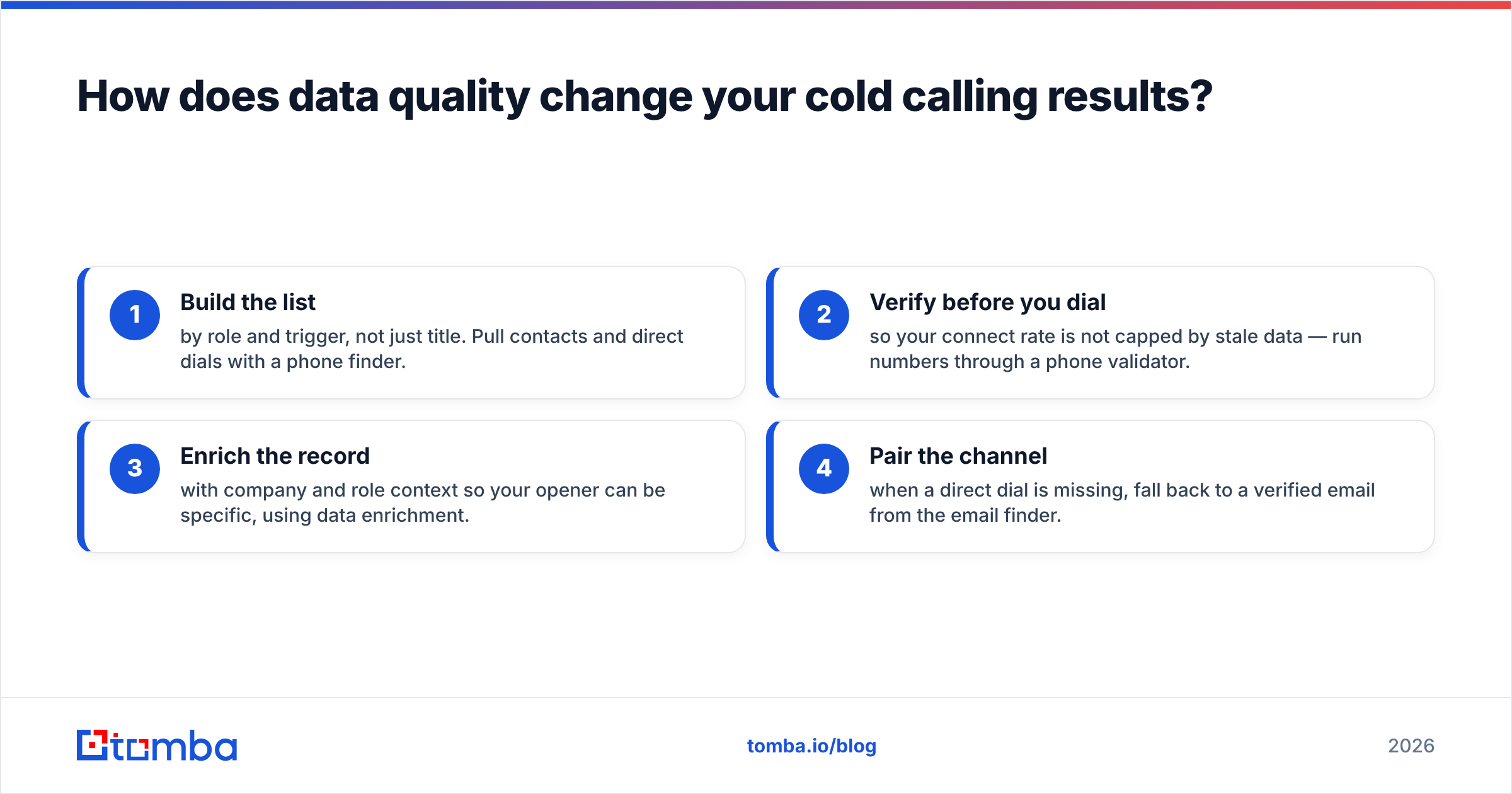
- Build the list by role and trigger, not just title. Pull contacts and direct dials with a phone finder.
- Verify before you dial so your connect rate is not capped by stale data — run numbers through a phone validator.
- Enrich the record with company and role context so your opener can be specific, using data enrichment.
- Pair the channel — when a direct dial is missing, fall back to a verified email from the email finder.
You can run this manually for a handful of accounts or in bulk for a full territory. Either way, the principle holds: fix the data layer and every script, opener, and cadence above it works harder. Check Tomba pricing to match the volume you actually dial — the Free tier gives you 25 searches a month to test the workflow before you commit.
What does a simple cold call framework look like?#
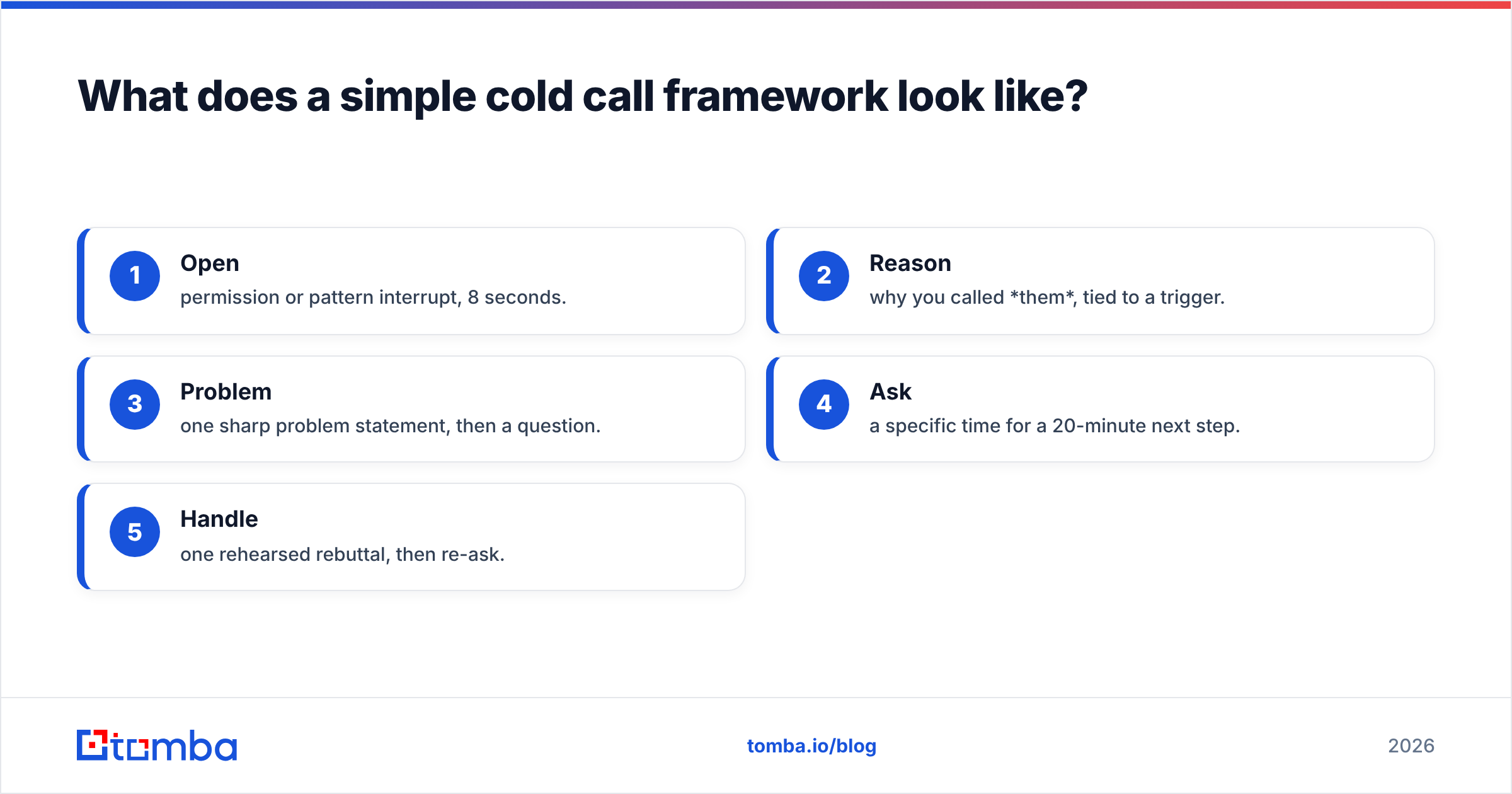
If you remember nothing else, run this five-beat structure on every call:
- Open — permission or pattern interrupt, 8 seconds.
- Reason — why you called them, tied to a trigger.
- Problem — one sharp problem statement, then a question.
- Ask — a specific time for a 20-minute next step.
- Handle — one rehearsed rebuttal, then re-ask.
Keep it under three minutes. The call is not the sale; it is the door to the sale.
Final word: technique scales, but only on clean data#
The best cold calling techniques in 2026 — honest openers, tactical silence, problem-first framing, multi-channel cadences — all assume one thing: you are reaching the right person at a number that rings. Skip that foundation and you are A/B testing scripts against a dial tone.
Start by fixing what you dial. Use the Tomba Email Finder to build verified contact lists by domain, name, or company, then layer in direct dials and enrichment so every call opens with the right name, the right context, and a number that actually connects. Better data first, better techniques second — that is how dials turn into booked meetings.
// get started
Find, verify and enrich your first contacts today
Start on the free plan with 25 searches a month, then scale when your team is ready.
Free plan · No credit card required · GDPR & CCPA
// about the author