The Best Day to Cold Call in 2026 (Backed by Real Data)
Monday morning or Thursday afternoon? We break down the best day to cold call using connect-rate data, time-zone math, and the list hygiene that actually moves the needle.
You can have the sharpest opener on the team and still get crushed by one thing you don't control: nobody picks up. The single biggest lever in cold calling isn't your script — it's whether a human answers. And that comes down to when you dial and whether the number is even real.
This guide breaks down the best day to cold call based on connect-rate patterns, the best hours inside those days, and the list hygiene that quietly decides your whole quarter.
TL;DR#
- Wednesday and Thursday are consistently the strongest days to cold call; Monday mornings and Friday afternoons are the weakest.
- The best hours cluster around 8–10 a.m. and 4–5 p.m. in the prospect's local time — before the calendar fills and after it empties.
- Avoid the dead zones: early Monday (planning mode) and post-lunch Friday (mentally clocked out).
- Day-of-week matters less than dial volume on accurate numbers — a wrong number on the perfect day still connects you to nobody.
- Pair good timing with verified direct dials from a phone finder so your "best day" isn't wasted on dead lines.
Why does the day of the week matter for cold calling?#
Think of cold calling like fishing. You can use the best rod and the best bait, but if you cast when the fish aren't biting, you go home empty. The day and hour you dial determine how many decision-makers are actually near their phone and mentally available to talk.
People move through a predictable weekly rhythm. Monday is triage — clearing the weekend backlog, sitting in status meetings, and bracing for the week. By midweek, the panic settles and calendars loosen. By Friday afternoon, attention has already left the building. Your dials land in those moods whether you like it or not.
That's why "best day to cold call" is a real, measurable question, not folklore. Connect rates, conversation rates, and meeting-booked rates all shift across the week. Sales research from groups like HubSpot and conversation-analytics vendors has repeatedly shown midweek outperforming the bookends. The exact percentages vary by industry and dataset, but the shape of the curve is stubbornly consistent.
What is the best day to cold call?#
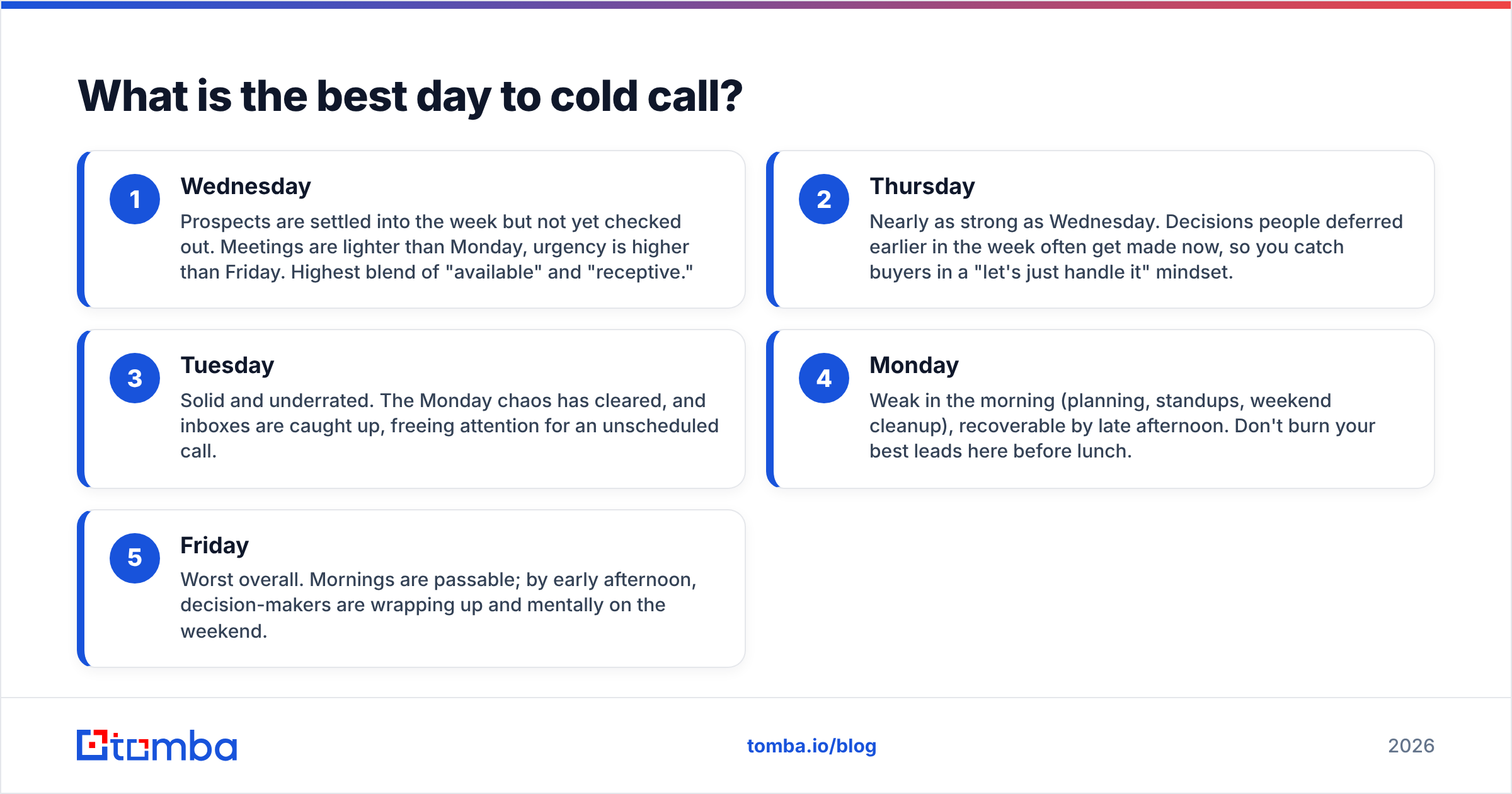
Wednesday is the best day to cold call, with Thursday a close second. Here's the reasoning behind the ranking, not just the verdict:
- Wednesday — Prospects are settled into the week but not yet checked out. Meetings are lighter than Monday, urgency is higher than Friday. Highest blend of "available" and "receptive."
- Thursday — Nearly as strong as Wednesday. Decisions people deferred earlier in the week often get made now, so you catch buyers in a "let's just handle it" mindset.
- Tuesday — Solid and underrated. The Monday chaos has cleared, and inboxes are caught up, freeing attention for an unscheduled call.
- Monday — Weak in the morning (planning, standups, weekend cleanup), recoverable by late afternoon. Don't burn your best leads here before lunch.
- Friday — Worst overall. Mornings are passable; by early afternoon, decision-makers are wrapping up and mentally on the weekend.
The takeaway: front-load your highest-value accounts into Tuesday through Thursday, and use Monday mornings and Friday afternoons for admin, research, and list building rather than your hottest prospects.
What is the best time of day to cold call?#
Day picks the right pond; hour picks the right cast. Two windows win across almost every dataset:
- Early morning, 8:00–10:00 a.m. (local time): You catch decision-makers before back-to-back meetings swallow the day. Gatekeepers may not be in yet, so senior people sometimes answer their own phones.
- Late afternoon, 4:00–5:00 p.m. (local time): The day's meetings are done, the to-do list is winding down, and people are more willing to take an unscheduled call.
The reliable dead zone is 11:30 a.m.–1:30 p.m., when prospects are heading to or returning from lunch. Early morning before 8 and anything after 5:30 sees diminishing returns outside of specific industries (founders and execs sometimes answer off-hours precisely because the gatekeeper is gone).
The phrase "local time" is doing heavy lifting here. If you're in New York dialing a 9 a.m. prospect in California, it's 6 a.m. for them and you've torched a good lead. Time-zone discipline is one of the most common and most fixable cold-calling mistakes.
How do the days and times compare?#
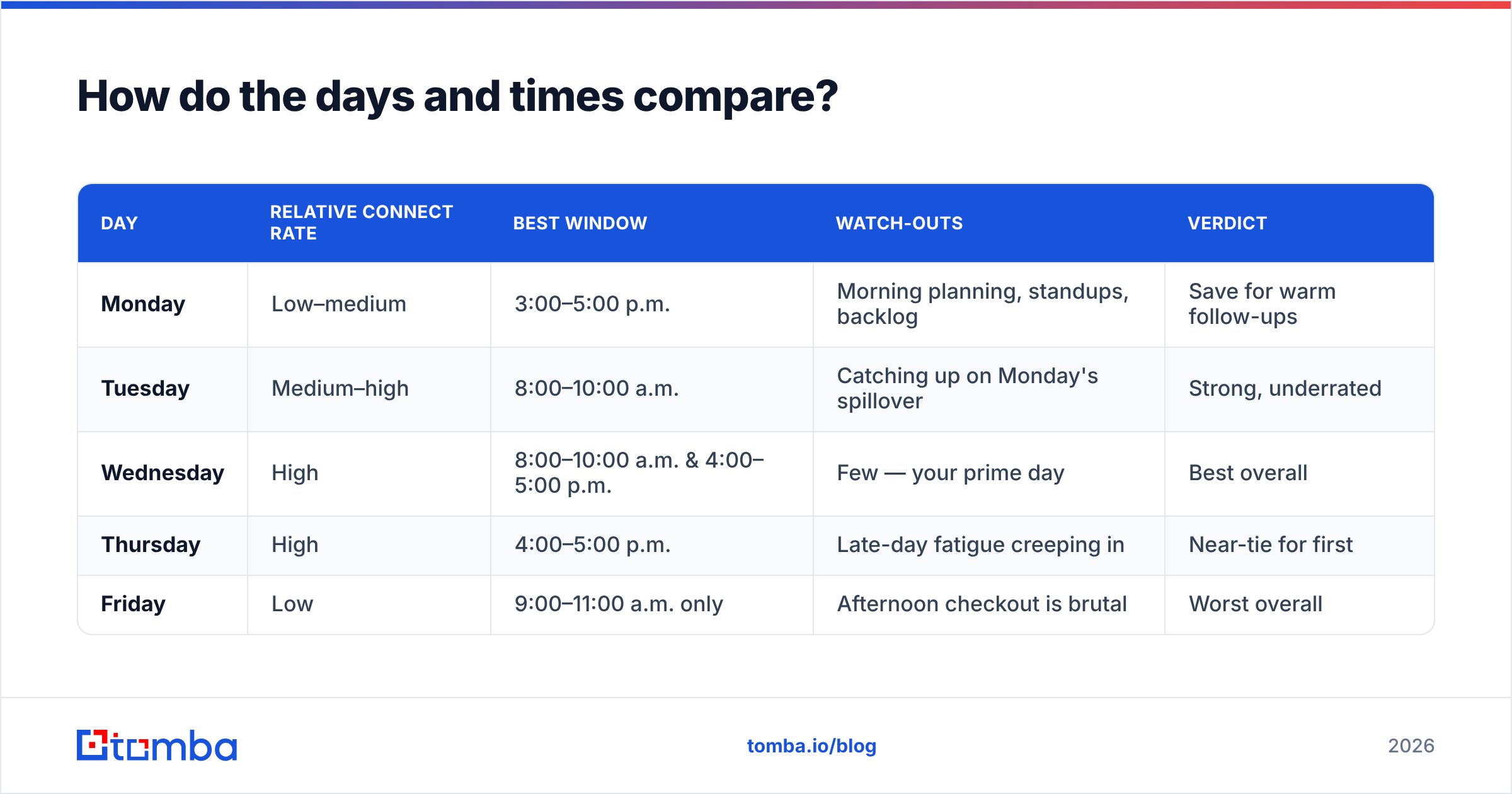
Here's a consolidated view of weekday performance for cold calling. Treat the connect-rate and meeting-rate columns as directional benchmarks — your real numbers depend on industry, persona, and list quality.
| Day | Relative connect rate | Best window | Watch-outs | Verdict |
|---|---|---|---|---|
| Monday | Low–medium | 3:00–5:00 p.m. | Morning planning, standups, backlog | Save for warm follow-ups |
| Tuesday | Medium–high | 8:00–10:00 a.m. | Catching up on Monday's spillover | Strong, underrated |
| Wednesday | High | 8:00–10:00 a.m. & 4:00–5:00 p.m. | Few — your prime day | Best overall |
| Thursday | High | 4:00–5:00 p.m. | Late-day fatigue creeping in | Near-tie for first |
| Friday | Low | 9:00–11:00 a.m. only | Afternoon checkout is brutal | Worst overall |
Notice the pattern: the strong days share the same two hourly windows. Your scheduling job is to stack the most attempts into the Tuesday–Thursday × morning/late-afternoon grid, and starve the weak slots.
Does the "best day" even matter if your data is bad?#
Conclusion first: the best day to cold call is worthless if the number you dial is wrong. This is the trap most teams never measure their way out of.
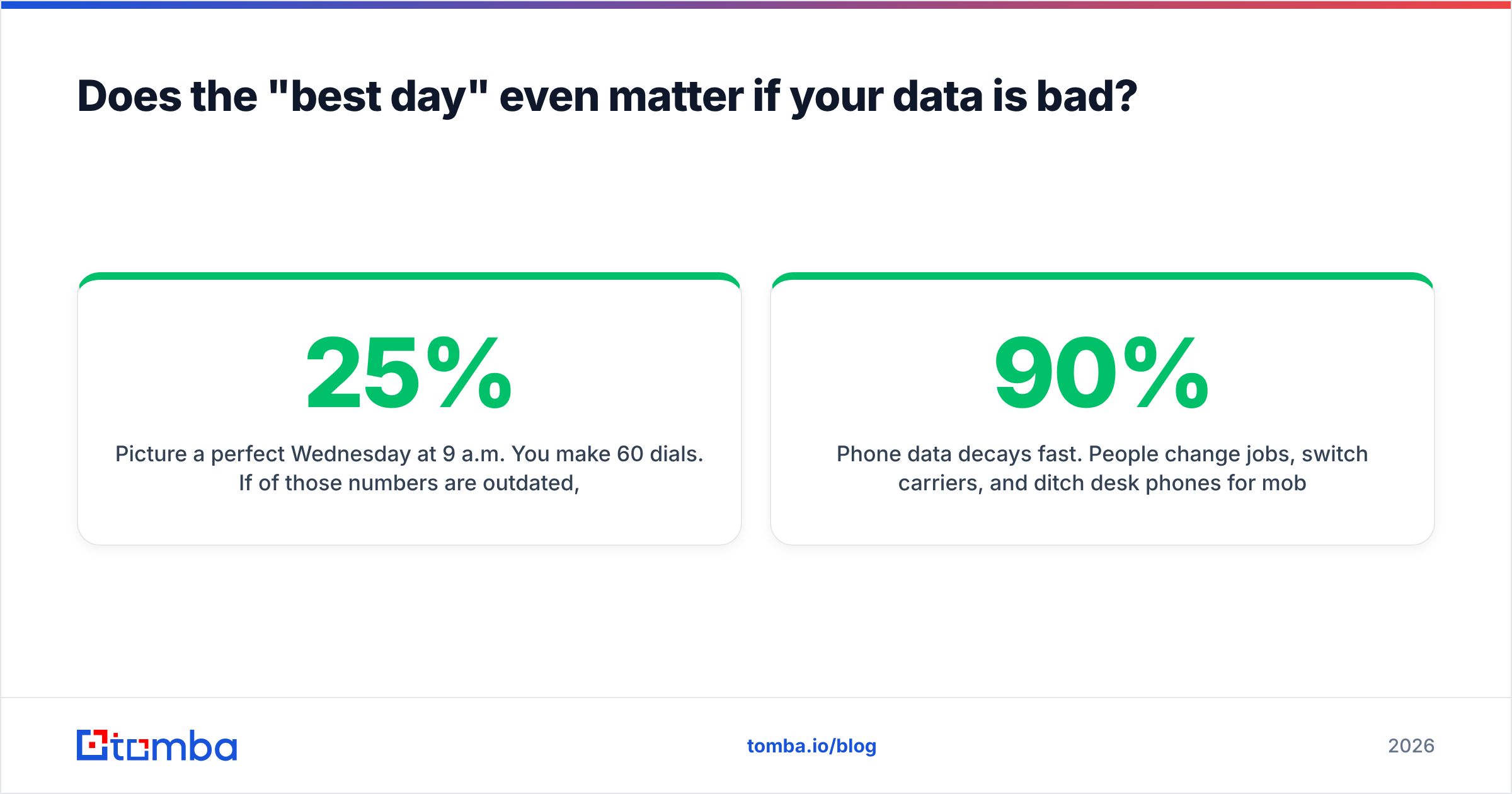
Picture a perfect Wednesday at 9 a.m. You make 60 dials. If 25% of those numbers are outdated, disconnected, or belong to the wrong person, you just paid premium-timing prices for 45 real attempts. Worse, dialing dead numbers and triggering carrier flags can hurt your caller reputation, so even your good numbers connect less often.
Phone data decays fast. People change jobs, switch carriers, and ditch desk phones for mobiles. A list that was 90% accurate a year ago can rot to 70% without anyone noticing — until your connect rate quietly craters and you blame the script.
So before you obsess over Wednesday-versus-Thursday, fix the inputs:
- Source direct dials, not switchboards. A verified mobile or direct line beats a main number that dumps you into an IVR. A modern phone finder returns direct contacts tied to a real person and company.
- Validate before you dial. Run numbers through a phone validator to drop disconnected and invalid lines, so your dial count reflects reality.
- Keep the underlying record fresh. Enrich contacts from a maintained B2B database so titles, companies, and numbers stay current as people move.
Timing optimization on a clean list compounds. Timing optimization on a rotten list just helps you reach a wrong number faster.
How should you build a weekly cold-calling schedule?#
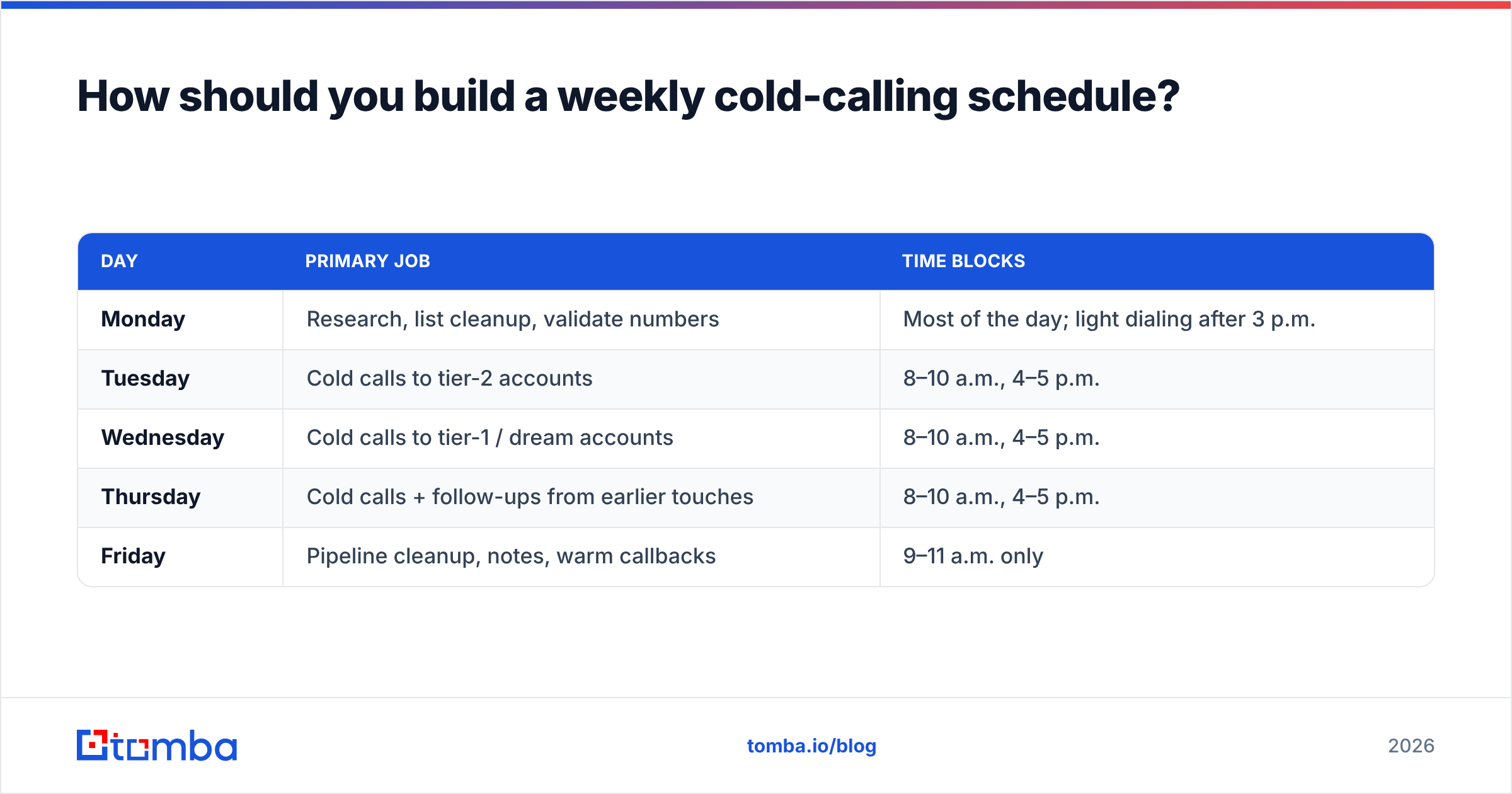
Don't treat all five days as identical blocks. Assign each day a job based on where it sits on the connect-rate curve. A simple, repeatable week looks like this:
| Day | Primary job | Time blocks |
|---|---|---|
| Monday | Research, list cleanup, validate numbers | Most of the day; light dialing after 3 p.m. |
| Tuesday | Cold calls to tier-2 accounts | 8–10 a.m., 4–5 p.m. |
| Wednesday | Cold calls to tier-1 / dream accounts | 8–10 a.m., 4–5 p.m. |
| Thursday | Cold calls + follow-ups from earlier touches | 8–10 a.m., 4–5 p.m. |
| Friday | Pipeline cleanup, notes, warm callbacks | 9–11 a.m. only |
This structure does two things. It puts your best leads in front of your best windows, and it moves low-yield work (data prep, admin) into the low-yield slots instead of letting it eat your prime calling time. Most reps invert this by accident — grinding the CRM at 9 a.m. Wednesday and dialing cold at 4 p.m. Friday.
Layer cadence on top: a single dial rarely connects. Industry analysts at Gartner and sales-engagement platforms consistently report that it takes multiple touches across channels to reach a B2B buyer. Combine calls with email and social so a missed dial on Wednesday becomes a touchpoint, not a dead end. Tying calls to LinkedIn outreach and email gives the prospect several chances to engage on their terms.
What about industry and persona differences?#
The Wednesday-Thursday rule is a strong default, but your specific buyer can shift the curve. A few adjustments worth testing:
- Founders and C-suite: Often reachable before 8 a.m. and after 6 p.m., precisely when the gatekeeper isn't screening. Off-peak can be on-peak for the top of the org.
- Retail, hospitality, field services: Mornings are operational chaos. Mid-afternoon lulls work better.
- Healthcare and education: Highly schedule-bound; ask reps who've sold into the vertical for the real open windows rather than guessing.
- Time-zone-spread territories: "8 a.m." is five different clock times across the U.S. Sort your call list by the prospect's zone, not yours, and chase the morning window westward through the day.
The point isn't to memorize every exception. It's to start from the data-backed default, then let your own connect-rate logs tell you where your buyers diverge. Track day, hour, and outcome for a few weeks and the pattern specific to your motion will surface.
How do you measure and improve your calling windows?#
You can't optimize what you don't log. Tag every call with the day, the local hour, and the outcome (no answer, gatekeeper, conversation, meeting). After two or three weeks you'll have your own heatmap — which beats any blog's averages, including this one.
Then act on it:
- Cut the dead slots. If Friday after 1 p.m. books zero meetings across 80 dials, stop spending leads there.
- Double down on winners. Found that Thursday 4 p.m. converts? Schedule your best accounts there deliberately.
- Separate timing from data problems. If connect rates are low everywhere, the issue is your list, not your clock. Re-verify and re-enrich before you re-time. Tools like G2 reviews can help you compare data providers on accuracy, not just price.
Treat it as a loop: measure, adjust, re-measure. The "best day" is a starting hypothesis you confirm with your own numbers.
The bottom line#
Wednesday and Thursday, mornings and late afternoons, in the prospect's local time — that's the best day to cold call for most B2B teams, and it's a defensible default to build your week around. But the real unlock is upstream of the calendar. Perfect timing on accurate, validated direct dials beats clever timing on a decayed list every single time.
Start by fixing what you dial, then optimize when you dial it. Use Tomba's Phone Finder to source verified direct numbers tied to real decision-makers, run them through validation, and keep the records fresh — so when Wednesday at 9 a.m. comes around, every dial lands on a line that can actually say yes. Check the Tomba pricing to find the plan that matches your call volume, starting free with 25 searches a month and scaling to Starter at $49/mo when you're ready to ramp.
// get started
Find, verify and enrich your first contacts today
Start on the free plan with 25 searches a month, then scale when your team is ready.
Free plan · No credit card required · GDPR & CCPA
// about the author