Best Day To Send Emails in 2026 (Data-Backed Guide)
Tuesday gets the headlines, but the best day to send emails depends on your audience, time zone, and list quality. Here's what the 2026 data actually shows.
TL;DR
- The best day to send emails for most B2B audiences is Tuesday through Thursday, with Tuesday morning leading on open and reply rates across nearly every 2026 benchmark study.
- Monday and Friday consistently underperform — Monday inboxes are buried, and Friday attention drops off by early afternoon.
- "Best day" is a starting hypothesis, not a law. Your audience's time zone, role, and industry shift the answer more than any global average.
- Send timing only matters if your email lands in the inbox. A clean, verified list beats a perfectly-timed blast to dead addresses every time.
- Test two send windows per week, measure replies (not just opens), and let your own data overrule the averages.
What is the best day to send emails in 2026?#
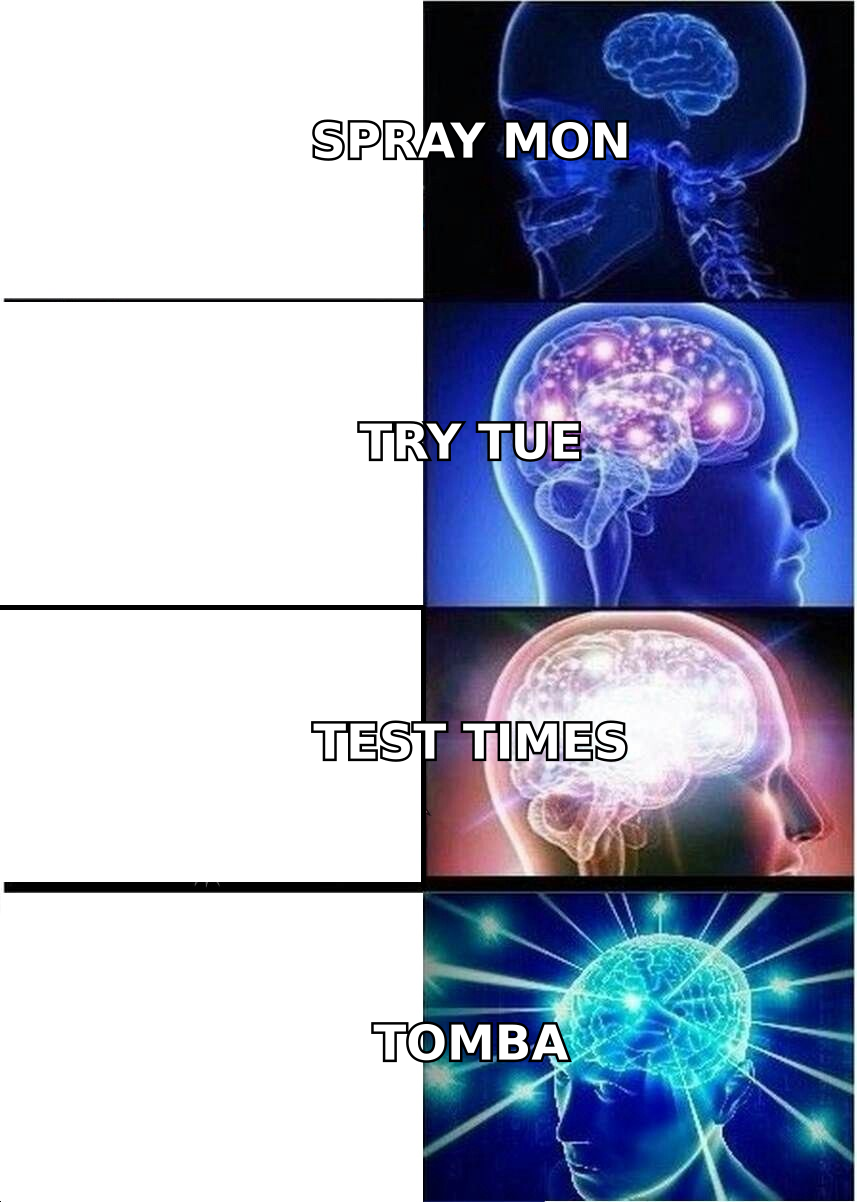
Send Tuesday morning first, then test Wednesday and Thursday. That's the short answer backed by years of aggregated data.
Across studies from HubSpot and other large-sample reports, mid-week sends — Tuesday, Wednesday, Thursday — outperform the bookend days. Tuesday is the most-cited winner because it sits in a sweet spot: recipients have cleared Monday's backlog but haven't mentally checked out for the weekend.
Here's the catch most "best day" articles ignore: these are averages across millions of emails sent to wildly different audiences. The global average tells you where to start your testing, not where to finish. A founder emailing other founders, a recruiter emailing nurses on rotating shifts, and an e-commerce brand emailing consumers will each find a different optimum.
Think of send timing like choosing when to call a friend. Calling at 2 a.m. is obviously wrong, and calling during dinner is risky — but the "perfect" moment depends entirely on that specific person's schedule, not on a survey of when people generally answer phones.
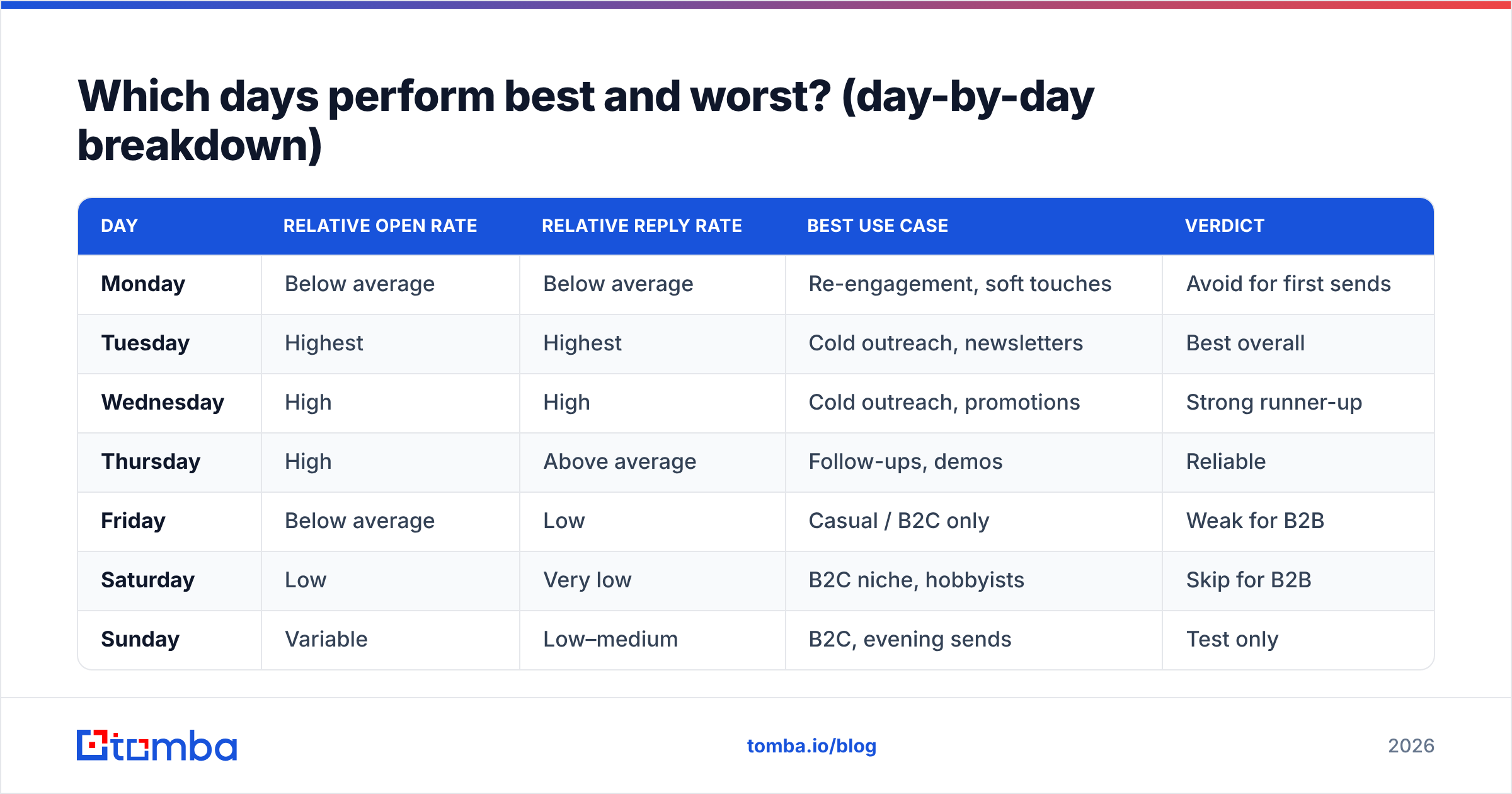
Which days perform best and worst? (day-by-day breakdown)#
Below is a synthesized view of how each weekday tends to perform for business email, based on recurring patterns in 2026 benchmark data. Treat the rankings as directional.
| Day | Relative open rate | Relative reply rate | Best use case | Verdict |
|---|---|---|---|---|
| Monday | Below average | Below average | Re-engagement, soft touches | Avoid for first sends |
| Tuesday | Highest | Highest | Cold outreach, newsletters | Best overall |
| Wednesday | High | High | Cold outreach, promotions | Strong runner-up |
| Thursday | High | Above average | Follow-ups, demos | Reliable |
| Friday | Below average | Low | Casual / B2C only | Weak for B2B |
| Saturday | Low | Very low | B2C niche, hobbyists | Skip for B2B |
| Sunday | Variable | Low–medium | B2C, evening sends | Test only |
A few patterns worth internalizing:
- Monday is a graveyard. Recipients triage a weekend backlog and delete aggressively. Your carefully written cold email competes with 40 others for a half-second of attention.
- Tuesday and Wednesday are prime time. This is where the majority of high performers concentrate their first sends.
- Thursday is the follow-up sweet spot. If you opened a thread Tuesday, a Thursday nudge often lands while the topic is still warm.
- Friday afternoon collapses. Open rates can hold, but replies crater — nobody wants to start a conversation they'll have to manage over the weekend.
- Weekends are audience-dependent. Useless for most B2B, occasionally excellent for B2C, creators, and hobby-driven niches where people check personal inboxes on their own time.
What time of day should you send?#
Aim for 9–11 a.m. in the recipient's local time zone, with a strong secondary window around 1–2 p.m. after lunch.
The morning window works because people process their inbox at the start of the workday before meetings stack up. The early-afternoon window catches the post-lunch reset. Both beat the dead zones: before 7 a.m. (buried by the time they look) and after 4 p.m. (deprioritized until tomorrow, then forgotten).
The single biggest mistake is sending in your time zone instead of theirs. If you're in New York blasting a list at 9 a.m. ET, your Pacific-time prospects get it at 6 a.m. — pushed down by the time they wake up. Segment your list by time zone and stagger sends accordingly. Most modern sending tools support this; if yours doesn't, batch manually.
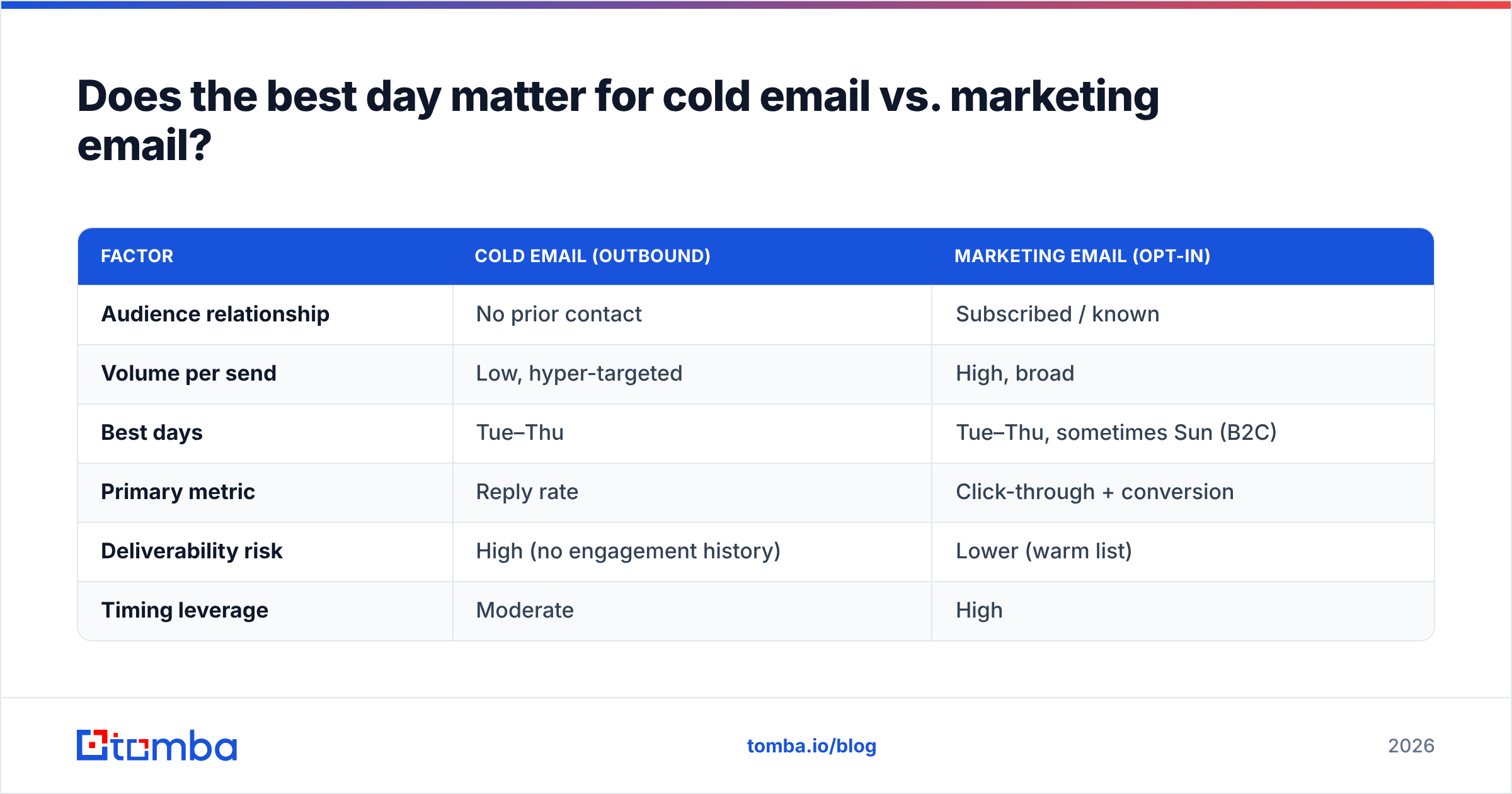
Does the best day matter for cold email vs. marketing email?#
Yes — the two have different mechanics, and conflating them is a common error.
| Factor | Cold email (outbound) | Marketing email (opt-in) |
|---|---|---|
| Audience relationship | No prior contact | Subscribed / known |
| Volume per send | Low, hyper-targeted | High, broad |
| Best days | Tue–Thu | Tue–Thu, sometimes Sun (B2C) |
| Primary metric | Reply rate | Click-through + conversion |
| Deliverability risk | High (no engagement history) | Lower (warm list) |
| Timing leverage | Moderate | High |
For cold email, timing helps at the margins, but sender reputation and list hygiene dominate. A cold email to an unverified address sent at the "perfect" time still bounces — and bounces destroy your domain reputation faster than bad timing ever could.
For marketing email to an engaged list, timing has more leverage because deliverability is already healthier. You're optimizing for clicks and conversions among people who chose to hear from you, so micro-optimizing the send hour produces measurable lift.
Either way, the foundation is the same: the right people, reachable addresses, and a domain that inboxes land in. You can read more on protecting that foundation in our guide to email deliverability.
Why does list quality matter more than the calendar?#
Because an email sent to a dead address has a 0% open rate on every day of the week.
This is the uncomfortable truth behind every "best day to send" debate: send timing is a rounding error compared to whether your list is clean. Consider the math. If 20% of your list is invalid — a realistic figure for lists older than six months — you're not just wasting those sends. You're tanking your bounce rate, which signals to mailbox providers that you're a spammer, which lands your good emails in spam too.
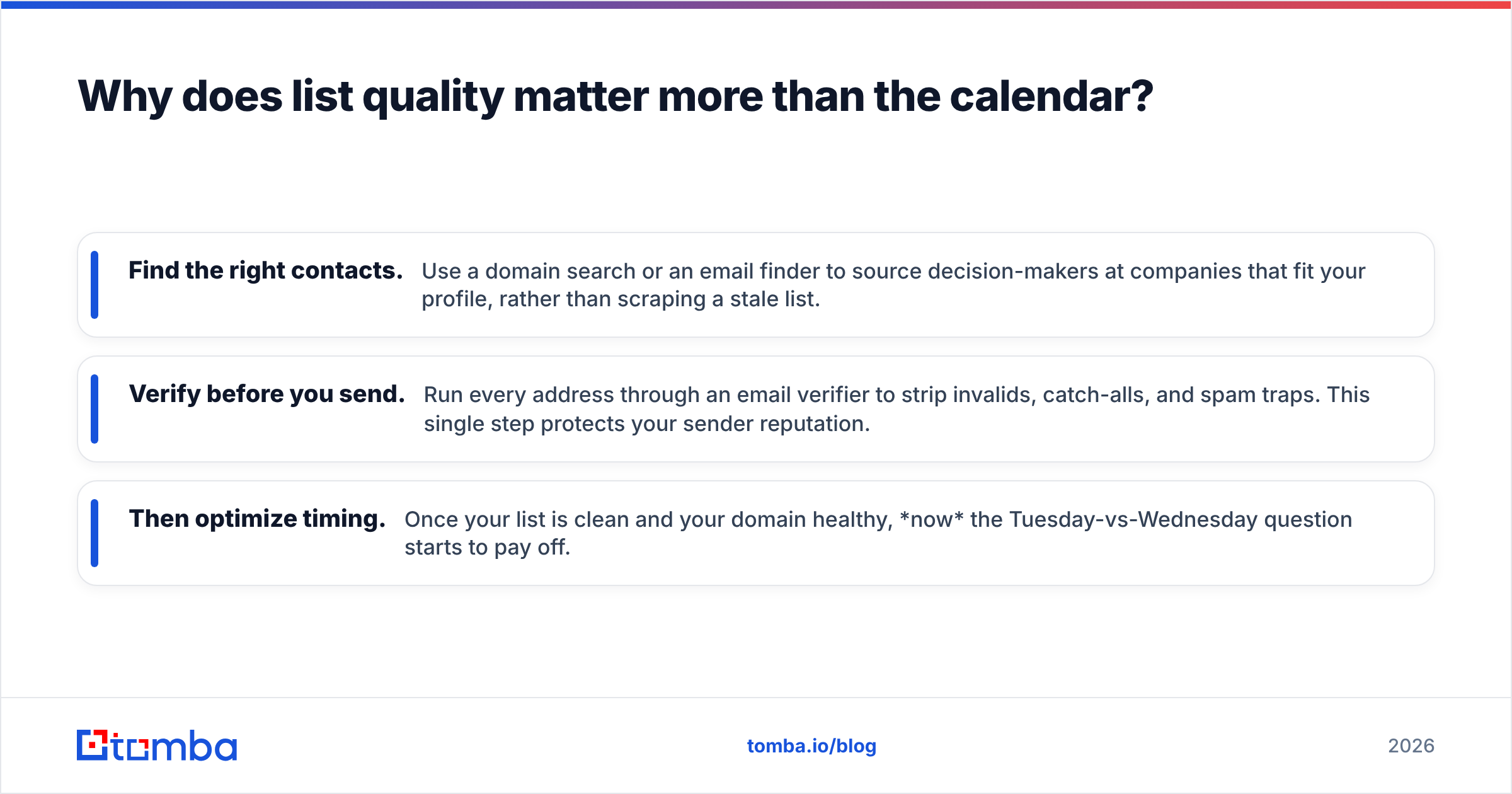
So the genuinely high-leverage sequence is:
- Find the right contacts. Use a domain search or an email finder to source decision-makers at companies that fit your profile, rather than scraping a stale list.
- Verify before you send. Run every address through an email verifier to strip invalids, catch-alls, and spam traps. This single step protects your sender reputation.
- Then optimize timing. Once your list is clean and your domain healthy, now the Tuesday-vs-Wednesday question starts to pay off.
Doing it in the reverse order — perfecting your send schedule on a dirty list — is like polishing the rims on a car with no engine.
How do you find your own best day to send emails?#
Run a structured two-week test and let replies decide. Don't trust the averages blindly; they're a hypothesis to validate against your specific audience.
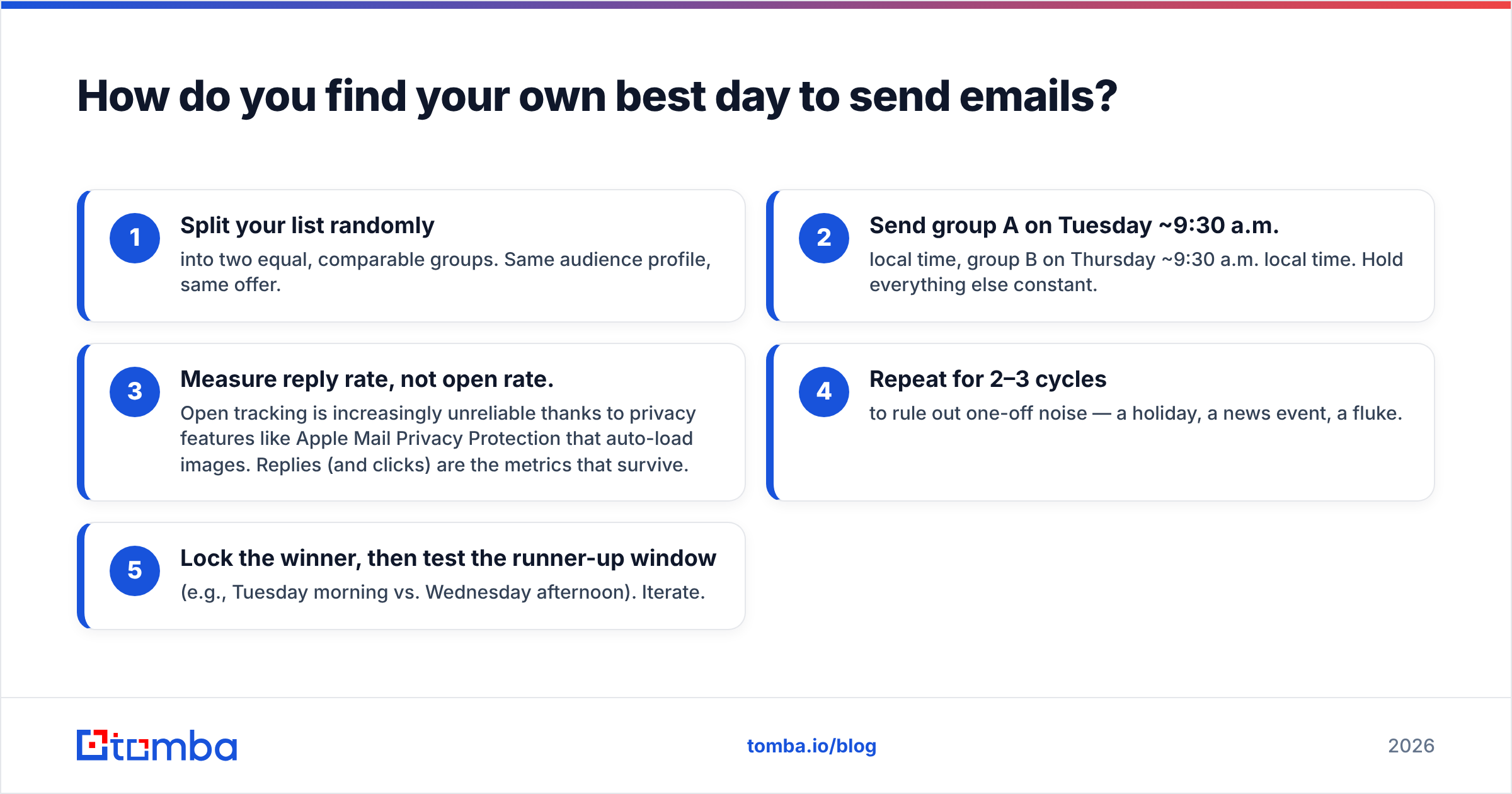
Here's a simple protocol:
- Split your list randomly into two equal, comparable groups. Same audience profile, same offer.
- Send group A on Tuesday ~9:30 a.m. local time, group B on Thursday ~9:30 a.m. local time. Hold everything else constant.
- Measure reply rate, not open rate. Open tracking is increasingly unreliable thanks to privacy features like Apple Mail Privacy Protection that auto-load images. Replies (and clicks) are the metrics that survive.
- Repeat for 2–3 cycles to rule out one-off noise — a holiday, a news event, a fluke.
- Lock the winner, then test the runner-up window (e.g., Tuesday morning vs. Wednesday afternoon). Iterate.
Keep a simple log of day, local time, segment, and reply rate. Within a month you'll have a send window tuned to your audience that beats any generic benchmark. If you want a deeper baseline, compare your numbers against our notes on a healthy email response rate.
What are common send-timing mistakes to avoid?#
- Sending in your time zone, not theirs. The most common and most costly error. Segment and stagger.
- Chasing opens instead of replies. Privacy features inflate opens. Optimize for the action that makes you money.
- Treating "Tuesday" as gospel. When everyone sends Tuesday at 10 a.m., that slot gets crowded. Sometimes the contrarian Wednesday-afternoon send wins simply because the inbox is quieter.
- Ignoring frequency. The best day is irrelevant if you email the same person five times a week and get marked as spam.
- Skipping verification. Worth repeating: a clean list outperforms perfect timing on a dirty one, every single time.
- Never re-testing. Audience behavior drifts. The optimum you found last year may have shifted. Re-run your test quarterly.
The bottom line#
Start with Tuesday morning, recipient's local time, expand testing into Wednesday and Thursday, and avoid Monday and Friday for first sends. But hold all of that loosely — your own reply data is the only benchmark that actually matters, and you can only generate trustworthy data if your emails reach real, verified inboxes.
That's where the real leverage sits. Before you obsess over the calendar, make sure the names on your list are people who exist and addresses that actually receive mail. Tomba's Email Finder helps you source accurate, decision-maker contacts by name, company, or domain — and pairs with built-in verification so your carefully-timed Tuesday send lands in the inbox instead of bouncing. Start free with 25 searches a month, then scale on a plan that fits your volume. Get the list right, and the best day to send emails finally starts working in your favor.
// get started
Find, verify and enrich your first contacts today
Start on the free plan with 25 searches a month, then scale when your team is ready.
Free plan · No credit card required · GDPR & CCPA
// about the author