Best Days To Send Email Marketing in 2026 (Data-Backed)
Tuesday and Thursday still win, but send time is only half the story. Here's what the 2026 data says about the best days to send email marketing — and how to test it for your own list.
Send timing is the cheapest lever in email marketing. You don't pay for a better subject line, a new tool, or a bigger list — you just hit "schedule" at a smarter hour. The catch is that everyone reads the same "Tuesday at 10am" advice, which means everyone crowds the same inbox window. This guide breaks down what the 2026 data actually says, where the conventional wisdom breaks, and how to find the best day for your audience instead of the internet's average.
TL;DR — Best Days To Send Email Marketing in 2026#
- Tuesday and Thursday remain the highest-performing weekdays for opens and clicks across most B2B and B2C benchmarks.
- Mid-morning (9–11am) and early afternoon (1–3pm) in the recipient's local time win on engagement.
- Monday mornings and Friday afternoons underperform — inbox overload and mental checkout.
- Weekends are quietly improving for B2C and ecommerce, with less competition and rising mobile opens.
- Timing is a multiplier, not a fix. A dirty list or weak sender reputation will sink the best-timed send.
What are the best days to send email marketing?#
The short answer: Tuesday, Wednesday, and Thursday, with Tuesday and Thursday usually edging ahead. This holds across most aggregated studies because it tracks human behavior, not magic. Monday is spent digging out of the weekend backlog. Friday minds are already at the weekend. The midweek stretch is when people are settled, caught up, and actually reading.
Think of the inbox like a grocery store. Monday is the post-weekend rush with carts everywhere; Friday is the pre-close scramble. Midweek mornings are the calm aisles where your message gets noticed instead of trampled. That's why the same email can earn a 22% open rate on Tuesday and an 18% open rate on Monday with nothing else changed.
But "best on average" is not "best for you." A newsletter for night-shift nurses, a Shopify flash sale, and a SaaS demo invite all peak at different moments. Treat the benchmark as a starting hypothesis, then test against your own data.
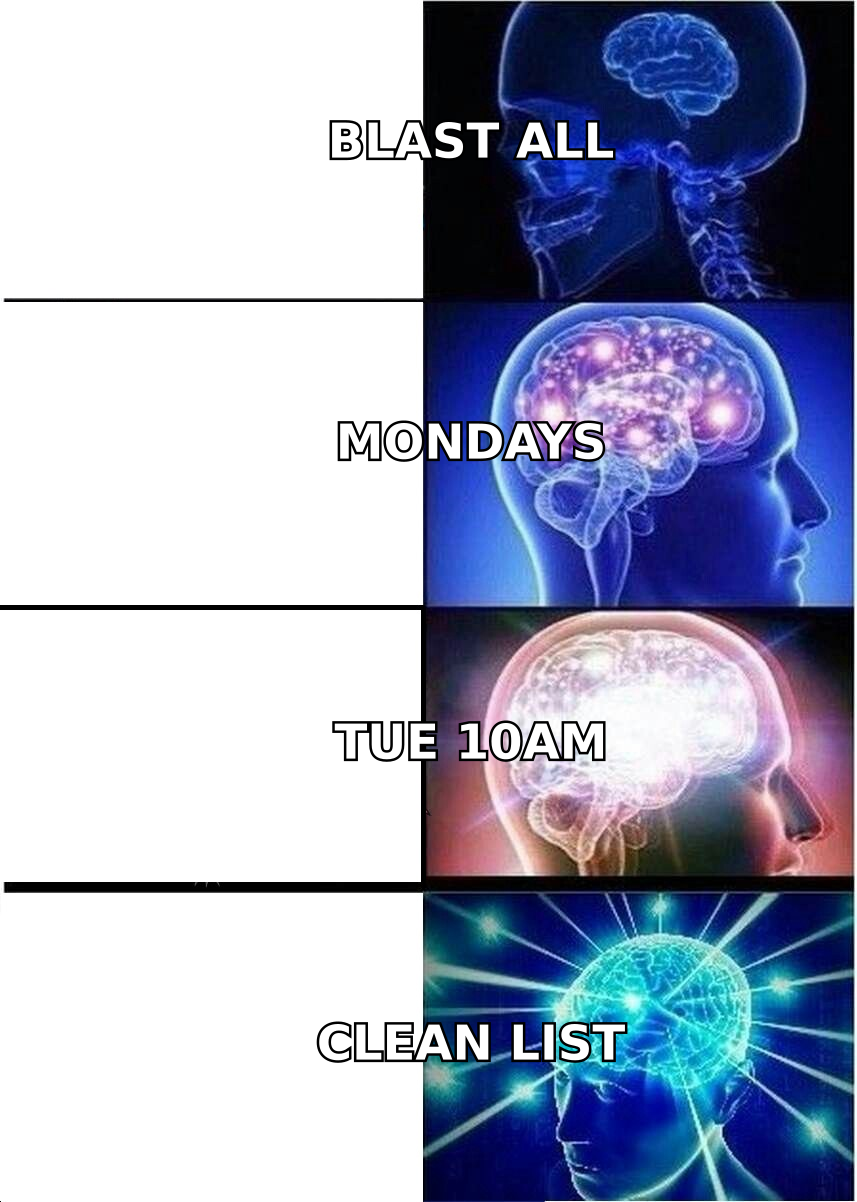
Which day actually performs best — a weekday breakdown#
Here's how the typical marketing week shakes out when you pool open-rate and click-rate data from major 2025–2026 benchmark reports. Numbers are directional ranges, not promises — your list will land somewhere on this curve, not exactly on it.
| Day | Avg. open rate | Avg. click rate | Competition | Verdict |
|---|---|---|---|---|
| Monday | 18–20% | 2.1% | High | Risky — backlog clearing |
| Tuesday | 21–24% | 2.6% | Very high | Strong, but crowded |
| Wednesday | 20–23% | 2.5% | High | Reliable midweek pick |
| Thursday | 21–24% | 2.7% | High | Often the click winner |
| Friday | 18–21% | 2.3% | Medium | Fades after noon |
| Saturday | 17–20% | 2.2% | Low | Sleeper for B2C |
| Sunday | 18–21% | 2.4% | Low | Rising for ecommerce |
Two patterns matter more than the exact percentages. First, Tuesday and Thursday trade the top spot depending on whether you optimize for opens or clicks — Thursday often produces slightly stronger clicks because buyers are in "let me handle this before the weekend" mode. Second, weekends have low competition, so a smaller but more attentive audience can outperform a crowded Tuesday for the right offer.
HubSpot's research and Mailchimp's send-time benchmarks both reinforce the midweek pattern, while noting that the gaps between days have narrowed as more senders adopt send-time optimization. When everyone sends on Tuesday, Tuesday gets noisier.
What is the best time of day to send?#
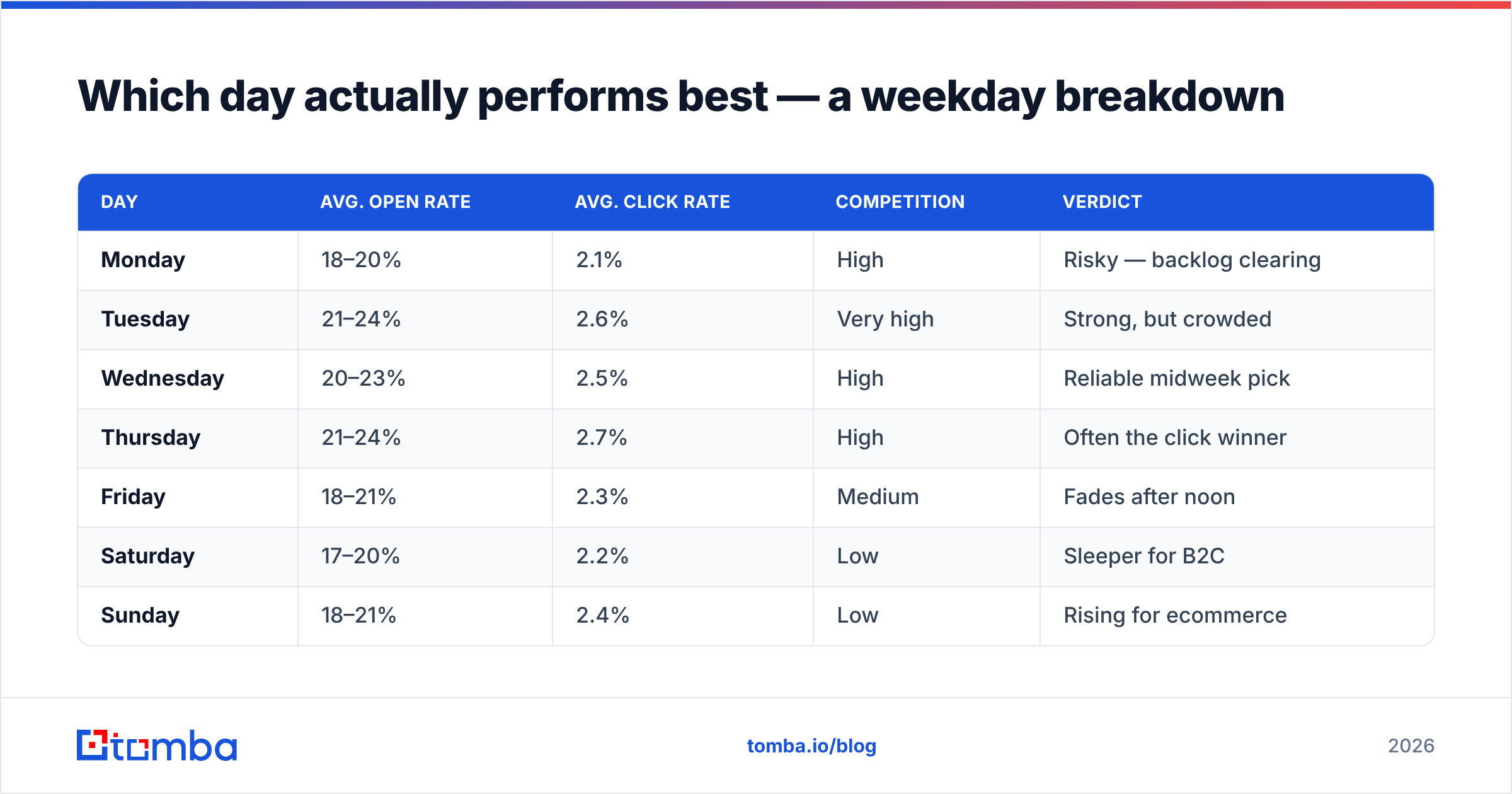
Days set the stage; hours close the deal. The best windows cluster around natural inbox-checking moments:
- 6–8am — early scrollers checking email before the day starts. Strong for mobile-first audiences and commuters.
- 9–11am — the biggest sweet spot. People are at their desks, triaging the inbox, and engaged. Most B2B sends should aim here.
- 1–3pm — the post-lunch second wind. A reliable backup window when mornings are crowded.
- 5–7pm — commute and wind-down scrolling, especially strong for B2C and ecommerce.
- 8–10pm — late-evening mobile opens, rising every year as phones replace desktops for personal email.
The non-negotiable detail: send in the recipient's local time zone, not yours. A 10am blast from New York hits California inboxes at 7am and London at 3pm. If your platform supports time-zone-aware sending or send-time optimization, turn it on. If it doesn't, segment your list by region and schedule each batch separately.
Is Tuesday really the best, or is that outdated?#
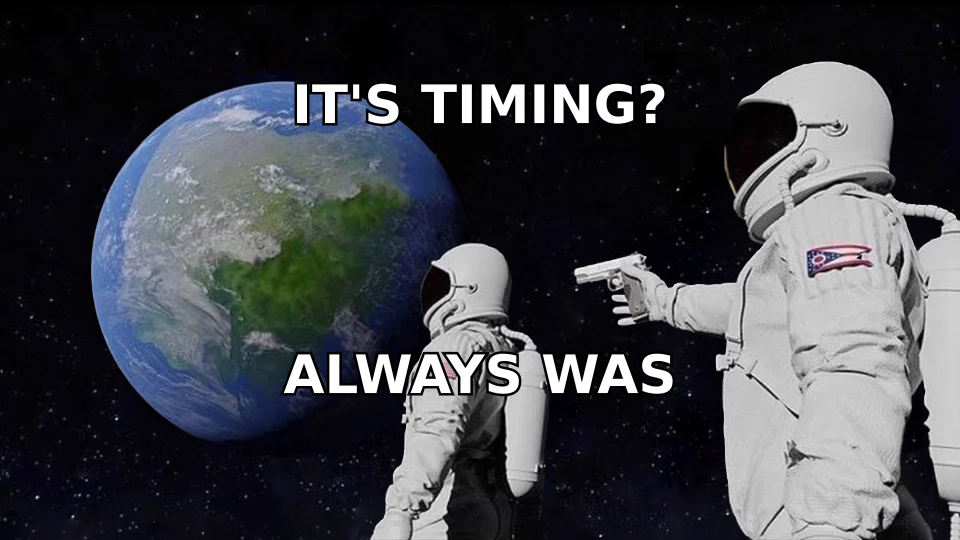
It's still true on average — but it's becoming a self-defeating prophecy. Because "Tuesday at 10am" has been repeated for a decade, that slot is now the most contested real estate in the inbox. You're competing with every other marketer who read the same blog post.
That creates a real opportunity in the gaps. Consider counter-programming:
- Send Tuesday at 8:15am instead of 10am to land before the crowd.
- Test Thursday afternoon when buyers clear their plates before Friday.
- Try Sunday evening for B2C — quiet inbox, relaxed reader, planning-ahead mindset.
The teams winning in 2026 aren't chasing the universal "best day." They're finding the best uncontested day for their specific list. That's an empirical question, and the only honest answer comes from your own A/B tests — not from a benchmark chart.
How do I find the best send day for my own list?#
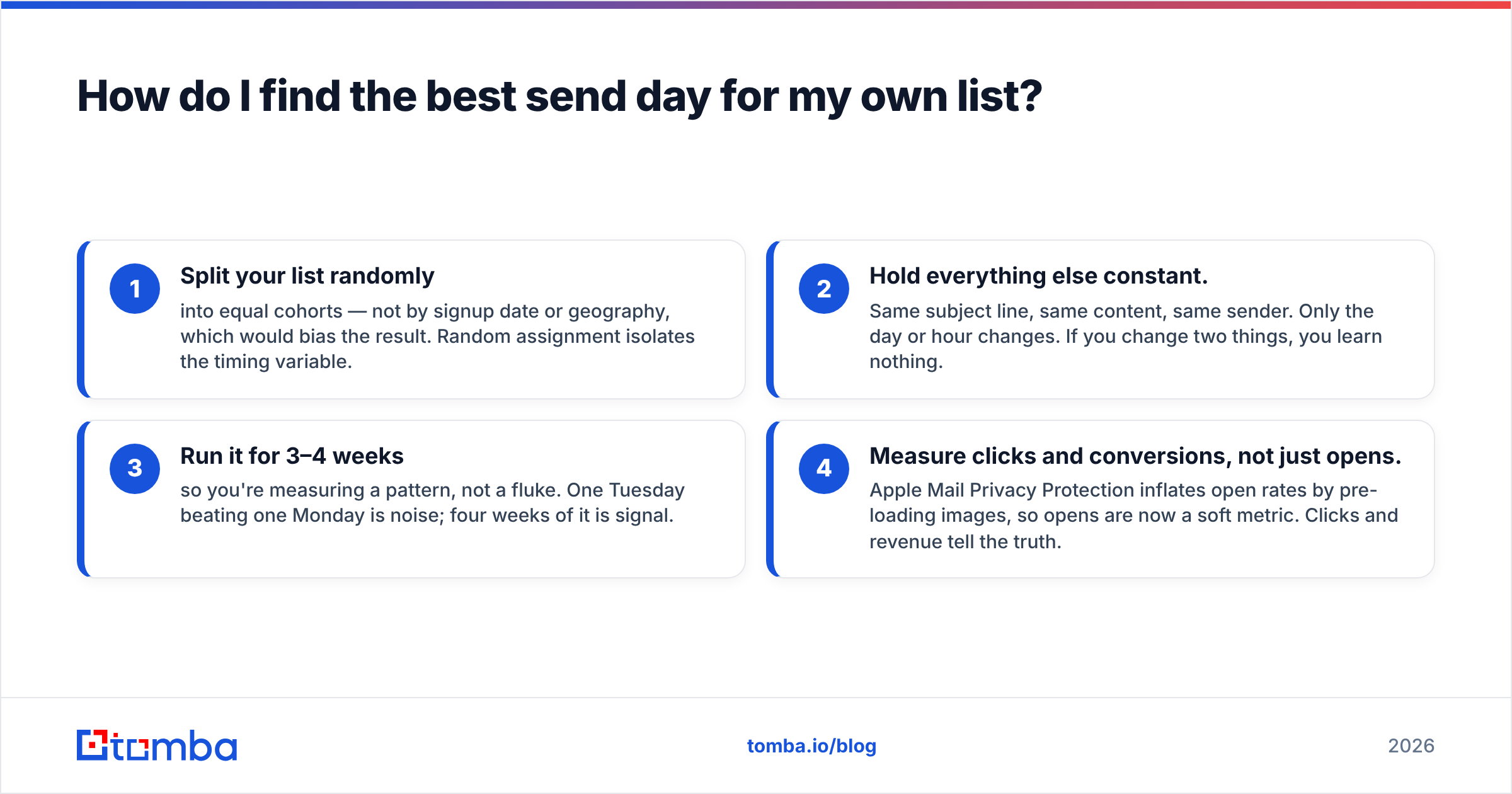
Stop borrowing someone else's average and run a structured test. Here's a four-step loop that works for lists of any size:
- Split your list randomly into equal cohorts — not by signup date or geography, which would bias the result. Random assignment isolates the timing variable.
- Hold everything else constant. Same subject line, same content, same sender. Only the day or hour changes. If you change two things, you learn nothing.
- Run it for 3–4 weeks so you're measuring a pattern, not a fluke. One Tuesday beating one Monday is noise; four weeks of it is signal.
- Measure clicks and conversions, not just opens. Apple Mail Privacy Protection inflates open rates by pre-loading images, so opens are now a soft metric. Clicks and revenue tell the truth.
Most email platforms — Mailchimp, HubSpot, Klaviyo, and others rated on G2 — include built-in send-time optimization that learns each subscriber's active hours. If yours does, use it as a baseline and still run periodic manual tests, because algorithms drift and your audience changes.
Why does timing only work if your list is clean?#
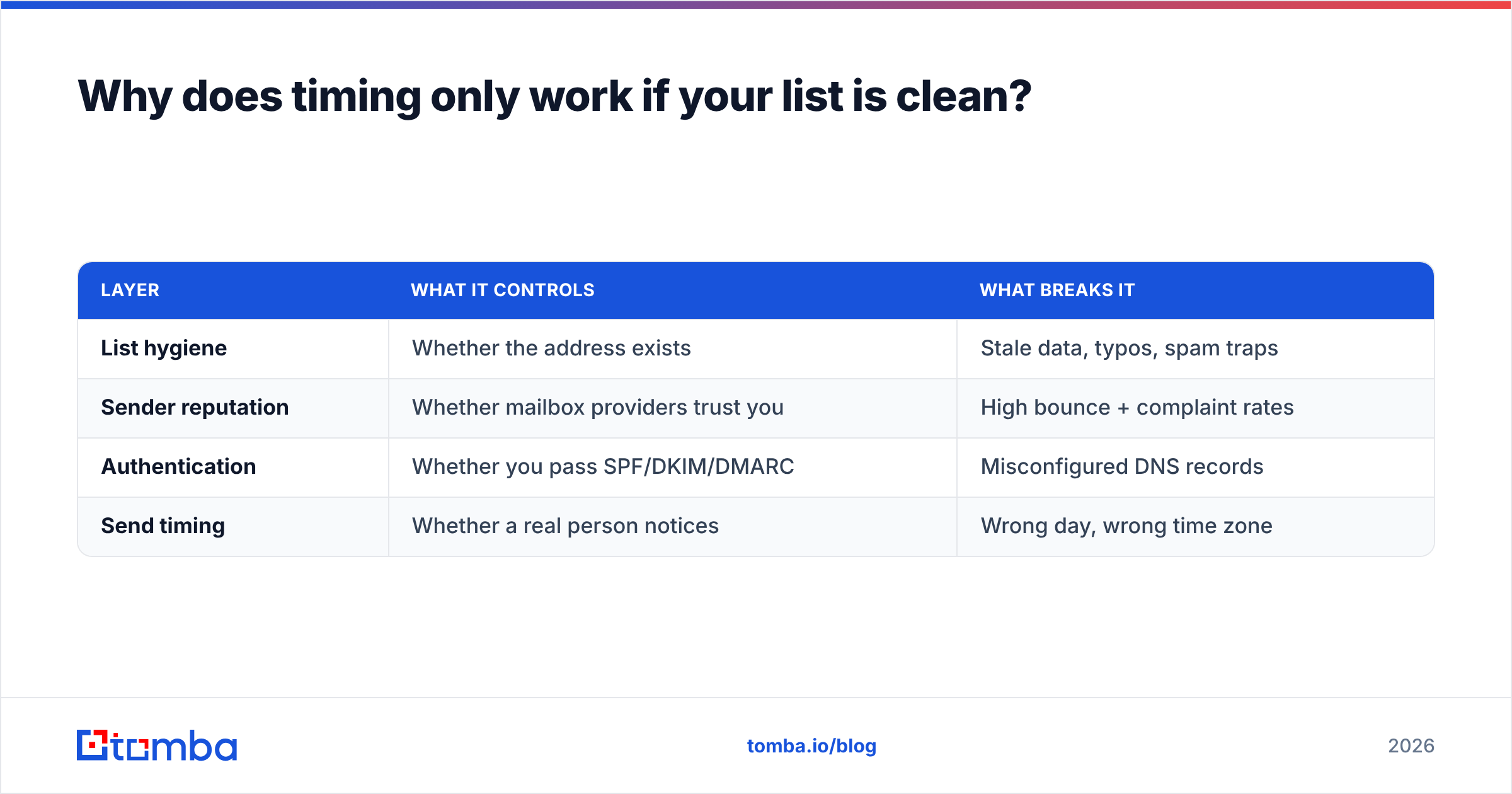
Because the best send day in the world can't save an email that never reaches the inbox. Timing optimizes for attention; deliverability decides whether you get the chance to compete for it at all. Send a perfectly timed campaign to a list full of dead addresses and spam traps, and your email deliverability collapses — bounces spike, mailbox providers throttle you, and even your good contacts stop seeing you.
Here's the dependency chain most marketers skip:
| Layer | What it controls | What breaks it |
|---|---|---|
| List hygiene | Whether the address exists | Stale data, typos, spam traps |
| Sender reputation | Whether mailbox providers trust you | High bounce + complaint rates |
| Authentication | Whether you pass SPF/DKIM/DMARC | Misconfigured DNS records |
| Send timing | Whether a real person notices | Wrong day, wrong time zone |
Timing sits at the top of the funnel, but it only pays off when the three layers beneath it are solid. Before you obsess over Tuesday-versus-Thursday, verify your list. A quick pass with an email verifier removes the invalid and risky addresses that quietly tank your bounce rate. If you're buying or scraping new contacts, run them through a catch-all verifier before they ever touch a campaign — catch-all domains accept everything at the SMTP level and will lie to you about validity.
Once the list is clean, build new segments from accurate data instead of recycling old contacts. A domain search pulls current, verified email patterns for a target company, so your new prospects start life as deliverable addresses rather than guesses. Clean inputs make every downstream timing test meaningful, because you're measuring human behavior — not the noise of bounced and ignored sends.
How do B2B and B2C timing differ?#
They run on different clocks, and treating them the same is a common mistake.
B2B lives inside the workday. Decision-makers read email at their desks, so midweek mornings (Tuesday–Thursday, 9–11am) dominate. Avoid weekends entirely for B2B — your email gets buried under Monday's avalanche before it's seen. B2B also rewards relevance over volume: a well-timed email to a verified, role-targeted contact beats a mass blast every time. This is where pairing timing with accurate contact data and data enrichment compounds your results.
B2C is more elastic. Consumers check personal email on their own schedule — evenings, lunch breaks, and increasingly weekends. Ecommerce and retail see genuine lift on Saturday and Sunday because the competition is asleep and the reader is in a browsing, not working, mindset. Evening sends (6–9pm) capture the couch-and-phone window that B2B can't touch.
The unifying rule across both: match the send to the moment your reader is actually free to act. A B2B demo invite at 9pm is wasted; a B2C flash sale at 9pm is perfectly placed.
What mistakes quietly kill well-timed campaigns?#
Even teams that nail the day undermine it with avoidable errors:
- Ignoring time zones. A single global send time means most of your list gets the email at a bad hour. Segment or use time-zone-aware scheduling.
- Over-sending. Hitting the same people daily trains them to ignore you, no matter the day. Frequency fatigue erases timing gains.
- Chasing opens over clicks. Apple MPP made open rates unreliable. Optimize for the metric tied to revenue.
- Skipping list hygiene. Sending to unverified addresses raises bounces and damages sender reputation, which throttles delivery for everyone on the list.
- Testing too many variables at once. Change one thing per test, or you'll never know what moved the needle.
- Setting it and forgetting it. Audience behavior shifts. Re-test your best day once a quarter.
Avoid these and your timing optimization actually sticks. Commit them and even a flawless Tuesday-10am send underperforms.
Putting it together: a simple send-timing playbook#
Start with the benchmark, then earn your own answer:
- Default to Tuesday or Thursday, 9–11am local time as your opening hypothesis.
- Clean your list first — verify addresses and remove risky catch-alls so your data is trustworthy.
- A/B test two days and two times over a month, measuring clicks and conversions.
- Adopt send-time optimization if your platform offers it, and re-test quarterly.
- Counter-program the crowd — if your audience also peaks on Tuesday, find the quieter slot that still works.
Timing rewards the marketers who treat it as a hypothesis to test, not a rule to obey.
Start with data you can trust#
The best day to send means nothing if half your list bounces. Before you fine-tune send times, make sure every address is real and reachable. Tomba's Email Finder helps you build clean, verified prospect lists from company domains and names — so your perfectly timed campaigns land in inboxes that actually exist. Pair it with Tomba's verifier to scrub your current list, and you'll finally be testing send timing on signal instead of noise. Check the Tomba pricing plans — there's a free tier to start, with the Starter plan at $49/mo when you scale. Get the data right, and timing becomes the easy win it was always supposed to be.
// get started
Find, verify and enrich your first contacts today
Start on the free plan with 25 searches a month, then scale when your team is ready.
Free plan · No credit card required · GDPR & CCPA
// about the author