Best Dialer for Cold Calling Real Estate in 2026 Ranked
Power, predictive, or single-line? Compare the best dialers for cold calling real estate in 2026 on price, compliance, and connect rate — plus the data that makes any dialer worth it.
Cold calling is still the fastest way real estate agents and investors turn a list into appointments — but only if the phone actually connects to a live human. The dialer you choose decides how many conversations you get per hour, whether you stay on the right side of the law, and how much of your day you burn listening to voicemail. This guide ranks the best dialer for cold calling real estate in 2026 and shows you why the dialer is only half the equation.
TL;DR#
- The best dialer for cold calling real estate depends on volume. Solo agents do well with single-line tools like Mojo or Kixie; teams dialing thousands of FSBO and expired leads need multi-line power dialers like PhoneBurner or BatchDialer.
- Predictive (multi-line) dialers triple your talk time but carry the highest TCPA and STIR/SHAKEN compliance risk. Use them carefully.
- Connect rate is mostly a data problem, not a dialer problem. A perfect dialer calling dead numbers still gets you nowhere.
- Budget $80–$150/user/month for a serious real estate dialing stack once you add a CRM and skip-tracing.
- Validate every number before you dial. A phone validator removes disconnected lines and protects your caller reputation.
What is a cold calling dialer for real estate?#
A real estate cold calling dialer is software that automates the act of dialing so you spend your time talking, not punching numbers. Think of it like a fishing trawler versus a single rod: a manual call is one line in the water, while a multi-line dialer drops several hooks at once and only reels you in when something bites.
Most dialers bundle four things: automated dialing (single or multi-line), a built-in CRM or list manager, local-presence caller ID, and voicemail drop so you leave a pre-recorded message in one click and move on. The better platforms add call recording, scripting, and analytics on connect rate and conversion.
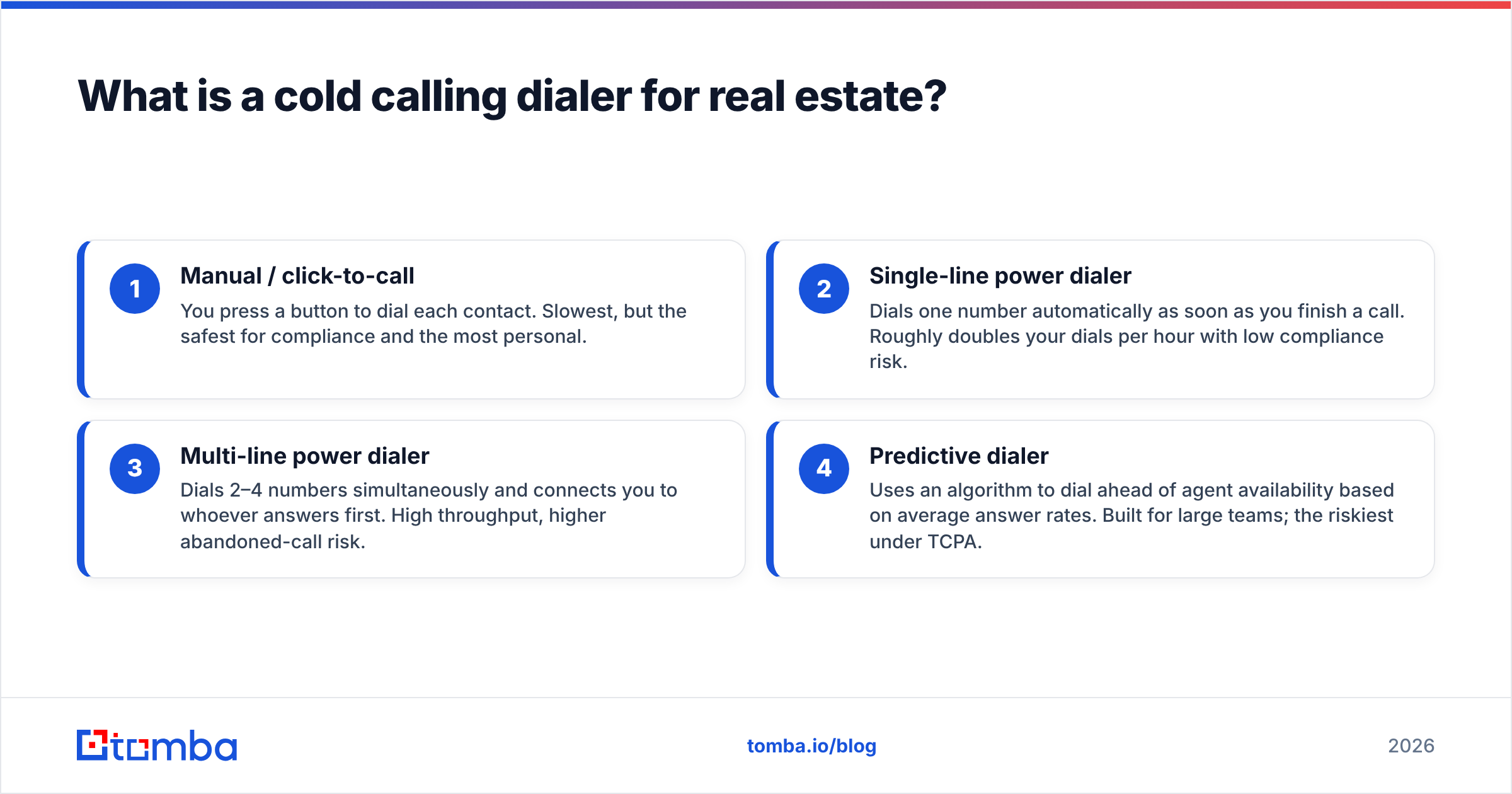
There are three core dialing modes, and choosing the wrong one is the most common mistake new callers make:
- Manual / click-to-call — You press a button to dial each contact. Slowest, but the safest for compliance and the most personal.
- Single-line power dialer — Dials one number automatically as soon as you finish a call. Roughly doubles your dials per hour with low compliance risk.
- Multi-line power dialer — Dials 2–4 numbers simultaneously and connects you to whoever answers first. High throughput, higher abandoned-call risk.
- Predictive dialer — Uses an algorithm to dial ahead of agent availability based on average answer rates. Built for large teams; the riskiest under TCPA.
)
Which is the best dialer for cold calling real estate in 2026?#
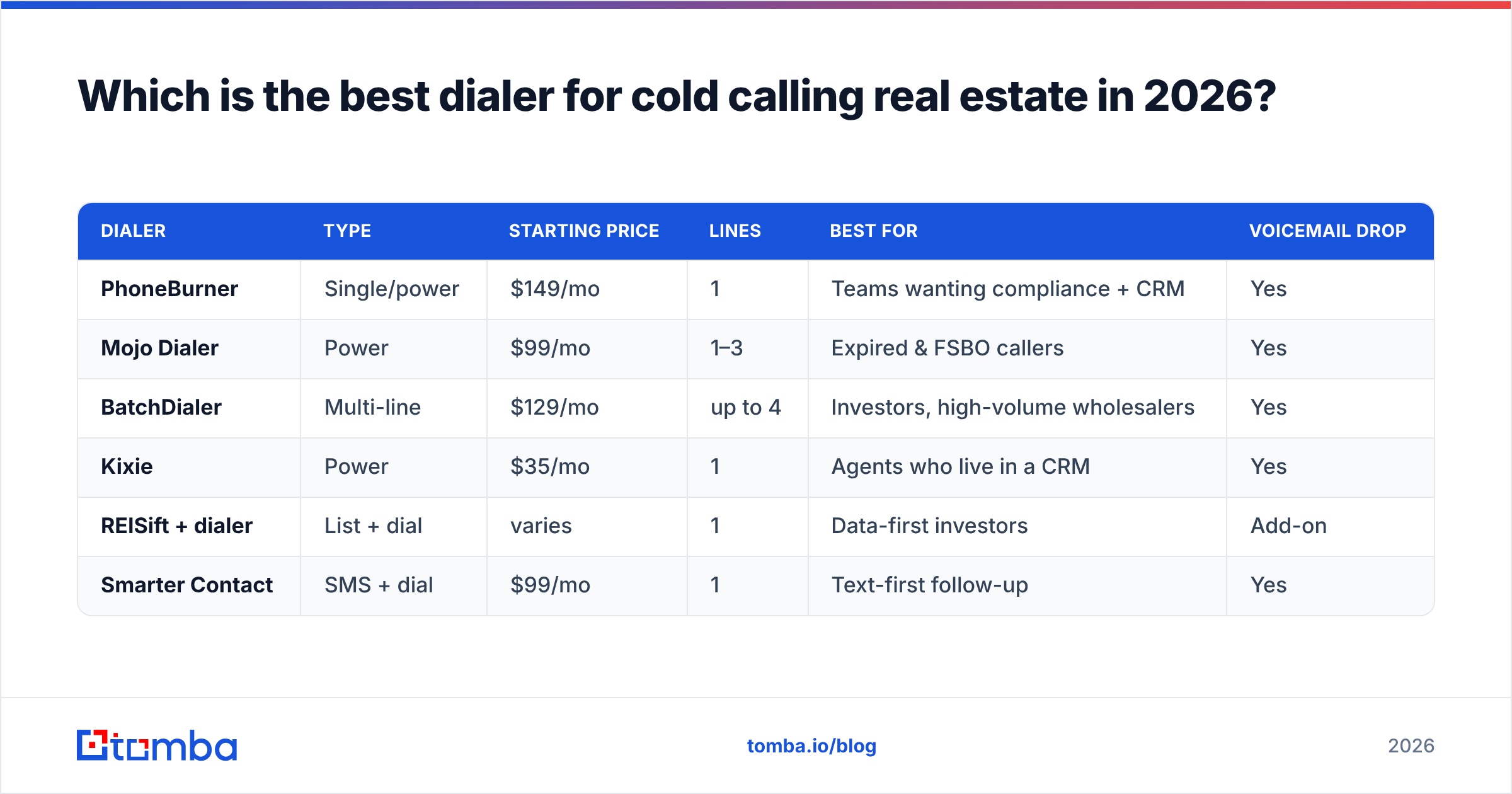
Here is a side-by-side comparison of the dialers real estate professionals actually use, based on public pricing and feature sets. Prices are per user, per month, and change often — confirm on each vendor's site before buying.
| Dialer | Type | Starting price | Lines | Best for | Voicemail drop |
|---|---|---|---|---|---|
| PhoneBurner | Single/power | $149/mo | 1 | Teams wanting compliance + CRM | Yes |
| Mojo Dialer | Power | $99/mo | 1–3 | Expired & FSBO callers | Yes |
| BatchDialer | Multi-line | $129/mo | up to 4 | Investors, high-volume wholesalers | Yes |
| Kixie | Power | $35/mo | 1 | Agents who live in a CRM | Yes |
| REISift + dialer | List + dial | varies | 1 | Data-first investors | Add-on |
| Smarter Contact | SMS + dial | $99/mo | 1 | Text-first follow-up | Yes |
A few honest takeaways from the table:
- PhoneBurner is the safest "serious team" pick because it is single-line by design — no predictive abandon-call exposure — and includes strong CRM and cadence tools. You pay for that peace of mind.
- Mojo remains the default for listing agents chasing expired and for-sale-by-owner leads because its data add-ons and triple-line mode are built around that workflow.
- BatchDialer wins on raw throughput for investors and wholesalers running large county lists, but multi-line dialing demands disciplined compliance.
- Kixie is the value pick if you already run HubSpot, Pipedrive, or Salesforce and want click-to-call that logs automatically.
No single product is the universally "best dialer for cold calling real estate." Match the dialing mode to your call volume and your tolerance for compliance overhead.
Is a predictive dialer better than a power dialer for real estate?#
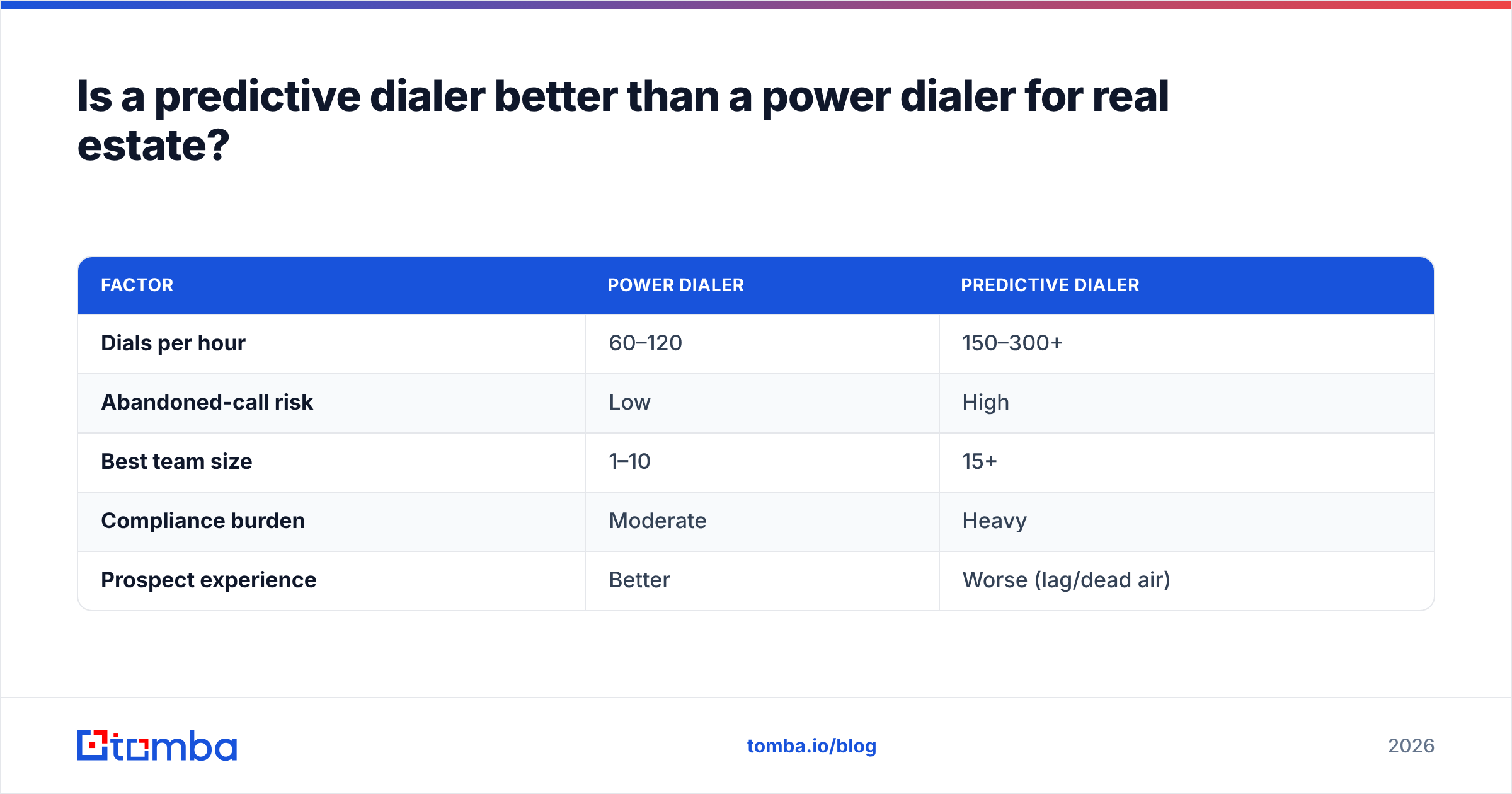
Not for most agents — a power dialer is the better default, and here's why. Predictive dialers maximize agent talk time by dialing more numbers than there are available agents, betting that some calls go unanswered. When the bet is wrong, a prospect answers and hears dead air, which creates an "abandoned call." Under the U.S. Telephone Consumer Protection Act (TCPA), abandoned calls are tightly regulated and the fines are real.
For a solo agent or a small team, the throughput gain from predictive dialing rarely justifies the legal exposure and the worse first impression. A single-line or low-ratio multi-line power dialer gives you most of the speed without dialing past your own capacity.
| Factor | Power dialer | Predictive dialer |
|---|---|---|
| Dials per hour | 60–120 | 150–300+ |
| Abandoned-call risk | Low | High |
| Best team size | 1–10 | 15+ |
| Compliance burden | Moderate | Heavy |
| Prospect experience | Better | Worse (lag/dead air) |
If you do run multi-line or predictive, keep your abandonment rate under the regulatory threshold, honor the National Do Not Call Registry, scrub against your internal DNC list, and make sure your carrier is STIR/SHAKEN attested so your calls don't get flagged as "Spam Likely." The U.S. Federal Trade Commission publishes the current Telemarketing Sales Rule requirements — read them before you scale.
Why your connect rate depends on data, not the dialer#
Here's the uncomfortable truth: the best dialer in the world calling a list of disconnected numbers will still get you a 4% connect rate. The dialer controls speed; your data controls whether anyone picks up.
Real estate lists decay fast. People port numbers, change carriers, and disconnect lines constantly. A list you skip-traced six months ago is already stale. Two things move your connect rate more than any dialer feature:
- Number accuracy — Is this the right mobile number for this owner, today?
- Number health — Is the line active, and is it a mobile or a landline?
Before a number ever touches your dialer, run it through validation. A phone validator confirms a line is active and identifies line type, so you stop wasting power-dialer cycles on dead numbers and protect your caller ID reputation from being marked as spam. Pair that with a phone finder when you have a name and company but no direct line, and you feed your dialer clean, dialable contacts instead of guesses.
)
For investors working off property records, the workflow looks like this: pull owner records, enrich with current contact info, validate the phone numbers, then load only the live mobile lines into your multi-line dialer. You'll see your contact rate climb without changing dialers at all. The same logic applies if you're enriching leads in bulk — data enrichment and bulk lead generation tools fill the gaps that skip-tracing alone leaves behind.
What features actually matter when choosing a dialer?#
Ignore the feature checklists that vendors love and focus on the handful of things that change your outcomes:
- Local presence / caller ID management — Calls from a local area code get answered noticeably more often. But rotate numbers responsibly; aggressive spoofing gets your lines flagged.
- Voicemail drop — Leaving a pre-recorded voicemail in one click can reclaim hours per week. On a list where 70% go to voicemail, this is the single biggest time-saver.
- CRM integration — If your dialer doesn't log calls and outcomes into your CRM automatically, you'll lose follow-ups. Native integrations beat Zapier glue for call data.
- Compliance tooling — Built-in DNC scrubbing, call recording with consent prompts, and STIR/SHAKEN attestation are non-negotiable at scale.
- Analytics — You need connect rate, contact-to-appointment ratio, and best-time-to-call reporting to improve, not just a dial counter.
- List management — Easy import, dedup, and the ability to pause/resume campaigns keeps a high-volume operation sane.
A dialer that nails caller ID, voicemail drop, CRM sync, and compliance will outperform a feature-bloated tool that does ten things poorly. When you evaluate, weight those five and treat everything else as a bonus.
How much should a real estate dialing stack cost?#
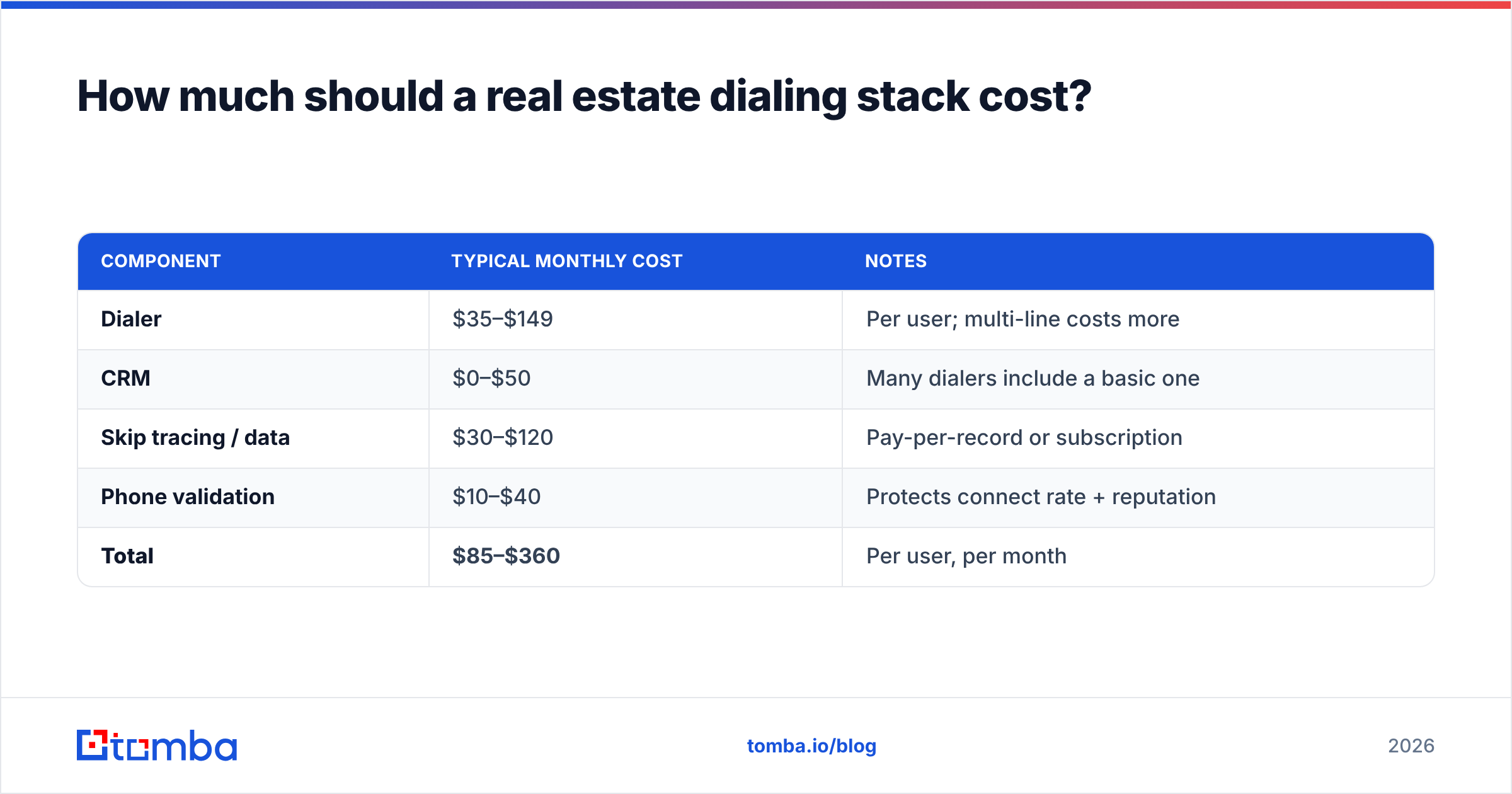
Plan for the whole stack, not just the dialer line item. A realistic monthly budget for one serious caller looks like this:
| Component | Typical monthly cost | Notes |
|---|---|---|
| Dialer | $35–$149 | Per user; multi-line costs more |
| CRM | $0–$50 | Many dialers include a basic one |
| Skip tracing / data | $30–$120 | Pay-per-record or subscription |
| Phone validation | $10–$40 | Protects connect rate + reputation |
| Total | $85–$360 | Per user, per month |
The cheapest mistake you can make is over-spending on a fancy predictive dialer while under-investing in data quality. Flip that ratio. A mid-tier power dialer plus clean, validated numbers beats a premium dialer fed garbage every single time. If you want a sense of how affordable accurate contact data can be, compare Tomba pricing — the Free tier gives you 25 searches a month to test number quality before committing.
How do you keep your cold calls compliant in 2026?#
Compliance is not optional, and the rules tightened again heading into 2026. A short, practical checklist:
- Scrub against the National DNC Registry and maintain your own internal do-not-call list. Honor opt-outs immediately and permanently.
- Respect calling hours — generally 8 a.m. to 9 p.m. in the prospect's local time zone.
- Use STIR/SHAKEN-attested carriers so your calls display correctly and don't get auto-blocked as spam.
- Keep abandonment rates low if you run predictive or multi-line dialing.
- Get consent for call recording where required by state law (two-party consent states especially).
- Validate line type — dialing mobile numbers with an autodialer carries specific TCPA rules; knowing which numbers are mobile matters.
Good data feeds good compliance. When you validate and enrich before dialing, you naturally avoid disconnected numbers and reassigned lines that trigger complaints. Tools like a phone validator and reverse email lookup help you confirm you're reaching the right owner, not a stranger who inherited a recycled number.
Final verdict: pick the dialer, but win on data#
The best dialer for cold calling real estate in 2026 is the one that matches your volume: Kixie or PhoneBurner for agents, Mojo for listing specialists, BatchDialer for high-volume investors. Single-line power dialing is the sweet spot for most people — fast enough to triple your conversations, safe enough to keep you out of TCPA trouble.
But whichever dialer you choose, remember the lever that actually moves your numbers: the quality of the list you load into it. A clean, validated, current set of mobile numbers will out-earn any premium dialer feature.
Start by getting accurate contact data and direct phone numbers for the owners you're trying to reach. Use the Tomba Email Finder and phone finder to build verified contact lists, then run every number through validation before it hits your dialer. Better data in means more live conversations out — and that's the only metric that pays. Try it on the free tier and feed your dialer the kind of list that actually connects.
// get started
Find, verify and enrich your first contacts today
Start on the free plan with 25 searches a month, then scale when your team is ready.
Free plan · No credit card required · GDPR & CCPA
// about the author