Best Email Subject Lines for Sales: 70+ That Convert (2026)
The best email subject lines for sales are short, specific, and earn the open without tricking it. Here are 70+ tested formulas, data, and a copy-paste framework for 2026.
Your subject line is doing 80% of the work before a single word of your pitch gets read. Get it wrong and the best cold email you ever wrote dies unopened in a crowded inbox. Get it right and you buy yourself the three seconds you need to start a conversation.
This is a practical guide to the best email subject lines for sales in 2026 — what actually works, why it works, and 70+ formulas you can adapt today. No clickbait tricks that torch your reputation. Just lines that earn the open and protect the reply.
TL;DR#
- Short wins. Subject lines of 1–5 words consistently outperform long ones, especially on mobile where 50%+ of B2B email is now opened.
- Specific beats clever. A line that names the prospect's company, role, or trigger event outperforms a generic "quick question" by a wide margin.
- Curiosity earns the open; relevance earns the reply. Trick subject lines inflate open rates and tank conversions.
- Personalization needs accurate data. A subject line referencing the wrong person or company is worse than no personalization — start with a clean list from a real email finder.
- Always test. A/B test two subject lines on every send; the winner is rarely the one you expected.
What makes the best email subject lines for sales work?#
The best sales subject lines share three traits: they're relevant, specific, and honest. Relevance means the message clearly applies to the recipient. Specificity means it references something concrete — a name, a number, a recent event. Honesty means the body delivers on the promise the subject made.
Think of a subject line like the headline on a billboard you pass at 70 mph. You have a fraction of a second and a handful of words. You're not trying to close the deal on the billboard — you're trying to make the driver slow down. The job of the subject line is exactly one thing: get the email opened by the right person, for the right reason.
Here's the trap most reps fall into. They optimize for the open and forget the reply. A subject line like "RE: our call" might get opened — and then get you marked as spam when the prospect realizes you never called. Open rate is a vanity metric if it doesn't convert into a response rate that fills your pipeline.
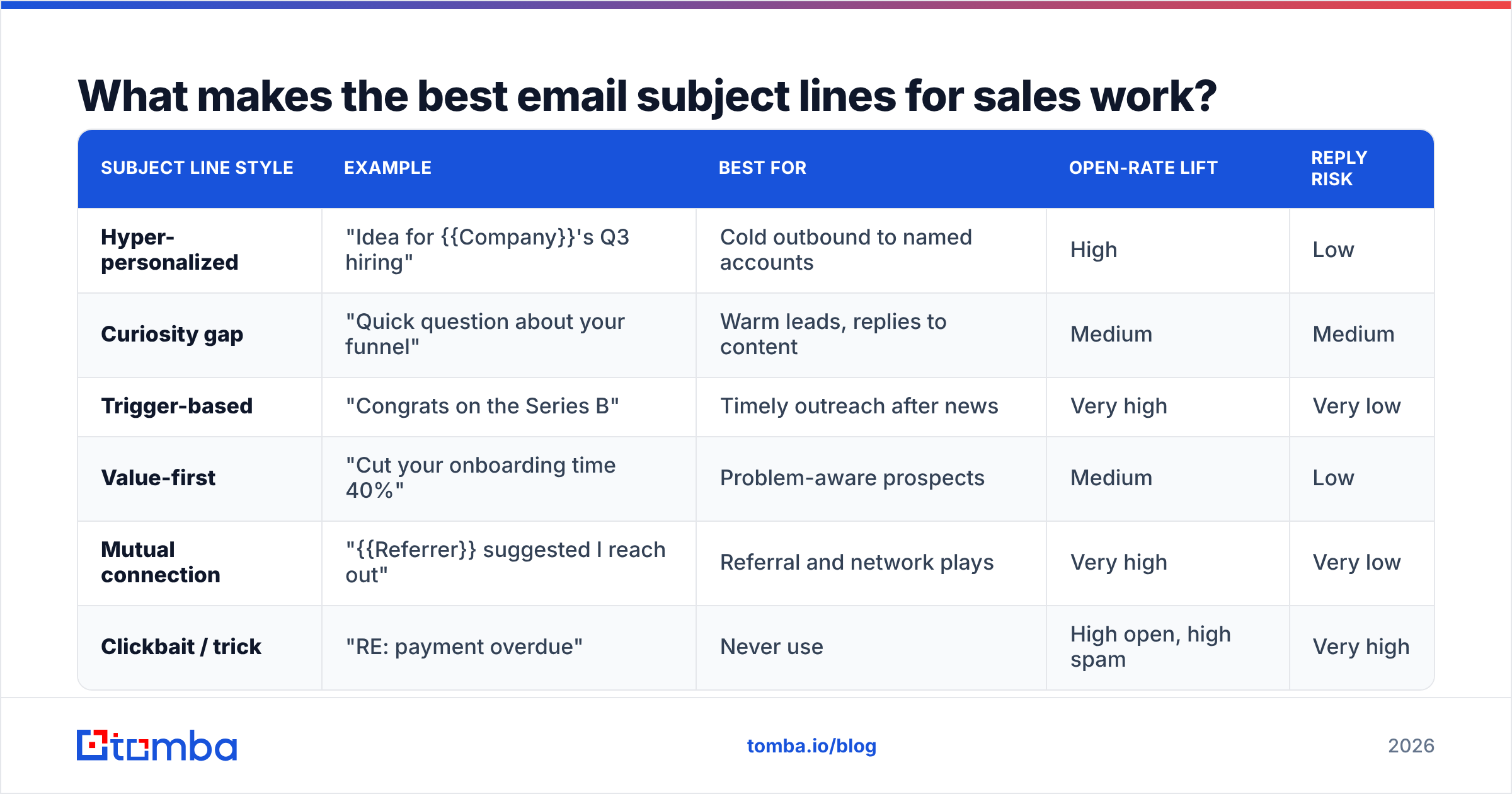
The strongest subject lines fall into a small number of repeatable patterns. Here's how they compare.
| Subject line style | Example | Best for | Open-rate lift | Reply risk |
|---|---|---|---|---|
| Hyper-personalized | "Idea for {{Company}}'s Q3 hiring" | Cold outbound to named accounts | High | Low |
| Curiosity gap | "Quick question about your funnel" | Warm leads, replies to content | Medium | Medium |
| Trigger-based | "Congrats on the Series B" | Timely outreach after news | Very high | Very low |
| Value-first | "Cut your onboarding time 40%" | Problem-aware prospects | Medium | Low |
| Mutual connection | "{{Referrer}} suggested I reach out" | Referral and network plays | Very high | Very low |
| Clickbait / trick | "RE: payment overdue" | Never use | High open, high spam | Very high |
The pattern is clear: the styles that win on opens without costing you replies are the ones grounded in real, specific information about the prospect. That's a data problem before it's a copywriting problem.
What are the best sales email subject line formulas?#
Below are field-tested formulas grouped by scenario. Swap the bracketed variables for your prospect's real details. Keep them short — aim for under 50 characters so nothing gets truncated on mobile.
Cold outreach (named account):
- Idea for {{Company}}
- {{FirstName}}, quick question about {{Department}}
- {{Competitor}} vs {{Company}}
- Worth a 10-min chat, {{FirstName}}?
- {{Company}} + {{YourCompany}}?
Trigger-based (after a news event):
- Congrats on the raise
- Saw the {{Product}} launch
- Your new {{Role}} hire
- Noticed you're hiring SDRs
Value-first (problem-aware):
- Cut {{metric}} by {{number}}%
- {{Pain point}}, solved
- A faster way to {{outcome}}
Curiosity (warm or re-engagement):
- Did you see this, {{FirstName}}?
- One thing about {{topic}}
- Should I stay or go?
- Permission to close your file?
Referral and social proof:
- {{Referrer}} said we should talk
- How {{Competitor}} grew {{metric}}
- {{Number}} {{industry}} teams switched
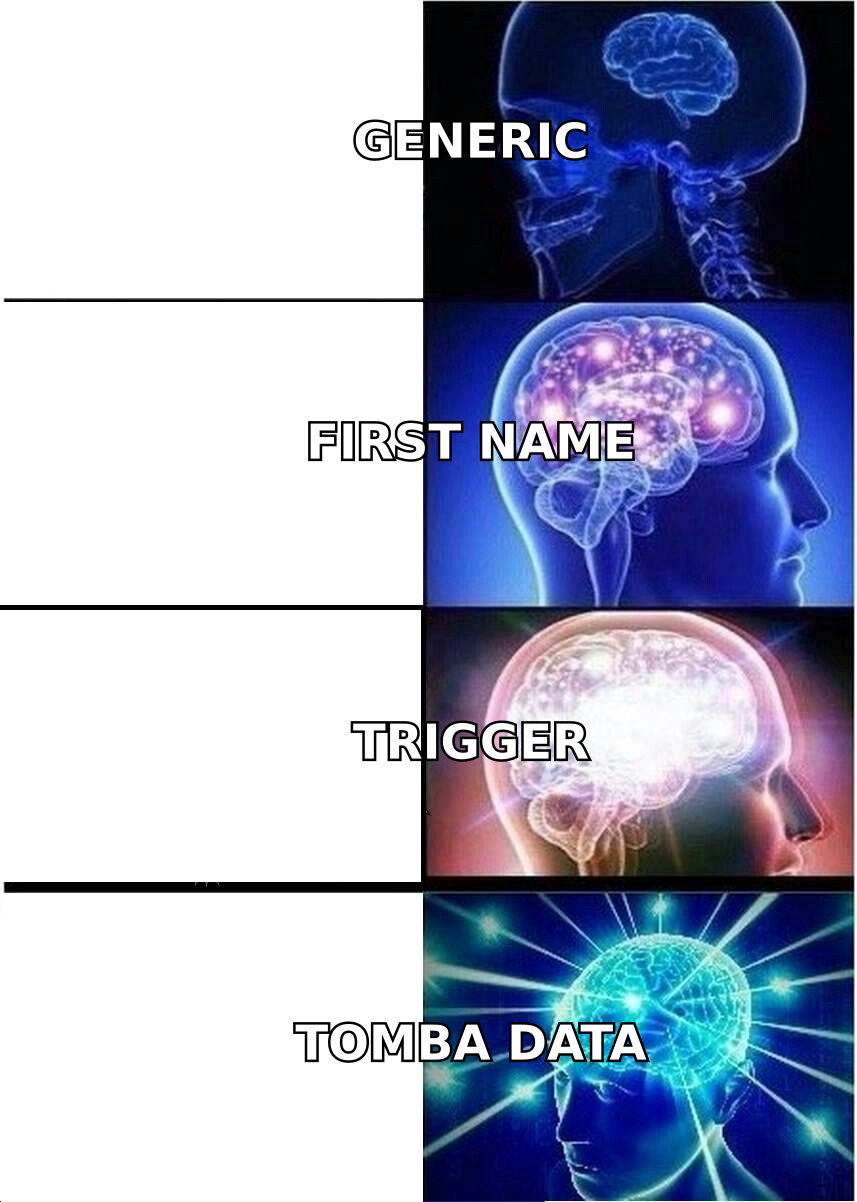
Notice that almost every high-performing line depends on a variable that must be accurate. "Congrats on the raise" lands beautifully — unless the company never raised, in which case you look careless. This is why the best copywriters treat clean data as step zero. If you want a head start, the subject line generator turns a one-line pitch into a dozen variations you can edit.
How long should a sales email subject line be?#
Short. The best email subject lines for sales run 1 to 5 words, or roughly 20 to 40 characters. There are two reasons, and both are mechanical, not stylistic.
First, mobile truncation. Most B2B inboxes now show 30–40 characters before cutting off on a phone. If your hook lives in word eight, it never gets seen. According to HubSpot's research on email marketing, mobile opens dominate, so writing for the phone screen is no longer optional.
Second, a short line reads as a note from a colleague, not a campaign from a vendor. "Quick question" feels human. "Transform Your Revenue Operations With Our Award-Winning Platform" feels like an ad — and your prospect's brain pattern-matches it to "delete" before they finish reading.
A useful test: read your subject line out loud. If it sounds like something a real coworker would type in a hurry, keep it. If it sounds like a press release, cut it in half and try again.
Should you personalize sales subject lines?#
Yes — but only with data you can trust. Personalization is the single biggest lever on open rates, and also the fastest way to embarrass yourself at scale.
A subject line like "{{FirstName}}, your team at {{Company}}" is powerful when the merge fields are correct. The same line with "Hi there, your team at " (because the data was missing) screams automated blast. Worse, a wrong name signals you bought a sketchy list — and primes the reader to distrust everything that follows.
This is where most cold campaigns quietly fail. The copy is fine; the underlying list is full of stale, guessed, or catch-all addresses. Before you obsess over wording, make sure every contact is real and verified. Run your list through an email verifier so bounces don't wreck your sender reputation, and use domain search to pull the right contacts at each target account in the first place.
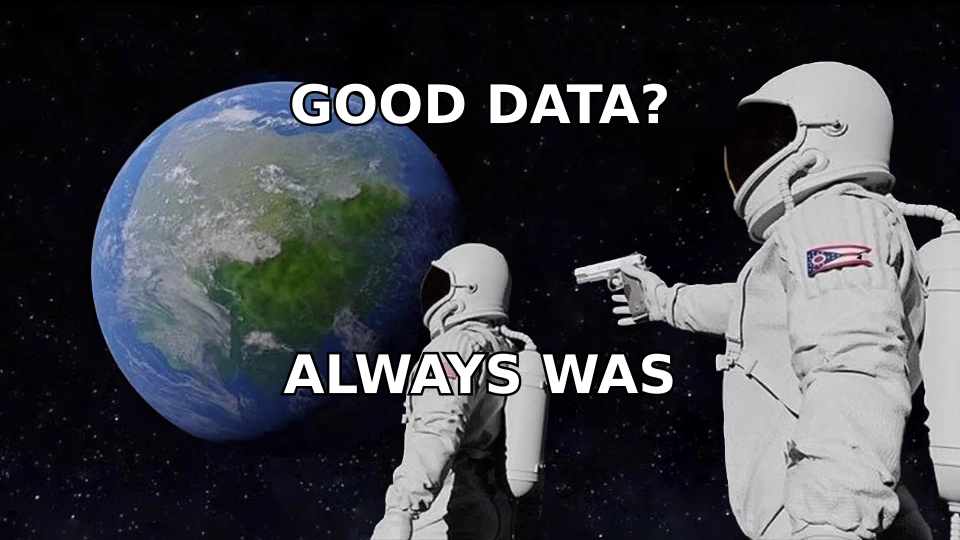
There's a deeper point here. Marketers spend hours wordsmithing subject lines and minutes thinking about their list. It's backwards. The personalization that moves the needle — the prospect's actual name, role, company, and recent activity — is a data-quality problem. Nail the data and average copy outperforms brilliant copy sent to a junk list, every time.
What sales subject lines should you avoid?#
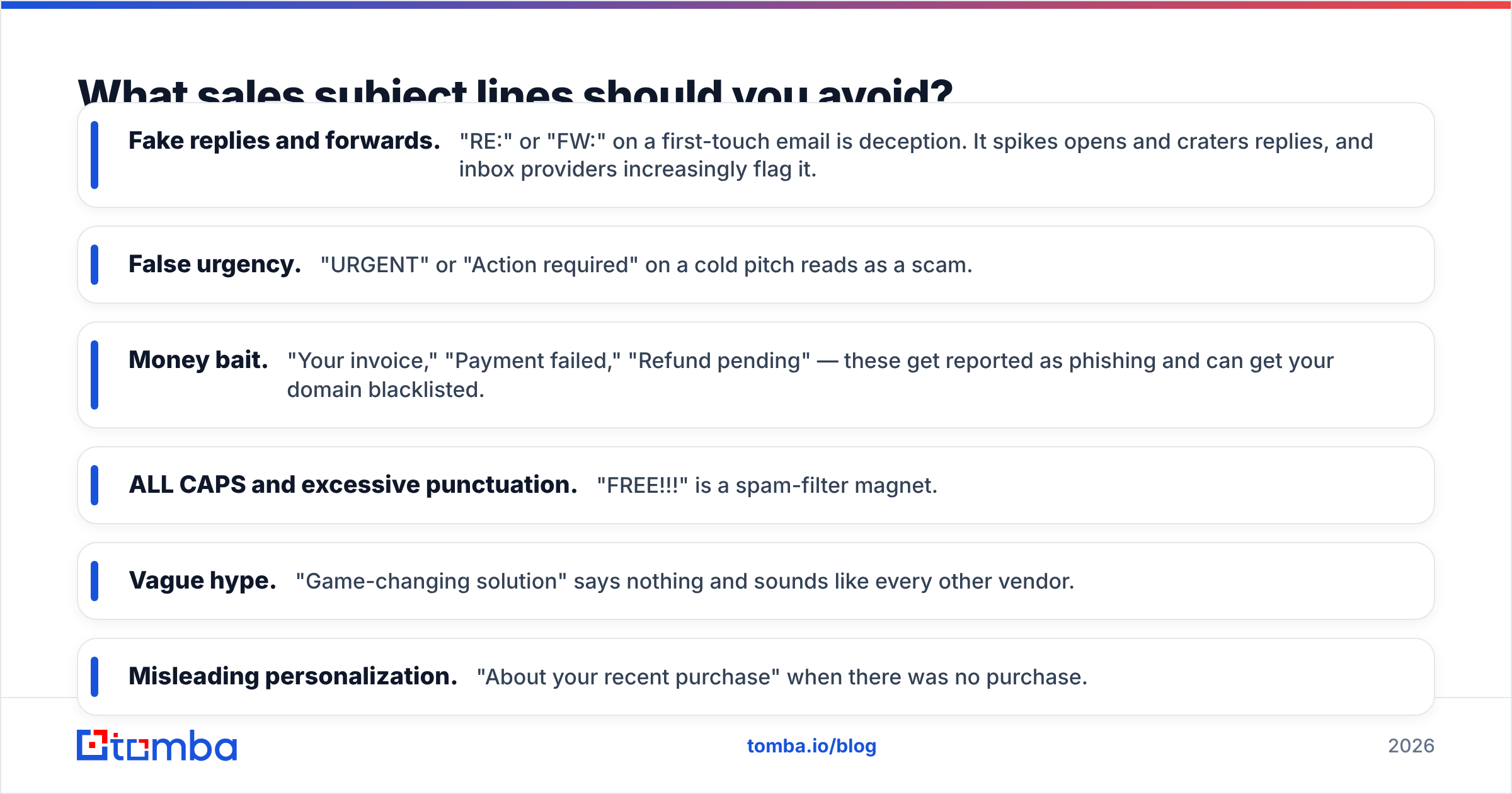
Some lines reliably destroy trust, conversions, or both. Avoid these categories entirely:
- Fake replies and forwards. "RE:" or "FW:" on a first-touch email is deception. It spikes opens and craters replies, and inbox providers increasingly flag it.
- False urgency. "URGENT" or "Action required" on a cold pitch reads as a scam.
- Money bait. "Your invoice," "Payment failed," "Refund pending" — these get reported as phishing and can get your domain blacklisted.
- ALL CAPS and excessive punctuation. "FREE!!!" is a spam-filter magnet.
- Vague hype. "Game-changing solution" says nothing and sounds like every other vendor.
- Misleading personalization. "About your recent purchase" when there was no purchase.
The common thread: each one borrows credibility it didn't earn. You might win the open, but you start the relationship with a lie, and you train the prospect to distrust your sender name forever. Spam complaints also feed directly into your sender reputation, which determines whether your future emails reach the inbox at all. One clever trick today can quietly suppress every campaign you send for months.
How do you test sales subject lines?#
A/B test every meaningful send, and change only one variable at a time. The mechanics are simple: split your list, send version A to one half and version B to the other, and let the higher open rate (or better, the higher reply rate) win. A/B testing is the most reliable way to replace opinion with evidence.
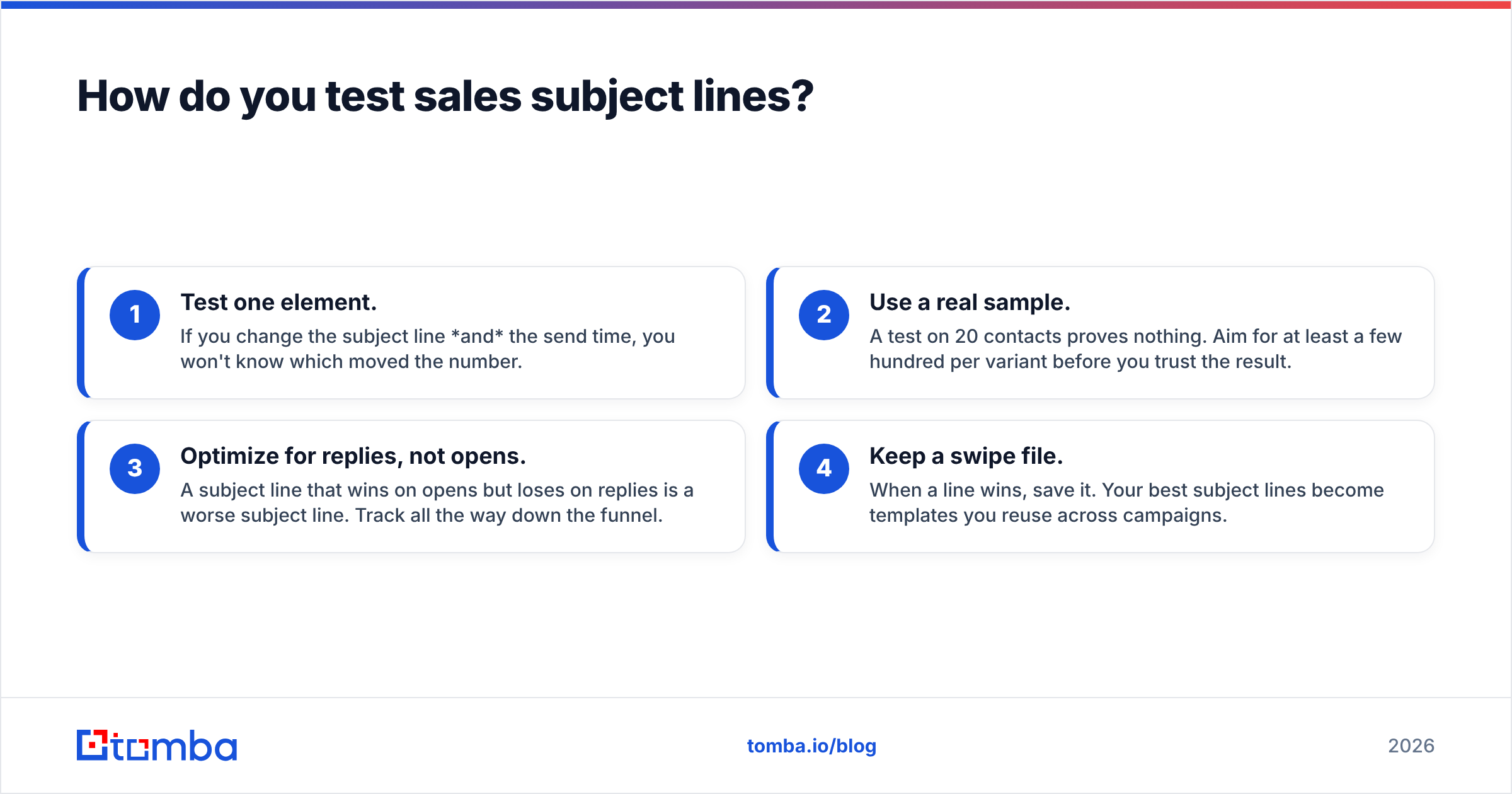
A few rules keep your tests honest:
- Test one element. If you change the subject line and the send time, you won't know which moved the number.
- Use a real sample. A test on 20 contacts proves nothing. Aim for at least a few hundred per variant before you trust the result.
- Optimize for replies, not opens. A subject line that wins on opens but loses on replies is a worse subject line. Track all the way down the funnel.
- Keep a swipe file. When a line wins, save it. Your best subject lines become templates you reuse across campaigns.
Before you even send, you can pre-screen wording against spam triggers and clarity with a subject line tester. It won't replace a live A/B test, but it catches the obvious mistakes — spammy words, length problems, weak hooks — before they cost you a send.
If you're building full sequences, pair your tested subject lines with proven body copy from a library of cold email templates so the whole message converts, not just the open.
Which subject line should I use? A quick decision guide#
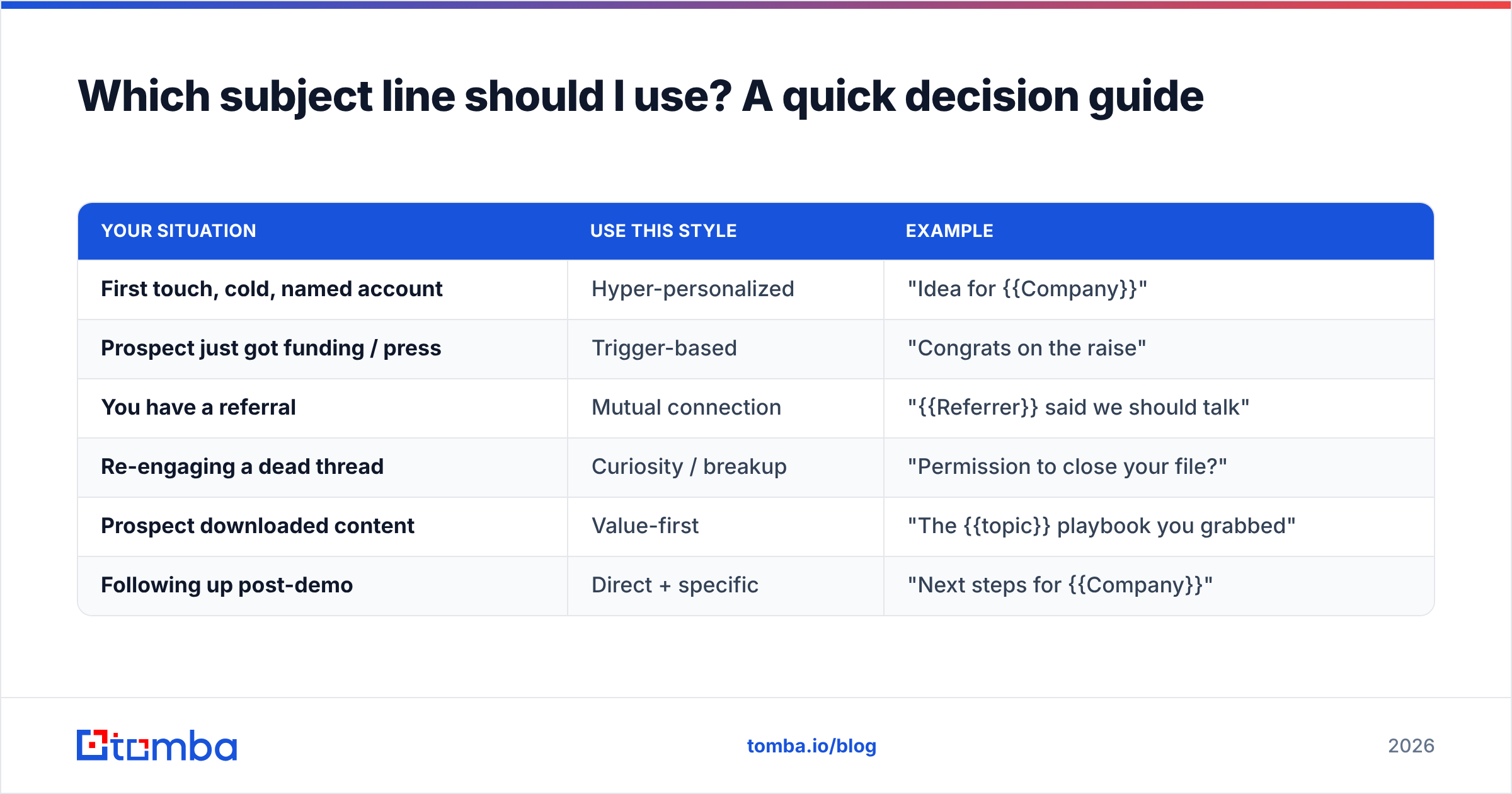
Match the line to the moment. Here's a fast lookup:
| Your situation | Use this style | Example |
|---|---|---|
| First touch, cold, named account | Hyper-personalized | "Idea for {{Company}}" |
| Prospect just got funding / press | Trigger-based | "Congrats on the raise" |
| You have a referral | Mutual connection | "{{Referrer}} said we should talk" |
| Re-engaging a dead thread | Curiosity / breakup | "Permission to close your file?" |
| Prospect downloaded content | Value-first | "The {{topic}} playbook you grabbed" |
| Following up post-demo | Direct + specific | "Next steps for {{Company}}" |
When in doubt, default to short, specific, and honest. Those three words will keep you out of the spam folder and inside the inbox more reliably than any single clever phrase.
Putting it together#
The best email subject lines for sales aren't magic words. They're the visible tip of a system: a clean, verified list; a relevant hook; a short, honest promise; and a body that delivers on it. Reps who win at outbound treat the subject line as the last 10% of polish on a process that starts with great data — not as a lottery ticket they buy at the end.
Get the inputs right and your subject lines almost write themselves, because you actually have something specific and true to say.
Start with data your subject lines can trust#
Even the sharpest subject line falls flat if it's pointed at the wrong inbox — or a stale one that bounces and drags down your sender reputation. Before you fine-tune wording, build a list you can stand behind. Tomba's Email Finder pulls accurate, verified professional emails by name, company, or domain, so every personalized line you write lands on a real person who can actually reply. Start free with 25 searches a month, and when you're ready to scale, check the Tomba pricing — Starter is $49/mo with room to grow. Clean data first, clever copy second. That's the order that fills pipeline.
// get started
Find, verify and enrich your first contacts today
Start on the free plan with 25 searches a month, then scale when your team is ready.
Free plan · No credit card required · GDPR & CCPA
// about the author