Best Email Warmup Service in 2026: Top 7 Tools Compared
A neutral, hands-on comparison of the best email warmup services in 2026 — pricing, deliverability gains, and which one fits cold email at scale.

Best Email Warmup Service in 2026: Top 7 Tools Compared
TL;DR
- The best email warmup service for most teams in 2026 is the one bundled into your sending platform (Instantly or Smartlead) — separate standalone warmup tools rarely justify a second subscription.
- Warmup raises your sender reputation by simulating real human conversations: opens, replies, and "move to inbox" actions across a network of real mailboxes.
- Price ranges from free (limited) to roughly $30–$50 per inbox per month at scale; per-inbox pricing is what actually hurts when you run 50+ accounts.
- Warmup fixes reputation, not bad data. Pair it with a clean list — verify emails before you send or your bounces will sink any warmup gains.
- Use our email warmup calculator to estimate ramp time before you commit to a tool.
If you send cold email and your messages keep landing in spam, the problem usually is not your copy. It is your sender reputation. An email warmup service is the standard fix — but the market is crowded, pricing is confusing, and half the "best warmup tool" lists online are affiliate pages in disguise. This guide ranks the real contenders by what matters: inbox-placement lift, per-inbox cost, and whether the warmup network is large enough to matter.
What is an email warmup service?#
An email warmup service is like breaking in a new pair of boots before a long hike. A brand-new email account that suddenly blasts 200 cold emails looks exactly like a spam bot to Google and Microsoft. Warmup eases the account in: it sends small volumes of friendly, human-looking email to a network of other real mailboxes, those mailboxes open and reply, and over a few weeks the mailbox providers learn that your address belongs to a real person worth delivering.
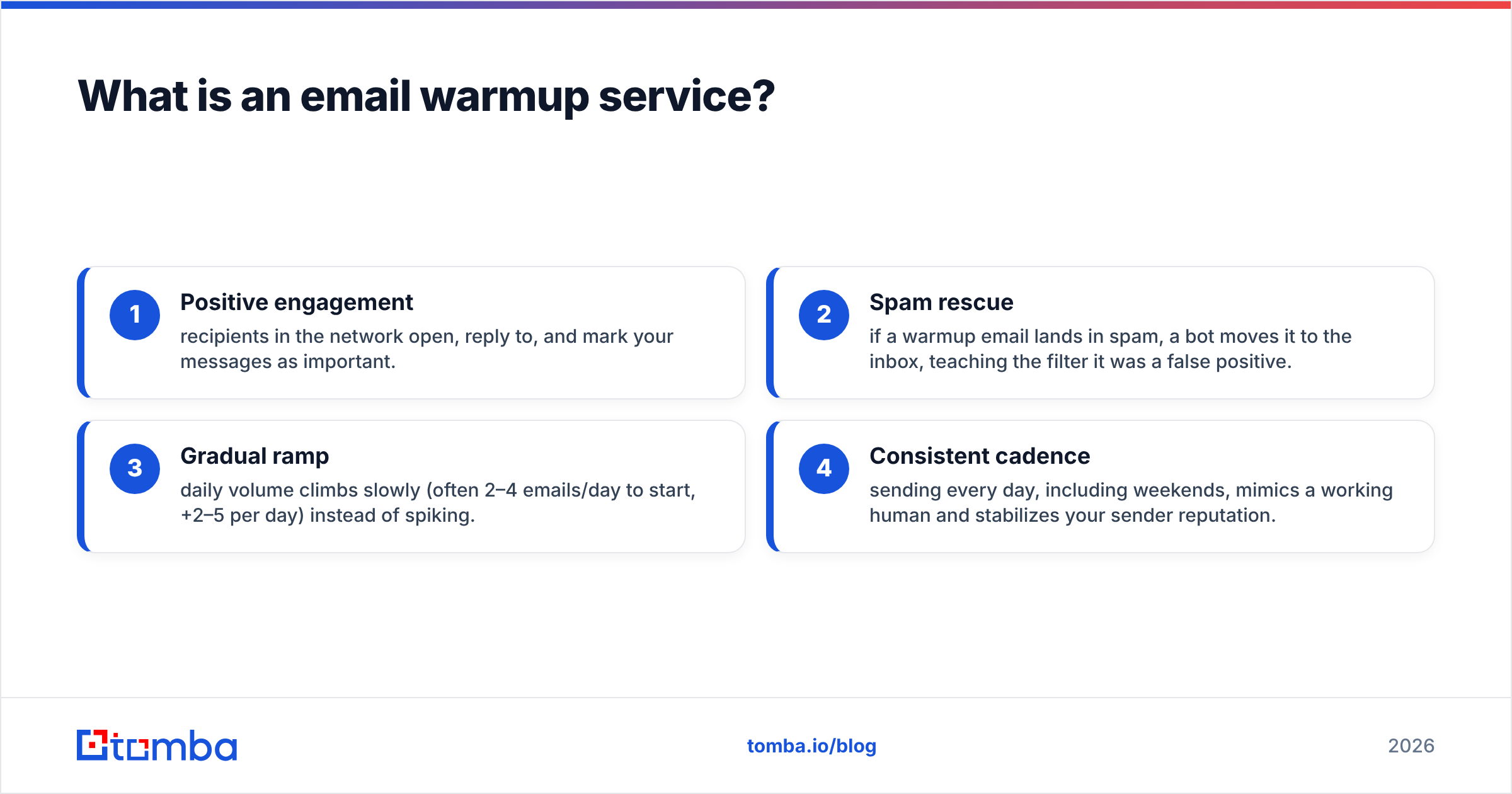
Technically, a warmup tool automates four reputation signals:
- Positive engagement — recipients in the network open, reply to, and mark your messages as important.
- Spam rescue — if a warmup email lands in spam, a bot moves it to the inbox, teaching the filter it was a false positive.
- Gradual ramp — daily volume climbs slowly (often 2–4 emails/day to start, +2–5 per day) instead of spiking.
- Consistent cadence — sending every day, including weekends, mimics a working human and stabilizes your sender reputation.
Warmup is one half of the deliverability equation. The other half is authentication (SPF, DKIM, DMARC) and clean recipient data. No warmup network on earth will save you if 30% of your real campaign list bounces.
Do you actually need a separate warmup tool?#
Short answer: probably not a separate one. The biggest shift in 2026 is that warmup is now a feature, not a product. Instantly, Smartlead, and most serious cold-email platforms include unlimited warmup in their base plan. Paying $30/inbox/month for a standalone warmup service on top of a sending tool that already includes it is how teams quietly double their software bill.
You need a dedicated warmup service in only a few cases:
- You send from a CRM or marketing platform (HubSpot, Salesforce) that has no warmup built in.
- You run a transactional/newsletter domain and want warmup decoupled from outbound tooling.
- Your sending tool's warmup network is weak and you want a larger, more reputable pool.
For everyone else, the right move is to pick a sending platform whose warmup is good enough and skip the extra tool. We will flag which platforms below include it.
Which is the best email warmup service in 2026?#
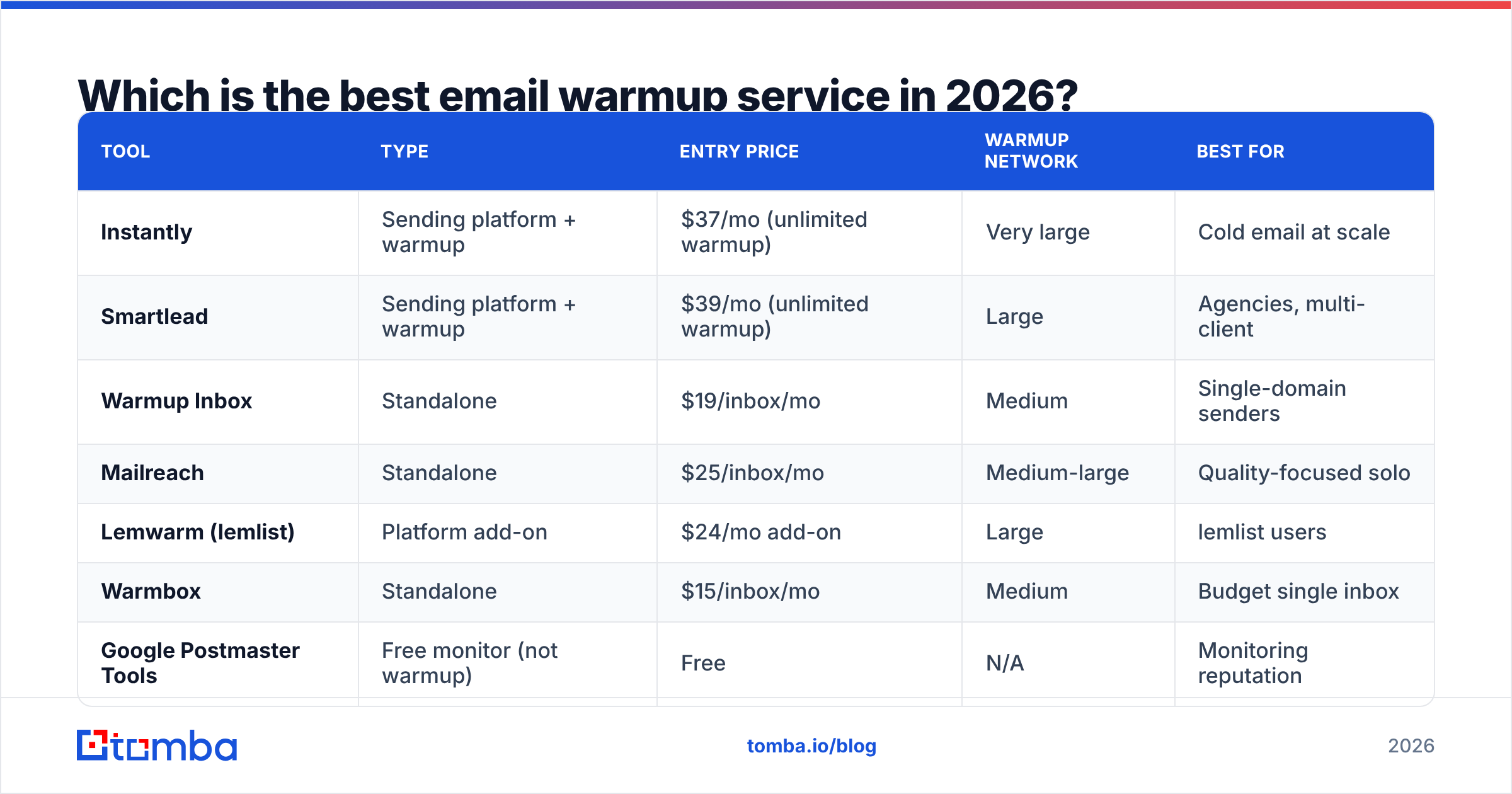
Here is the head-to-head. Prices are per the vendors' public pages at time of writing and are quoted per sending inbox unless noted; always check the vendor for current numbers since this market moves fast.
| Tool | Type | Entry price | Warmup network | Best for |
|---|---|---|---|---|
| Instantly | Sending platform + warmup | $37/mo (unlimited warmup) | Very large | Cold email at scale |
| Smartlead | Sending platform + warmup | $39/mo (unlimited warmup) | Large | Agencies, multi-client |
| Warmup Inbox | Standalone | $19/inbox/mo | Medium | Single-domain senders |
| Mailreach | Standalone | $25/inbox/mo | Medium-large | Quality-focused solo |
| Lemwarm (lemlist) | Platform add-on | $24/mo add-on | Large | lemlist users |
| Warmbox | Standalone | $15/inbox/mo | Medium | Budget single inbox |
| Google Postmaster Tools | Free monitor (not warmup) | Free | N/A | Monitoring reputation |
A few honest caveats on that table:
- Per-inbox pricing is the trap. A $19/inbox tool looks cheap until you run 40 inboxes — that is $760/month. Unlimited-warmup platforms like Instantly and Smartlead win hard at scale.
- Network size is hard to verify. Vendors all claim "the largest network." Treat those claims skeptically; what matters is whether your placement rate actually climbs, which you can measure with Google Postmaster Tools.
- Google Postmaster is not a warmup service. It is a free reputation monitor. We include it because every serious sender should run it alongside whatever warmup tool they pick.
How do warmup tools compare on deliverability lift?#
The metric that matters is inbox placement rate — the percentage of your sends that reach the primary inbox versus spam or Promotions. A good warmup run typically moves a fresh domain from roughly 50–70% placement to 90%+ over three to four weeks, assuming authentication is set up correctly.
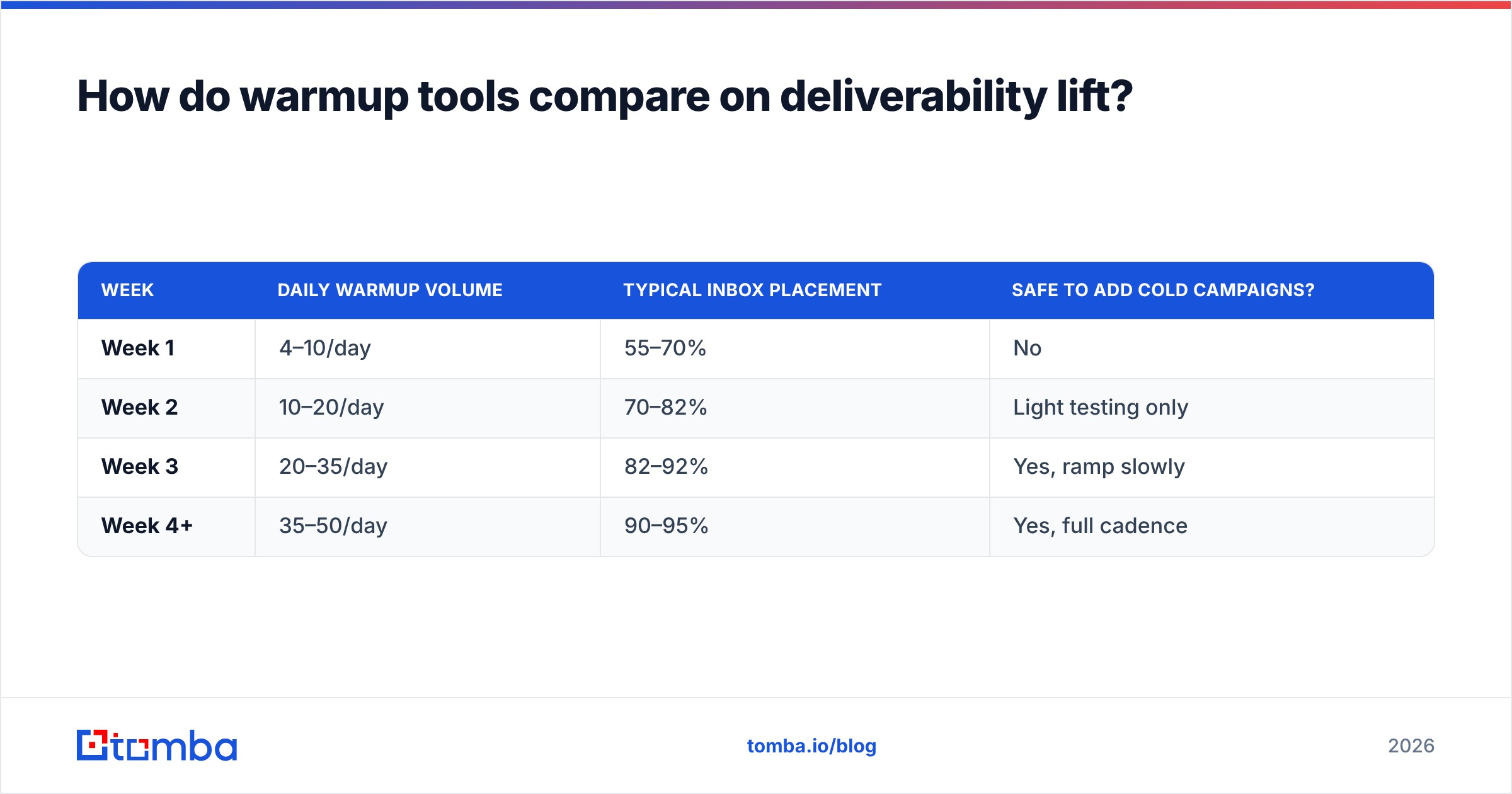
Here is a realistic ramp for a new Google Workspace inbox on a competent warmup service:
| Week | Daily warmup volume | Typical inbox placement | Safe to add cold campaigns? |
|---|---|---|---|
| Week 1 | 4–10/day | 55–70% | No |
| Week 2 | 10–20/day | 70–82% | Light testing only |
| Week 3 | 20–35/day | 82–92% | Yes, ramp slowly |
| Week 4+ | 35–50/day | 90–95% | Yes, full cadence |
Two things sabotage these numbers no matter which tool you choose:
- Authentication gaps. Missing or broken SPF/DKIM/DMARC caps your ceiling. Run a quick SPF check and confirm your DMARC policy before you start.
- Dirty campaign lists. Warmup builds reputation; one bad campaign to an unverified list of 2,000 addresses with a 25% bounce rate can undo a month of warmup in a day. This is the single most common reason warmup "doesn't work."

How do you choose the right warmup service?#
Match the tool to your sending setup, not to whichever blog ranked it #1. Use this decision shortcut:
- Already on a cold-email platform? Use its built-in warmup (Instantly, Smartlead, lemlist's Lemwarm). Don't pay twice.
- Sending from a CRM with no warmup? Pick a standalone — Mailreach for quality, Warmbox for budget.
- Running an agency with dozens of inboxes? Prioritize unlimited-warmup, flat-rate pricing. Per-inbox fees will bankrupt the model.
- Just monitoring an existing healthy domain? You may not need warmup at all — set up Google Postmaster and watch.
- Brand-new domain and brand-new to cold email? Start with the warmup bundled in your sending tool, give it three full weeks, and read up on email deliverability fundamentals in parallel.
The warmup tool is the easy part. The hard part — and the part that actually determines whether your cold email works — is the quality of the list you send to once warmup is done.
Why does list quality matter more than the warmup tool?#
Because warmup protects your reputation and bad data destroys it, in that order. Picture warmup as building up your credit score and a bounce-heavy campaign as maxing out a credit card the day after. The score doesn't care how hard you worked; the damage is immediate.
Mailbox providers track your bounce rate, spam-complaint rate, and engagement. A clean list keeps all three healthy:
- Bounce rate under 2–3% signals you send to real, current addresses. Verify your list with an email verifier before every campaign.
- Catch-all domains are a hidden bounce risk — many "valid" catch-all addresses silently fail. Screen them with a catch-all verifier.
- Accurate sourcing beats scraping. Pulling verified, role-correct contacts with a real email finder or domain search gives you addresses that engage instead of bouncing.
This is where the two halves connect. A warmed-up inbox is a loaded weapon; verified data is what makes it hit the target instead of backfiring. Teams that obsess over picking the "best warmup service" and then send to a scraped, unverified list are optimizing the wrong variable.
What mistakes ruin warmup results?#
Even with the best email warmup service running, these errors keep showing up:
- Stopping warmup once campaigns start. Keep a baseline warmup running permanently — it cushions reputation against bad campaign days.
- Ramping campaigns too fast. Going from 0 to 100 cold emails the moment week 3 ends spikes your volume the same way a spam bot would. Increase gradually.
- Ignoring the seed/spam rate inside the tool. If your warmup dashboard shows emails still hitting spam in week 3, fix authentication before scaling — don't just push volume.
- One mega-inbox. Spreading volume across several warmed inboxes on a few domains is safer than hammering one address. Many senders manage this with bulk tooling and a clean B2B database feeding each inbox.
- Skipping verification "to save credits." The cheapest credit you'll ever spend is the one that stops a bounce. Verification pays for itself in protected reputation.
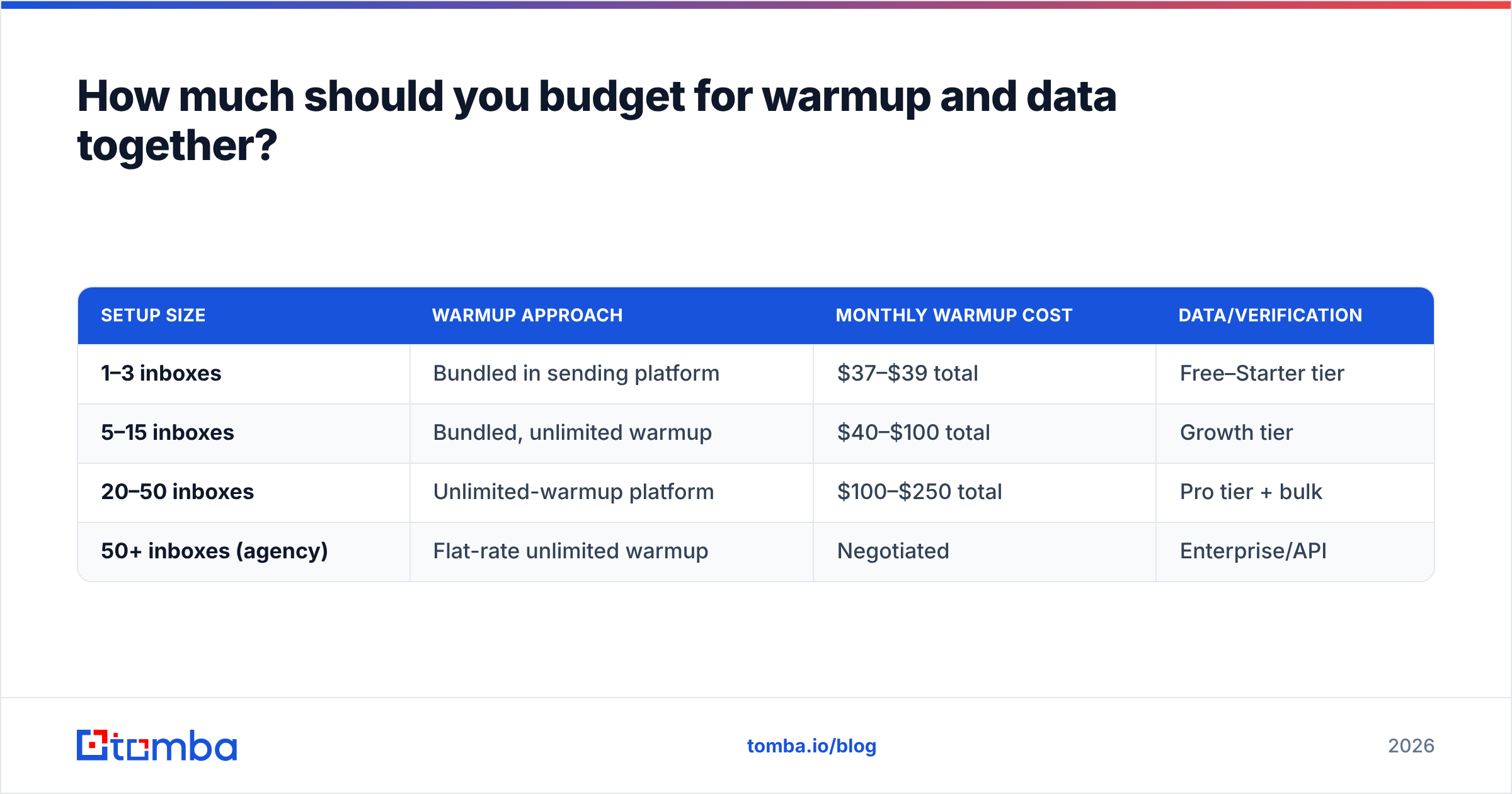
How much should you budget for warmup and data together?#
Think of it as one line item: deliverability infrastructure. Splitting it mentally into "warmup tool" and "data tool" leads people to over-spend on one and under-spend on the other.
| Setup size | Warmup approach | Monthly warmup cost | Data/verification |
|---|---|---|---|
| 1–3 inboxes | Bundled in sending platform | $37–$39 total | Free–Starter tier |
| 5–15 inboxes | Bundled, unlimited warmup | $40–$100 total | Growth tier |
| 20–50 inboxes | Unlimited-warmup platform | $100–$250 total | Pro tier + bulk |
| 50+ inboxes (agency) | Flat-rate unlimited warmup | Negotiated | Enterprise/API |
On the data side, Tomba pricing lines up cleanly with those tiers: a Free tier for testing (25 searches/mo), Starter at $49/mo, Growth at $99/mo, and Pro at $249/mo for high-volume teams running many inboxes. The point is to budget for verified data at the same scale you budget for warmup — they grow together.
The verdict: which warmup service wins?#
For most teams in 2026, the best email warmup service is the one already built into Instantly or Smartlead — unlimited warmup, flat pricing, and no second subscription. If you send from a CRM with no native warmup, Mailreach is the strongest standalone for quality and Warmbox the cheapest entry point. And every sender, regardless of tool, should run Google Postmaster Tools as a free reputation monitor.
But remember what warmup can and cannot do. It builds and protects sender reputation. It does not generate accurate prospects, and it does not save you from a bounce-heavy list. The teams with the best inbox placement are the ones that treat warmup and data verification as a single discipline.
That is where Tomba fits. Once your inboxes are warmed, fill them with addresses that actually land: use the Tomba Email Finder to source verified professional emails by name, domain, or company, then run them through verification before you send. Warmup gets you into the inbox — verified data keeps you there. Start free with 25 searches and pair it with whichever warmup service fits your stack.
// get started
Find, verify and enrich your first contacts today
Start on the free plan with 25 searches a month, then scale when your team is ready.
Free plan · No credit card required · GDPR & CCPA
// about the author