Best Free Email Checker in 2026: Top Tools Compared
A free email checker tells you if an address is real before you hit send. Here are the best free options in 2026, what their credit limits actually mean, and the moment it pays to upgrade.
TL;DR
- A free email checker confirms whether an address is real, deliverable, and safe to send to — before a bounce wrecks your sender reputation.
- The best free email checker for you depends on volume: single-address lookups, small monthly batches, or API access each have a different "best."
- Most free tiers cap you at 25–100 checks/month and hide catch-all detection behind paid plans — that limit, not the UI, is what you're really choosing between.
- Tomba's free email checker handles one-off checks instantly, and the email verifier scales to bulk lists when you outgrow the free tier.
- Free is fine for testing. The moment you send cold email at volume, accuracy and catch-all handling matter more than price.
What is a free email checker?#
A free email checker is a tool that tells you whether an email address actually exists and can receive mail — without charging you for the lookup. Think of it like knocking on a door before mailing a package: you confirm someone lives there before you spend the postage.
Under the hood, a checker runs several tests in sequence. It validates the syntax, confirms the domain has mail servers (MX records), and then pings the receiving server over SMTP to ask whether the mailbox exists. Good tools layer on extra checks: disposable-domain detection, role-account flags (like info@ or sales@), and catch-all detection. If you want the protocol-level detail, the SMTP article on Wikipedia explains the handshake these tools automate.
Why does this matter? Because bounces are expensive. Mailbox providers like Gmail and Outlook track your bounce rate as a signal of list quality. A spike tells them you're guessing at addresses, and your email deliverability drops for everyone on your domain — not just the bad addresses.
How does an email checker actually work?#
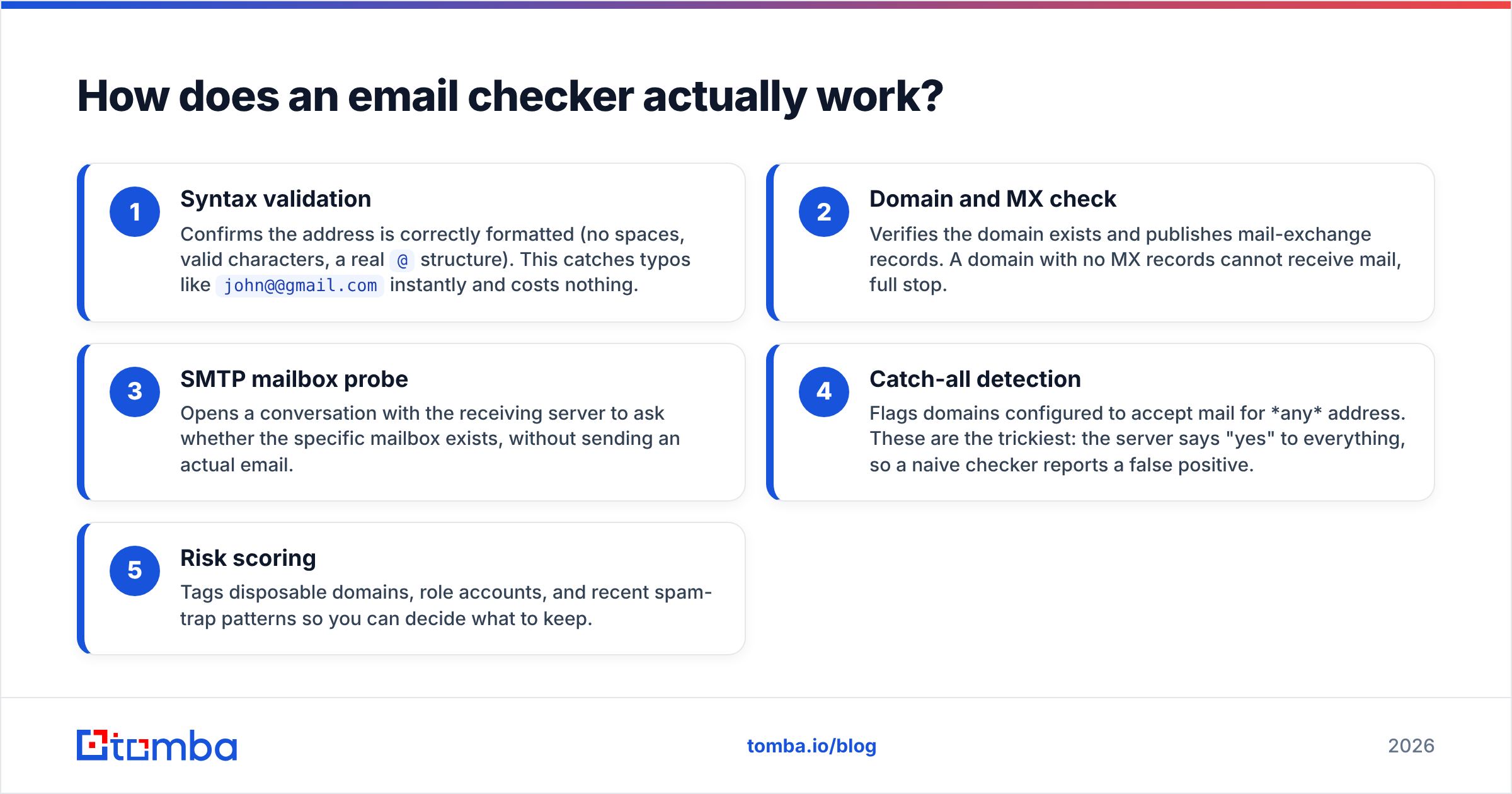
Most people assume an email checker just "looks up" an address in some master database. It doesn't — there is no global registry of every valid mailbox. Instead, the tool reconstructs the answer through layered checks. Here are the stages that separate a reliable checker from a coin flip:
- Syntax validation — Confirms the address is correctly formatted (no spaces, valid characters, a real
@structure). This catches typos likejohn@@gmail.cominstantly and costs nothing. - Domain and MX check — Verifies the domain exists and publishes mail-exchange records. A domain with no MX records cannot receive mail, full stop.
- SMTP mailbox probe — Opens a conversation with the receiving server to ask whether the specific mailbox exists, without sending an actual email.
- Catch-all detection — Flags domains configured to accept mail for any address. These are the trickiest: the server says "yes" to everything, so a naive checker reports a false positive.
- Risk scoring — Tags disposable domains, role accounts, and recent spam-trap patterns so you can decide what to keep.
The first two stages are easy and free everywhere. The last three are where free tools quietly differ — and where accuracy is won or lost.

What makes the best free email checker?#
Conclusion first: the best free email checker is the one whose free tier covers your real volume and handles catch-all domains honestly. Price is identical across "free" tools — it's zero. The differences live in the limits and the accuracy.
Use these five criteria to judge any tool:
- Monthly free credits — How many checks before you hit a paywall? 25 is enough to test; 100+ lets you verify a small list.
- Catch-all handling — Does it tell you the truth ("accept-all, risk unknown") or pretend the address is valid?
- Bulk upload — Can you drop a CSV, or is it one address at a time?
- API access — Is programmatic checking available on the free tier, or locked behind a paid plan?
- Accuracy and bounce guarantee — Does the vendor publish an accuracy figure or guarantee a bounce rate?
A single-address browser tool and a bulk API are both "email checkers," but they solve different problems. Pick based on whether you're spot-checking one contact or cleaning a list of 5,000.
Which free email checker is best in 2026?#
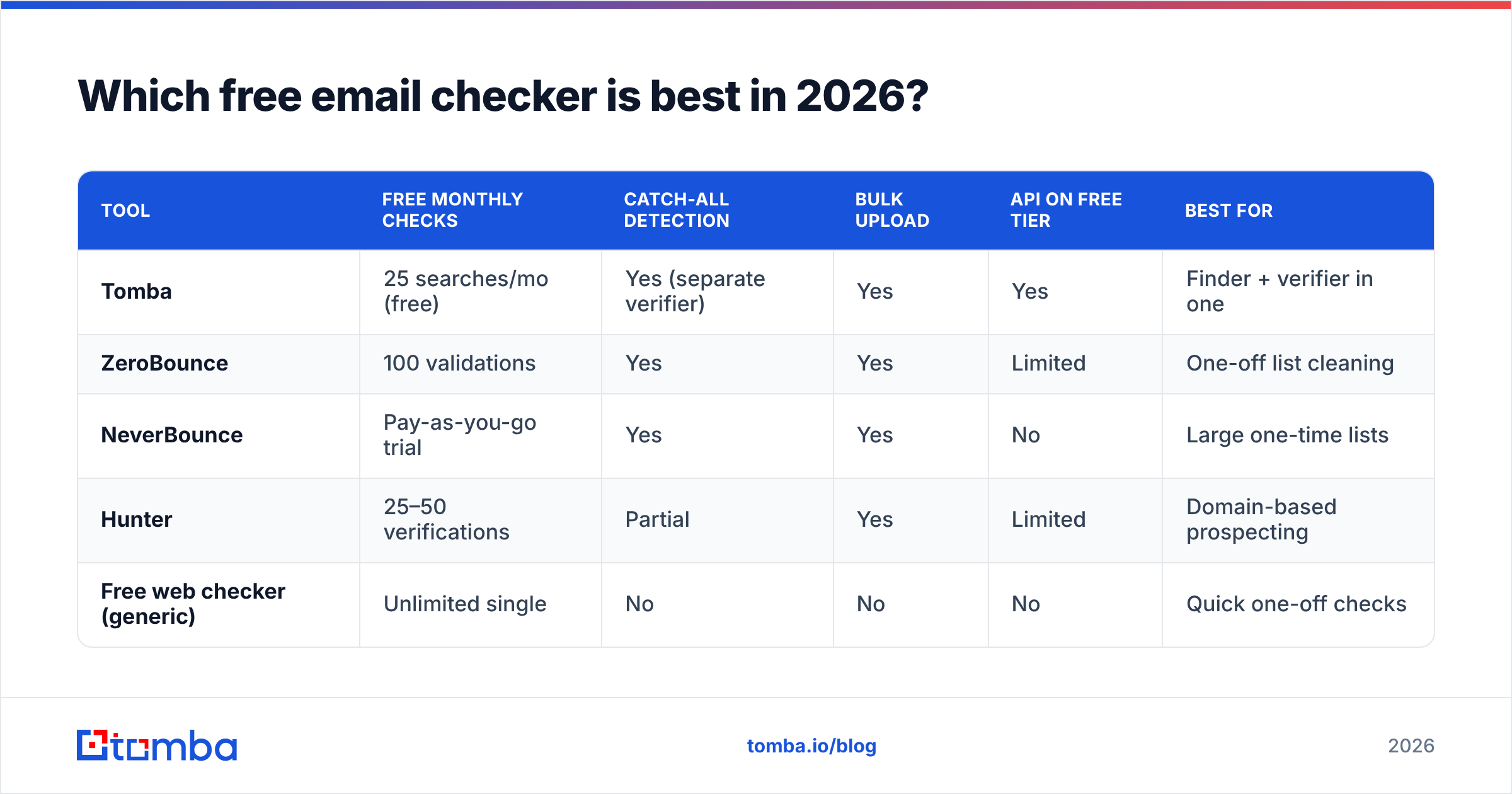
Here's a concrete comparison of the most-used options and their free tiers as of 2026. Figures reflect each vendor's published free plan; always confirm current limits before relying on them.
| Tool | Free monthly checks | Catch-all detection | Bulk upload | API on free tier | Best for |
|---|---|---|---|---|---|
| Tomba | 25 searches/mo (free) | Yes (separate verifier) | Yes | Yes | Finder + verifier in one |
| ZeroBounce | 100 validations | Yes | Yes | Limited | One-off list cleaning |
| NeverBounce | Pay-as-you-go trial | Yes | Yes | No | Large one-time lists |
| Hunter | 25–50 verifications | Partial | Yes | Limited | Domain-based prospecting |
| Free web checker (generic) | Unlimited single | No | No | No | Quick one-off checks |
A few honest takeaways from the table:
- If you only need to confirm one address right now, any free single-check tool works — including Tomba's free email checker, which returns a result in seconds with no signup for a quick look.
- If you need to clean a list, look at the monthly free credits, not the headline. 100 free validations sounds generous until you have 800 contacts.
- If you plan to automate, API access on the free tier is rare. Tomba exposes the email verification API so you can wire checks into your signup flow or CRM from day one.

You can also cross-reference user reviews on a neutral marketplace like G2 before committing — the free-tier complaints there usually surface the limits vendors bury in footnotes.
Is a free email checker accurate enough?#
For most spot-checks, yes. For high-volume cold outreach, it depends on one feature: catch-all handling.
Free checkers nail the easy cases — bad syntax, dead domains, obvious typos. Where they diverge is the gray zone. A catch-all domain accepts mail for every possible address, so an SMTP probe always returns "OK." A weak tool marks those as valid and you find out they bounce only after you've sent. A strong tool labels them "accept-all / risk unknown" and lets you decide.
This is exactly why a dedicated catch-all verifier exists as a separate step. It uses additional signals — historical deliverability, pattern matching, and engagement data — to estimate whether a catch-all address is actually live, rather than shrugging.

The practical accuracy ladder looks like this:
- Syntax + MX only (most free unlimited tools): catches ~60% of bad addresses. Fine for a sanity check.
- SMTP probe added (most free tiers with signup): catches the majority of dead mailboxes. Good for small lists.
- SMTP + catch-all scoring (paid tiers and Tomba's verifier): the level you need before sending thousands of cold emails.
If your bounce rate creeping above 2–3% is a business problem, you've outgrown the free unlimited tools and need the third tier.
When should you upgrade from free?#
Upgrade when any of these become true:
- You verify more than ~100 addresses a month. Free credits run out fast on real lists.
- You send cold email at scale. Catch-all blindness will cost you deliverability, and a recovering domain costs far more than a paid plan.
- You want to automate. Manual CSV uploads don't scale; you need an email finder API and webhook-driven checks.
- You need finding and verifying together. If you're sourcing new contacts, a standalone checker is only half the job.
That last point is the real efficiency gain. Finding an address and verifying it are usually two tools and two bills. Tomba combines them: the email finder sources the address from a name and domain, and verification runs inline so you never export a contact that bounces. For lists, the bulk email finder does both across thousands of rows at once.
How do the paid tiers compare?#
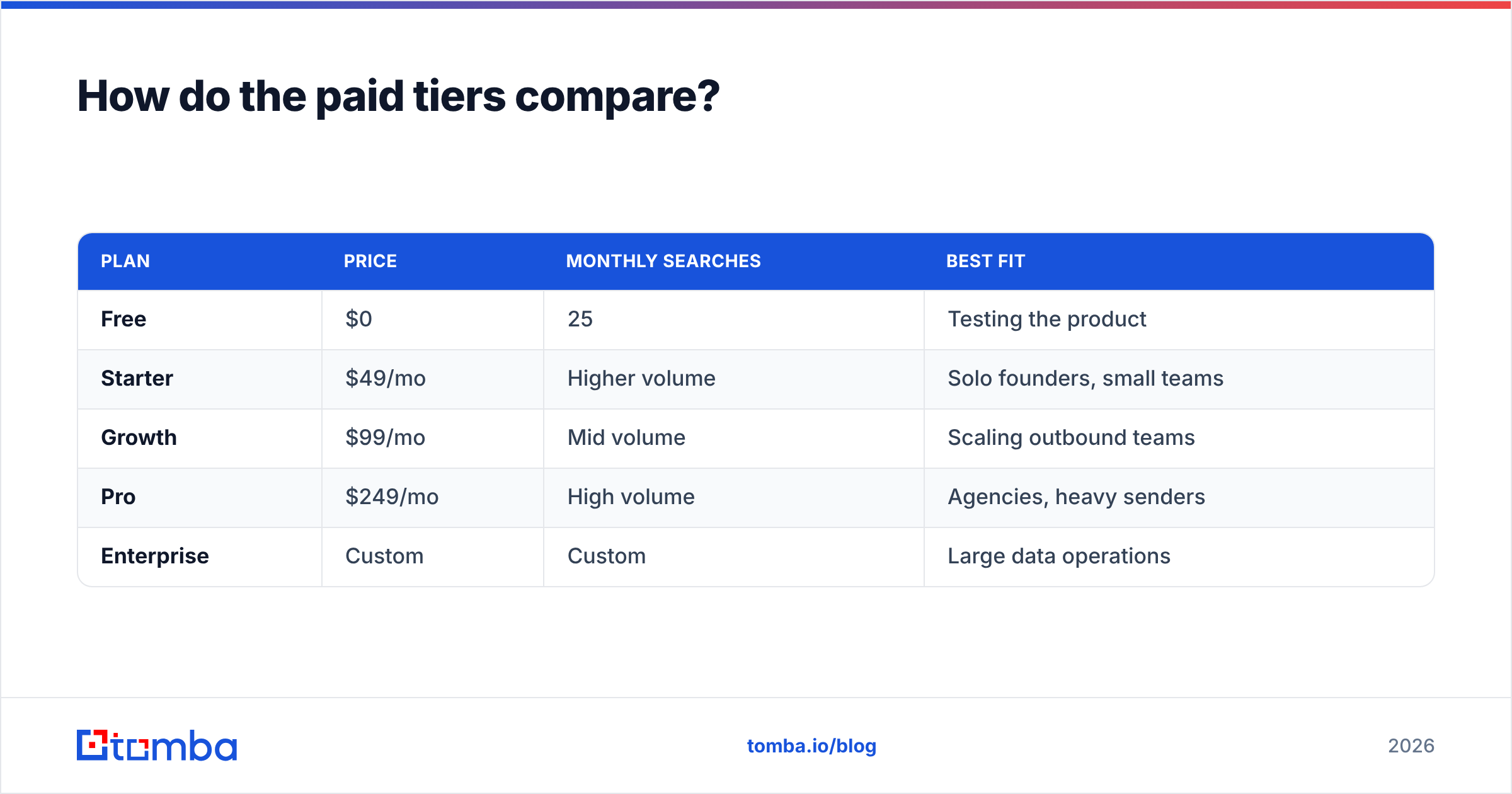
If you decide to upgrade, here's how Tomba's plans line up so you can budget honestly. Full details are on the Tomba pricing page.
| Plan | Price | Monthly searches | Best fit |
|---|---|---|---|
| Free | $0 | 25 | Testing the product |
| Starter | $49/mo | Higher volume | Solo founders, small teams |
| Growth | $99/mo | Mid volume | Scaling outbound teams |
| Pro | $249/mo | High volume | Agencies, heavy senders |
| Enterprise | Custom | Custom | Large data operations |
Note the starter tier is $49/mo — a common point of confusion since some comparison posts quote outdated figures. The free plan's 25 searches are genuinely free forever, which makes it a real testing ground rather than a time-limited trial.
For teams already living in a CRM, the HubSpot integration and Salesforce integration let verified contacts flow straight into your pipeline, so checking happens at the point of capture instead of as a cleanup chore later.
How to check an email address right now (free)#
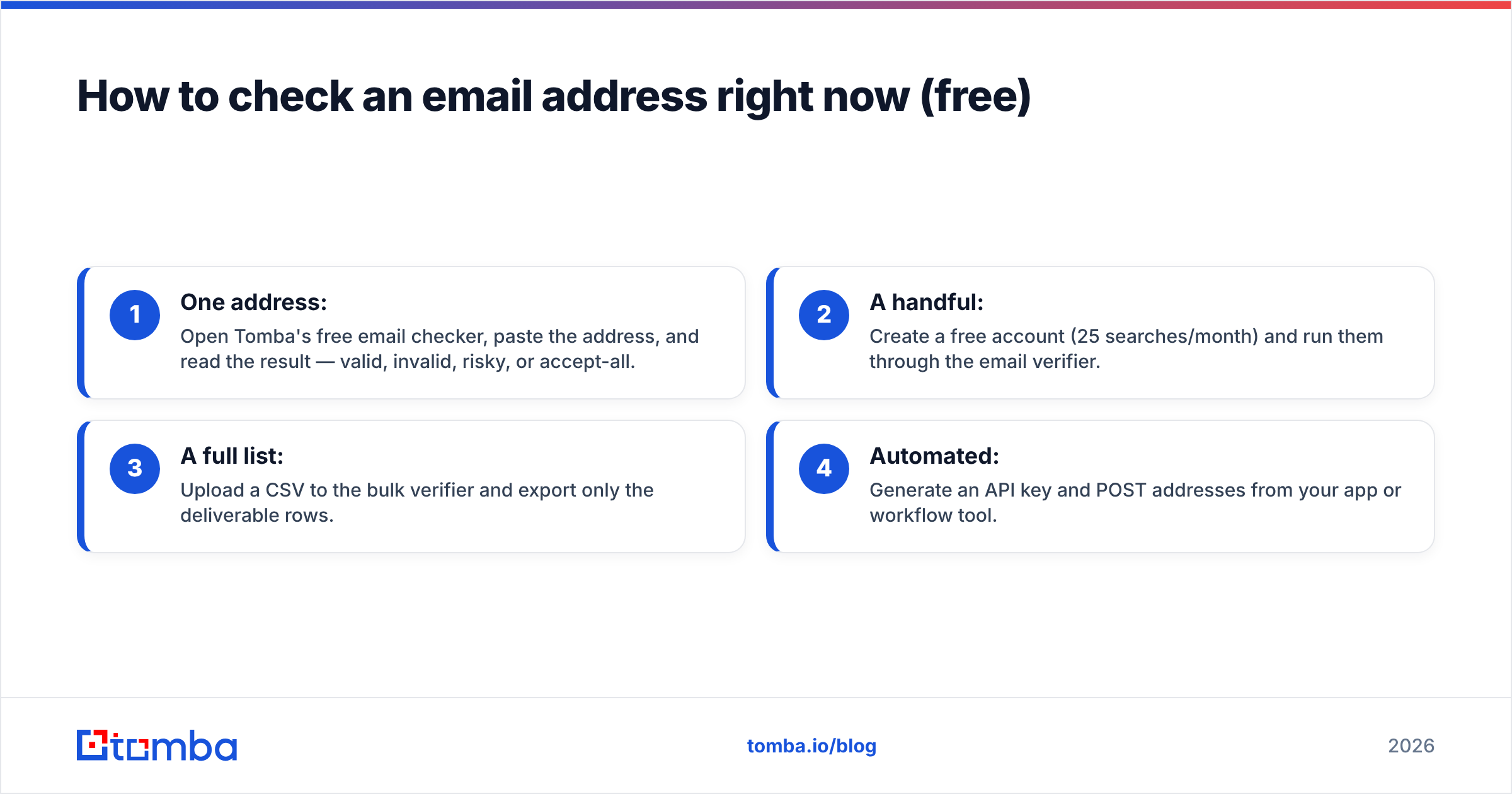
You don't need a credit card to start. Here's the fastest path:
- One address: Open Tomba's free email checker, paste the address, and read the result — valid, invalid, risky, or accept-all.
- A handful: Create a free account (25 searches/month) and run them through the email verifier.
- A full list: Upload a CSV to the bulk verifier and export only the deliverable rows.
- Automated: Generate an API key and POST addresses from your app or workflow tool.
For a deeper sanity check on your domain's sending health, pair the checker with a sender reputation checker — knowing your addresses are valid is only useful if your domain can actually deliver to them. HubSpot's guide to email deliverability best practices is a solid primer on the broader picture.
The bottom line#
The best free email checker isn't a single product — it's the one matched to your volume and honest about catch-all domains. For a quick one-off, any free single-check tool does the job. For real outreach, you want SMTP probing plus catch-all scoring, and you want finding and verifying under one roof so you stop paying twice and stop exporting bounces.
Start free with Tomba's Email Finder and its built-in verification: source the address, confirm it's real, and push clean contacts into your pipeline — all on the free tier until your volume tells you it's time to scale. Run your first 25 checks today and see how many "valid" addresses your old tool was getting wrong.
// get started
Find, verify and enrich your first contacts today
Start on the free plan with 25 searches a month, then scale when your team is ready.
Free plan · No credit card required · GDPR & CCPA
// about the author