Best Lead Capture System in 2026: Tools & How to Build One
A lead capture system is more than a form. Here's how to pick the best lead capture system in 2026 — tools, data enrichment, and a stack that actually converts.

TL;DR
- A lead capture system is the full pipeline that turns an anonymous visitor into a contact record you can act on — not just the form on your landing page.
- The best lead capture system in 2026 combines a capture surface (form, popup, chatbot, or visitor reveal) with verification and enrichment so the data is usable the moment it lands.
- Pretty forms with garbage data are worthless. Capture without verification floods your CRM with typos, fakes, and role accounts that wreck deliverability.
- Below: a side-by-side comparison of the main capture methods, the components every stack needs, and where each tool fits by budget and use case.
- Tomba slots in as the enrichment and verification layer — it cleans and completes whatever your forms collect, then fills the gaps your forms never could.
What is a lead capture system?#
A lead capture system is the connected set of tools that detects interest, collects a contact, confirms the data is real, and pushes a complete record into your CRM. Think of it like a restaurant's front-of-house: the greeter (capture surface) gets people in the door, the host (verification) checks the reservation is legit, and the server (enrichment) already knows your name and usual order before you sit down. Most teams only build the greeter and wonder why service falls apart later.
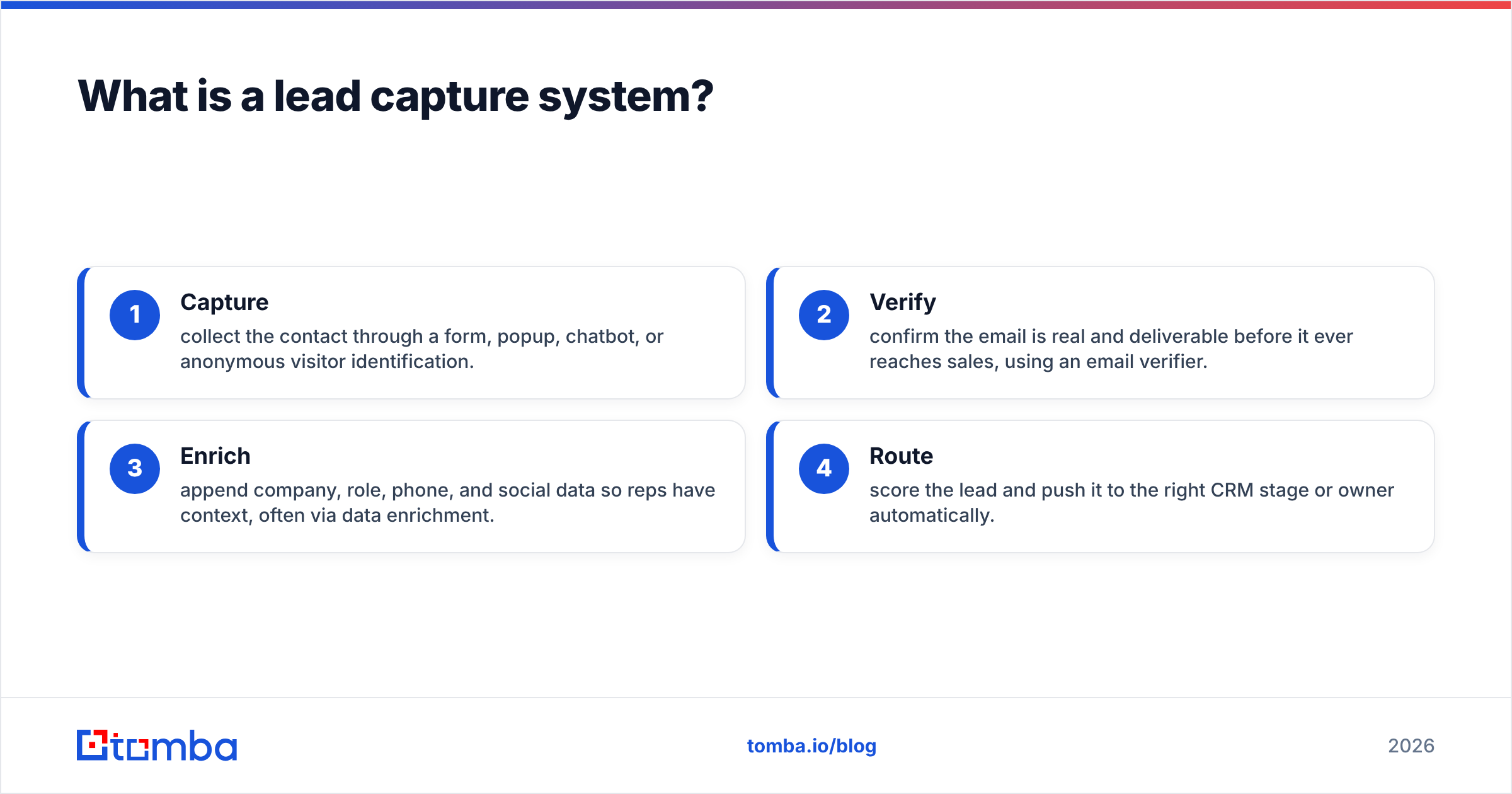
The mistake is treating "lead capture" as a synonym for "form." A form is one capture surface. The system is everything that happens to the data after the submit button — and that back half is where conversion is won or lost. A complete system has four jobs:
- Capture — collect the contact through a form, popup, chatbot, or anonymous visitor identification.
- Verify — confirm the email is real and deliverable before it ever reaches sales, using an email verifier.
- Enrich — append company, role, phone, and social data so reps have context, often via data enrichment.
- Route — score the lead and push it to the right CRM stage or owner automatically.
Skip any one of those and the others underperform. A flawless form that captures fake emails still poisons your sender reputation. Perfect enrichment on a lead nobody routes still dies in a spreadsheet.

What are the main lead capture methods?#
There's no single "best" capture surface — the right one depends on your traffic volume, sales motion, and how much of your pipeline is inbound versus outbound. Here are the five that matter in 2026, with the honest trade-offs.
- Static forms — The baseline. Cheap, reliable, and expected on pricing and demo pages. They only capture people already motivated enough to fill out fields, so volume is low but intent is high.
- Exit-intent popups — Trigger when a visitor moves to leave. Great for recovering abandoning traffic on content and ecommerce pages, but easy to overuse and annoy.
- Conversational chatbots — Qualify and capture in a chat thread. Strong for high-consideration B2B where buyers have questions, weaker when they just want to download something.
- Anonymous visitor reveal — Identifies the companies (and sometimes contacts) behind traffic that never fills out anything. This is the big unlock: most B2B sites convert under 3% of visitors, and visitor identification recovers intent signals from the other 97%.
- Outbound capture (finder + enrichment) — Instead of waiting for inbound, you build the contact yourself from a domain or name using an email finder. This is how outbound teams "capture" leads who never visited at all.
Most strong stacks run two or three of these in parallel. A common 2026 setup: forms for high-intent pages, visitor reveal for everything else, and an outbound finder to chase target accounts that browsed but never converted.
Which is the best lead capture system? A side-by-side comparison#
The table below compares capture methods on the attributes that actually drive a buying decision — not feature checklists, but cost, data quality, and where each one fits.
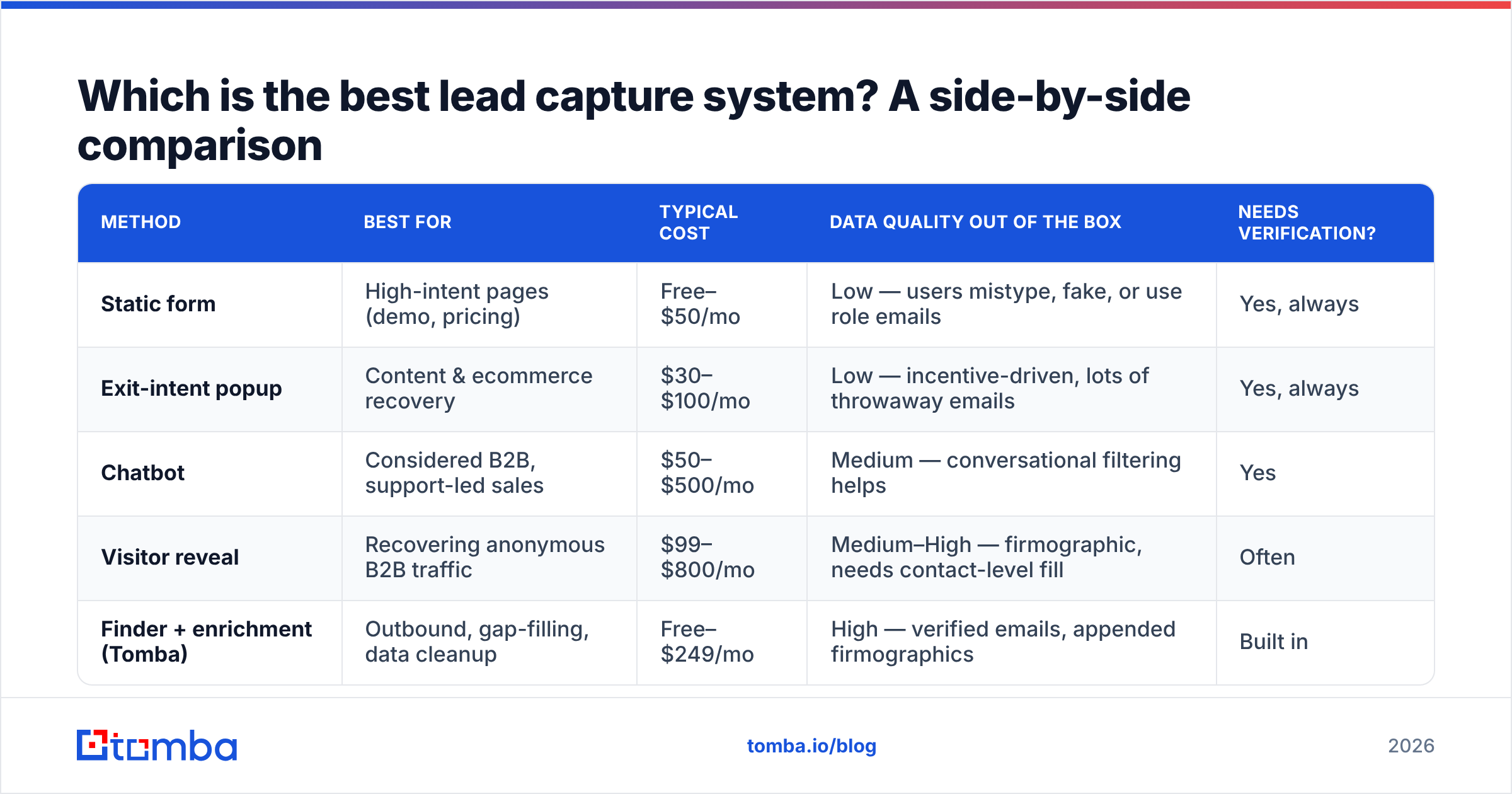
| Method | Best for | Typical cost | Data quality out of the box | Needs verification? |
|---|---|---|---|---|
| Static form | High-intent pages (demo, pricing) | Free–$50/mo | Low — users mistype, fake, or use role emails | Yes, always |
| Exit-intent popup | Content & ecommerce recovery | $30–$100/mo | Low — incentive-driven, lots of throwaway emails | Yes, always |
| Chatbot | Considered B2B, support-led sales | $50–$500/mo | Medium — conversational filtering helps | Yes |
| Visitor reveal | Recovering anonymous B2B traffic | $99–$800/mo | Medium–High — firmographic, needs contact-level fill | Often |
| Finder + enrichment (Tomba) | Outbound, gap-filling, data cleanup | Free–$249/mo | High — verified emails, appended firmographics | Built in |
The pattern is hard to miss: every capture surface except a finder-plus-enrichment layer produces data you can't trust until something cleans it. That "something" is the verification and enrichment tier — and it's the part teams skip when they shop for a "form builder" instead of a system.

Why does data quality matter more than the form?#
Because a beautiful form that captures bad data costs you more than no form at all. Every fake, mistyped, or disposable address that hits your CRM does three things: it inflates your lead count so reporting lies to you, it wastes rep time on contacts that bounce, and worst of all it drags down your sender reputation when those messages hard-bounce.
Here's the uncomfortable math. If 20% of your captured emails are invalid — a realistic rate for incentive-driven popups — and you email them, your bounce rate spikes past the 2% threshold that mailbox providers use to throttle senders. One bad campaign can suppress deliverability for your good leads for weeks. The form didn't fail; the missing verification step did.
This is why the verification and enrichment layer is the real differentiator in 2026. Tools like HubSpot handle the capture surface well, but the cleanliness of the data still depends on what you bolt on behind it. Verifying every address at the point of capture — and rejecting catch-all and role-based traps with a catch-all verifier — is what separates a lead list you can sell from one that gets you blocklisted.
A quick gut check from the analyst community: browse the lead-capture category on G2 and the highest-rated tools almost all advertise verification or enrichment as a core feature, not an add-on. The market already priced in this lesson.
What components does the best lead capture system need?#
If you're building or buying in 2026, evaluate the system against these five components rather than the prettiness of the form. A stack that nails all five outperforms a best-in-class form builder that nails one.
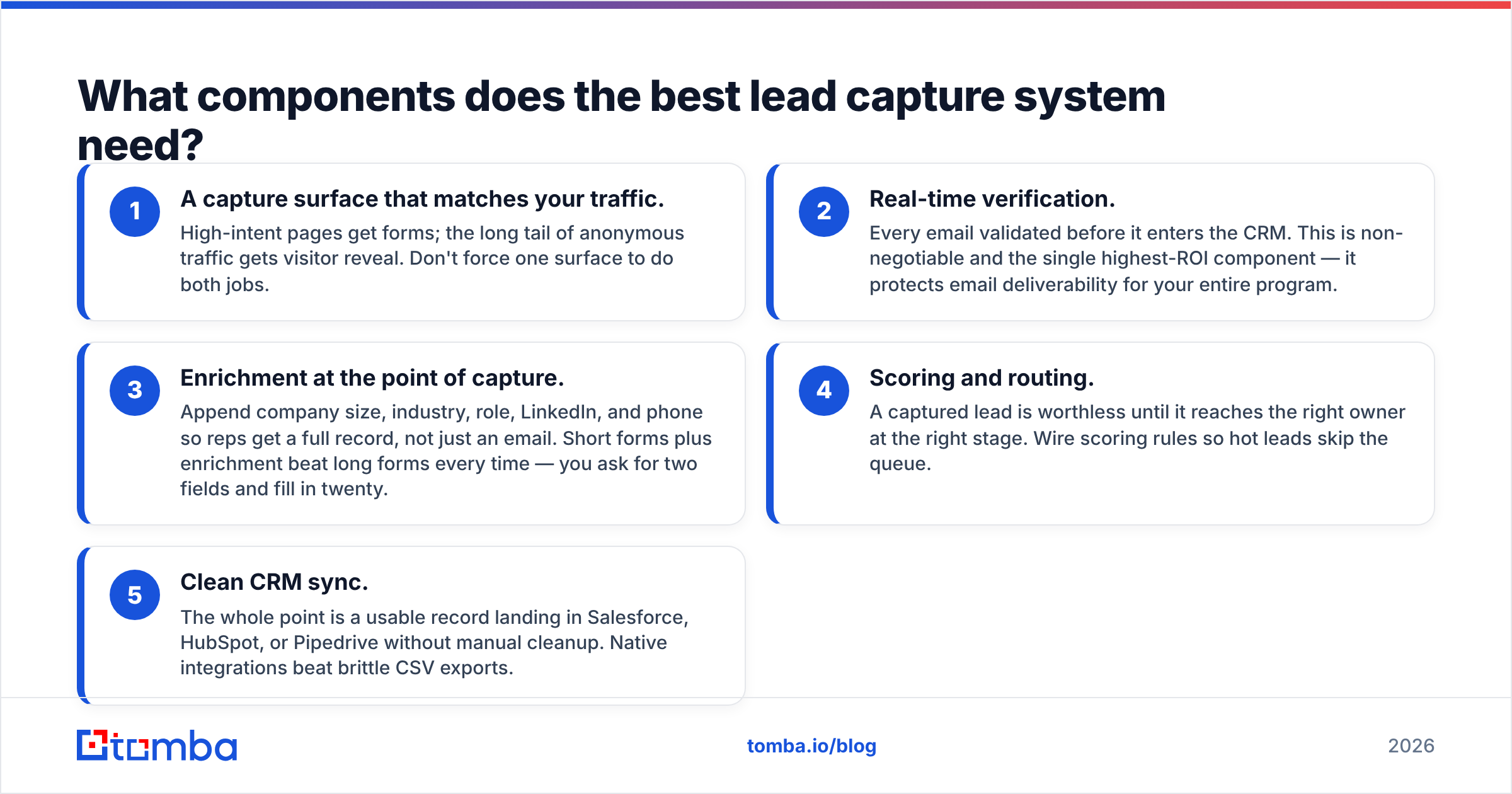
- A capture surface that matches your traffic. High-intent pages get forms; the long tail of anonymous traffic gets visitor reveal. Don't force one surface to do both jobs.
- Real-time verification. Every email validated before it enters the CRM. This is non-negotiable and the single highest-ROI component — it protects email deliverability for your entire program.
- Enrichment at the point of capture. Append company size, industry, role, LinkedIn, and phone so reps get a full record, not just an email. Short forms plus enrichment beat long forms every time — you ask for two fields and fill in twenty.
- Scoring and routing. A captured lead is worthless until it reaches the right owner at the right stage. Wire scoring rules so hot leads skip the queue.
- Clean CRM sync. The whole point is a usable record landing in Salesforce, HubSpot, or Pipedrive without manual cleanup. Native integrations beat brittle CSV exports.
Notice that capture — the part everyone obsesses over — is one of five. The other four are data operations. That's the reframe: the best lead capture system is a data system with a form attached, not a form with some data features attached.
How does Tomba fit into a lead capture stack?#
Tomba is the verification and enrichment layer — the back half of the system that most form builders ignore. It doesn't replace your landing page form or your chatbot; it makes whatever they collect actually usable, and it captures the leads your forms never could.
Three concrete jobs Tomba does in a 2026 stack:
- Cleans inbound captures. Pipe form and popup submissions through the email verifier and catch-all checks so only deliverable contacts reach sales. Use the bulk verify flow to scrub existing lists you've already collected.
- Enriches thin records. A form that only asked for an email becomes a full profile — company, role, phone, socials — through contact enrichment, so reps never start cold.
- Captures outbound leads your forms can't. For target accounts that browsed but never converted, the domain search and email finder build verified contacts from a company name or website, turning anonymous intent into an outreach-ready list.
It connects to the rest of the stack through the Tomba API, a HubSpot integration, and direct Google Sheets and Chrome workflows — so verification and enrichment happen automatically, not as a manual cleanup chore.
Where the budget goes#
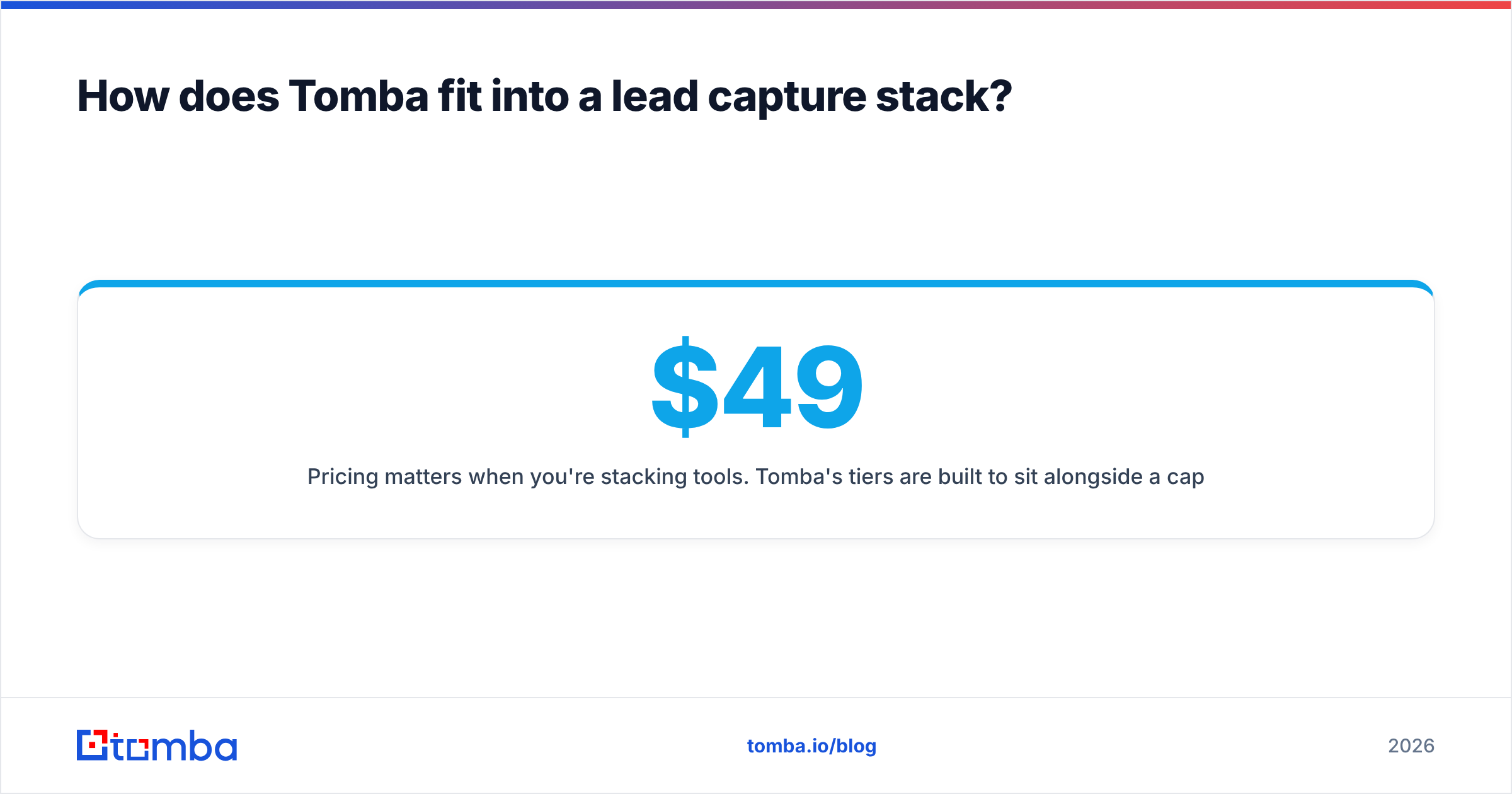
Pricing matters when you're stacking tools. Tomba's tiers are built to sit alongside a capture surface without doubling your spend: a Free tier (25 searches/mo) to test the workflow, Starter at $49/mo, Growth at $99/mo, and Pro at $249/mo for high-volume teams, with Enterprise custom. Full Tomba pricing scales with verification and enrichment volume, so you pay for clean records, not seats. For most mid-market teams, Growth covers the verification and enrichment layer for an entire inbound program.
How do you choose the right setup for your team?#
Match the stack to your motion, not to a feature list.
- Mostly inbound, content-heavy: Forms plus exit-intent popups on top of the funnel, with real-time verification and enrichment behind both. Add visitor reveal once traffic justifies it.
- Outbound or ABM-led: Lead with the finder and enrichment layer. Your "capture" is building verified contacts for target accounts, then routing them straight to reps.
- Hybrid (most B2B): Forms on high-intent pages, visitor reveal for the anonymous long tail, and an enrichment-plus-verification layer cleaning everything before CRM sync.
In every case, the constant is the data layer. Swap the capture surface to fit your traffic; never swap out verification and enrichment. That's the part that determines whether your captured leads convert or quietly rot in the CRM.
The bottom line#
The best lead capture system in 2026 isn't a better form — it's a pipeline that captures, verifies, enriches, and routes without you babysitting it. The capture surface is the cheap, visible part. The verification and enrichment layer is the part that decides whether those leads become revenue or bounces.
If your forms are already collecting contacts but your CRM is full of half-empty, unverified records, start by fixing the back half. Run your captures through the Tomba Email Finder and enrichment stack to verify every address and complete every profile before it reaches a rep — and use the same engine to build verified contacts for the accounts that visited but never filled anything out. Start free with 25 searches and see how much of your pipeline was hiding in dirty data.
// get started
Find, verify and enrich your first contacts today
Start on the free plan with 25 searches a month, then scale when your team is ready.
Free plan · No credit card required · GDPR & CCPA
// about the author