Best Marketing Strategies For B2B in 2026: A Playbook
The B2B marketing tactics that actually move pipeline in 2026 — from ABM and intent data to clean contact enrichment. A practical, no-fluff playbook.
B2B marketing in 2026 rewards focus, not volume. The teams winning pipeline aren't the ones sending the most emails or publishing the most blog posts — they're the ones who pick a few high-leverage strategies, feed them accurate data, and measure relentlessly. This playbook breaks down the strategies that work, what they cost, and how to sequence them.
TL;DR#
- The best marketing strategies for B2B in 2026 are account-based, data-driven, and content-led — not channel-by-channel spray and pray.
- Account-based marketing (ABM) delivers the highest ROI for deals over $20K, but only if your target list and contact data are clean.
- Intent data and content marketing feed the top of funnel; tight segmentation and enrichment turn that traffic into pipeline.
- Dirty data quietly kills every strategy — bounce rates above 5% throttle deliverability and waste ad spend.
- Start with a focused ICP, layer in two or three channels, and instrument everything before scaling.
What are the best marketing strategies for B2B in 2026?#
The short answer: account-based marketing, content and SEO, intent-driven outbound, and demand-gen advertising — all sitting on a foundation of accurate contact data. No single tactic wins alone. What separates high-growth teams is how they combine these into one motion where marketing and sales share the same target accounts, the same data, and the same definition of a qualified lead.
The mistake most teams make is treating each channel as an island. They run LinkedIn ads, publish blog posts, and send cold email — but the audiences never overlap, the messaging drifts, and attribution becomes impossible. The strategies below are most effective when they reinforce each other around a single ideal customer profile (ICP).
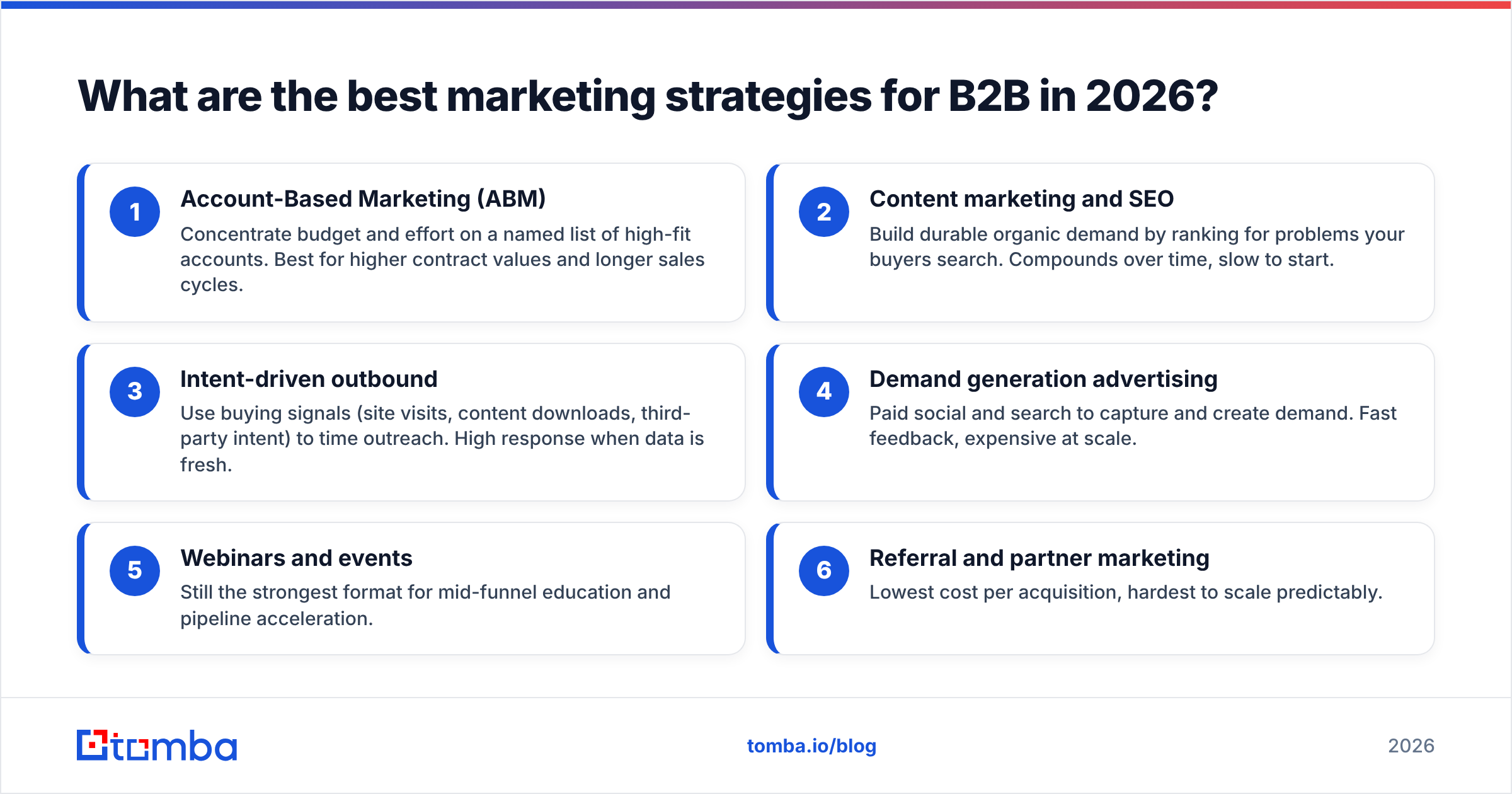
Here are the six strategies that consistently produce pipeline, ranked roughly by how much control you have over the outcome:
- Account-Based Marketing (ABM) — Concentrate budget and effort on a named list of high-fit accounts. Best for higher contract values and longer sales cycles.
- Content marketing and SEO — Build durable organic demand by ranking for problems your buyers search. Compounds over time, slow to start.
- Intent-driven outbound — Use buying signals (site visits, content downloads, third-party intent) to time outreach. High response when data is fresh.
- Demand generation advertising — Paid social and search to capture and create demand. Fast feedback, expensive at scale.
- Webinars and events — Still the strongest format for mid-funnel education and pipeline acceleration.
- Referral and partner marketing — Lowest cost per acquisition, hardest to scale predictably.
)
How do these B2B marketing strategies compare?#
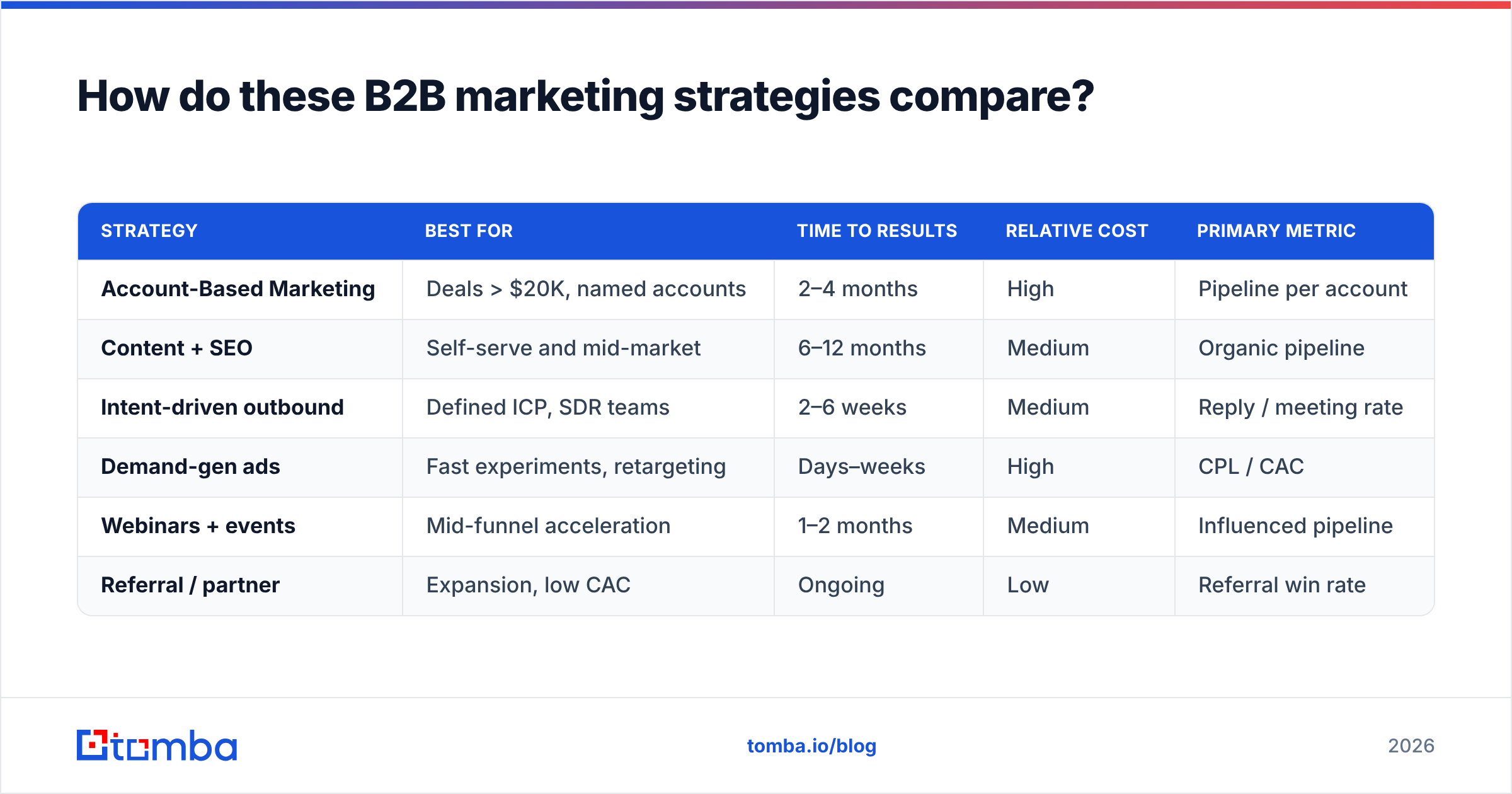
Different strategies fit different deal sizes, time horizons, and budgets. Use this table to decide where to start based on your motion, not on what's trendy.
| Strategy | Best for | Time to results | Relative cost | Primary metric |
|---|---|---|---|---|
| Account-Based Marketing | Deals > $20K, named accounts | 2–4 months | High | Pipeline per account |
| Content + SEO | Self-serve and mid-market | 6–12 months | Medium | Organic pipeline |
| Intent-driven outbound | Defined ICP, SDR teams | 2–6 weeks | Medium | Reply / meeting rate |
| Demand-gen ads | Fast experiments, retargeting | Days–weeks | High | CPL / CAC |
| Webinars + events | Mid-funnel acceleration | 1–2 months | Medium | Influenced pipeline |
| Referral / partner | Expansion, low CAC | Ongoing | Low | Referral win rate |
A practical sequence for most B2B teams: start with content and SEO to build a base of organic demand, layer intent-driven outbound to capture in-market buyers now, and add ABM once you can identify which accounts are worth concentrated effort. Demand-gen ads work best as an amplifier on top of that, not as your first move.
Why is account-based marketing the highest-ROI B2B strategy?#
ABM wins because it aligns spend with revenue concentration. In most B2B markets, a small slice of accounts represents the majority of addressable revenue. Instead of marketing to everyone, you build a target list of accounts that look like your best customers, then orchestrate marketing and sales around them.
The mechanics matter more than the philosophy. A working ABM program needs three things:
- A tight account list built from firmographics, technographics, and fit signals — not a 50,000-row export.
- Accurate contact data for the buying committee at each account, because ABM dies when your messages bounce or reach the wrong person.
- Coordinated plays across channels: ads to the account, personalized email to named contacts, and sales outreach timed to engagement.
This is where data quality becomes the hidden bottleneck. You can build a perfect account list, but if you can't reach the four to seven people who make the decision, the program stalls. Building the buying committee means finding verified work emails and, increasingly, B2B phone numbers for each role. A reliable email finder and data enrichment layer turn an account list into an addressable one. For a deeper primer on the discipline, HubSpot's ABM resources and Gartner's account-based research are solid neutral references.
How does intent data make outbound work in 2026?#
Intent data tells you which accounts are researching a problem you solve right now, so you reach out while the buying window is open. Cold outreach to a random list converts poorly; outreach timed to a real signal — a pricing-page visit, a competitor comparison download, a spike in topic research — converts several times better.
Think of intent data like a doorbell. Without it, you're knocking on every door in the neighborhood hoping someone's home. With it, you only knock when you can hear someone moving inside. The signal doesn't guarantee a sale, but it dramatically improves your odds and your timing.
To operationalize intent in your outbound motion:
- Capture first-party signals from your own site — repeat visits, high-intent pages, content downloads — using website visitor reveal to put a company name to anonymous traffic.
- Enrich the signal into contacts. A company name isn't actionable until you have the right person and a verified email. Run it through domain search to map the org and surface the relevant roles.
- Verify before you send. Always run addresses through an email verifier so your warm signal doesn't get torched by a hard bounce.
- Sequence with relevance, referencing the topic the account was researching, not a generic pitch.
The order is what makes it work: signal first, then contact, then verification, then message. Skip the verification step and your sender reputation erodes, which quietly undermines every other email-based strategy you run.
What role does content marketing and SEO play?#
Content is the only B2B strategy that compounds. Ads stop the moment you stop paying; a piece of content that ranks keeps generating pipeline for years. The catch is that it's slow and it's crowded — generic, AI-spun listicles no longer rank or convert. What works in 2026 is content that demonstrates first-hand expertise and answers the specific questions your buyers actually search.
A durable B2B content engine has three layers:
- Bottom-of-funnel pages — comparisons, alternatives, pricing explainers, and use-case pages that capture buyers ready to evaluate. These convert highest.
- Problem-aware guides — the educational content that builds trust and earns links, targeting the questions buyers ask before they know your category exists.
- Distribution — content that isn't promoted is content that doesn't exist. Repurpose into LinkedIn, newsletter, and sales enablement.
Pair every published asset with a capture mechanism. If you publish a guide that attracts your ICP, you want to identify and enrich those readers, not just count pageviews. That feedback loop — content brings traffic, enrichment turns traffic into named accounts, outbound and ads re-engage them — is what turns a blog into a pipeline source instead of a vanity metric. For benchmarks on what good content performance looks like, G2's research hub and vendor-neutral data from Forrester are useful baselines.
)
Why does clean data underpin every B2B marketing strategy?#
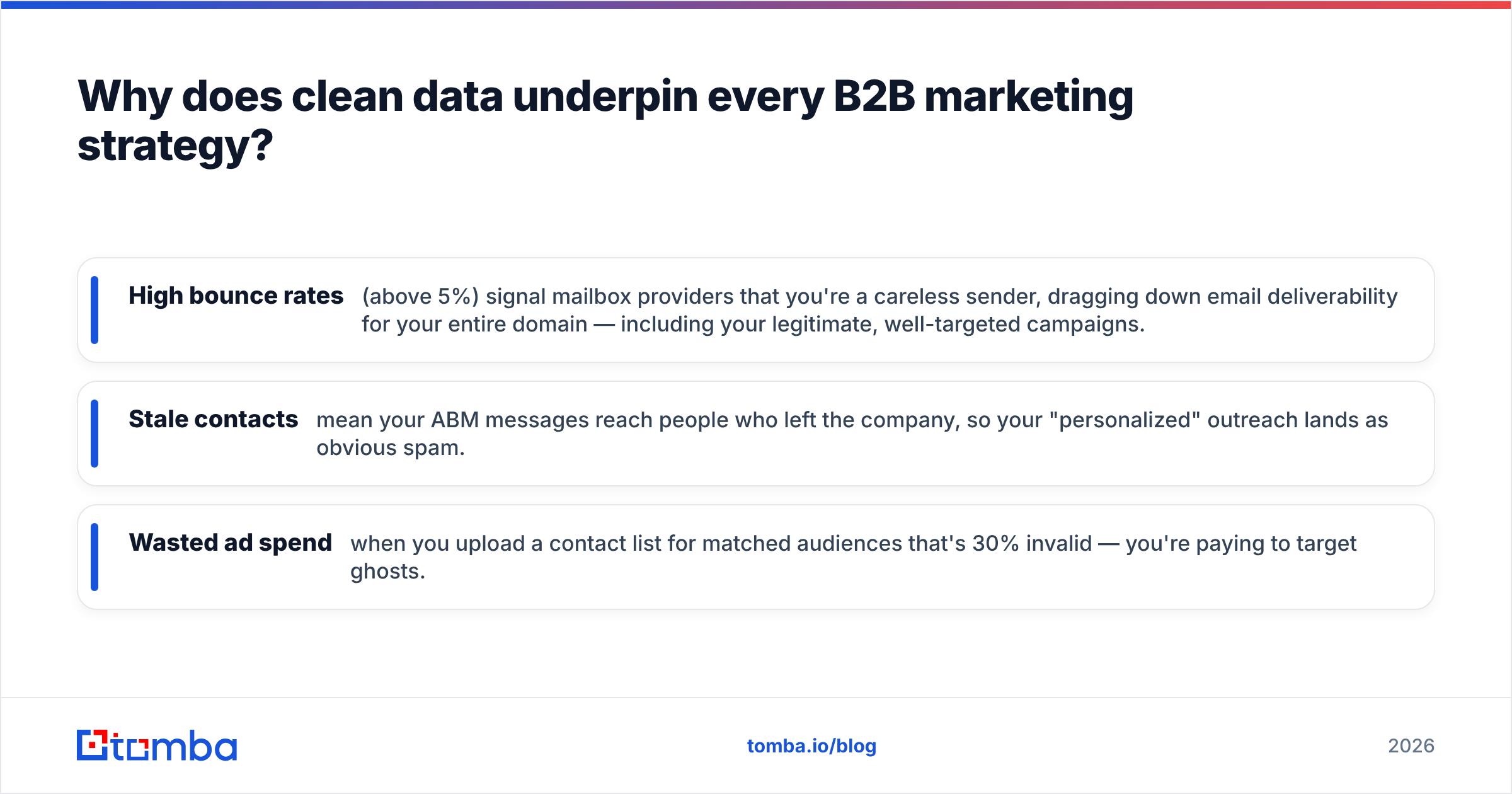
Every strategy above shares one dependency: accurate, deliverable contact data. It's the unglamorous foundation that determines whether your clever ABM play, your intent-timed outbound, and your content-driven retargeting actually reach a human.
The cost of bad data is rarely visible on a dashboard until it's severe. Consider the chain reaction:
- High bounce rates (above 5%) signal mailbox providers that you're a careless sender, dragging down email deliverability for your entire domain — including your legitimate, well-targeted campaigns.
- Stale contacts mean your ABM messages reach people who left the company, so your "personalized" outreach lands as obvious spam.
- Wasted ad spend when you upload a contact list for matched audiences that's 30% invalid — you're paying to target ghosts.
Clean data isn't a one-time project; it's hygiene. People change jobs, companies rebrand, and email formats shift. The teams that win treat verification and enrichment as a continuous process: find, verify, enrich, re-verify on a cadence. Tools like a bulk email finder and a catch-all verifier handle this at the volume B2B programs require, and the Tomba API lets you bake verification directly into your CRM and enrichment workflows so it happens automatically.
The strategic point: don't pick between investing in strategy and investing in data. Strategy without data is a plan you can't execute. Data without strategy is a list nobody uses. You need both, and data is the cheaper of the two to get right first.
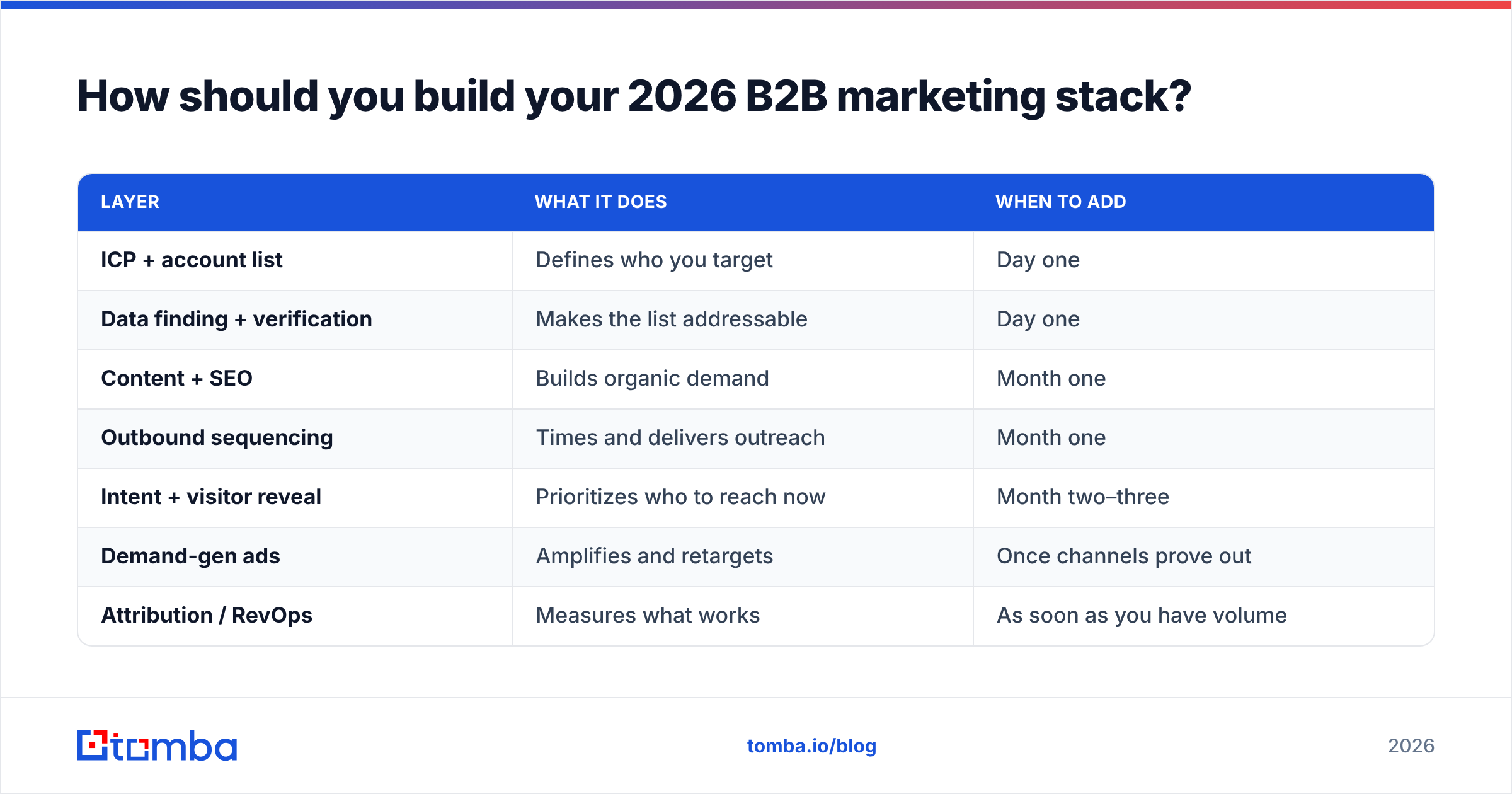
How should you build your 2026 B2B marketing stack?#
Start lean and instrument everything. The temptation is to buy a dozen tools; the better move is to nail the core loop — identify, reach, measure — and expand only when a clear bottleneck appears.
| Layer | What it does | When to add |
|---|---|---|
| ICP + account list | Defines who you target | Day one |
| Data finding + verification | Makes the list addressable | Day one |
| Content + SEO | Builds organic demand | Month one |
| Outbound sequencing | Times and delivers outreach | Month one |
| Intent + visitor reveal | Prioritizes who to reach now | Month two–three |
| Demand-gen ads | Amplifies and retargets | Once channels prove out |
| Attribution / RevOps | Measures what works | As soon as you have volume |
The thread running through every row is data. Your ICP is a data definition. Your outbound depends on verified emails. Your retargeting depends on matched, valid lists. Your attribution depends on clean records flowing into a single source of truth. If you're standing up a revenue operations function, make data hygiene its first mandate — it pays back across every channel.
A reasonable starter budget: most teams can run a focused ABM-plus-content motion on a low-five-figure monthly spend, with data tooling being a small fraction of that. Tomba's plans, for example, scale from a free tier (25 searches/month) through Starter at $49/mo and Growth at $99/mo — see the full Tomba pricing for where your volume lands. The point isn't the specific numbers; it's that data tooling is the cheapest line item with the highest leverage on every other dollar you spend.
What are the most common B2B marketing mistakes to avoid?#
- Chasing volume over fit. A 50,000-contact list with 40% bad data is worse than a 2,000-contact list that's verified and on-ICP.
- Running channels in isolation. If your ads, content, and outbound don't share a target account list, you're paying three times for fragmented results.
- Skipping verification. One careless bulk send can damage deliverability for months. Verify first, always.
- Measuring activity, not pipeline. Emails sent and posts published are inputs. Pipeline and revenue are the only outputs that matter.
- Treating data as a one-time buy. Contact data decays ~30% a year. Refresh on a cadence or watch your results quietly degrade.
Conclusion: which strategy should you start with?#
Start with a tight ICP, a verified contact list, and one or two channels you can execute well — then expand. The "best" B2B marketing strategy isn't a single tactic; it's the discipline of concentrating effort on the right accounts, reaching them with accurate data, and measuring against pipeline rather than activity. ABM and intent-driven outbound give you the fastest path to qualified conversations, while content and SEO build the compounding base underneath.
Whatever mix you choose, it lives or dies on whether you can actually reach the right people. That's the part you can fix today. Tomba's Email Finder turns your target account list into verified, deliverable contacts — by domain, name, or company — so every strategy above has clean data to run on. Start free with 25 searches a month, plug it into your CRM via the API, and build your 2026 pipeline on a foundation that won't bounce.
Ready to find emails that actually work?
Join 150,000+ professionals who stopped guessing and started sending. Free credits on signup — no credit card required.
Get the Tomba newsletter
Practical outbound tactics and product updates — once every two weeks.
About the author