The Best Nurture Campaigns in 2026: Examples That Convert
The best nurture campaigns in 2026 aren't blasts — they're triggered, segmented, and data-backed. Here are the frameworks, examples, and tools that move leads to revenue.
Most "nurture campaigns" are just a newsletter wearing a costume. The best nurture campaigns in 2026 are something else entirely: triggered sequences that react to what a lead actually does, segmented by intent, and built on clean contact data instead of a guessed-at email list. This guide breaks down the frameworks that work, real campaign examples you can copy, and the stack that powers them.
TL;DR#
- The best nurture campaigns are behavioral, not calendar-based. They fire on actions (a demo no-show, a pricing-page visit) rather than "day 3, day 7, day 14."
- Segmentation beats volume. A 5-email sequence to the right 200 people outperforms a 12-email blast to 5,000 every time.
- Bad data kills good nurture. If 20% of your list bounces, your sender reputation tanks and your best emails never land. Verify before you send.
- Multi-channel wins. Email + LinkedIn + a timed phone touch lifts reply rates well above email-only.
- Tooling matters less than triggers — but you still need accurate contacts, verified emails, and enrichment to personalize at scale.
What is a nurture campaign, really?#
A nurture campaign is a planned series of touches that moves a lead from "vaguely aware" to "ready to buy" without a human manually chasing each one. Think of it like watering a plant on a schedule the plant chooses: instead of dumping a bucket every Monday, you respond to when the soil is actually dry.
The old definition — an automated email drip — is now the weakest version. Modern nurture spans email, LinkedIn, retargeting, and sales calls, and it keys off behavior. The difference between a mediocre and a best-in-class nurture campaign usually comes down to three things:
- Trigger quality — what starts the sequence
- Segmentation — who gets which message
- Data hygiene — whether your contacts are real and reachable
What separates the best nurture campaigns from the rest?#
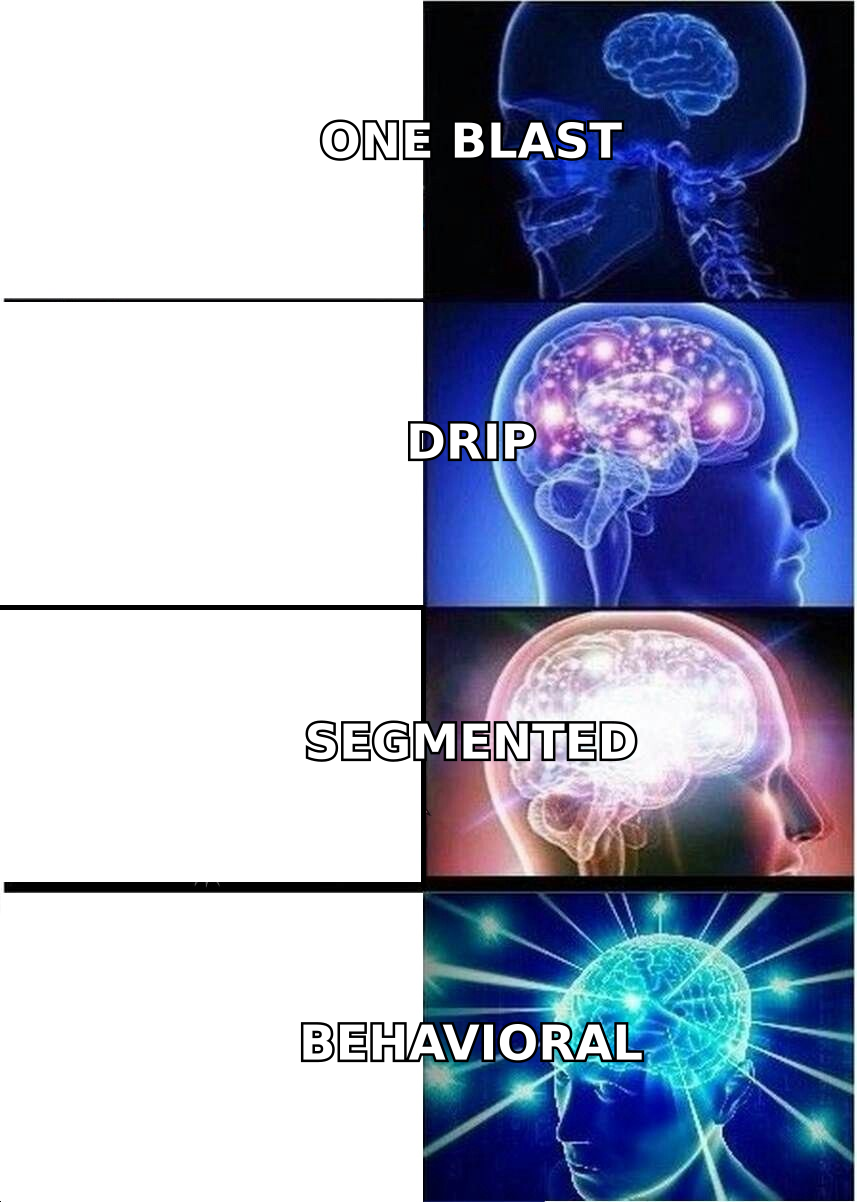
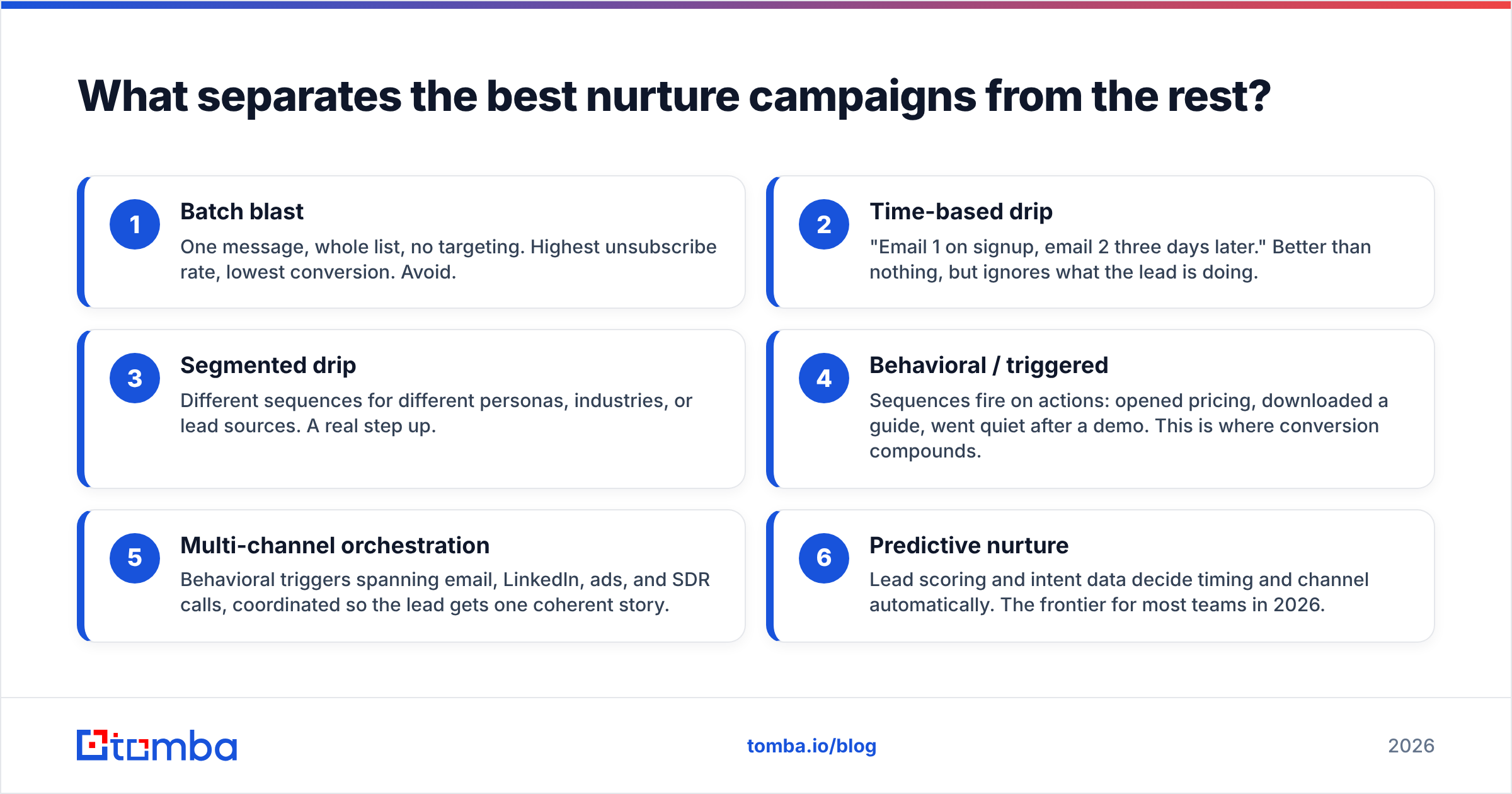
Here's the core concept laid out as a progression. Each level is more sophisticated — and more effective — than the one above it:
- Batch blast — One message, whole list, no targeting. Highest unsubscribe rate, lowest conversion. Avoid.
- Time-based drip — "Email 1 on signup, email 2 three days later." Better than nothing, but ignores what the lead is doing.
- Segmented drip — Different sequences for different personas, industries, or lead sources. A real step up.
- Behavioral / triggered — Sequences fire on actions: opened pricing, downloaded a guide, went quiet after a demo. This is where conversion compounds.
- Multi-channel orchestration — Behavioral triggers spanning email, LinkedIn, ads, and SDR calls, coordinated so the lead gets one coherent story.
- Predictive nurture — Lead scoring and intent data decide timing and channel automatically. The frontier for most teams in 2026.
You don't need to reach level 6 to win. Most teams see the biggest jump moving from level 2 to level 4 — and that jump depends almost entirely on having accurate contact and behavioral data to trigger on.
What are the best nurture campaign types in 2026?#
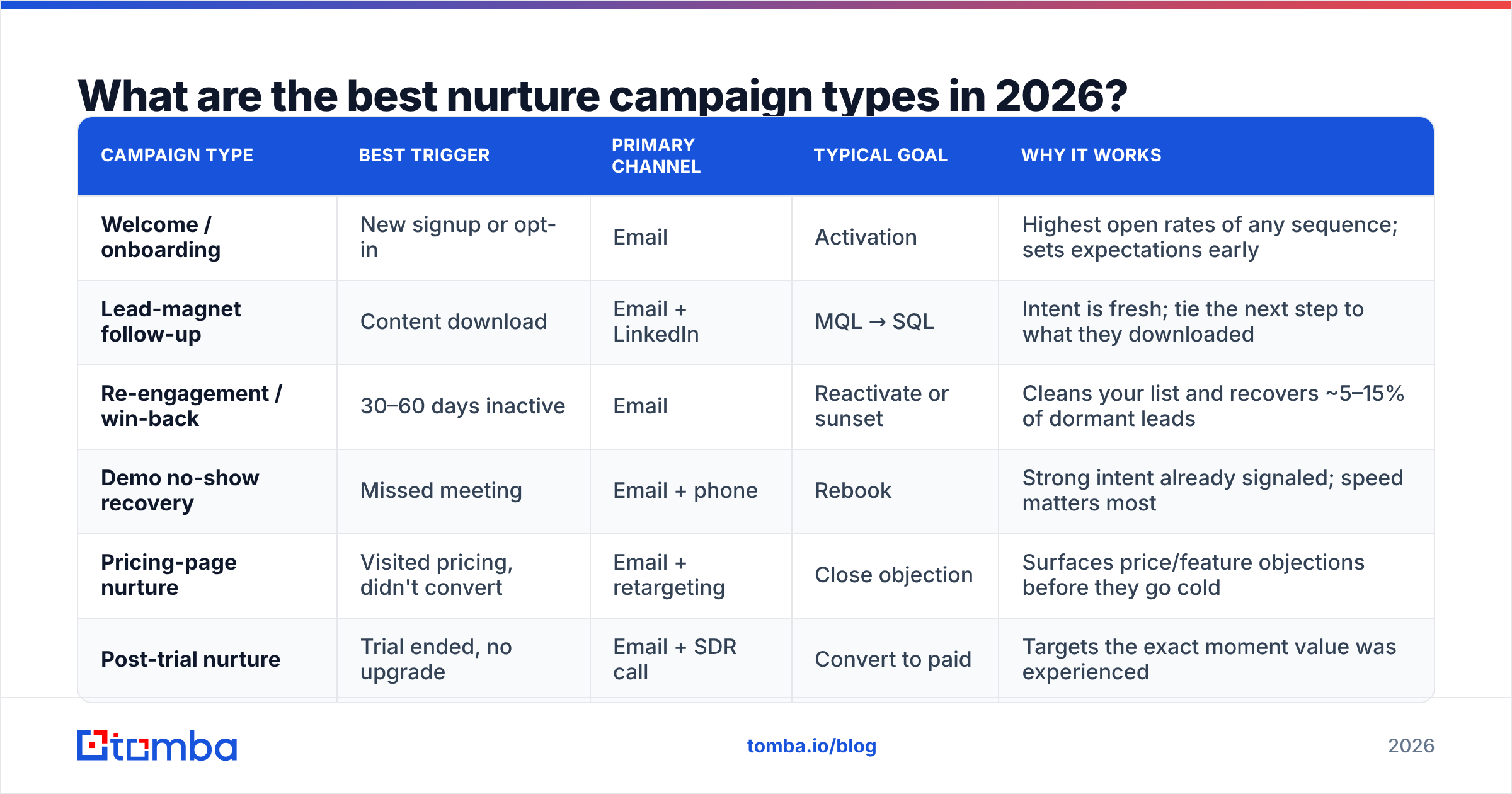
Below are the campaign archetypes that consistently outperform. Mix and match them to your funnel.
| Campaign type | Best trigger | Primary channel | Typical goal | Why it works |
|---|---|---|---|---|
| Welcome / onboarding | New signup or opt-in | Activation | Highest open rates of any sequence; sets expectations early | |
| Lead-magnet follow-up | Content download | Email + LinkedIn | MQL → SQL | Intent is fresh; tie the next step to what they downloaded |
| Re-engagement / win-back | 30–60 days inactive | Reactivate or sunset | Cleans your list and recovers ~5–15% of dormant leads | |
| Demo no-show recovery | Missed meeting | Email + phone | Rebook | Strong intent already signaled; speed matters most |
| Pricing-page nurture | Visited pricing, didn't convert | Email + retargeting | Close objection | Surfaces price/feature objections before they go cold |
| Post-trial nurture | Trial ended, no upgrade | Email + SDR call | Convert to paid | Targets the exact moment value was experienced |
A practical rule: if a lead's behavior changed, your message should too. A pricing-page visitor and a blog subscriber are not the same person and should never get the same email.
Is behavioral nurture better than a time-based drip?#
Yes — in almost every case, behavioral nurture beats a fixed time-based drip. A time-based drip sends "day 3, day 7, day 14" no matter what the lead does. A behavioral sequence sends the next relevant thing based on the last relevant action.
The catch: behavioral nurture needs reliable signals. You're triggering on opens, clicks, page visits, form fills, and CRM stage changes. If your contact records are incomplete or your emails bounce, the triggers never fire correctly. This is where most "behavioral" programs quietly fall back to time-based — not because the strategy is wrong, but because the underlying data is dirty.
That's why list quality is a strategy decision, not a janitorial one. Run new contacts through an email verifier before they enter any sequence, and use data enrichment to fill in the firmographic and role fields you'll segment on. Clean inputs are what make the fancy triggers actually work.

How do you build a best-in-class nurture campaign? (7 steps)#
Here's a repeatable build process. It works whether you're in HubSpot, Salesforce, or a lightweight sequencer.
- Define the exit, not just the entry. Decide what "graduated" looks like (booked a call, upgraded, replied) before you write a single email. Every message should pull toward that exit.
- Pick one trigger per sequence. Don't blend "downloaded ebook" and "abandoned trial" into one campaign. One trigger, one audience, one story.
- Source and verify the contacts. If you're building outbound nurture, find the right people first. Use a domain search to map decision-makers at a target account, then verify every address before it enters the flow.
- Enrich for personalization tokens. Pull role, company size, and tech stack so your merge fields are real ("I saw {company} is hiring SDRs") instead of generic.
- Write 4–6 touches, not 12. Lead with value, not features. Each email earns the next. The best-performing sequences are short and specific.
- Add a non-email channel. Layer in a LinkedIn touch or a single, well-timed call on the highest-intent step. Multi-channel consistently lifts reply rates.
- Measure per-step, then prune. Track open, reply, and conversion at each step. Kill the step that leaks the most. Iterate monthly.
For deliverability, warm your sending domain and keep bounce rates under 2% — your sender reputation is the difference between landing in the inbox and the spam folder. HubSpot's own lead nurturing research backs the short-and-segmented approach: targeted nurtured leads produce meaningfully larger sales-ready volume at lower cost.
What does a real nurture sequence look like?#
Here's a concrete 5-touch lead-magnet follow-up you can adapt. Trigger: a prospect downloaded a comparison guide.
- Touch 1 (immediate, email): Deliver the asset + one sentence on the single most useful takeaway. No pitch.
- Touch 2 (day 2, email): A short case study tied to the guide's topic. Ask one soft question.
- Touch 3 (day 4, LinkedIn): Connection request or comment referencing the download topic — human, not salesy.
- Touch 4 (day 6, email): Address the most common objection directly. Offer a low-friction next step (a 15-minute call, not a "demo").
- Touch 5 (day 9, email): A clean breakup email: "Should I close your file?" These routinely get the highest reply rate of the whole sequence.
Notice there's no touch 6 through 12. Restraint is a feature. If none of five relevant, well-timed messages land, more of the same won't help — and it will hurt your reputation.
Which tools power the best nurture campaigns?#
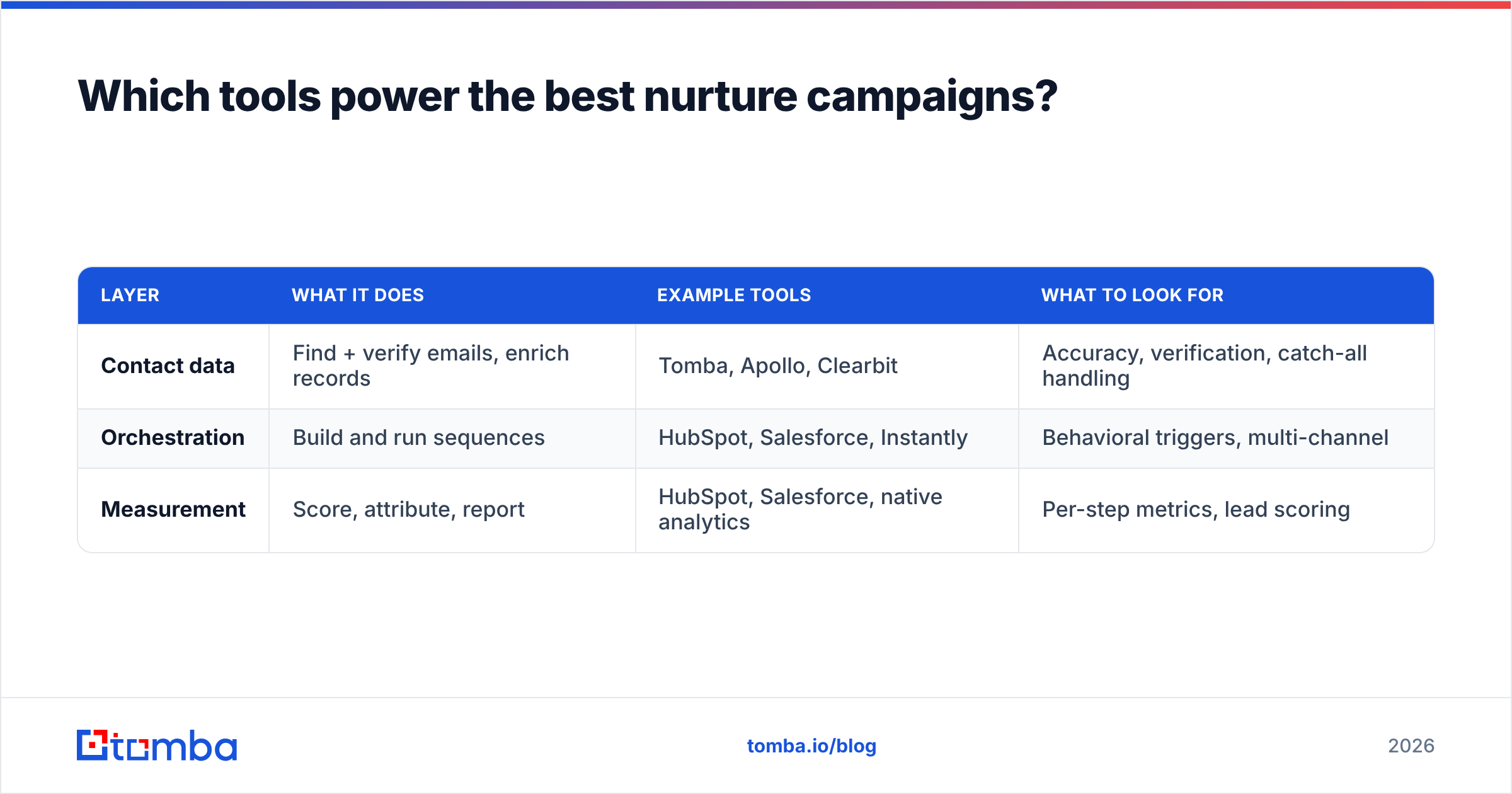
Tooling splits into three jobs: data (find and verify contacts), orchestration (run the sequences), and measurement (score and report). You'll usually combine a data layer with a sequencing/CRM layer.
| Layer | What it does | Example tools | What to look for |
|---|---|---|---|
| Contact data | Find + verify emails, enrich records | Tomba, Apollo, Clearbit | Accuracy, verification, catch-all handling |
| Orchestration | Build and run sequences | HubSpot, Salesforce, Instantly | Behavioral triggers, multi-channel |
| Measurement | Score, attribute, report | HubSpot, Salesforce, native analytics | Per-step metrics, lead scoring |
On the data layer, accuracy is the whole game. A nurture engine fed bad emails produces bounces, spam complaints, and broken triggers. Tomba covers the data job end to end — email finding, verification, catch-all checks, and enrichment — and its pricing is straightforward: a free tier with 25 searches/mo, Starter at $49/mo, Growth at $99/mo, Pro at $249/mo, and custom Enterprise. You can compare options on independent review sites like G2 before committing.
For orchestration, most teams run HubSpot or Salesforce for the workflow engine and CRM-stage triggers, then plug a data provider in via their integrations so contacts arrive verified and enriched.
How the layers fit together#
- Find the right contacts at target accounts (domain search + email finder)
- Verify every address so nothing bounces into your sequence
- Enrich records with role and firmographic data for real personalization
- Trigger behavioral sequences in your CRM or sequencer
- Score and prune based on per-step performance
Get the first three right and the last two get dramatically easier.
What are the most common nurture campaign mistakes?#
- Sending to unverified lists. One spam trap or a 15% bounce rate can blacklist your domain. Verify first, always.
- Confusing frequency with nurture. More emails is not more nurturing. It's more unsubscribing.
- Ignoring the no-reply signal. Silence is data. Move quiet leads to a low-frequency track instead of hammering them.
- One message for every persona. A VP and an individual contributor don't share goals — or objections.
- No exit criteria. Sequences that never end annoy buyers and clog your reporting.
- Personalization theater. "{FirstName}, I loved your work" with no real detail reads worse than no personalization at all. Enrich properly or keep it honest.
How do you measure if a nurture campaign is working?#
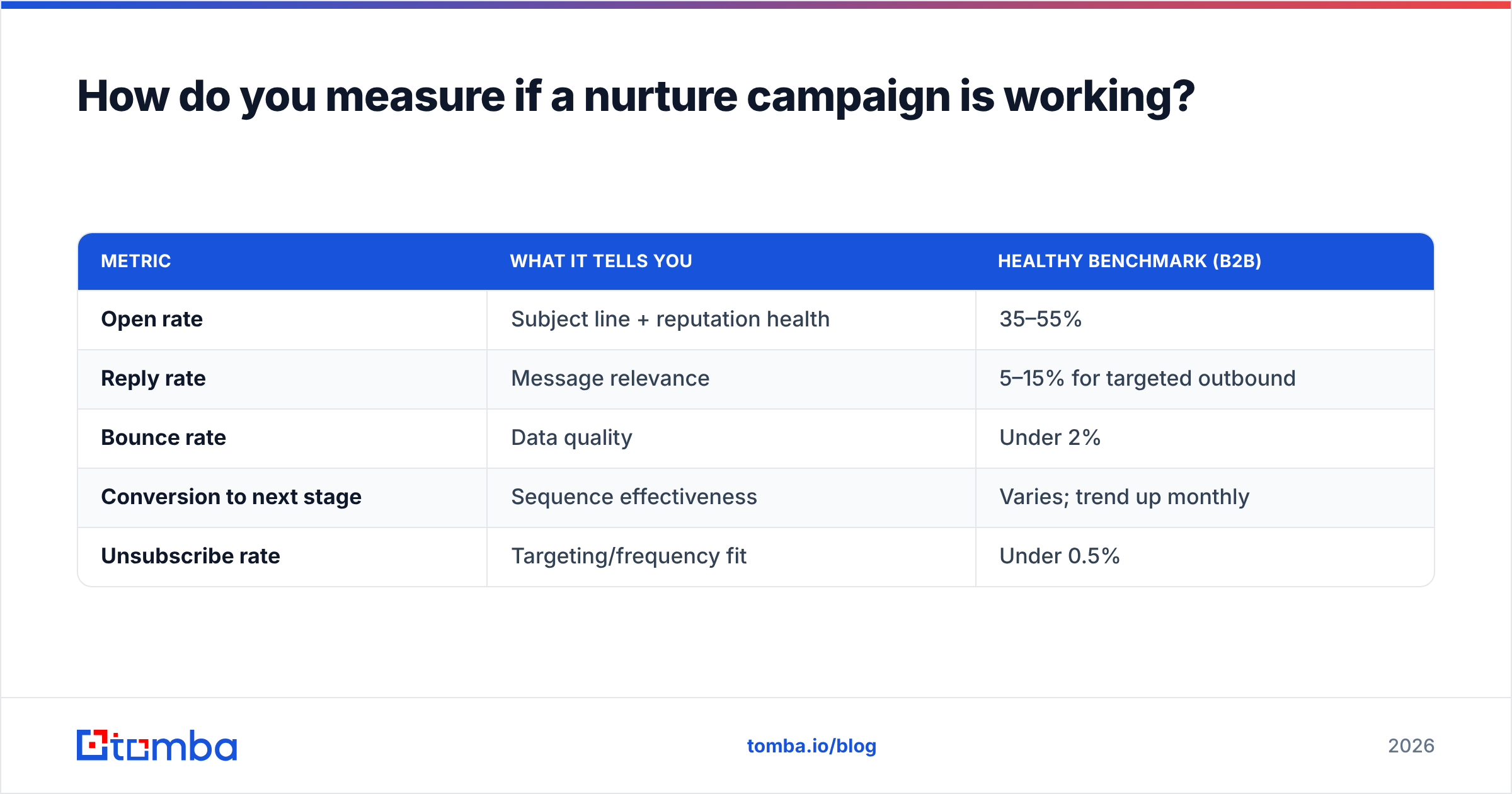
Track these at the campaign and per-step level:
| Metric | What it tells you | Healthy benchmark (B2B) |
|---|---|---|
| Open rate | Subject line + reputation health | 35–55% |
| Reply rate | Message relevance | 5–15% for targeted outbound |
| Bounce rate | Data quality | Under 2% |
| Conversion to next stage | Sequence effectiveness | Varies; trend up monthly |
| Unsubscribe rate | Targeting/frequency fit | Under 0.5% |
If your bounce rate is high, stop everything and fix data before optimizing copy. No subject line saves an email that never arrives. Watch email deliverability as your leading indicator — it moves before your conversion numbers do.
Frequently asked questions#
How many emails should a nurture campaign have? Usually 4–6 touches per sequence. Short, relevant sequences outperform long ones. Add channels (LinkedIn, phone) rather than more emails.
How often should I email a nurtured lead? Every 2–3 days inside an active sequence, then back off to a low-frequency track if they don't engage. Respect the silence signal.
Do I need a CRM to run nurture campaigns? For anything beyond a basic drip, yes — you need somewhere to store behavior and trigger off it. HubSpot and Salesforce are the common choices; lightweight sequencers work for pure outbound.
What's the single biggest lever for better nurture results? Clean, verified, enriched contact data. It powers your triggers, your personalization, and your deliverability all at once.
Start with the data layer#
The best nurture campaigns in 2026 aren't about clever copy or a bigger send list — they're about reacting to real behavior with messages aimed at real people whose details you actually trust. That trust starts with your contact data.
Before you build your next sequence, fix the foundation: find the right decision-makers, verify every email, and enrich each record so your personalization is true. The Tomba Email Finder does exactly that — find professional emails by domain, name, or company, verify them, and feed clean, ready-to-nurture contacts straight into your CRM. Start free with 25 searches a month, and let your triggers fire on data you can count on.
// get started
Find, verify and enrich your first contacts today
Start on the free plan with 25 searches a month, then scale when your team is ready.
Free plan · No credit card required · GDPR & CCPA
// about the author