Best Practices for Lead Generation: A 2026 Playbook
The lead-gen tactics that worked in 2021 now bleed budget. Here are the best practices for lead generation that actually fill pipeline in 2026 — with a framework, a channel table, and the metrics that matter.
Lead generation got harder and more expensive at the same time. Buyers ignore cold blasts, gated PDFs convert worse every quarter, and the "spray a 50,000-row list" play now mostly buys you spam complaints. The teams winning in 2026 are not the ones with the biggest lists — they are the ones with the tightest targeting, the cleanest data, and the discipline to measure what actually turns into revenue.
This is a working playbook, not a listicle. It covers how to define who you chase, which channels still pay off, how to keep your data clean enough to reach people, and how to score and measure leads so you stop confusing volume with pipeline.
TL;DR — the short version#
- Define a sharp ICP before you spend a dollar. Narrow targeting beats volume every time; a 500-account list you understand outperforms a 50,000-row list you bought.
- Verify and enrich every contact before it enters a sequence. Bad data is the single biggest silent killer of lead-gen ROI — it tanks deliverability and wastes rep hours.
- Run multi-channel, not single-channel. Email plus LinkedIn plus phone, sequenced and personalized, beats any one channel alone.
- Score leads on fit and behavior, route fast, and follow up persistently — most conversions happen after the third touch.
- Measure cost per qualified lead and pipeline created, not raw lead count. Vanity metrics hide a leaky funnel.
What does "lead generation" actually mean in 2026?#
Lead generation is the process of attracting and identifying people who might buy from you, then collecting enough accurate contact and context data to start a real conversation. That second half — accurate data and context — is where most programs quietly fail.
Think of lead gen like fishing. Buying a giant email list is casting a net into a parking lot: lots of effort, no fish. Modern lead gen is knowing which lake holds the fish, what they bite, and showing up with the right bait at the right hour. The "lake" is your Ideal Customer Profile. The "bait" is relevance. Everything in this guide ladders up to those two ideas.
A healthy 2026 program blends inbound (content, SEO, intent-driven signals that pull buyers to you) and outbound (researched, personalized direct outreach). The old wall between the two is gone — your best outbound list is often built from inbound signals like website visits, content engagement, and product trials.
/blog/generated/memes/2026-06-18/best-practices-for-lead-generation-meme-1.png
What are the core best practices for lead generation?#
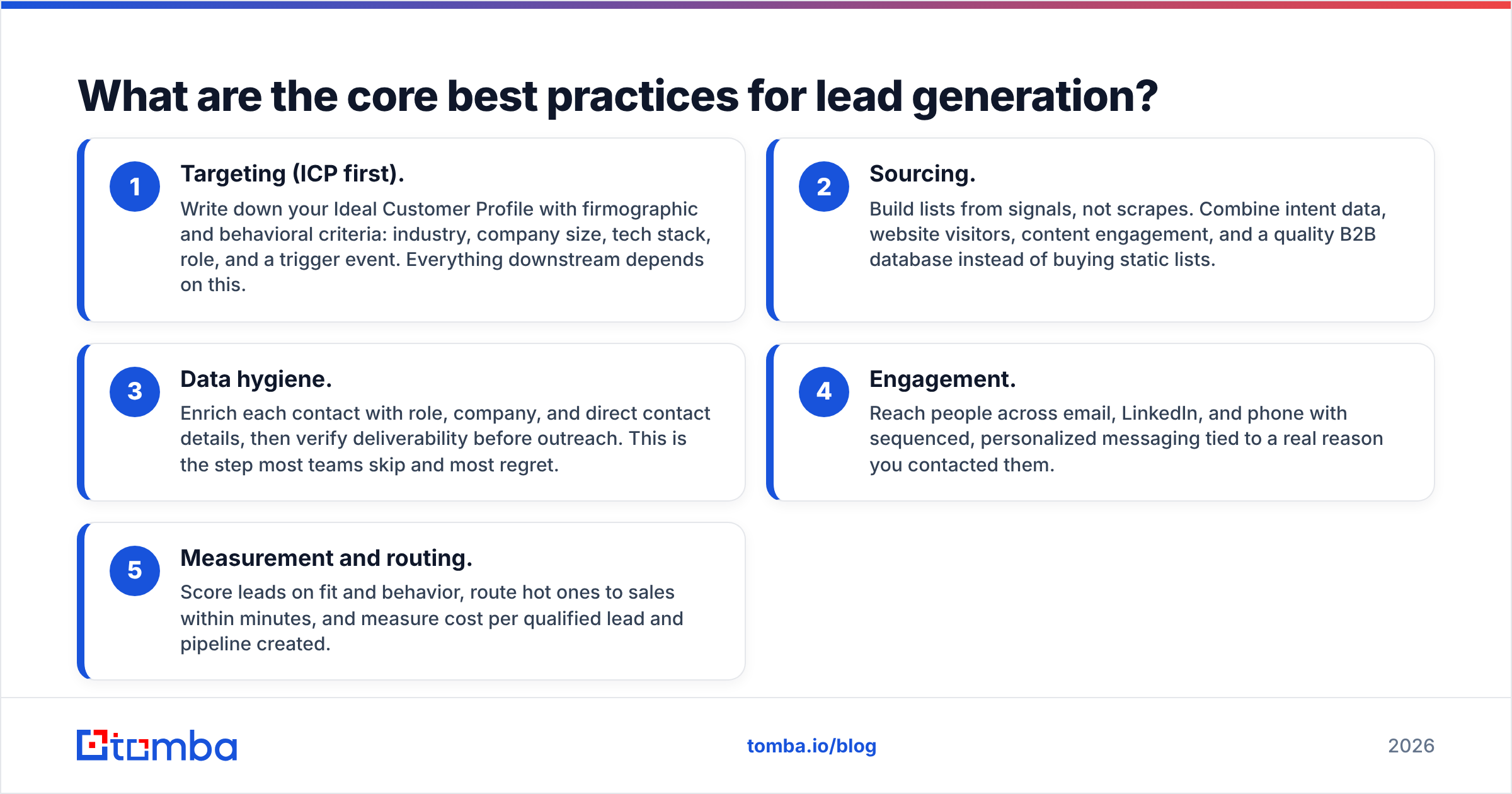
Here is the framework. Five disciplines, in order — each one makes the next one work better.
- Targeting (ICP first). Write down your Ideal Customer Profile with firmographic and behavioral criteria: industry, company size, tech stack, role, and a trigger event. Everything downstream depends on this.
- Sourcing. Build lists from signals, not scrapes. Combine intent data, website visitors, content engagement, and a quality B2B database instead of buying static lists.
- Data hygiene. Enrich each contact with role, company, and direct contact details, then verify deliverability before outreach. This is the step most teams skip and most regret.
- Engagement. Reach people across email, LinkedIn, and phone with sequenced, personalized messaging tied to a real reason you contacted them.
- Measurement and routing. Score leads on fit and behavior, route hot ones to sales within minutes, and measure cost per qualified lead and pipeline created.
Skip any one of these and the others lose force. Perfect targeting with dirty data still bounces. Clean data with a generic message still gets ignored.
How do you build an Ideal Customer Profile that works?#
Conclusion first: a good ICP is specific enough that you can disqualify a prospect in ten seconds. If your ICP is "B2B SaaS companies," it is too vague to be useful.
Build it from three layers:
- Firmographics — industry, employee count, revenue band, geography, and funding stage. These are your hard filters.
- Technographics — the tools they already run. If you integrate with HubSpot, companies running HubSpot are warmer by default. Tools like a website tech stack checker help you filter on this signal.
- Trigger events — hiring for a relevant role, a new funding round, a leadership change, or expansion into a new market. Triggers tell you when to reach out, which doubles reply rates.
Validate the ICP against your closed-won deals. If your best customers do not match your written ICP, the ICP is wrong — fix it before scaling outreach. A precise marketing qualified lead definition flows directly from this work.
Which lead generation channels still perform?#
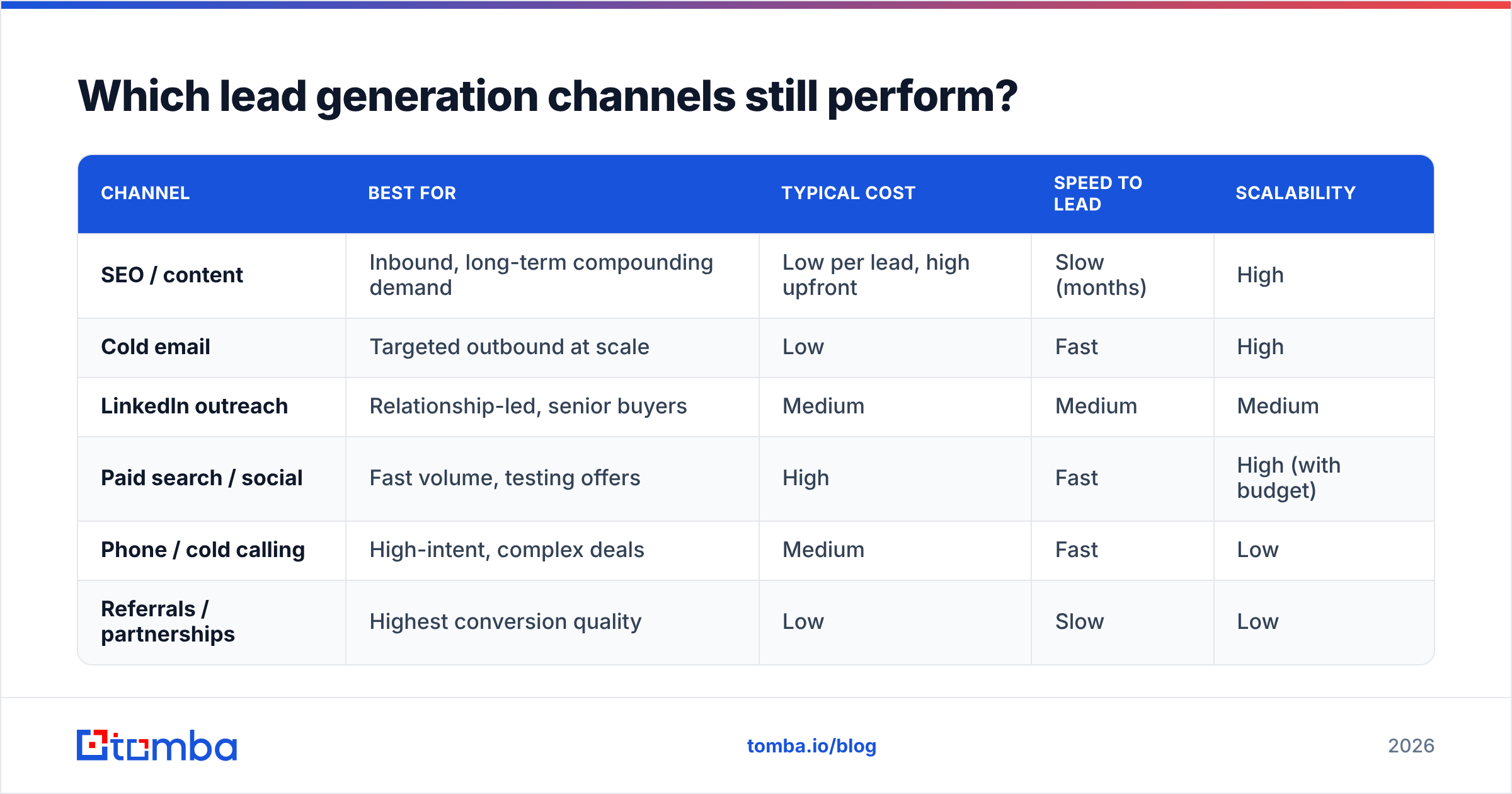
No single channel carries a program anymore. The winners run a coordinated mix and let each channel do what it does best. Here is how the main channels stack up in 2026.
| Channel | Best for | Typical cost | Speed to lead | Scalability |
|---|---|---|---|---|
| SEO / content | Inbound, long-term compounding demand | Low per lead, high upfront | Slow (months) | High |
| Cold email | Targeted outbound at scale | Low | Fast | High |
| LinkedIn outreach | Relationship-led, senior buyers | Medium | Medium | Medium |
| Paid search / social | Fast volume, testing offers | High | Fast | High (with budget) |
| Phone / cold calling | High-intent, complex deals | Medium | Fast | Low |
| Referrals / partnerships | Highest conversion quality | Low | Slow | Low |
The practical move: pick one primary inbound engine (usually SEO/content) for compounding demand, and one or two outbound channels for speed and control. Cold email plus LinkedIn is the most common high-leverage pair, with phone reserved for your hottest accounts. For deeper outbound tactics, see Tomba's guidance on LinkedIn outreach and pairing it with verified email.
Why does data quality decide whether lead generation works?#
Because you cannot convert a lead you cannot reach. Conclusion first: dirty data is the most expensive problem in lead gen, and it is invisible until your sender reputation is already damaged.
Here is the chain reaction. A list with 25% invalid emails means a quarter of your sends bounce. High bounce rates wreck email deliverability, which means even your valid contacts stop seeing your messages because mailbox providers start routing you to spam. One bad list can poison outreach to your good contacts for weeks.
The fix is a two-step hygiene routine before any contact enters a sequence:
- Enrich — fill in missing role, company, LinkedIn, and direct details so your message can be personalized and routed correctly. Data enrichment turns a bare email into a usable lead.
- Verify — confirm the mailbox actually exists and accepts mail. An email verifier catches invalids, traps, and risky catch-all domains before they cost you.
Make this non-negotiable. The fastest ROI improvement most teams can make is not a new channel — it is verifying the list they already have.
/blog/generated/memes/2026-06-18/best-practices-for-lead-generation-meme-2.png
How do you find and verify contact data at scale?#
You need a repeatable way to go from "I know the company" to "I have a verified, personalized contact." That is exactly the job of a dedicated email finder: give it a name and domain, get back a professional email with a confidence score, then verify it.
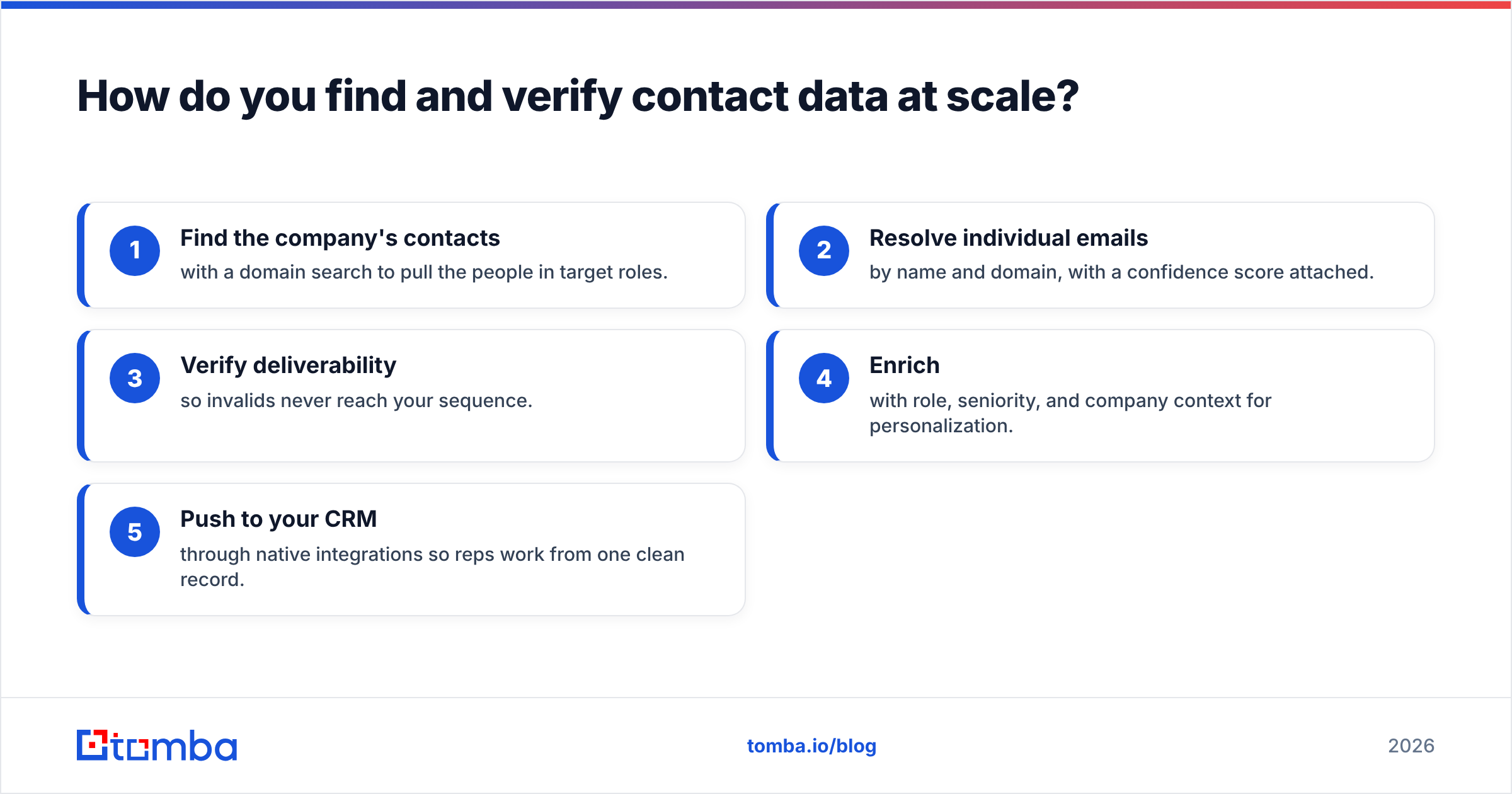
A clean sourcing workflow looks like this:
- Find the company's contacts with a domain search to pull the people in target roles.
- Resolve individual emails by name and domain, with a confidence score attached.
- Verify deliverability so invalids never reach your sequence.
- Enrich with role, seniority, and company context for personalization.
- Push to your CRM through native integrations so reps work from one clean record.
For large pulls, a bulk email finder processes whole account lists at once, and the Tomba API wires the whole flow into your own automation. The principle holds at any scale: find, verify, enrich, then engage — never engage first.
How should you score and route leads?#
Score on two axes and route on the result. Fit (does this match the ICP?) and behavior (are they showing buying signals?). A simple model: assign points for fit attributes and for actions — pricing-page visits, demo requests, repeat opens, content downloads — then set a threshold that flips a lead from "nurture" to "sales-ready."
The rule that matters more than the model: speed of routing. Research on inbound response consistently shows that contacting a web lead within five minutes versus thirty minutes can swing your odds of qualifying it by an order of magnitude (see HubSpot's research on lead response time). Hot leads decay fast. Automate the hand-off so a sales-ready lead never sits in a queue.
Keep your scoring honest by reviewing it quarterly against actual closed deals — the same way you validate the ICP. A scoring model that no longer predicts revenue is just busywork.
What metrics actually tell you lead generation is working?#
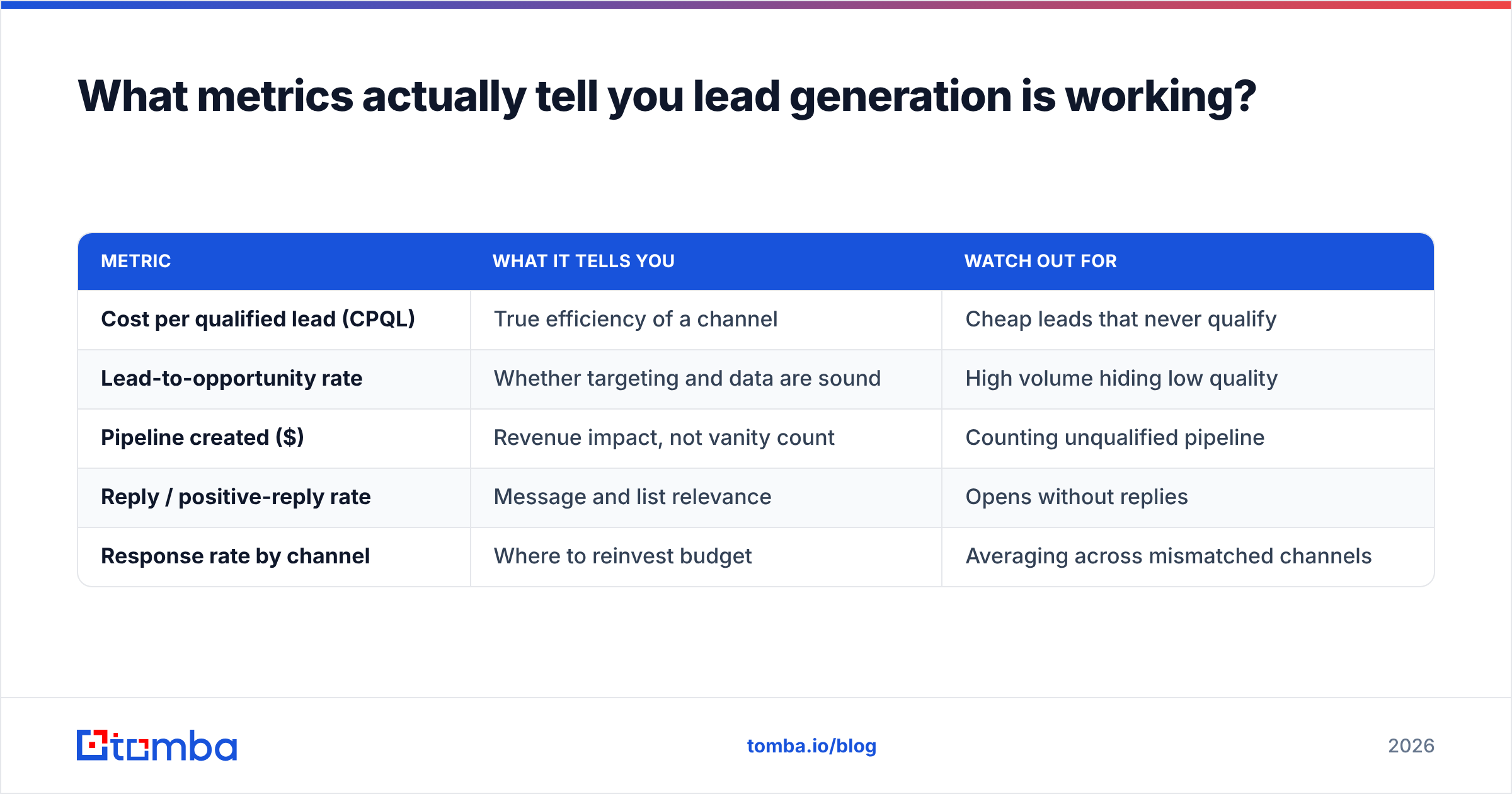
Stop counting raw leads. A pile of unqualified leads costs money to chase and tells you nothing. Track the metrics that connect activity to revenue.
| Metric | What it tells you | Watch out for |
|---|---|---|
| Cost per qualified lead (CPQL) | True efficiency of a channel | Cheap leads that never qualify |
| Lead-to-opportunity rate | Whether targeting and data are sound | High volume hiding low quality |
| Pipeline created ($) | Revenue impact, not vanity count | Counting unqualified pipeline |
| Reply / positive-reply rate | Message and list relevance | Opens without replies |
| Response rate by channel | Where to reinvest budget | Averaging across mismatched channels |
The north-star pair is cost per qualified lead and pipeline created. If those two are healthy, the funnel is working. If raw lead count is up but pipeline is flat, you have a quality problem disguised as a growth story — usually traceable back to weak targeting or dirty data.
For benchmarks on what "good" looks like by industry, third-party review sites like G2 and analyst notes from Gartner are useful sanity checks against your own numbers.
What are the most common lead generation mistakes?#
The same handful of errors drain most budgets:
- Buying static lists instead of building from signals. They are stale on arrival and tank deliverability.
- Skipping verification. One unverified send batch can damage sender reputation for weeks.
- Single-channel dependence. Email-only or LinkedIn-only programs cap out fast.
- Generic messaging. No trigger, no personalization, no reason to reply.
- Giving up after one or two touches. Most positive replies come on touch three through five.
- Measuring volume, not pipeline. The metric you choose shapes the behavior you get.
Fix these in order and most programs improve before you ever add a new channel or tool.
Putting it together#
Best-practice lead generation in 2026 is not a growth hack — it is a system: a sharp ICP, signal-based sourcing, clean and verified data, multi-channel personalized engagement, fast scoring and routing, and revenue-based measurement. The teams that win treat data quality as the foundation, not an afterthought, because every other step compounds on top of it.
Start where the ROI is fastest. If you only fix one thing this quarter, make it your data: find the right contacts, verify them, and enrich them before they ever hit a sequence. The Tomba Email Finder does exactly that — turning a company domain or a name into a verified, enrichment-ready contact with a confidence score, so your outreach lands in inboxes instead of spam folders. Pair it with the free tier (25 searches/month) to test it on your real target list, then scale through Tomba's pricing plans starting at $49/month as your pipeline grows. Clean data first, then everything else works.
// get started
Find, verify and enrich your first contacts today
Start on the free plan with 25 searches a month, then scale when your team is ready.
Free plan · No credit card required · GDPR & CCPA
// about the author