The Best Prospecting Email Ever: A 2026 Teardown
What makes the best prospecting email ever? We break down the structure, the data behind it, and steal-worthy templates that actually book meetings in 2026.
The Best Prospecting Email Ever: A 2026 Teardown
Everyone claims to have written the best prospecting email ever. Most of them are lying, and the proof is in your spam folder. The truth is less glamorous: the highest-converting cold emails are short, specific, sent to the right person, and built on a verified address. There is no magic sentence — there is a repeatable structure plus clean data.
This teardown shows you exactly what that structure looks like, why it works, and how to copy it without sounding like a bot.
TL;DR#
- The best prospecting email ever is under 90 words, leads with relevance, and asks for one tiny next step — not a 30-minute "quick call."
- Targeting and data beat clever copy. A perfect line sent to the wrong inbox still bounces. Verified addresses are the unglamorous foundation.
- A reliable skeleton: trigger → relevance → value → soft CTA → P.S. Each line earns the next.
- Personalization at scale only works when your contact data (name, role, company signal) is accurate — garbage in, ghosted out.
- Templates below are copy-paste ready; swap the brackets, keep the brevity.
What actually makes a prospecting email "the best"?#
The best prospecting email ever is the one that gets a reply from a real buyer — not the one that wins a copywriting award. By that definition, three things matter far more than word choice:
- Right person. You're emailing someone who owns the problem and can act on it.
- Right reason. A trigger event or specific observation makes the timing feel deliberate, not random.
- Right deliverability. The message lands in the primary inbox because the address is verified and your sending reputation is intact.
Copy is the fourth lever, and it only pays off once the first three are handled. A study of cold outreach by HubSpot repeatedly lands on the same conclusion: relevance and brevity outperform polish. You can write Hemingway-grade prose and still get ignored if you sent it to a shared info@ mailbox.
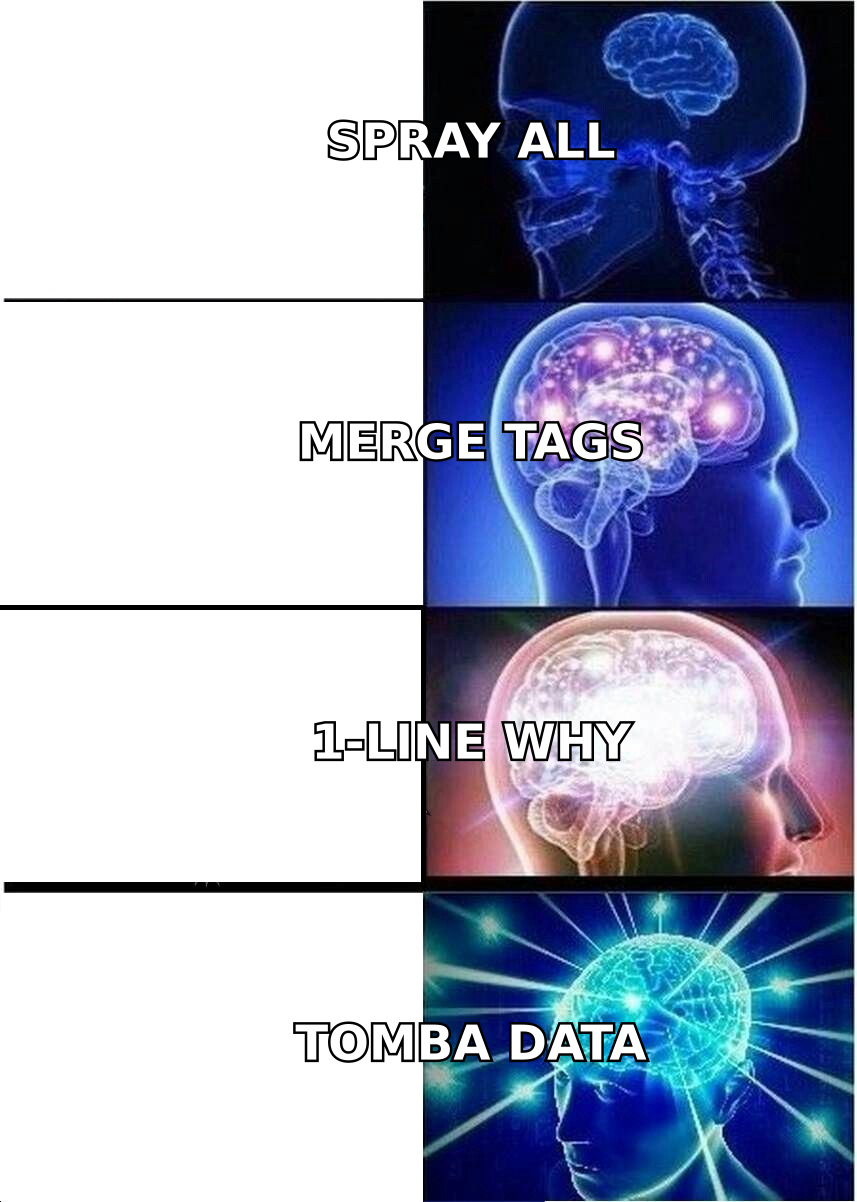
So before we praise any template, understand the order of operations: get the data right, then write the email. If you find emails that are wrong half the time, no subject line saves you. Tools like the Tomba Email Finder and an email verifier exist precisely because targeting fails silently — a bounced email never tells you it was a great pitch.
What is the anatomy of the best prospecting email ever?#
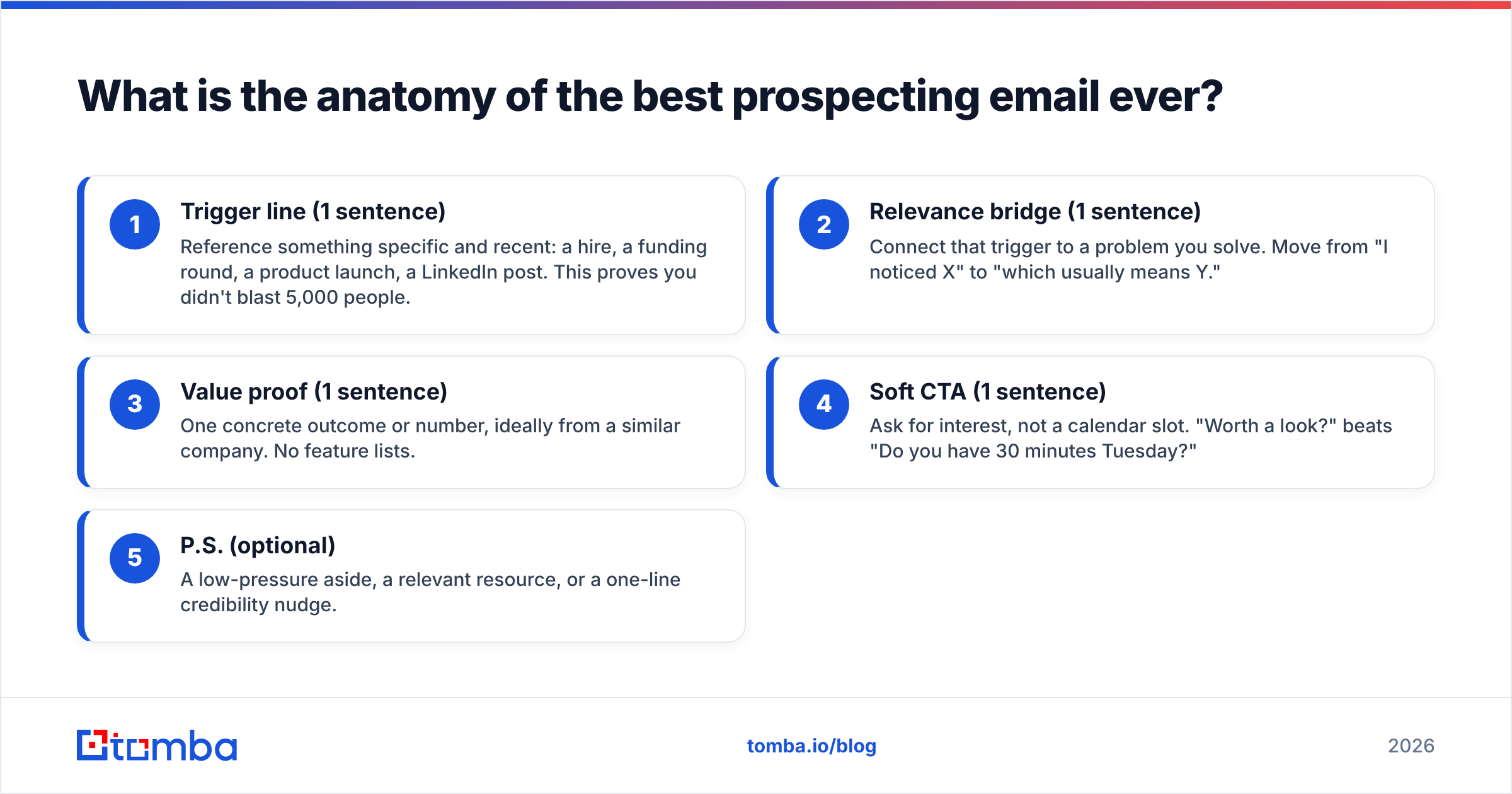
Strip away the gimmicks and nearly every high-performing cold email follows the same five-part skeleton. Here is the structure, line by line, with the job each part does:
- Trigger line (1 sentence) — Reference something specific and recent: a hire, a funding round, a product launch, a LinkedIn post. This proves you didn't blast 5,000 people.
- Relevance bridge (1 sentence) — Connect that trigger to a problem you solve. Move from "I noticed X" to "which usually means Y."
- Value proof (1 sentence) — One concrete outcome or number, ideally from a similar company. No feature lists.
- Soft CTA (1 sentence) — Ask for interest, not a calendar slot. "Worth a look?" beats "Do you have 30 minutes Tuesday?"
- P.S. (optional) — A low-pressure aside, a relevant resource, or a one-line credibility nudge.
That's it. Five sentences, roughly 60–90 words. The discipline is in what you leave out: no "I hope this email finds you well," no company history, no three paragraphs about your platform.
Which prospecting email style wins? A side-by-side comparison#
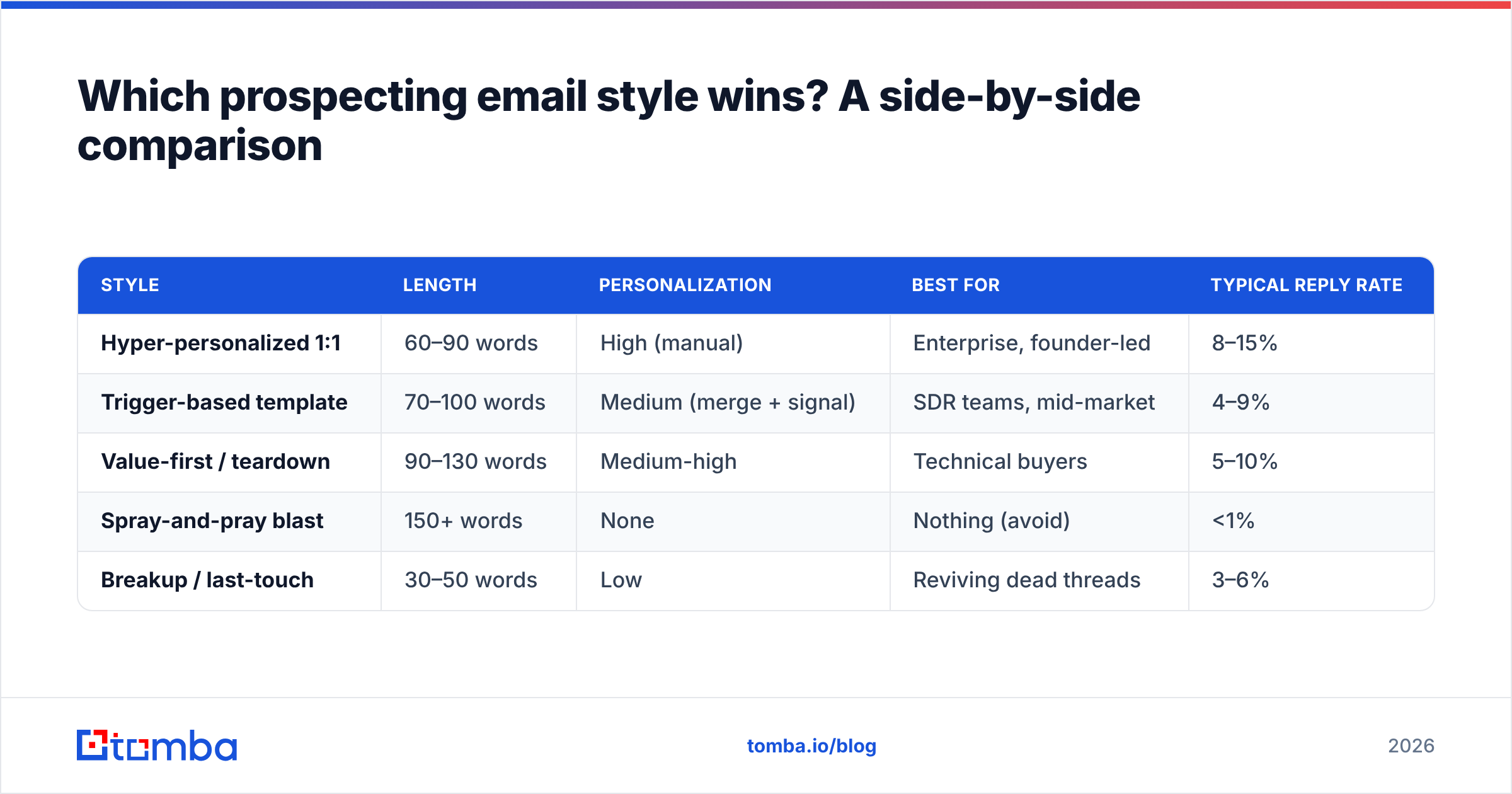
Not every prospecting email serves the same goal. The "best" format depends on your motion — high-volume SDR outreach reads differently than a founder-led, hyper-personalized note. Here's how the common styles stack up:
| Style | Length | Personalization | Best for | Typical reply rate |
|---|---|---|---|---|
| Hyper-personalized 1:1 | 60–90 words | High (manual) | Enterprise, founder-led | 8–15% |
| Trigger-based template | 70–100 words | Medium (merge + signal) | SDR teams, mid-market | 4–9% |
| Value-first / teardown | 90–130 words | Medium-high | Technical buyers | 5–10% |
| Spray-and-pray blast | 150+ words | None | Nothing (avoid) | <1% |
| Breakup / last-touch | 30–50 words | Low | Reviving dead threads | 3–6% |
The pattern is obvious: shorter and more relevant trends toward higher reply rates, and the blast loses every time. The trigger-based template is the sweet spot for most teams because it scales without collapsing into generic spam — provided your underlying data supports the merge fields.
Can you show me a copy-paste template?#
Yes. Here is a trigger-based template that consistently outperforms, with brackets you fill from your research and enrichment data.
Subject: quick thought on [specific initiative]
Hi [First name],
Saw [Company] just [trigger event — launched X / hired a VP of Y / raised your Series B]. Usually that means [relevant pressure — pipeline targets jumped / new territory to cover / data hygiene under scrutiny].
We helped [similar company] [specific outcome — cut bounce rates from 12% to under 2% / add 400 verified contacts a month] without adding headcount.
Worth a quick look, or is this not a priority right now?
[Your name]
P.S. Happy to send the 2-minute breakdown even if the timing's off.
Why it works: the trigger proves relevance, the outcome is specific and numeric, and the CTA gives an easy "not now" exit — which paradoxically increases replies because it lowers pressure. The P.S. offers value with zero ask.
For a deeper library you can adapt, browse Tomba's cold email templates and run any draft through a subject line tester before you hit send.
Why does data matter more than the copy?#
Because the best-written email sent to a wrong or dead address has a conversion rate of exactly zero. This is the unglamorous truth behind every "best prospecting email ever" thread: the winners quietly fixed their data first.
Three data failures silently kill otherwise-great campaigns:
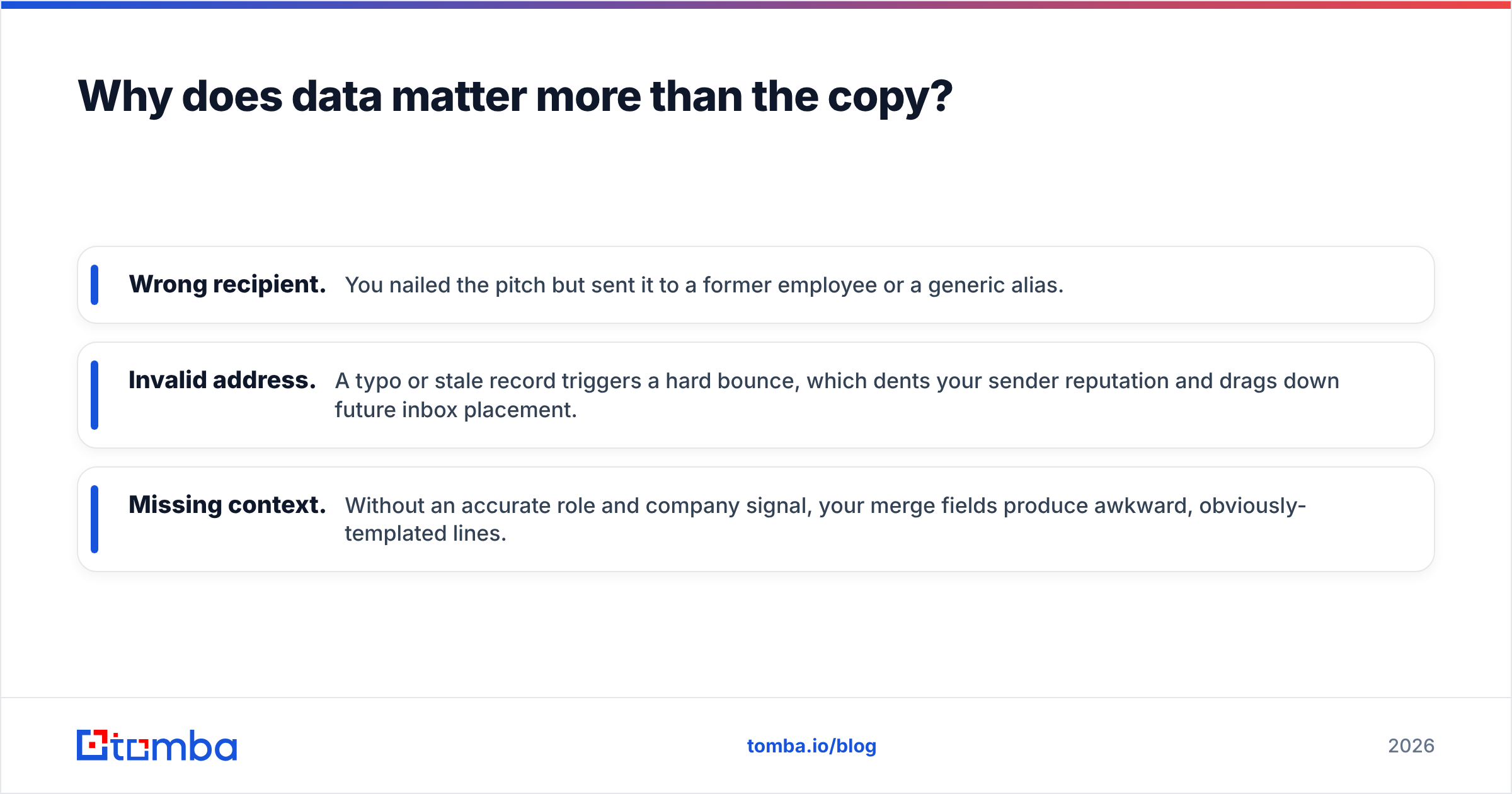
- Wrong recipient. You nailed the pitch but sent it to a former employee or a generic alias.
- Invalid address. A typo or stale record triggers a hard bounce, which dents your sender reputation and drags down future inbox placement.
- Missing context. Without an accurate role and company signal, your merge fields produce awkward, obviously-templated lines.
Verifying before you send protects email deliverability and keeps your domain off blocklists. Sending to a list with a 15% bounce rate teaches inbox providers that you're a careless sender — and that reputation follows you. This is why pairing outreach with a bulk email finder and verification step isn't optional housekeeping; it's the difference between landing in the inbox and the promotions tab.
Authoritative deliverability guidance from providers like Google Postmaster Tools reinforces the point: keep complaint and bounce rates low, and the algorithm rewards you with placement. Great copy never overrides a bad sender score.
How do you personalize at scale without sounding fake?#
The trap is "personalization tokens" that fool no one — Hi {{FirstName}}, I loved your work at {{Company}}! reads as automated because it is. Real personalization at scale comes from feeding accurate, structured data into a tight template so the specific details do the work.
A practical workflow:
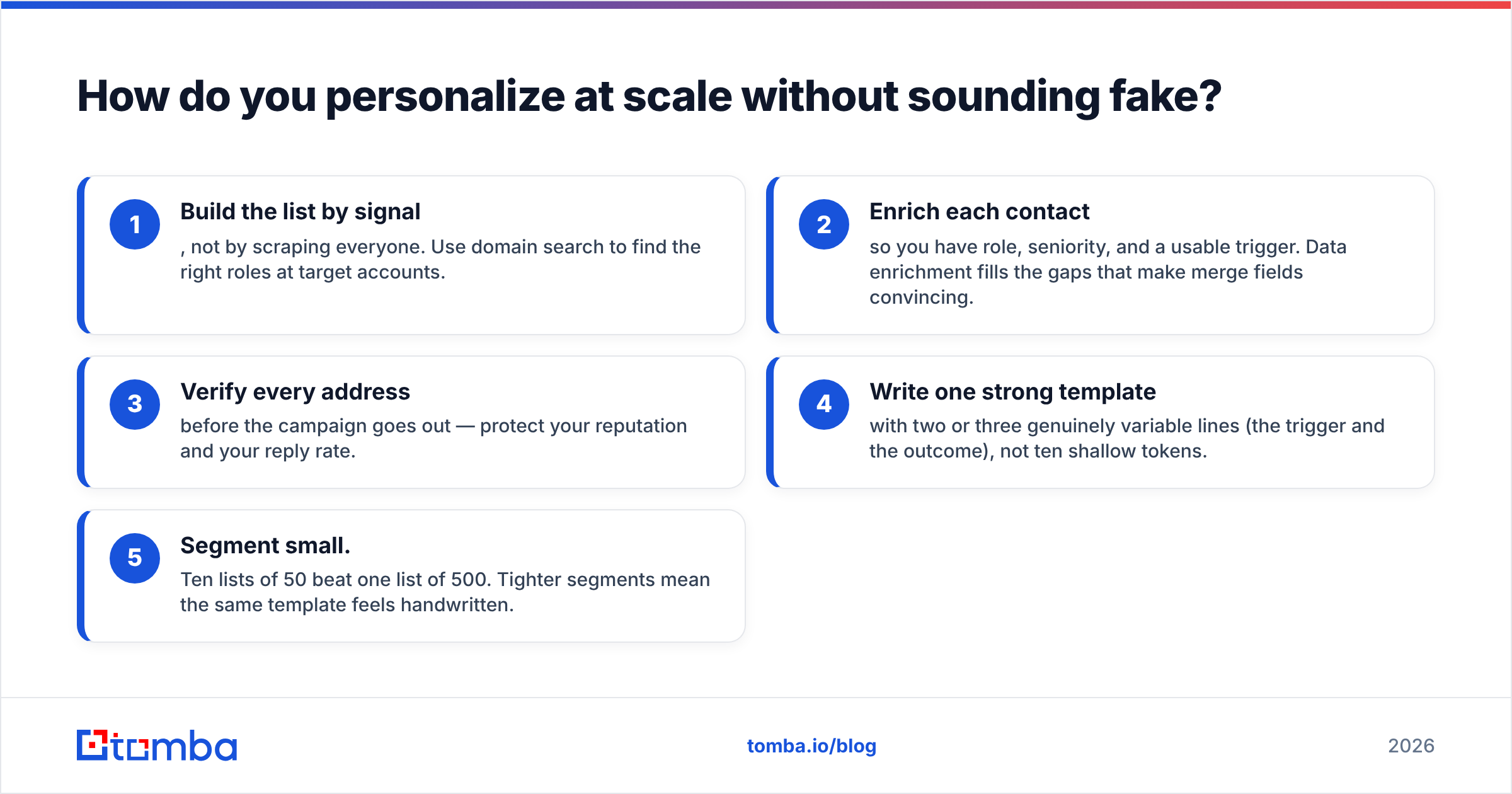
- Build the list by signal, not by scraping everyone. Use domain search to find the right roles at target accounts.
- Enrich each contact so you have role, seniority, and a usable trigger. Data enrichment fills the gaps that make merge fields convincing.
- Verify every address before the campaign goes out — protect your reputation and your reply rate.
- Write one strong template with two or three genuinely variable lines (the trigger and the outcome), not ten shallow tokens.
- Segment small. Ten lists of 50 beat one list of 500. Tighter segments mean the same template feels handwritten.
The goal isn't to fake one-to-one outreach for thousands of people. It's to make each segment small and well-researched enough that a shared structure still reads as relevant. Accurate data is what lets a template scale without becoming spam.
What are the biggest mistakes that kill prospecting emails?#
Even with a good skeleton, these errors quietly tank performance:
- Asking for too much, too soon. "30 minutes Tuesday" assumes interest you haven't earned. Ask for a yes/no first.
- Leading with yourself. Nobody cares about your company in line one. Lead with them.
- Feature dumping. List five capabilities and you've buried the one outcome they care about.
- Skipping verification. Bounces compound into reputation damage that no copy can fix.
- No follow-up. Most replies come on touches two through four. A single email is a coin flip you usually lose.
- Vague subject lines. "Touching base" gets deleted; specific beats clever.
Fix these six and you're already ahead of the majority of cold outreach hitting your prospects' inboxes.
Is one perfect email enough, or do you need a sequence?#
You need a sequence — but a short, polite one. The best prospecting email ever is rarely a single message; it's the first link in a 3–4 touch chain where each follow-up adds a new angle rather than nagging.
A clean cadence looks like:
- Day 1: The trigger-based email above.
- Day 3: A one-line bump with a new proof point or resource.
- Day 7: A different angle — a relevant case study or a question.
- Day 12: A short breakup email that gives them an easy out.
Keep each message standalone and brief. The breakup note often pulls the highest reply rate of the whole sequence because it signals you're about to stop, which triggers a response from people who meant to reply and forgot.
The bottom line#
The best prospecting email ever isn't a sentence you can steal — it's a system: right person, right reason, verified address, tight five-line structure, and a short follow-up cadence. Copy beats no copy, but data beats copy. Nail the foundation and even an average template outperforms a brilliant one sent into the void.
Start where the leverage is highest: your list. Use the Tomba Email Finder to source accurate, verified contacts by name, company, or domain, then enrich and verify before your first send. Clean data turns a decent template into your best-performing campaign — see Tomba pricing to start free with 25 searches a month and build the kind of list that makes great copy finally land.
// get started
Find, verify and enrich your first contacts today
Start on the free plan with 25 searches a month, then scale when your team is ready.
Free plan · No credit card required · GDPR & CCPA
// about the author