Best Sales Email Subject Lines That Get Opened in 2026
The best sales email subject lines in 2026 are short, specific, and personalized. Here are 40+ proven examples, data benchmarks, and a framework to write your own.
Best Sales Email Subject Lines That Get Opened in 2026
TL;DR
- The best sales email subject lines are short (under 7 words), specific, and written like a message from a colleague, not a campaign.
- Personalization beyond
{{first_name}}— referencing a trigger, a peer, or a number — is the single biggest lever on open rates in 2026. - Curiosity and question-based lines outperform pitch-y lines, but only when the body delivers on the promise.
- Avoid spam-trigger words, ALL CAPS, and fake "Re:" prefixes; they wreck both opens and email deliverability.
- A great subject line on a wrong or unverified address is wasted effort — clean data is the prerequisite, not an afterthought.
You can write the sharpest subject line on the planet and still get a 4% open rate if you're sending to stale, mistyped, or guessed addresses. So before the copy lesson, hold one idea in your head: the subject line decides whether a real, reachable prospect opens. Everything below assumes you've already done the boring part — finding and verifying the address.
What Makes a Sales Email Subject Line "Good" in 2026?#
A good subject line earns the open without tricking the reader. That's the whole job. It's the movie trailer, not the movie — it has to be honest about what's inside or the click costs you trust on every future send.
Three forces decide whether your line works:
- Relevance — Does it speak to something the recipient actually cares about right now? A subject line tied to a funding round, a new hire, or a recent product launch beats any clever wordplay.
- Brevity — Mobile clients clip subject lines around 35–45 characters. More than half of B2B email is opened on a phone, so the front-loaded first 5–6 words carry the weight.
- Curiosity without clickbait — You want an open information gap the body closes, not a bait-and-switch that burns your sender reputation.
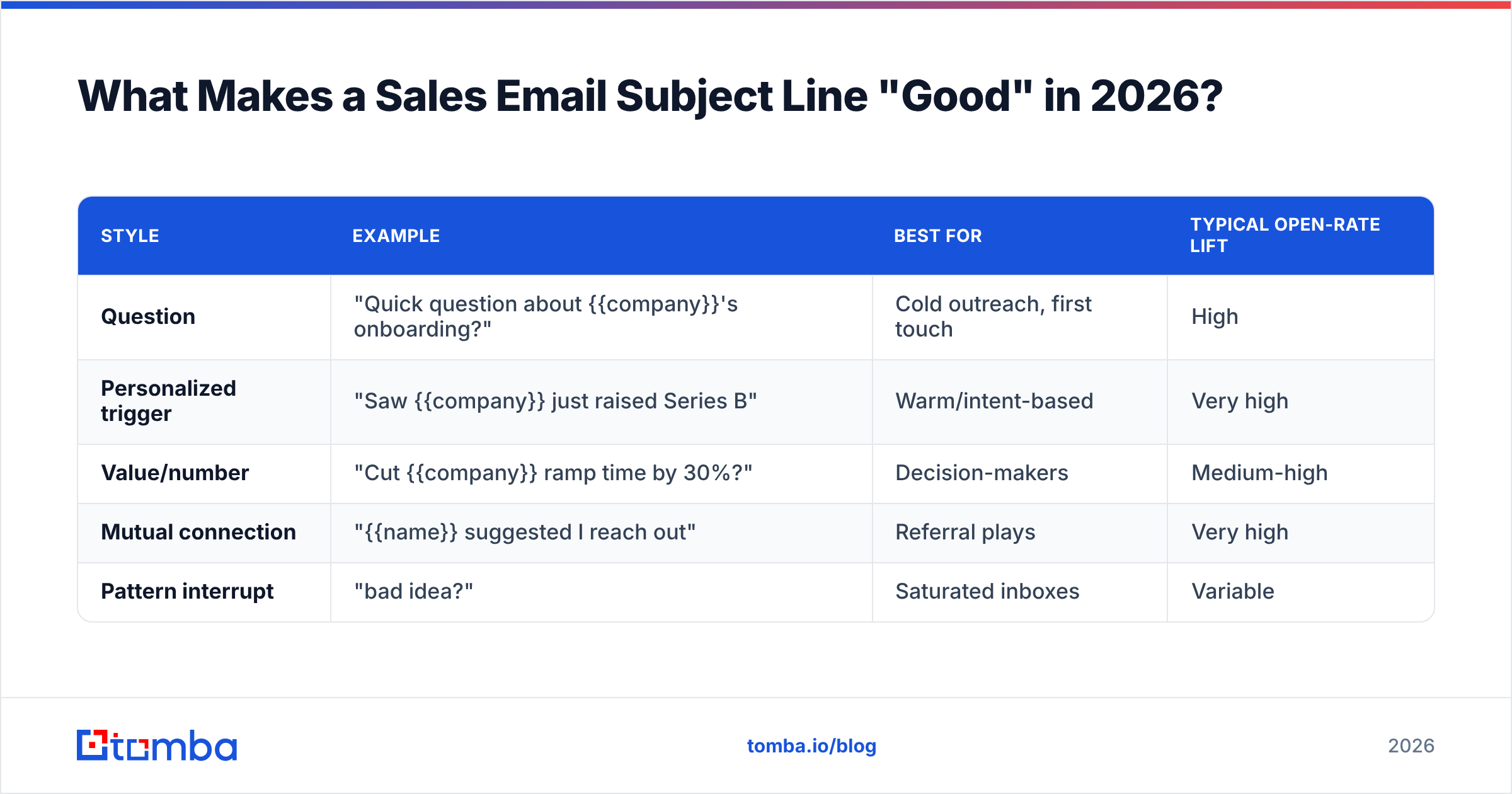
Here's how those forces map to subject-line styles you can actually steal:
| Style | Example | Best for | Typical open-rate lift |
|---|---|---|---|
| Question | "Quick question about {{company}}'s onboarding?" | Cold outreach, first touch | High |
| Personalized trigger | "Saw {{company}} just raised Series B" | Warm/intent-based | Very high |
| Value/number | "Cut {{company}} ramp time by 30%?" | Decision-makers | Medium-high |
| Mutual connection | "{{name}} suggested I reach out" | Referral plays | Very high |
| Pattern interrupt | "bad idea?" | Saturated inboxes | Variable |
Notice the pattern: the higher-performing styles all require information about the prospect. "Saw {{company}} just raised Series B" is only possible if you know it happened. That's why subject-line quality and data quality are the same conversation.
What Are the Best Sales Email Subject Lines? (40+ Examples)#
Below are proven lines grouped by scenario. Treat them as templates, not scripts — swap in real specifics. You can also generate variations with a subject line generator and pressure-test them with a subject line tester before you send.
Cold outreach (first touch)#
- "Quick question, {{first_name}}"
- "{{company}} + [your product]?"
- "Idea for your Q3 pipeline"
- "Worth a 10-minute look?"
- "Saw your post on {{topic}}"
- "Re: {{company}}'s 2026 hiring plans"
- "Mind if I send 2 ideas?"
- "{{competitor}} is doing this — are you?"
- "Noticed {{company}} is hiring SDRs"
- "Should I stay or should I go?"
Follow-up (no reply yet)#
- "Bumping this up, {{first_name}}"
- "Did this get buried?"
- "One more try, then I'll stop"
- "Still the right person?"
- "Closing the loop on {{company}}"
- "Thoughts on the below?"
- "Permission to close your file?"
Referral / mutual connection#
- "{{referrer}} said to reach out"
- "{{referrer}} thought we should talk"
- "We both know {{name}}"
Trigger-based (intent / news)#
- "Congrats on the {{round}} raise"
- "Saw {{company}} opened a {{city}} office"
- "Your new {{role}} hire — quick idea"
- "Noticed you're using {{tool}}"
Value / outcome#
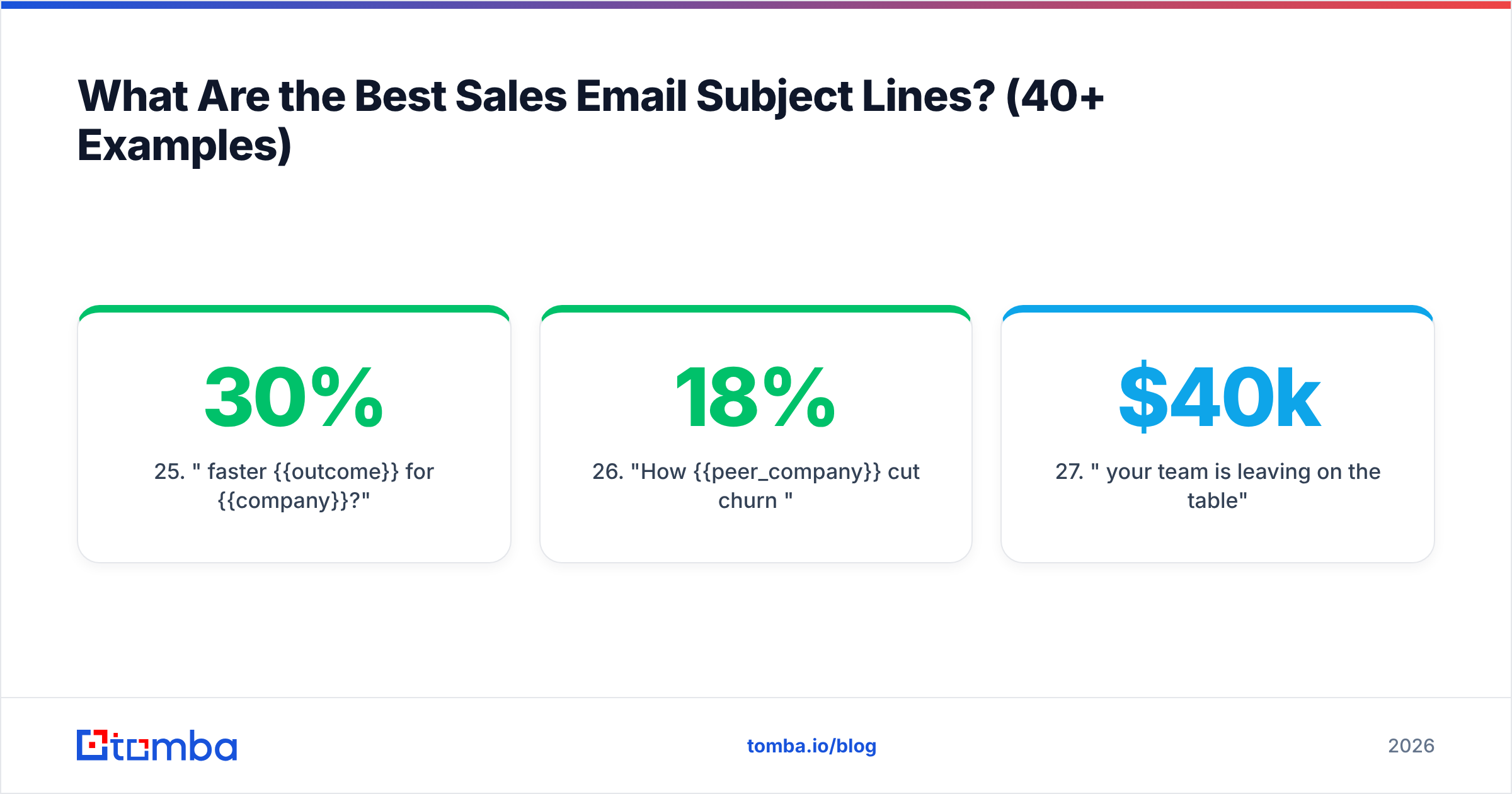
- "30% faster {{outcome}} for {{company}}?"
- "How {{peer_company}} cut churn 18%"
- "$40k your team is leaving on the table"
- "A faster path to {{goal}}"
Curiosity / pattern interrupt#
- "bad idea?"
- "you, me, 15 minutes"
- "this is not a sales email"
- "I was wrong about {{company}}"
Re-engagement (cold list)#
- "Should I close your account?"
- "It's been a while, {{first_name}}"
- "Still interested in {{topic}}?"
Event / webinar#
- "Saving you a seat"
- "{{event}} — 2 spots left"
- "Recap inside (you missed it)"
Breakup emails#
- "Goodbye for now, {{first_name}}"
- "I'll take the hint"
- "Last one, promise"
For full email bodies to pair with these, grab ready-made cold email templates instead of starting from a blank page.
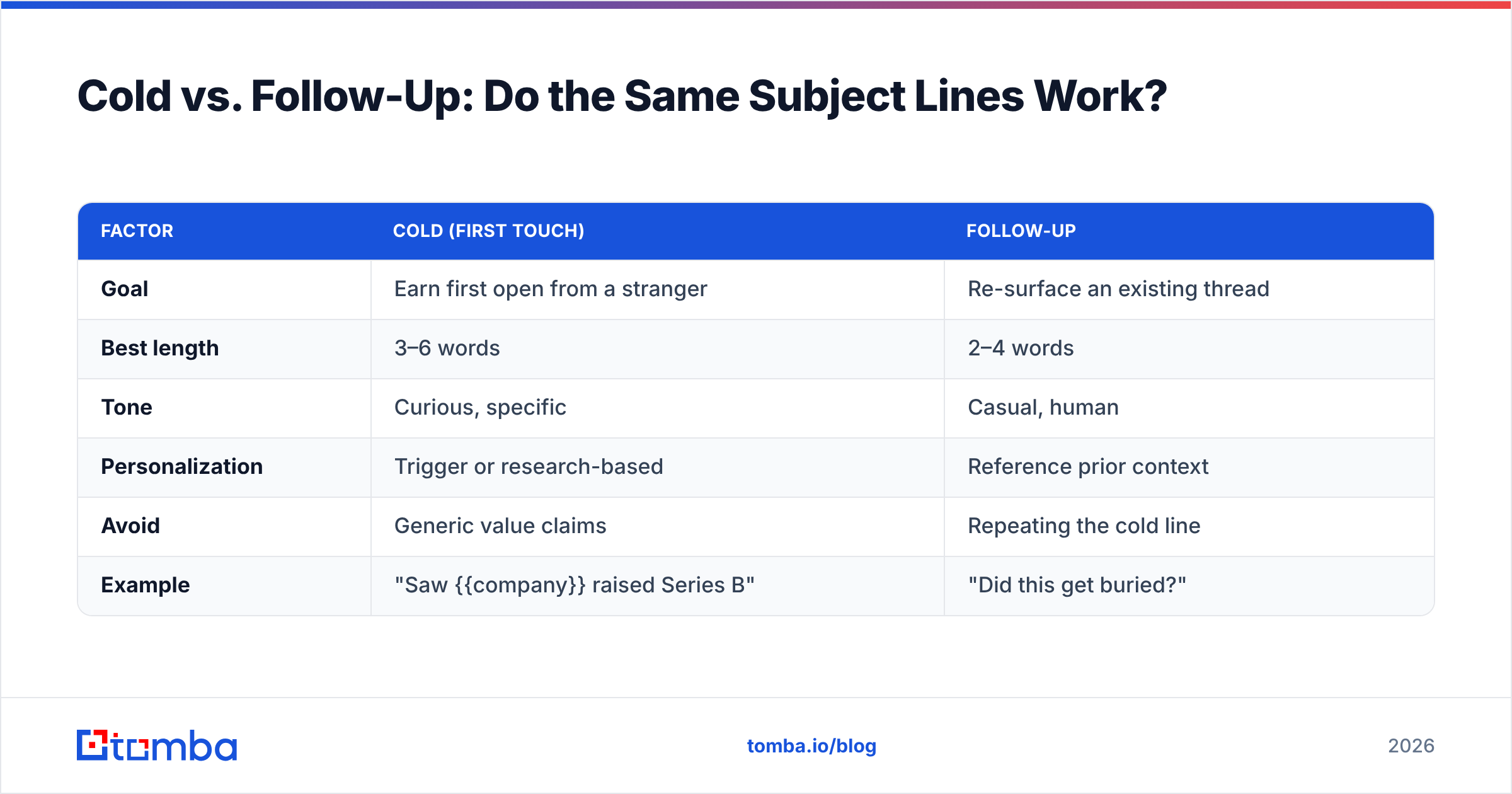
Cold vs. Follow-Up: Do the Same Subject Lines Work?#
No — and treating them the same is a common mistake. Cold subject lines need to earn a first open from a stranger, so curiosity and relevance do the heavy lifting. Follow-up lines are talking to someone who already saw your name, so brevity and a light nudge work better than restating the pitch.
| Factor | Cold (first touch) | Follow-up |
|---|---|---|
| Goal | Earn first open from a stranger | Re-surface an existing thread |
| Best length | 3–6 words | 2–4 words |
| Tone | Curious, specific | Casual, human |
| Personalization | Trigger or research-based | Reference prior context |
| Avoid | Generic value claims | Repeating the cold line |
| Example | "Saw {{company}} raised Series B" | "Did this get buried?" |
One technical note on follow-ups: keep them in the same thread with a real Re: (because it actually is a reply), never a faked Re: on a brand-new cold email. Inbox providers and savvy buyers both penalize the fake. If your response rate on follow-ups is flat, the subject line is usually not the problem — the original targeting is.
What Subject Lines Should You Avoid?#
Some lines actively hurt you. They tank opens, trip spam filters, or both. Avoid:
- Spam-trigger words: "free," "guarantee," "act now," "limited time," "$$$," "100% free." Run drafts through a spam checker before a big send.
- ALL CAPS and excessive punctuation: "OPEN NOW!!!" reads as a scam.
- Fake personalization: "Hey {{first_name}}" that didn't merge correctly is worse than no name at all.
- Misleading "Re:" or "Fwd:" on emails that were never part of a thread.
- Vague corporate value: "Synergize your workflow solutions" says nothing.
- Over-length lines that clip mid-word on mobile.
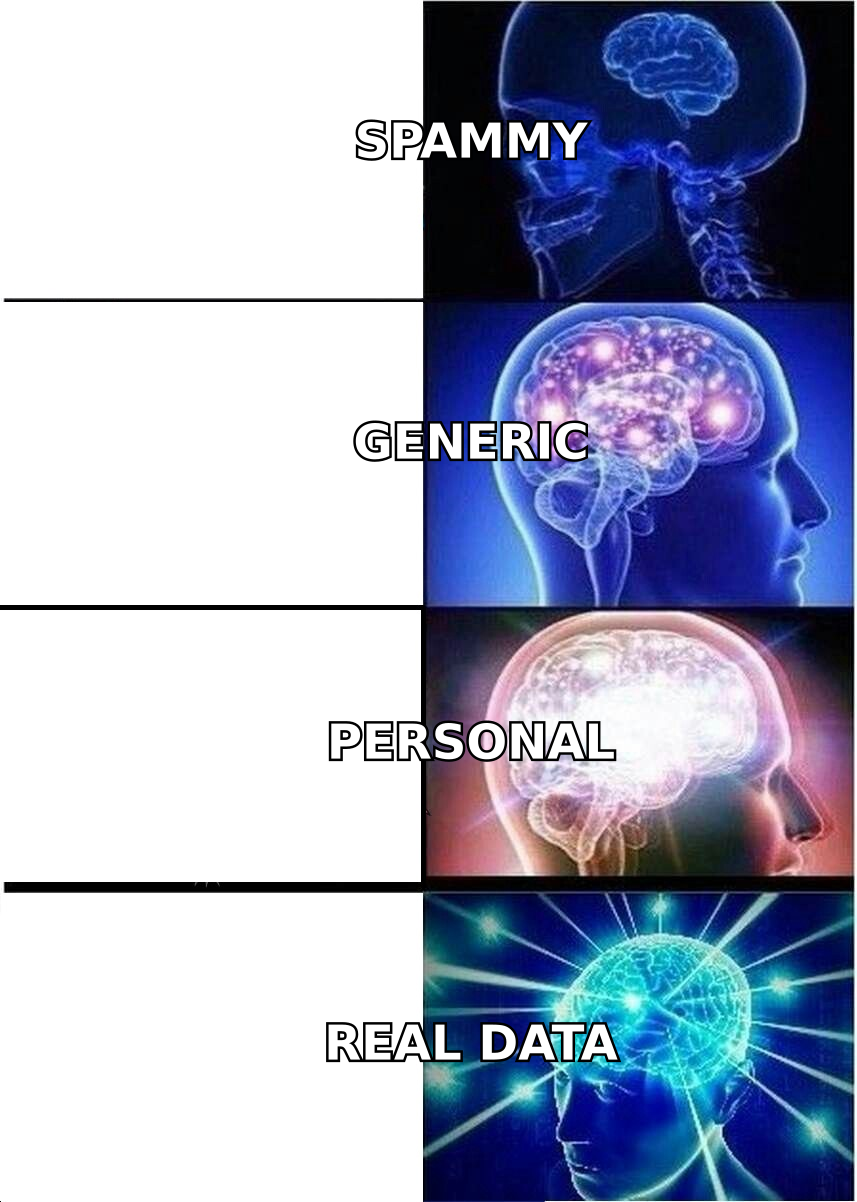
The meme isn't a joke at your expense — it's the actual finding. Strip away the copywriting tricks and the lines that win all share one trait: they're built on something true and specific about the recipient. Which brings us to the part most subject-line listicles skip.
How Does Data Quality Affect Subject-Line Performance?#
Your open rate is a fraction: opens divided by delivered emails. Bad data attacks the denominator before your copy ever gets a chance. Send to a list that's 25% invalid and you've capped your open rate at 75% no matter how brilliant the line — and the bounces drag your sender reputation down, which means even your valid recipients see fewer of your emails land in the inbox.
There's a second, sneakier link. The highest-performing subject lines — trigger-based and personalized — depend on knowing real attributes: the person's correct name spelling, their actual role, their company's recent activity. Get the name wrong in the subject line and you've done worse than being generic.
So the workflow that produces great subject lines looks like this:
- Find the right contact with an accurate email finder — by name, role, or domain search across the target company.
- Verify every address with an email verifier so bounces don't poison your reputation.
- Enrich the record via data enrichment to pull the role, seniority, and company details that fuel personalization.
- Write the subject line using those real specifics.
- Test and send, then iterate on what gets opened.
Skip steps 1–3 and you're writing clever lines for an audience that may not exist.
How Should You A/B Test Subject Lines?#
Test one variable at a time, on a sample big enough to mean something. Two lines, 50 recipients each, and a 2-point open-rate gap tells you nothing — that's noise. Aim for at least a few hundred sends per variant before you call a winner.
A simple, honest A/B framework:
- Isolate the variable. Change only the subject line between variant A and B. Same body, same send time, same audience segment.
- Define the metric first. Open rate measures the subject line; reply rate measures the whole email. Don't credit a subject line for a reply the body earned.
- Use a meaningful sample. Bigger is better; small lists give random results.
- Account for the inbox. Apple Mail Privacy Protection inflates open rates, so weight reply and meeting-booked rates as your real signals.
- Log everything. Keep a running doc of which lines win for which segments — patterns emerge over months, not days.
For programmatic testing across large lists, the Tomba API and bulk email finder let you build clean, verified segments to test against, so your experiment measures copy — not data rot.
Subject Line Frameworks You Can Reuse#
When you run out of examples, fall back on formulas. Each forces specificity:
- [Benefit] + [Company] → "Faster onboarding for {{company}}?"
- [Trigger] + [Curiosity] → "Saw your {{round}} — one idea"
- [Question] → "Still owning {{topic}} at {{company}}?"
- [Social proof] + [Outcome] → "How {{peer}} cut churn 18%"
- [Mutual] + [Soft ask] → "{{referrer}} said we should talk"
- [Number] + [Loss aversion] → "$40k you're leaving on the table"
Pair a framework with verified, enriched data and you have a repeatable engine instead of a one-off lucky line.
How Tomba Helps You Write Subject Lines That Land#
Great subject lines start with reaching the right inbox. Tomba's Email Finder locates accurate, professional email addresses by name, company, or domain, then verifies them so your sends actually land — which is the floor your open rate is built on. Plans start with a free tier (25 searches/month) and scale through Starter at $49/mo, Growth at $99/mo, and Pro at $249/mo; see full Tomba pricing for details.
Combine accurate contacts with the frameworks above, layer in real enrichment data for personalization, and test relentlessly. Start free with the Tomba Email Finder and give your best subject lines a real audience to open them.
// get started
Find, verify and enrich your first contacts today
Start on the free plan with 25 searches a month, then scale when your team is ready.
Free plan · No credit card required · GDPR & CCPA
// about the author