Best Sales Introduction Email Templates & Examples (2026)
The best sales introduction email earns a reply, not an unsubscribe. Here are the templates, subject lines, structures, and data hygiene habits that actually book meetings in 2026.
placeholder
TL;DR
- The best sales introduction email is short (under 120 words), leads with the prospect's world, and asks for one tiny next step — not a 30-minute "discovery call."
- Personalization beats volume: a relevant first line and a clear reason for reaching out drive most of your reply rate.
- Subject lines should sound like a colleague, not a campaign — lowercase, 2–5 words, no hype.
- Structure wins: hook, relevance, value, single CTA. Every sentence should earn the next one.
- None of it matters if the email bounces. Verified, accurate contact data is the silent multiplier behind every good template.
What is a sales introduction email?#
A sales introduction email is the first message you send to a prospect who doesn't know you yet — the cold (or lightly warm) opener whose only job is to earn a reply. Think of it like knocking on a stranger's door: you have about three seconds before they decide whether to listen or shut it. The email isn't there to close a deal. It's there to start a conversation.
That distinction matters because most reps overload the first email. They cram in the pitch, the case study, the calendar link, and three paragraphs about their "innovative platform." The prospect smells a sales sequence and deletes it. The best sales introduction email does the opposite: it reads like one human noticed something specific about another and had a genuine reason to reach out.
There are three rough flavors you'll write:
- Cold introduction — no prior relationship. Hardest mode; relevance is everything.
- Warm introduction — triggered by a referral, an event, a download, or a LinkedIn interaction.
- Internal/partner introduction — connecting two parties or introducing yourself to a new account contact.
This guide focuses on the cold and warm versions, because that's where reps win or lose pipeline.
What makes the best sales introduction email work?#
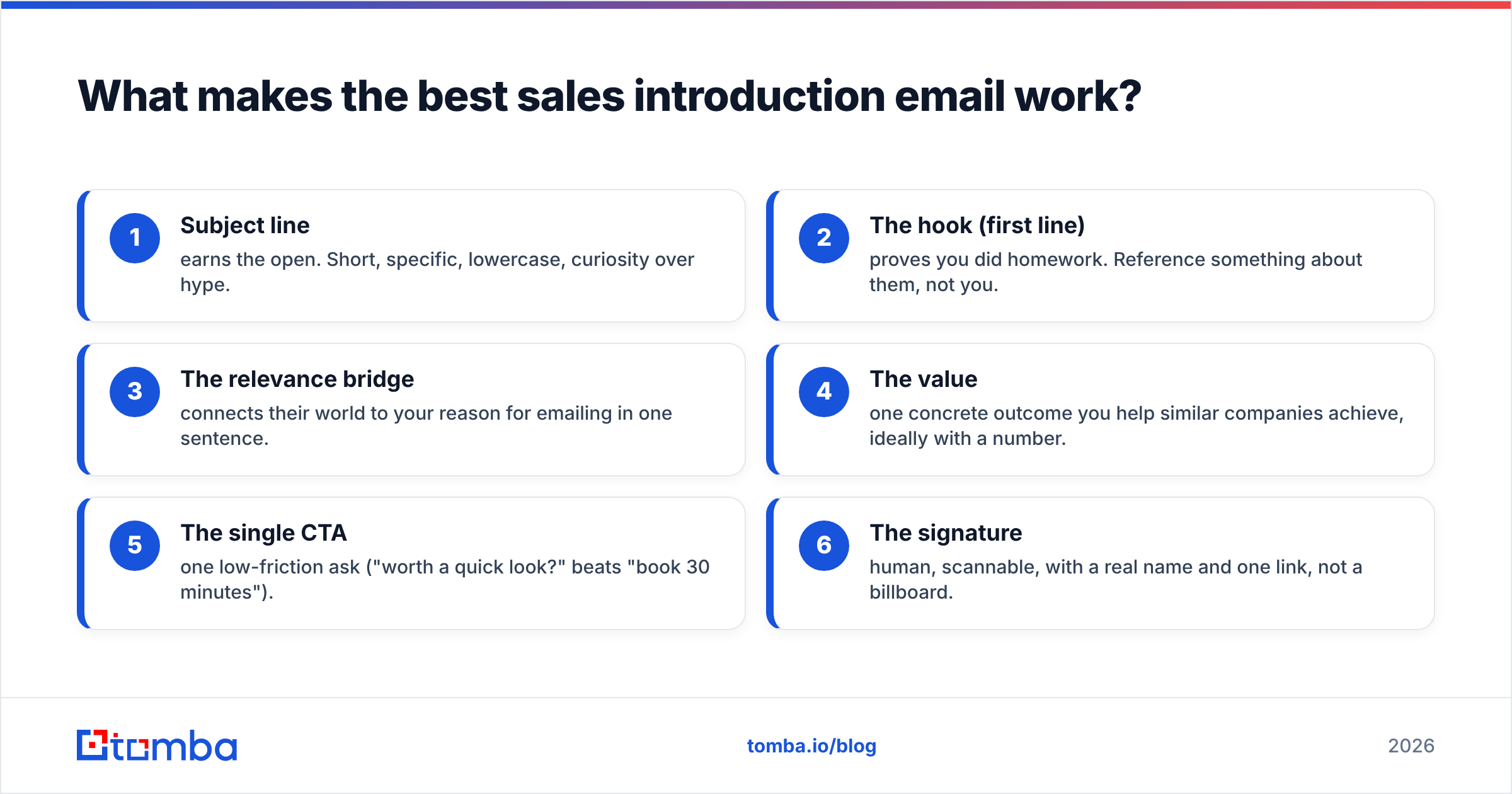
The best-performing intros share a skeleton. Here are the six components, with the bold lead telling you what each one does:
- Subject line — earns the open. Short, specific, lowercase, curiosity over hype.
- The hook (first line) — proves you did homework. Reference something about them, not you.
- The relevance bridge — connects their world to your reason for emailing in one sentence.
- The value — one concrete outcome you help similar companies achieve, ideally with a number.
- The single CTA — one low-friction ask ("worth a quick look?" beats "book 30 minutes").
- The signature — human, scannable, with a real name and one link, not a billboard.
Drop any one of these and the email wobbles. Add a seventh thing — a second CTA, a second paragraph of pitch — and conversion drops. According to HubSpot's sales research, shorter, personalized outreach consistently outperforms long templated blasts, and the same pattern shows up across every modern outbound team.
)
Notice the escalation: a generic "hey there" sits at the bottom, and a researched message landing in the right inbox sits at the top. Sophistication isn't about clever copy. It's about relevance plus reaching the right person at a working address.
What does the best sales introduction email look like? (templates)#
Here are four templates you can adapt today. Keep them under 120 words in practice.
Template 1 — The trigger-event opener
Subject: congrats on the Series B
Hi {First Name},
Saw {Company} just closed your Series B — usually that means the SDR team is about to double overnight.
When teams scale outbound that fast, list quality tends to crack first: bounces climb, reps waste mornings on dead addresses. We help RevOps keep contact data clean so new hires hit quota faster.
Worth a quick look at how {similar company} cut bounce rate to under 2%?
{Your name}
Template 2 — The problem-first opener
Subject: bounce rates at {Company}?
Hi {First Name},
Quick question — how are you keeping your prospect lists verified before reps send? Most teams I talk to are still finding out an address was dead after the email bounces.
We fix that upstream. Happy to share the 3-step workflow other {industry} teams use.
Open to it?
{Your name}
Template 3 — The referral / warm opener
Subject: {Mutual contact} suggested I reach out
Hi {First Name},
{Mutual contact} mentioned you're rethinking how your team sources B2B contacts this quarter. That's our wheelhouse.
In one line: we help sales teams find email addresses and verify them before they ever hit send, so deliverability stays high.
Mind if I send a 2-minute overview?
{Your name}
Template 4 — The mutual-value opener
Subject: idea for {Company}'s Q3 outbound
Hi {First Name},
I pulled a quick read on {Company}'s hiring signals and noticed you're expanding the AE team. Two thoughts on keeping their lists clean from day one — want me to send them over?
{Your name}
Need a faster starting point? Tomba's free library of cold email templates gives you variants by industry, and the cold email AI writer can draft personalized first lines at scale.
Which subject lines get the open?#
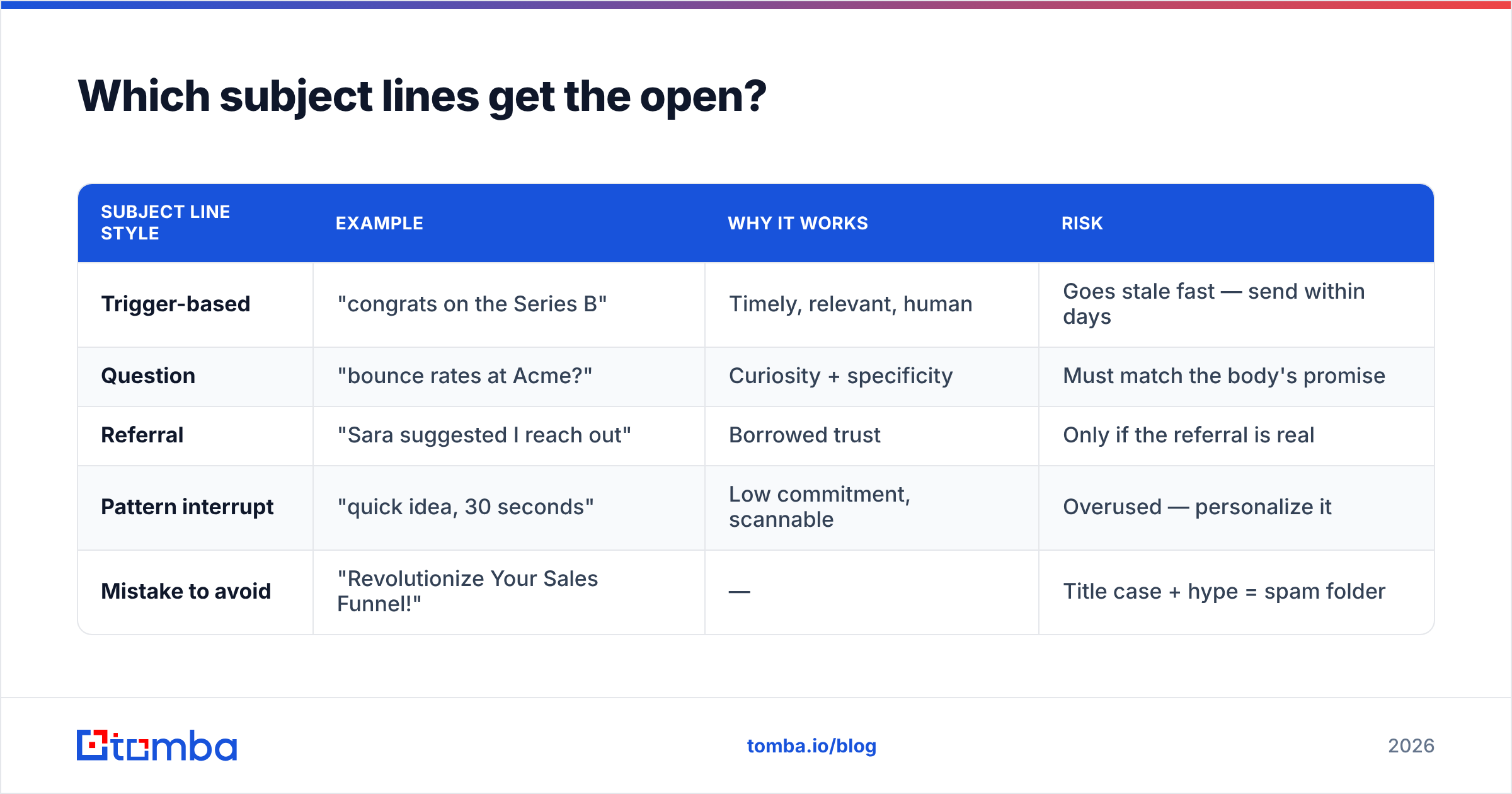
The subject line is the gatekeeper. If it sounds like marketing, the body never gets read. The pattern that works in 2026 is "internal colleague energy": short, lowercase, specific, zero hype words.
| Subject line style | Example | Why it works | Risk |
|---|---|---|---|
| Trigger-based | "congrats on the Series B" | Timely, relevant, human | Goes stale fast — send within days |
| Question | "bounce rates at Acme?" | Curiosity + specificity | Must match the body's promise |
| Referral | "Sara suggested I reach out" | Borrowed trust | Only if the referral is real |
| Pattern interrupt | "quick idea, 30 seconds" | Low commitment, scannable | Overused — personalize it |
| Mistake to avoid | "Revolutionize Your Sales Funnel!" | — | Title case + hype = spam folder |
Two rules cover most of it. First, test before you send at volume — a subject line tester catches spam triggers and length problems instantly. Second, never let the subject overpromise what the body delivers; mismatch tanks your reply rate and trains prospects to ignore you. For a deeper benchmark on what "good" looks like, G2's sales engagement category is a useful reality check against vendor claims.
How long should a sales introduction email be?#
Shorter than you think. The sweet spot is 50–125 words and a single, scannable screen on mobile — because more than half of first opens happen on a phone.
Here's a quick gut-check framework. Read your draft and count:
- Sentences about you vs. them. The "them" count should be higher in the first half.
- Number of asks. It should be exactly one.
- Clicks required to say yes. Aim for zero in the first email — a reply is the ask, not a booking.
- Jargon density. If you used "synergy," "solution," or "leverage" more than once, cut.
Longer emails aren't always wrong — a warm, referred prospect will tolerate more context. But cold? Brevity is respect. You're asking a stranger for attention, so spend as little of it as possible.
How do you personalize at scale without sounding fake?#
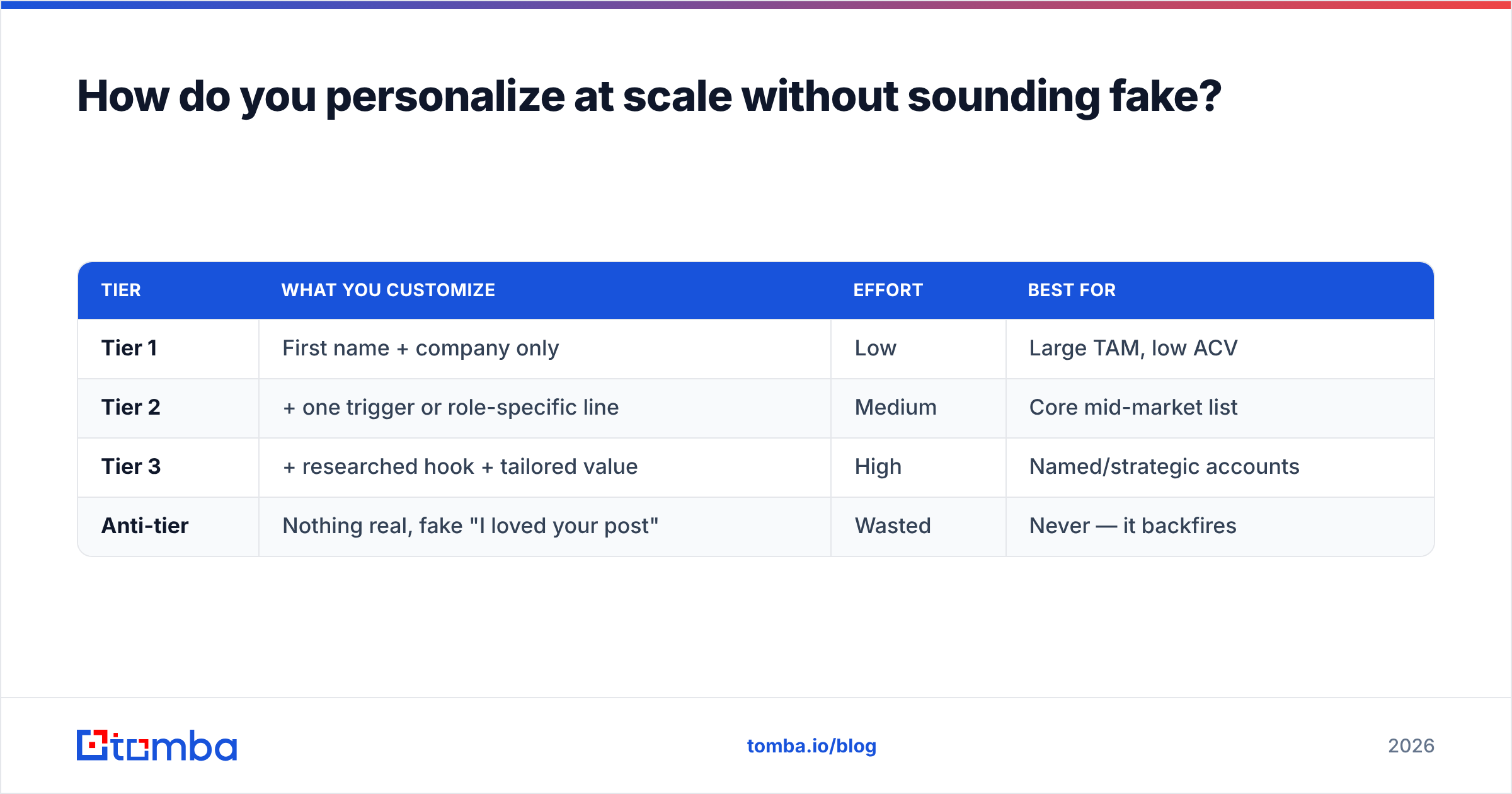
Personalization is a spectrum, not a switch. The mistake reps make is treating it as binary: either a fully hand-written email (doesn't scale) or "Hi {First Name}" mail-merge (doesn't work). The win is tiered personalization.
| Tier | What you customize | Effort | Best for |
|---|---|---|---|
| Tier 1 | First name + company only | Low | Large TAM, low ACV |
| Tier 2 | + one trigger or role-specific line | Medium | Core mid-market list |
| Tier 3 | + researched hook + tailored value | High | Named/strategic accounts |
| Anti-tier | Nothing real, fake "I loved your post" | Wasted | Never — it backfires |
The unlock for Tier 2 at scale is good data. If your CRM knows the prospect's role, company size, recent funding, and tech stack, you can template a relevant line without writing each one by hand. That's where data enrichment earns its keep — it fills the fields your personalization tokens pull from, so a templated email still feels specific.
)
And here's the quiet truth behind every reply-rate case study: the email reached a real, verified inbox. You can write the best sales introduction email in the world, but if the address is wrong or the domain is a catch-all, it never lands. Right email? It always had to be.
Why does data quality decide your reply rate?#
Because reply rate is a fraction, and the denominator is "emails that actually arrived." Every bounce is a perfect template thrown in the trash. Worse, a spike in bounces hurts your sender reputation, which quietly drags down deliverability for the messages that would have converted. One bad list can poison a whole sending domain.
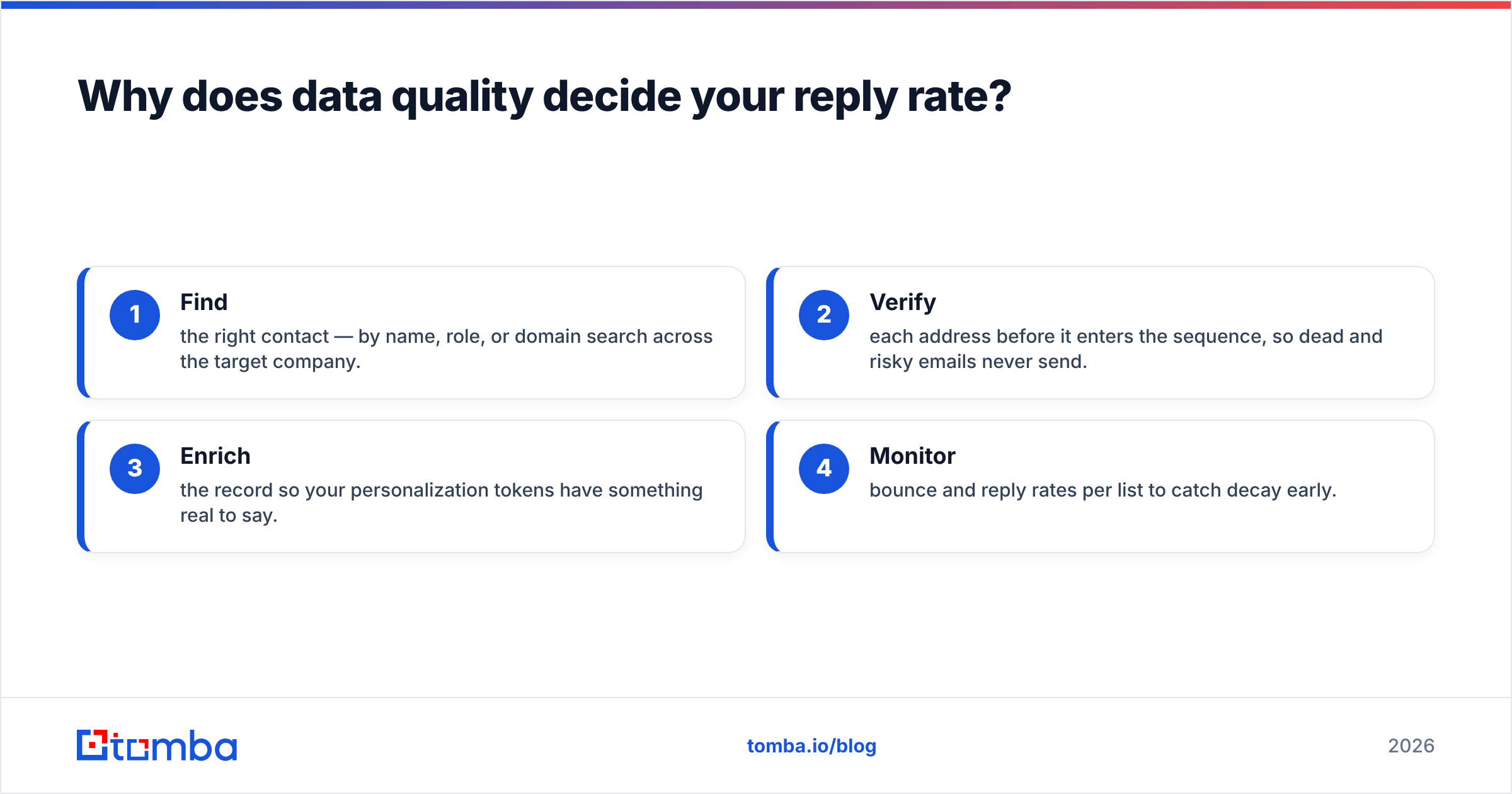
This is why the best outbound teams treat verification as step zero, not an afterthought:
- Find the right contact — by name, role, or domain search across the target company.
- Verify each address before it enters the sequence, so dead and risky emails never send.
- Enrich the record so your personalization tokens have something real to say.
- Monitor bounce and reply rates per list to catch decay early.
Skip step two and your beautifully written intro competes with a 10–20% bounce rate that no copy can overcome. Salesforce's guidance on outbound hygiene echoes this — clean data is the foundation, not the polish. (See Salesforce's sales resources for the broader framework.) Pair clean data with a tracked response rate benchmark and you can finally tell whether a template change moved the needle or whether you were just emailing ghosts.
What mistakes kill the best sales introduction email?#
A short field guide to self-inflicted wounds:
- The wall of text. If it needs scrolling on mobile, it's too long.
- The double CTA. "Reply, or book here, or check our site" splits attention to zero.
- The fake compliment. "Big fan of your work" with no specifics reads as automation.
- The all-about-me opener. Starting with "We are a leading platform that…" loses them in line one.
- The unverified send. The most expensive mistake, because it's invisible until your numbers crater.
- The hype subject. Title case plus exclamation points is a one-way ticket to spam.
Fix these and you're already ahead of most of the inbox.
Sales introduction email checklist#
Before you hit send, run this:
- Subject line is 2–5 words, lowercase, no hype
- First line is about them, not you
- One clear reason you're reaching out
- One concrete value statement, ideally with a number
- Exactly one CTA, low friction
- Under 125 words, scannable on mobile
- Human signature with one link
- Email address verified before sending
Start with the address, not the adjectives#
The best sales introduction email is a system, not a sentence. Nail the structure, personalize in tiers, keep it short, and ask for one small yes. But remember the foundation: none of it converts if the email bounces. Before you obsess over the perfect hook, make sure you're reaching a real person at a working inbox.
That's exactly what the Tomba Email Finder is built for — find verified professional email addresses by name, company, or domain, so every intro you write actually lands. Start free with 25 searches a month, then scale on the Starter plan at $49/mo when your pipeline outgrows it. Check the full Tomba pricing to match a plan to your sending volume. Write the better email. We'll make sure it gets delivered.
// get started
Find, verify and enrich your first contacts today
Start on the free plan with 25 searches a month, then scale when your team is ready.
Free plan · No credit card required · GDPR & CCPA
// about the author