The Best Sales Process for B2B in 2026: A Step-by-Step Guide
A repeatable B2B sales process beats raw hustle every time. Here are the seven stages that close deals in 2026 — plus the tools and metrics that make each one work.
You can hire the best closers in the market and still miss quota if every rep runs deals their own way. The teams that win in B2B are not the ones with the most aggressive sellers — they are the ones with a process so clear that a new hire can follow it on day one and a VP can forecast from it on the last day of the quarter.
This guide breaks down the best sales process for B2B in 2026: the seven stages that move a stranger to a signed contract, the metrics that tell you where deals leak, and the tooling that makes each stage repeatable instead of heroic.
TL;DR#
- A sales process is a repeatable map, not a vibe. The best B2B teams document seven stages: prospect, qualify, connect, discover, present, negotiate, close — then standardize what "done" means at each one.
- Qualification is where most pipeline dies. Use a framework like MEDDIC or BANT so reps disqualify early instead of nursing dead deals for a quarter.
- Data quality is the foundation. A clean, verified contact list at the top means everything downstream converts better — bad data wrecks even a perfect process.
- Measure conversion stage-to-stage, not just win rate. The leak is always between two specific stages.
- Tools should enforce the process, not replace it. CRM, an email finder, and sequencing software are the minimum stack.
What is a B2B sales process?#
A B2B sales process is the documented, repeatable set of stages your team moves every deal through, from first contact to closed revenue. Think of it like a recipe versus "cooking by feel." A great chef can improvise, but a restaurant kitchen needs a recipe so every plate comes out the same whether the star chef is in or not. Your sales process is that recipe — it makes results predictable across reps, deals, and quarters.
It is different from a sales methodology. The methodology (MEDDIC, Challenger, SPIN) is the philosophy of how you sell. The process is the sequence of stages you track in your CRM. You need both, but the process is what your forecast is built on.
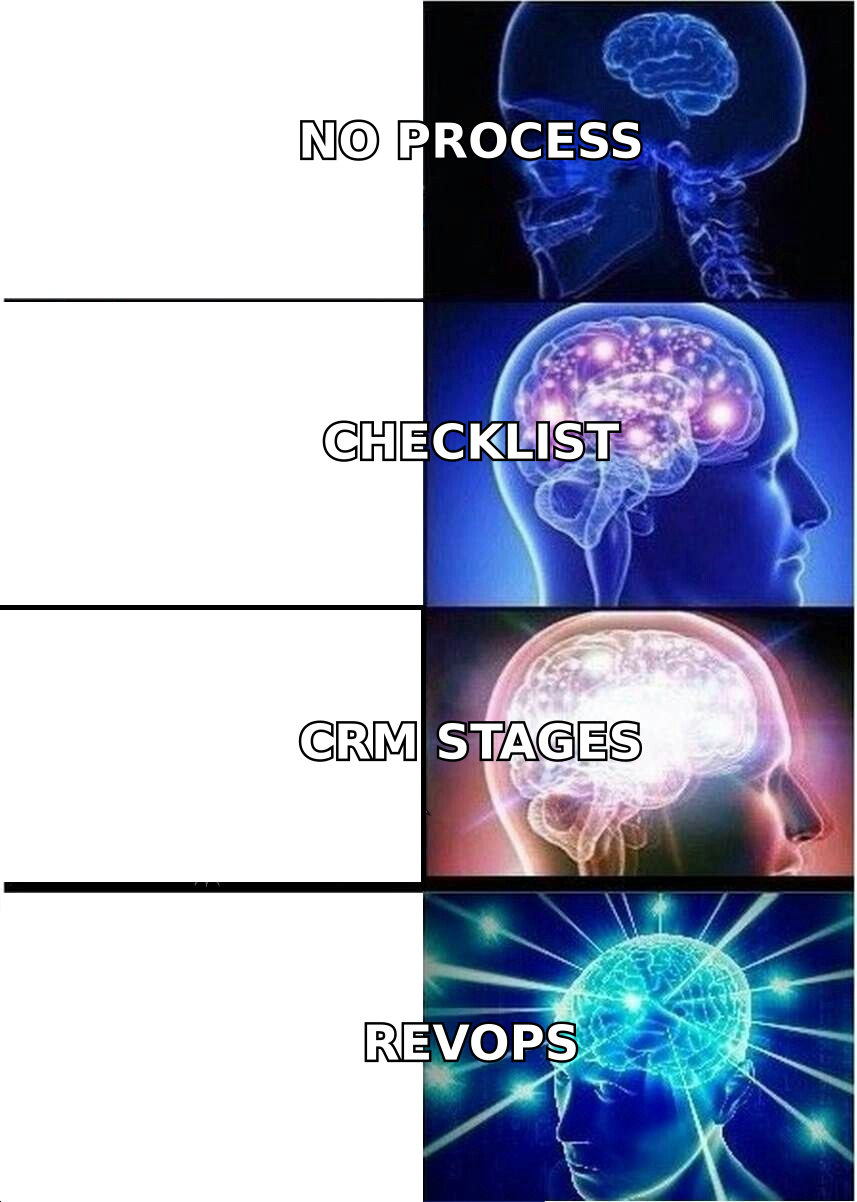
The seven stages of a modern B2B sales process#
- Prospecting — Build a target list of accounts and contacts that match your ideal customer profile, then find verified ways to reach them.
- Qualifying — Decide fast whether a lead is worth your time using a scoring framework. Disqualifying early is a feature, not a failure.
- Connecting — Make first contact across email, phone, and LinkedIn. The goal is a booked conversation, not a pitch.
- Discovery — Diagnose the prospect's real problem, budget, timeline, and decision process before you ever demo.
- Presenting — Map your solution to the specific pain you uncovered. A demo is a tailored answer, not a feature tour.
- Negotiating — Handle objections, pricing, and procurement. Protect margin and avoid the end-of-quarter discount reflex.
- Closing & handoff — Get signature, then transition cleanly to onboarding so the deal you closed actually renews.
Why does a defined sales process matter?#
Because consistency beats talent at scale. Research from HubSpot and others has repeatedly found that companies with a formal, documented sales process outperform those without one on revenue growth and forecast accuracy. The reason is simple: when every rep defines "qualified" differently, your pipeline number is fiction.
A defined process gives you three things you cannot get from talented improvisation:
- Forecast accuracy. Stage-based probability only works when stages mean the same thing for everyone.
- Faster ramp. New reps copy a proven path instead of reinventing it and burning leads while they learn.
- Diagnosable problems. When conversion drops, you can point to the exact stage instead of guessing.
The cost of skipping this is quiet but expensive: reps chase unqualified deals, managers coach on gut feel, and good leads rot because nobody agreed on what happens after the first email.
Which sales qualification framework is best for B2B?#
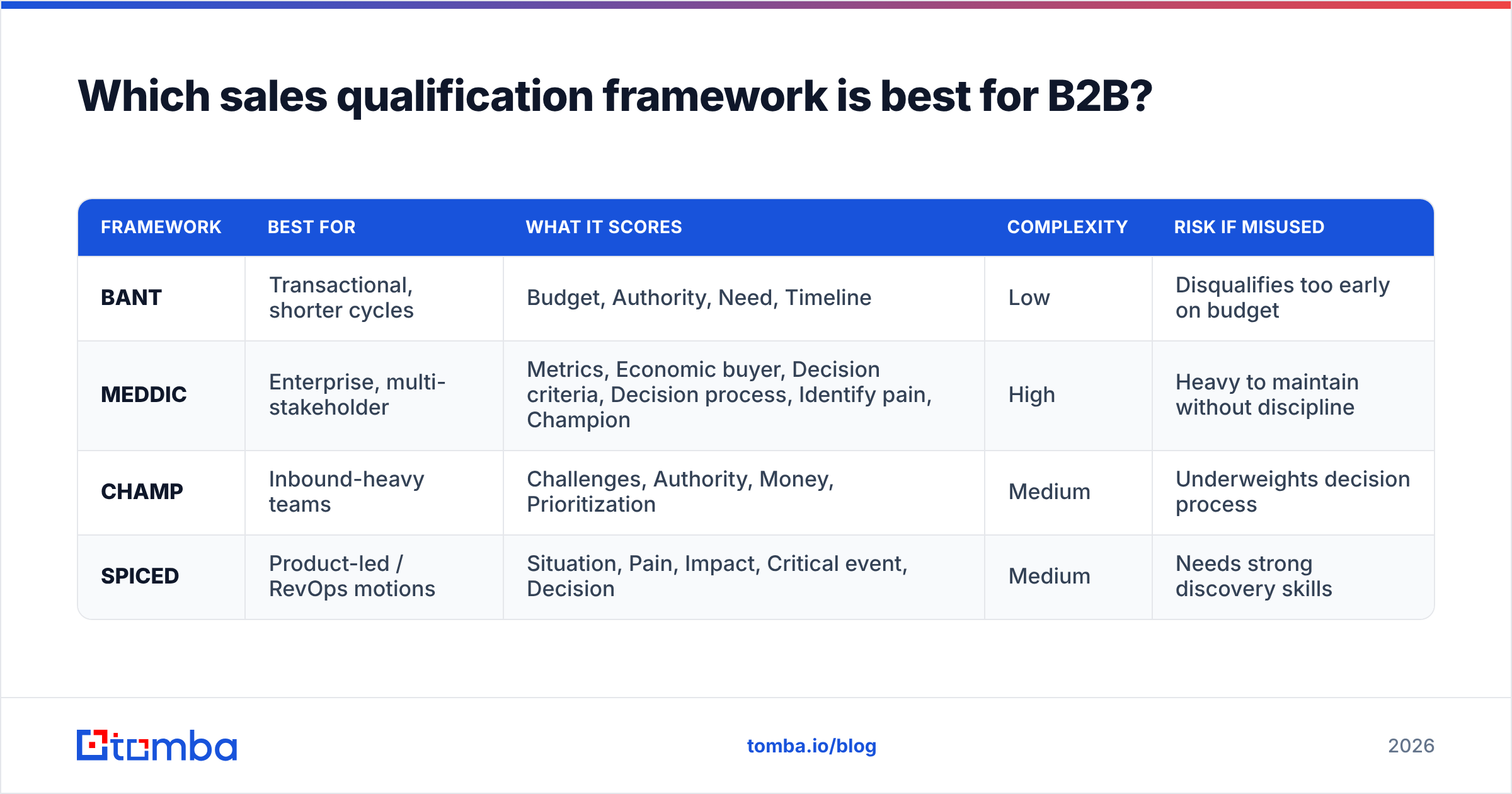
The best framework is the one your team will actually use consistently — but for complex B2B deals, MEDDIC and its variants have become the default for a reason. Here is how the common options compare.
| Framework | Best for | What it scores | Complexity | Risk if misused |
|---|---|---|---|---|
| BANT | Transactional, shorter cycles | Budget, Authority, Need, Timeline | Low | Disqualifies too early on budget |
| MEDDIC | Enterprise, multi-stakeholder | Metrics, Economic buyer, Decision criteria, Decision process, Identify pain, Champion | High | Heavy to maintain without discipline |
| CHAMP | Inbound-heavy teams | Challenges, Authority, Money, Prioritization | Medium | Underweights decision process |
| SPICED | Product-led / RevOps motions | Situation, Pain, Impact, Critical event, Decision | Medium | Needs strong discovery skills |
For most growing B2B teams, start with BANT to build the habit of qualifying, then graduate to MEDDIC once deals get larger and more committees get involved. The framework matters less than the rule behind it: no deal advances a stage without meeting that stage's exit criteria.
How do data and tooling fit into the process?#
Tooling enforces the process so it survives a busy quarter. A process that lives only in a slide deck gets abandoned the first week reps are slammed. The same process wired into your CRM, your outreach sequencer, and your prospecting tools runs itself.
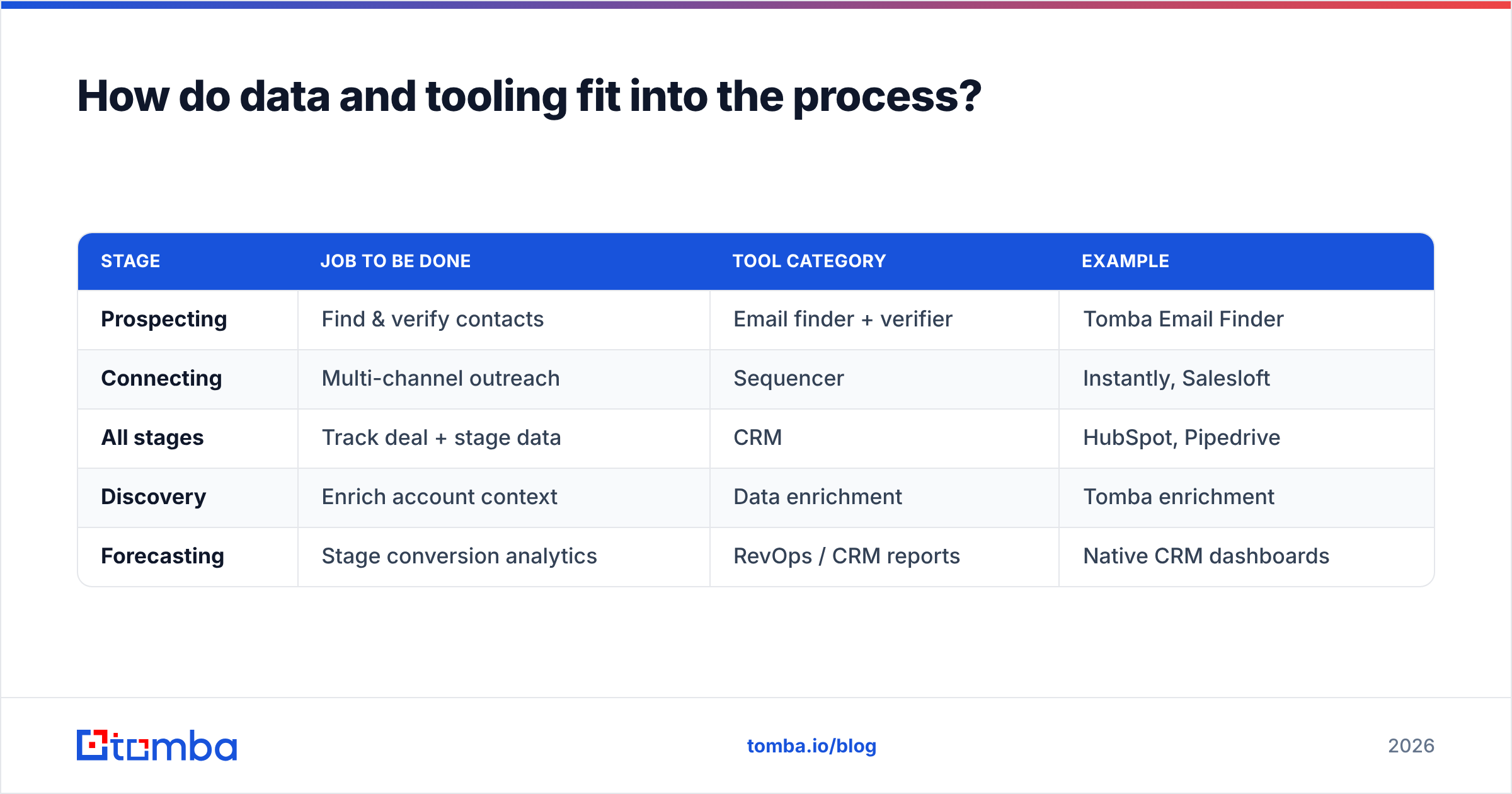
Here is the minimum stack, mapped to the stages it powers:
| Stage | Job to be done | Tool category | Example |
|---|---|---|---|
| Prospecting | Find & verify contacts | Email finder + verifier | Tomba Email Finder |
| Connecting | Multi-channel outreach | Sequencer | Instantly, Salesloft |
| All stages | Track deal + stage data | CRM | HubSpot, Pipedrive |
| Discovery | Enrich account context | Data enrichment | Tomba enrichment |
| Forecasting | Stage conversion analytics | RevOps / CRM reports | Native CRM dashboards |
The unglamorous truth is that the process starts with data. If your prospecting list is full of guessed addresses and stale contacts, every downstream stage converts worse — you waste connect attempts on bounces and discovery calls on the wrong people. Running your list through an email verifier before the first send protects your sender reputation and your reps' time. For teams building lists at scale, a bulk email finder turns a list of target companies into reachable, verified contacts in one pass.
You can read more about where Tomba gets its data if accuracy at the top of the funnel is your concern — and it should be.
What metrics tell you the process is working?#
Track conversion between stages, not just the final win rate. Win rate tells you that something is broken; stage-to-stage conversion tells you where. Think of your pipeline like a series of pipes — you do not fix a leak by measuring how much water reaches the end; you measure each joint.
The core metrics worth instrumenting:
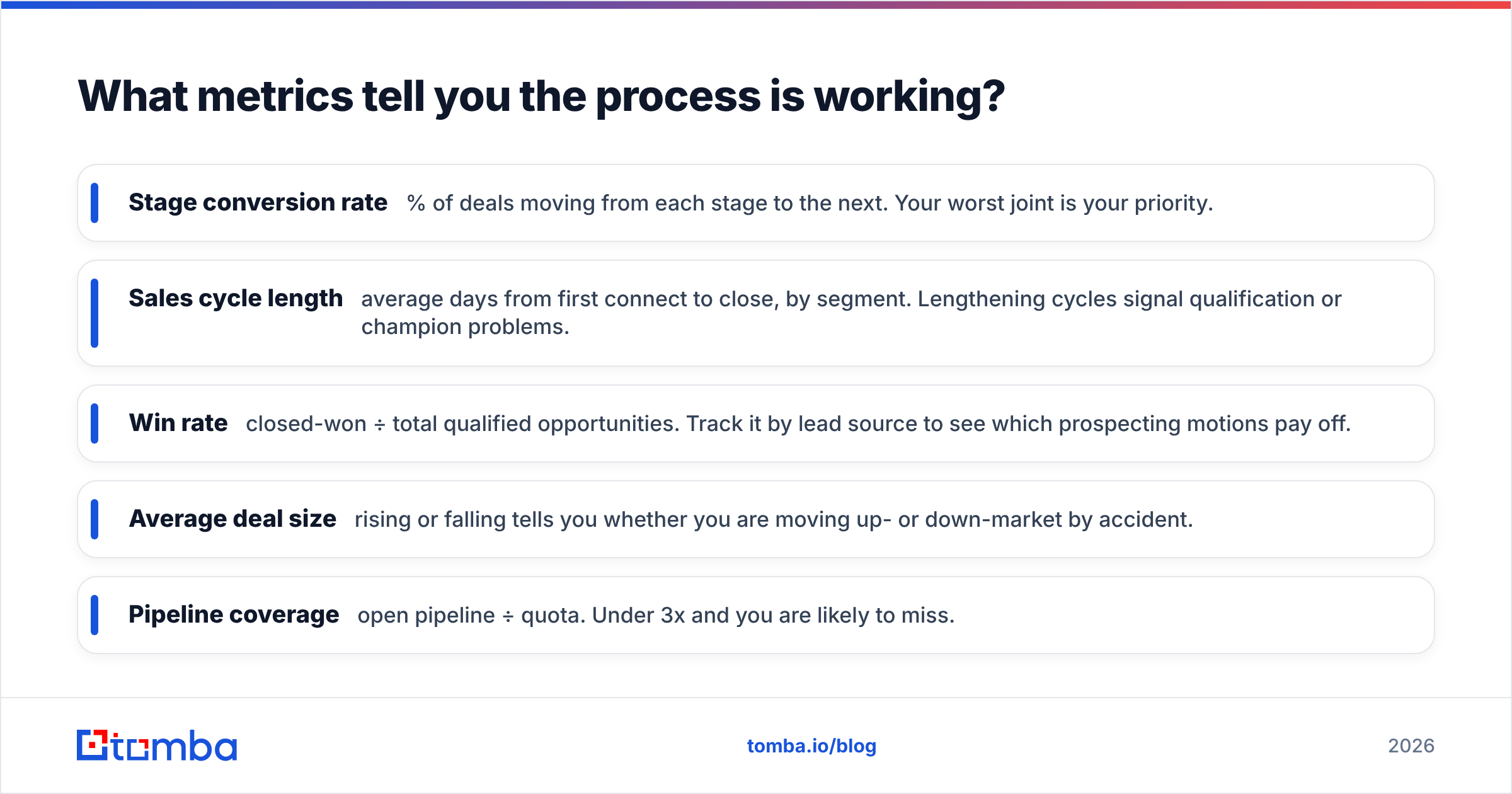
- Stage conversion rate — % of deals moving from each stage to the next. Your worst joint is your priority.
- Sales cycle length — average days from first connect to close, by segment. Lengthening cycles signal qualification or champion problems.
- Win rate — closed-won ÷ total qualified opportunities. Track it by lead source to see which prospecting motions pay off.
- Average deal size — rising or falling tells you whether you are moving up- or down-market by accident.
- Pipeline coverage — open pipeline ÷ quota. Under 3x and you are likely to miss.
A quick note on benchmarking: your own historical conversion rates are a better target than any industry average, because your ICP, price point, and motion are unique. Use external numbers from sources like G2 to sanity-check, not to set goals.
How do you actually implement this without a six-month project?#
Start small and instrument as you go. You do not need a RevOps team or a six-figure tool migration to get the best sales process for B2B working. You need agreement on stages and the discipline to enforce exit criteria.
A pragmatic 30-day rollout:
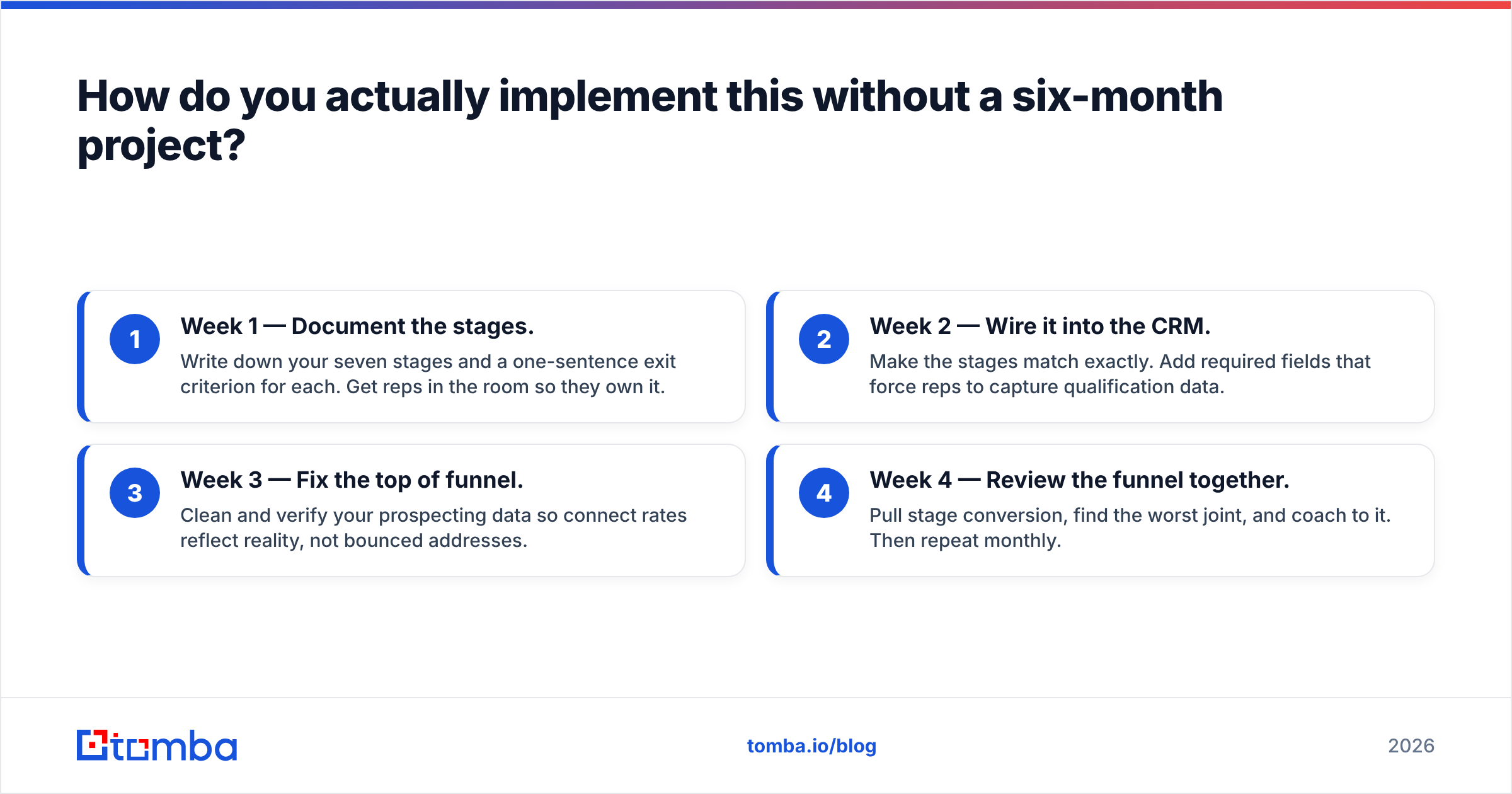
- Week 1 — Document the stages. Write down your seven stages and a one-sentence exit criterion for each. Get reps in the room so they own it.
- Week 2 — Wire it into the CRM. Make the stages match exactly. Add required fields that force reps to capture qualification data.
- Week 3 — Fix the top of funnel. Clean and verify your prospecting data so connect rates reflect reality, not bounced addresses.
- Week 4 — Review the funnel together. Pull stage conversion, find the worst joint, and coach to it. Then repeat monthly.
The mistake teams make is treating this as a one-time setup. The process is a living thing — you inspect it every month, find the leak, fix it, and move to the next. Compare your stack and budget against Tomba pricing when you decide how much tooling to layer in; you can start free and scale as the process proves out.
Common mistakes that quietly kill a B2B sales process#
- Stages that describe rep activity instead of buyer commitment. "Demo given" is an activity; "buyer agreed on decision criteria" is progress. Define stages from the buyer's side.
- No disqualification path. If deals only ever move forward, your pipeline is bloated and your forecast is junk. Reps should be rewarded for killing bad deals early.
- Letting data decay. Contacts change jobs constantly. A list that was clean six months ago is leaking now. Re-verify before big campaigns.
- Over-engineering the framework. A perfect MEDDIC field set that reps ignore is worse than a simple BANT habit they actually follow.
- Forecasting from gut, not stages. If your forecast and your stage data disagree, your stages are not trusted — fix the definitions.
How do email finders strengthen the prospecting stage?#
The prospecting stage decides the ceiling of everything that follows, and verified contact data is what separates a list that converts from one that bounces. When a rep works from accurate emails, their connect rate climbs, their sender reputation stays healthy, and discovery calls happen with real decision-makers instead of dead inboxes.
A good email finder lets reps go from a name and company to a verified, deliverable address in seconds — and a domain search turns a single target company into a full map of reachable contacts. Pair that with verification and your top-of-funnel data stops being the weakest link in your process.
If you want the prospecting stage of your B2B sales process to stop leaking, start there: build your target list, find verified emails with the Tomba Email Finder, and feed clean data into the rest of your pipeline. You can begin on the free tier (25 searches a month), move to Starter at $49/mo as volume grows, and scale to Growth or Pro when your process is humming. A repeatable process plus reliable data is what turns a good quarter into a predictable one.
// get started
Find, verify and enrich your first contacts today
Start on the free plan with 25 searches a month, then scale when your team is ready.
Free plan · No credit card required · GDPR & CCPA
// about the author