Best Sales System in 2026: Build a Repeatable Pipeline
The best sales system isn't a single tool — it's data, process, and automation working together. Here's how to build one that closes in 2026.
The phrase "best sales system" gets thrown around like it means one product you can buy. It doesn't. A sales system is the connected set of process, data, and automation that turns a stranger into revenue — and the teams that win in 2026 treat it as a system, not a shopping list.
This guide breaks down what a modern sales system actually contains, how to compare the common architectures, and where most teams quietly bleed pipeline. You'll leave with a blueprint you can build this quarter.
TL;DR#
- The best sales system is three layers working together: a data layer (who to contact), a process layer (how deals move), and an automation layer (how it scales). Miss one and the other two underperform.
- A great CRM with bad contact data is an expensive filing cabinet. Fix data accuracy first — it compounds through everything downstream.
- Pick a process framework (stage definitions, exit criteria, a forecast model) before you pick tools. Tools enforce process; they don't create it.
- For most B2B teams, a "good-enough CRM + clean enrichment + a sequencer" beats an all-in-one platform you only half-configure.
- Measure the system on three numbers: pipeline coverage, stage conversion, and sales cycle length. Everything else is vanity.
What is a sales system, really?#
A sales system is your repeatable method for converting attention into closed revenue. Think of it like a restaurant kitchen: the recipe (process) only works if the ingredients are fresh (data) and the line cooks have stations and tickets (automation). A Michelin recipe with spoiled ingredients still poisons the customer.
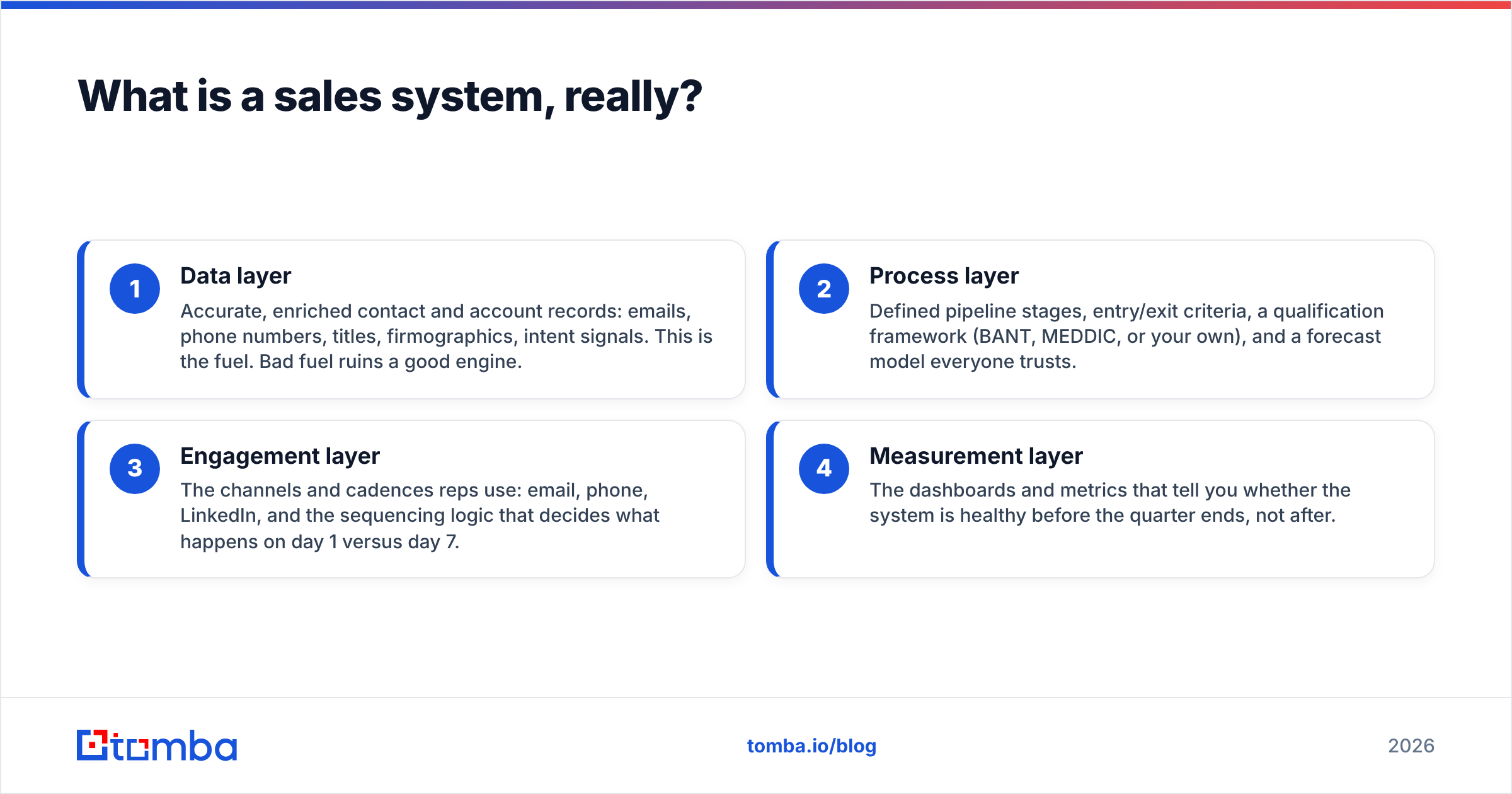
Technically, a sales system spans four moving parts that have to stay in sync:
- Data layer — Accurate, enriched contact and account records: emails, phone numbers, titles, firmographics, intent signals. This is the fuel. Bad fuel ruins a good engine.
- Process layer — Defined pipeline stages, entry/exit criteria, a qualification framework (BANT, MEDDIC, or your own), and a forecast model everyone trusts.
- Engagement layer — The channels and cadences reps use: email, phone, LinkedIn, and the sequencing logic that decides what happens on day 1 versus day 7.
- Measurement layer — The dashboards and metrics that tell you whether the system is healthy before the quarter ends, not after.
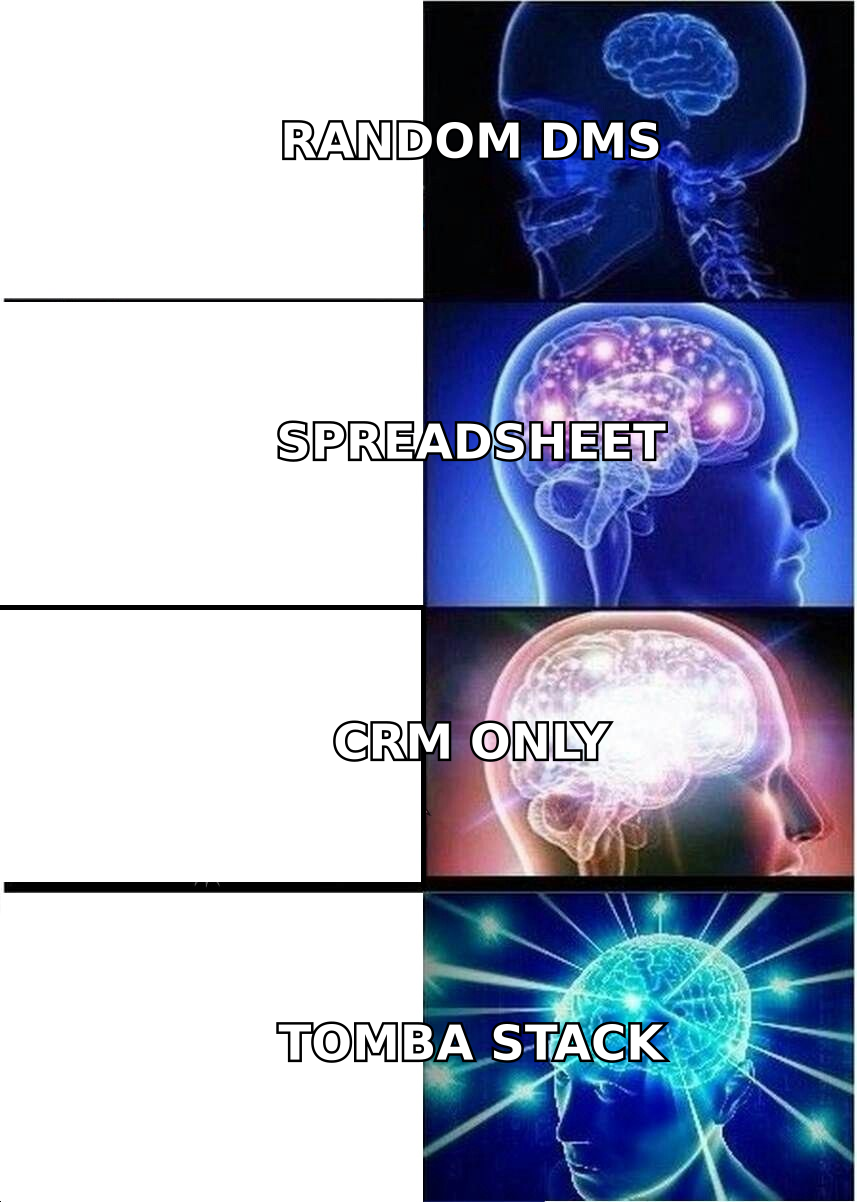
When people ask for the "best sales system," they're usually missing one of these four. Most often it's the first one.
Why does data quality decide whether a sales system works?#
Because every other layer multiplies against it. Your process can be flawless and your sequencer perfectly tuned, but if 30% of your contact records bounce or route to the wrong person, you've capped your ceiling on day one.
Gartner has repeatedly flagged that poor data quality is one of the most expensive and least-tracked drags on sales performance — reps waste hours chasing dead contacts, and forecasts inherit the noise. The fix isn't glamorous: you verify contacts before they enter the system and you re-enrich them on a schedule so they don't rot.
This is where a dedicated email verifier and data enrichment layer earns its keep. Cleaning records at the point of entry stops bad data from poisoning your CRM, your reporting, and your sender reputation all at once.
A practical data-hygiene baseline:
- Verify on capture. Every new lead's email gets validated before a rep ever touches it.
- Enrich on capture. Fill in title, company size, and phone so reps can prioritize without manual research.
- Re-verify quarterly. People change jobs ~20% per year; your database decays whether you watch it or not.
- Deduplicate ruthlessly. Two records for one buyer breaks attribution and annoys the buyer.
What does the best sales system look like, layer by layer?#
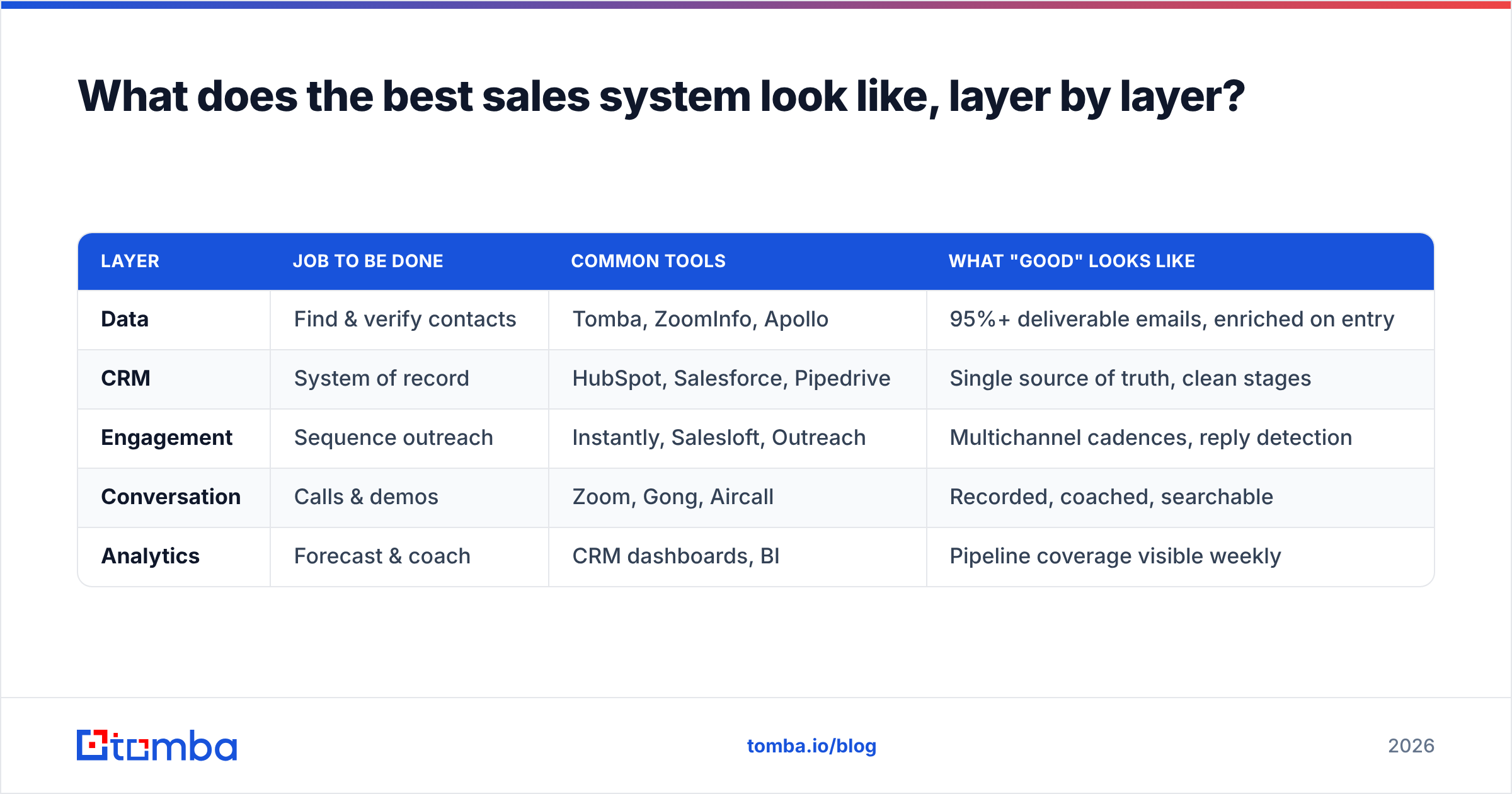
Here's the reference architecture most high-performing B2B teams converge on. You don't need every box on day one, but you should know where each tool plugs in.
| Layer | Job to be done | Common tools | What "good" looks like |
|---|---|---|---|
| Data | Find & verify contacts | Tomba, ZoomInfo, Apollo | 95%+ deliverable emails, enriched on entry |
| CRM | System of record | HubSpot, Salesforce, Pipedrive | Single source of truth, clean stages |
| Engagement | Sequence outreach | Instantly, Salesloft, Outreach | Multichannel cadences, reply detection |
| Conversation | Calls & demos | Zoom, Gong, Aircall | Recorded, coached, searchable |
| Analytics | Forecast & coach | CRM dashboards, BI | Pipeline coverage visible weekly |
The mistake teams make is buying the engagement and conversation layers first because they're exciting, then starving the data layer that feeds them. Build bottom-up: data, then CRM, then engagement.
All-in-one platform or best-of-breed stack: which sales system wins?#
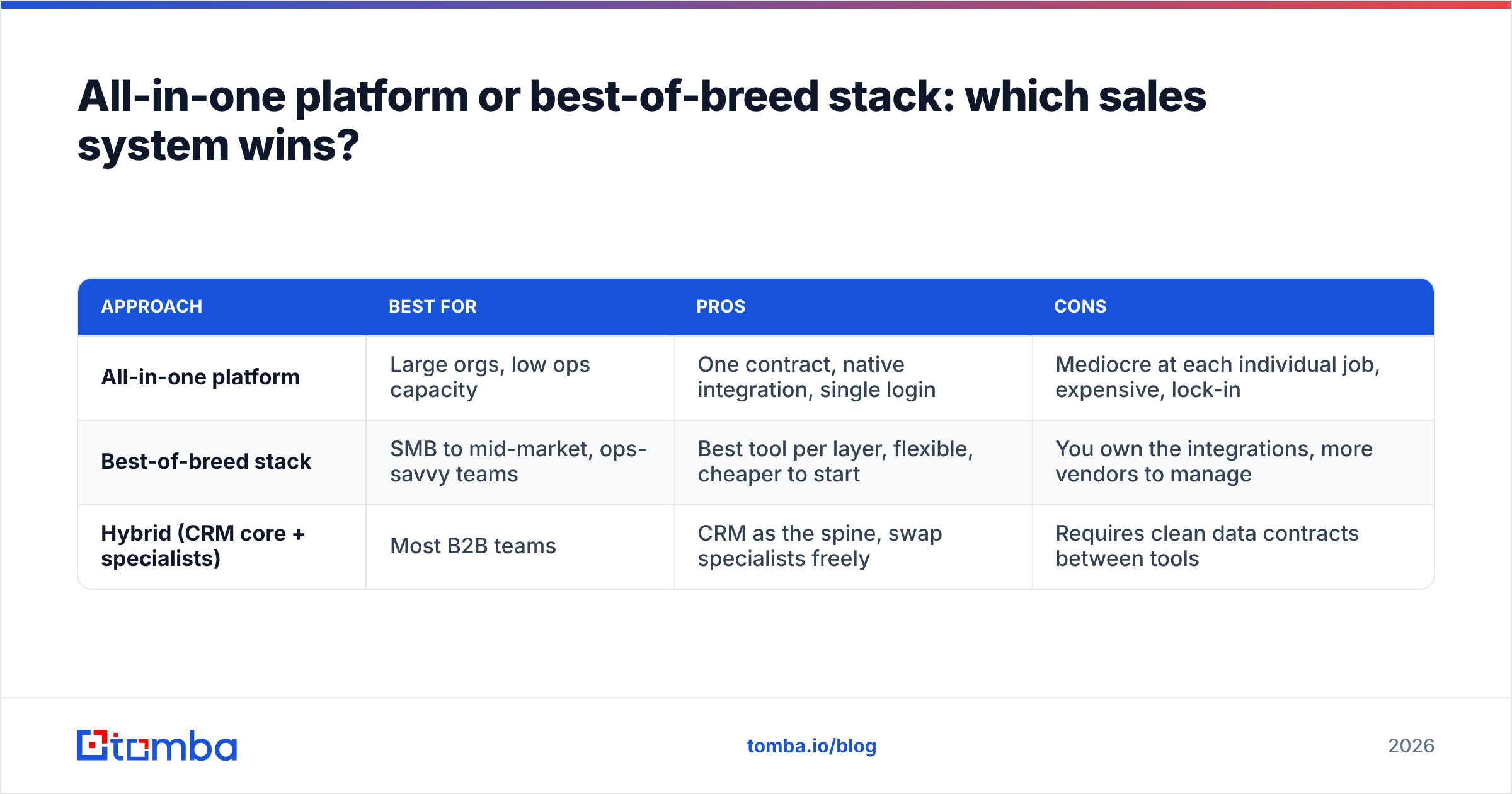
Short answer: best-of-breed wins for most teams under a few hundred reps; all-in-one wins when integration overhead and procurement fatigue outweigh feature depth.
Here's the honest trade-off:
| Approach | Best for | Pros | Cons |
|---|---|---|---|
| All-in-one platform | Large orgs, low ops capacity | One contract, native integration, single login | Mediocre at each individual job, expensive, lock-in |
| Best-of-breed stack | SMB to mid-market, ops-savvy teams | Best tool per layer, flexible, cheaper to start | You own the integrations, more vendors to manage |
| Hybrid (CRM core + specialists) | Most B2B teams | CRM as the spine, swap specialists freely | Requires clean data contracts between tools |
The hybrid model — a solid CRM as your spine with specialist tools bolted on for data and engagement — is the pragmatic default. You get HubSpot or Salesforce as the system of record, then connect a focused email-finding and enrichment layer through native HubSpot integration or Salesforce integration so contact data flows in clean.
How do you actually build a sales system in 2026?#
Follow this sequence. Each step assumes the one before it is done — that ordering is the whole point.
Step 1 — Define your pipeline stages and exit criteria. Write down, in plain language, what has to be true for a deal to move from "discovery" to "demo" to "proposal." If two reps would disagree on whether a deal qualifies, your stages aren't defined yet. This is process work, not software work.
Step 2 — Pick your CRM and make it the single source of truth. Whatever you choose, the rule is non-negotiable: if it isn't in the CRM, it didn't happen. G2's CRM category is a reasonable place to compare options on real user reviews rather than vendor claims.
Step 3 — Wire in a clean data layer. Connect an email finder and verifier so every contact that enters the CRM is real and reachable. This is the step teams skip and the one that quietly caps results. Use domain search to map whole target accounts, not just individuals.
Step 4 — Layer on engagement. Add a sequencer for multichannel cadences. Keep volumes sane and protect sender reputation — a clean data layer already does most of that work because you're not blasting invalid addresses.
Step 5 — Instrument the measurement layer. Build three dashboards: pipeline coverage (do you have 3–4x your quota in pipeline?), stage conversion (where do deals die?), and sales cycle length (is it speeding up or dragging?).
Step 6 — Run a weekly system review. Not a deal review — a system review. Where is the bottleneck this week, and which layer owns the fix?
Which metrics prove your sales system is healthy?#
Three numbers tell you almost everything. Track these weekly and resist the urge to drown them in twenty others.
- Pipeline coverage — Total open pipeline divided by quota. Below 3x and you're behind before the quarter starts.
- Stage-to-stage conversion — The percentage of deals that advance from each stage to the next. A sudden drop pinpoints exactly where the system leaks.
- Sales cycle length — Median days from first touch to close. A growing cycle usually means a data or qualification problem upstream, not a closing problem.
Two supporting metrics worth watching: response rate on outbound (a proxy for data and message quality) and win rate by lead source (tells you which parts of the system to feed).
What are the most common sales system mistakes?#
The failures repeat across companies of every size:
- Buying tools before defining process. Software enforces a process; it can't invent one. A CRM rollout onto an undefined process just digitizes the chaos.
- Treating data as a one-time import. Your list was clean the day you bought it and decays every day after. Without re-verification, accuracy quietly slides toward 70%.
- Over-buying an all-in-one and under-configuring it. A platform you use at 30% is more expensive than three specialist tools you use fully.
- Optimizing volume before deliverability. More emails to a dirty list means more bounces, worse sender reputation, and eventually a blocked domain.
- No single source of truth. When the spreadsheet, the CRM, and the rep's memory disagree, your forecast is fiction.
Fix data and process first. The flashy layers only pay off once those two are solid.
How much should a sales system cost?#
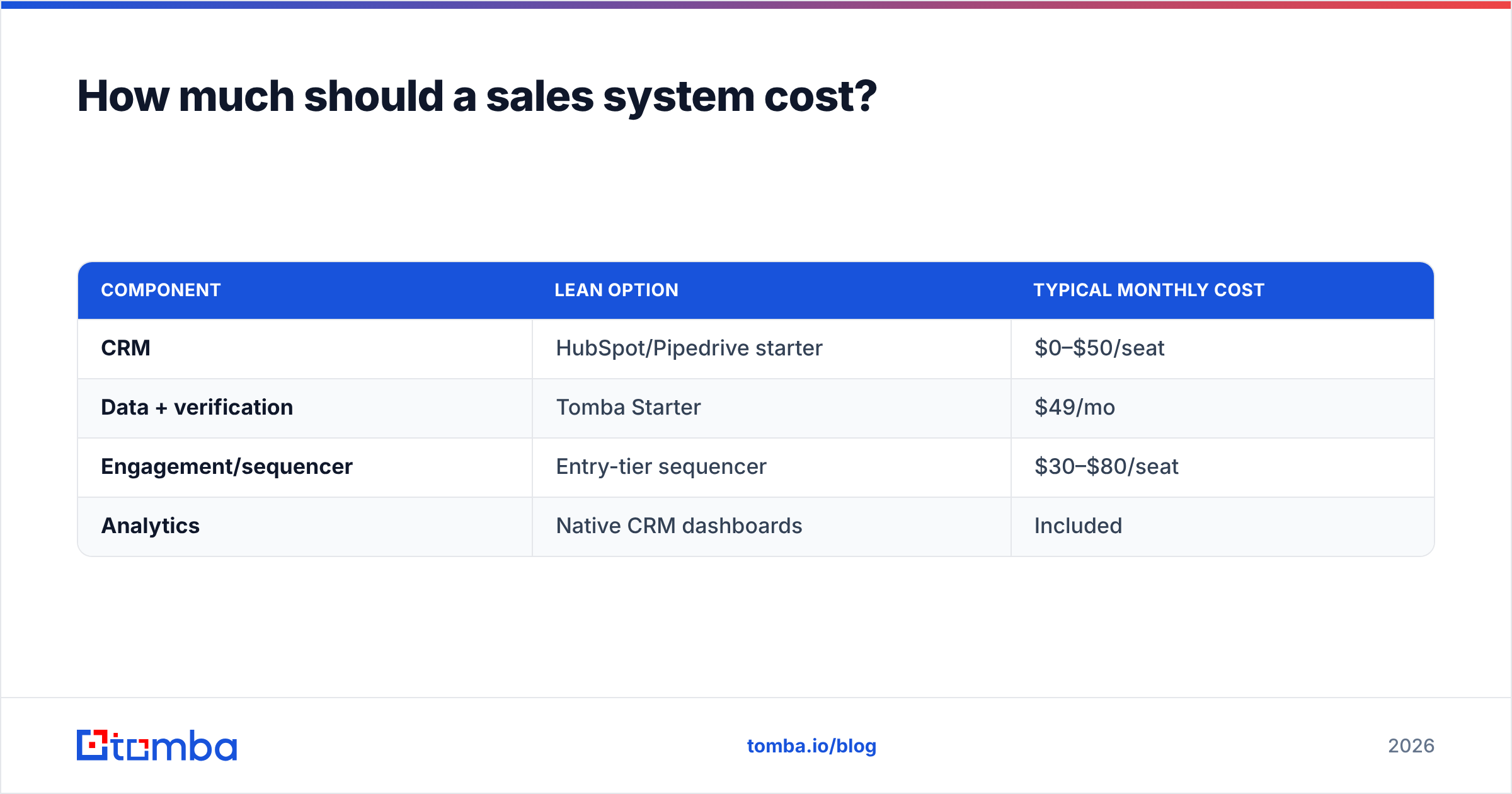
Less than you think to start, and it scales with seats and data volume rather than with feature checklists. A lean, effective stack for a small B2B team looks roughly like this:
| Component | Lean option | Typical monthly cost |
|---|---|---|
| CRM | HubSpot/Pipedrive starter | $0–$50/seat |
| Data + verification | Tomba Starter | $49/mo |
| Engagement/sequencer | Entry-tier sequencer | $30–$80/seat |
| Analytics | Native CRM dashboards | Included |
You can run a credible system for the price of a few software seats. Tomba's own data layer starts free (25 searches/month), with Tomba pricing moving to Starter at $49/mo, Growth at $99/mo, and Pro at $249/mo as your volume grows. The point is to start lean, prove the system works, and scale the layer that's actually constraining you — usually data — rather than over-buying everything at once.
Frequently asked questions#
Is a CRM the same as a sales system? No. A CRM is the system of record — one layer. A sales system is the CRM plus the data feeding it, the process governing it, and the automation scaling it.
What's the single highest-leverage upgrade? Clean contact data. It multiplies through every other layer, improves deliverability, and sharpens your forecast at the same time.
Do I need an all-in-one platform? Usually not. A solid CRM spine plus best-of-breed data and engagement tools beats a half-configured suite for most teams under a few hundred reps.
How often should I audit the system? Weekly for metrics, quarterly for data re-verification, and annually for the tool stack itself.
Build the data layer your sales system runs on#
A sales system is only as good as the contacts flowing through it. Before you spend on more seats or a fancier platform, fix the fuel: start with the Tomba Email Finder to find and verify professional emails by name, company, or domain, then enrich them so every record that hits your CRM is real, reachable, and ready for your reps to work. Spin up the free tier, point it at one target account, and watch how much cleaner the rest of your pipeline gets. That's the layer the best sales systems are built on — and the one most teams skip.
// get started
Find, verify and enrich your first contacts today
Start on the free plan with 25 searches a month, then scale when your team is ready.
Free plan · No credit card required · GDPR & CCPA
// about the author