Best Sales Tracking Software in 2026: Top 9 Tools Ranked
A neutral, hands-on guide to the best sales tracking software in 2026 — pricing, pipeline features, reporting, and which tool fits your team's stage.
Sales tracking software is the system of record that tells you where every deal stands, why it's stuck, and which reps will hit quota — before the quarter closes, not after. Pick the wrong one and your pipeline reports become fiction. Pick the right one and forecasting stops being a guessing game.
This guide ranks the best sales tracking software for 2026 by what actually matters: pipeline visibility, forecast accuracy, reporting depth, automation, and total cost. No tool is "best" for everyone, so we map each to a team stage and budget.
TL;DR — Best Sales Tracking Software for 2026#
- Best all-around: HubSpot Sales Hub — generous free tier, clean UI, scales from startup to mid-market.
- Best for complex enterprise pipelines: Salesforce Sales Cloud — unmatched customization, steep cost and learning curve.
- Best value for SMB pipelines: Pipedrive — visual, cheap, fast to deploy.
- Best for revenue forecasting: Clari — purpose-built for forecast accuracy, enterprise pricing.
- The hidden dependency: every tracker is only as accurate as the contact data feeding it. A data enrichment layer like Tomba keeps records from rotting.
What Is Sales Tracking Software?#
Sales tracking software is a tool that records and visualizes every interaction, deal, and stage in your sales process so you can measure progress and predict revenue. Think of it like the dashboard in a car: the engine (your reps) does the work, but without the gauges you have no idea how fast you're going, how much fuel is left, or whether the engine is about to fail.
Most sales tracking lives inside a CRM, but the two aren't identical. A CRM stores relationships; a sales tracker turns that stored data into pipeline stages, activity logs, conversion metrics, and forecasts.
The core jobs of any sales tracker break down into five layers:
- Pipeline tracking — visualize deals across stages (lead → qualified → proposal → closed) with drag-and-drop or automated movement.
- Activity logging — capture calls, emails, meetings, and tasks automatically so reps stop doing data entry.
- Forecasting — project closed revenue from weighted pipeline value and historical win rates.
- Reporting and dashboards — surface conversion rates, sales-cycle length, win rate, and rep performance.
- Automation — trigger follow-ups, stage changes, and alerts without manual clicks.
)
When you evaluate the best sales tracking software, weight these five layers against your actual team size and deal complexity — not against a feature list you'll never touch.
What Should You Look for in the Best Sales Tracking Software?#
Conclusion first: prioritize data accuracy and adoption over feature count. The most feature-rich tool is worthless if reps won't use it or if the contact data is stale.
Here's the evaluation checklist that separates serious contenders from shelfware:
- Pipeline customization — can you model your real stages, not a vendor's default?
- Automated activity capture — does it log email and calls without manual entry? Manual logging is where adoption goes to die.
- Forecast accuracy — does it weight deals by stage probability and flag at-risk deals early?
- Reporting flexibility — custom dashboards, cohort analysis, and exportable reports.
- Integrations — native connections to your email, calendar, dialer, and enrichment stack. Check the Salesforce integration and HubSpot integration depth if you're committed to one ecosystem.
- Data hygiene — duplicate detection, validation, and enrichment to keep records current.
- Total cost — per-seat pricing plus add-ons, onboarding, and admin overhead.
According to peer-review data on G2, the tools that win highest satisfaction scores aren't the most powerful — they're the ones reps actually log into daily. Adoption beats capability.
What Are the Best Sales Tracking Software Tools in 2026?#
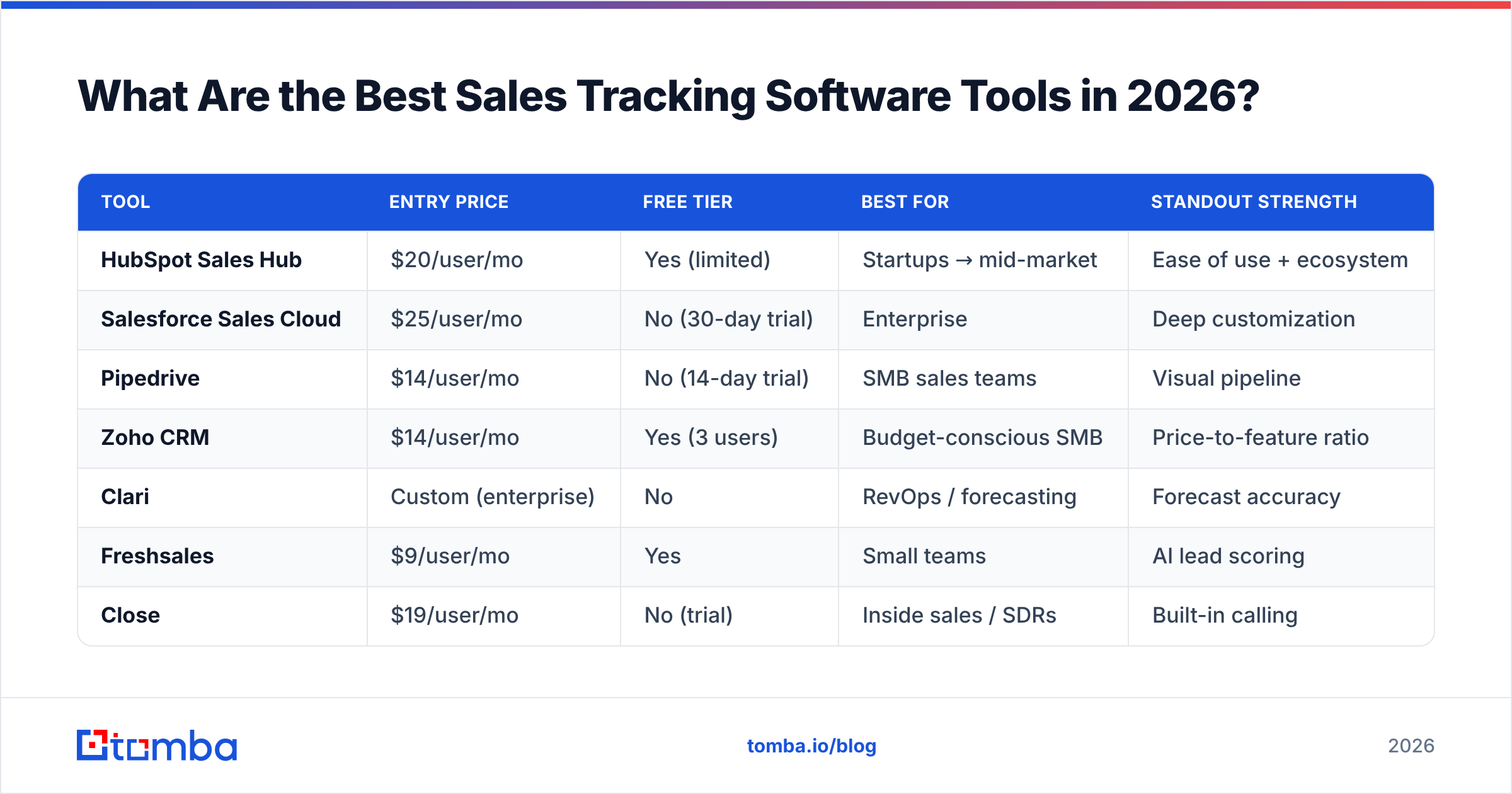
Below is a head-to-head comparison of the nine tools we tested across pricing, ideal team size, and standout strength. Pricing reflects publicly listed entry tiers as of mid-2026 and is per user/month billed annually unless noted.
| Tool | Entry price | Free tier | Best for | Standout strength |
|---|---|---|---|---|
| HubSpot Sales Hub | $20/user/mo | Yes (limited) | Startups → mid-market | Ease of use + ecosystem |
| Salesforce Sales Cloud | $25/user/mo | No (30-day trial) | Enterprise | Deep customization |
| Pipedrive | $14/user/mo | No (14-day trial) | SMB sales teams | Visual pipeline |
| Zoho CRM | $14/user/mo | Yes (3 users) | Budget-conscious SMB | Price-to-feature ratio |
| Clari | Custom (enterprise) | No | RevOps / forecasting | Forecast accuracy |
| Freshsales | $9/user/mo | Yes | Small teams | AI lead scoring |
| Close | $19/user/mo | No (trial) | Inside sales / SDRs | Built-in calling |
| monday Sales CRM | $12/user/mo | Yes (2 seats) | Cross-functional teams | Flexible boards |
| Salesloft | Custom | No | Outbound revenue teams | Engagement + cadence |
HubSpot Sales Hub — best all-around#
HubSpot wins the broadest recommendation because it scales without forcing a re-platform. The free tier is genuinely usable for pipeline tracking, and paid tiers add sequences, forecasting, and custom reporting. The catch: costs climb fast once you add Marketing Hub and seats. See the HubSpot pricing page for current tiers — the published entry price hides per-seat jumps at scale.
Salesforce Sales Cloud — best for enterprise#
If your pipeline has 12 custom stages, territory rules, and approval workflows, Salesforce is still the ceiling for customization. It's also the most expensive to run once you factor in admin headcount and integration work. Small teams almost always over-buy here.
Pipedrive — best value for SMB#
Pipedrive does one thing exceptionally well: a visual, drag-and-drop pipeline that reps adopt in a day. It lacks the marketing depth of HubSpot and the customization of Salesforce, which is exactly why it stays fast and cheap.
Clari — best for forecasting#
Clari isn't a CRM; it sits on top of one and specializes in forecast accuracy and pipeline inspection. RevOps teams at larger orgs use it to catch slipping deals weeks earlier. Pricing is enterprise-only and not published.
The remaining tools — Zoho, Freshsales, Close, monday, and Salesloft — each fill a specific niche (budget, inside sales, cross-functional, outbound) rather than competing for the all-around title.
How Much Does Sales Tracking Software Cost in 2026?#
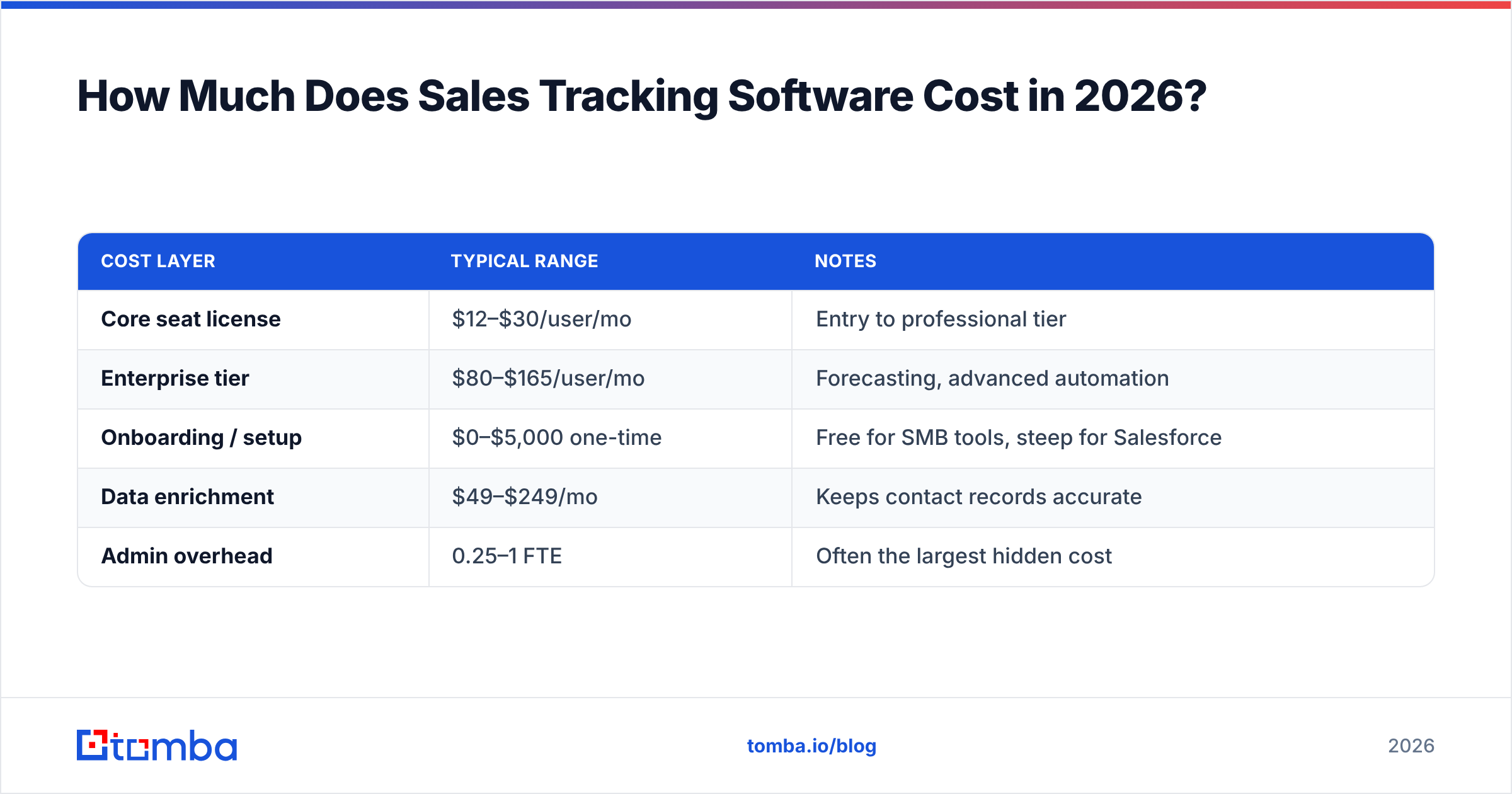
Conclusion first: budget $15–$30 per user per month for a capable mid-tier plan, then add 20–40% for the data and automation layers you'll inevitably need.
The sticker price is rarely the real cost. Here's the breakdown most buyers miss:
| Cost layer | Typical range | Notes |
|---|---|---|
| Core seat license | $12–$30/user/mo | Entry to professional tier |
| Enterprise tier | $80–$165/user/mo | Forecasting, advanced automation |
| Onboarding / setup | $0–$5,000 one-time | Free for SMB tools, steep for Salesforce |
| Data enrichment | $49–$249/mo | Keeps contact records accurate |
| Admin overhead | 0.25–1 FTE | Often the largest hidden cost |
That data-enrichment line is where sales tracking quietly succeeds or fails. A tracker full of bounced emails and wrong job titles produces confident, wrong forecasts. This is why teams pair their CRM with a contact-data tool — for example, Tomba pricing starts with a free tier (25 searches/month), then Starter at $49/mo and Growth at $99/mo, so enrichment doesn't blow up the budget.
)
Is Expensive Sales Tracking Software Worth It?#
Not automatically. The premium tiers earn their cost only when three conditions hold: your deals are complex, your team is large enough that small forecast errors cost real money, and you have an admin to configure the tool properly.
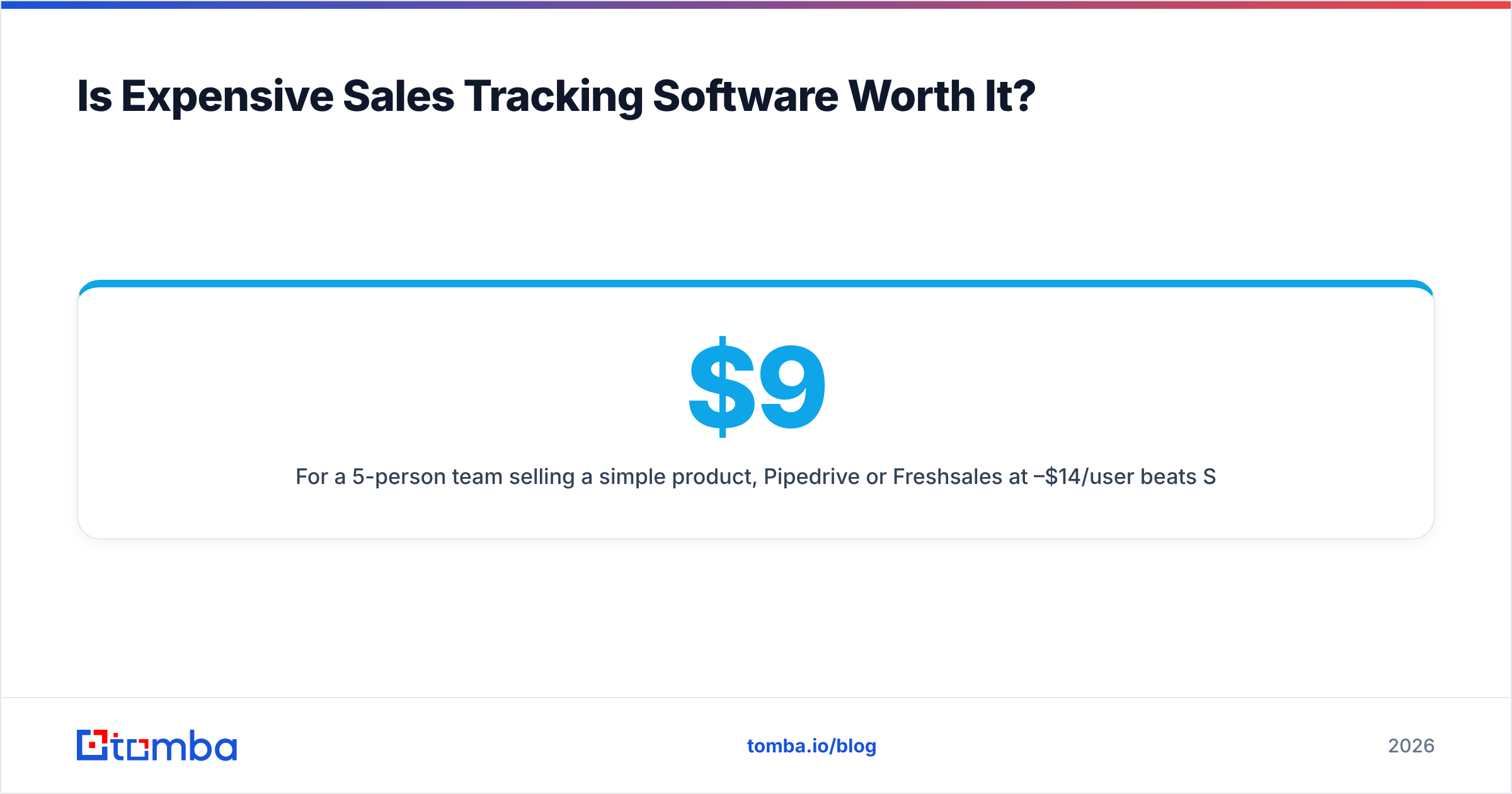
For a 5-person team selling a simple product, Pipedrive or Freshsales at $9–$14/user beats Salesforce in every metric that matters — adoption, time-to-value, and total cost. The expensive tools are priced for orgs where a 5% forecast improvement is worth six figures.
A useful rule: buy for the pipeline you have, not the one you imagine. You can always upgrade. Re-platforming down from an over-bought enterprise CRM is far more painful than growing into a bigger plan.
How Does Data Quality Affect Sales Tracking Accuracy?#
Directly and brutally. Your sales tracker's forecast is a calculation on top of your contact data — and garbage in produces confident garbage out. Industry research consistently finds that B2B contact data decays at roughly 25–30% per year as people change jobs, companies rebrand, and emails go dead. Salesforce's own research on data management echoes this: bad data is the leading cause of inaccurate forecasts.
Three failure modes show up in every neglected pipeline:
- Duplicate records inflate pipeline value and double-count deals.
- Dead contacts keep deals "open" against people who left the company.
- Wrong attributes (title, company size, region) break segmentation and routing.
The fix is a recurring hygiene layer, not a one-time cleanup. Tools like the email verifier catch bounced addresses before they pollute your tracker, while an email finder and enrichment fill the gaps when a contact changes roles. Wire these into your CRM via integrations so records update continuously instead of rotting between manual audits.
If you're building a new pipeline from scratch, a bulk email finder lets you populate the tracker with verified contacts rather than guesses — which means your first forecast is built on signal, not noise.
How Do You Choose the Right Sales Tracking Software?#
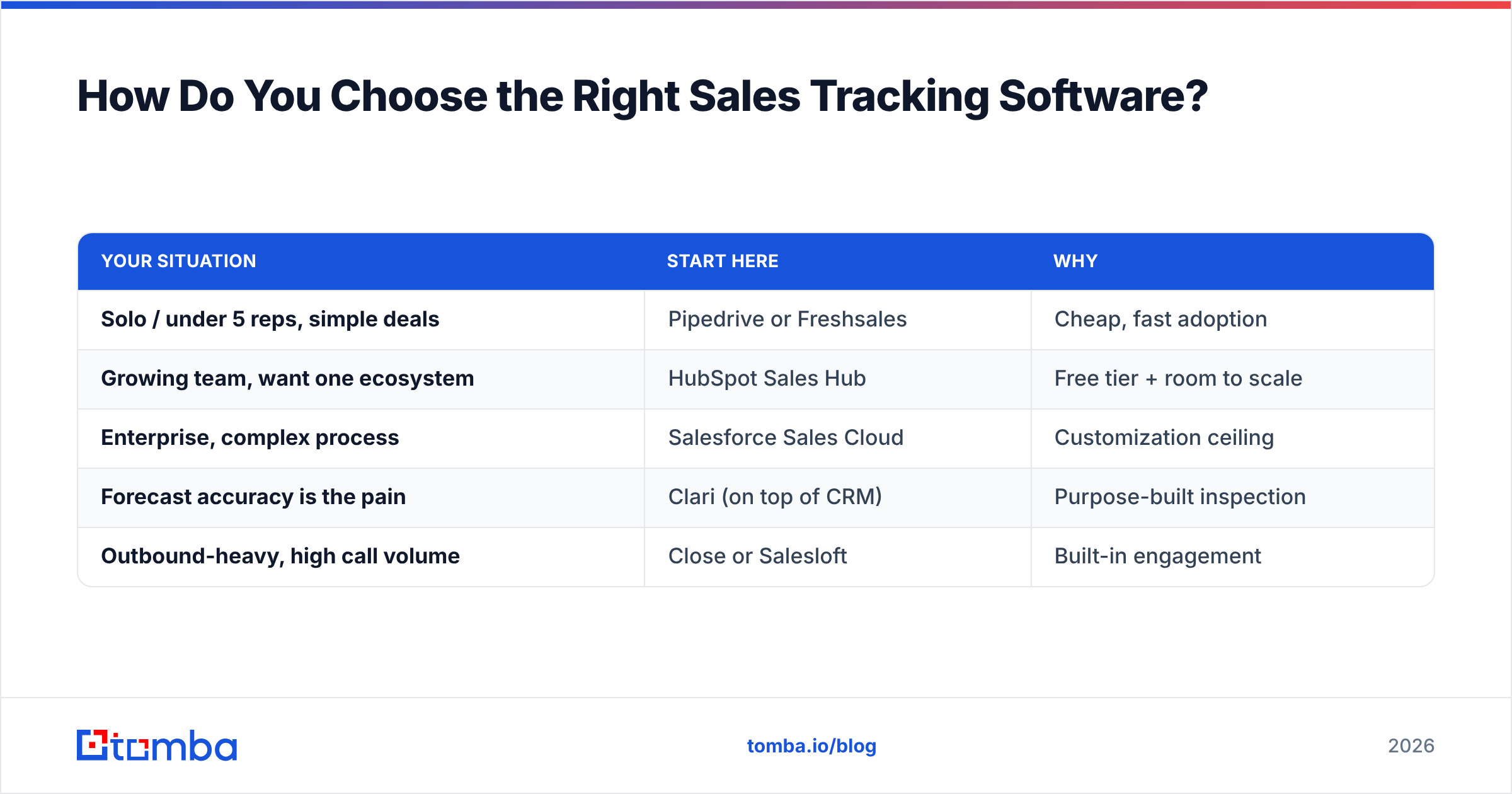
Match the tool to your stage using this decision shortcut:
| Your situation | Start here | Why |
|---|---|---|
| Solo / under 5 reps, simple deals | Pipedrive or Freshsales | Cheap, fast adoption |
| Growing team, want one ecosystem | HubSpot Sales Hub | Free tier + room to scale |
| Enterprise, complex process | Salesforce Sales Cloud | Customization ceiling |
| Forecast accuracy is the pain | Clari (on top of CRM) | Purpose-built inspection |
| Outbound-heavy, high call volume | Close or Salesloft | Built-in engagement |
Then, regardless of which tracker you pick, add the data layer. The tracker tells you where deals are; clean data tells you whether those deals are real.
The Bottom Line#
The best sales tracking software in 2026 is the one your reps actually use, fed by data you can trust. HubSpot wins the broadest recommendation, Salesforce owns the enterprise ceiling, and Pipedrive is the value pick for lean SMB teams. But the tool choice is only half the equation — forecast accuracy lives and dies on contact-data quality.
Before you trust another pipeline report, make sure the contacts behind it are real. Start with the Tomba Email Finder to find and verify professional emails by domain, name, or company — then sync verified records straight into your tracker. It's free to test (25 searches/month), and it turns your sales tracking software from a confident guesser into an accurate one.
// get started
Find, verify and enrich your first contacts today
Start on the free plan with 25 searches a month, then scale when your team is ready.
Free plan · No credit card required · GDPR & CCPA
// about the author