Best Sales Voicemail Greetings: 12 Scripts for Callbacks 2026
Most sales voicemails get deleted in under 6 seconds. Here are 12 proven sales voicemail scripts, the structure behind them, and how to actually get callbacks in 2026.
Best Sales Voicemail Greetings: 12 Scripts That Actually Get Callbacks
TL;DR
- The best sales voicemail greetings are short (under 25 seconds), lead with a reason to call back, and end with your number said twice — slowly.
- A clear, specific message can lift callback rates from the industry-typical 4–6% into double digits, because most reps still ramble for 45 seconds and get auto-deleted.
- Structure beats personality: hook, relevance, value, single ask, contact info. Every script below follows it.
- Voicemail is a setup for your next touch — pair it with an email and a LinkedIn note the same day.
- Accurate contact data is the multiplier. A perfect script left on a wrong number is worth zero, so verify the number first.
Why do most sales voicemails get deleted?#
The short answer: they waste the prospect's first six seconds. Decision-makers triage voicemail like they triage email — they decide whether to keep listening almost instantly. If your opening is "Hi, my name is, uh, I'm calling from [Company] and we're a leading provider of…", you're already deleted.
Think of a voicemail like a movie trailer. Nobody watches a trailer to see the whole plot; they watch to decide if the film is worth two hours. Your voicemail isn't the pitch — it's the trailer for the conversation you want. Its only job is to earn a callback or prime the email you're sending two minutes later.
Three things kill the average sales voicemail:
- It's too long. Anything past 30 seconds and people hang up before the reason to call.
- It's about you. "We help companies like yours" is filler. The prospect cares about their problem, not your category.
- It has no clear next step. If you don't say what happens next, nothing happens next.
What makes the best sales voicemail greetings work?#
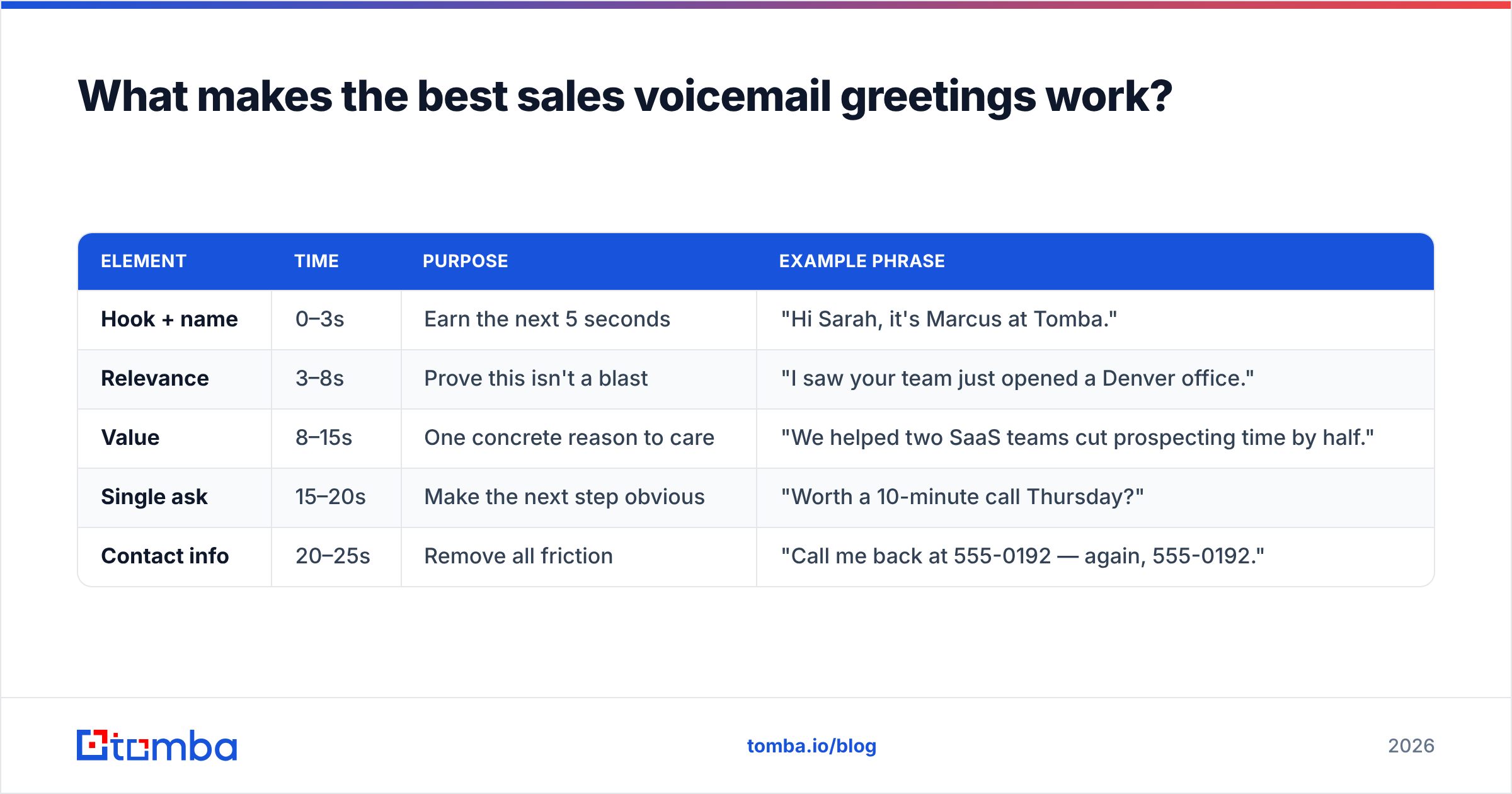
Every high-performing voicemail follows the same five-part skeleton. Memorize the structure, not the words — that way you sound human instead of like you're reading.
| Element | Time | Purpose | Example phrase |
|---|---|---|---|
| Hook + name | 0–3s | Earn the next 5 seconds | "Hi Sarah, it's Marcus at Tomba." |
| Relevance | 3–8s | Prove this isn't a blast | "I saw your team just opened a Denver office." |
| Value | 8–15s | One concrete reason to care | "We helped two SaaS teams cut prospecting time by half." |
| Single ask | 15–20s | Make the next step obvious | "Worth a 10-minute call Thursday?" |
| Contact info | 20–25s | Remove all friction | "Call me back at 555-0192 — again, 555-0192." |
Notice three rules baked into the table. First, one ask only — never "call me back, or check the email, or visit our site." Pick one. Second, say your number twice and slowly; the single most common reason callbacks don't happen is that nobody could write the number down. Third, lead with relevance before value so the prospect knows you did your homework.
The reps who consistently win at this are the ones who treat research as part of the script. According to HubSpot's sales benchmarks, personalization and timing move reply rates far more than volume does. The same logic applies on the phone.
12 best sales voicemail greetings (copy-and-adapt scripts)#
Use these as templates. Swap in real names, real triggers, real numbers. Keep each one under 25 seconds when spoken at a normal pace.
Cold outreach (first touch)#
1. The trigger-event opener
"Hi [Name], it's [You] at [Company]. I noticed [trigger — funding round, new hire, product launch]. We help teams in that exact moment [specific outcome]. Worth a quick call? Reach me at [number], again [number]."
2. The referral bridge
"Hi [Name], [Mutual contact] suggested I reach out. They thought [outcome] might be relevant for your team this quarter. I'll keep it to 10 minutes — call me back at [number], that's [number]."
3. The one-metric hook
"Hi [Name], it's [You] at [Company]. One number for you: [stat]. That's what [similar company] saw after working with us. If that's interesting, I'm at [number], again [number]."
4. The pattern-interrupt
"Hi [Name], this is [You] — and no, this isn't a pitch. I have a specific idea for how [their company] could [outcome]. If I'm wrong, tell me and I'll never call again. [Number], that's [number]."
Follow-up (no response yet)#
5. The polite nudge
"Hi [Name], [You] again at [Company]. I left a note last week about [topic] — totally understand if the timing's off. If it's worth 10 minutes, I'm at [number], again [number]."
6. The new-angle follow-up
"Hi [Name], it's [You]. Since we last spoke, [new development]. I think it changes the math for your team. Quick call? [Number], that's [number]."
7. The breakup voicemail
"Hi [Name], [You] at [Company]. I don't want to keep filling your inbox, so this is my last note unless I hear back. If [outcome] ever becomes a priority, I'm at [number]. Thanks for your time."
Inbound / warm leads#
8. The fast-response
"Hi [Name], it's [You] at [Company] — thanks for downloading [asset]. I have two ideas specific to [their use case]. Call me back at [number], again [number], and we'll keep it short."
9. The demo confirm
"Hi [Name], [You] here, confirming our call [day/time]. I'll send a calendar link too. If anything changes, reach me at [number], that's [number]. Looking forward to it."
Voicemail-to-email combos#
10. The "check your inbox"
"Hi [Name], it's [You]. I just sent a short email with [specific resource]. Two-minute read — and if it lands, I'm at [number]. Again, [number]."
11. The decision-maker handoff
"Hi [Name], [You] at [Company]. I think this is more relevant for [colleague] on your team. If you can point me their way, that'd help a lot. I'm at [number], that's [number]."
12. The event tie-in
"Hi [Name], it's [You]. I saw you're attending [event]. We'll be there too and I'd love 10 minutes. Call me at [number], again [number]."
These scripts pair naturally with written follow-ups. If you want a head start on the email half, our cold email templates library mirrors the same hook-relevance-ask structure.
When is the best time to leave a sales voicemail?#
Timing changes whether your message is heard fresh or buried under 14 others. The patterns below come from aggregated outbound dialing studies and hold up across most B2B segments.
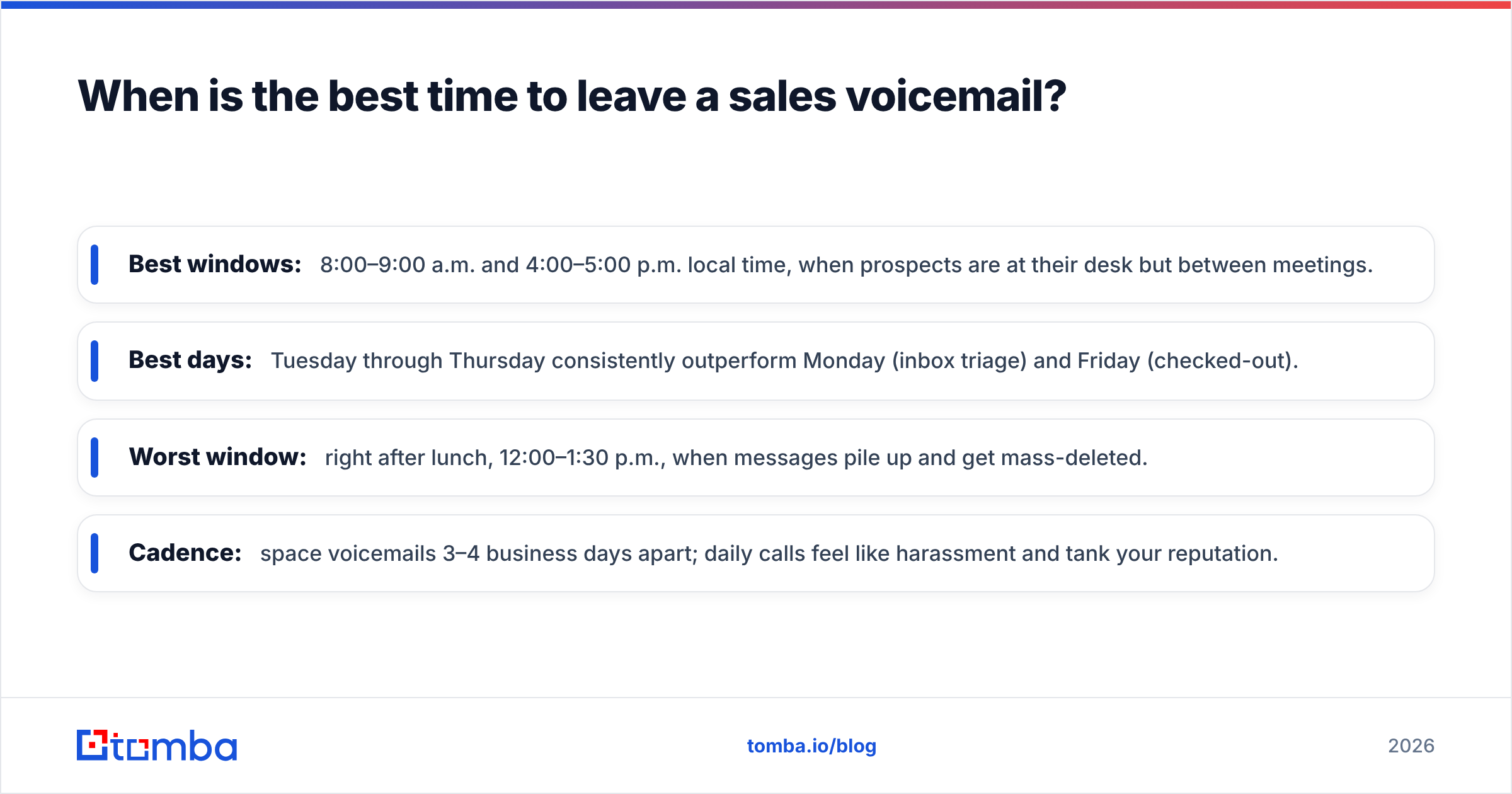
- Best windows: 8:00–9:00 a.m. and 4:00–5:00 p.m. local time, when prospects are at their desk but between meetings.
- Best days: Tuesday through Thursday consistently outperform Monday (inbox triage) and Friday (checked-out).
- Worst window: right after lunch, 12:00–1:30 p.m., when messages pile up and get mass-deleted.
- Cadence: space voicemails 3–4 business days apart; daily calls feel like harassment and tank your reputation.
Leave the voicemail, then send the matching email within a few minutes while you're still top of mind. The phone-plus-email combo routinely outperforms either channel alone — Salesforce's State of Sales research repeatedly finds that multi-channel sequences drive the highest conversion.
How long should a sales voicemail be?#
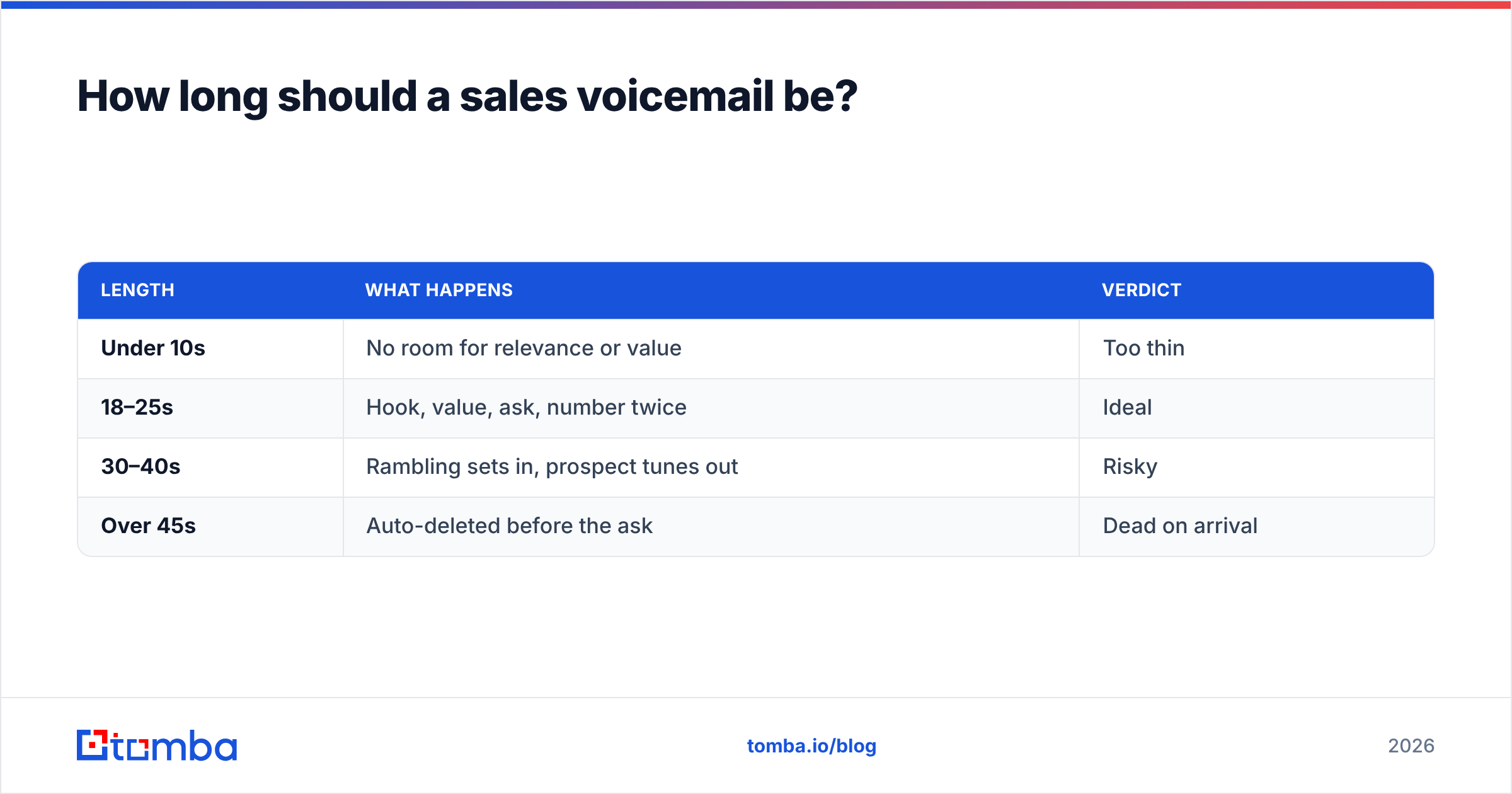
Keep it between 18 and 25 seconds. That's long enough for the five-part structure and short enough to respect the listener. Here's how length maps to outcome in practice:
| Length | What happens | Verdict |
|---|---|---|
| Under 10s | No room for relevance or value | Too thin |
| 18–25s | Hook, value, ask, number twice | Ideal |
| 30–40s | Rambling sets in, prospect tunes out | Risky |
| Over 45s | Auto-deleted before the ask | Dead on arrival |
A useful test: record yourself, then play it back at 1.5x speed. If it still makes sense and lands a clear ask, you're in good shape. If it's a blur of filler words, cut it down. Practiced reps can deliver the full structure in 20 seconds without sounding rushed.
How do you actually get the callback (not just leave the message)?#
Three levers separate reps who get callbacks from reps who just fill voicemail boxes.
1. Reach the right person on the right number. The best script is useless on a disconnected line or a generic switchboard. Direct-dial mobile numbers convert far better than office mains because you reach the person, not the gatekeeper. This is where data quality quietly decides everything — use a phone finder to source verified direct numbers, and run them through a phone validator before you dial so you're not burning calls on dead lines. If you only have a company name, a quick company-to-phone lookup can surface the right starting point.
2. Personalize the relevance line. "I saw you're hiring three AEs" beats "I help sales teams" every time. The relevance line is the one part you must customize per prospect — and it's the part that proves you're not a robocall.
3. Make the callback effortless. Say your number twice, slowly, and at the very end. People remember the last thing they hear. If you bury your number in the middle, they'd have to replay the whole message — and they won't.
Here's the uncomfortable truth most reps learn late: the script is maybe 30% of the result. Targeting and data are the other 70%. A mediocre voicemail to a perfectly-qualified, correctly-numbered prospect outperforms a brilliant voicemail to the wrong contact. You can validate vendor data claims yourself on review sites like G2 before committing budget.
What mistakes should you avoid?#
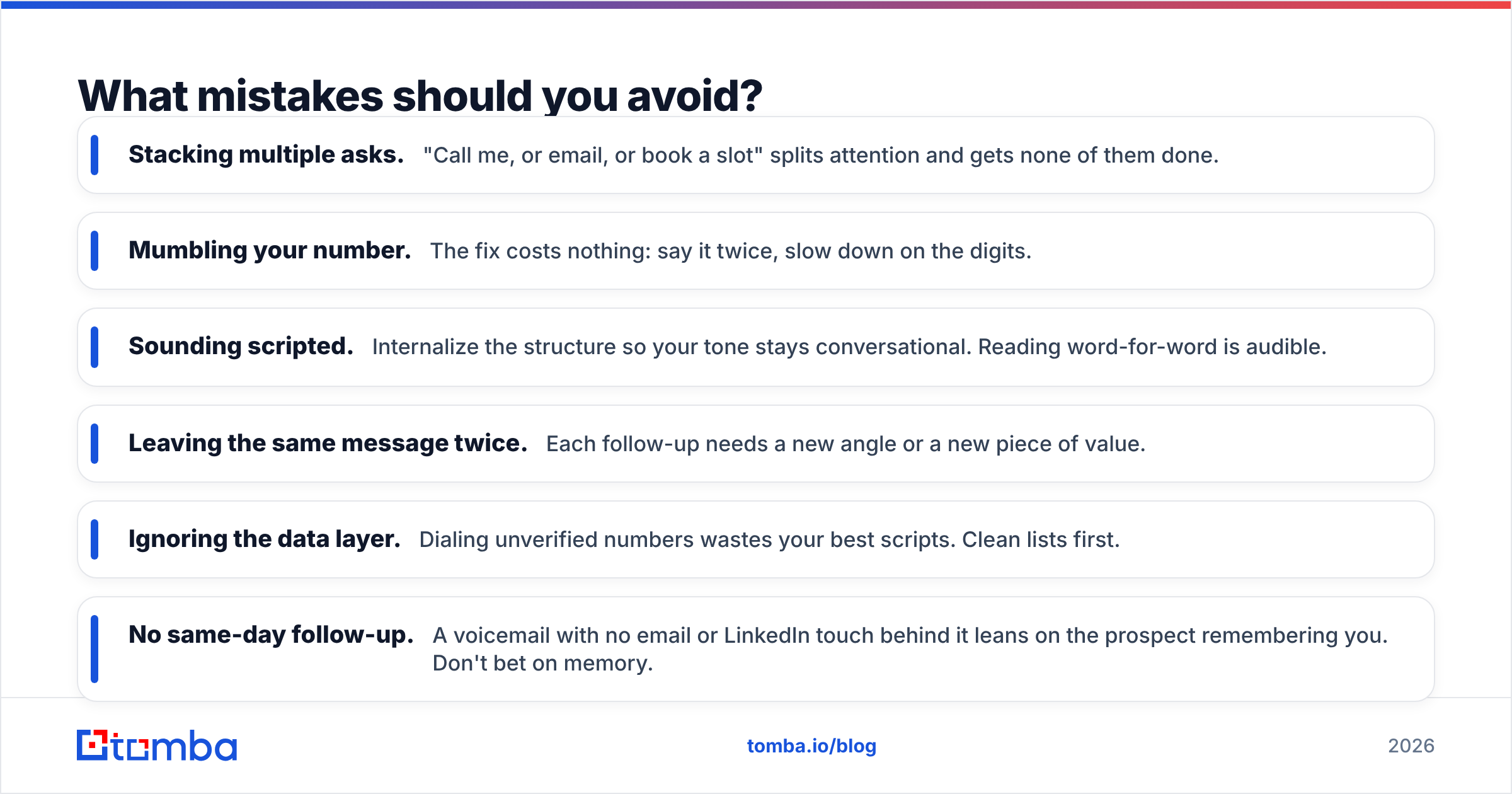
- Stacking multiple asks. "Call me, or email, or book a slot" splits attention and gets none of them done.
- Mumbling your number. The fix costs nothing: say it twice, slow down on the digits.
- Sounding scripted. Internalize the structure so your tone stays conversational. Reading word-for-word is audible.
- Leaving the same message twice. Each follow-up needs a new angle or a new piece of value.
- Ignoring the data layer. Dialing unverified numbers wastes your best scripts. Clean lists first.
- No same-day follow-up. A voicemail with no email or LinkedIn touch behind it leans on the prospect remembering you. Don't bet on memory.
For the written half of your cadence, our phone finder and contact tools plug directly into the workflow so your dialer and your inbox are working from the same verified record.
Put your best sales voicemail greetings to work#
The scripts above will lift your callback rate — but only if they land on the right person, on a number that actually rings. That's the part most teams underinvest in. Start with verified, direct-dial contact data so every one of these greetings reaches a real human instead of a dead line.
Tomba's Email Finder and phone tools give you accurate, verified contact details to power your outbound — find the decision-maker, confirm the number, and pair every voicemail with an email that hits the same minute. Try the free tier (25 searches a month), and when you're ready to scale, Tomba pricing starts at $49/mo for the Starter plan. Get the data right, and these greetings do the rest.
// get started
Find, verify and enrich your first contacts today
Start on the free plan with 25 searches a month, then scale when your team is ready.
Free plan · No credit card required · GDPR & CCPA
// about the author