Best SDR Tools in 2026: The Complete Sales Dev Stack
A no-fluff breakdown of the best SDR tools in 2026 across data, sequencing, dialing, and enrichment — with a comparison table and a realistic budget.
Your SDR team can run the best sequence in the world and still miss quota if the contact data feeding it is wrong. The tooling layer underneath your reps decides how many real conversations they get to have. This guide ranks the best SDR tools in 2026 by job — finding contacts, sequencing outreach, dialing, and enriching records — and shows you how to assemble a stack that actually books meetings instead of burning sends.
TL;DR#
- The best SDR tools in 2026 split into four jobs: prospecting data, multichannel sequencing, dialing, and enrichment. No single tool wins all four.
- Data quality is the multiplier. A great sequencer firing at bad emails just gets you blacklisted faster, so start with an accurate email finder and email verifier.
- Apollo and Outreach anchor most stacks, but they are expensive and lock you in. Pairing a focused data tool like Tomba with a lean sequencer often costs less and converts better.
- Budget realistically: a working SDR stack runs $150–$500 per rep per month once you add data credits, sequencing seats, and a dialer.
- Verify before you send. Bounce rates above 3% throttle deliverability across your whole domain, so verification is non-negotiable.
What counts as an SDR tool in 2026?#
An SDR tool is anything that helps a sales development rep turn a target account into a booked meeting. Think of the SDR stack like a kitchen: data is the ingredients, the sequencer is the recipe, the dialer is the stove, and enrichment is the seasoning that makes each touch land. If the ingredients are spoiled, no recipe saves the meal.
In practice, the best SDR tools fall into five categories:
- Prospecting data — find verified emails, phone numbers, and job titles for the people you want to reach.
- Multichannel sequencing — schedule and automate email, LinkedIn, and call steps in one cadence.
- Dialing — power dialers and parallel dialers that cut dead time between calls.
- Enrichment and intent — fill missing fields and flag accounts showing buying signals.
- Workflow glue — Chrome extensions, CRM syncs, and APIs that keep everything in one place.
Most teams overspend on category 2 and underspend on category 1. That is backwards. Your data accuracy sets the ceiling on everything downstream.

What are the best SDR tools by category?#
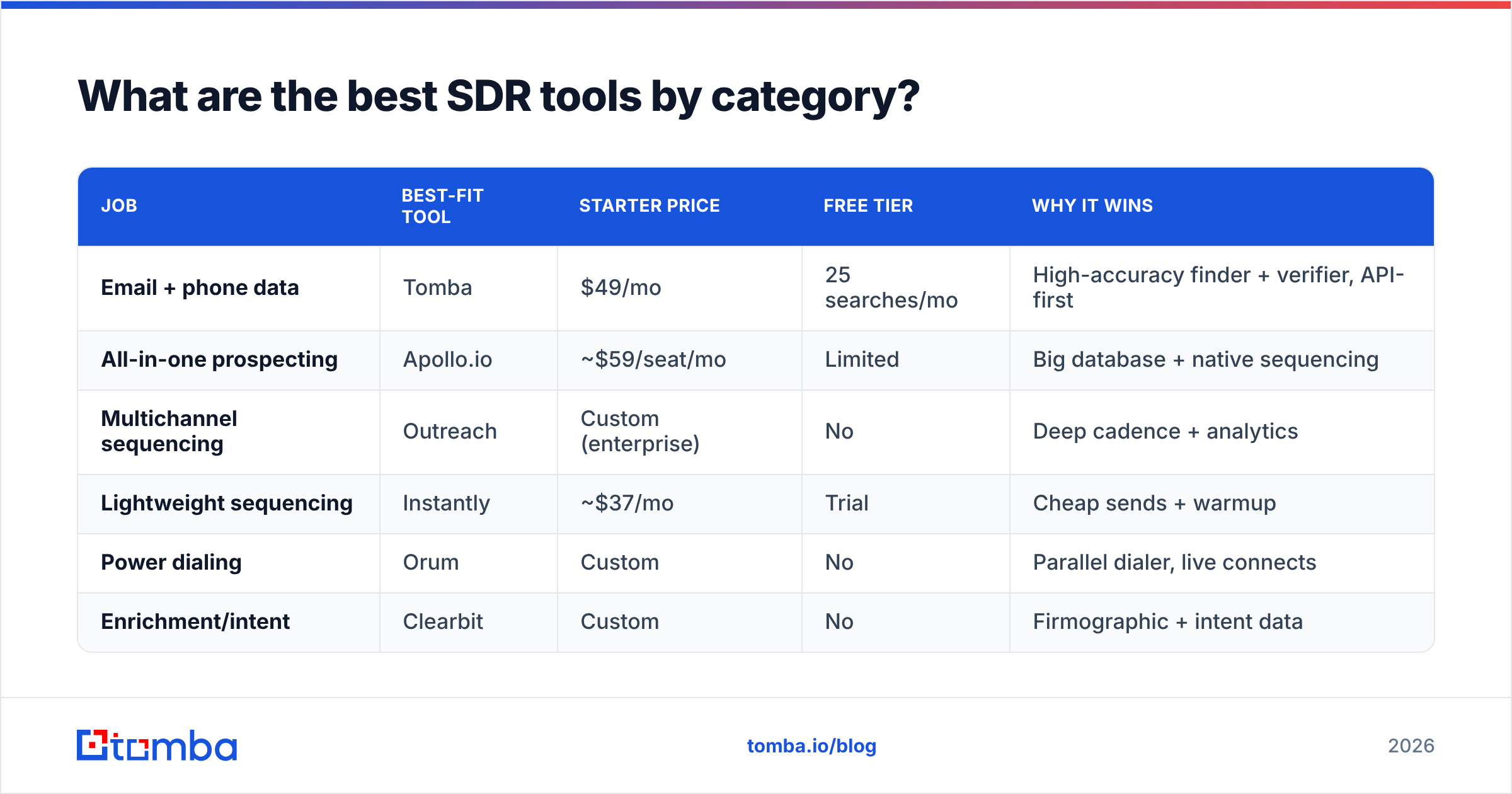
Here is the short version before we go deep. Each pick is a category leader, not a do-everything suite — because the do-everything suites are where margins go to die.
| Job | Best-fit tool | Starter price | Free tier | Why it wins |
|---|---|---|---|---|
| Email + phone data | Tomba | $49/mo | 25 searches/mo | High-accuracy finder + verifier, API-first |
| All-in-one prospecting | Apollo.io | ~$59/seat/mo | Limited | Big database + native sequencing |
| Multichannel sequencing | Outreach | Custom (enterprise) | No | Deep cadence + analytics |
| Lightweight sequencing | Instantly | ~$37/mo | Trial | Cheap sends + warmup |
| Power dialing | Orum | Custom | No | Parallel dialer, live connects |
| Enrichment/intent | Clearbit | Custom | No | Firmographic + intent data |
Prices move, so treat them as anchors and confirm on each vendor's page. The pattern that holds year over year: a focused data tool plus a focused sequencer beats one bloated suite on both cost and quality.
Prospecting data: the foundation#
This is where reps live. A rep who spends 40 minutes hunting one VP's email is a rep not booking meetings. The best data tools return a verified address in seconds and tell you their confidence level so you can skip the risky ones.
Tomba sits here. The find email addresses workflow takes a name and domain and returns the verified work email, while domain search pulls every public address at a company at once. For outbound at volume, the bulk email finder processes lists, and the Tomba API wires the same data into your own tools. Apollo and RocketReach compete here too, but they bundle data into pricier all-in-one plans — fine if you want one bill, wasteful if you only need clean contacts.
Multichannel sequencing#
Sequencing tools automate the cadence: email day 1, LinkedIn view day 2, call day 3, and so on. Outreach and Salesloft are the enterprise standards with deep analytics and CRM hooks. Instantly and Saleshandy are the budget-friendly options that focus on email volume and inbox warmup. The trap: a sequencer is only as good as the list you load. Sending to unverified addresses is the fastest way to wreck sender reputation.
Dialing#
For teams doing phone outreach, a parallel dialer like Orum or Nooks can multiply live connects by calling several numbers at once and routing the first human to a rep. Pair it with accurate mobile numbers — a dialer firing at dead lines just wastes the rep's day. Tomba's phone finder and phone validator keep the dial list clean before the dialer ever spins up.
Enrichment and intent#
Enrichment fills the gaps: missing title, company size, tech stack, LinkedIn URL. Clearbit (now part of HubSpot) and ZoomInfo lead the enterprise tier; Tomba's data enrichment covers the same contact and company fields without the enterprise contract. Intent data — signals that an account is researching your category — is the premium add-on most teams add only after the basics work.
Is an all-in-one suite better than a best-of-breed stack?#
It depends on your team size and how much you value flexibility versus a single invoice. The honest answer: all-in-one suites trade quality for convenience.
An all-in-one like Apollo gives you data, sequencing, and a dialer under one login. That is genuinely convenient for a 3-rep team that wants to move fast. But you inherit that vendor's data quality whether it is good for your market or not, and switching costs climb every quarter you stay.
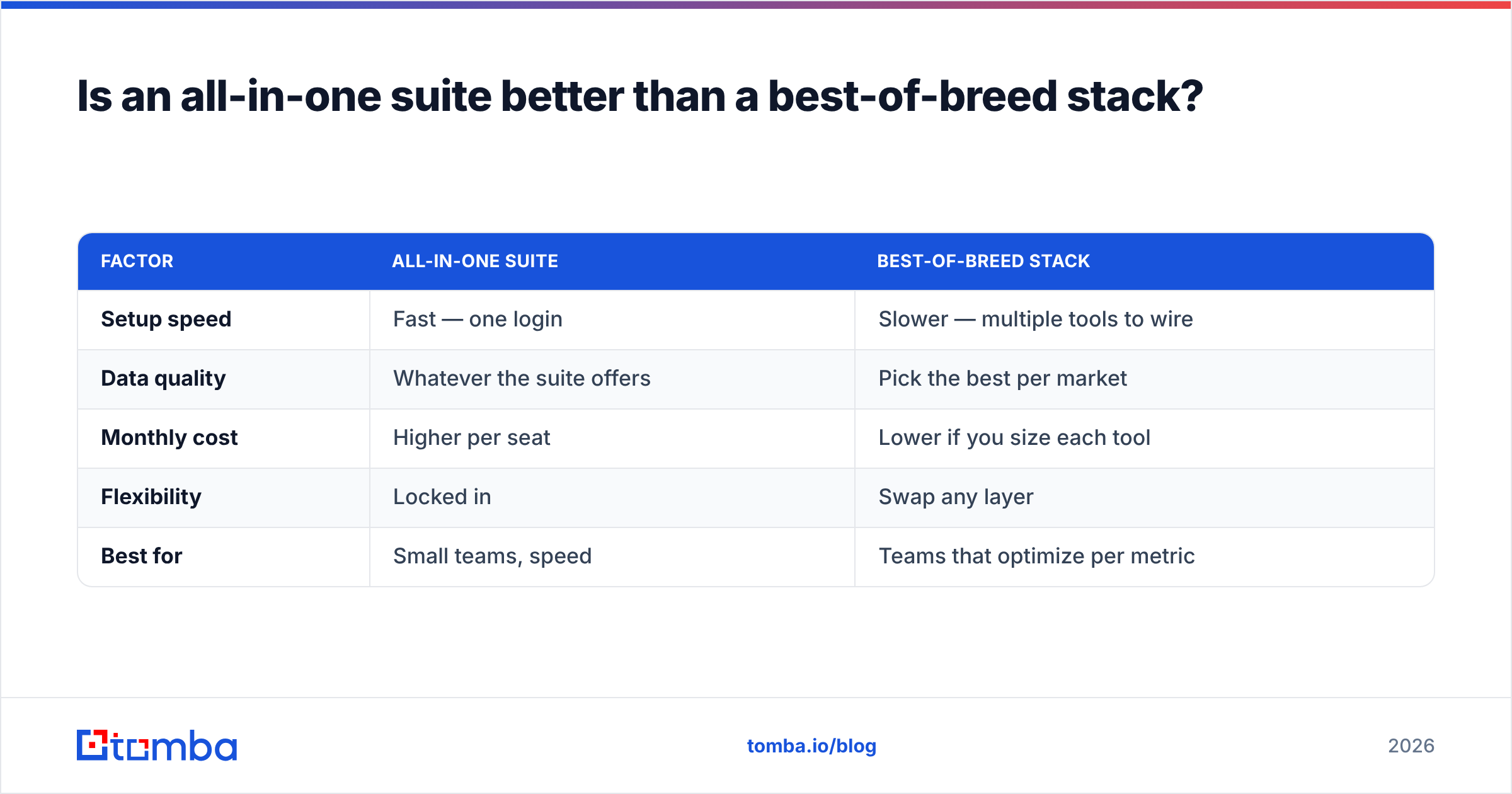
A best-of-breed stack lets you swap the weak link without rebuilding everything. If your data goes stale, you change the data provider, not the whole system. Here is the trade-off laid out:
| Factor | All-in-one suite | Best-of-breed stack |
|---|---|---|
| Setup speed | Fast — one login | Slower — multiple tools to wire |
| Data quality | Whatever the suite offers | Pick the best per market |
| Monthly cost | Higher per seat | Lower if you size each tool |
| Flexibility | Locked in | Swap any layer |
| Best for | Small teams, speed | Teams that optimize per metric |
For most growing teams, the winning move is a hybrid: a focused, accurate data layer feeding a sequencer you can afford. That keeps the part that matters most — the data — under your control.
How much should an SDR stack cost per rep?#
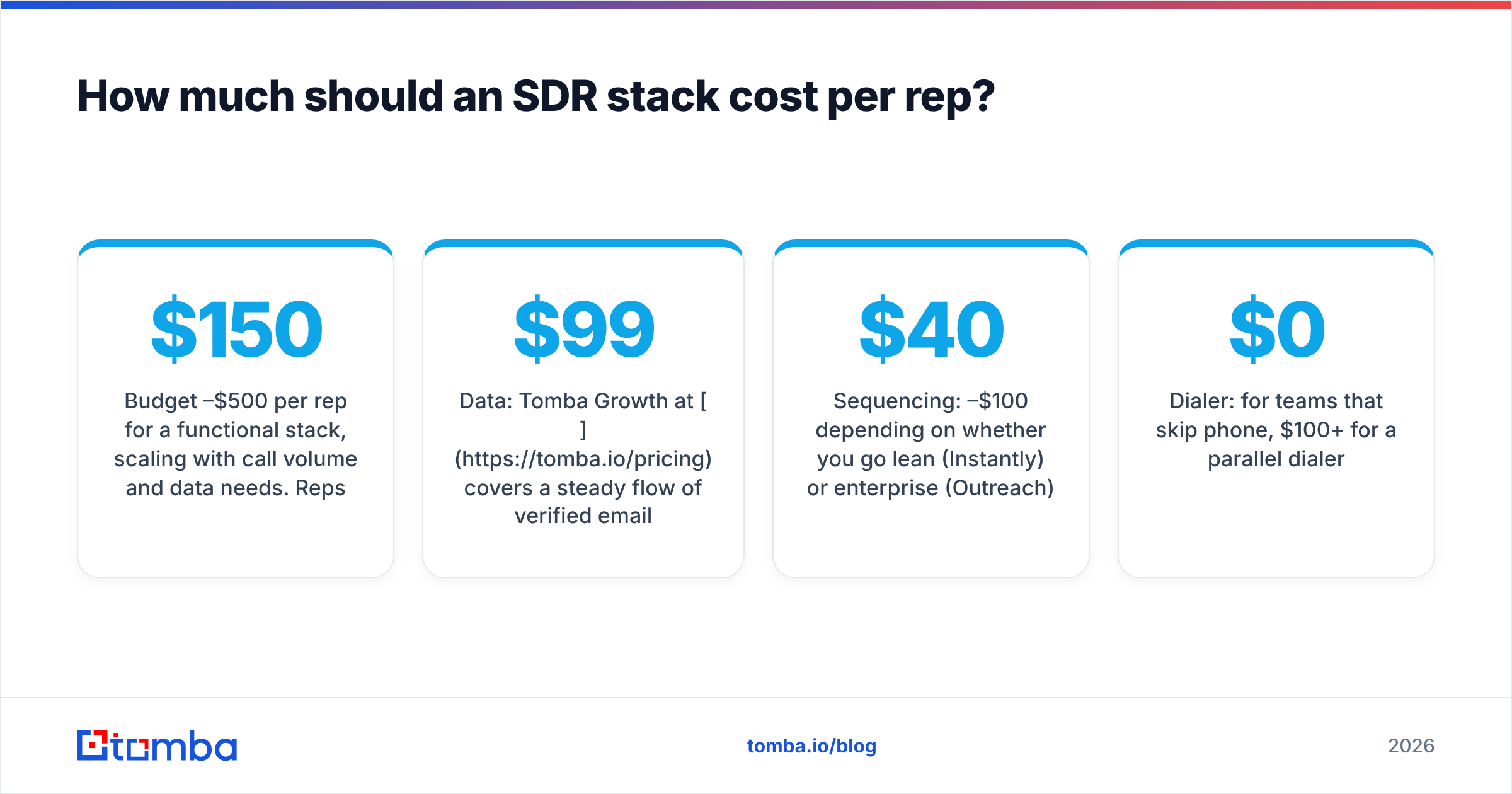
Budget $150–$500 per rep per month for a functional stack, scaling with call volume and data needs. Reps doing heavy phone work cost more because dialers and mobile data add up.
Here is a realistic mid-market build:
- Data: Tomba Growth at $99/mo covers a steady flow of verified emails for a small team, or Starter at $49/mo for a single rep ramping up.
- Sequencing: $40–$100 per seat depending on whether you go lean (Instantly) or enterprise (Outreach).
- Dialer: $0 for teams that skip phone, $100+ per seat for a parallel dialer.
- Enrichment: often folded into your data tool, or $50+ for a standalone.
A lean two-person team can run a credible outbound motion for under $200 a month total by combining Tomba's data with a budget sequencer. A 10-rep enterprise team with full intent data and parallel dialing will land closer to $500 per rep. Spend the marginal dollar on data accuracy before you spend it on another sequencing feature — it has a higher return on every send.
Why does data accuracy matter more than any other feature?#
Because bad data poisons every tool downstream and quietly destroys your domain reputation. This is the single biggest mistake new SDR teams make.
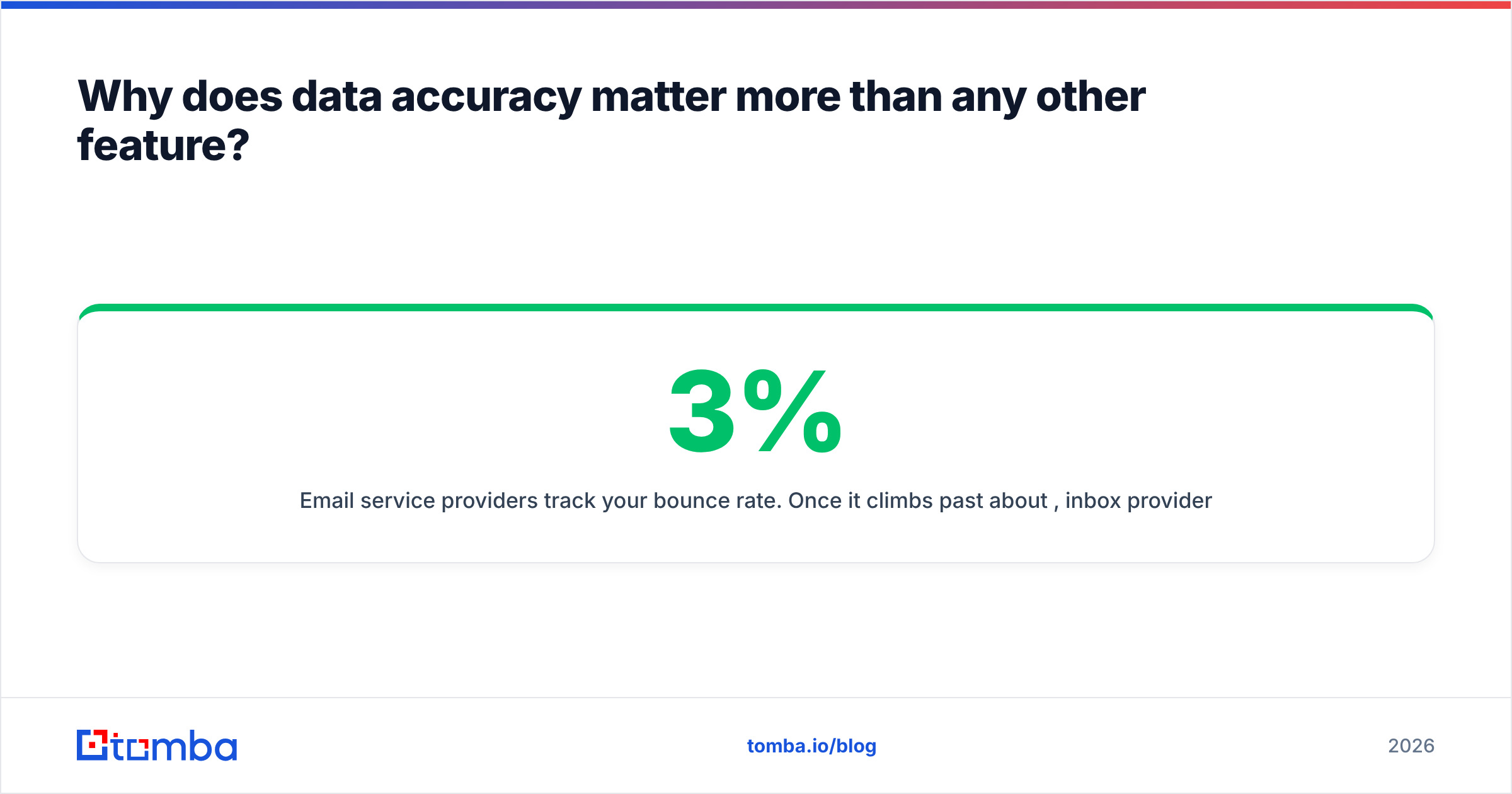
Email service providers track your bounce rate. Once it climbs past about 3%, inbox providers start routing your mail to spam — not just for the bad addresses, but for your good ones too. So a list with 15% invalid emails does not just waste 15% of your sends; it drags down the deliverability of the other 85%. One bad list can blacklist a domain you spent a year warming up.
That is why verification is a step, not an afterthought. Run every list through an email verification pass before it touches a sequencer. For domains that accept everything at the server level, a catch-all verifier tells you which catch-all addresses are actually safe to send to — a check most cheap tools skip entirely. Tomba builds verification into the finder, so the address you pull is already scored before it lands in your sequence.
This is the part that does not show up in a feature comparison chart but decides whether your campaign works. A flashy sequencer with analytics dashboards is worthless if half its sends bounce. Get the data right first.
How do you choose the right SDR tools for your team?#
Start from your motion, not from the tool list. The best SDR tools for an email-heavy startup look nothing like the stack for an enterprise phone team. Work through these questions in order:
- What is your primary channel? Email-first teams prioritize a finder, verifier, and a deliverability-focused sequencer. Phone-first teams prioritize accurate mobile numbers and a parallel dialer.
- What is your data market? Verify that your chosen data tool covers your geography and industry. Test it against 20 known contacts before you commit.
- What does your CRM need? If you live in HubSpot or Salesforce, pick tools with native syncs. Tomba's integrations and Chrome extension push verified contacts straight into your CRM and workflow.
- How technical is your team? API-first teams can build custom flows; everyone else should favor no-code extensions and add-ins like the Google Sheets add-on.
- What is your true budget? Add data credits, not just seat prices — credits are where surprise costs hide.
Run a two-week trial on the data layer before anything else. Pull 50 contacts in your real target market, verify them, and check how many are genuinely reachable. That single test tells you more than any review site, because it measures the one metric that decides everything downstream: can your reps actually reach the people they are paid to reach?
The bottom line#
The best SDR tools in 2026 are not the ones with the longest feature lists — they are the ones that get a verified contact in front of your rep and keep your domain out of the spam folder. Build your stack from the data up: accurate finding and verification first, then sequencing, dialing, and enrichment layered on top.
If you want to fix the layer that limits everything else, start with the data. Tomba's Email Finder returns verified work emails by name, domain, or company — with verification built in so your sequencer fires at real inboxes, not bounces. Try it free with 25 searches a month, then scale to a plan that fits your team on the pricing page. Get the data right, and the rest of your stack finally earns its keep.
// get started
Find, verify and enrich your first contacts today
Start on the free plan with 25 searches a month, then scale when your team is ready.
Free plan · No credit card required · GDPR & CCPA
// about the author