Best Subject Line for Referral Email: 20+ Examples (2026)
The best subject line for a referral email leads with the referrer's name. See 20+ tested examples, an open-rate comparison table, and the formula that wins replies in 2026.
Best Subject Line for Referral Email: 20+ Examples (2026)
A referral is the warmest lead you will ever email — and most reps waste it with a cold-sounding subject line. The single biggest lever you control is the inbox preview line, and the data is blunt about what works: lead with the name of the person who referred you, and lead with it early.
This guide breaks down the best subject line for a referral email, why name-dropping beats clever every time, 20+ copy-paste examples sorted by scenario, and the mistakes that quietly tank your open rate.
TL;DR — What makes the best referral email subject line?#
- Put the referrer's name first. "John Smith suggested I reach out" outperforms clever or vague lines because the recipient trusts the name before they trust you.
- Stay under ~50 characters so the full name survives on mobile, where 60%+ of B2B email is now opened.
- Be specific, not salesy. Name + reason ("John said you handle RevOps") beats name + pitch ("John thought you'd love our demo").
- Match the warmth of the intro. A double opt-in intro earns a casual line; a cold name-drop needs more proof.
- Verify the address first. The best subject line in the world bounces if the email is wrong — clean your list before you send.
Why does the referrer's name belong in the subject line?#
Because trust transfers through people, not pitches. Think of a referral email like showing up to a party where you know nobody — except you mention "Sarah invited me" at the door. Suddenly you are not a stranger; you are Sarah's friend. The subject line is that door.
Recipients scan their inbox in roughly a quarter of a second, deciding open-or-archive on pattern recognition alone. A familiar name is the strongest pattern there is. When the referrer's name appears in the first two or three words, the recipient's brain flags the message as relevant and safe before reading anything else.
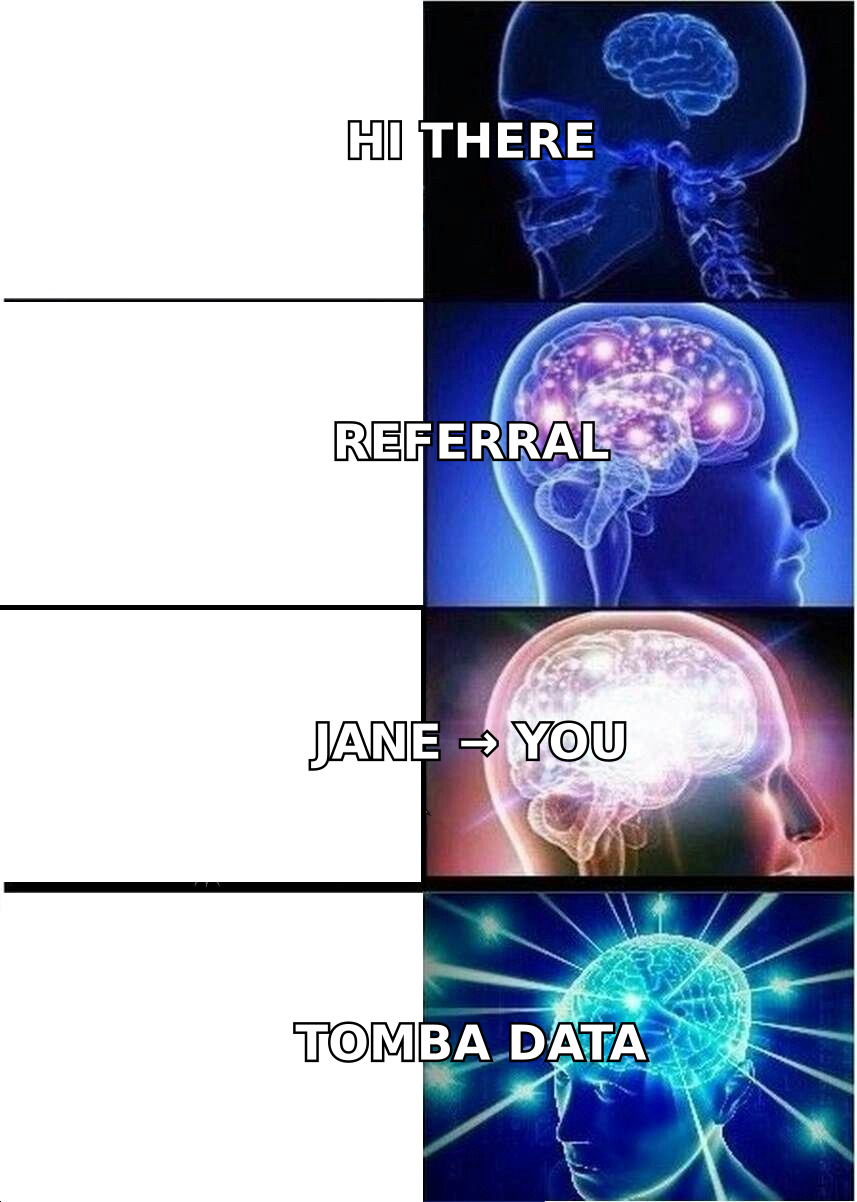
This is also why "clever" loses. A witty subject line asks the reader to do interpretive work. A name-drop does the opposite — it removes friction. You are borrowing credibility that already exists in the relationship instead of trying to manufacture it in eight words.
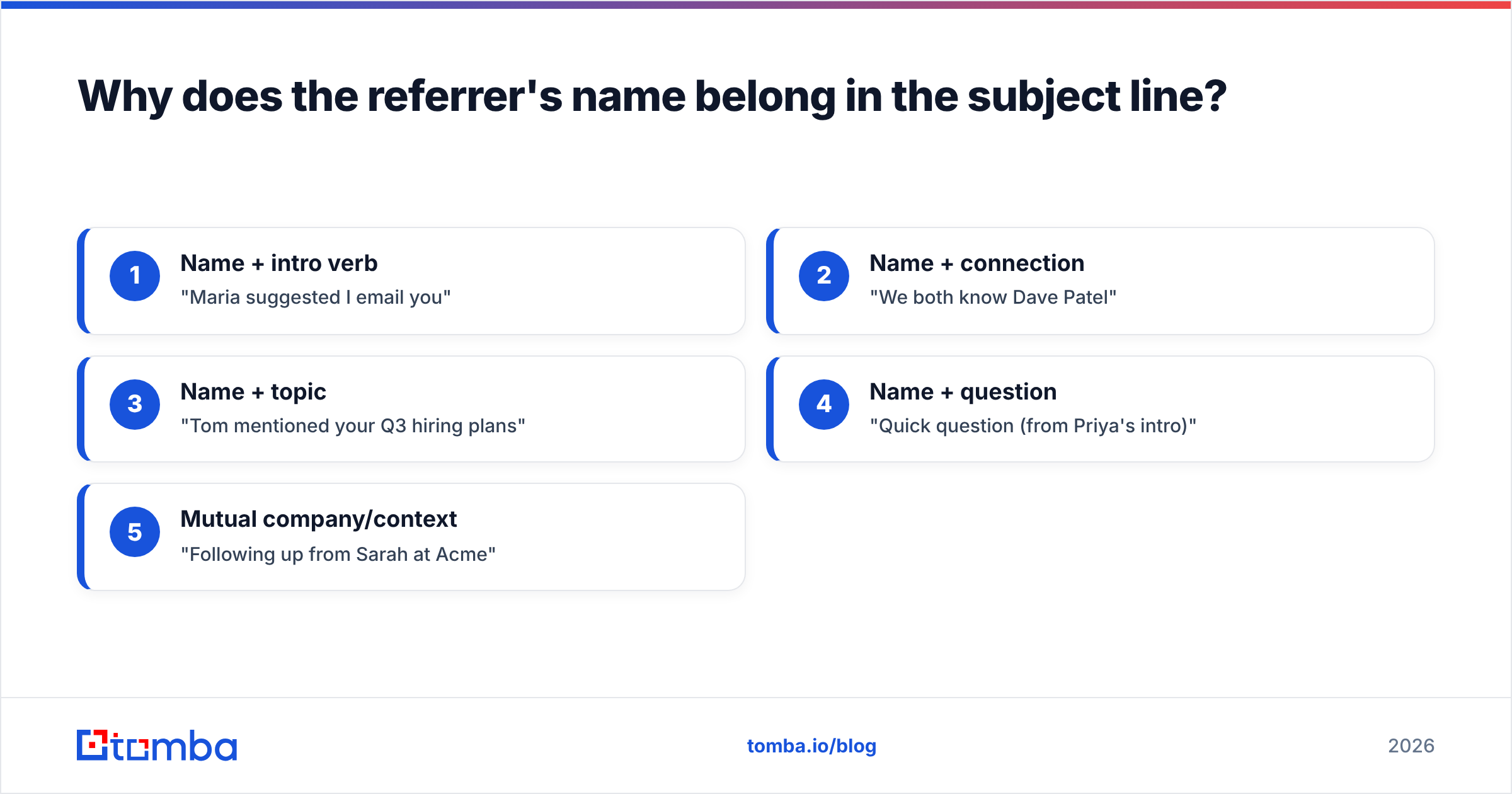
The structure of a high-performing referral subject line is almost always one of these:
- Name + intro verb — "Maria suggested I email you"
- Name + connection — "We both know Dave Patel"
- Name + topic — "Tom mentioned your Q3 hiring plans"
- Name + question — "Quick question (from Priya's intro)"
- Mutual company/context — "Following up from Sarah at Acme"
Each one front-loads the social proof. The rest of the email then has permission to make its case.
What are the best subject lines for a referral email? (20+ examples)#
Sorted by scenario so you can grab the one that fits your situation. Keep them short — every example below is built to survive mobile truncation.
When someone explicitly referred you (double opt-in):
- "Dana said we should talk"
- "Intro from Dana Lopez"
- "Dana suggested I reach out"
- "Dana connected us — quick hello"
- "Following Dana's intro"
When you're name-dropping a mutual connection (cold-ish):
- "We both know Chris Mehta"
- "Chris Mehta speaks highly of you"
- "Chris thought you'd be the right person"
- "Friend of Chris Mehta here"
- "Chris mentioned your team is scaling"
When the referral is about a specific topic or pain:
- "Priya mentioned your churn problem"
- "Re: the RevOps gap Tom flagged"
- "Sam said outbound is your 2026 focus"
- "About the hiring push Lee mentioned"
When you want a softer, curiosity-led open:
- "Quick question (Jordan sent me)"
- "Jordan thought of you"
- "A favor, courtesy of Jordan"
- "Jordan's idea, not mine"
When following up after a referral with no reply:
- "Bumping this — Alex's intro"
- "Still good to connect? (via Alex)"
- "Re: Alex Rivera introduction"
Notice the pattern: the name appears in the first 1–3 words in nearly every winner. The exceptions ("Quick question (Jordan sent me)") still surface the name inside the parenthetical preview, which mobile clients show.
How do referral subject lines compare on open rate?#
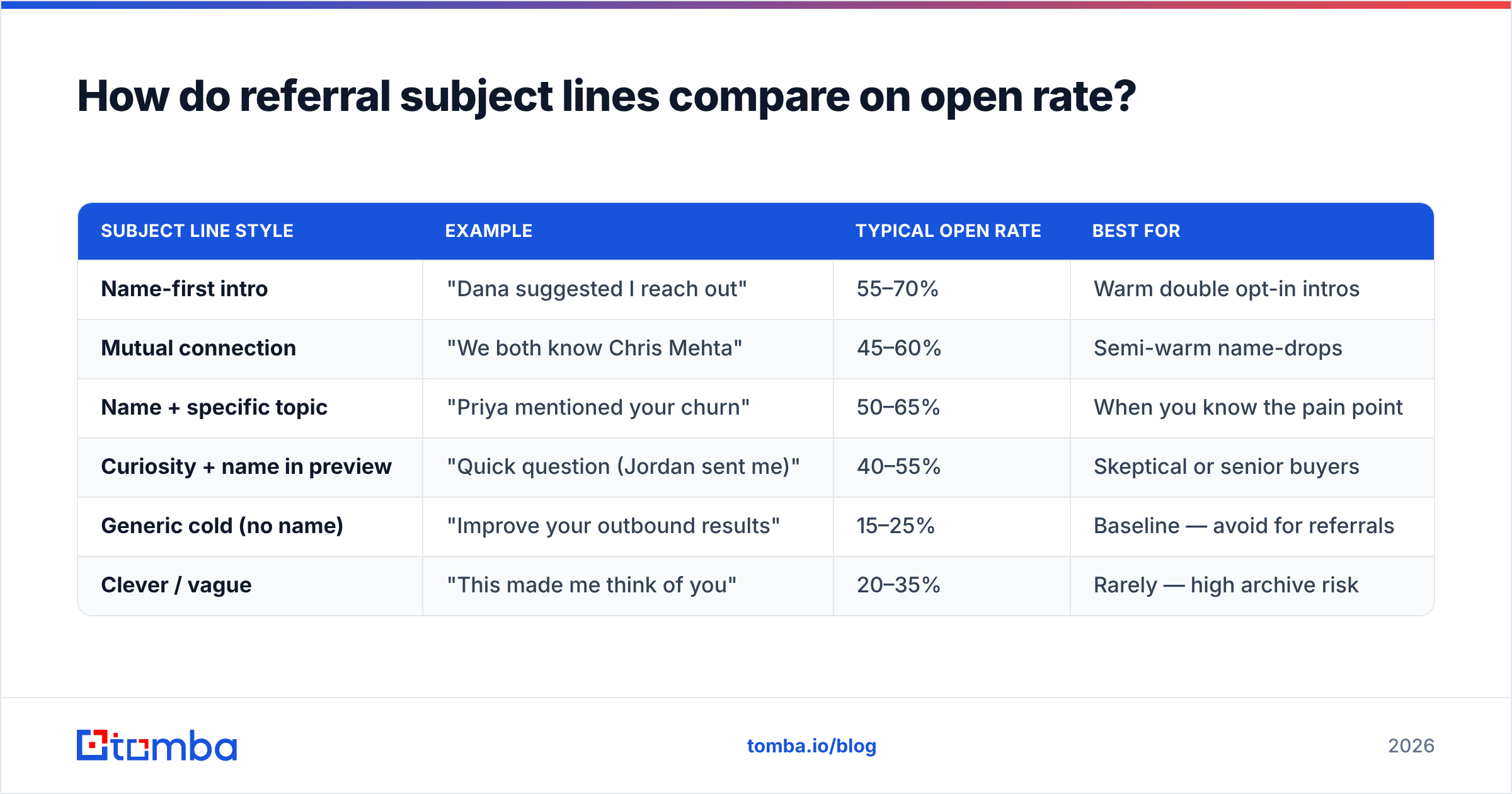
Referral subject lines outperform standard cold lines, but not all referral styles are equal. The table below summarizes commonly reported B2B benchmarks for each style. Treat these as directional — your audience, list hygiene, and sender reputation move the absolute numbers — but the relative ranking holds up consistently.
| Subject line style | Example | Typical open rate | Best for |
|---|---|---|---|
| Name-first intro | "Dana suggested I reach out" | 55–70% | Warm double opt-in intros |
| Mutual connection | "We both know Chris Mehta" | 45–60% | Semi-warm name-drops |
| Name + specific topic | "Priya mentioned your churn" | 50–65% | When you know the pain point |
| Curiosity + name in preview | "Quick question (Jordan sent me)" | 40–55% | Skeptical or senior buyers |
| Generic cold (no name) | "Improve your outbound results" | 15–25% | Baseline — avoid for referrals |
| Clever / vague | "This made me think of you" | 20–35% | Rarely — high archive risk |
The takeaway is hard to argue with: surfacing a real human's name roughly doubles the open rate versus a generic cold line. The warmer the referral, the more directly you should state the name. Save curiosity-driven phrasing for senior buyers who get pitched constantly and have learned to distrust anything that reads like a template.
For more on how subject phrasing affects engagement across all of cold email, see HubSpot's running research on email subject line best practices, which consistently ranks personalization and brevity as the top two drivers.
What mistakes kill a referral email subject line?#
Even with a name in place, these errors leak opens:
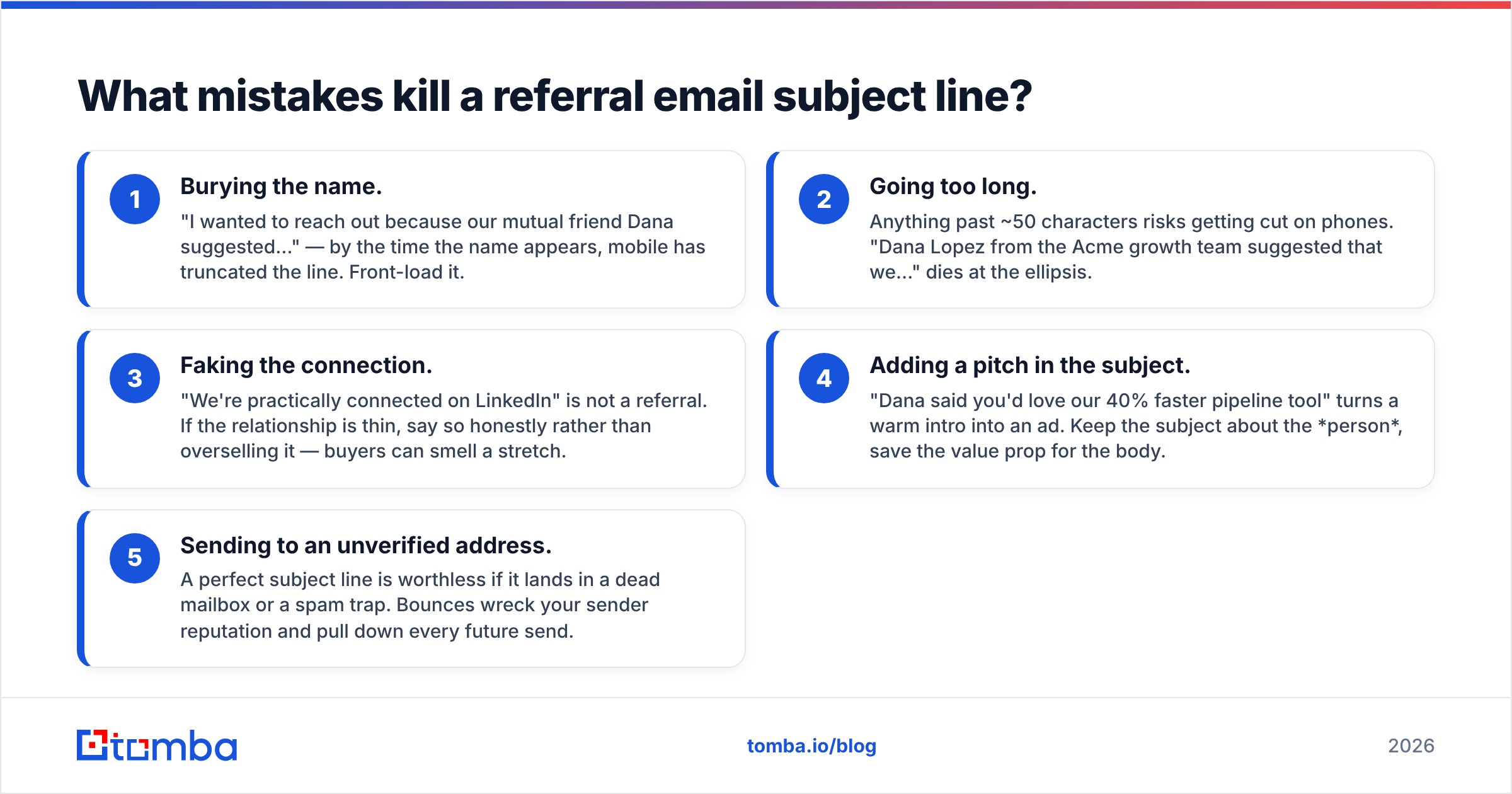
- Burying the name. "I wanted to reach out because our mutual friend Dana suggested…" — by the time the name appears, mobile has truncated the line. Front-load it.
- Going too long. Anything past ~50 characters risks getting cut on phones. "Dana Lopez from the Acme growth team suggested that we…" dies at the ellipsis.
- Faking the connection. "We're practically connected on LinkedIn" is not a referral. If the relationship is thin, say so honestly rather than overselling it — buyers can smell a stretch.
- Adding a pitch in the subject. "Dana said you'd love our 40% faster pipeline tool" turns a warm intro into an ad. Keep the subject about the person, save the value prop for the body.
- Sending to an unverified address. A perfect subject line is worthless if it lands in a dead mailbox or a spam trap. Bounces wreck your sender reputation and pull down every future send.
That last point is where most referral campaigns quietly fail. You got the intro, you wrote the perfect line — and the email was dana.lopez@oldcompany.com because she switched jobs. Before you send, confirm the address is live with an email verifier, and if you only have a name and company, find the current address with a proper email finder instead of guessing the format.
How do you write the rest of the referral email?#
The subject line earns the open; the first line earns the read. Mirror the subject immediately so the recipient's "why is this relevant" question is answered before they scroll.
A reliable structure:
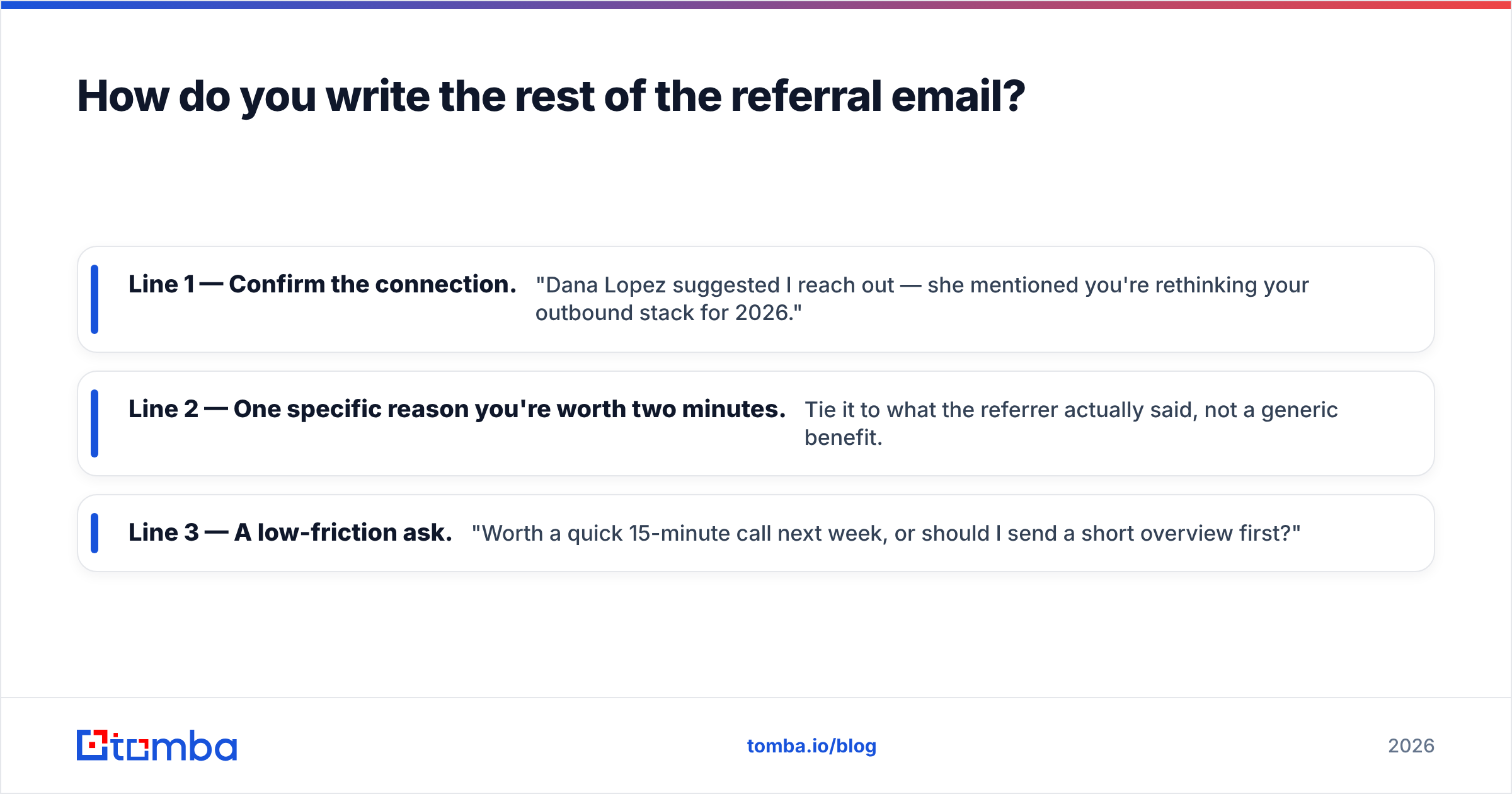
- Line 1 — Confirm the connection. "Dana Lopez suggested I reach out — she mentioned you're rethinking your outbound stack for 2026."
- Line 2 — One specific reason you're worth two minutes. Tie it to what the referrer actually said, not a generic benefit.
- Line 3 — A low-friction ask. "Worth a quick 15-minute call next week, or should I send a short overview first?"
Keep the whole thing under 120 words. Referrals fail when reps treat the warm intro as license to dump a full pitch. The intro buys attention; brevity keeps it. If you want a faster starting point, Tomba's free cold email templates include referral-specific frameworks you can adapt.
One more reputation note: even warm referral sends count toward your domain's sending behavior. If you're scaling referral outreach across a list, protect email deliverability by warming the domain, keeping volume steady, and never blasting an unverified list. A clean list plus a name-driven subject line is the combination that actually books meetings.
When should you NOT use a name in the subject line?#
Rarely — but two cases exist. First, when the referrer explicitly asked you to keep the intro confidential (some executives prefer quiet introductions). In that case use a topic-led line and reveal the connection in the body. Second, when the "referral" is so loose it would feel dishonest to name-drop — for example, you saw someone mention a contact in a podcast. There, lead with the shared context ("Re: your comments on the SaaS Growth podcast") rather than implying a personal intro.
In every other scenario, the name wins. The fastest way to test this for your own audience is a simple A/B: same email, one subject with the referrer's name in the first three words, one without. The name version almost always takes the open rate.
For a deeper benchmark on what "good" looks like across industries, G2's email marketing statistics and most vendor reports agree that personalized, relationship-driven subject lines sit at the top of the performance curve — exactly where referral emails should live.
Ready to make every referral email land?#
The best subject line for a referral email is only half the equation — it has to reach a real, current inbox to do its job. Use the Tomba Email Finder to pull the verified, up-to-date address for anyone your referrer points you to, so your perfectly named subject line never bounces. Start free with 25 searches a month, and scale up on the Tomba pricing plans (Starter at $49/mo) when your referral pipeline grows. Get the intro, find the right inbox, and send the line that gets opened.
// get started
Find, verify and enrich your first contacts today
Start on the free plan with 25 searches a month, then scale when your team is ready.
Free plan · No credit card required · GDPR & CCPA
// about the author