Best Subject Lines for Prospecting Emails (2026 Guide)
The best subject lines for prospecting emails are short, specific, and earn a reply before the body is even read. Here are the formulas, data, and tests that work in 2026.
(rendered separately)
TL;DR
- The best subject lines for prospecting emails are short (3–6 words), specific to one person, and promise a single clear reason to open — not a pitch.
- Curiosity and relevance beat cleverness. "Question about [their initiative]" outperforms "Revolutionary solution inside" almost every time.
- Personalization tokens that reference a trigger event (funding, hire, product launch) lift open rates more than just inserting a first name.
- Avoid spammy words, ALL CAPS, and fake "Re:" tricks — they tank deliverability faster than they raise opens.
- A great subject line is wasted on a bad address. Verified contact data is the multiplier that makes every other tactic work.
Why do prospecting email subject lines matter so much?#
Your subject line is the bouncer at the door. It decides whether the rest of your email gets seen at all, because a prospect reading their inbox sees only two things before deciding to open, archive, or report spam: who it's from, and the subject. Everything you wrote in the body is invisible until that one line earns the click.
The math is brutal. If 100 people receive your cold email and only 35 open it, you've already lost two-thirds of your pipeline before your value proposition gets a single word in. A 10-point swing in open rate — from 35% to 45% — is the difference between a campaign that books meetings and one that quietly dies in the "Promotions" tab.
Subject lines also feed your sender reputation. Mailbox providers watch how recipients react. Opens, replies, and "not spam" actions build trust; deletes-without-opening and spam reports erode it. Write subject lines people ignore, and you don't just lose this campaign — you teach Gmail to bury your next one. That's why subject lines and email deliverability are two sides of the same coin.
What makes the best subject lines for prospecting emails work?#
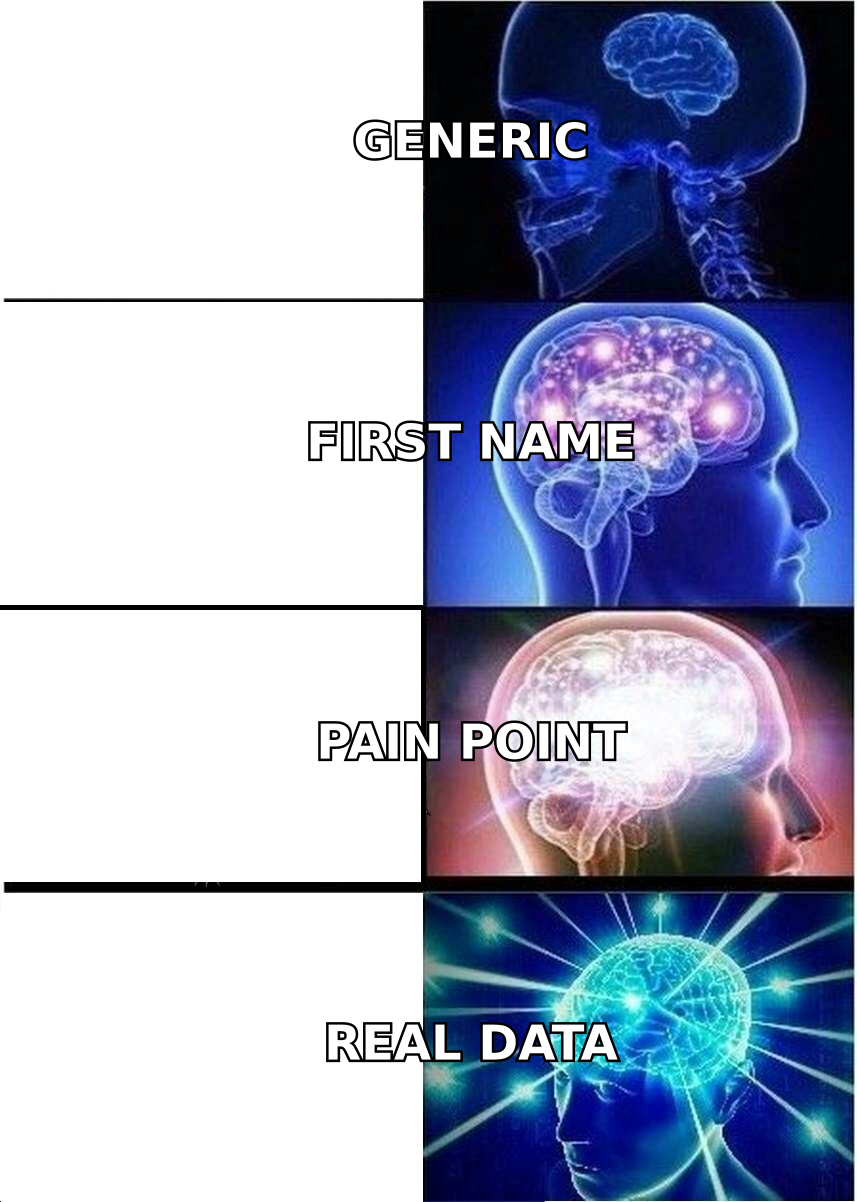
Five traits show up again and again in subject lines that get opened. Think of them like a checklist a recruiter uses to scan a résumé in six seconds — miss one and you're in the reject pile.
- Brevity — 3 to 6 words. Mobile inboxes truncate after roughly 30–40 characters, so the front of your line has to carry the weight. "Quick question, Sarah" survives the cut; "I wanted to reach out regarding a potential partnership opportunity" gets sliced mid-thought.
- Specificity — reference something only this prospect would recognize: their tool, their team's goal, a number from their world. Specificity signals you did homework, and homework signals you're not a bot blasting 10,000 inboxes.
- Curiosity with a payoff — open a small loop the body closes. The trick is honest curiosity, not clickbait. If the email doesn't deliver on the subject, you win the open and lose the reply.
- Relevance to a trigger — tie the line to something timely: a funding round, a new hire, a competitor move. Timing turns a cold email into a warm one.
- A human voice — write like a person emailing one other person. The best prospecting subject lines look like internal notes between colleagues, not marketing headlines.
Notice what's missing: cleverness for its own sake, your product name, and exclamation points. None of those earn opens. They earn eye-rolls.
Which subject line formulas get the highest open rates?#
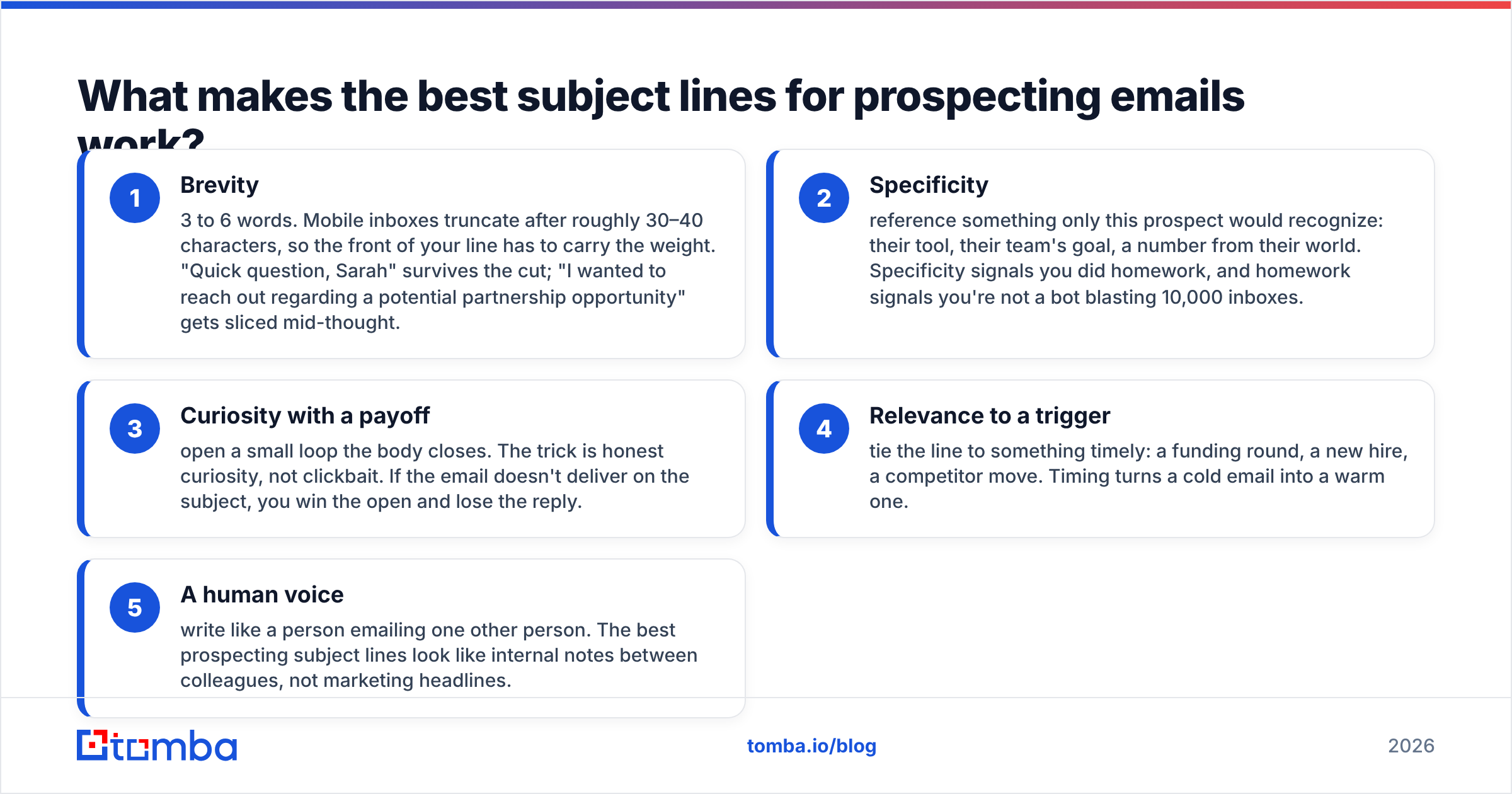
Below are formulas that consistently perform, with the psychological lever each one pulls and a worked example you can adapt today.
| Formula | Example | Lever it pulls | Best for |
|---|---|---|---|
| Question about their world | Question about your Q3 hiring plan |
Curiosity + relevance | Cold outbound to a named role |
| Mutual connection | Priya suggested I reach out |
Social proof | Warm intros, referrals |
| Trigger event | Congrats on the Series B |
Timeliness | Funding, launches, promotions |
| Pain point, no pitch | Cutting onboarding time at [Company] |
Self-interest | Pain-led prospecting |
| Short + personal | Quick question, Marcus |
Pattern interrupt | Busy executives |
| Specific number | 3 ideas for your demo funnel |
Concreteness | Value-first sequences |
A few notes on using these well. The question formula is the workhorse — it's low-pressure, implies a real reason to talk, and invites a reply rather than a sale. The trigger-event formula is the highest-converting when you can pull it off, but it depends entirely on knowing when something happened, which is a data problem before it's a copy problem. The specific-number formula works because "3 ideas" is a promise the reader can size up instantly; "some thoughts" is not.
Resist the urge to stack formulas. "Quick question about your Series B, Marcus — 3 ideas inside!" tries to do everything and lands as noise. One lever per line.
If you want a head start, Tomba's free subject line generator spins variations from a short brief, and the subject line tester scores them before you hit send.
What subject lines should you never send?#
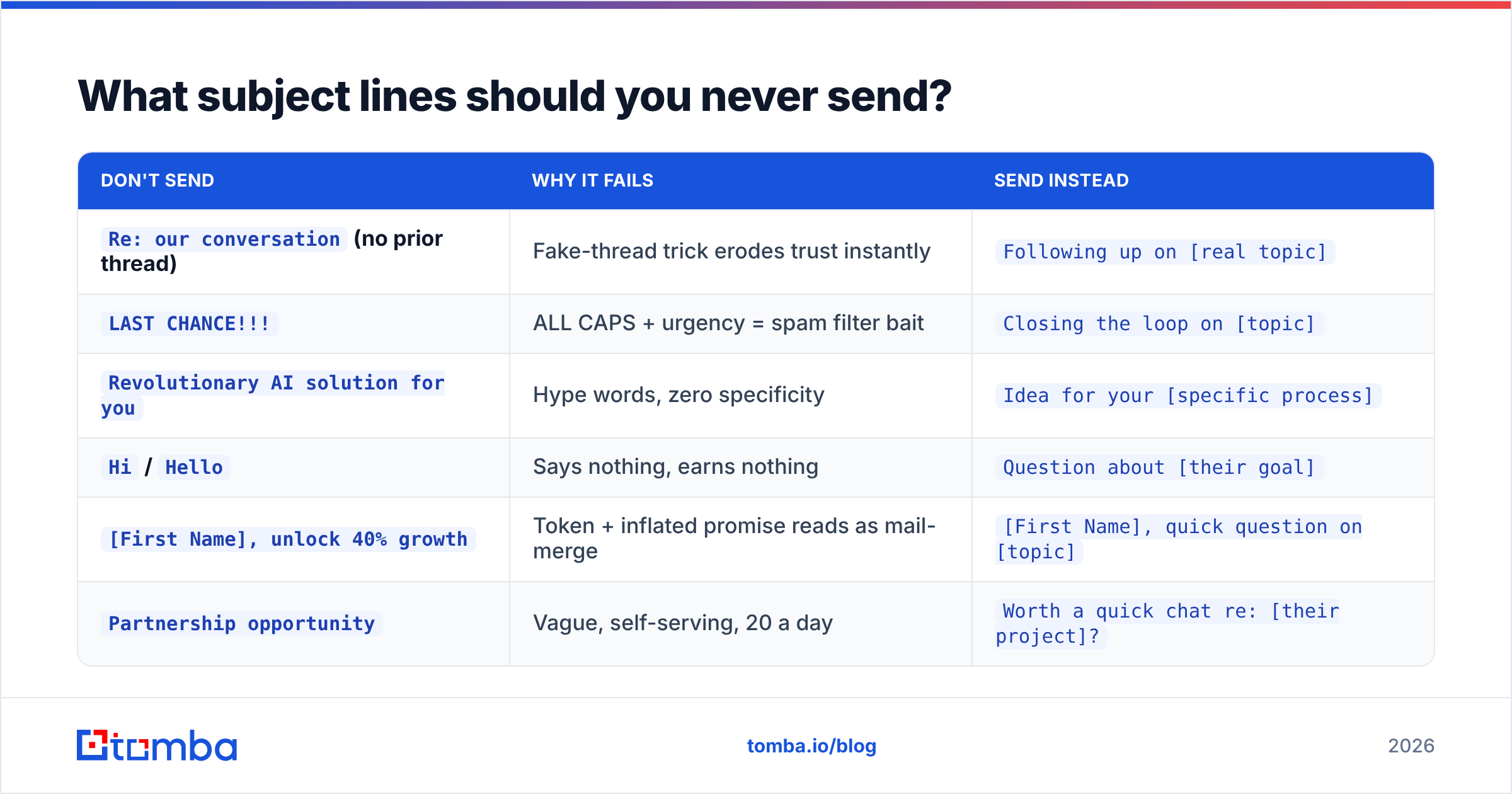
Some patterns are so overused they actively signal "cold blast." Here's the avoid list, and what to do instead.
| Don't send | Why it fails | Send instead |
|---|---|---|
Re: our conversation (no prior thread) |
Fake-thread trick erodes trust instantly | Following up on [real topic] |
LAST CHANCE!!! |
ALL CAPS + urgency = spam filter bait | Closing the loop on [topic] |
Revolutionary AI solution for you |
Hype words, zero specificity | Idea for your [specific process] |
Hi / Hello |
Says nothing, earns nothing | Question about [their goal] |
[First Name], unlock 40% growth |
Token + inflated promise reads as mail-merge | [First Name], quick question on [topic] |
Partnership opportunity |
Vague, self-serving, 20 a day | Worth a quick chat re: [their project]? |
The fake "Re:" deserves a special callout. It might bump opens once, but the moment a prospect realizes you faked a reply to a conversation that never happened, you've burned the relationship and invited a spam report. Spam reports hit your sender reputation directly, which means even your honest emails start landing in junk. The short-term trick costs you the long-term channel.
Also watch your trigger words. Run drafts through a spam checker before a big send — terms like "free," "guarantee," "act now," and a forest of exclamation points can drop you into Promotions or worse, regardless of how good the rest of your copy is.
How do you A/B test prospecting subject lines?#
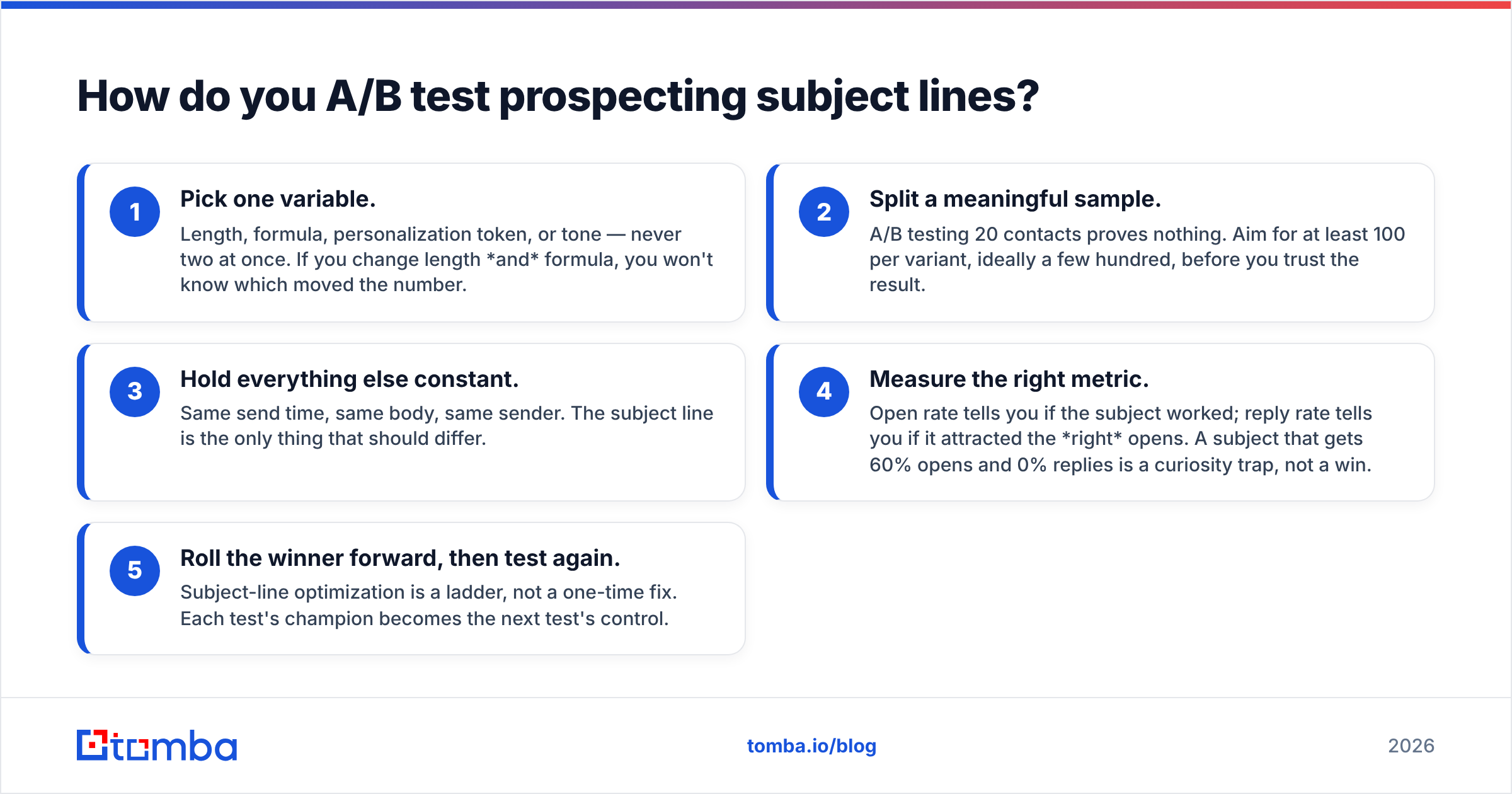
Conclusion first: test one variable at a time, against a sample big enough to mean something, and let reply rate — not just open rate — pick the winner.
Here's a simple, repeatable process:
- Pick one variable. Length, formula, personalization token, or tone — never two at once. If you change length and formula, you won't know which moved the number.
- Split a meaningful sample. A/B testing 20 contacts proves nothing. Aim for at least 100 per variant, ideally a few hundred, before you trust the result.
- Hold everything else constant. Same send time, same body, same sender. The subject line is the only thing that should differ.
- Measure the right metric. Open rate tells you if the subject worked; reply rate tells you if it attracted the right opens. A subject that gets 60% opens and 0% replies is a curiosity trap, not a win.
- Roll the winner forward, then test again. Subject-line optimization is a ladder, not a one-time fix. Each test's champion becomes the next test's control.
One caveat worth stating plainly: Apple Mail Privacy Protection and similar features auto-load images and inflate open rates. That's why reply rate is the metric you can actually bank on in 2026. Treat open rate as a directional signal, not gospel.
How does data quality change your subject line results?#
Here's the part most "best subject lines" articles skip: the greatest subject line in the world earns zero opens if it lands in a dead inbox or gets the prospect's name wrong.
Think of your subject line as a key and your contact data as the lock. A beautifully cut key opens nothing if it's the wrong lock. Three data problems quietly sabotage subject-line performance:
- Wrong or stale addresses — your email bounces, your bounce rate climbs, and providers start throttling your domain. Bounces above ~3% put your whole sending reputation at risk. Clean your list with an email verifier before launch.
- Missing personalization fields — if your subject line relies on
[Company]or[First Name]and the field is blank, you ship "Quick question, " with a dangling comma. Mail merges with gaps look exactly like the spam they are. - No trigger data — the highest-converting subject lines reference timely events, and you can't reference what you don't know. Enriched records that include role, company size, and recent signals let you write "Congrats on the new VP Sales role" instead of "Hope you're well."
This is where sourcing accurate contacts up front pays off across every campaign. Tomba's email finder returns professional addresses with a confidence score and source citations, and pairs with data enrichment so the personalization tokens behind your subject lines are actually filled in. Clean data doesn't replace good copy — it's what lets good copy reach a human and read correctly when it lands. For high-volume sends, the bulk email finder and email verifier keep your list healthy at scale.
For context on why list hygiene matters this much, mailbox-provider guidance from sources like Google Postmaster Tools and review platforms like G2 consistently rank low bounce rates and engaged recipients as the top deliverability factors — ahead of any subject-line tactic.
What about subject lines for follow-ups versus first touches?#
Different jobs, different lines. A first-touch subject line has to earn a cold open from a stranger; a follow-up gets to lean on the context you've already established.
For first touches, lead with relevance and curiosity, keep it short, and never mention price, demos, or contracts. You're earning permission for a conversation, nothing more.
For follow-ups, you have two solid options. Either reply within the same thread (so the subject naturally becomes "Re: [original]" — genuinely, not faked), or write a fresh line that adds new value: "One more idea for [their goal]" or "Did the timing not work?" The worst follow-up subject is "Just following up" — it adds nothing and reminds them they ignored you. Give every follow-up its own reason to exist.
A practical cadence: keep first-touch subjects benefit-and-curiosity led, then make each follow-up progressively more direct. By the third or fourth touch, "Should I close your file?" — a respectful breakup line — often pulls more replies than the original pitch, because it triggers loss aversion. People who ignored your value proposition will answer to keep their options open.
How do you write subject lines at scale without sounding like a robot?#
The tension in outbound is real: you need volume and personalization, and they pull against each other. The answer isn't choosing one — it's templating the structure while varying the variable.
Build subject-line frameworks, not fixed strings. "Question about [specific initiative]" is a framework; the initiative is pulled per-prospect from enriched data. You write the skeleton once and let clean data fill the personalized joint. That's how teams send hundreds of emails a day where each subject line still reads like it was written for one person — because the part that matters was.
To keep quality up at volume:
- Segment before you write. Group prospects by role, industry, or trigger, then write one framework per segment. A subject line that lands with a CFO won't land with a developer.
- Cap your tokens. One personalization variable per subject line. Two starts to read like a mail merge showing its seams.
- Pressure-test a sample. Before sending 500, eyeball 20 generated subject lines for blanks, awkward grammar, and broken tokens. If the data's clean, they'll read clean.
- Keep a swipe file. Save every subject line that beats your average reply rate. Your best future lines are variations on your past winners.
Pull contact and company data through Tomba's API or one of the integrations into your sequencing tool, and your subject-line frameworks fill themselves — accurately — for every prospect in the list. That's the whole game: structure from you, specificity from the data.
The bottom line: pair great copy with great data#
The best subject lines for prospecting emails in 2026 are short, specific, honest, and tied to something the prospect actually cares about right now. Skip the hype words, test one variable at a time, and judge your winners by replies, not just opens.
But remember the multiplier. Every formula in this guide assumes your email reaches a real person, with their name and company spelled right, at a moment that's relevant to them. That's a data job. Start with verified, enriched contacts from the Tomba Email Finder — find professional addresses by name, domain, or company, complete with the confidence scores and personalization fields your subject lines depend on. Write the line, but cut the right key first. Spin up a free Tomba account (25 searches a month, no card) and put your next batch of subject lines in front of inboxes that will actually open them.
// get started
Find, verify and enrich your first contacts today
Start on the free plan with 25 searches a month, then scale when your team is ready.
Free plan · No credit card required · GDPR & CCPA
// about the author