Best Time To Call Customers in 2026: A Data-Backed Guide
The best time to call customers is not random. See the days, hours, and cadence that actually get prospects to pick up — backed by real connect-rate data.
You can double your dials and still book the same number of meetings. Or you can keep the same dial count, move it to the right windows, and watch your connect rate climb. Timing is the cheapest lever in phone sales — it costs nothing and most reps ignore it.
TL;DR — When Should You Call Customers?#
- Best hours: late afternoon (4:00–5:00 PM) and mid-late morning (10:00–11:30 AM) in the prospect's local time zone consistently win on connect rate.
- Best days: Wednesday and Thursday outperform Monday and Friday across most B2B datasets.
- Worst windows: Monday mornings, Friday afternoons, and the dead hour right after lunch (1:00–2:00 PM).
- Cadence beats single calls: 6–8 touches across days and times beats hammering one slot. The first call rarely connects.
- Timing only works on a clean list. A perfect call window dialed against a wrong or dead number is wasted — accurate contact data is the multiplier.
Why Does Call Timing Matter So Much?#
Think of cold calling like fishing. You can have the best rod and the perfect bait, but if you cast when the fish aren't feeding, you go home empty. Call timing is choosing the moment the fish are near the surface.
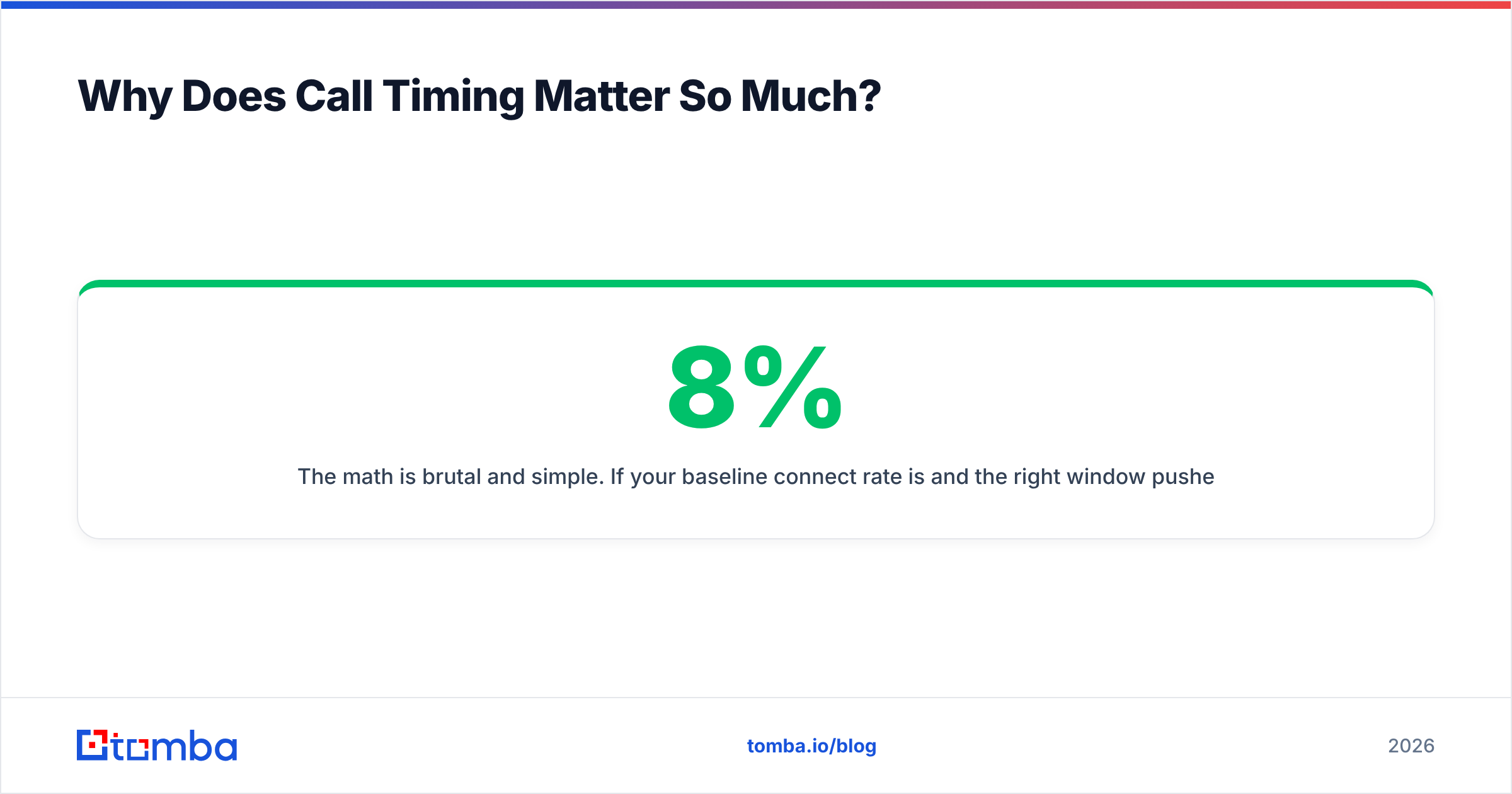
The math is brutal and simple. If your baseline connect rate is 8% and the right window pushes it to 12%, that is a 50% lift in conversations from the exact same number of dials. Conversations are the raw material of pipeline — no connect, no conversation, no meeting, no deal. Reps obsess over scripts and objection handling, which matter, but those only fire after a human answers. Timing decides whether anyone answers at all.
There is also a buyer-psychology layer. Early morning, people are triaging email and bracing for the day. Right after lunch, energy dips and inboxes are full. By late afternoon, the urgent fires are mostly out and decision-makers have a few minutes of slack before they wrap up. That slack is your window.
What Is the Best Time of Day To Call Customers?#
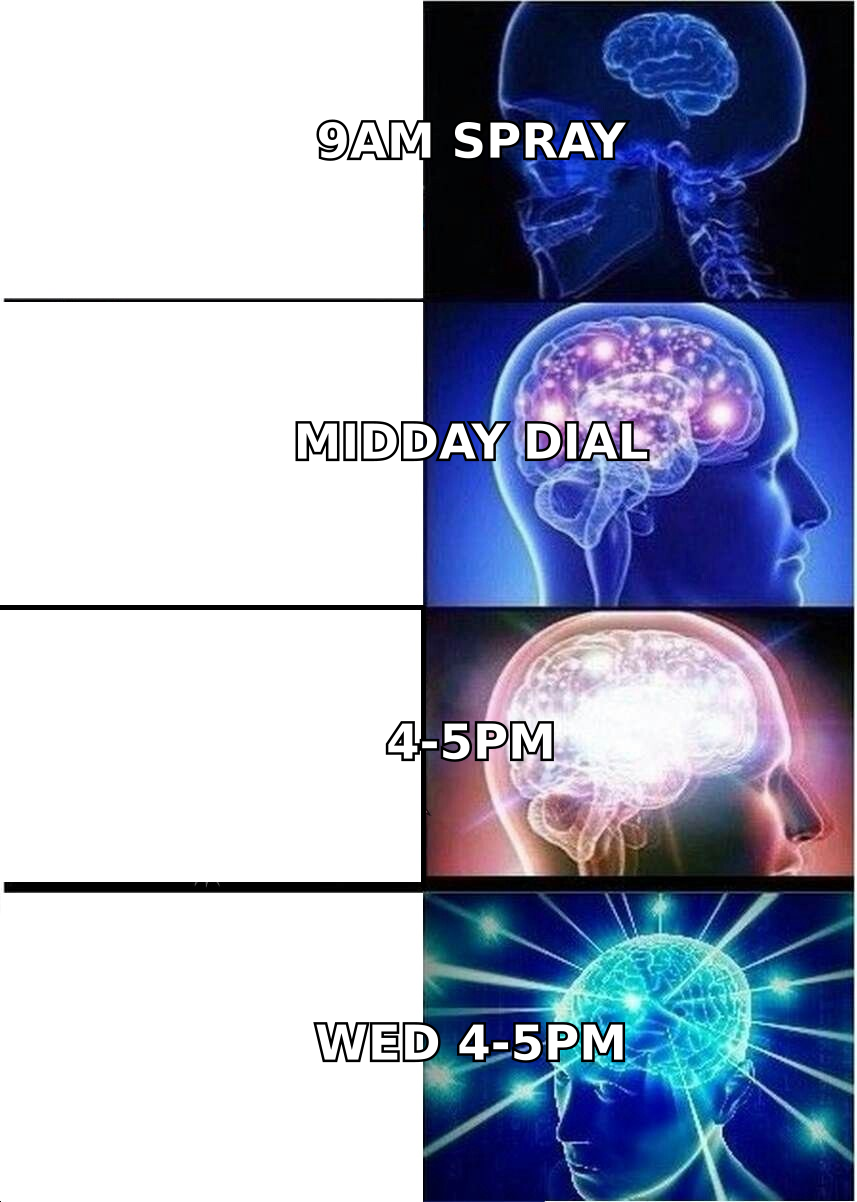
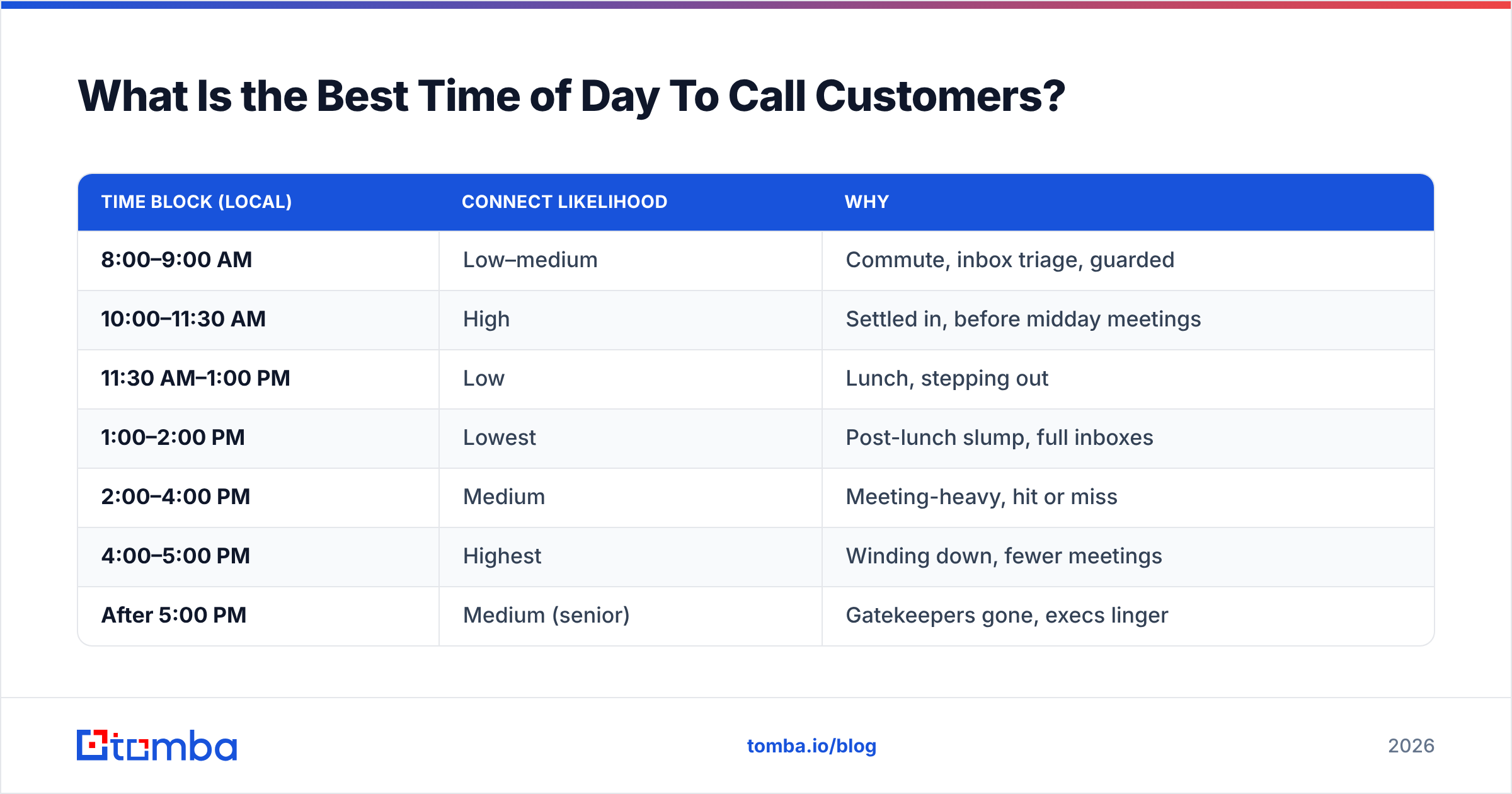
The single best block in most B2B studies is 4:00 PM to 5:00 PM local time, followed closely by 10:00 AM to 11:30 AM. HubSpot's sales research and multiple connect-rate studies have pointed at these late-morning and late-afternoon pockets for years, and the reason is consistent: those are the moments decision-makers are between meetings rather than buried in them.
Here is how a typical business day breaks down for outbound calling:
| Time block (local) | Connect likelihood | Why |
|---|---|---|
| 8:00–9:00 AM | Low–medium | Commute, inbox triage, guarded |
| 10:00–11:30 AM | High | Settled in, before midday meetings |
| 11:30 AM–1:00 PM | Low | Lunch, stepping out |
| 1:00–2:00 PM | Lowest | Post-lunch slump, full inboxes |
| 2:00–4:00 PM | Medium | Meeting-heavy, hit or miss |
| 4:00–5:00 PM | Highest | Winding down, fewer meetings |
| After 5:00 PM | Medium (senior) | Gatekeepers gone, execs linger |
One underrated trick: senior executives and founders often answer their own phone after 5:00 PM because the gatekeepers and back-to-back meetings are done. If you are selling to the C-suite, a 5:15 PM call can outperform anything earlier in the day.
Always anchor these windows to the prospect's time zone, not yours. A 4:30 PM call from New York lands at 1:30 PM in California — the post-lunch dead zone. Segment your list by region and build your dial blocks around their clock.
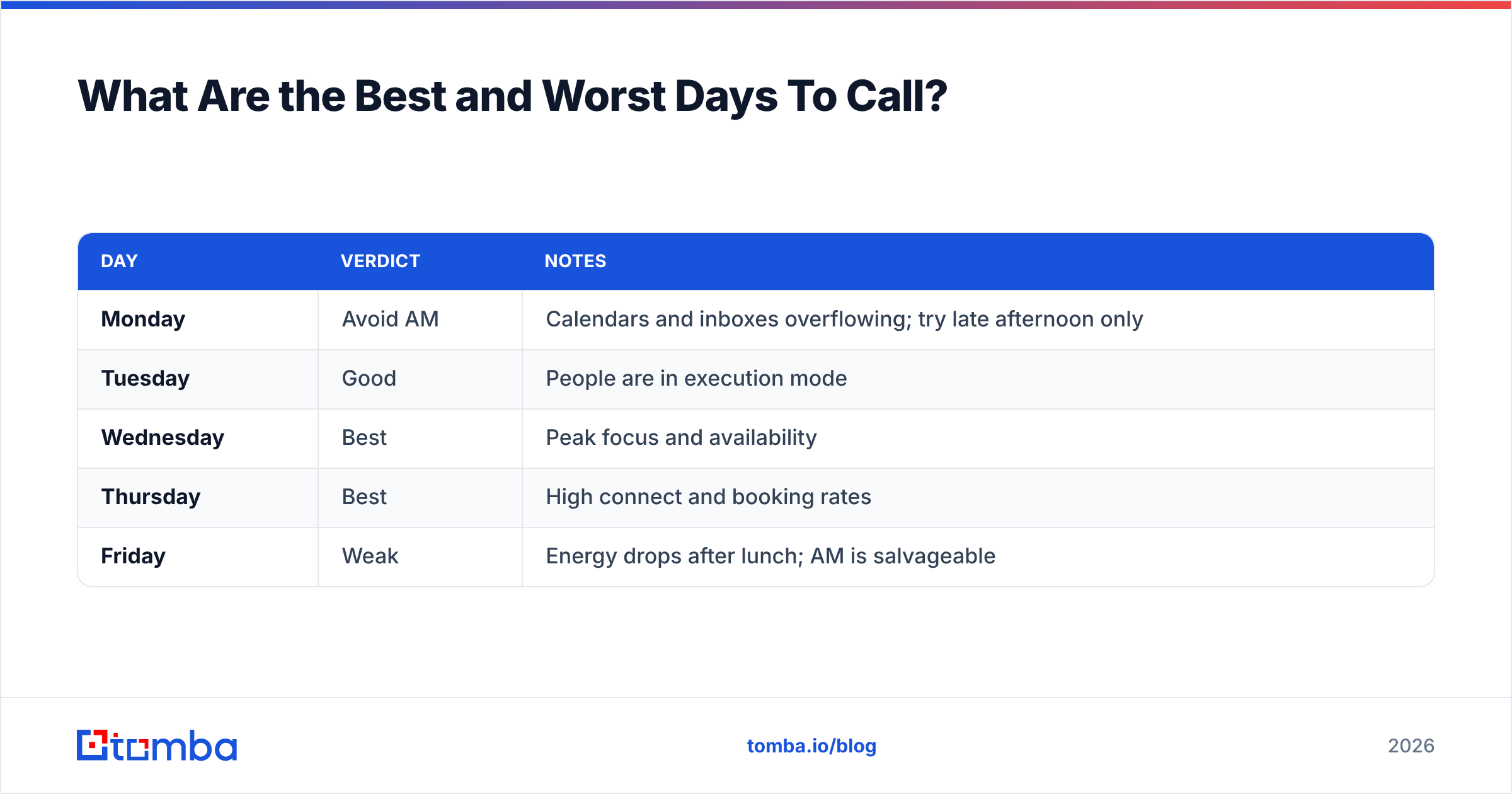
What Are the Best and Worst Days To Call?#
Midweek wins. Wednesday and Thursday are the strongest days for connecting and for booking, because Monday is consumed by planning and Friday by mentally checking out.
| Day | Verdict | Notes |
|---|---|---|
| Monday | Avoid AM | Calendars and inboxes overflowing; try late afternoon only |
| Tuesday | Good | People are in execution mode |
| Wednesday | Best | Peak focus and availability |
| Thursday | Best | High connect and booking rates |
| Friday | Weak | Energy drops after lunch; AM is salvageable |
This does not mean you should never dial on Monday or Friday — it means you should weight your effort. Put your highest-value accounts in the Wednesday and Thursday afternoon slots, and use the weaker days for follow-ups, list research, and warm callbacks where the prospect already knows you.
How Many Times Should You Call Before Giving Up?#
More than you think. Most reps quit after one or two attempts, yet a large share of connections happen on the fourth through eighth touch. The single biggest reason a "good time to call" fails is that it was the only time you tried.
Treat call timing as a grid, not a guess. Spread your attempts across different days and different hours so you eventually catch the prospect in a free moment:
- Touch 1 — Tuesday, 10:30 AM. Leave a specific voicemail.
- Touch 2 — Wednesday, 4:15 PM. No voicemail; let the missed call register.
- Touch 3 — Thursday, 11:00 AM. Pair with an email referencing your call.
- Touch 4 — Following Tuesday, 4:45 PM. Try the after-hours edge.
- Touch 5 — Thursday, 9:00 AM. A new window you have not tested on them.
- Touch 6 — Mix in a LinkedIn touch, then call again midweek afternoon.
Notice that each attempt hits a different slot. If every call lands at the same 9:00 AM you have not run six experiments — you have run the same failed experiment six times. Rotating windows is how you discover the prospect's personal pattern.
For deeper benchmarks on how persistence affects outcomes, your own dial logs beat any blog stat. Track connects by hour and by attempt number, and let the data reset your assumptions every quarter. If you want a framework for measuring this, see how response rate is defined and tracked in the Tomba glossary.
Does the Best Time To Call Customers Change by Industry?#
Yes — match the window to the prospect's workday, not a generic average.
- Retail and hospitality owners: call before opening (9:00–10:00 AM) or mid-afternoon lull (2:00–4:00 PM), never during the lunch or dinner rush.
- Healthcare and clinics: early morning before patients arrive, or the late-afternoon wind-down.
- Construction and trades: very early (7:00–8:00 AM) or end of day; they are on-site midday.
- Software and tech: standard 10–11 AM and 4–5 PM windows hold well; this crowd lives in calendars.
- Finance and executives: before 9:00 AM and after 5:00 PM, when gatekeepers are off the clock.
The principle underneath all of these: figure out when your buyer has unstructured time, and call then. A restaurant owner's free minute looks nothing like a CFO's.
What Matters More Than Timing — Calling the Right Number#
Here is the uncomfortable truth: the best call window in the world is worthless if you are dialing a disconnected line, a wrong extension, or a number that belongs to someone who left the company 18 months ago. Timing optimizes a valid attempt. It does nothing for a bad one.
This is where data quality quietly decides your whole quarter. Reps who "can't get anyone on the phone" usually do not have a timing problem — they have a list problem. Stale CRM data and scraped numbers route you to dead ends regardless of when you dial. Fixing the list is the highest-leverage move available, and it happens before you ever pick up the phone.
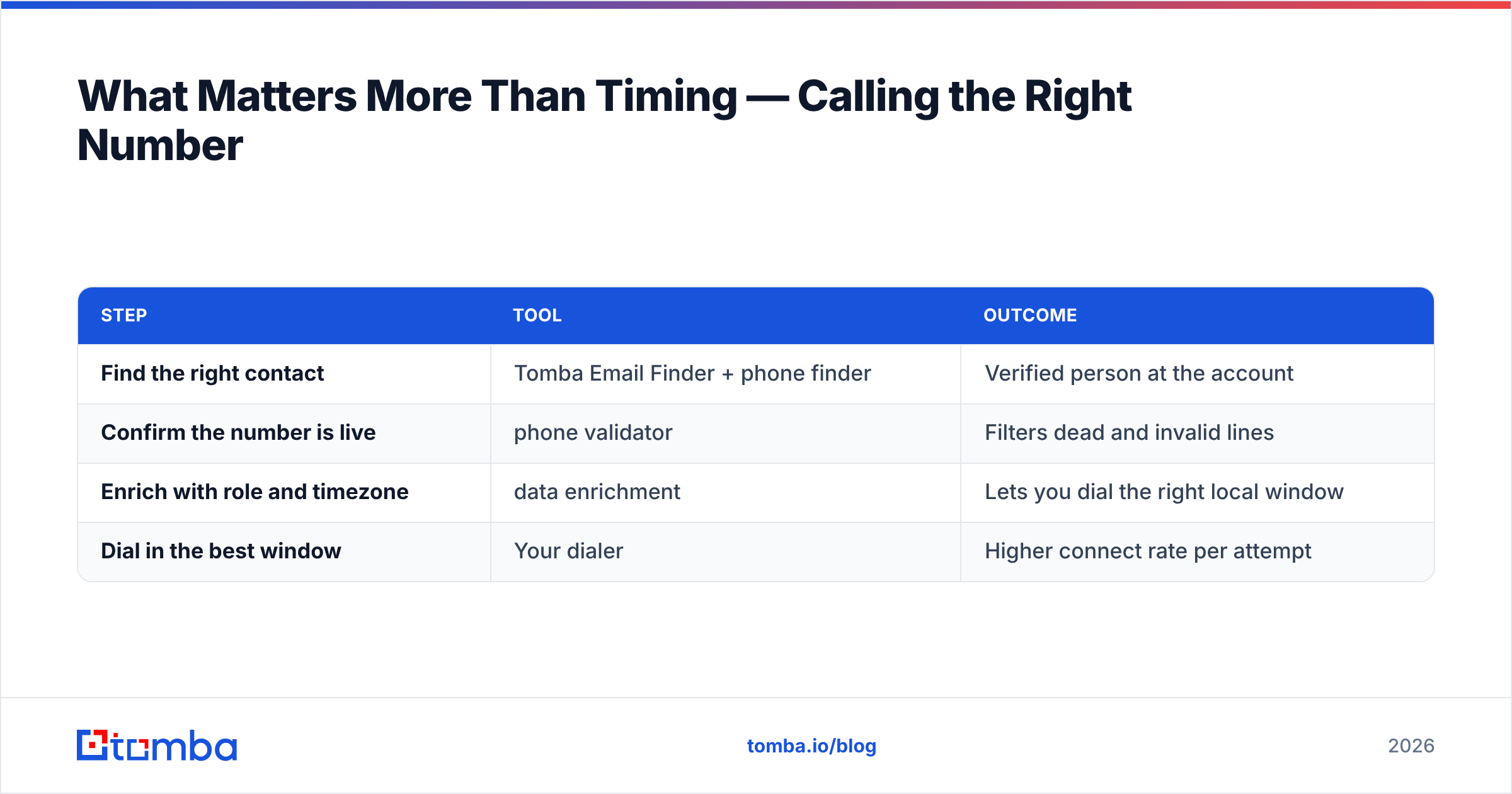
A clean calling motion looks like this:
| Step | Tool | Outcome |
|---|---|---|
| Find the right contact | Tomba Email Finder + phone finder | Verified person at the account |
| Confirm the number is live | phone validator | Filters dead and invalid lines |
| Enrich with role and timezone | data enrichment | Lets you dial the right local window |
| Dial in the best window | Your dialer | Higher connect rate per attempt |
When you combine an accurate, validated list with disciplined timing, both levers compound. A 12% window connect rate on a clean list crushes a 12% window rate on a list that is 30% junk — because in the second case, a third of your "perfectly timed" dials were never going to connect at all.
How Do You Build a Timing System That Sticks?#
Stop treating call timing as folklore and turn it into a repeatable system:
- Segment by time zone first. Group every contact by their local clock so "4:30 PM" always means their 4:30 PM.
- Block your calendar around the peaks. Reserve 10:00–11:30 AM and 4:00–5:00 PM for outbound dialing. Protect those blocks like meetings.
- Validate before you dial. Run new numbers through a phone validator so you are not burning prime windows on dead lines.
- Rotate your attempts. Never call the same prospect at the same hour twice. Use the grid above.
- Log everything and review weekly. Track connect rate by day, hour, and attempt number. Let your own data overrule generic advice.
- Pair calls with other channels. A LinkedIn view or a short email before the call lifts answer rates — multi-channel beats phone-only.
For a broader look at orchestrating outreach across channels, the HubSpot sales blog and peer-reviewed tool comparisons on G2 are solid, vendor-neutral starting points. And if you are evaluating dialers and sequencing platforms, analyst coverage from firms like Gartner can help you separate features from marketing.
Frequently Asked Questions#
What is the single best time to call customers? Late afternoon, 4:00–5:00 PM in the prospect's local time zone, is the highest-connecting block in most B2B datasets, with mid-late morning (10:00–11:30 AM) a close second.
What is the worst time to call? The hour right after lunch (1:00–2:00 PM) and Friday afternoons are consistently the weakest. Monday before 10:00 AM is also rough.
How many call attempts should I make? Plan for at least six to eight touches spread across different days and hours. Most connections happen well past the first or second attempt.
Does timing matter more than the script? They solve different problems. Timing gets a human to answer; the script handles what happens next. You need both, but no script fires if nobody picks up.
Stop Guessing — Dial the Right Person at the Right Time#
Timing is free, but it only pays off when you are calling a real, verified contact. Before you optimize your call windows, fix the list underneath them. Use the Tomba Email Finder to surface the right decision-maker at any company, pair it with the phone finder and phone validator to confirm the line is live, and enrich each contact with role and region so you always dial in their best window. You can start on the free tier and scale up through Tomba pricing as your call volume grows. Clean data plus disciplined timing is the combination that actually moves your connect rate — everything else is noise.
// get started
Find, verify and enrich your first contacts today
Start on the free plan with 25 searches a month, then scale when your team is ready.
Free plan · No credit card required · GDPR & CCPA
// about the author