Best Time To Make Sales Calls in 2026 (Data-Backed)
The best time to make sales calls isn't a guess. Here's what the connect-rate data says about the best days, hours, and cadence to dial in 2026.
Timing is the cheapest lever in outbound sales. You can rewrite your script, retrain your reps, and buy a fancier dialer, but if you call when nobody picks up, none of it matters. The good news: decades of connect-rate studies point to the same handful of windows, and you can act on them today.
TL;DR — When Should You Make Sales Calls?#
- Best days: Wednesday and Thursday consistently beat Monday and Friday for connects and conversations.
- Best hours: Late afternoon (4–5 p.m.) and the late-morning slot (10–11 a.m.) win most studies; lunch (12–1 p.m.) is the dead zone.
- Speed beats timing: Calling a fresh inbound lead within 5 minutes outperforms any "perfect hour" by an order of magnitude.
- Persistence matters more than the clock: Most connects happen on attempts 4–6, not attempt 1.
- Localize everything: "4 p.m." means nothing until you anchor it to the prospect's time zone — which requires accurate phone data.
What Is the Best Time to Make Sales Calls?#
The short answer: Wednesday and Thursday, between 4 p.m. and 5 p.m. in the prospect's local time, with a strong second window at 10–11 a.m. That pattern shows up across multiple analyses of millions of dialed calls, including widely cited research summarized by HubSpot and decades-old academic work from the Kellogg School and MIT Lead Response studies.
Why those windows? Think of your prospect's day like a tide. Early morning they're triaging email and bracing for the day — low patience for an unknown number. Midday they're heads-down or at lunch. But late morning and late afternoon are natural "coming up for air" moments: meetings have wrapped, the inbox is under control, and people are more willing to take an unscheduled call.

The reason timing works at all is answer rate — the percentage of dials that turn into a live human conversation. Small percentage gains compound fast across a rep's daily call volume, which is why a 2-point lift from better timing can mean dozens of extra conversations per month.
Which Days and Hours Actually Convert? (The Data)#
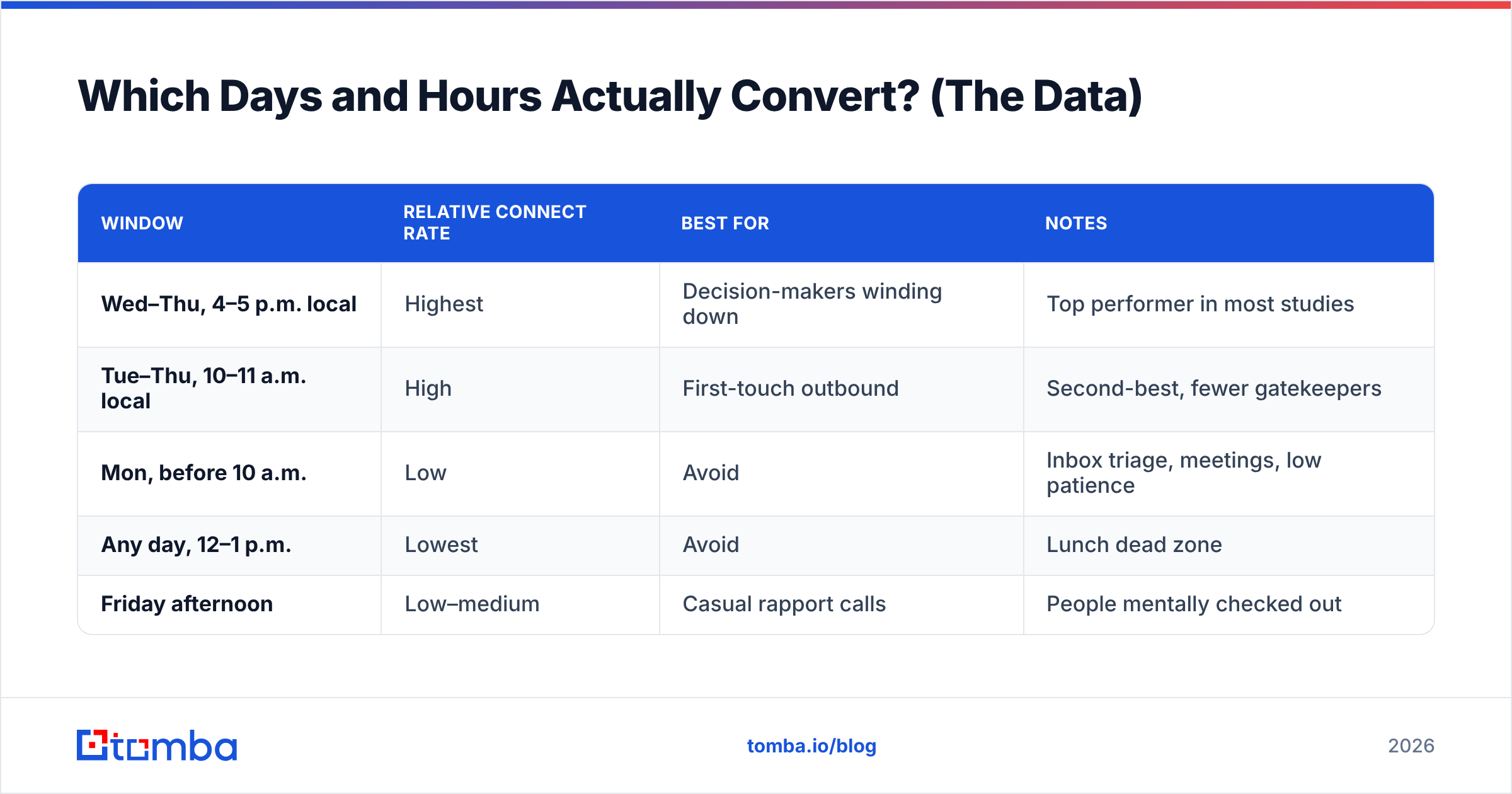
Here's how the common windows stack up. Treat these as directional benchmarks from aggregated industry studies, not laws of physics — your own dial logs are the final authority.
| Window | Relative connect rate | Best for | Notes |
|---|---|---|---|
| Wed–Thu, 4–5 p.m. local | Highest | Decision-makers winding down | Top performer in most studies |
| Tue–Thu, 10–11 a.m. local | High | First-touch outbound | Second-best, fewer gatekeepers |
| Mon, before 10 a.m. | Low | Avoid | Inbox triage, meetings, low patience |
| Any day, 12–1 p.m. | Lowest | Avoid | Lunch dead zone |
| Friday afternoon | Low–medium | Casual rapport calls | People mentally checked out |
A few patterns are worth calling out directly:
- Wednesday is the workhorse. It avoids Monday's overload and Friday's mental checkout, and it shows up at or near the top in nearly every dataset.
- The 4–5 p.m. slot rewards patience. Reps abandon the afternoon early; the prospects who pick up then often have more time to actually talk.
- First-touch and follow-up want different hours. Use late morning to break through to new names, late afternoon to reconnect with people who already know you.
- Lunch is unrecoverable. No script saves a noon dial. Use that hour for research, list-building, or admin instead.
Does Speed-to-Lead Beat the "Perfect Hour"?#
Yes — and it isn't close. The single most decisive timing factor in B2B isn't the day of the week, it's how fast you respond to an inbound signal.
The classic MIT/InsideSales lead-response study found that calling a web lead within 5 minutes versus 30 minutes made the lead roughly 100x more likely to be reached and 21x more likely to qualify. After the first hour, the odds fall off a cliff. So while Wednesday at 4 p.m. is the best scheduled time, a hot inbound lead that just filled out a demo form should be called now, whatever the clock says.
The practical takeaway: run two motions in parallel.
- Reactive (speed): Inbound leads get called within minutes, no exceptions. Build alerting so a rep is dialing before the prospect closes the tab.
- Proactive (timing): Cold and warm outbound lists get scheduled into the high-connect windows above.
This is also why response rate is the metric to obsess over, not raw dial count. A rep who dials less but reaches more wins every time.
How Many Attempts Before You Connect?#
Timing gets you in the door; persistence gets you the meeting. Aggregate dialer data repeatedly shows that most successful connects happen on the 4th to 6th attempt, yet a large share of reps quit after one or two tries. They're leaving connected conversations on the table.
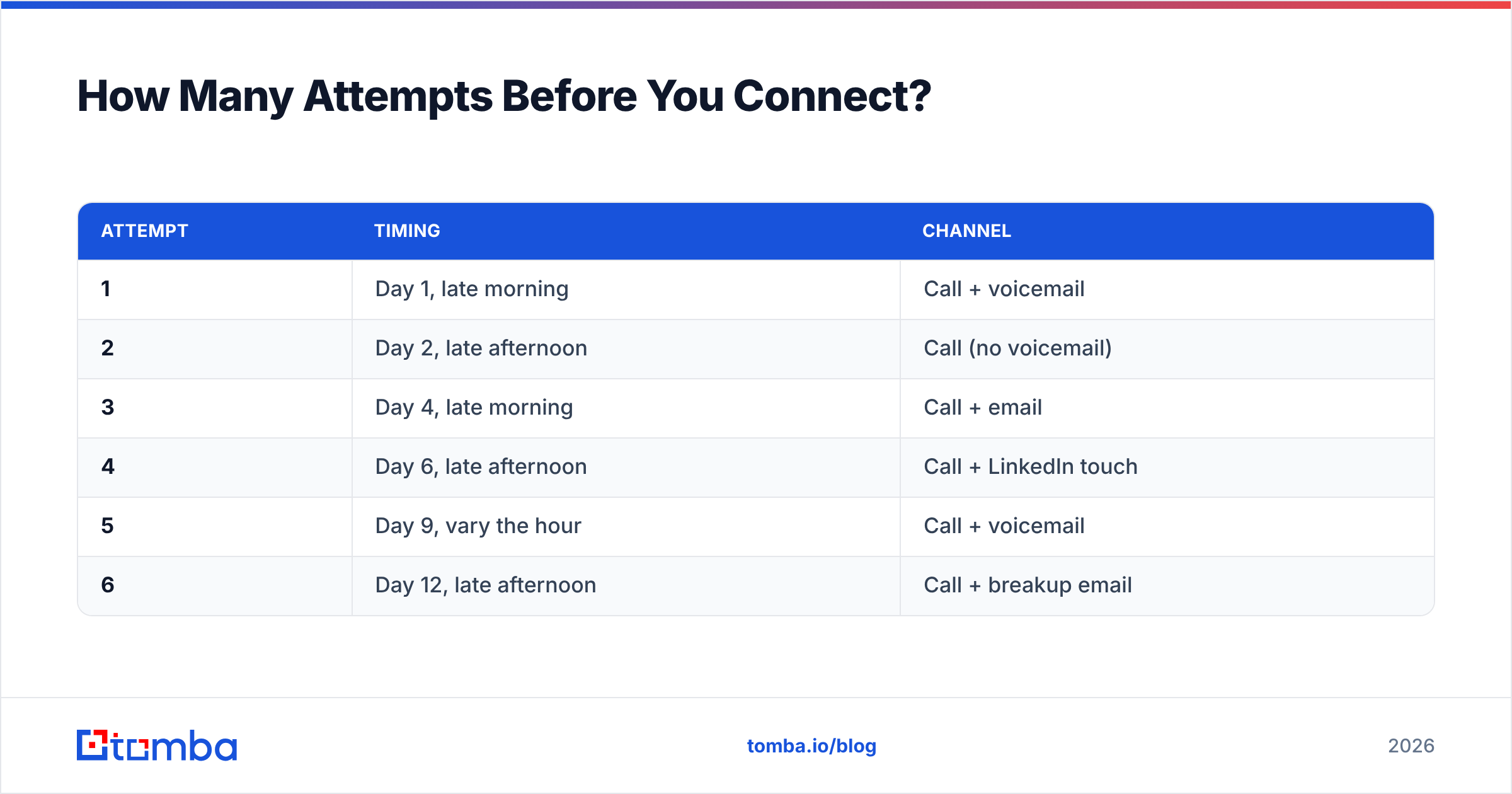
A simple, defensible cadence looks like this:
| Attempt | Timing | Channel |
|---|---|---|
| 1 | Day 1, late morning | Call + voicemail |
| 2 | Day 2, late afternoon | Call (no voicemail) |
| 3 | Day 4, late morning | Call + email |
| 4 | Day 6, late afternoon | Call + LinkedIn touch |
| 5 | Day 9, vary the hour | Call + voicemail |
| 6 | Day 12, late afternoon | Call + breakup email |
Notice the cadence rotates the hour on each attempt. If a prospect never answers at 10 a.m., stop calling at 10 a.m. Varying the window is how you discover their pickup time instead of betting everything on the population average. Pairing calls with a LinkedIn outreach touch on alternating attempts keeps you visible without becoming a pest.

Why Do Time Zones Quietly Ruin Good Timing?#
Here's the trap that wrecks otherwise solid timing strategy: "4 p.m." is meaningless without a time zone. A rep in New York dialing a prospect in San Francisco at 4 p.m. ET is actually calling at 1 p.m. PT — right after lunch, in the weakest window of the day. Multiply that across a national or global list and your carefully chosen hours dissolve into noise.
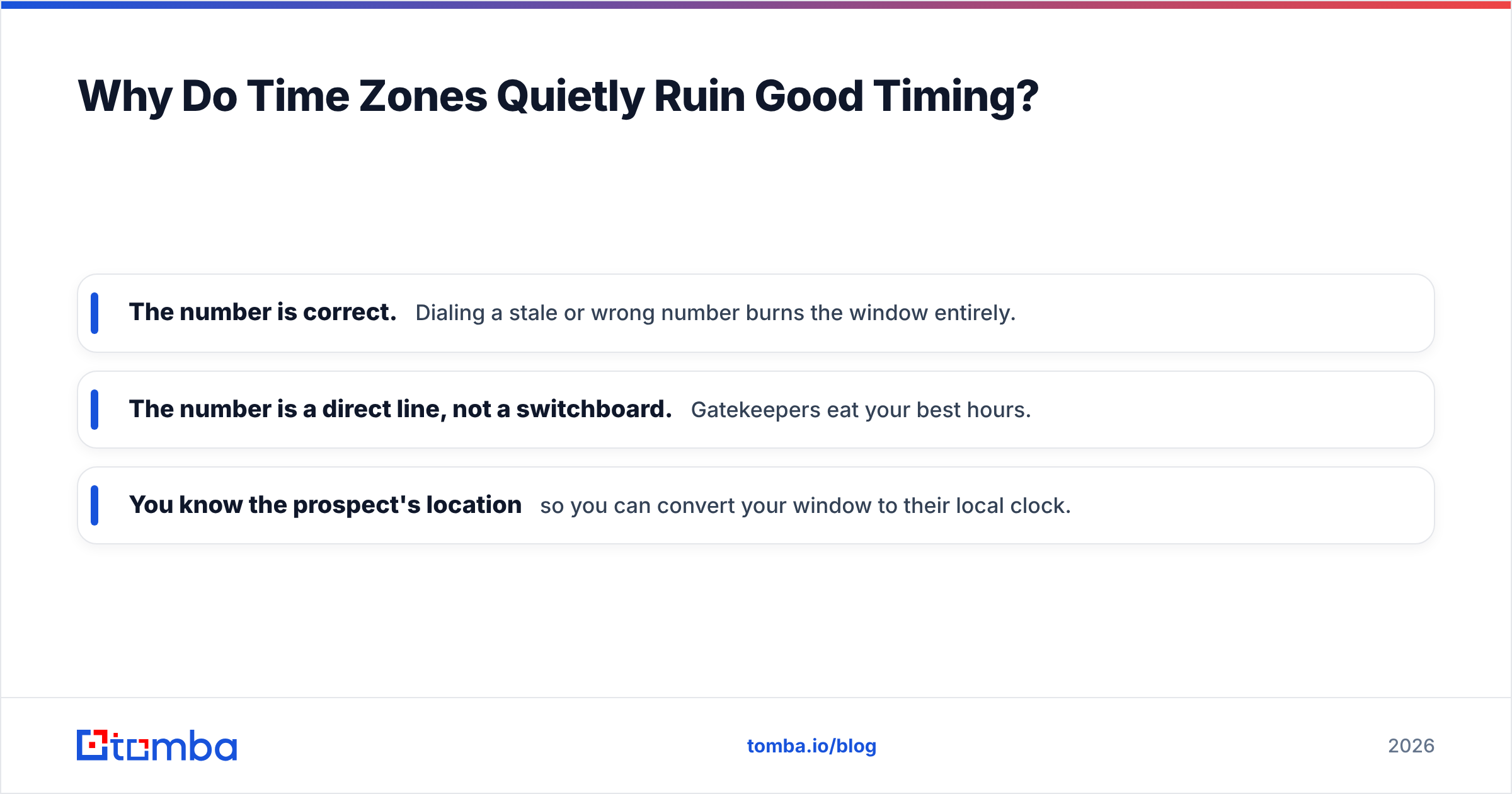
Three things have to be true before timing strategy can work:
- The number is correct. Dialing a stale or wrong number burns the window entirely.
- The number is a direct line, not a switchboard. Gatekeepers eat your best hours.
- You know the prospect's location so you can convert your window to their local clock.
All three depend on data quality. This is where most "best time to call" advice falls apart — it assumes you already have clean, direct, geo-tagged phone numbers, which most teams don't. If you're enriching lists from scratch, a phone finder that returns direct dials plus location lets you actually localize your calling windows instead of guessing. And because email and phone work better together, keeping verified contact data flowing from an email finder into your follow-up steps closes the loop on the call-plus-email cadence above.
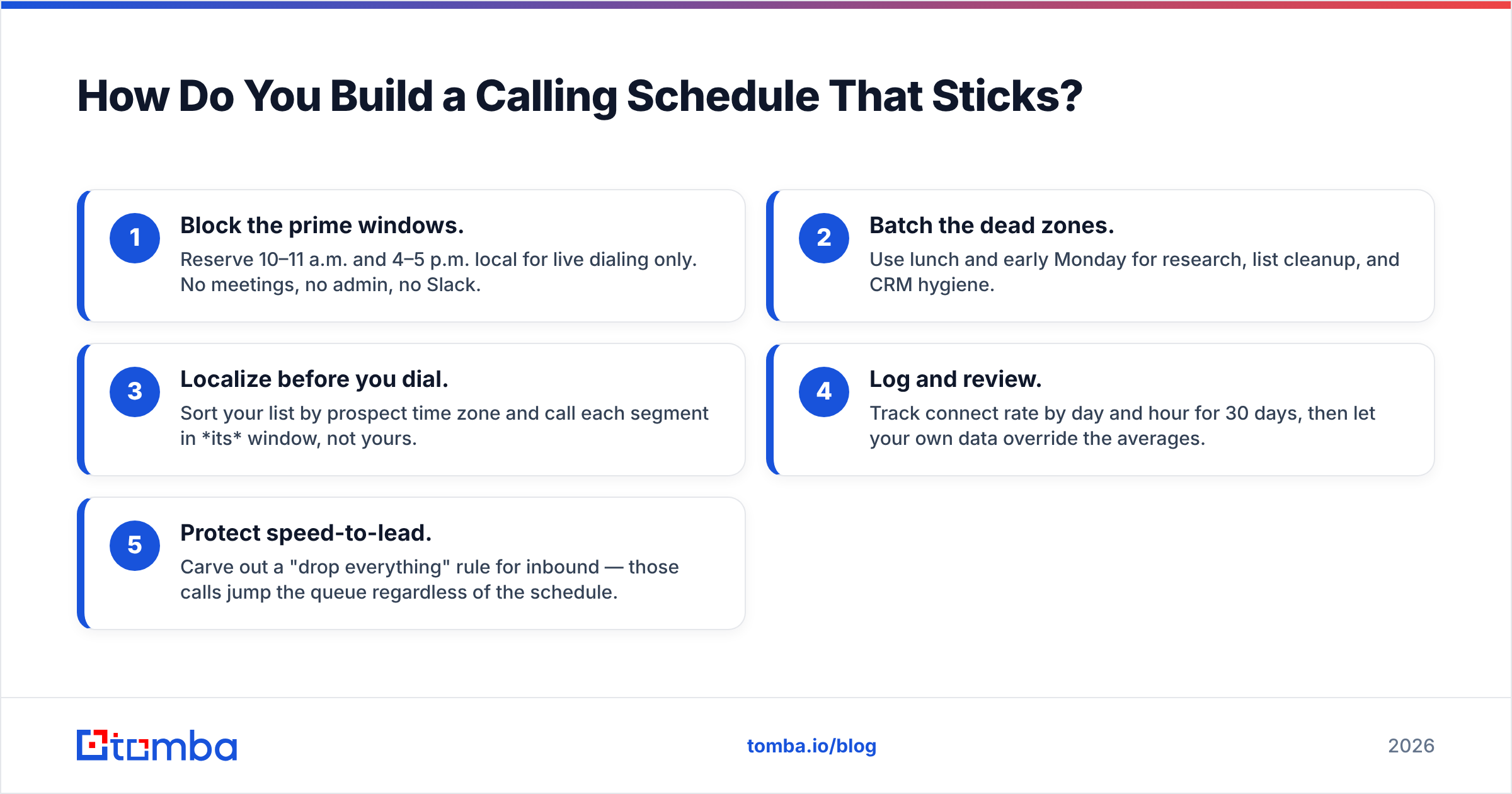
How Do You Build a Calling Schedule That Sticks?#
Strategy fails when it lives in a blog post instead of a calendar. Turn the data into a repeatable weekly rhythm:
- Block the prime windows. Reserve 10–11 a.m. and 4–5 p.m. local for live dialing only. No meetings, no admin, no Slack.
- Batch the dead zones. Use lunch and early Monday for research, list cleanup, and CRM hygiene.
- Localize before you dial. Sort your list by prospect time zone and call each segment in its window, not yours.
- Log and review. Track connect rate by day and hour for 30 days, then let your own data override the averages.
- Protect speed-to-lead. Carve out a "drop everything" rule for inbound — those calls jump the queue regardless of the schedule.
For a deeper playbook on building repeatable outbound motions, our guide to sales prospecting tactics pairs well with this timing framework. The combination of right list, right time, and enough attempts is what separates teams that hit quota from teams that blame the market.
How Tomba Helps You Dial at the Right Time#
Great timing is wasted on bad numbers. Before you can call a decision-maker at 4 p.m. their time, you need a direct line and a known location — and that's a data problem, not a scheduling one.
Tomba's Phone Finder returns verified, direct-dial B2B phone numbers so your reps spend their prime windows talking to prospects instead of fighting switchboards or dialing dead lines. Pair it with the email finder for the call-plus-email cadence above, and you've got both channels covered from one source. Start free with 25 searches a month, and scale up through transparent Tomba pricing — Starter at $49/mo, Growth at $99/mo — as your dialing volume grows. Get the numbers right first, then let the clock do its job.
Ready to find emails that actually work?
Join 150,000+ professionals who stopped guessing and started sending. Free credits on signup — no credit card required.
Get the Tomba newsletter
Practical outbound tactics and product updates — once every two weeks.
About the author