Best Time to Send an Email on Tuesday (2026 Data Guide)
Tuesday is the most-cited best day for email, but the hour matters more than the day. Here's the 2026 data on the best time to send an email on Tuesday.
TL;DR
- The best time to send an email on Tuesday in 2026 is the 9:00–11:00 a.m. window in the recipient's local time zone, with 10:00 a.m. the single strongest hour across most B2B datasets.
- A second, smaller bump shows up around 1:00–3:00 p.m., when people clear their inboxes after lunch.
- Tuesday outperforms Monday and Friday, but the hour you pick moves results more than the day you pick.
- Time zones beat clever copy: a perfectly timed send to the wrong zone lands at 3 a.m. and dies in the overnight pile.
- Treat every benchmark below as a starting hypothesis. Your list, your offer, and your audience decide the real winner — so test.
Why does Tuesday get all the attention?#
Tuesday wins because Monday loses. Monday mornings are buried under weekend backlog, status meetings, and the mental reset of a new week. By Tuesday, people have triaged the urgent stuff and have bandwidth for the merely important — which is where most cold and marketing email lives.
Think of the work week like a restaurant service. Monday is the chaotic open: orders backed up, kitchen scrambling. Tuesday is the steady mid-service rhythm when the staff can actually pay attention to a new table. That's your email.
Multiple long-running studies — including HubSpot's send-time research and analyses from Mailchimp across billions of campaigns — repeatedly land on Tuesday (with Wednesday and Thursday close behind) as the strongest weekday for opens and engagement. The pattern is consistent enough to plan around, but loose enough that you should never treat it as gospel.
)
What is the best time to send an email on Tuesday?#
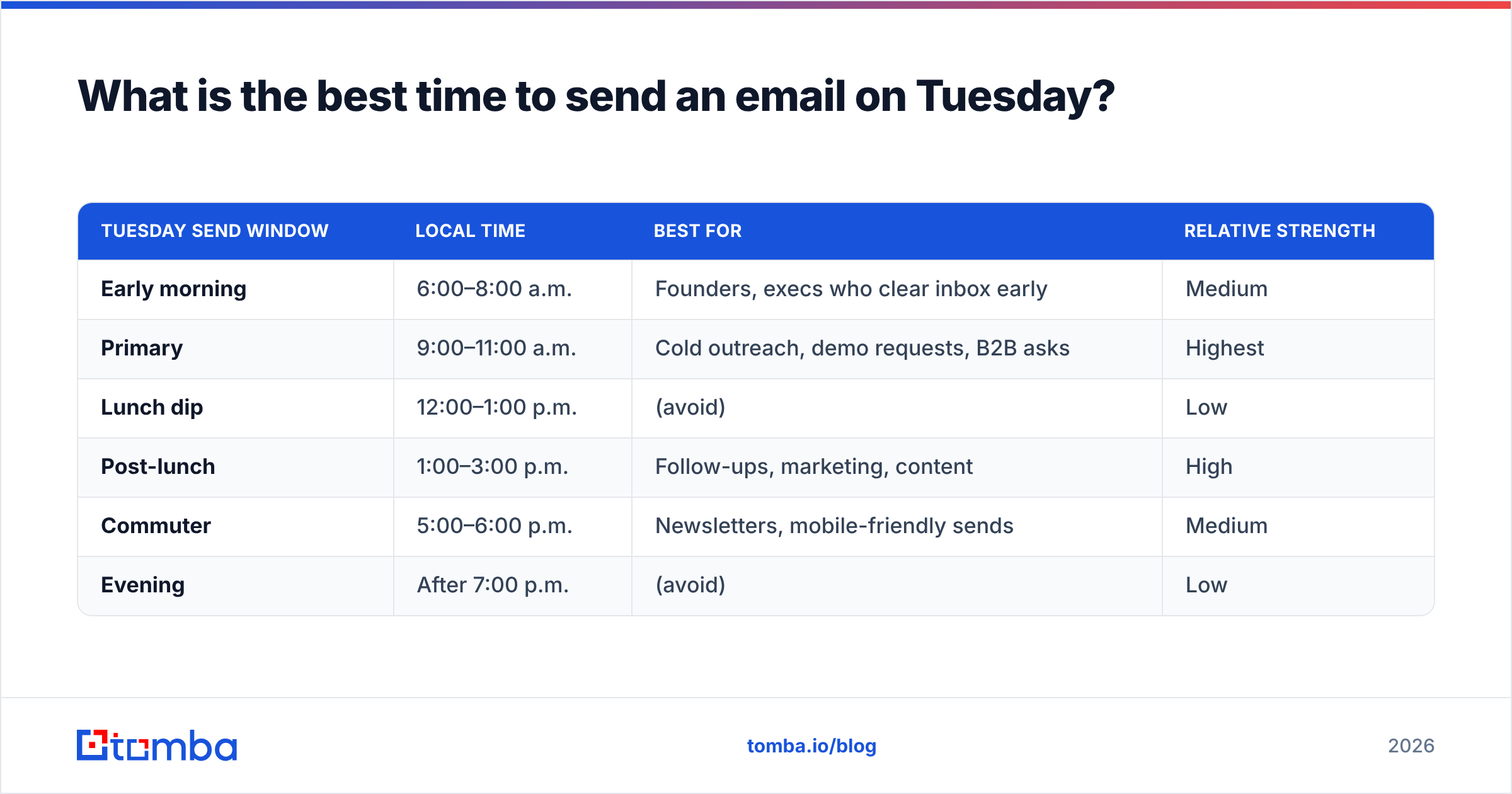
Aim for 10:00 a.m. in the recipient's local time zone. That's the short answer. The longer answer is that there are three usable windows on a Tuesday, and they map to predictable behavior:
- 9:00–11:00 a.m. (primary window). People have settled in, cleared overnight noise, and are deciding what to act on. This is the highest-intent stretch of the day. If you only get one shot, take 10:00 a.m.
- 1:00–3:00 p.m. (secondary window). The post-lunch inbox sweep. Opens are solid; replies are slightly slower because afternoons fill with meetings.
- 5:00–6:00 p.m. (commuter window). A smaller, mobile-heavy bump as people check email before logging off. Good for newsletters and lighter content, weaker for asks that need a desktop reply.
The hours to avoid are the dead zones: before 7:00 a.m. (buried by the time they look), 12:00–1:00 p.m. (lunch), and after 7:00 p.m. (weekend-adjacent neglect, especially later in the week).
| Tuesday send window | Local time | Best for | Relative strength |
|---|---|---|---|
| Early morning | 6:00–8:00 a.m. | Founders, execs who clear inbox early | Medium |
| Primary | 9:00–11:00 a.m. | Cold outreach, demo requests, B2B asks | Highest |
| Lunch dip | 12:00–1:00 p.m. | (avoid) | Low |
| Post-lunch | 1:00–3:00 p.m. | Follow-ups, marketing, content | High |
| Commuter | 5:00–6:00 p.m. | Newsletters, mobile-friendly sends | Medium |
| Evening | After 7:00 p.m. | (avoid) | Low |
Is Tuesday actually better than other days?#
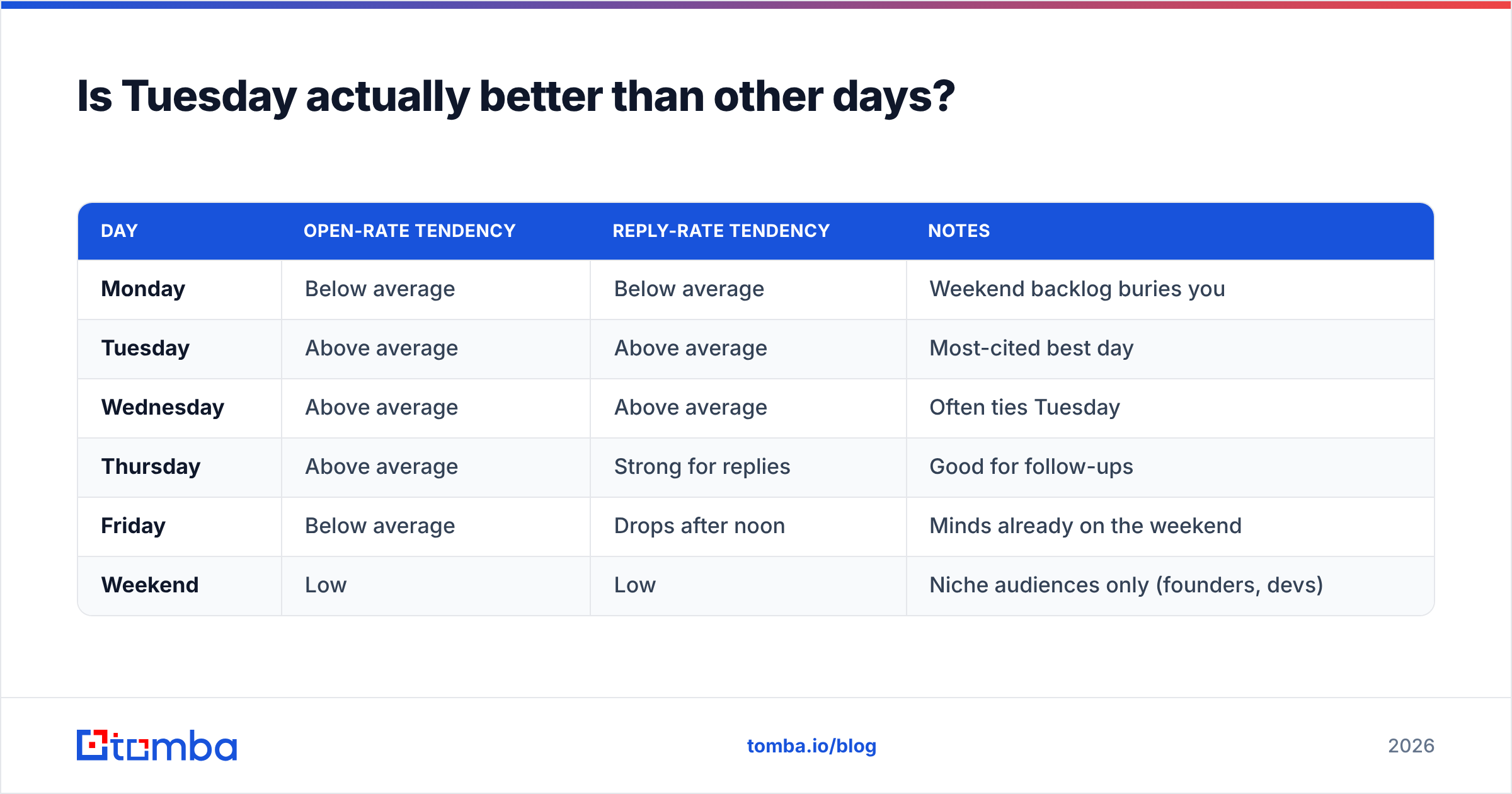
Yes, but the margin is smaller than the headlines suggest. Across most B2B datasets, Tuesday, Wednesday, and Thursday cluster within a few percentage points of each other for open and reply rates, while Monday and Friday trail and weekends fall off a cliff.
Here's the honest framing: picking Tuesday over Monday might earn you a modest lift; picking 10:00 a.m. over 4:00 p.m. earns you a bigger one. The day sets the stage; the hour and the time zone do the heavy lifting. If you obsess over "Tuesday vs. Wednesday" while blasting everyone at a single server-clock time, you're optimizing the wrong variable.
| Day | Open-rate tendency | Reply-rate tendency | Notes |
|---|---|---|---|
| Monday | Below average | Below average | Weekend backlog buries you |
| Tuesday | Above average | Above average | Most-cited best day |
| Wednesday | Above average | Above average | Often ties Tuesday |
| Thursday | Above average | Strong for replies | Good for follow-ups |
| Friday | Below average | Drops after noon | Minds already on the weekend |
| Weekend | Low | Low | Niche audiences only (founders, devs) |
Why does the recipient's time zone matter more than the clock on your wall?#
Because 10:00 a.m. only works if it's 10:00 a.m. for them. Send a U.S. East Coast 10:00 a.m. blast to a list that's 40% West Coast and 20% European, and a huge chunk of your audience gets it at 7:00 a.m. or 4:00 p.m. — outside the sweet spot you worked so hard to find.
Time zones are the most under-managed lever in send timing. The fix is mechanical:
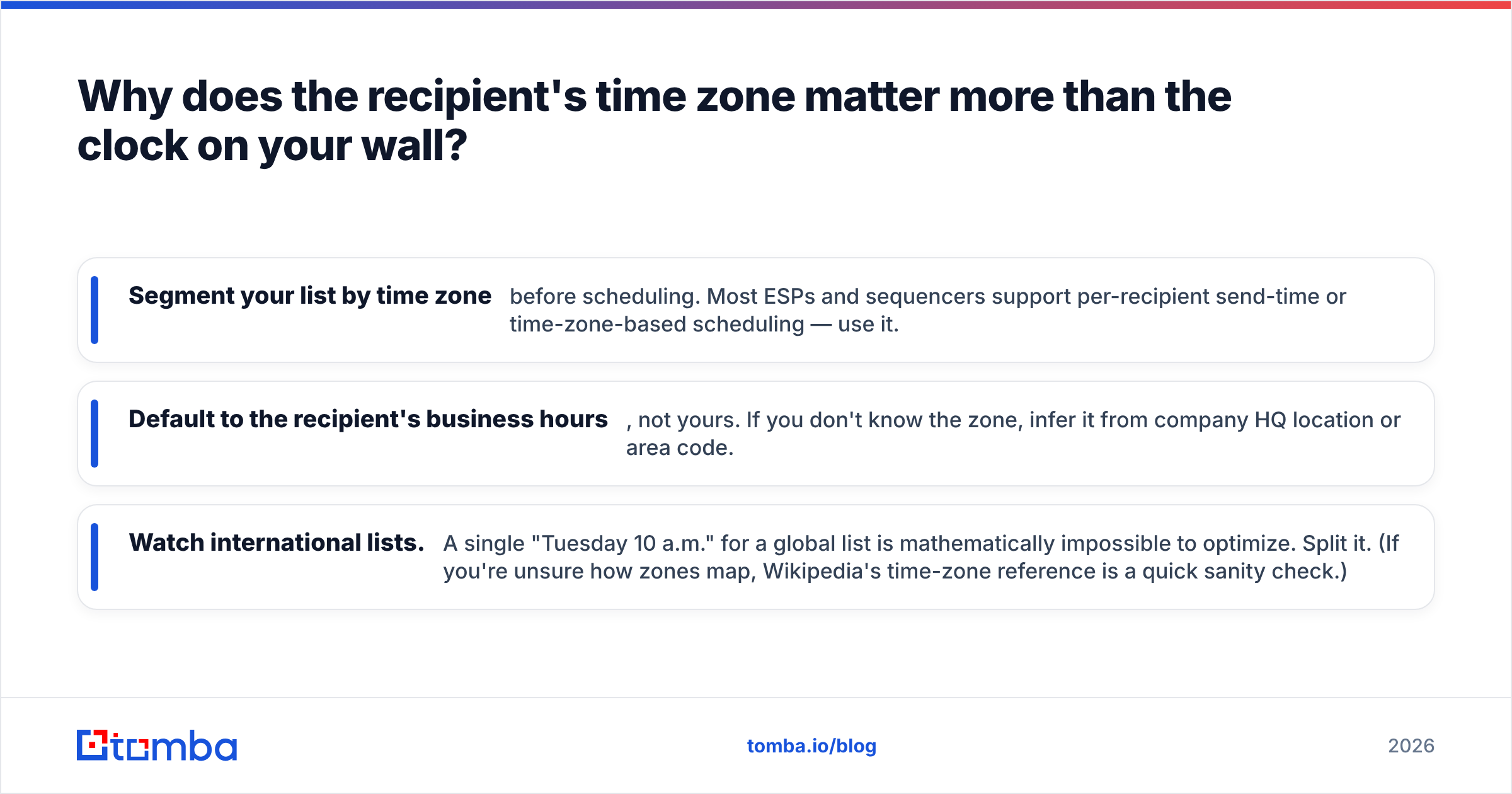
- Segment your list by time zone before scheduling. Most ESPs and sequencers support per-recipient send-time or time-zone-based scheduling — use it.
- Default to the recipient's business hours, not yours. If you don't know the zone, infer it from company HQ location or area code.
- Watch international lists. A single "Tuesday 10 a.m." for a global list is mathematically impossible to optimize. Split it. (If you're unsure how zones map, Wikipedia's time-zone reference is a quick sanity check.)
This is also where data quality quietly decides your results. If your contact records are stale or missing location fields, your time-zone segmentation is guesswork. Clean, enriched contact data — accurate company, role, and location — is what makes precise scheduling possible in the first place. Pairing a reliable email finder with contact enrichment gives your sequencer the fields it needs to schedule intelligently instead of blindly.
How does Tuesday timing change by industry and role?#
The 10:00 a.m. rule is a default, not a law. Different audiences keep different clocks:
- Executives and founders often clear inbox very early (6:00–7:30 a.m.) or late at night. A Tuesday 7:00 a.m. send can beat 10:00 a.m. for this group.
- Operations, marketing, and IC roles fit the classic 9:00–11:00 a.m. window well.
- Developers and technical buyers skew later and are more weekend-tolerant; a Tuesday afternoon or even off-hours send can perform.
- Retail, hospitality, and field roles check email in bursts — early morning and end of shift — so the standard mid-morning window is less reliable.
- Healthcare and education have rigid schedules; aim for the narrow gaps (early morning, lunch) when they're actually at a screen.
The takeaway: match the send to the recipient's workday shape, not to a universal "best time." A well-segmented list lets you run different Tuesday windows for different personas in the same campaign.
What about open rates vs. reply rates on Tuesday?#
These two metrics peak at slightly different moments, and conflating them leads to bad scheduling.
- Opens spike fastest in the 9:00–11:00 a.m. window — people are scanning subject lines and triaging.
- Replies lean a touch later and benefit from the early-week energy of Tuesday and Thursday, when recipients still have the runway to act before the weekend.
If your goal is a booked meeting (a reply), you care about the window where people both see the email and have time to respond. That's why Tuesday and Thursday mid-morning are reply-rate favorites: opened early, with enough day and week left to act. Your subject line still has to earn the open — a strong subject line generator helps — but timing decides whether it's even seen while attention is high. For a deeper benchmark on what "good" looks like, see how response rate is defined and measured.
)
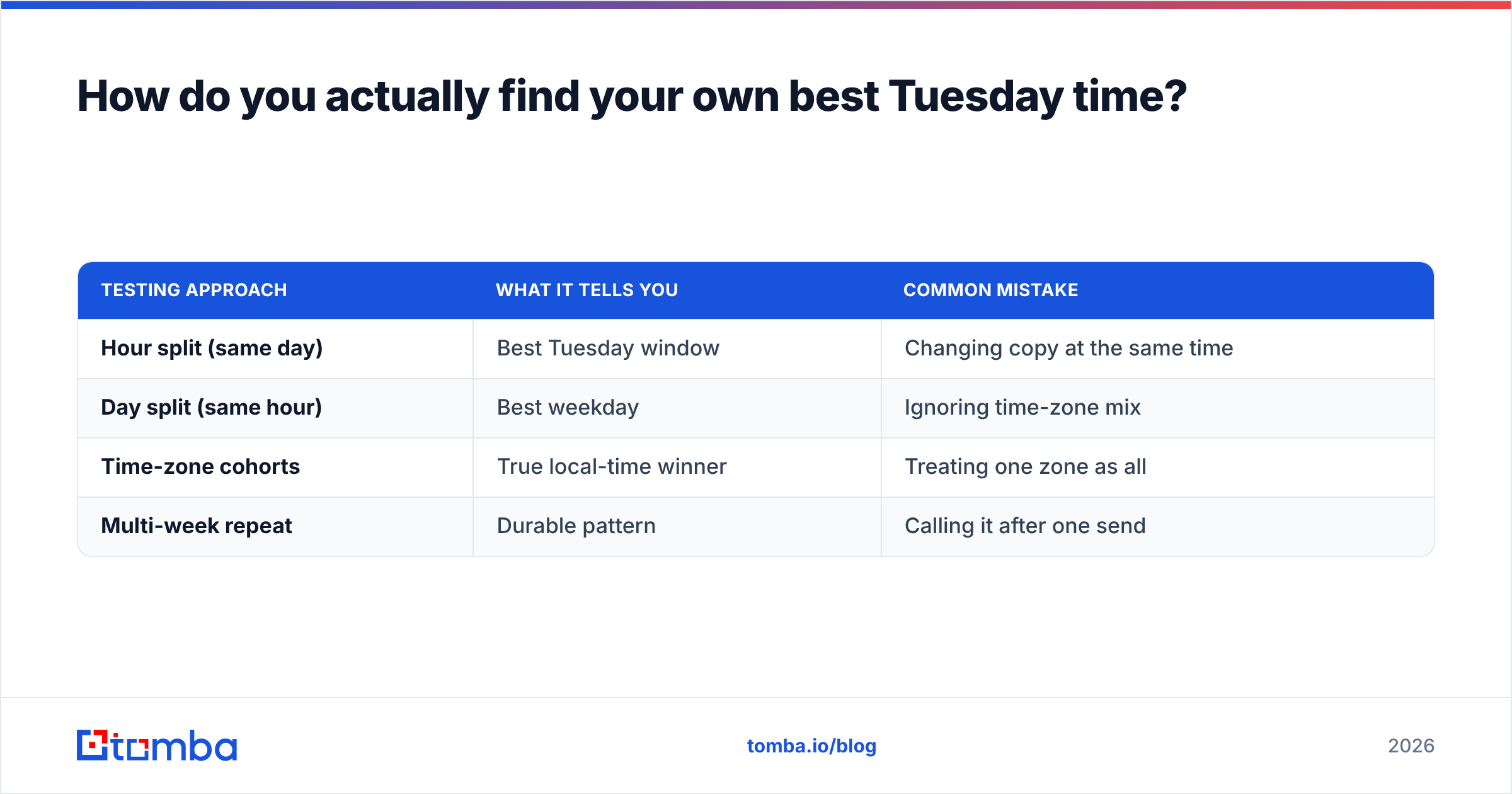
How do you actually find your own best Tuesday time?#
Stop trusting averages and run a clean test. Benchmarks point you to a starting hypothesis; your own data confirms the winner. Here's a five-step playbook:
- Pick one variable. Hold the day (Tuesday) constant and test only the hour. Don't change subject lines and send times in the same test — you won't know what moved the needle.
- Split into time-zone-matched cohorts. Compare 9:00 a.m. local vs. 1:00 p.m. local within the same zone, so geography isn't secretly skewing results.
- Use a meaningful sample. A few hundred sends per variant minimum. Tiny lists produce noise that looks like signal.
- Measure the metric that matters. For cold outreach, that's replies and meetings booked — not opens, which are increasingly unreliable thanks to privacy proxies that pre-fetch images.
- Repeat across a few weeks. One Tuesday is an anecdote. Four Tuesdays is a pattern. Lock in the winner, then re-test quarterly as your audience shifts.
| Testing approach | What it tells you | Common mistake |
|---|---|---|
| Hour split (same day) | Best Tuesday window | Changing copy at the same time |
| Day split (same hour) | Best weekday | Ignoring time-zone mix |
| Time-zone cohorts | True local-time winner | Treating one zone as all |
| Multi-week repeat | Durable pattern | Calling it after one send |
One more thing that quietly tanks send-time tests: deliverability. If your domain reputation is weak, your perfectly timed Tuesday email lands in spam at 10:00 a.m. and never gets opened regardless. Warm your domain, authenticate it, and keep your list clean before you fuss over the perfect hour. Strong email deliverability is the floor under every timing decision — there's no "best time" for a message that never reaches the inbox. You can pressure-test your setup with a free email checker before you launch.
What are the most common Tuesday send-time mistakes?#
- One clock for everyone. Blasting your entire list at your local 10:00 a.m. ignores every other time zone on it.
- Optimizing opens instead of replies. Open tracking is noisy in 2026; reply and meeting rates are what pay rent.
- Sending to a dirty list. Bounces and spam traps wreck your sender reputation, which sabotages timing for every future send.
- Over-indexing on the day. Tuesday is a default, not a moat. The hour and the zone matter more.
- Never re-testing. Audience behavior drifts. Last year's winning window may be this year's dead zone.
- Ignoring follow-ups. A single Tuesday send is rarely the one that converts. The sequence — and the timing of each step — does the work.
Quick reference: your Tuesday send-time cheat sheet#
- Default send: Tuesday, 10:00 a.m., recipient's local time.
- Backup window: Tuesday, 1:30 p.m. local.
- Audience tweaks: Earlier for execs, later for technical buyers.
- Non-negotiables: Segment by time zone, measure replies, keep the list clean.
- Cadence: Re-test every quarter; treat all benchmarks as hypotheses.
Get the data right before you get the timing right#
The best time to send an email on Tuesday is 10:00 a.m. in your recipient's time zone — but that precision is worthless if your contact data is wrong. Accurate emails, verified deliverability, and reliable location and role fields are what let you segment, schedule, and actually reach the inbox at the right moment.
That's where Tomba's Email Finder fits. Find verified professional emails by name, company, or domain, enrich each contact with the fields your sequencer needs for time-zone-aware scheduling, and start on the free tier (25 searches/month) before scaling to Starter at $49/mo. Compare options on the Tomba pricing page. Nail the data first; the perfect Tuesday 10:00 a.m. send takes care of itself.
Ready to find emails that actually work?
Join 150,000+ professionals who stopped guessing and started sending. Free credits on signup — no credit card required.
Get the Tomba newsletter
Practical outbound tactics and product updates — once every two weeks.
About the author