Best Time To Send Cold Emails in 2026 (Data-Backed Guide)
The best time to send cold emails is less about a magic hour and more about timezone, segment, and consistency. Here's the 2026 data-backed playbook.
Best Time To Send Cold Emails in 2026
You can write the sharpest cold email of your career and still get ignored because it landed in an inbox at the wrong moment. Timing won't fix bad copy, but bad timing will bury good copy. This guide breaks down what the data actually says about the best time to send cold emails in 2026, and — more importantly — how to find the windows that work for your list instead of copying a blog's generic "Tuesday at 10 AM."
TL;DR#
- Tuesday, Wednesday, and Thursday remain the strongest weekdays for cold outreach; Monday and Friday lag, and weekends are situational.
- Two windows win most B2B tests: roughly 8–10 AM (before the day fills up) and 1–3 PM (post-lunch reset) — always in the recipient's local time.
- Timezone batching beats absolute send times. A 9 AM blast from your timezone hits half your list at 6 AM and the other half at noon.
- Consistency and deliverability matter more than the perfect minute. A verified list and a warm domain move reply rates further than shifting your send by an hour.
- Test, don't trust. Your audience's calendar — founders, ops, nurses, developers — overrides every benchmark below.
Why does send time matter for cold email at all?#
Think of an inbox like a busy restaurant host stand. Walk in at 6 PM on a Friday and you're one of forty people waving for a table — you get triaged and forgotten. Walk in at an off-peak moment and the host actually looks at you. Cold email works the same way: your message competes with every newsletter, internal thread, and Slack-notification-turned-email for a sliver of attention.
Send time influences three things that compound:
- Position in the stack. Emails are read newest-first. Land near the top of the morning triage and you get a real read; land at 4 PM and you're under sixty other messages by morning.
- Reply latency. A prospect who sees your email while they're at their desk and not slammed can reply in ten seconds. The same email at a chaotic hour gets a "later" that never comes.
- Deliverability signals. Mailbox providers watch engagement. Opens and replies clustered in human, business-hours patterns look legitimate; 3 AM bulk blasts look like a bot and hurt your sender reputation.
That third point is the one most people miss. Timing isn't only a psychology lever — it's a deliverability lever.
What is the best day to send cold emails in 2026?#
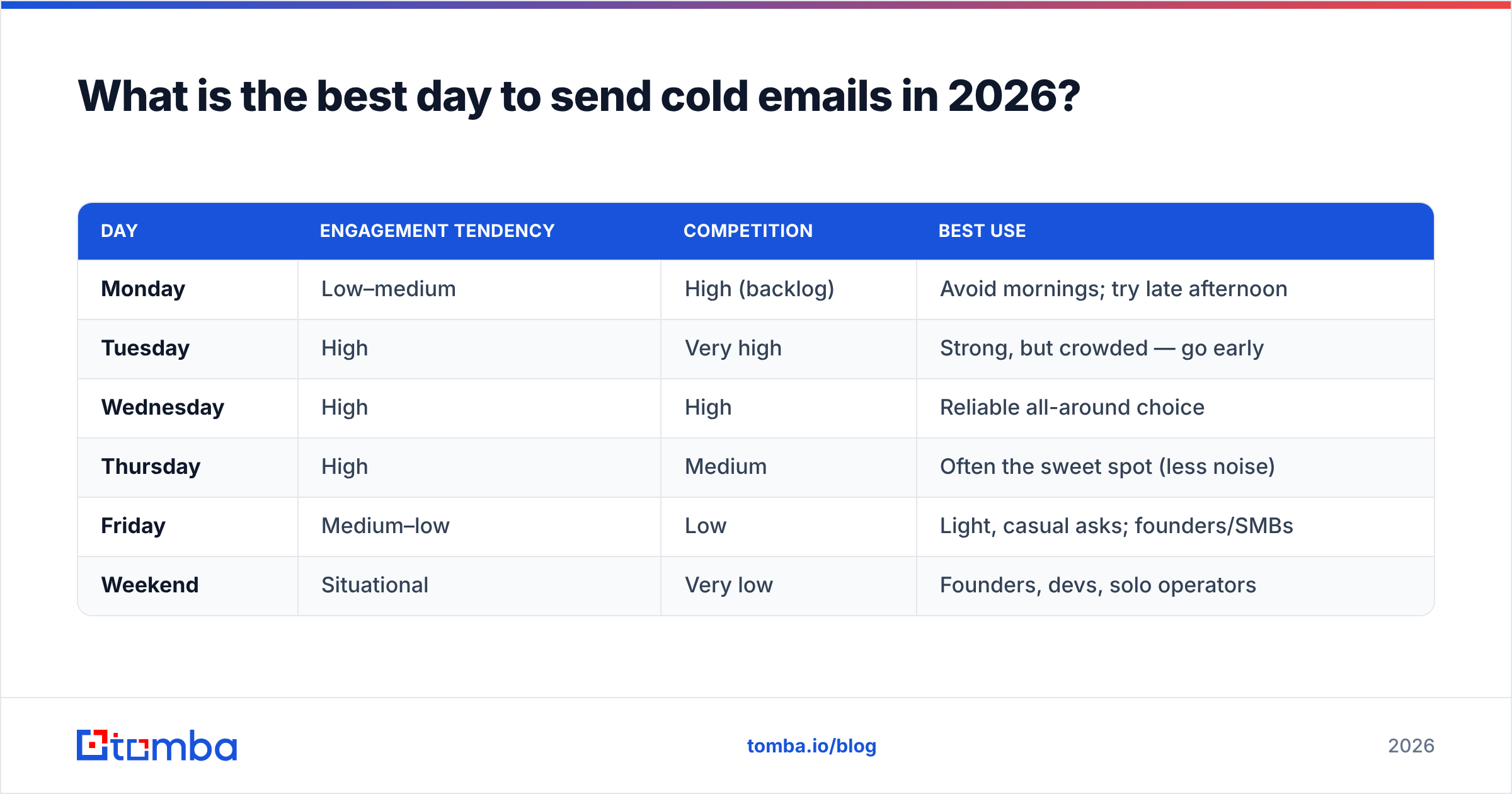
The midweek consensus has held up across years of outreach data: Tuesday through Thursday is the core window. Industry analyses from teams like HubSpot consistently show midweek mornings drawing the highest engagement, while Mondays are buried under weekend backlog and Fridays lose the back half of the day to mental check-out.
That said, "best day" depends on how crowded the day is. The most popular days are also the most competitive. If everyone sends Tuesday at 10 AM, a Thursday 8 AM send can outperform simply by facing less noise. Treat the table below as a starting hypothesis, not gospel.
| Day | Engagement tendency | Competition | Best use |
|---|---|---|---|
| Monday | Low–medium | High (backlog) | Avoid mornings; try late afternoon |
| Tuesday | High | Very high | Strong, but crowded — go early |
| Wednesday | High | High | Reliable all-around choice |
| Thursday | High | Medium | Often the sweet spot (less noise) |
| Friday | Medium–low | Low | Light, casual asks; founders/SMBs |
| Weekend | Situational | Very low | Founders, devs, solo operators |
Weekends deserve a note. For enterprise buyers, Saturday is dead. But for founders, indie developers, and owner-operators who never fully log off, a Sunday-evening or Saturday-morning email can stand out precisely because the inbox is quiet. This is exactly why audience beats benchmark.
What is the best time of day to send cold emails?#
Two windows win the majority of B2B tests, both anchored to the recipient's local time:
- 8:00–10:00 AM — Prospects triage their inbox before meetings swallow the day. Land here and you're in the first read.
- 1:00–3:00 PM — The post-lunch reset. Morning fires are out, focus returns, and people clear their inbox before afternoon calls.
The hours to generally avoid: very early (looks automated), the noon lunch dip, and the post-5 PM slide where your email gets buried by morning. None of these are absolute — a 7 AM send can crush it for an audience of early-rising operations leaders.
Here's the trap almost everyone falls into: scheduling tools default to your clock. If you're in New York sending at 9 AM, your San Francisco prospects get it at 6 AM and your London prospects got it at 2 PM. "9 AM" is meaningless across a multi-region list. Which brings us to the single highest-leverage timing tactic.
Why does timezone batching beat a fixed send time?#
Because "the best hour" only exists relative to where your prospect is sitting. A single blast at one absolute time scatters your message across every local hour on your list. Timezone batching means segmenting contacts by region and scheduling each segment to hit its own local 9 AM — so everyone lands in their morning window.
To batch by timezone, you need to know where each contact actually is. That's a data problem before it's a scheduling problem. Enriched contact records — company location, role, region — let you bucket a list cleanly. If your data is a pile of bare email addresses with no location, you can't batch, and you're back to guessing. Tools that handle data enrichment turn a flat list into something you can segment by geography and seniority.
A practical batching workflow:
- Enrich each contact with company location and role.
- Bucket into 3–5 timezone groups (e.g., Americas-East, Americas-West, EMEA, APAC).
- Schedule each bucket to its own local 9 AM and 2 PM.
- Cap volume per bucket per day so each segment warms gradually.
- Measure reply rate per bucket — your windows will differ by region.
Does send time even matter if your deliverability is broken?#
No — and this is the honest part most timing articles skip. The perfect send time is worthless if your email lands in spam. Sequence matters: fix the foundation first, optimize timing second.
Before you obsess over 9:14 AM versus 9:47 AM, confirm the basics:
- Authentication is set up — SPF, DKIM, and DMARC records published and passing. Check your SPF record and DKIM alignment before any campaign.
- Your domain is warmed — a brand-new domain sending 500 cold emails on day one gets throttled regardless of timing.
- Your list is verified — bouncing into dead mailboxes spikes your bounce rate and tanks email deliverability fast. Run the list through an email verifier first.
- Volume ramps gradually — sudden spikes look like spam behavior to mailbox providers.
A clean, verified list does more for reply rates than any timing tweak. If 20% of your sends bounce, no send hour saves the campaign — and the bounces themselves degrade your sender reputation for the contacts who were valid.
How do the timing factors stack up against each other?#
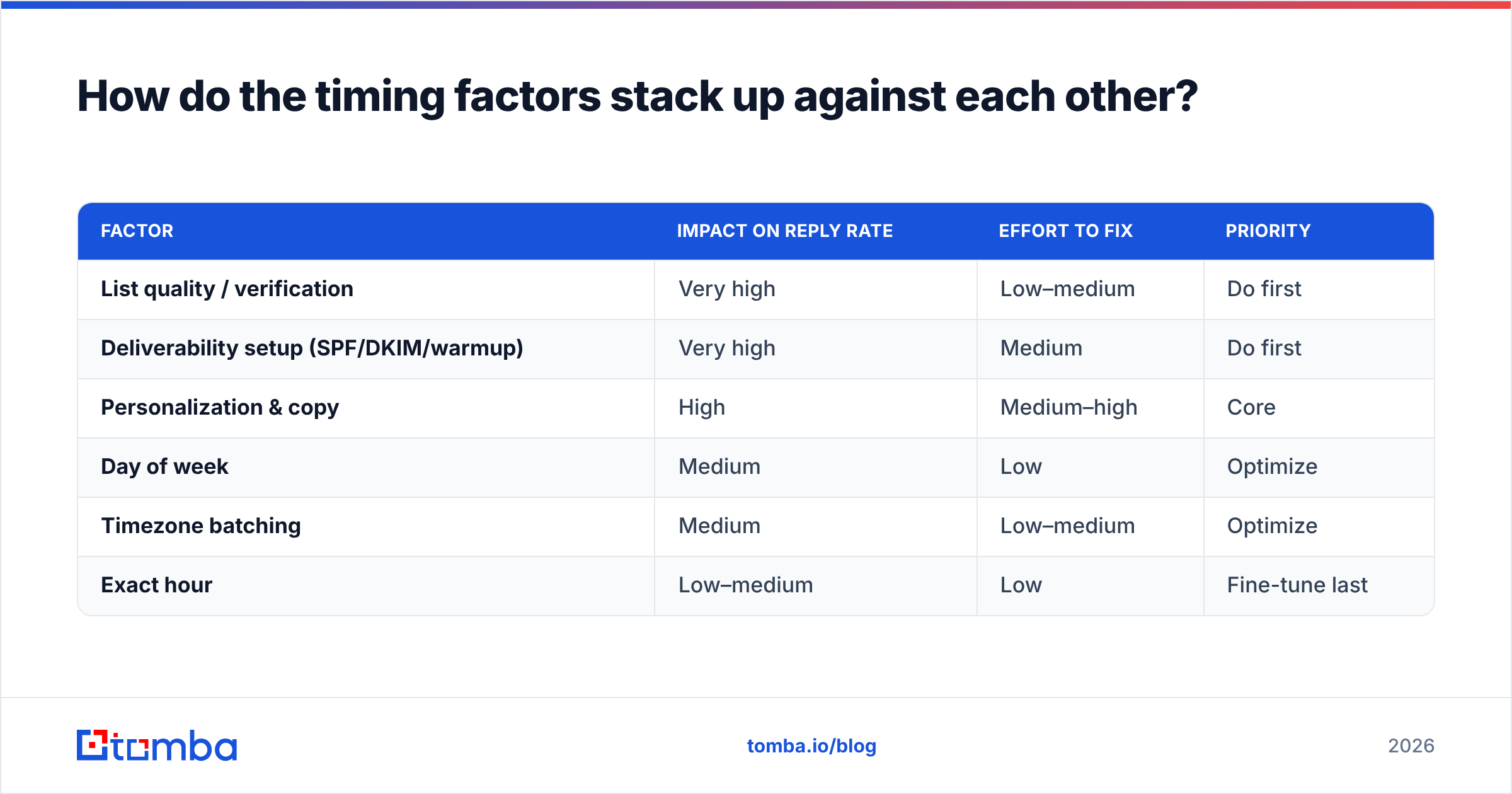
It helps to see relative impact. The table below ranks the levers by how much they typically move cold-email reply rates, based on what consistently shows up in outreach testing and vendor benchmarks on review sites like G2.
| Factor | Impact on reply rate | Effort to fix | Priority |
|---|---|---|---|
| List quality / verification | Very high | Low–medium | Do first |
| Deliverability setup (SPF/DKIM/warmup) | Very high | Medium | Do first |
| Personalization & copy | High | Medium–high | Core |
| Day of week | Medium | Low | Optimize |
| Timezone batching | Medium | Low–medium | Optimize |
| Exact hour | Low–medium | Low | Fine-tune last |
Read this top-down. The exact hour — the thing people Google most — is the last lever to pull, not the first. It's the difference between a good campaign and a slightly better one, not between silence and replies.
How do you find your own best time to send cold emails?#
Benchmarks get you to a starting hypothesis. Testing gets you to the truth for your specific audience. A founder list, a hospital-procurement list, and a developer-tool list have three completely different "best times," and no blog knows yours.
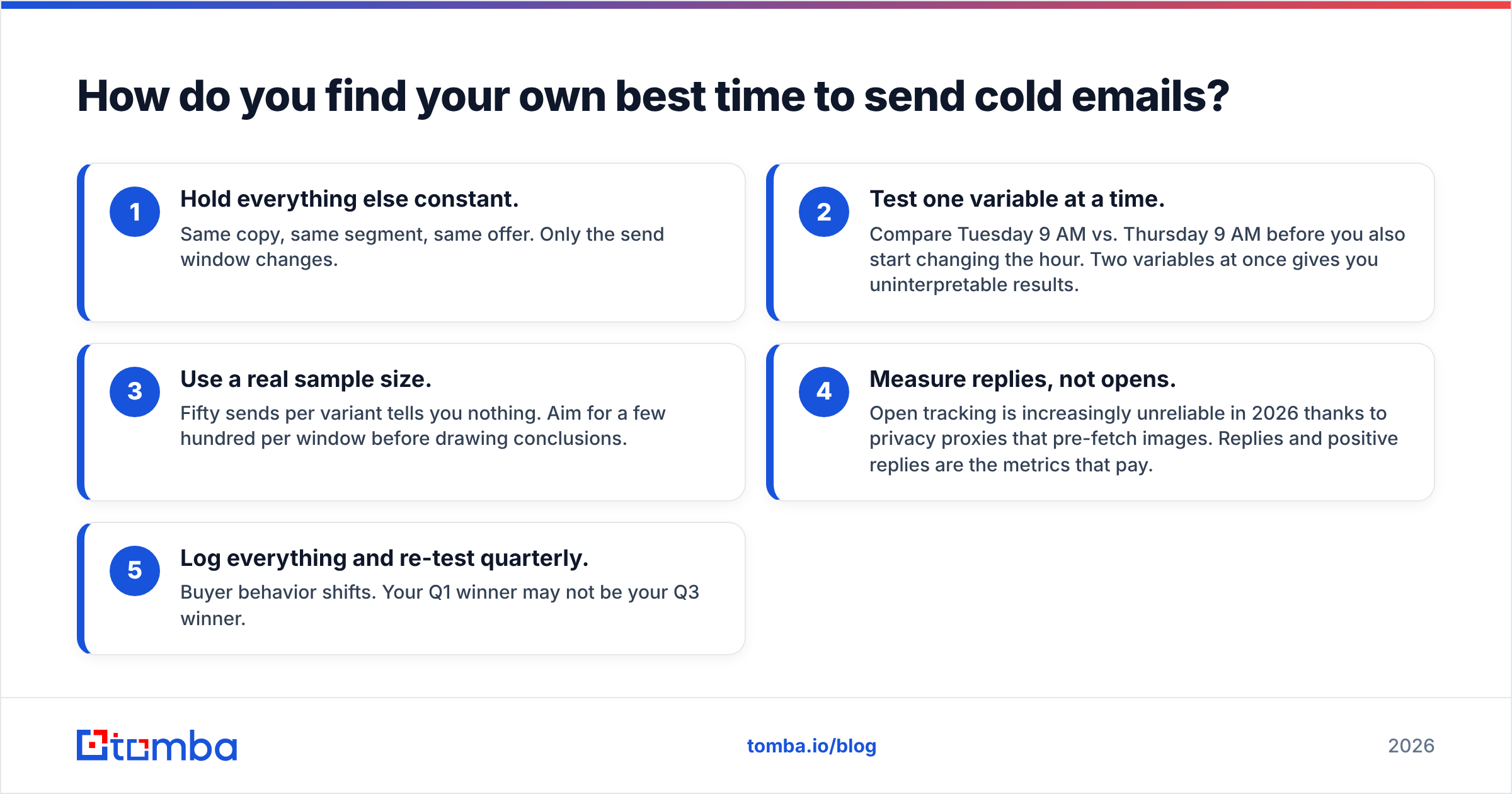
Run a structured test instead of guessing:
- Hold everything else constant. Same copy, same segment, same offer. Only the send window changes.
- Test one variable at a time. Compare Tuesday 9 AM vs. Thursday 9 AM before you also start changing the hour. Two variables at once gives you uninterpretable results.
- Use a real sample size. Fifty sends per variant tells you nothing. Aim for a few hundred per window before drawing conclusions.
- Measure replies, not opens. Open tracking is increasingly unreliable in 2026 thanks to privacy proxies that pre-fetch images. Replies and positive replies are the metrics that pay.
- Log everything and re-test quarterly. Buyer behavior shifts. Your Q1 winner may not be your Q3 winner.
This is also where good tooling compounds. If your sequencing tool can schedule per-timezone batches and your data source can supply clean, enriched, location-tagged contacts, you can run these tests without manual list surgery every week. Cleaner inputs mean your test results reflect timing, not the noise of a dirty list.
For the copy side of those tests, starting from proven structures saves cycles — our cold email templates give you a controlled baseline so the only thing you're changing is the send window.
What about send-time across regions and roles?#
Two adjustments refine the benchmarks further:
By region. Business-hours norms differ. Many European inboxes peak earlier; APAC working hours wrap before some US teams have logged on. Always convert to local time — when in doubt, the list of UTC time offsets is a quick reference for bucketing. Never send "your morning" to "their night."
By role. Executives often clear email before 8 AM and after 6 PM, around the meeting-heavy middle of the day. Individual contributors skew toward standard 9-to-5 windows. Operations and support roles may read steadily all day. If you've enriched your list with job titles, you can layer a role-based send window on top of the timezone bucket — a small refinement that adds up at scale.
A simple send-time playbook to start with today#
If you want a default to launch from while you gather your own data:
- Days: Tuesday, Wednesday, Thursday.
- Windows: 8–10 AM and 1–3 PM, recipient-local.
- Batching: segment by timezone, never send one absolute time to a global list.
- Foundation: verified list + authenticated, warmed domain before anything else.
- Cadence: consistent daily volume beats sporadic blasts.
- Iterate: test one variable, measure replies, re-test quarterly.
Lock the foundation, batch by timezone, start midweek-morning, then let your own reply data pull you toward the windows that actually convert your audience.
Where Tomba fits#
Timing only pays off when it's pointed at real people. Garbage-in, garbage-out applies harder to cold email than almost anywhere else — the wrong addresses don't just waste your perfect 9 AM send, they damage the domain reputation you need for the next one.
That's the gap Tomba's Email Finder closes. Find accurate, professional email addresses by name, company, or domain; verify them so your bounce rate stays low; and enrich each contact with the location and role data you need to batch by timezone in the first place. Plans start free with 25 searches a month, and paid tiers begin at $49/mo on the Starter plan — see full Tomba pricing for the Growth ($99/mo) and Pro ($249/mo) options if you're scaling volume.
Get the list right, warm the domain, batch by timezone, and then the best time to send cold emails starts working in your favor. Start with a clean, verified list — the rest is tuning.
// get started
Find, verify and enrich your first contacts today
Start on the free plan with 25 searches a month, then scale when your team is ready.
Free plan · No credit card required · GDPR & CCPA
// about the author