Best Time To Send Email in 2026: Data-Backed Send Windows
The best time to send email is less about a magic hour and more about timezone, audience, and deliverability. Here's what the 2026 data actually says.
Ask ten marketers for the best time to send email and you'll get ten different answers, half of them lifted from a 2015 infographic. The truth in 2026 is more useful and more boring: timing matters, but it matters relative to your recipient, not relative to some universal "10 a.m. Tuesday" rule everyone copied from each other.
This guide breaks down what the current data actually supports, how B2B and B2C timing diverge, why timezone beats clock-time, and how send timing interacts with deliverability so your perfectly-timed campaign doesn't land in spam anyway.
TL;DR — The Best Time To Send Email in 2026#
- Mid-morning on Tuesday, Wednesday, and Thursday remains the strongest general window — roughly 9–11 a.m. in the recipient's local timezone.
- B2B peaks on weekday mornings; B2C often performs better in the evening (6–9 p.m.) and on weekends.
- Timezone-aware sending beats clock-time sending. "10 a.m." means nothing if half your list wakes up five hours later than you.
- Deliverability comes first. A well-timed email that fails authentication or hits a spam trap never gets the chance to be "well-timed."
- Your own data wins. Benchmarks are a starting hypothesis; A/B test send times against your actual list and let the open and reply data decide.
What Does "Best Time To Send Email" Actually Mean?#
The phrase hides three different questions, and conflating them is why advice feels contradictory.
- Best day of the week — which weekday gets the highest open and reply rates.
- Best time of day — which hour window catches people when they're actually reading.
- Best send cadence — how the timing of one message relates to the next in a sequence.
Think of it like fishing. The day is choosing which day the fish are biting, the hour is casting when they're near the surface, and the cadence is how often you re-cast without scaring them off. Most "best time" articles only answer question one and pretend they've answered all three.
For cold outreach specifically, timing also has to respect email deliverability — sending a burst of messages at "the optimal hour" can spike your volume in a way that mailbox providers read as suspicious. Timing and reputation are not separate problems.
)
When Is the Best Time To Send Email for B2B?#
For business audiences, the pattern is stable across most 2026 industry reports: weekday mornings, mid-week. People triage their inbox when they sit down at their desk, and a message that arrives during that triage window gets read instead of buried.
The strongest B2B window is Tuesday through Thursday, 8 a.m. to 11 a.m. local time. Monday mornings are crowded with weekend backlog, and Friday afternoons are mentally checked out. The mid-week morning slot threads that needle.
A few B2B-specific nuances:
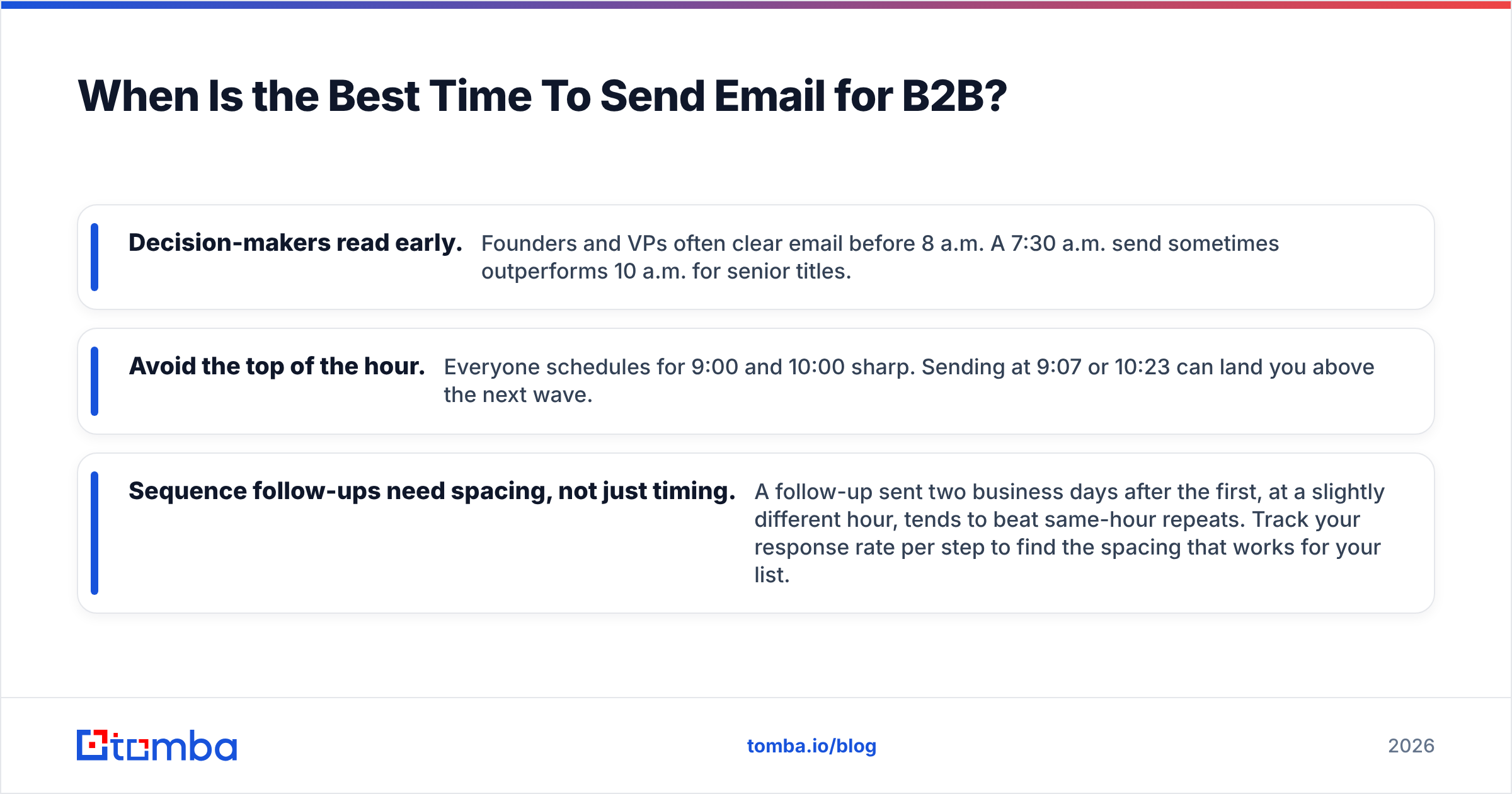
- Decision-makers read early. Founders and VPs often clear email before 8 a.m. A 7:30 a.m. send sometimes outperforms 10 a.m. for senior titles.
- Avoid the top of the hour. Everyone schedules for 9:00 and 10:00 sharp. Sending at 9:07 or 10:23 can land you above the next wave.
- Sequence follow-ups need spacing, not just timing. A follow-up sent two business days after the first, at a slightly different hour, tends to beat same-hour repeats. Track your response rate per step to find the spacing that works for your list.
When Is the Best Time To Send Email for B2C?#
Consumer behavior inverts much of the B2B advice. People check personal email on their own time — commuting, during lunch, and especially in the evening on the couch.
The strongest B2C windows tend to be:
- Early morning (6–8 a.m.) — the wake-up scroll.
- Lunch (12–1 p.m.) — the midday break.
- Evening (6–9 p.m.) — the highest-engagement window for many retail and lifestyle brands.
- Weekends — often outperform weekdays for B2C, the opposite of B2B.
The takeaway: if you're emailing consumers, test evenings and weekends aggressively. The "never send on a weekend" rule is a B2B rule that escaped into B2C advice where it doesn't belong.
Best Time To Send Email: Day and Hour Comparison#
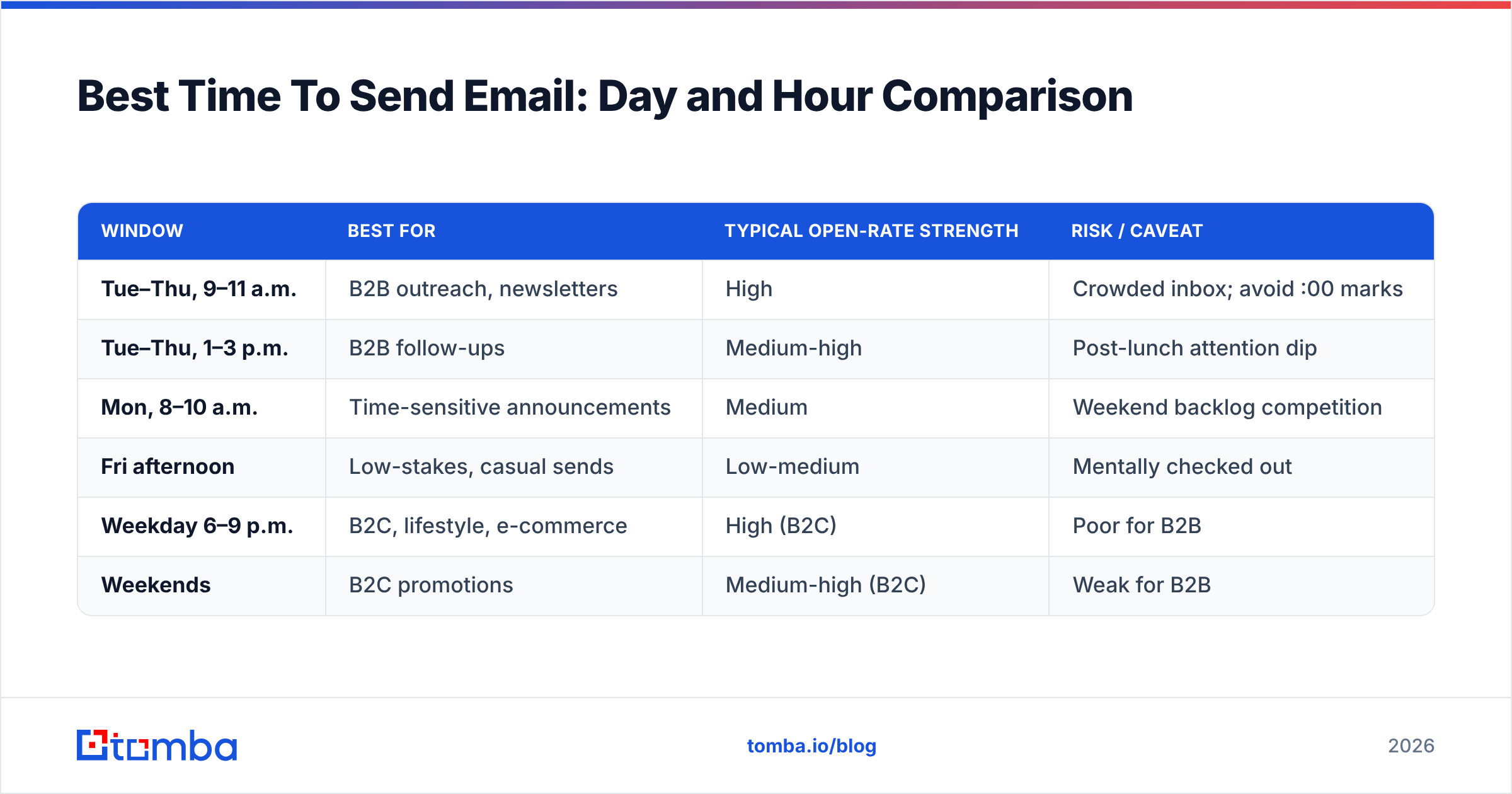
Here's a consolidated view of where the 2026 consensus lands. Treat these as starting hypotheses, not laws.
| Window | Best for | Typical open-rate strength | Risk / caveat |
|---|---|---|---|
| Tue–Thu, 9–11 a.m. | B2B outreach, newsletters | High | Crowded inbox; avoid :00 marks |
| Tue–Thu, 1–3 p.m. | B2B follow-ups | Medium-high | Post-lunch attention dip |
| Mon, 8–10 a.m. | Time-sensitive announcements | Medium | Weekend backlog competition |
| Fri afternoon | Low-stakes, casual sends | Low-medium | Mentally checked out |
| Weekday 6–9 p.m. | B2C, lifestyle, e-commerce | High (B2C) | Poor for B2B |
| Weekends | B2C promotions | Medium-high (B2C) | Weak for B2B |
Notice that no single cell is "the answer." The best time to send email is a function of who you're emailing, not a coordinate on the clock.
Why Does Timezone Matter More Than the Clock?#
Because "10 a.m." is a lie when your list spans five timezones. If you blast everyone at 10 a.m. your time, your West Coast leads get it at 7 a.m. and your European leads get it after lunch. You've optimized the hour for exactly one slice of your audience.
The fix is timezone-aware scheduling: send each contact at their local optimal window, not yours. Most modern sending platforms support this, and it routinely lifts open rates more than any day-of-week tweak.
To do timezone sending well, you need clean location data on each contact — which is a data-quality problem before it's a scheduling problem. Enriching your list with reliable company and location fields through contact enrichment lets you segment by timezone instead of guessing. Garbage location data produces garbage scheduling.
)
How Does Send Time Interact With Deliverability?#
This is the part most timing guides skip, and it's the part that quietly kills campaigns. The best-timed email in the world earns nothing if it lands in spam.
Three timing-adjacent deliverability factors:
- Volume spikes. Cramming your whole list into one "optimal" hour can look like a spam blast to mailbox providers. Spreading sends across a window — even a tight one — protects your sender reputation.
- List hygiene. Sending to dead addresses at any hour drives up bounces and tanks reputation. Run your list through an email verifier before a big send so you're not timing your way into a spam trap.
- Authentication. None of the timing advice matters if your SPF, DKIM, and DMARC aren't aligned. Industry guidance from sources like Google's Postmaster Tools is blunt about this: authenticate or expect filtering.
In other words, timing is the last 10% of optimization. The first 90% is sending verified addresses from an authenticated, warmed-up domain. Get the foundation right, then tune the hour.
What Do the Major Studies Actually Say in 2026?#
Aggregating the recurring findings from large-scale reports — the kind published by platforms reviewed on G2 and analyzed by marketing teams at companies like HubSpot — a few patterns hold up year after year:
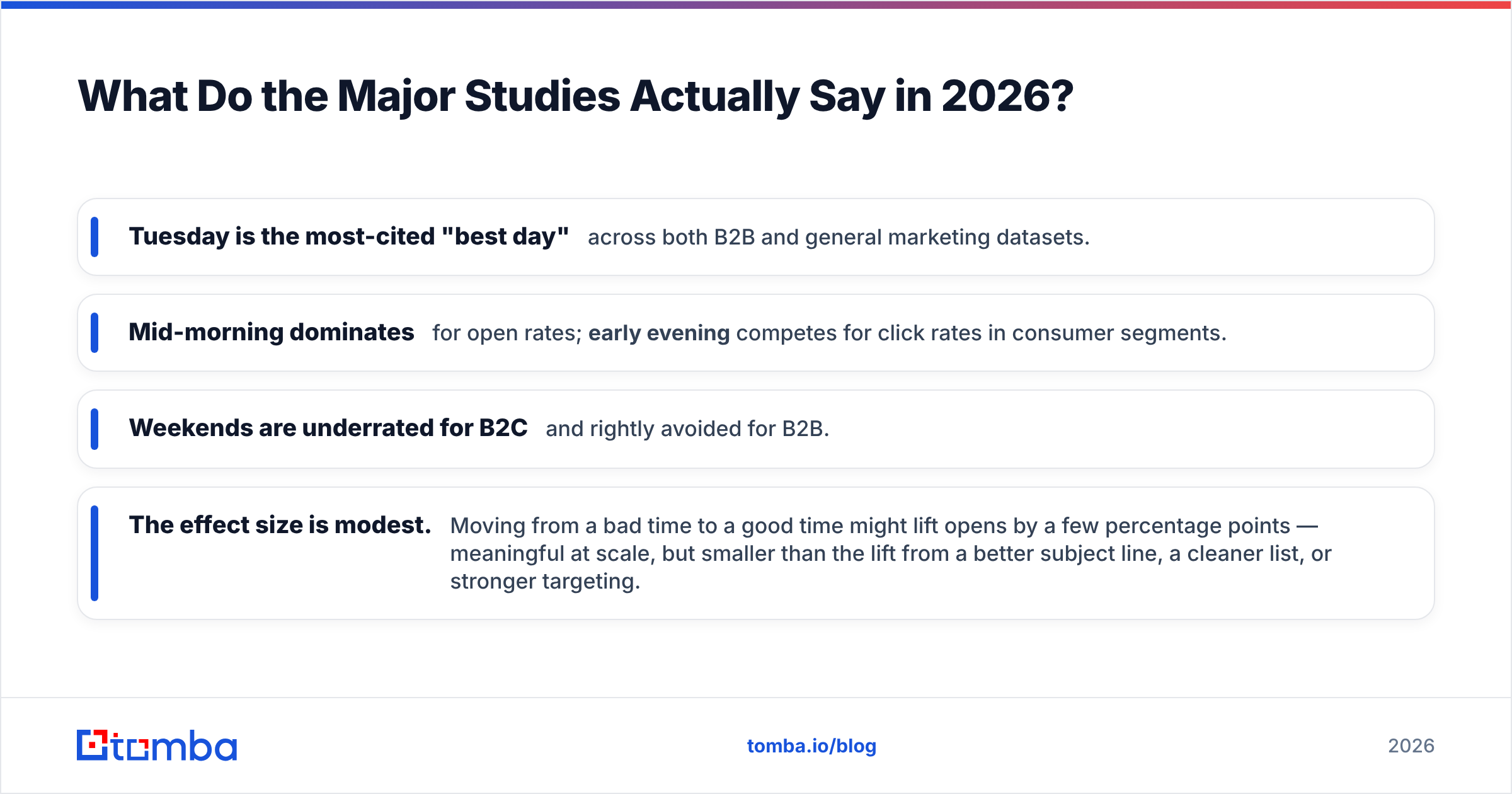
- Tuesday is the most-cited "best day" across both B2B and general marketing datasets.
- Mid-morning dominates for open rates; early evening competes for click rates in consumer segments.
- Weekends are underrated for B2C and rightly avoided for B2B.
- The effect size is modest. Moving from a bad time to a good time might lift opens by a few percentage points — meaningful at scale, but smaller than the lift from a better subject line, a cleaner list, or stronger targeting.
That last point is the one to internalize. Send timing is real, but it's a tiebreaker, not a silver bullet. If your opens are at 8%, the problem isn't the hour.
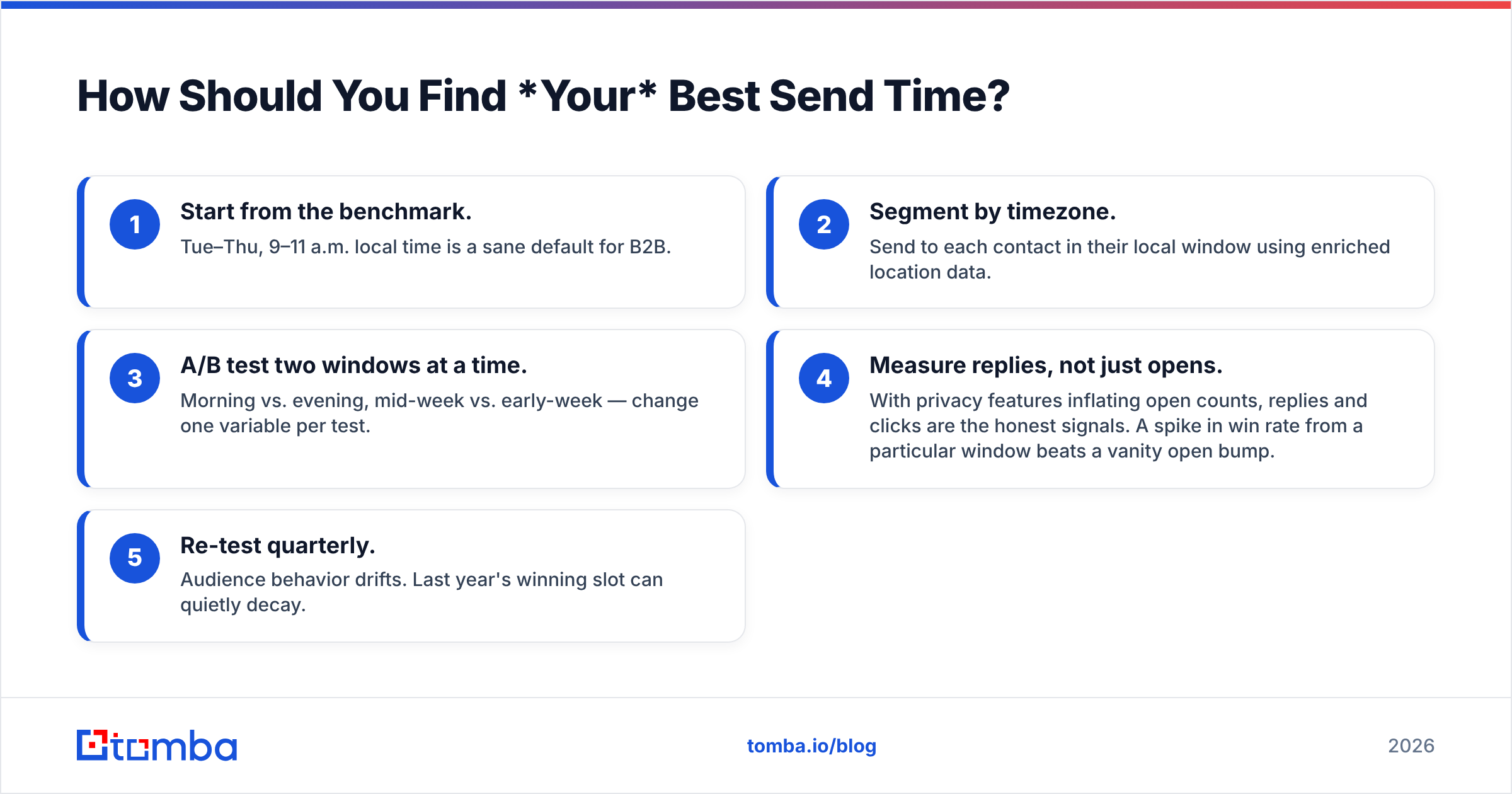
How Should You Find Your Best Send Time?#
Benchmarks get you a hypothesis. Your own data gets you the answer. Here's a practical loop:
- Start from the benchmark. Tue–Thu, 9–11 a.m. local time is a sane default for B2B.
- Segment by timezone. Send to each contact in their local window using enriched location data.
- A/B test two windows at a time. Morning vs. evening, mid-week vs. early-week — change one variable per test.
- Measure replies, not just opens. With privacy features inflating open counts, replies and clicks are the honest signals. A spike in win rate from a particular window beats a vanity open bump.
- Re-test quarterly. Audience behavior drifts. Last year's winning slot can quietly decay.
Run that loop for a few cycles and you'll have a send-time profile tuned to your specific list — which is worth more than any blog's universal recommendation, including this one.
Common Send-Time Mistakes To Avoid#
- Sending on the exact hour. :00 and :30 are the most crowded minutes. Offset by a few minutes.
- Ignoring timezones. The single biggest avoidable mistake on geographically spread lists.
- Optimizing timing on a dirty list. Verify and dedupe first, or you're timing bounces.
- Treating opens as truth. Apple Mail Privacy Protection and similar features inflate opens. Lean on replies and clicks.
- One-and-done testing. A single A/B test on one campaign isn't a pattern. Repeat before you commit.
- Forgetting cadence. In a sequence, when the next message lands relative to the last one matters as much as the absolute hour.
Frequently Asked Questions#
What is the single best time to send email in 2026? For B2B, Tuesday through Thursday between 9 and 11 a.m. in the recipient's local timezone is the strongest general default. For B2C, test early morning, lunch, and 6–9 p.m. evenings, including weekends.
Is it bad to send email on Mondays or Fridays? Not bad, just suboptimal for B2B. Monday mornings compete with weekend backlog and Friday afternoons catch people checked out. Mid-week mornings usually win.
Does send time matter more than subject line? No. Subject line, list quality, and targeting move the needle more than timing. Send time is a tiebreaker you tune after the fundamentals are solid.
How do I send at the recipient's local time? Enrich each contact with reliable location data, segment by timezone, and use a sending platform that supports per-recipient local scheduling.
Get the Foundation Right First#
The best time to send email only pays off when the email reaches a real person in a real inbox. That starts with accurate contacts. Use the Tomba Email Finder to build lists from verified professional addresses by name, company, or domain, then layer your timezone-aware send strategy on top. Check current Tomba pricing — there's a free tier with 25 searches a month to test it before committing. Nail the data, then nail the hour, and timing finally does what every infographic promised it would.
Ready to find emails that actually work?
Join 150,000+ professionals who stopped guessing and started sending. Free credits on signup — no credit card required.
Get the Tomba newsletter
Practical outbound tactics and product updates — once every two weeks.
About the author