Best Way to Follow Up on an Email: 2026 Templates & Timing
Most deals die in the follow-up, not the first email. Here's the exact cadence, timing, and templates that get replies in 2026 — plus how to make sure your messages actually land.
TL;DR
- The best way to follow up on an email is a planned sequence of 3–5 short messages, not one anxious "just checking in" note.
- Timing matters: wait 2–3 business days after the first send, then space follow-ups 3–5 days apart across 2–3 weeks.
- Every follow-up should add value (a resource, a new angle, a question) — never just repeat "did you see my last email?"
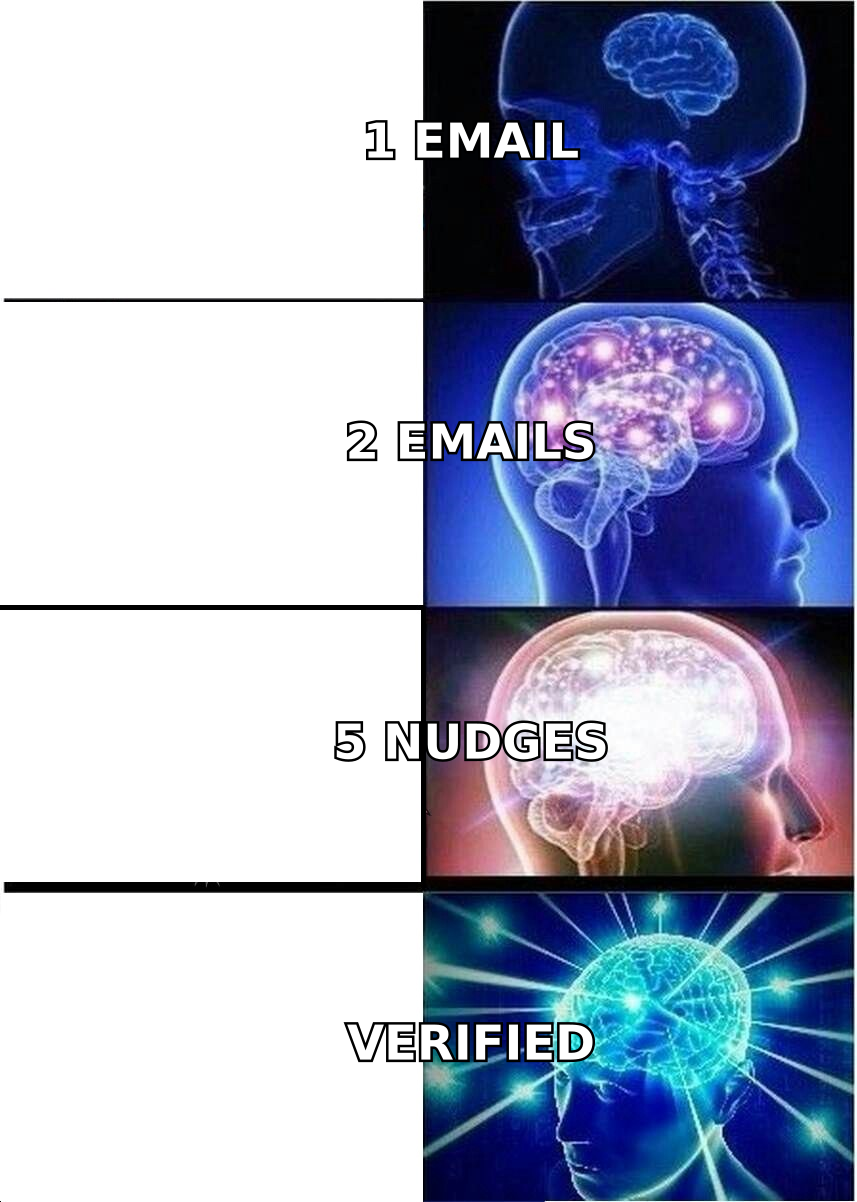
- Deliverability beats persistence. If your messages hit spam or bounce, cadence is irrelevant. Verify addresses first.
- Reply, bump, and break-up emails each have a job. Match the message to where the prospect is in the thread.
You closed the laptop feeling good about that first email. Then nothing. Silence for a week. Most people read that silence as a "no" and move on — which is exactly why they lose deals they could have won.
The truth is uncomfortable: roughly half of all replies come after the first message. The first email starts the conversation; the follow-up finishes it. This guide breaks down the best way to follow up on an email in 2026 — the timing, the cadence, the templates, and the one thing almost everyone forgets.
Why do follow-up emails matter so much?#
Because attention is rented, not owned. Your prospect saw your email between a calendar invite and a Slack ping, meant to reply, and forgot. That's not rejection — it's noise.
Think of a follow-up like a second knock on a door. The first knock might land while someone's in the shower. The second knock, a few minutes later, catches them in the hallway. You're not being pushy; you're being present at a better moment.
The data backs this up. Across most B2B outbound programs, sequences with 4–5 touches consistently outperform single sends, often doubling reply rates. According to HubSpot's sales research, a large share of salespeople give up after one or two attempts — while most conversions require five or more. The gap between those two numbers is where your pipeline hides.
What is the best follow-up cadence and timing?#
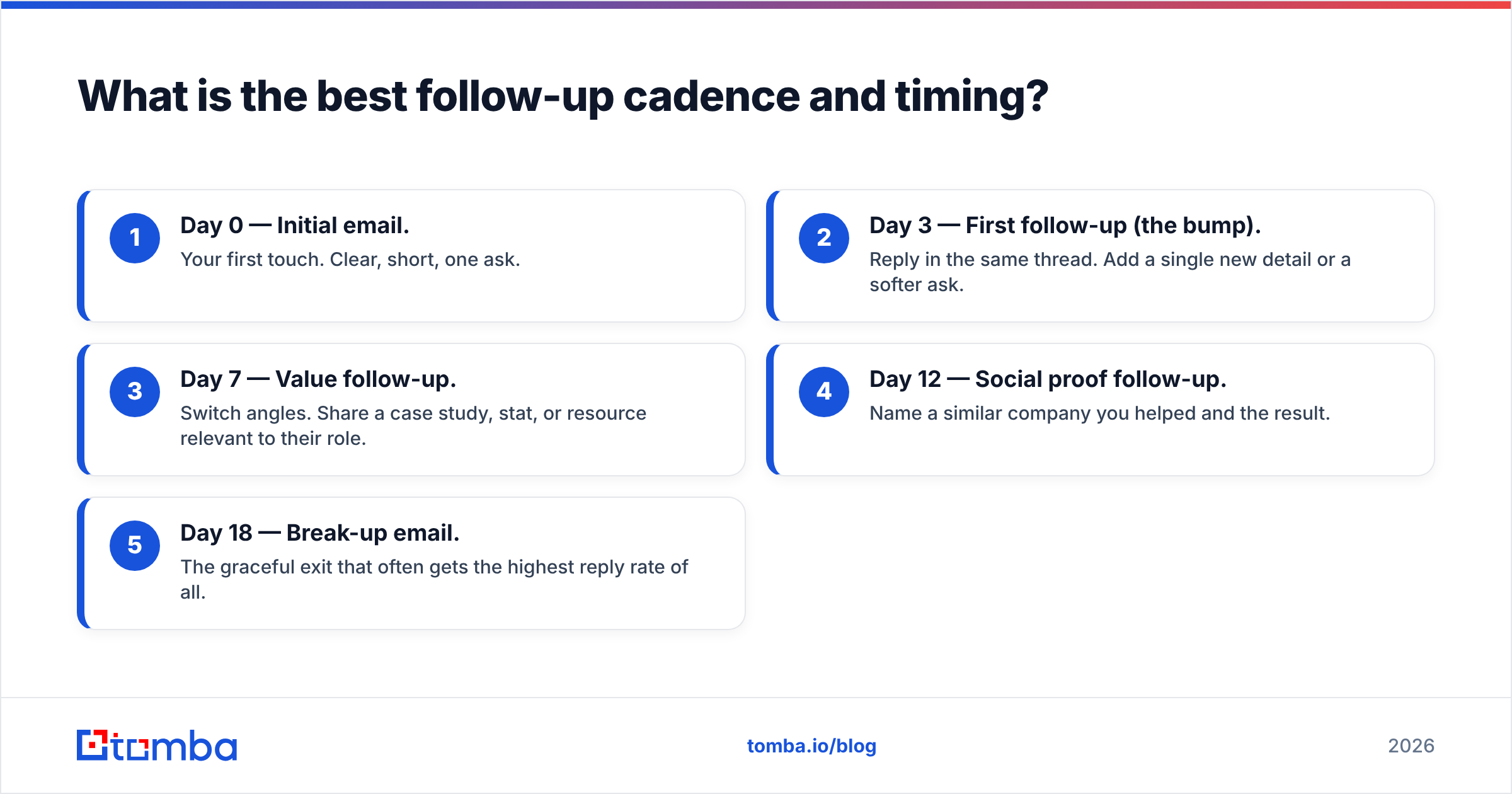
The best way to follow up on an email is a fixed cadence that escalates in spacing, not in desperation. Here is a cadence that works for cold and warm outreach alike:
- Day 0 — Initial email. Your first touch. Clear, short, one ask.
- Day 3 — First follow-up (the bump). Reply in the same thread. Add a single new detail or a softer ask.
- Day 7 — Value follow-up. Switch angles. Share a case study, stat, or resource relevant to their role.
- Day 12 — Social proof follow-up. Name a similar company you helped and the result.
- Day 18 — Break-up email. The graceful exit that often gets the highest reply rate of all.
A few timing rules that separate pros from spammers:
- Send Tuesday–Thursday, mid-morning in the prospect's timezone. Monday inboxes are buried; Friday afternoons are checked out.
- Wait at least 2 full business days between the first email and the first follow-up. Same-day "bumps" read as needy.
- Stretch the gaps as you go. Three days, then four, then five. Shrinking gaps feel like pressure; growing gaps feel like patience.
- Stop at 5 touches unless they've engaged. Beyond that you're harming your sender reputation more than your odds.
How long should you wait before following up?#
Two to three business days for the first follow-up; longer gaps after that. Waiting one day looks anxious. Waiting two weeks lets the thread go cold and forces you to re-explain context.
Here's a simple way to think about it: the warmer the lead, the faster you follow up. An inbound demo request deserves a same-day or next-day nudge. A cold prospect who's never heard of you deserves breathing room. Match your urgency to their awareness, not your quota.
Which follow-up email gets the best reply rate?#
The break-up email — the one where you politely close the loop — almost always punches above its weight. Loss aversion is real: people who ignored four emails suddenly reply to "I'll close your file" because the door is about to shut.
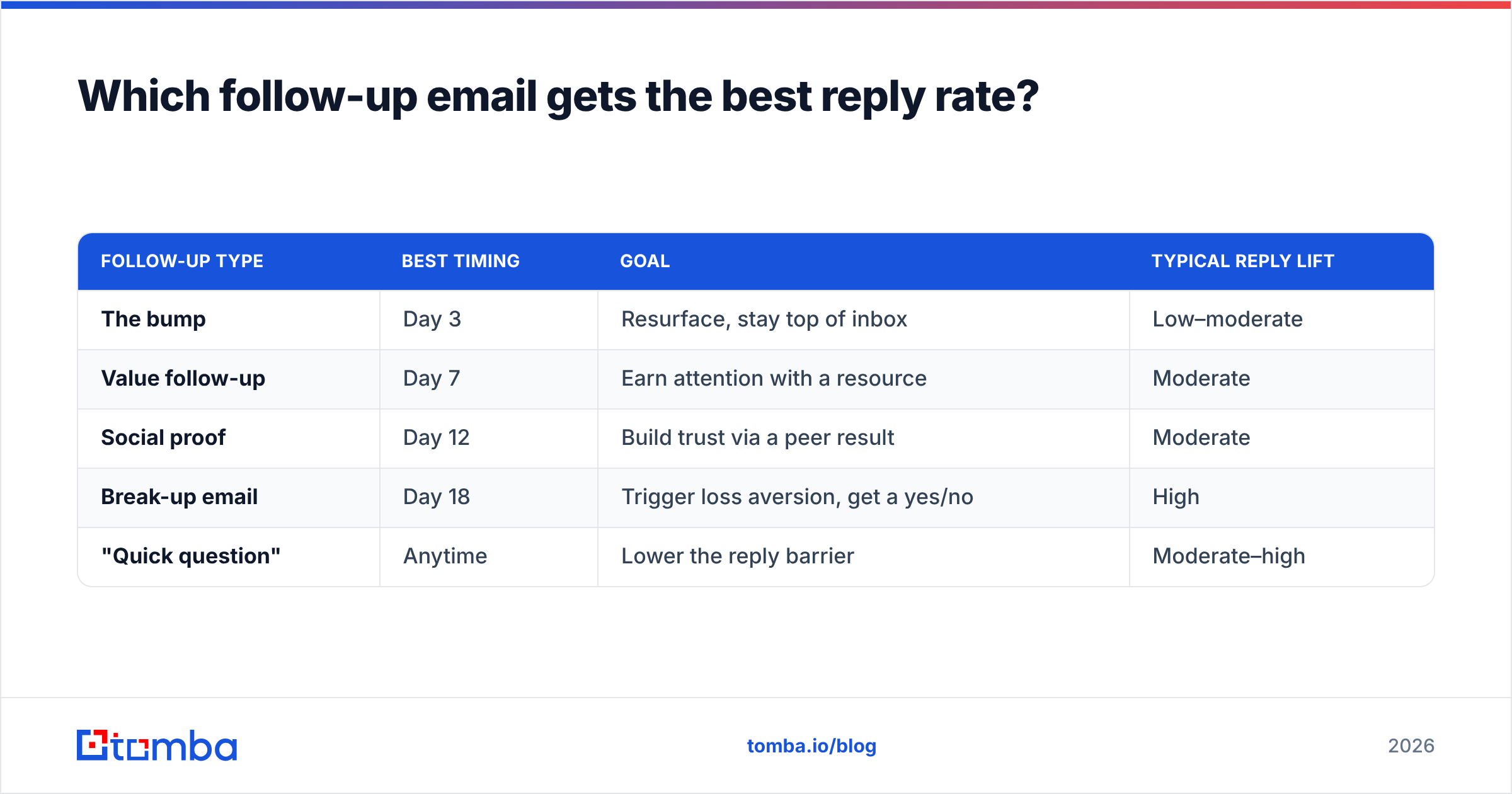
Here's how the main follow-up types compare:
| Follow-up type | Best timing | Goal | Typical reply lift |
|---|---|---|---|
| The bump | Day 3 | Resurface, stay top of inbox | Low–moderate |
| Value follow-up | Day 7 | Earn attention with a resource | Moderate |
| Social proof | Day 12 | Build trust via a peer result | Moderate |
| Break-up email | Day 18 | Trigger loss aversion, get a yes/no | High |
| "Quick question" | Anytime | Lower the reply barrier | Moderate–high |
Notice that no row says "just checking in." That phrase adds zero new information and trains the prospect to ignore you. Every follow-up needs a reason to exist beyond your own anxiety.
What should each follow-up email actually say?#
Short, specific, and easy to answer. If your follow-up takes more than 15 seconds to read, it's too long. Here are four templates you can adapt today.
1. The value bump (Day 7)
Subject: re: [original subject]
Hi [Name] — sharing this in case it's useful: [one-line resource or stat tied to their role]. We see [specific outcome] when [their type of team] tackles [their problem]. Worth a 15-minute look?
2. The social proof nudge (Day 12)
Subject: how [Competitor/Peer] handled [problem]
Hi [Name] — [Peer company] had the same [challenge] last quarter. After switching, they [specific result]. Happy to walk you through how it'd map to [their company]. Open to it?
3. The one-line question
Subject: quick one, [Name]
Is [problem] still a priority this quarter, or has it moved down the list? Either answer helps me know whether to keep this on your radar.
4. The break-up email (Day 18)
Subject: closing your file
Hi [Name] — I don't want to clutter your inbox, so I'll stop here. If [problem] becomes a priority later, just reply and I'll pick things back up. All the best.
You can pull more ready-to-send copy from Tomba's library of cold email templates, and tighten your hooks with the subject line generator before you hit send.
How do you make sure follow-ups don't hurt deliverability?#
This is the step everyone skips, and it quietly kills more campaigns than bad copy ever will. The best way to follow up on an email is worthless if the email never reaches the inbox.
Two things wreck deliverability during a follow-up sequence:
- Bouncing off dead addresses. Every hard bounce dings your sender reputation. Send five follow-ups to an invalid address and you've sent five strikes against yourself. Run your list through an email verifier before the sequence starts, not after it fails.
- Looking like a bot. Identical messages blasted at scale trip spam filters. Vary your wording, keep links minimal in early touches, and authenticate your domain.
Get your domain fundamentals right before you scale. Confirm your SPF record is published, warm up new sending domains, and monitor email deliverability like a vital sign. Google's own Postmaster Tools guidance spells out the spam-rate and authentication thresholds you need to stay under — read it once, set it up, and stop guessing why replies dried up.
A clean, verified list also means your cadence math actually works. If 20% of your addresses are dead, your "30% reply rate" is a fiction calculated against a phantom denominator.
Manual follow-ups vs automated sequences — which is better?#
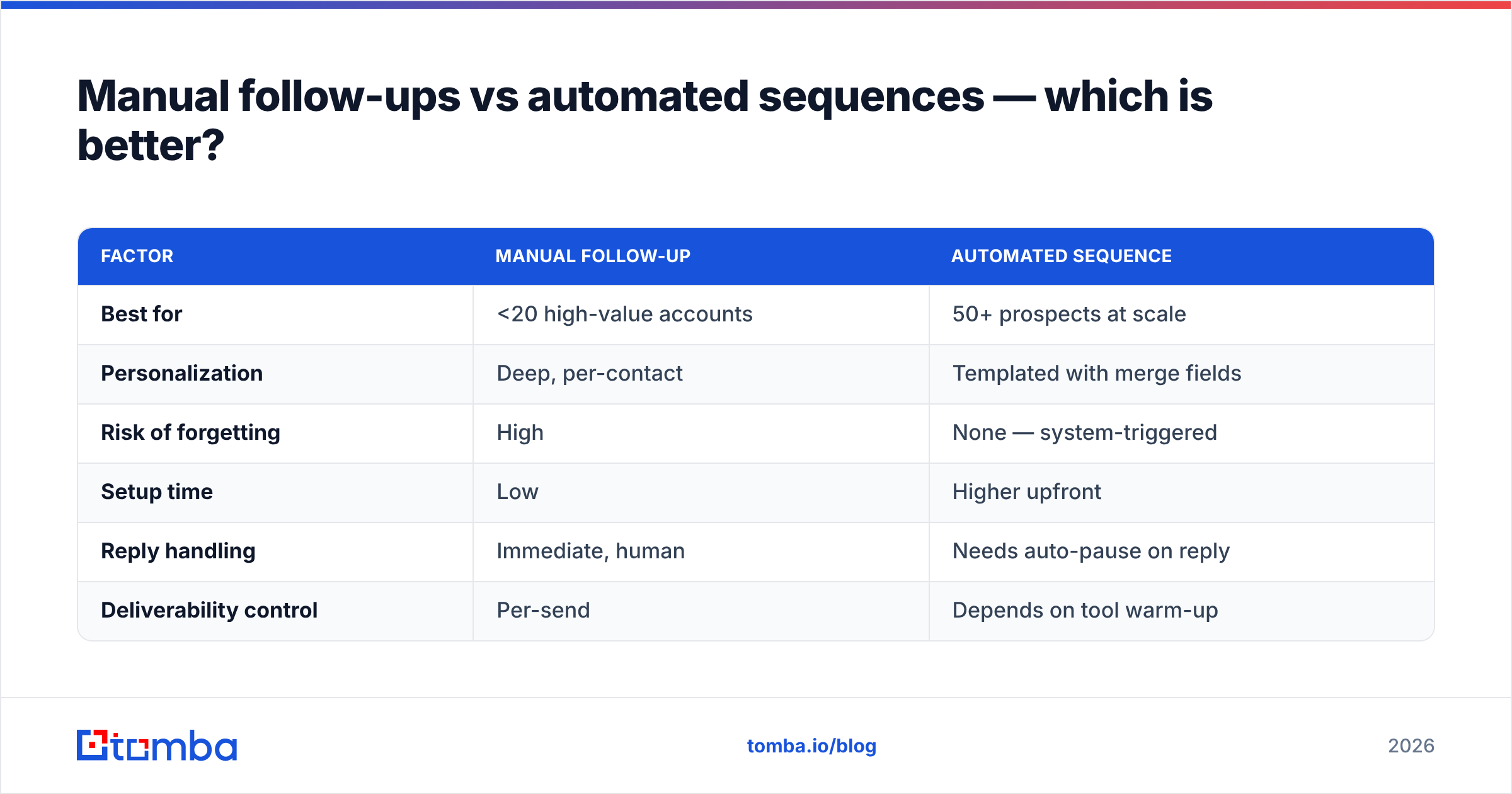
It depends on volume, but the honest answer is: automate the cadence, personalize the content. Here's the trade-off:
| Factor | Manual follow-up | Automated sequence |
|---|---|---|
| Best for | <20 high-value accounts | 50+ prospects at scale |
| Personalization | Deep, per-contact | Templated with merge fields |
| Risk of forgetting | High | None — system-triggered |
| Setup time | Low | Higher upfront |
| Reply handling | Immediate, human | Needs auto-pause on reply |
| Deliverability control | Per-send | Depends on tool warm-up |
For a named-account list of ten dream clients, follow up by hand and tailor every word. For a thousand-lead campaign, use a sequencing tool — but make sure it pauses the sequence the instant someone replies. Nothing burns trust faster than sending a "did you get my last email?" the day after a prospect already answered.
Whichever route you choose, the data underneath has to be right. You can build a clean prospect list quickly with the Tomba Email Finder, then enrich each contact with role and company context so your follow-ups reference the right priorities instead of generic filler.
What are the most common follow-up mistakes?#
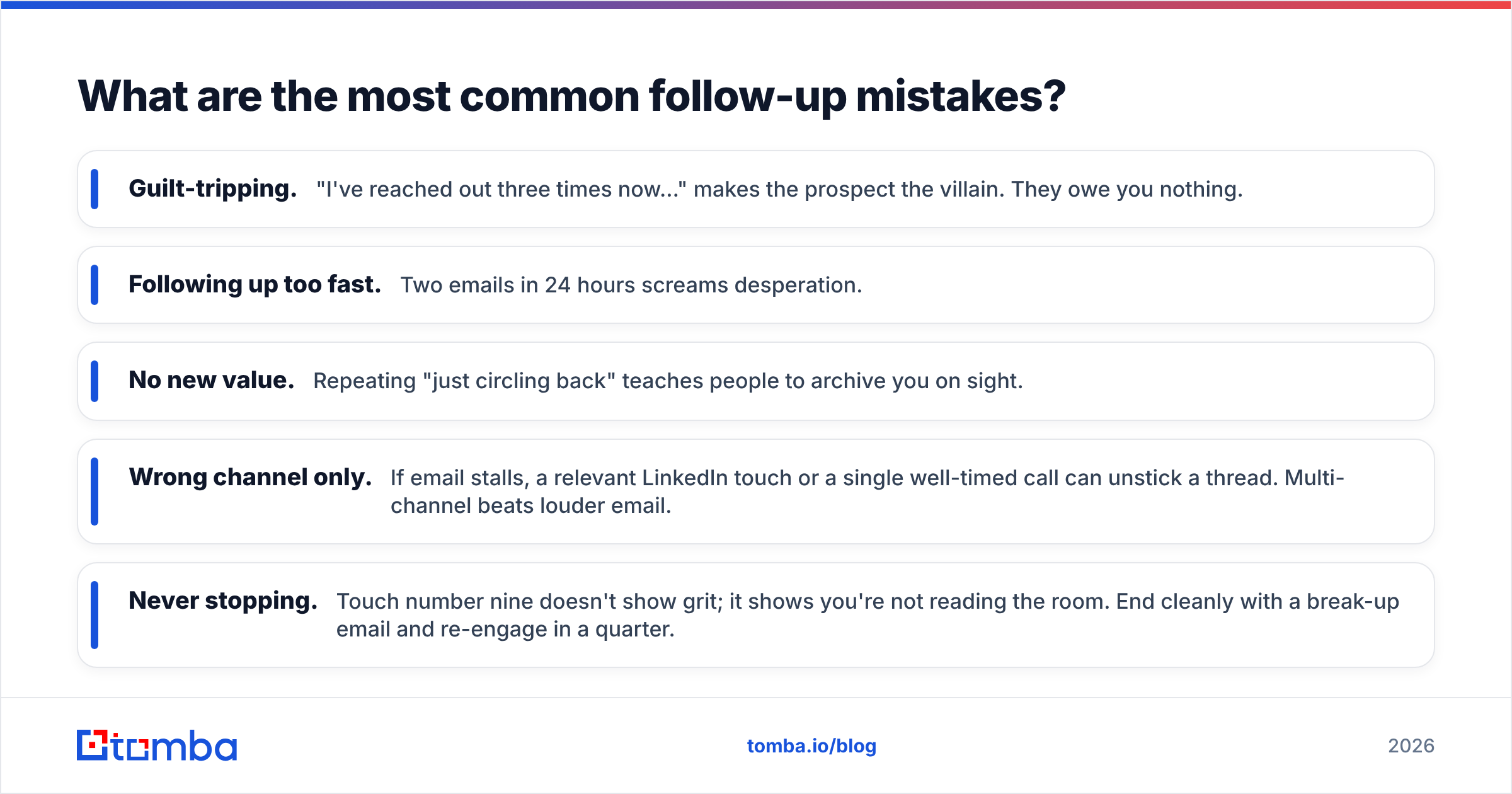
- Guilt-tripping. "I've reached out three times now…" makes the prospect the villain. They owe you nothing.
- Following up too fast. Two emails in 24 hours screams desperation.
- No new value. Repeating "just circling back" teaches people to archive you on sight.
- Wrong channel only. If email stalls, a relevant LinkedIn touch or a single well-timed call can unstick a thread. Multi-channel beats louder email.
- Never stopping. Touch number nine doesn't show grit; it shows you're not reading the room. End cleanly with a break-up email and re-engage in a quarter.
How many times should you follow up before giving up?#
Three to five follow-ups for most B2B outreach, then a graceful exit. The sweet spot balances persistence against reputation. Past five unanswered touches, your reply odds flatten while your spam risk climbs — a bad trade.
But "giving up" isn't permanent. A prospect who ghosts you in June might have budget in September. Move silent contacts to a nurture list, check back next quarter, and lead with something genuinely new. The best way to follow up on an email is sometimes to wait three months and start a better conversation.
Putting it all together#
The best way to follow up on an email in 2026 comes down to five moves: verify the address, plan a 3–5 touch cadence, space your sends 3–5 days apart, make every message earn its place with new value, and exit gracefully with a break-up email. Persistence without deliverability is noise; deliverability without persistence is a wasted first email. You need both.
Start at the source. Before you write a single follow-up, make sure the address is real and the contact is right — because the smoothest cadence in the world can't fix a bounced send. Use the Tomba Email Finder to build accurate, verified prospect lists from any domain or name, then layer your follow-up sequence on top of data you can trust. Free tier includes 25 searches a month, and paid plans start at $49/mo — check the full Tomba pricing to match a plan to your outreach volume. Find the right person, reach the real inbox, and let your follow-ups do what they were always meant to do: close the conversation you started.
// get started
Find, verify and enrich your first contacts today
Start on the free plan with 25 searches a month, then scale when your team is ready.
Free plan · No credit card required · GDPR & CCPA
Get the Tomba newsletter
Product and data updates
// about the author