Best Ways To Follow Up With Customers: Examples for 2026
The best ways to follow up with customers come down to timing, channel, and a reason to reply. Here are copy-paste examples, cadences, and the data behind what actually works in 2026.
Best Ways To Follow Up With Customers: Examples for 2026
Most deals and renewals are not lost on the first contact. They die in the silence after it. The difference between a closed-won account and a ghosted thread is almost never a better product pitch — it is a better follow-up.
This guide breaks down the best ways to follow up with customers, with concrete examples you can copy today, the cadences that pace them, and the timing data that decides whether your message gets read or buried.
TL;DR#
- Follow-ups win on timing and relevance, not persistence. Each message needs a fresh reason to exist — a resource, a question, or a trigger event — never just "checking in."
- A 5-to-7 touch cadence over 2-3 weeks beats both one-and-done and daily nagging. Space touches, vary the channel.
- Multichannel follow-up (email + phone + LinkedIn) lifts response rates well above email-only sequences.
- Examples below cover post-demo, post-purchase, renewal, re-engagement, and review requests — copy-paste and adapt.
- Clean contact data is the hidden variable. Bounced emails and dead numbers quietly kill cadences before the copy ever matters.
What makes a follow-up actually work?#
A good follow-up is a small gift, not a reminder of your needs. Think of it like a waiter checking on your table: the welcome version refills your water and disappears; the annoying version asks "everything okay?" four times while you chew. Both are "follow-ups." Only one gets a tip.
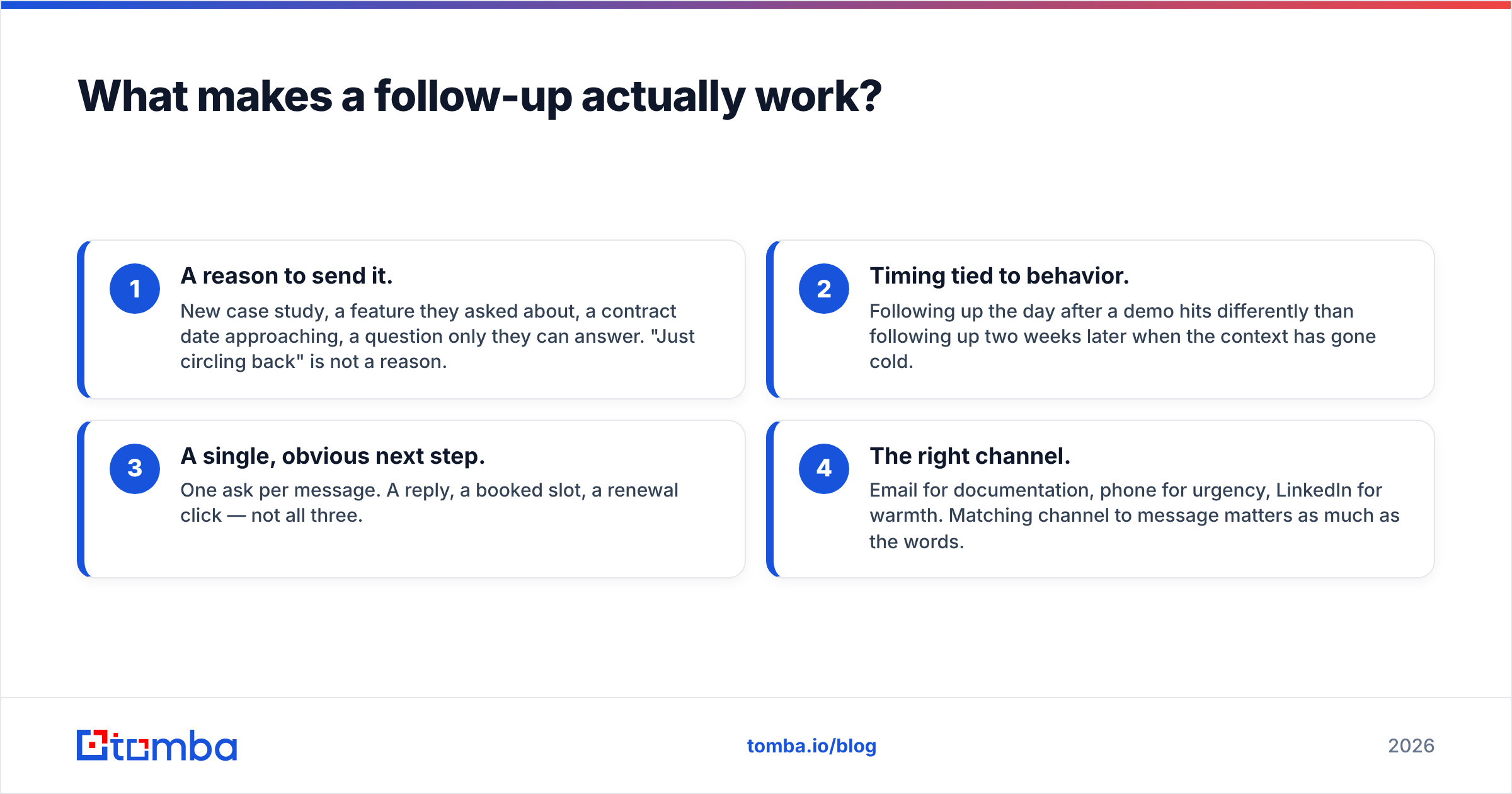
Three things separate the two:
- A reason to send it. New case study, a feature they asked about, a contract date approaching, a question only they can answer. "Just circling back" is not a reason.
- Timing tied to behavior. Following up the day after a demo hits differently than following up two weeks later when the context has gone cold.
- A single, obvious next step. One ask per message. A reply, a booked slot, a renewal click — not all three.
- The right channel. Email for documentation, phone for urgency, LinkedIn for warmth. Matching channel to message matters as much as the words.
Before any of this works, the message has to land in a real inbox. If you are following up with contacts pulled from an old list, run them through an email verifier first — a 12% bounce rate makes even perfect copy invisible.
)
What is the ideal follow-up cadence?#
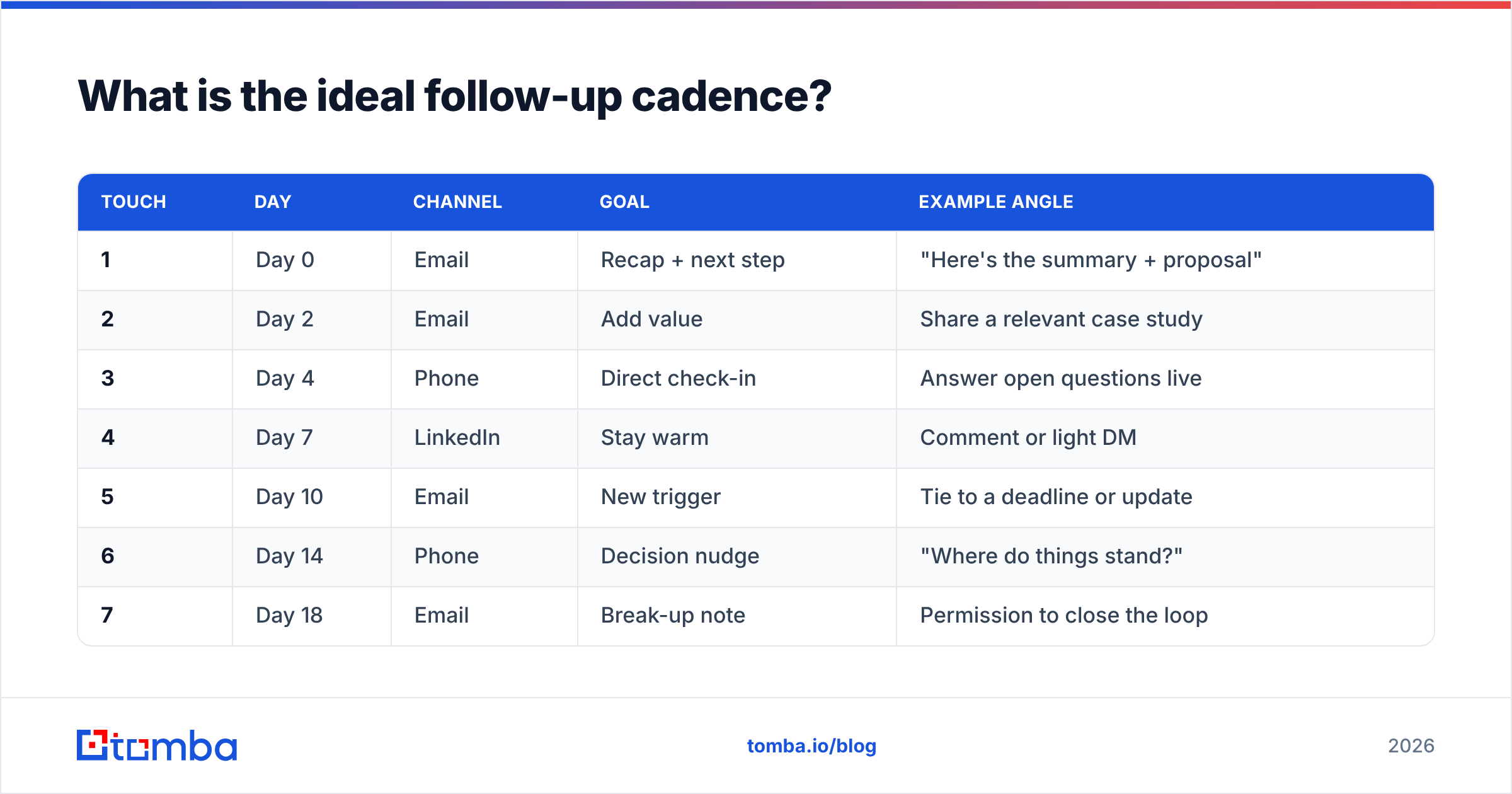
The best cadence is frequent enough to stay top of mind and spaced enough to avoid the spam reflex. For most B2B relationships, that means 5 to 7 touches across 2 to 3 weeks, mixing channels. Here is a battle-tested template you can adapt to renewals, post-demo, or re-engagement.
| Touch | Day | Channel | Goal | Example angle |
|---|---|---|---|---|
| 1 | Day 0 | Recap + next step | "Here's the summary + proposal" | |
| 2 | Day 2 | Add value | Share a relevant case study | |
| 3 | Day 4 | Phone | Direct check-in | Answer open questions live |
| 4 | Day 7 | Stay warm | Comment or light DM | |
| 5 | Day 10 | New trigger | Tie to a deadline or update | |
| 6 | Day 14 | Phone | Decision nudge | "Where do things stand?" |
| 7 | Day 18 | Break-up note | Permission to close the loop |
The "break-up" email at the end is the highest-converting message in many sequences — it triggers loss aversion and often surfaces the real answer. Pair this cadence with the right B2B phone numbers so the call touches are not dead ends.
What are the best follow-up examples by scenario?#
Templates below are deliberately short. Long follow-ups read as anxious. Keep them under 90 words and lead with the recipient, not yourself.
Post-demo follow-up#
Subject: The 2 things you flagged in our call
Hi {First name},
Thanks for the time today. You raised two concerns — onboarding speed and the Salesforce sync. I pulled a one-page answer for each (attached).
Worth a 15-minute call Thursday to map this to your Q3 rollout? Here's my calendar: {link}
{Your name}
Why it works: it proves you listened, removes friction with attachments, and offers one specific next step.
Post-purchase / onboarding#
Subject: Your first win with {Product}
Hi {First name},
You're set up. The fastest path to value for teams like yours is {specific action}. Want me to walk your team through it this week?
Reply with a day and I'll send an invite.
Why it works: it shifts the customer from "bought it" to "used it," which is where retention is actually won.
Renewal follow-up#
Subject: {Company}'s renewal — 30 days out
Hi {First name},
Your plan renews on {date}. Over the last year your team {specific outcome / usage stat}.
I'd love 20 minutes to review results and lock in next year's pricing before it changes. Does Tuesday work?
Why it works: it anchors on value delivered and gives a time-bound reason to act now.
Re-engagement (gone quiet)#
Subject: Should I close your file?
Hi {First name},
I haven't heard back, which usually means one of three things: timing's off, it's not a priority, or you're slammed.
A one-word reply tells me how to help — or whether to stop reaching out. No hard feelings either way.
Why it works: it is honest, low-pressure, and the "close your file" framing reliably restarts dead threads.
Review / referral request#
Subject: Quick favor (2 minutes)
Hi {First name},
You mentioned {specific result} last month — that made my week. Would you be open to a short G2 review? It helps other teams like yours decide.
Here's the direct link: {url}. Thank you either way.
Why it works: it references a real moment, sets a tiny time cost, and links straight to the action.
Which channel should you use?#
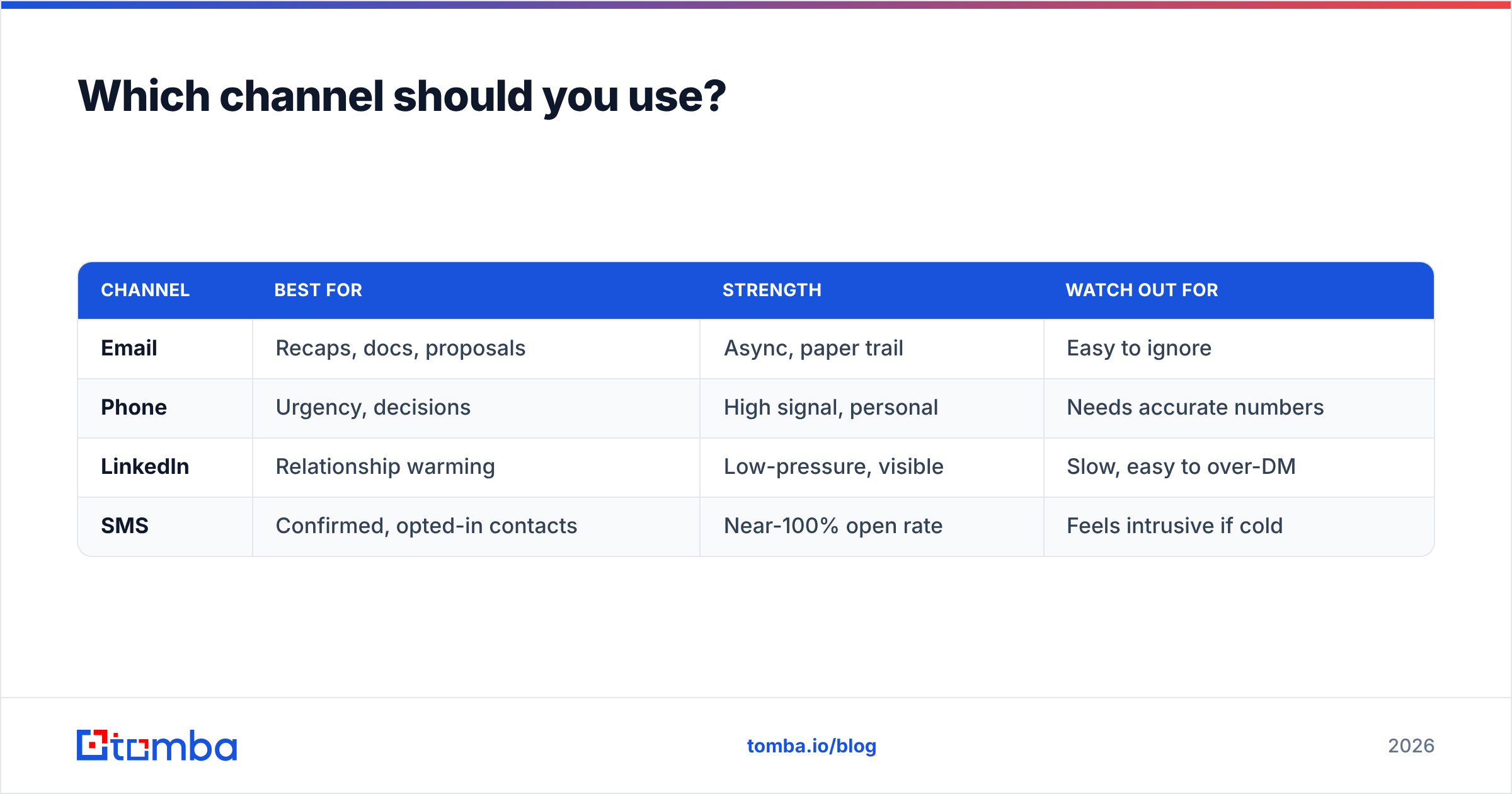
The honest answer: more than one. Email-only follow-up leaves the highest-intent prospects on the table because some people simply do not live in their inbox. According to research aggregated by sales platforms like HubSpot, multichannel sequences consistently outperform single-channel ones.
| Channel | Best for | Strength | Watch out for |
|---|---|---|---|
| Recaps, docs, proposals | Async, paper trail | Easy to ignore | |
| Phone | Urgency, decisions | High signal, personal | Needs accurate numbers |
| Relationship warming | Low-pressure, visible | Slow, easy to over-DM | |
| SMS | Confirmed, opted-in contacts | Near-100% open rate | Feels intrusive if cold |
The catch with phone and LinkedIn is data quality. A cadence that calls disconnected numbers or DMs the wrong profile burns goodwill fast. Use a LinkedIn finder to match the real decision-maker to a verified work email, then layer channels around a contact you trust.
)
How do you write follow-ups that don't sound desperate?#
Desperation leaks through three tells: apologizing for following up, asking the same thing again, and stacking multiple requests. Fix those and your messages read as confident, not needy.
- Cut the apology. "Sorry to bother you again" tells the reader they are right to ignore you. Lead with value instead.
- Change the angle every time. Touch 2 should not be a copy of touch 1. New resource, new question, new trigger — give them something fresh to react to.
- Make the ask binary. "Does Thursday at 2pm work, yes or no?" converts better than "let me know if you'd like to chat sometime."
- Match length to channel. A follow-up email is 60-90 words. A LinkedIn note is one or two sentences. A voicemail is 20 seconds.
- Personalize the first line, not the signature. Reference their words, their company, their trigger event — generic openers signal a blast.
If you are running these at scale, draft variants with a tool like the cold email AI writer, then tighten by hand. The AI handles the skeleton; you supply the specific detail that makes it land.
How do you scale follow-up without losing the personal touch?#
Scale and personalization fight each other only when your data is messy. The teams that follow up with hundreds of customers a week without sounding robotic share one habit: they invest in clean, enriched contact records first, then automate the cadence on top.
Here is the practical stack:
- Build the list with verified contacts. Use bulk email finder and verification so every record has a deliverable email before it enters a sequence.
- Enrich for personalization tokens. Pull role, company, and recent triggers via data enrichment so your merge fields say something specific.
- Sync to your CRM. Push clean records into HubSpot, Salesforce, or Pipedrive through native integrations so follow-ups fire on real lifecycle stages.
- Automate cadence, personalize content. Let the tool handle timing and channel switching; you write the human first line and the value in each touch.
This is where data quality quietly decides the outcome. A 2-3% bounce ceiling keeps your sender reputation intact across long cadences — and reputation is what lets touch 6 and 7 actually reach the inbox.
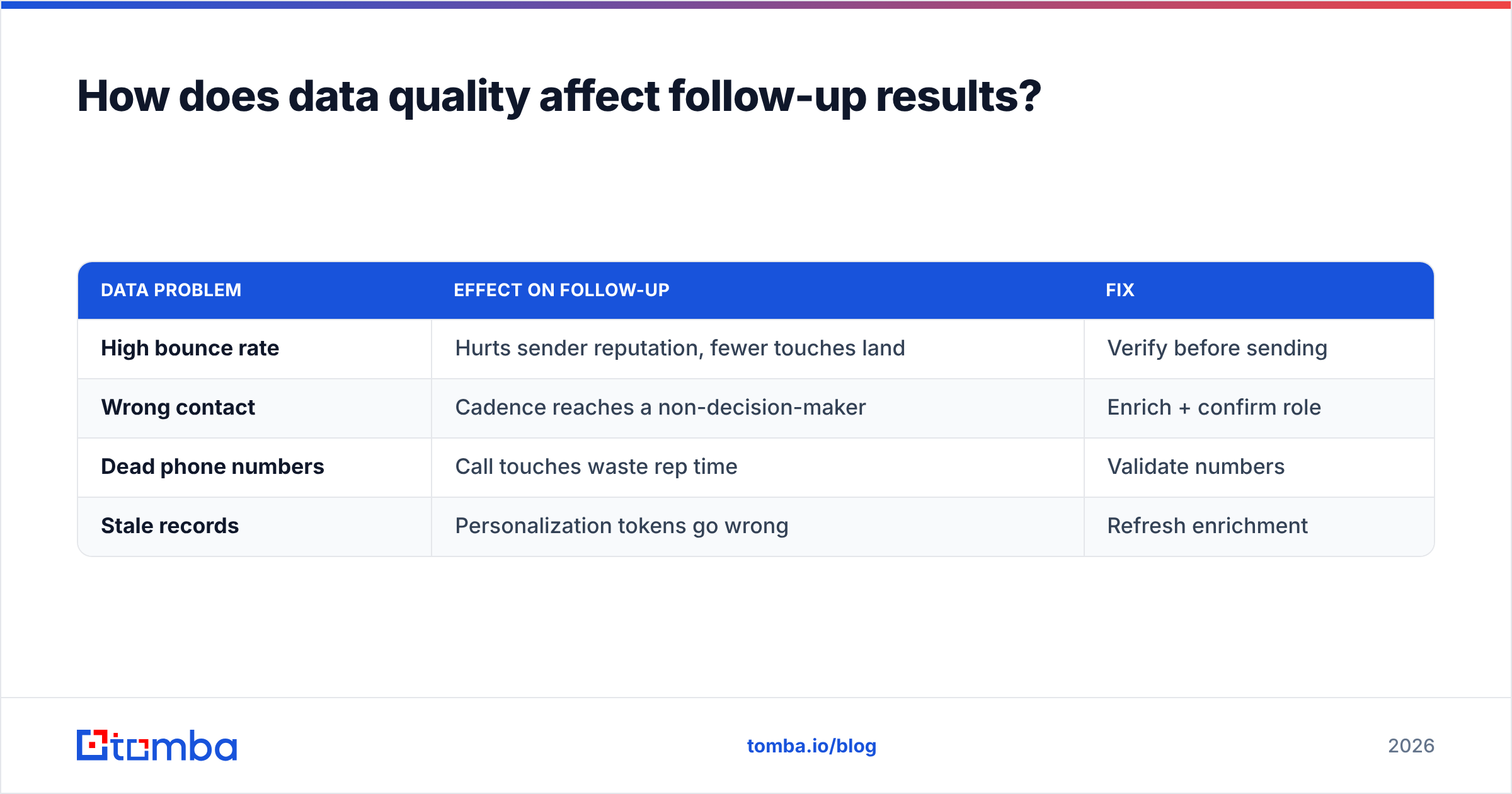
How does data quality affect follow-up results?#
A follow-up never sent is a follow-up that never works. The most common reason a cadence underperforms is not weak copy — it is that a chunk of the list was undeliverable from the start, dragging down open rates and triggering spam filters that bury the rest.
| Data problem | Effect on follow-up | Fix |
|---|---|---|
| High bounce rate | Hurts sender reputation, fewer touches land | Verify before sending |
| Wrong contact | Cadence reaches a non-decision-maker | Enrich + confirm role |
| Dead phone numbers | Call touches waste rep time | Validate numbers |
| Stale records | Personalization tokens go wrong | Refresh enrichment |
Tomba's contact data is built for exactly this — sourced and verified so your cadences run on records that actually resolve. You can read more on where Tomba gets data and how that translates into deliverability. Compared with cheaper list vendors, the difference shows up not in the first email but in touches three through seven, when reputation either holds or collapses.
For most teams, Tomba pricing starts at a free tier with 25 searches a month, then $49/mo for Starter — enough to clean and enrich a real follow-up list before you scale.
Putting it together: your follow-up checklist#
Before you launch a cadence, confirm:
- Every contact's email is verified and every phone number validated.
- Records are enriched with role and company for real personalization.
- The cadence spans 5-7 touches over 2-3 weeks, across at least two channels.
- Each message has one ask and a fresh reason to exist.
- The sequence ends with a break-up message to surface the real answer.
Nail those five, and you stop guessing why people go quiet — because most of them won't.
Start with contacts that actually reach the customer#
The best follow-up copy in the world fails against a bounced address or a wrong number. Build your cadence on a foundation of verified, enriched contacts and every other improvement compounds.
Start free with the Tomba Email Finder — find professional email addresses by domain, name, or company, verify them, and push clean records into your follow-up sequences. Twenty-five searches a month on the free tier is enough to feel the difference on your next round of follow-ups, and the Starter plan at $49/mo scales it across your whole pipeline.
// get started
Find, verify and enrich your first contacts today
Start on the free plan with 25 searches a month, then scale when your team is ready.
Free plan · No credit card required · GDPR & CCPA
// about the author