Bettermerge vs Cloduraai: Which B2B Sales Tool Wins in 2026?
Bettermerge and Clodura.ai promise faster B2B outreach, but they solve different problems. Here's an honest 2026 breakdown of features, pricing, accuracy, and where each one actually fits.
TL;DR
- Bettermerge is a mail-merge and email-sending layer — it helps you personalize and send outreach, but it does not build your contact list for you.
- Clodura.ai is a sales-intelligence and lead-generation platform — it builds lists, surfaces buying signals, and includes basic sequencing, but its contact data quality is uneven.
- They are not true head-to-head competitors: one moves messages, the other finds people. Most teams need a piece of both, plus a dedicated data source.
- For pricing, Clodura.ai sits in the mid-market range with credit-gated exports; Bettermerge is a cheaper, narrower sending tool.
- The cleanest stack: use a verified data provider like Tomba Email Finder for accurate contacts, then send through whichever delivery tool you prefer.
If you searched "bettermerge vs cloduraai," you are probably trying to decide which one anchors your outbound motion. The honest answer is that the comparison is a little lopsided, because these tools live at different stages of the same pipeline. This post breaks down what each does, where each breaks, the pricing reality, and how to assemble a stack that actually converts.
What is Bettermerge?#
Bettermerge is a mail-merge tool. Think of it like a smart envelope-stuffing machine: you hand it a list of contacts and a template, and it personalizes and sends each message at scale. It is built for the delivery half of outreach — merge tags, follow-up steps, basic tracking, and inbox sending.
What Bettermerge does well:
- Personalization at scale — merge fields pull first name, company, and custom columns into each email.
- Simple follow-ups — schedule a short sequence so non-responders get a nudge.
- Low cost of entry — sending tools are cheaper than full sales-intelligence suites.
- Spreadsheet-native workflow — you live in your list, upload it, and go.
What Bettermerge does not do: it does not find the contacts. You bring the list. If your spreadsheet is full of guessed addresses or stale data, Bettermerge will faithfully send to all of them — and your bounce rate will wreck your sender reputation. A sending tool is only as good as the data you feed it.

What is Clodura.ai?#
Clodura.ai is a sales-intelligence and prospecting platform. If Bettermerge is the envelope machine, Clodura is the phone book plus a research analyst: it claims a large B2B contact database, org charts, technographic and buying-signal data, plus a built-in email sequencer so you can prospect and send in one place.
Clodura's core pieces:
- Contact and company database — search by title, industry, geography, and tech stack.
- Buying signals and intent — alerts on hiring, funding, and trigger events.
- Direct dials and email addresses — exportable, credit-gated.
- Built-in sequencer — basic cadences without leaving the platform.
The catch is data quality. Like most aggregated B2B databases, Clodura's coverage is broad but inconsistent — verified at the moment of scraping, then left to decay. Reviews on G2 repeatedly mention outdated direct dials and emails that bounce. That is not unique to Clodura; it is the structural weakness of any "download a list" model. You can read more about why on Clodura's own site, which leans heavily on database size rather than freshness guarantees.
Bettermerge vs Cloduraai: how do they compare?#
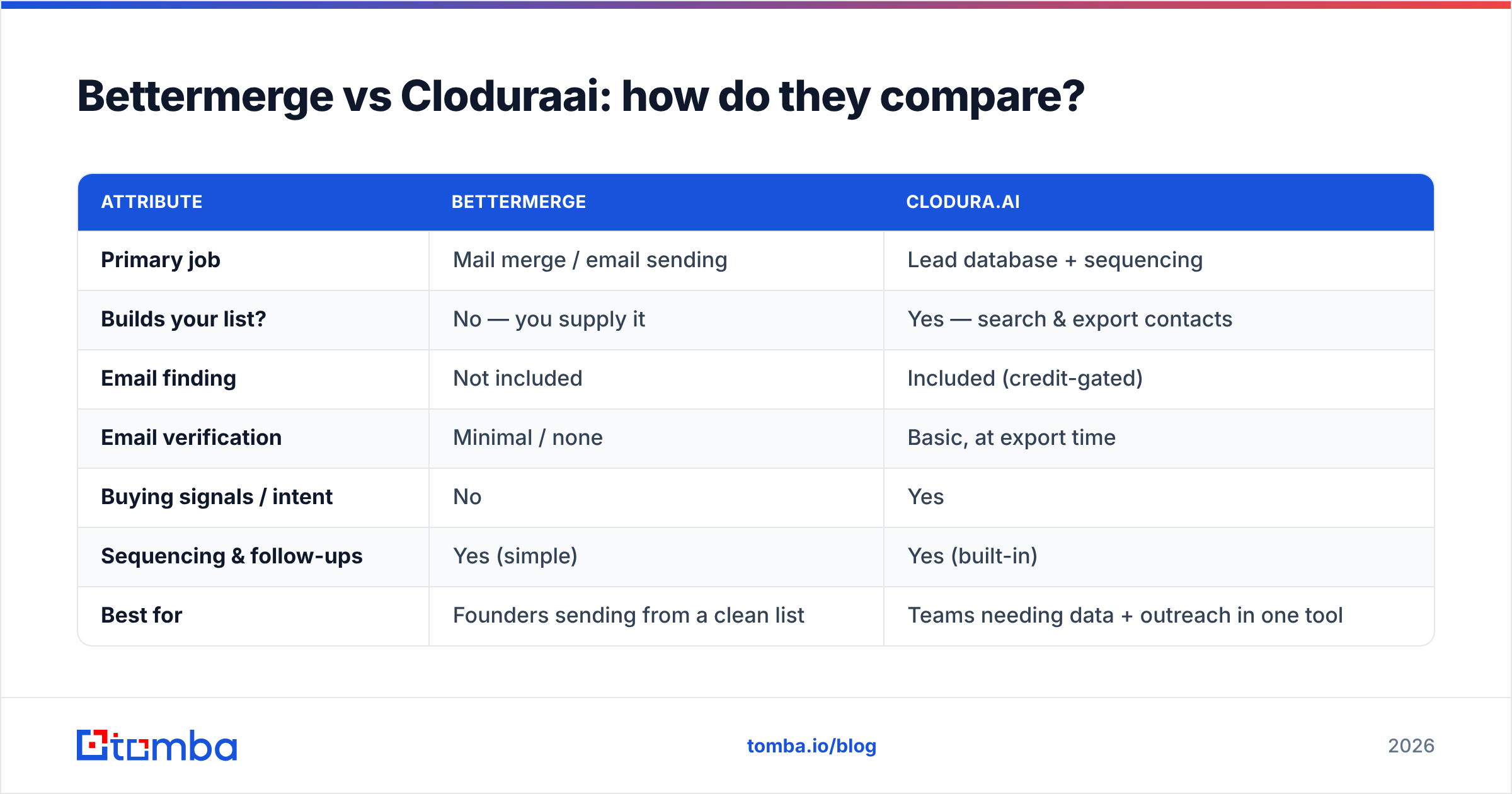
Here is the side-by-side. Remember that these tools overlap only partially — Clodura covers data plus sending, while Bettermerge is sending only.
| Attribute | Bettermerge | Clodura.ai |
|---|---|---|
| Primary job | Mail merge / email sending | Lead database + sequencing |
| Builds your list? | No — you supply it | Yes — search & export contacts |
| Email finding | Not included | Included (credit-gated) |
| Email verification | Minimal / none | Basic, at export time |
| Buying signals / intent | No | Yes |
| Sequencing & follow-ups | Yes (simple) | Yes (built-in) |
| Best for | Founders sending from a clean list | Teams needing data + outreach in one tool |
| Data freshness | N/A (depends on your source) | Decays between scrapes |
| Typical price band | Low (sending utility) | Mid-market (per-seat + credits) |
The takeaway: Bettermerge is a feature, Clodura is a platform. If you already have great data, Bettermerge is a cheap way to send it. If you have no list at all, Clodura gives you a starting point — but you will still want to verify before you send.
Which one is better for cold outreach?#
Conclusion first: neither one alone gives you a deliverable cold-email engine. The deciding factor is your data, not the sending UI.
Cold outreach lives or dies on three numbers:
- Bounce rate — anything over 3-4% signals mailbox providers that you are spraying. Both tools punish you here if the list is dirty.
- Reply rate — driven by targeting and personalization, where Clodura's signals help and Bettermerge's merge tags help.
- Inbox placement — driven by email deliverability fundamentals: warmed domain, SPF/DKIM/DMARC, and a clean list.
Clodura wins on targeting because of intent data. Bettermerge wins on cost if you bring your own list. But both depend on contact accuracy that neither fully guarantees. This is exactly the gap a dedicated finder-and-verifier fills.
Where does data accuracy actually come from?#
Accuracy comes from verification at the moment you use the contact — not from the size of a database that was scraped months ago. This is the single biggest blind spot in the Bettermerge-vs-Clodura debate.
A database export is a snapshot. People change jobs every few years, companies rebrand domains, and catch-all servers hide whether a mailbox even exists. By the time a Clodura list lands in Bettermerge, a meaningful slice is already wrong. That is why a verification-first workflow matters:
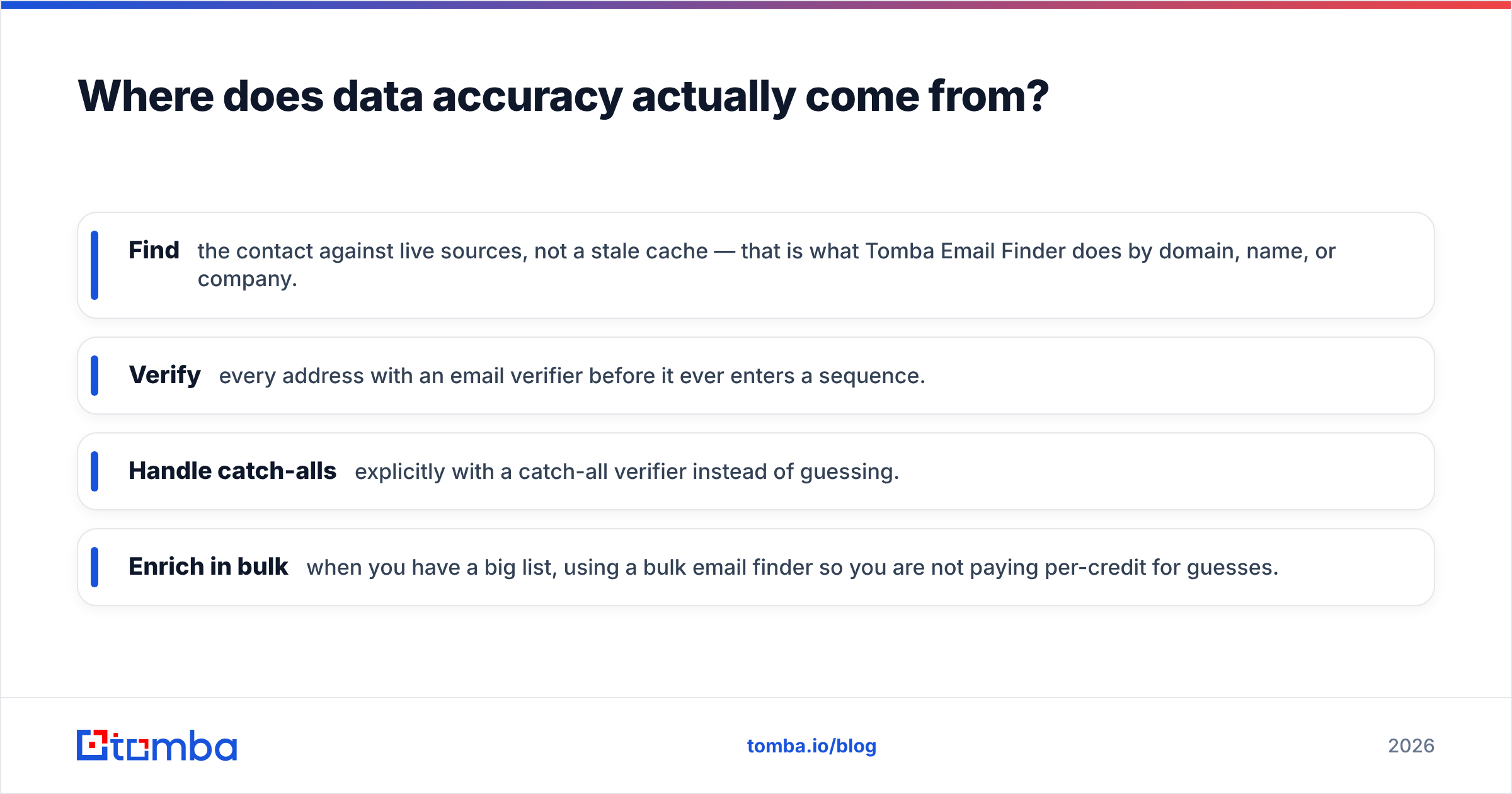
- Find the contact against live sources, not a stale cache — that is what Tomba Email Finder does by domain, name, or company.
- Verify every address with an email verifier before it ever enters a sequence.
- Handle catch-alls explicitly with a catch-all verifier instead of guessing.
- Enrich in bulk when you have a big list, using a bulk email finder so you are not paying per-credit for guesses.
You can see how Tomba sources and validates contacts on its data sources page. The point is not that Tomba replaces Bettermerge's sending or Clodura's signals — it is that the contact layer should be a specialist, not a side feature.
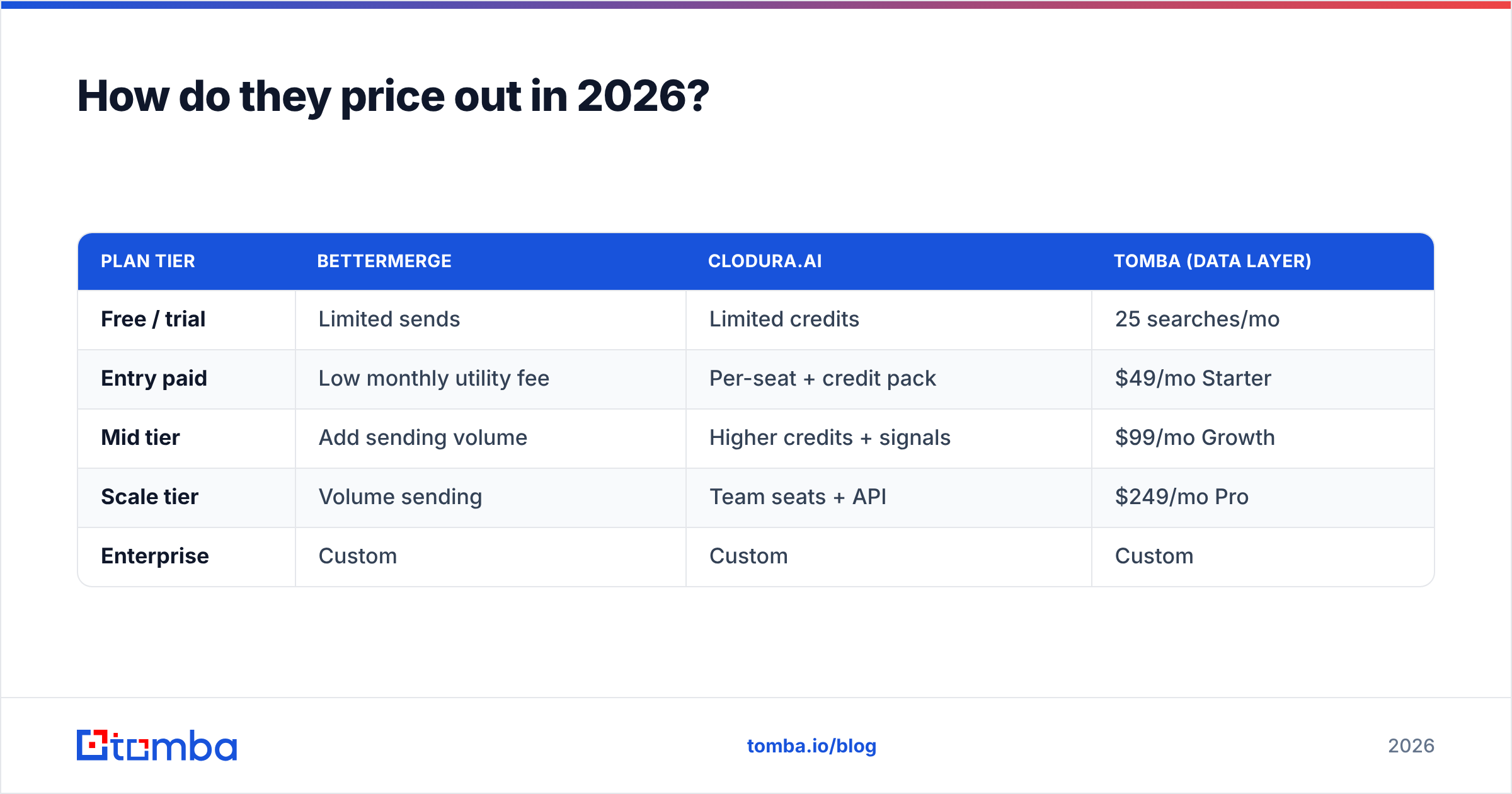
How do they price out in 2026?#
Pricing shapes which tool you can actually justify. Here is the structural picture (always check each vendor's current page, since tiers shift).
| Plan tier | Bettermerge | Clodura.ai | Tomba (data layer) |
|---|---|---|---|
| Free / trial | Limited sends | Limited credits | 25 searches/mo |
| Entry paid | Low monthly utility fee | Per-seat + credit pack | $49/mo Starter |
| Mid tier | Add sending volume | Higher credits + signals | $99/mo Growth |
| Scale tier | Volume sending | Team seats + API | $249/mo Pro |
| Enterprise | Custom | Custom | Custom |
A few honest notes:
- Bettermerge is the cheapest line item because it does the least — it sends. Budget for it as a utility, not a platform.
- Clodura.ai charges per seat and gates exports behind credits, so heavy prospecting teams hit credit ceilings fast and pay for re-exports of data that may already be decaying.
- Tomba sits alongside either tool. Full Tomba pricing starts free, then $49/mo Starter, $99/mo Growth, and $249/mo Pro — and because you only spend credits on verified results, you are not paying for bounces.
If you are weighing total cost, add the hidden tax of bad data: every bounced send costs you domain reputation, which costs you future deliverability across all your tools.
What stack should you actually build?#
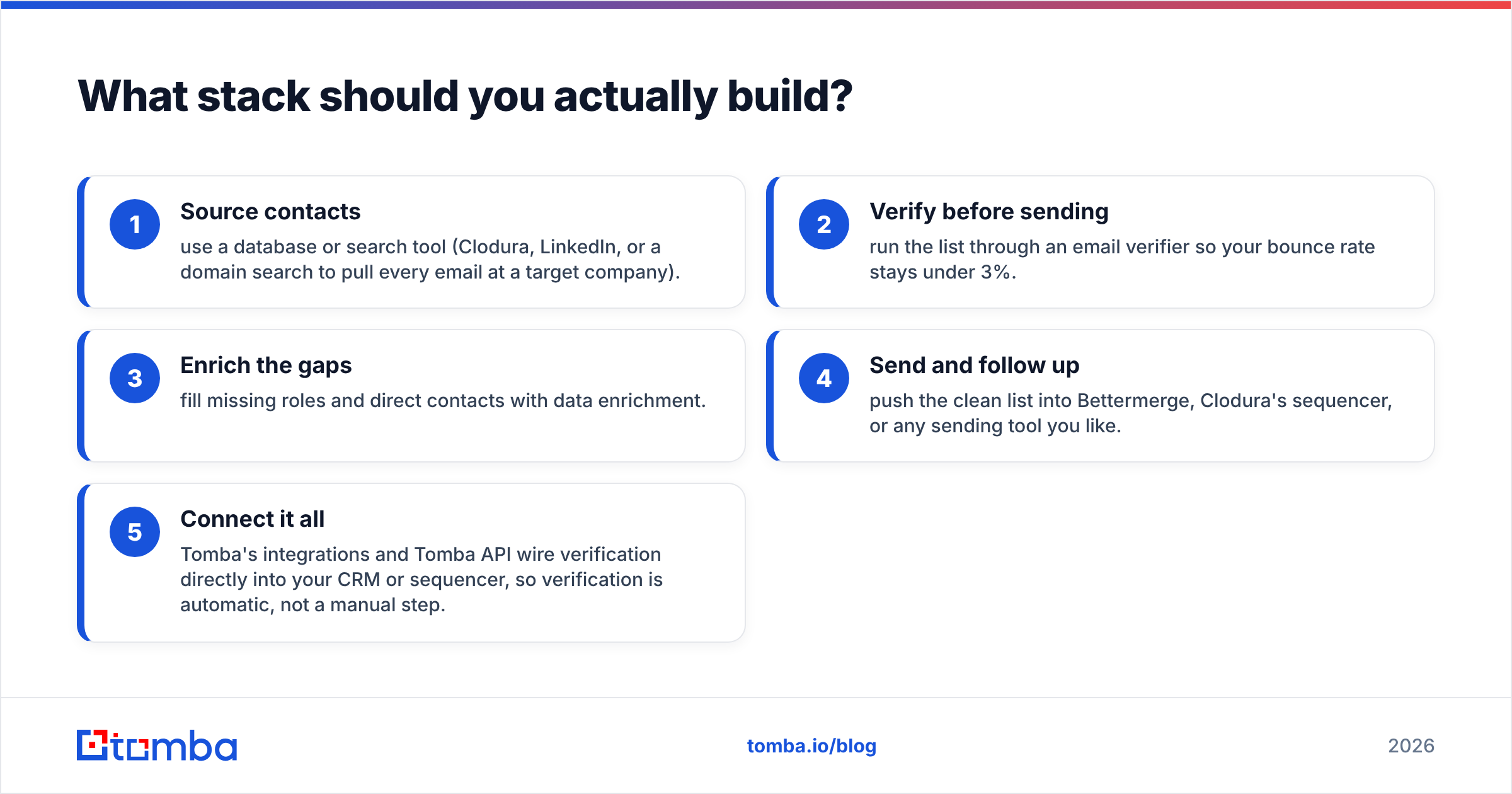
The best setup treats finding, verifying, and sending as three jobs done by three specialists. Here is a clean, vendor-neutral pattern:
- Source contacts — use a database or search tool (Clodura, LinkedIn, or a domain search to pull every email at a target company).
- Verify before sending — run the list through an email verifier so your bounce rate stays under 3%.
- Enrich the gaps — fill missing roles and direct contacts with data enrichment.
- Send and follow up — push the clean list into Bettermerge, Clodura's sequencer, or any sending tool you like.
- Connect it all — Tomba's integrations and Tomba API wire verification directly into your CRM or sequencer, so verification is automatic, not a manual step.
This is the part both Bettermerge and Clodura quietly assume you have solved. You don't have to pick one of them and live with its data limits — you decouple the data layer and let each tool do its one job well.
So, Bettermerge or Clodura.ai?#
Pick by the gap you are actually trying to fill:
- Choose Bettermerge if you already have a clean, verified list and just need a cheap, simple way to personalize and send. It is a focused utility and priced like one.
- Choose Clodura.ai if you have no list and want database, signals, and sequencing under one login — accepting that you will need to verify exports before you trust them.
- Choose neither as your data source. Both are downstream of the real problem: accurate, current contacts. That is a specialist job.
For sales and RevOps teams that care about deliverability, the smartest 2026 move is to stop asking a sending tool or a database to also be your verifier. Treat data as its own discipline. Comparison shoppers also weigh tools on platforms like HubSpot's ecosystem and G2 — and the consistent theme in reviews is that data freshness, not feature count, decides who replies.
The bottom line#
Bettermerge and Clodura.ai solve different halves of outbound: one sends, one sources. Neither guarantees the contact accuracy that actually drives replies and protects your domain. Build your stack so the data layer is a specialist, and the sending tools simply execute on clean inputs.
Start with the part everything else depends on. Use Tomba Email Finder to find and verify real, deliverable B2B contacts — by name, domain, or company — then send them through Bettermerge, Clodura, or whatever sequencer you prefer. Spin up the free tier (25 searches/mo), confirm the accuracy on your own target accounts, and only pay for results that land. Your bounce rate, and your future deliverability, will thank you.
// get started
Find, verify and enrich your first contacts today
Start on the free plan with 25 searches a month, then scale when your team is ready.
Free plan · No credit card required · GDPR & CCPA
// about the author