Bettermerge vs Leadengineai: Best AI Lead Tool in 2026?
A neutral, side-by-side breakdown of Bettermerge vs Leadengineai in 2026 — data quality, pricing models, workflows, and where a dedicated email finder beats both.
Choosing between two AI lead platforms usually comes down to one boring question that nobody markets around: how good is the data once the demo ends? Bettermerge vs Leadengineai is exactly that kind of decision — two tools that promise "AI-powered pipeline" but solve slightly different parts of the same problem. This breakdown keeps the hype out and the trade-offs in.
TL;DR#
- Bettermerge leans toward data merging, dedup, and enrichment hygiene — cleaning and unifying the records you already have.
- Leadengineai leans toward AI-driven lead discovery and scoring — generating and prioritizing net-new prospects.
- Neither is primarily an email finder or verifier, so contact accuracy is the gap you have to close yourself.
- Pricing for both is usage- or seat-based and quote-heavy; budget for the data-verification layer separately.
- The pragmatic 2026 stack: pick one engine for workflow, then bolt on a dedicated email verifier so you stop paying to email bounced addresses.
What are Bettermerge and Leadengineai?#
Think of them as two specialists in the same hospital. Bettermerge is the records department — it takes messy, duplicated, half-filled contact rows from your CRM, spreadsheets, and forms, then merges them into one clean profile per person or company. Its value is order: fewer duplicates, consistent fields, enriched firmographics.
Leadengineai is the scout. It uses AI models and intent signals to surface accounts and contacts you didn't know to chase, then scores them by fit and likelihood to convert. Its value is discovery: more named targets at the top of the funnel.
That distinction matters because "which is better" is the wrong frame. They overlap in the middle — both touch enrichment — but they're optimized for opposite ends of the lead lifecycle. The honest answer to bettermerge vs leadengineai depends on whether your bottleneck is dirty data or not enough data.

How do Bettermerge and Leadengineai compare head-to-head?#
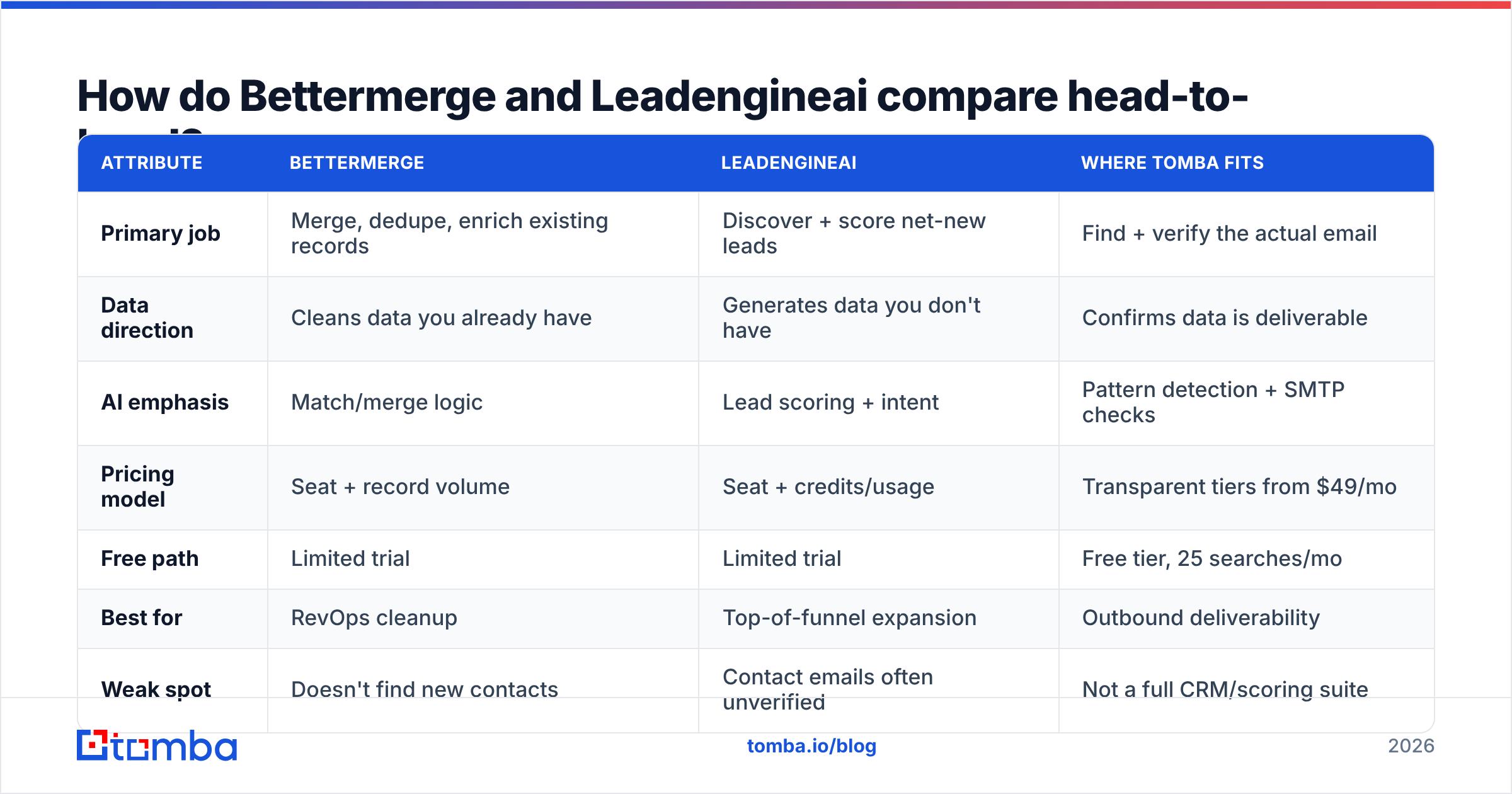
Here's the side-by-side. Pricing for both platforms is quote-driven and changes by seat and volume, so the rows below describe the model rather than asserting a fixed sticker price.
| Attribute | Bettermerge | Leadengineai | Where Tomba fits |
|---|---|---|---|
| Primary job | Merge, dedupe, enrich existing records | Discover + score net-new leads | Find + verify the actual email |
| Data direction | Cleans data you already have | Generates data you don't have | Confirms data is deliverable |
| AI emphasis | Match/merge logic | Lead scoring + intent | Pattern detection + SMTP checks |
| Pricing model | Seat + record volume | Seat + credits/usage | Transparent tiers from $49/mo |
| Free path | Limited trial | Limited trial | Free tier, 25 searches/mo |
| Best for | RevOps cleanup | Top-of-funnel expansion | Outbound deliverability |
| Weak spot | Doesn't find new contacts | Contact emails often unverified | Not a full CRM/scoring suite |
A few things stand out. First, both tools assume you'll trust their enrichment, but enrichment and verification are not the same thing — an enriched email can still bounce. Second, neither publishes the kind of plainly listed pricing that lets you model cost before a sales call, which is a real factor for small teams.
Which one has better data accuracy?#
Neither tool is built to guarantee a contact email actually receives mail — and that's the metric that decides your sender reputation. Bettermerge can produce a beautifully merged record with a stale address; Leadengineai can score a perfect-fit lead whose email pattern is a guess. Both improve organization and targeting, but the last mile — does this inbox exist and accept mail — is its own discipline.
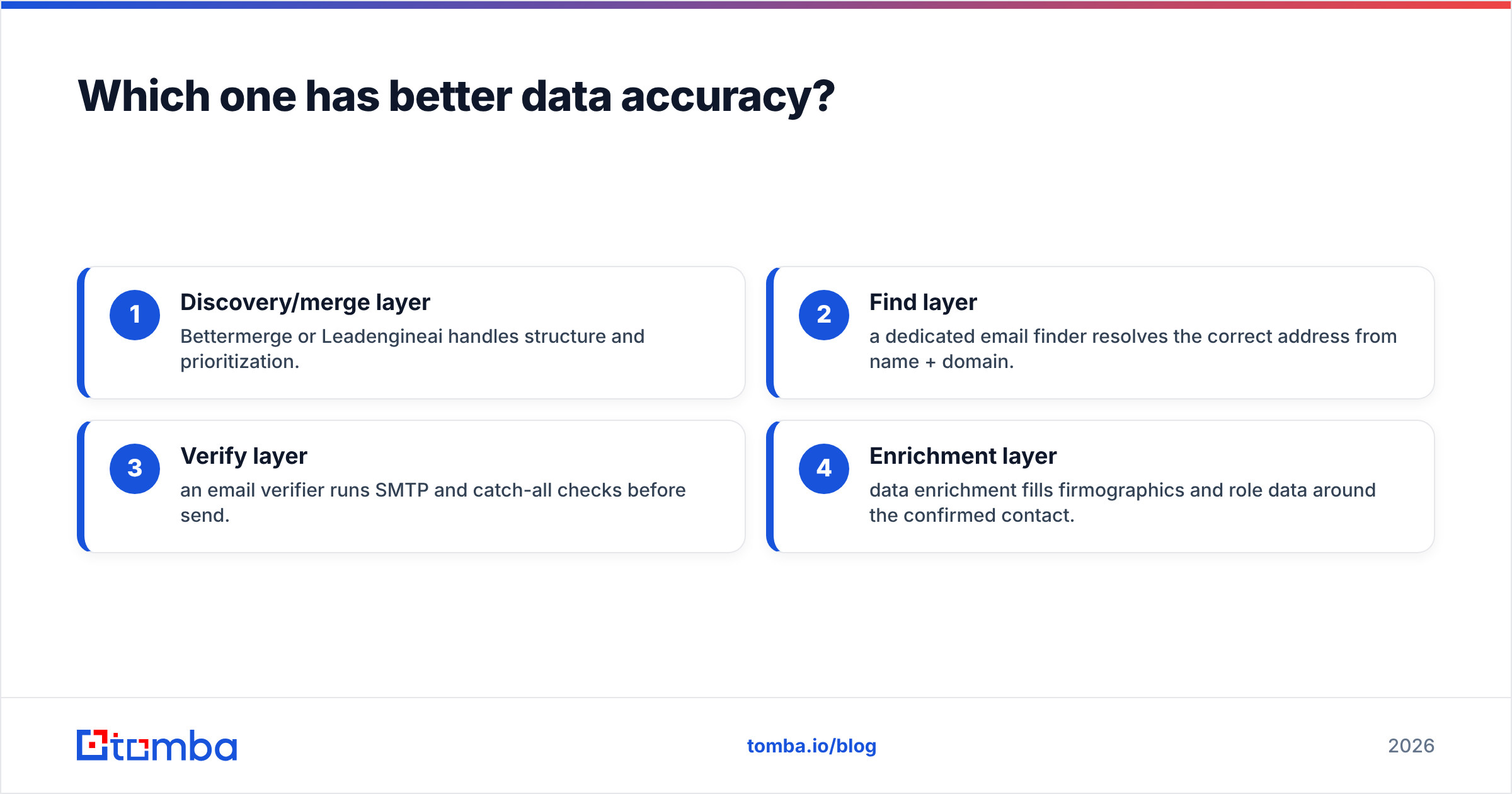
This is why accuracy-focused teams separate the two concerns:
- Discovery/merge layer — Bettermerge or Leadengineai handles structure and prioritization.
- Find layer — a dedicated email finder resolves the correct address from name + domain.
- Verify layer — an email verifier runs SMTP and catch-all checks before send.
- Enrichment layer — data enrichment fills firmographics and role data around the confirmed contact.
Treating verification as an afterthought is the most common reason "good" lists still bounce. Industry guidance from inbox providers like Google Postmaster Tools is blunt about it: high bounce and complaint rates throttle your delivery regardless of how clean your CRM looks.
Is Bettermerge better than Leadengineai for outbound?#
For outbound specifically, the deciding factor is what your reps run out of first.
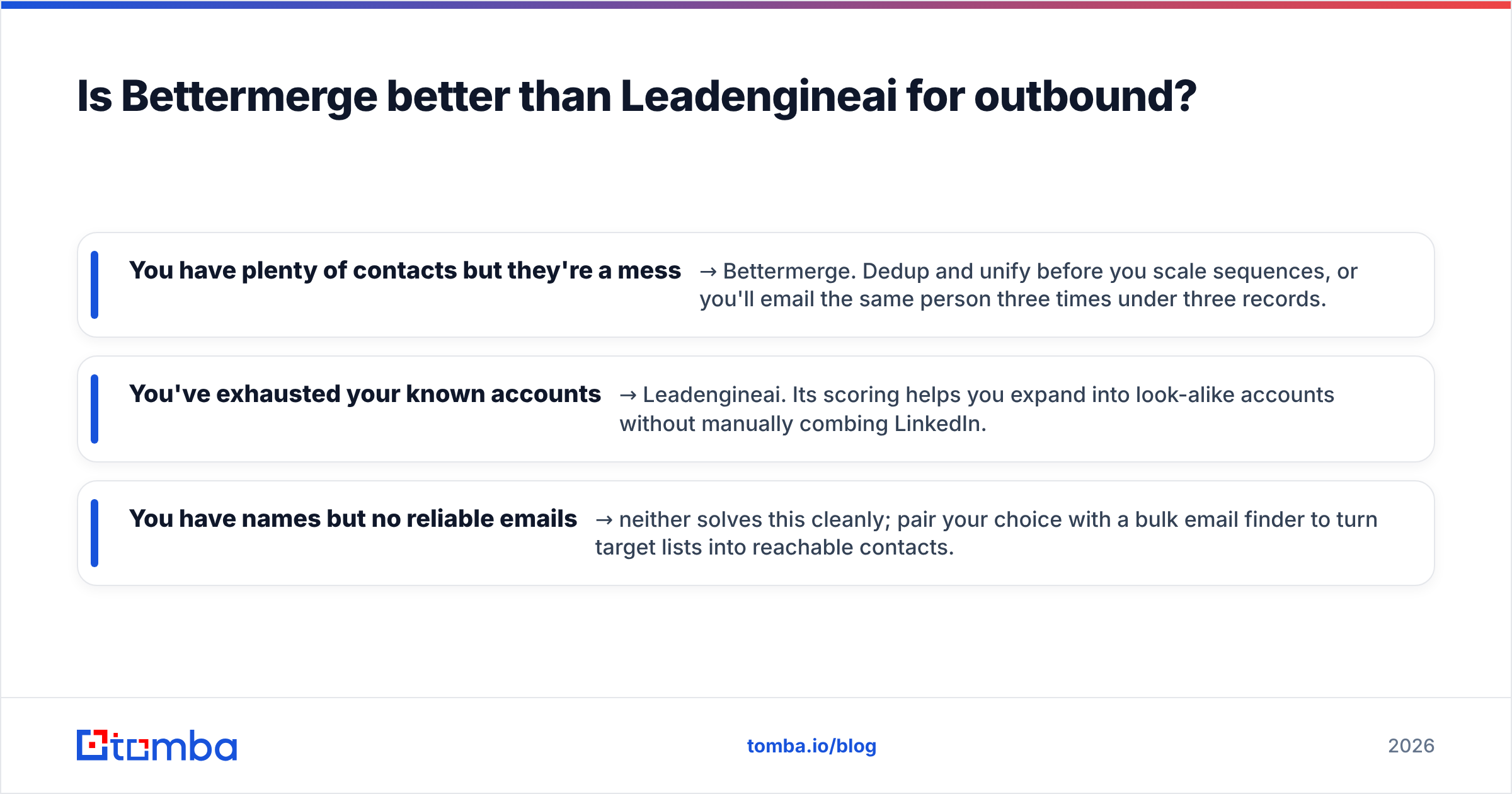
- You have plenty of contacts but they're a mess → Bettermerge. Dedup and unify before you scale sequences, or you'll email the same person three times under three records.
- You've exhausted your known accounts → Leadengineai. Its scoring helps you expand into look-alike accounts without manually combing LinkedIn.
- You have names but no reliable emails → neither solves this cleanly; pair your choice with a bulk email finder to turn target lists into reachable contacts.
Outbound also lives or dies on email deliverability, which both platforms treat as your problem, not theirs. If you're sending cold, you need verified addresses and warmed infrastructure — a clean list into a cold domain still lands in spam.
What about pricing and total cost?#
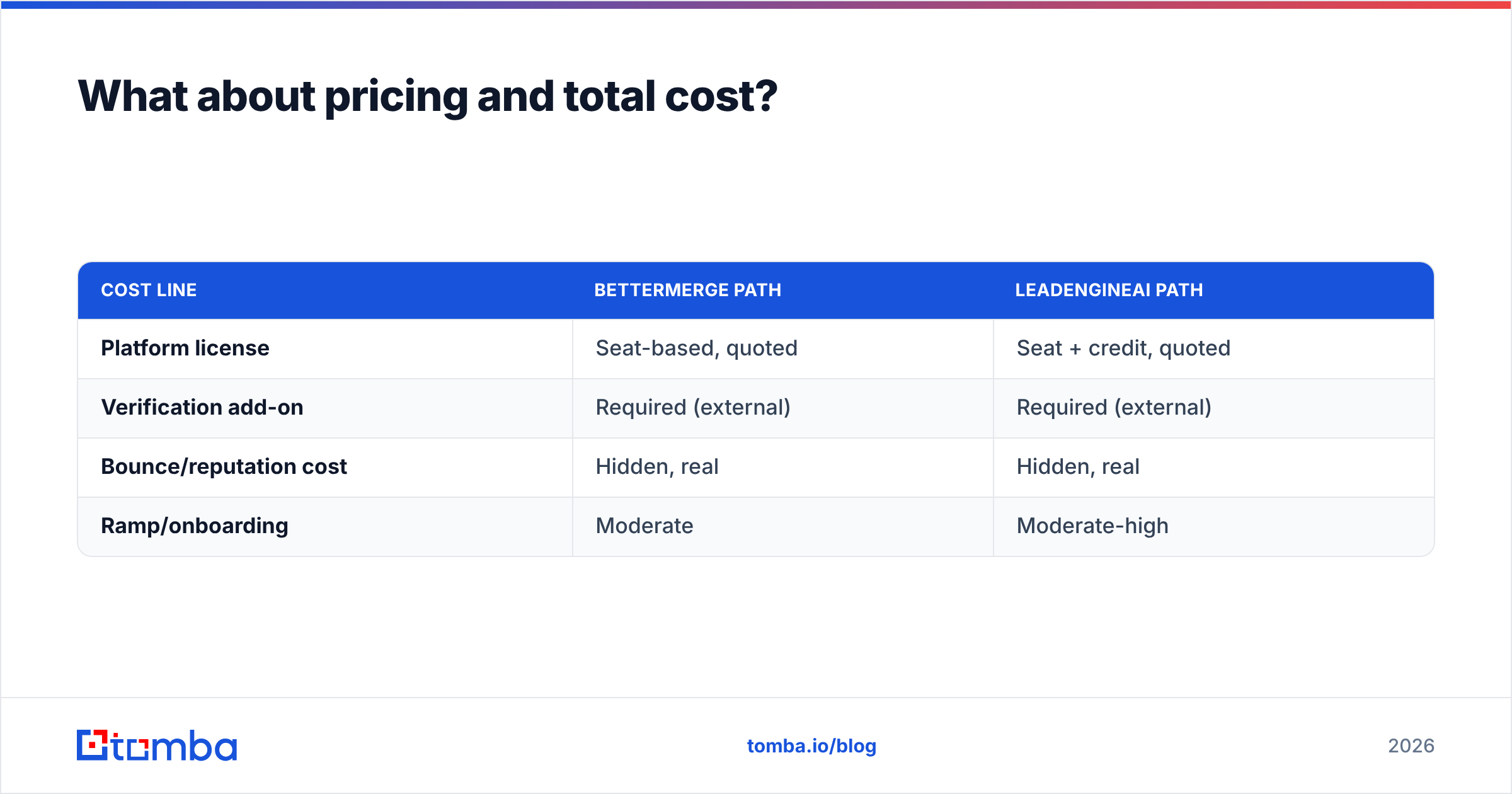
The headline price is rarely the real price with either tool, because both bill on usage that scales with your team. A realistic 2026 budget has three lines, not one:
| Cost line | Bettermerge path | Leadengineai path |
|---|---|---|
| Platform license | Seat-based, quoted | Seat + credit, quoted |
| Verification add-on | Required (external) | Required (external) |
| Bounce/reputation cost | Hidden, real | Hidden, real |
| Ramp/onboarding | Moderate | Moderate-high |
The "hidden" row is the one teams forget. Every bounced send chips at your domain reputation, and recovering it costs far more than verification would have. For comparison, Tomba's pricing is published outright — Free (25 searches/mo), Starter $49/mo, Growth $99/mo, Pro $249/mo, and custom Enterprise — so you can model the verification line precisely instead of guessing. You can sanity-check vendor claims on a neutral source like G2 before committing.
How do they handle integrations and workflow?#
Both platforms expect to sit inside an existing CRM rather than replace it. Bettermerge typically pushes cleaned records back into your system of record; Leadengineai pushes scored leads in. The friction shows up at the edges — does the tool round-trip cleanly with your CRM, your sequencer, and your data warehouse?
If you'd rather assemble a lean stack than adopt a heavyweight suite, a finder/verifier with broad integrations (HubSpot, Salesforce, Pipedrive, Zapier, Sheets) plus a documented email finder API lets you wire verification into whichever engine you pick. That keeps you from being locked into one vendor's view of "complete" data.
Bettermerge vs Leadengineai: which should you choose?#
Quick decision guide:
- Choose Bettermerge if your CRM is bloated with duplicates and your reps waste time reconciling records. Its merge logic is the point.
- Choose Leadengineai if your funnel is starving for net-new, well-scored accounts and you have analysts who'll act on intent signals.
- Choose neither as your accuracy layer. Both are workflow tools, not deliverability tools. Whichever you adopt, verify before you send.
The most resilient setup in 2026 isn't "one platform to rule them all." It's a discovery or merge engine you trust for structure, plus a focused contact layer you trust for truth. The first gets your team organized; the second keeps your domain out of the spam folder.
The bottom line#
Bettermerge and Leadengineai solve different halves of the same funnel — cleanup versus discovery — and both quietly hand you the verification problem. Pick the engine that matches your bottleneck, then close the accuracy gap deliberately instead of hoping enrichment is enough.
That's where Tomba slots in. Use the Tomba Email Finder to resolve the correct address from any name and domain, run it through the verifier before a single send, and start on the free tier (25 searches/mo) before scaling to a transparent $49/mo Starter plan. Let your AI tool find and prioritize the who — let Tomba confirm the how to reach them actually works.
// get started
Find, verify and enrich your first contacts today
Start on the free plan with 25 searches a month, then scale when your team is ready.
Free plan · No credit card required · GDPR & CCPA
// about the author