Bettermerge vs Leadzenai 2026: Which B2B Data Tool Wins?
Bettermerge vs Leadzenai compared on data accuracy, coverage, pricing, and workflow fit — plus where a dedicated finder beats both for verified B2B contact data in 2026.
Bettermerge vs Leadzenai: The 2026 B2B Data Tool Breakdown
Choosing between Bettermerge and Leadzenai comes down to one question most review sites skip: do you want a data enrichment layer that cleans and merges what you already have, or a prospecting database that hands you net-new leads? They sound similar in marketing copy, but they solve opposite ends of the pipeline.
This breakdown compares both on accuracy, coverage, pricing, and real workflow fit — then shows where a dedicated, verification-first tool beats both for the part everyone actually cares about: reaching a real human inbox.
TL;DR — Bettermerge vs Leadzenai at a glance#
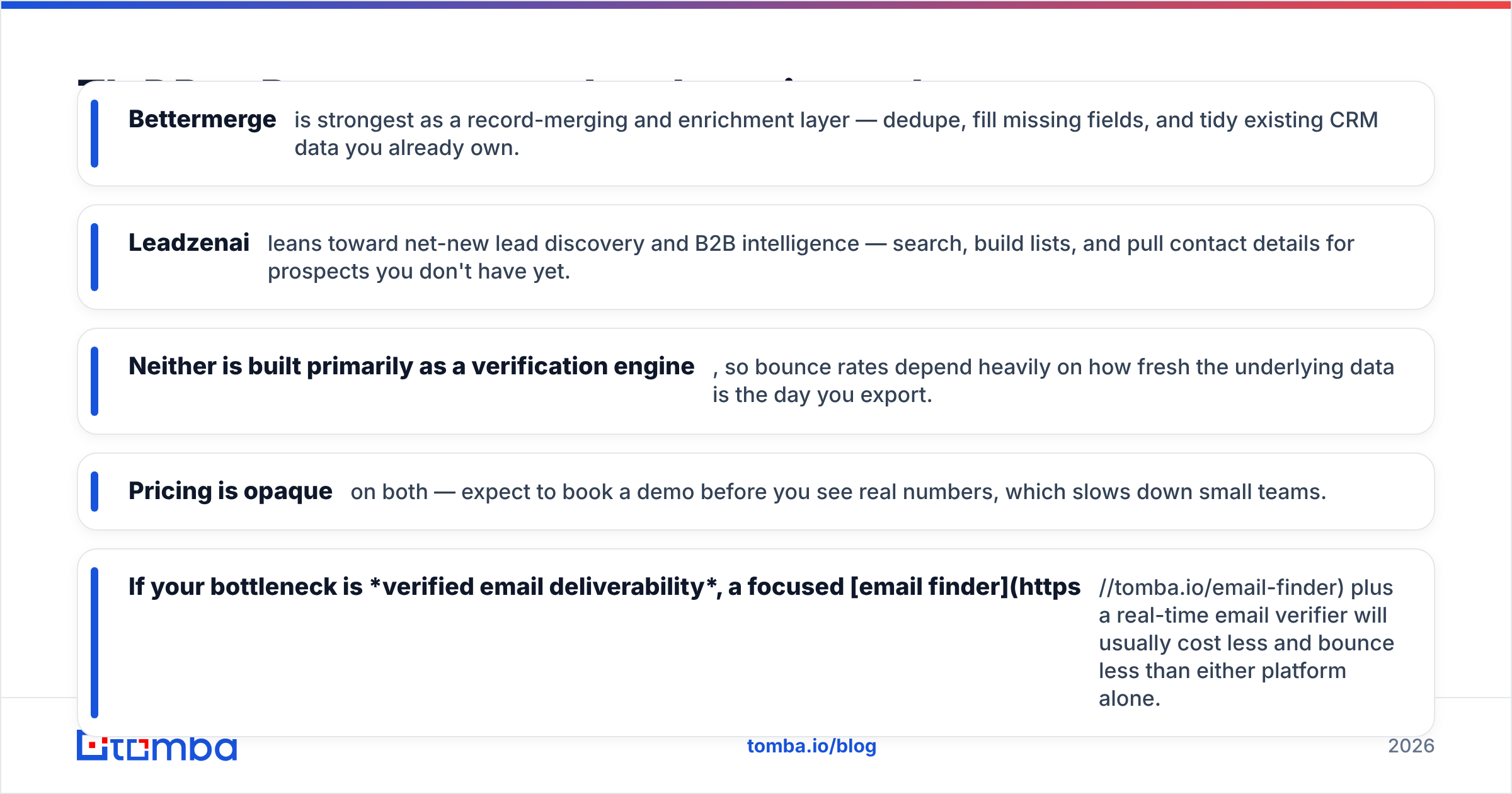
- Bettermerge is strongest as a record-merging and enrichment layer — dedupe, fill missing fields, and tidy existing CRM data you already own.
- Leadzenai leans toward net-new lead discovery and B2B intelligence — search, build lists, and pull contact details for prospects you don't have yet.
- Neither is built primarily as a verification engine, so bounce rates depend heavily on how fresh the underlying data is the day you export.
- Pricing is opaque on both — expect to book a demo before you see real numbers, which slows down small teams.
- If your bottleneck is verified email deliverability, a focused email finder plus a real-time email verifier will usually cost less and bounce less than either platform alone.
What is Bettermerge and who is it for?#
Bettermerge positions itself as a data hygiene and enrichment tool. Think of it as the dishwasher for your CRM: you load in messy, half-empty, duplicated records, and it returns clean, merged, enriched rows. The core jobs are deduplication, field completion (title, company, location), and normalizing inconsistent formatting across thousands of contacts.
That makes Bettermerge a fit for teams that already have a large but dirty database — say, years of trade-show scans, webform fills, and CSV imports that never got reconciled. If 40% of your records are duplicates or missing a job title, an enrichment-first tool earns its keep fast.
Where it's weaker: Bettermerge assumes you already have the contacts. It is not designed to go out and find a brand-new list of 500 VPs of Engineering at Series B SaaS companies you've never touched. For that, you need a discovery engine.
What is Leadzenai and who is it for?#
Leadzenai is a B2B lead generation and intelligence platform. The everyday analogy: it's the phone book plus a recommendation engine. You define a target — industry, role, geography, company size — and it surfaces matching prospects along with contact details and signals.
Leadzenai's center of gravity is net-new discovery: filling the top of the funnel with people you don't already have. It blends sourced contact data with intent and firmographic signals so SDRs can build lists without manually scraping LinkedIn all day. You can read user reviews of both categories on G2 and Capterra to sanity-check vendor claims against real accounts.
Where it's weaker: discovery platforms live and die on data freshness. A contact sourced eight months ago may have changed jobs, and unless the record is re-verified at export, you're emailing a ghost. Leadzenai is also more than most one-person teams need if all they want is a verified email for a known name and domain.
Let me restate that image properly — embedding the meme placeholder:
Bettermerge vs Leadzenai: full comparison table#
Here's the side-by-side, plus a verification-first finder as a third lens so you can see the trade-offs honestly.
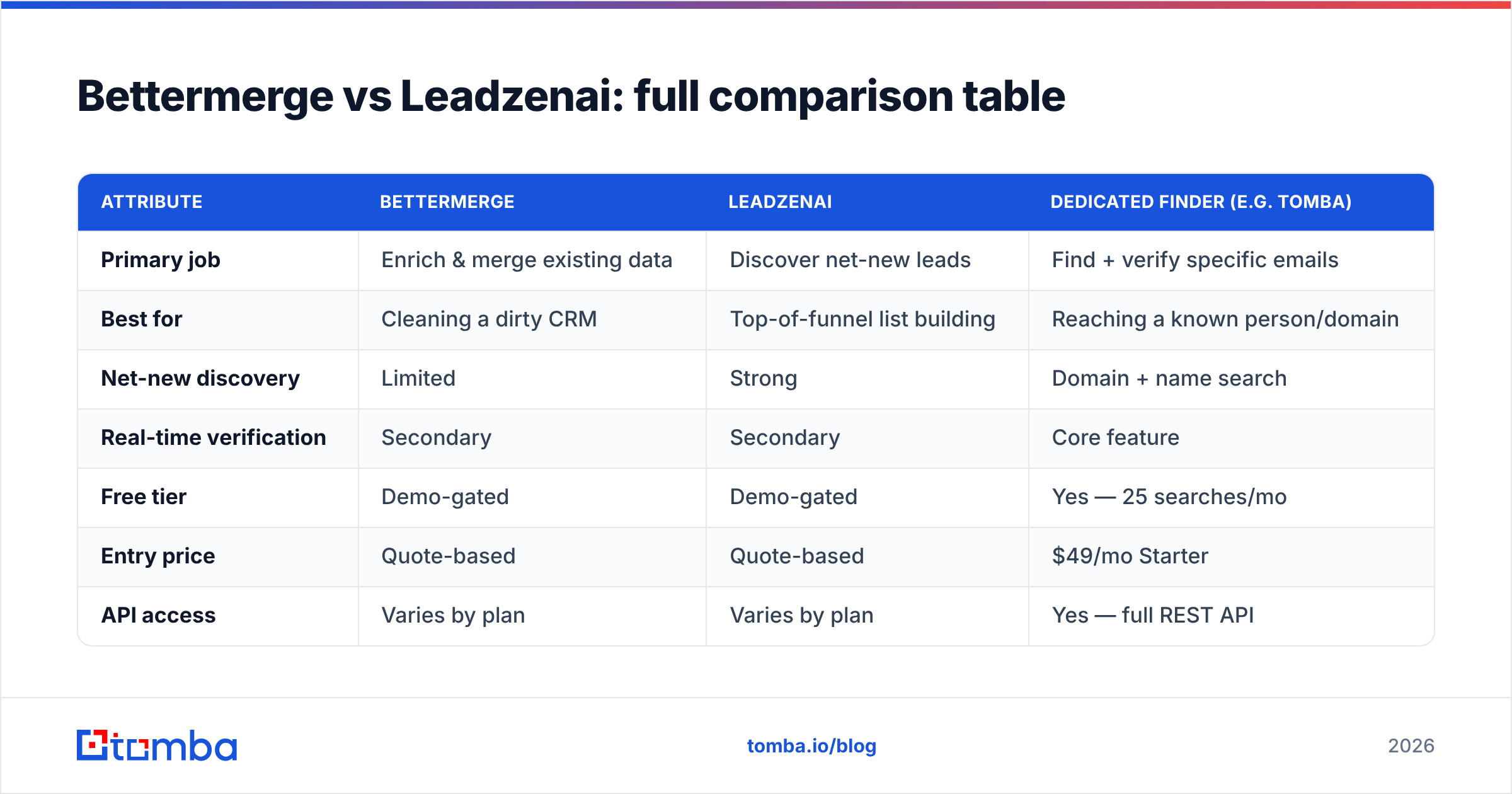
| Attribute | Bettermerge | Leadzenai | Dedicated Finder (e.g. Tomba) |
|---|---|---|---|
| Primary job | Enrich & merge existing data | Discover net-new leads | Find + verify specific emails |
| Best for | Cleaning a dirty CRM | Top-of-funnel list building | Reaching a known person/domain |
| Net-new discovery | Limited | Strong | Domain + name search |
| Real-time verification | Secondary | Secondary | Core feature |
| Free tier | Demo-gated | Demo-gated | Yes — 25 searches/mo |
| Entry price | Quote-based | Quote-based | $49/mo Starter |
| API access | Varies by plan | Varies by plan | Yes — full REST API |
| Bulk processing | Yes | Yes | Yes — bulk finder |
| Transparent pricing | No | No | Yes — public pricing |
The pattern is clear: Bettermerge and Leadzenai cover different stages, and both keep pricing behind a sales call. A finder competes on a narrower job — turning a name and company into a deliverable, verified address — but does it transparently and cheaply.
Which has better data accuracy?#
Accuracy is the only metric that survives contact with a real campaign, so treat vendor "95%+" claims as a starting hypothesis, not a fact.
The honest answer: accuracy depends on when the record was last verified, not on which logo is on the dashboard. A merge tool like Bettermerge inherits the accuracy of whatever sources it pulls from; it improves completeness more than it guarantees deliverability. A discovery tool like Leadzenai surfaces more contacts, but breadth and freshness trade off against each other — the larger the sourced database, the staler its tail.
This is where workflow design matters more than tool choice. Three habits cut bounce rates regardless of platform:
- Verify at the moment of export, not at the moment of import — a record valid in January may be dead by June.
- Re-check catch-all domains separately, because "accepted" doesn't mean "deliverable" on a catch-all server.
- Enrich the company, validate the person — firmographics age slowly, but individual email validity decays fast.
If you want to understand where contact data actually comes from and why freshness varies, Tomba documents its data sources openly — a useful benchmark when a vendor won't tell you how their database is built.
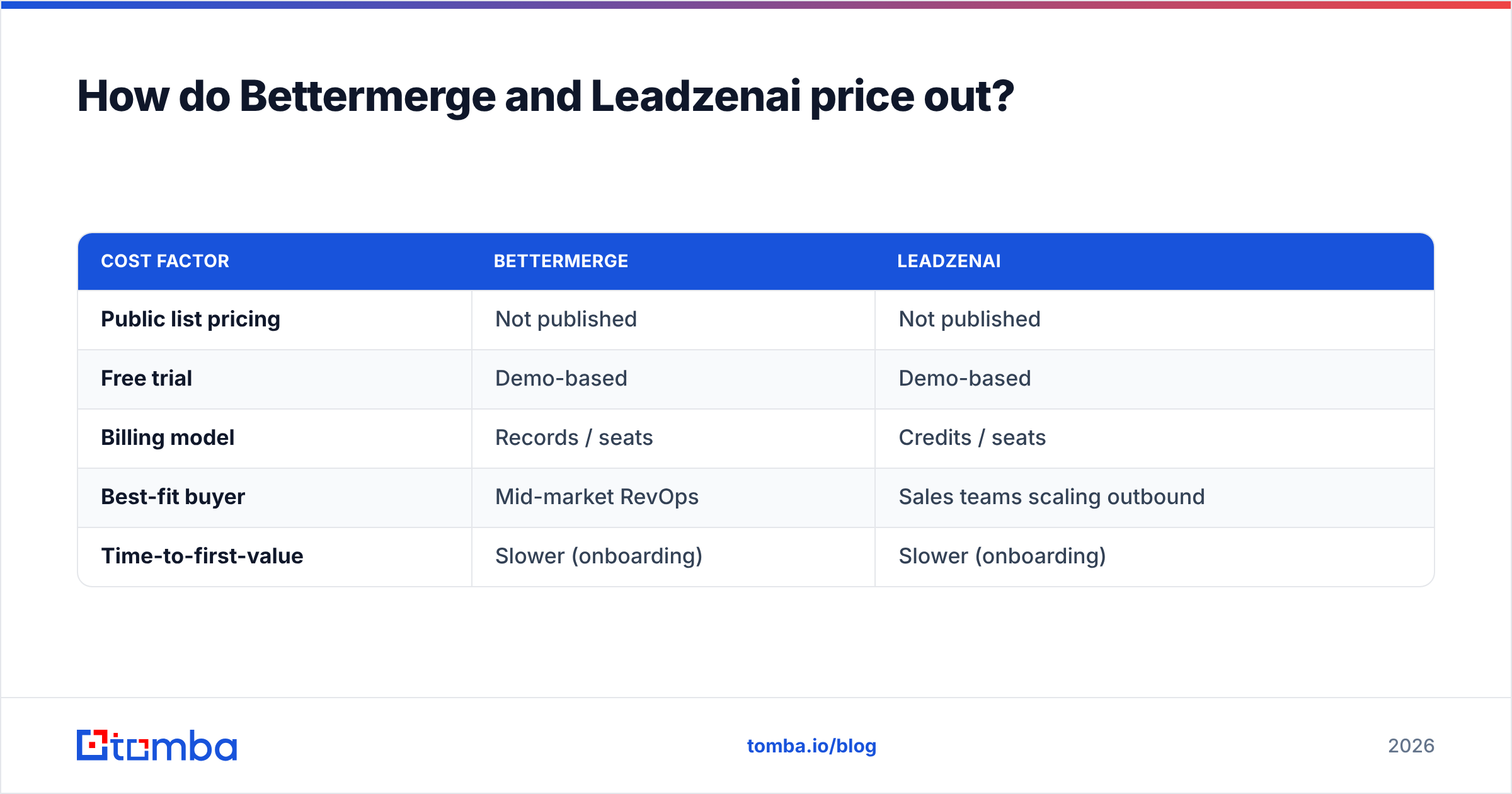
How do Bettermerge and Leadzenai price out?#
Both lean on the classic enterprise playbook: "contact us for pricing." That's fine for a 50-seat revenue org with a procurement team, and frustrating for a founder who just wants to know if it costs $50 or $5,000 before booking a call.
| Cost factor | Bettermerge | Leadzenai |
|---|---|---|
| Public list pricing | Not published | Not published |
| Free trial | Demo-based | Demo-based |
| Billing model | Records / seats | Credits / seats |
| Best-fit buyer | Mid-market RevOps | Sales teams scaling outbound |
| Time-to-first-value | Slower (onboarding) | Slower (onboarding) |
Compare that to fully public Tomba pricing: a free tier with 25 searches a month, Starter at $49/mo, Growth at $99/mo, and Pro at $249/mo. You can start the same afternoon without a sales conversation — which, for small and mid teams, is the difference between testing this quarter and "circling back next quarter."
Is Bettermerge better than Leadzenai?#
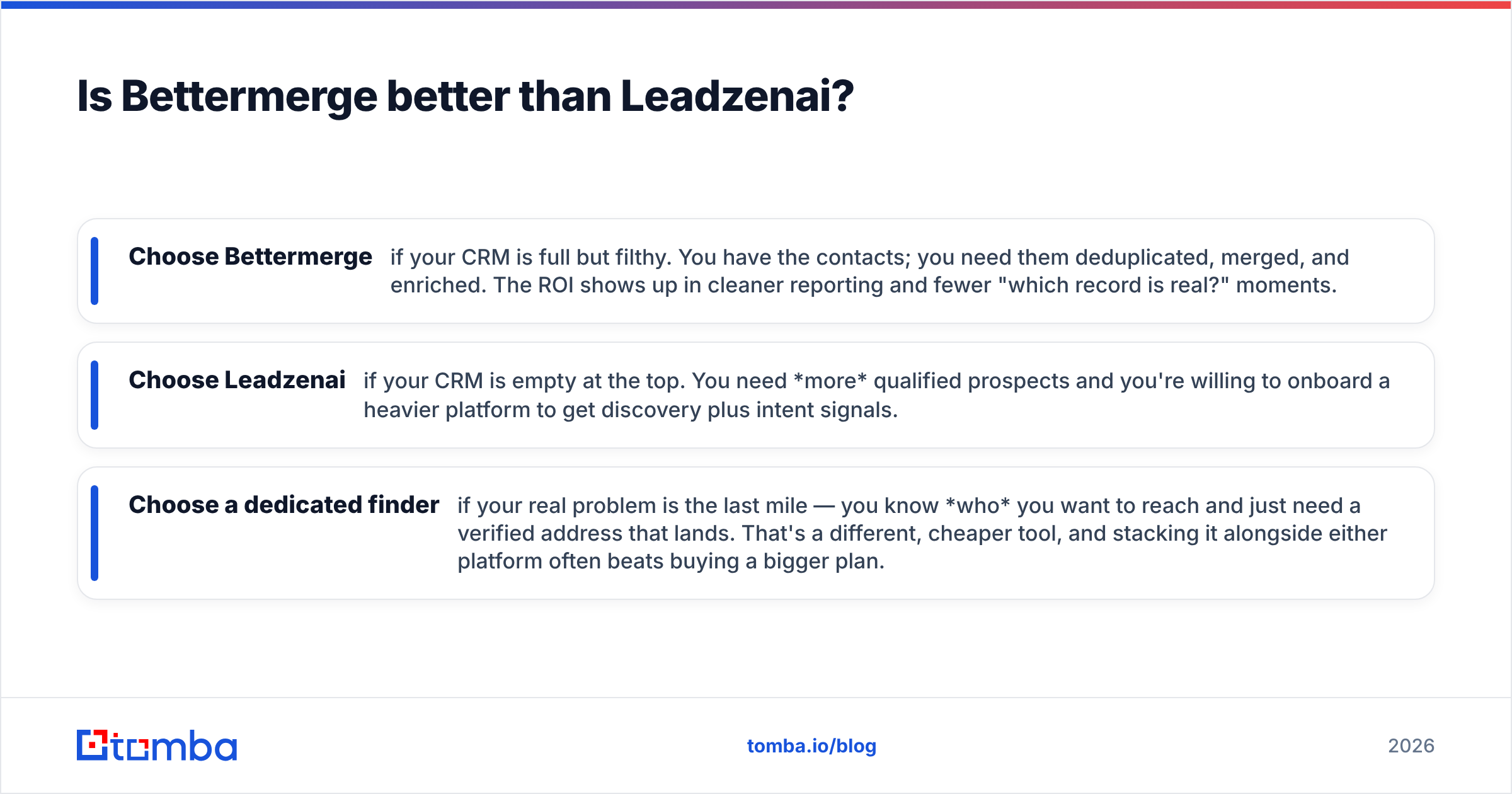
Neither wins outright — they're optimized for different problems. Pick by your bottleneck:
- Choose Bettermerge if your CRM is full but filthy. You have the contacts; you need them deduplicated, merged, and enriched. The ROI shows up in cleaner reporting and fewer "which record is real?" moments.
- Choose Leadzenai if your CRM is empty at the top. You need more qualified prospects and you're willing to onboard a heavier platform to get discovery plus intent signals.
- Choose a dedicated finder if your real problem is the last mile — you know who you want to reach and just need a verified address that lands. That's a different, cheaper tool, and stacking it alongside either platform often beats buying a bigger plan.
The mistake teams make is buying one expensive all-in-one and expecting it to nail discovery, enrichment, and verification equally. In practice, the verification step is what protects your sender reputation, and it's the step most bundled platforms treat as a footnote.
Where does a dedicated email finder fit alongside these tools?#
You don't have to pick a single vendor for the whole pipeline — and you usually shouldn't. A clean stack often looks like this:
- Discovery — use Leadzenai (or your own list) to identify target accounts and roles.
- Enrichment — use Bettermerge to merge and complete the records you keep.
- Verification + finding — use a focused finder to confirm a real, deliverable email before anything hits your sequencer.
That third layer is where Tomba slots in. Its domain search pulls every public email pattern for a company, the finder resolves a specific person, and the verifier confirms deliverability in real time — including catch-all handling that most enrichment tools gloss over. Everything is reachable through the Tomba API, so it drops into an existing workflow instead of replacing it.
The point isn't "Tomba instead of both." It's that the part you're most likely to over-pay for inside a bundled platform — verified, deliverable contact data — is exactly the part a specialized tool does better and cheaper.
What should you actually buy in 2026?#
Conclusion first: match the tool to your bottleneck, and don't pay enterprise quotes for a job a focused tool does for $49.
- Dirty CRM, plenty of leads → Bettermerge for hygiene and merging.
- Empty funnel, need volume → Leadzenai for discovery and intent.
- Known targets, need inboxes → a verification-first finder, layered on top of either.
For most small and mid-market teams, the fastest path to pipeline isn't a six-figure data platform — it's a clean discovery list plus rigorous verification. Start by finding and verifying the contacts you already know you want, prove the ROI, then decide whether a heavier enrichment or discovery suite earns its seat.
Ready to skip the demo gauntlet and test real, verified contact data today? Try the Tomba Email Finder free — 25 searches a month, transparent $49 Starter pricing, and a built-in verifier so the emails you find are emails that land. Pair it with your favorite discovery or enrichment tool and only pay enterprise rates for the layers that genuinely need them.
// get started
Find, verify and enrich your first contacts today
Start on the free plan with 25 searches a month, then scale when your team is ready.
Free plan · No credit card required · GDPR & CCPA
// about the author