BetterMerge vs Seamless.AI: Which Lead Data Tool Wins in 2026?
BetterMerge vs Seamless.AI compared on accuracy, pricing, data freshness, and verification. See which lead-data tool actually feeds clean pipeline in 2026 — and where a focused email finder beats both.
BetterMerge vs Seamless.AI: Which Lead Data Tool Wins in 2026?
Picking between BetterMerge and Seamless.AI usually comes down to one question: do you want a waterfall enrichment engine that stitches data from many providers, or a self-reported B2B database that promises "real-time" emails at scale? Both sell the same dream — full inboxes and booked meetings — but they buy it very differently.
This breakdown compares the two on accuracy, pricing transparency, data freshness, verification, and the workflows they actually fit. It also shows where a focused tool like Tomba quietly beats both on cost-per-valid-email.
TL;DR#
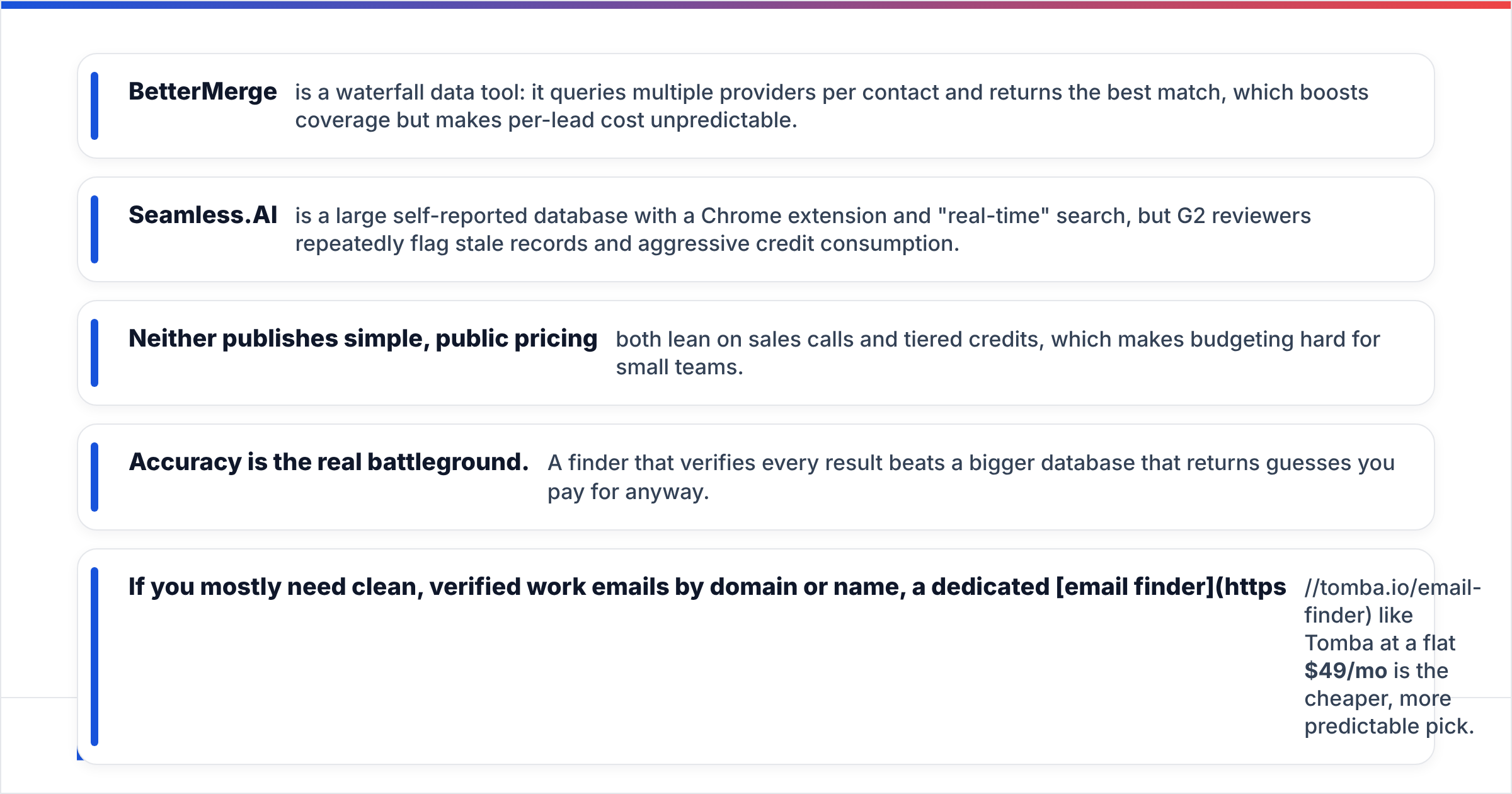
- BetterMerge is a waterfall data tool: it queries multiple providers per contact and returns the best match, which boosts coverage but makes per-lead cost unpredictable.
- Seamless.AI is a large self-reported database with a Chrome extension and "real-time" search, but G2 reviewers repeatedly flag stale records and aggressive credit consumption.
- Neither publishes simple, public pricing — both lean on sales calls and tiered credits, which makes budgeting hard for small teams.
- Accuracy is the real battleground. A finder that verifies every result beats a bigger database that returns guesses you pay for anyway.
- If you mostly need clean, verified work emails by domain or name, a dedicated email finder like Tomba at a flat $49/mo is the cheaper, more predictable pick.
What is BetterMerge?#
BetterMerge belongs to the "waterfall enrichment" category. Instead of relying on one data source, it sends each contact request through a chain of providers in priority order. If the first source has no email, it falls through to the second, then the third, and so on until something returns a hit.
The upside is coverage. By merging many vendors, waterfall tools find emails that any single database would miss — especially for hard-to-reach niches and non-US regions. That's genuinely useful when you've already exhausted your primary provider and need to squeeze more contacts out of a finite account list.
The downside is cost control and consistency. You're effectively paying for several lookups to land one contact, and the quality of each result depends on whichever vendor "won" that row. Verification standards differ across sources, so a merged list can be a patchwork of freshly validated emails and months-old records sitting side by side.
What is Seamless.AI?#
Seamless.AI is a sales intelligence platform built around a large, self-reported contact database and a "real-time search engine" that claims to verify emails as you query. It ships with a Chrome extension, list-building tools, and integrations into common CRMs. You can read their own positioning on the Seamless.AI homepage.
In practice, Seamless.AI is a volume play. The pitch is "find anyone, anywhere," and for popular US tech roles it does surface a lot of contacts quickly. Sales reps who live in LinkedIn like the extension because it pulls contact data without leaving the profile.
The recurring criticism — visible across Seamless.AI reviews on G2 — is data decay and credit burn. Reviewers describe outdated phone numbers, bounced emails that still consumed credits, and a hard-sell renewal process. When a "verified" email bounces, you pay twice: once for the credit, and again in sender-reputation damage.
BetterMerge vs Seamless.AI: how do they compare?#
Here's the head-to-head on the attributes that actually change your cost-per-meeting. Where a vendor doesn't publish public numbers, that itself is the data point.
| Attribute | BetterMerge | Seamless.AI | Tomba |
|---|---|---|---|
| Core model | Waterfall (multi-provider merge) | Self-reported database + extension | Verified email finder + verifier |
| Public pricing | Sales-led / credit packs | Sales-led, opaque tiers | Public: Free, $49, $99, $249/mo |
| Free tier | Limited trial credits | Limited credits | 25 searches/mo, free |
| Per-email verification | Varies by source | "Real-time," disputed | SMTP verifier on every result |
| Data freshness | Depends on winning vendor | Frequent stale-record reports | Re-verified at lookup time |
| Bulk workflow | Yes | Yes | Bulk finder + verifier |
| Best fit | Coverage top-ups | High-volume US prospecting | Predictable, clean B2B email |
The pattern is clear: BetterMerge optimizes for coverage, Seamless.AI for volume, and a focused finder for accuracy and price predictability. The right answer depends on what breaks your pipeline today — too few contacts, or too many bad ones.
Which tool has better data accuracy?#
Accuracy is where this comparison is won or lost, because every bounced email costs you more than the credit. It dents your sender reputation, and once your domain reputation slips, even your good emails land in spam.

Three things separate accurate tools from optimistic ones:
- Verification at lookup time. A database that was "verified" six months ago is not verified today. People change jobs constantly. Tools that re-check the SMTP response when you query — not when the record was first ingested — return fewer surprises.
- Honest catch-all handling. Many corporate domains accept every address (catch-all), so a naive checker marks guesses as "valid." A proper catch-all verifier flags this risk instead of hiding it.
- Confidence scoring you can act on. You should be able to set a threshold and only export contacts above it, rather than dumping everything into a sequence and hoping.
BetterMerge's accuracy is only as good as the source that answered each row, so it's inconsistent by design. Seamless.AI's "real-time" claim is undercut by the volume of stale-record complaints. A tool that runs a dedicated email verifier on every single result gives you the one thing both struggle with: a predictable bounce rate.
How does pricing compare?#
Neither BetterMerge nor Seamless.AI makes it easy to know what you'll actually pay, and that's the single biggest frustration for small teams.
- BetterMerge charges on a credit basis, and because it queries multiple providers per contact, your effective cost per landed email is hard to forecast before you run a batch.
- Seamless.AI routes most buyers through a sales call, with credits that reviewers say deplete faster than expected — and renewals that are hard to downgrade.
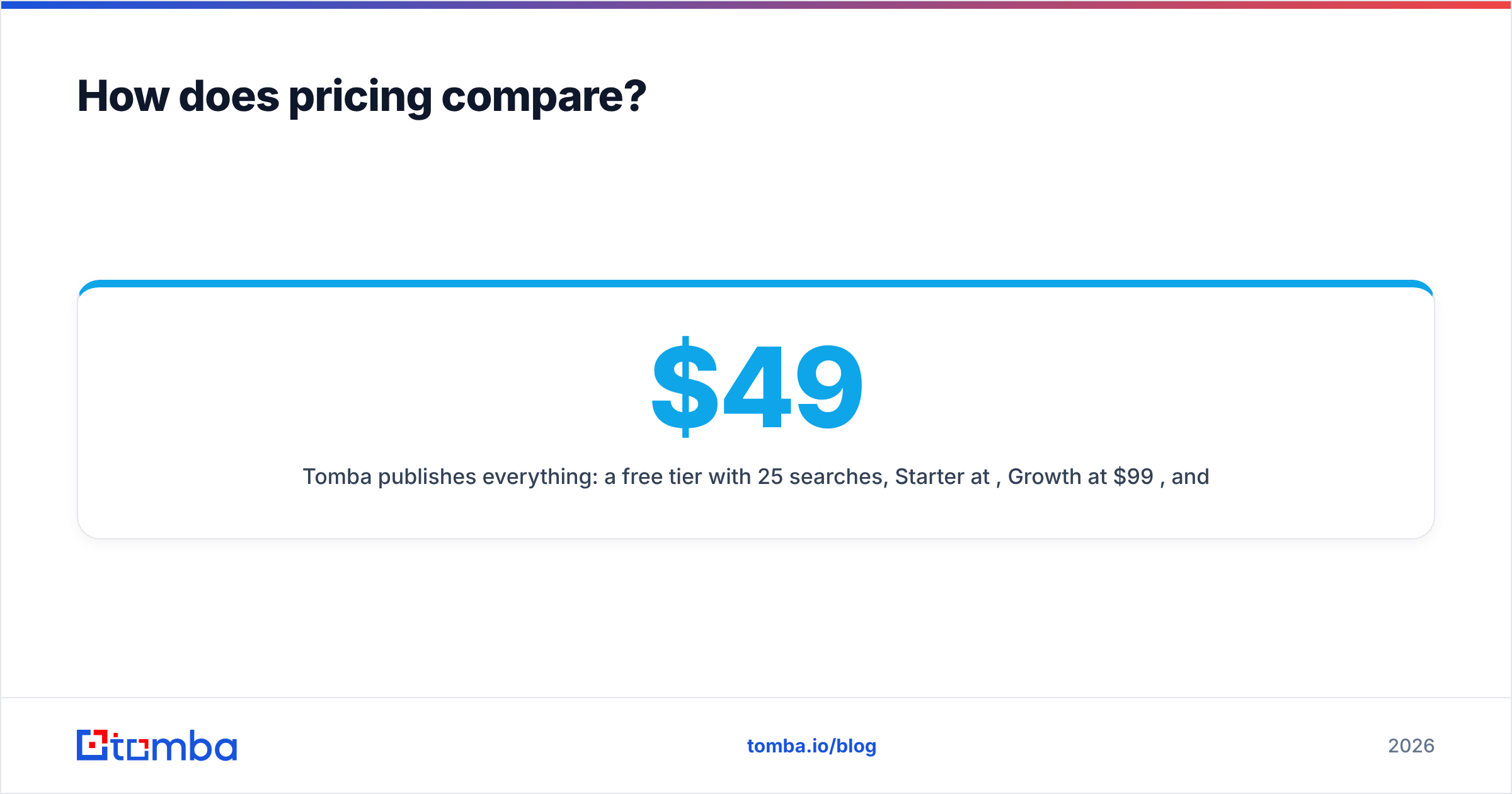
- Tomba publishes everything: a free tier with 25 searches, Starter at $49/mo, Growth at $99/mo, and Pro at $249/mo. You can see the full Tomba pricing without booking a demo.
For a bootstrapped team, predictability beats theoretical coverage. Knowing that 1,000 verified emails costs a fixed amount is worth more than a tool that might find a few extra contacts at an unknown price. If your monthly volume is steady, flat pricing wins on both budgeting and procurement headaches.
When should you choose a waterfall tool like BetterMerge?#
Waterfall enrichment earns its keep in specific situations:
- You've hit the ceiling of one provider and need to fill coverage gaps on a fixed, high-value account list.
- You operate in regions or niches where no single database is strong, and merging sources genuinely lifts hit rates.
- Cost-per-lead is secondary to not missing a single contact in a small, strategic target set.
If that's you, a waterfall layer can be a smart top-up. Just keep it as a supplement, not your primary engine, and always run results through an independent email verification step so the merged output meets one consistent standard before it enters a sequence.
When should you choose Seamless.AI?#
Seamless.AI fits high-velocity, US-heavy outbound teams that:
- Prospect heavily inside LinkedIn and want a fast extension-driven workflow.
- Have reps who self-correct and won't blindly trust every record.
- Value volume over precision at the top of the funnel and verify downstream anyway.
If you go this route, budget for a separate verification pass and watch your credit consumption closely. Many teams looking at Seamless.AI eventually evaluate a Seamless.AI alternative once the renewal quote and bounce rates land — so it's worth pricing the alternatives before you sign an annual contract.
Where does Tomba fit in this comparison?#
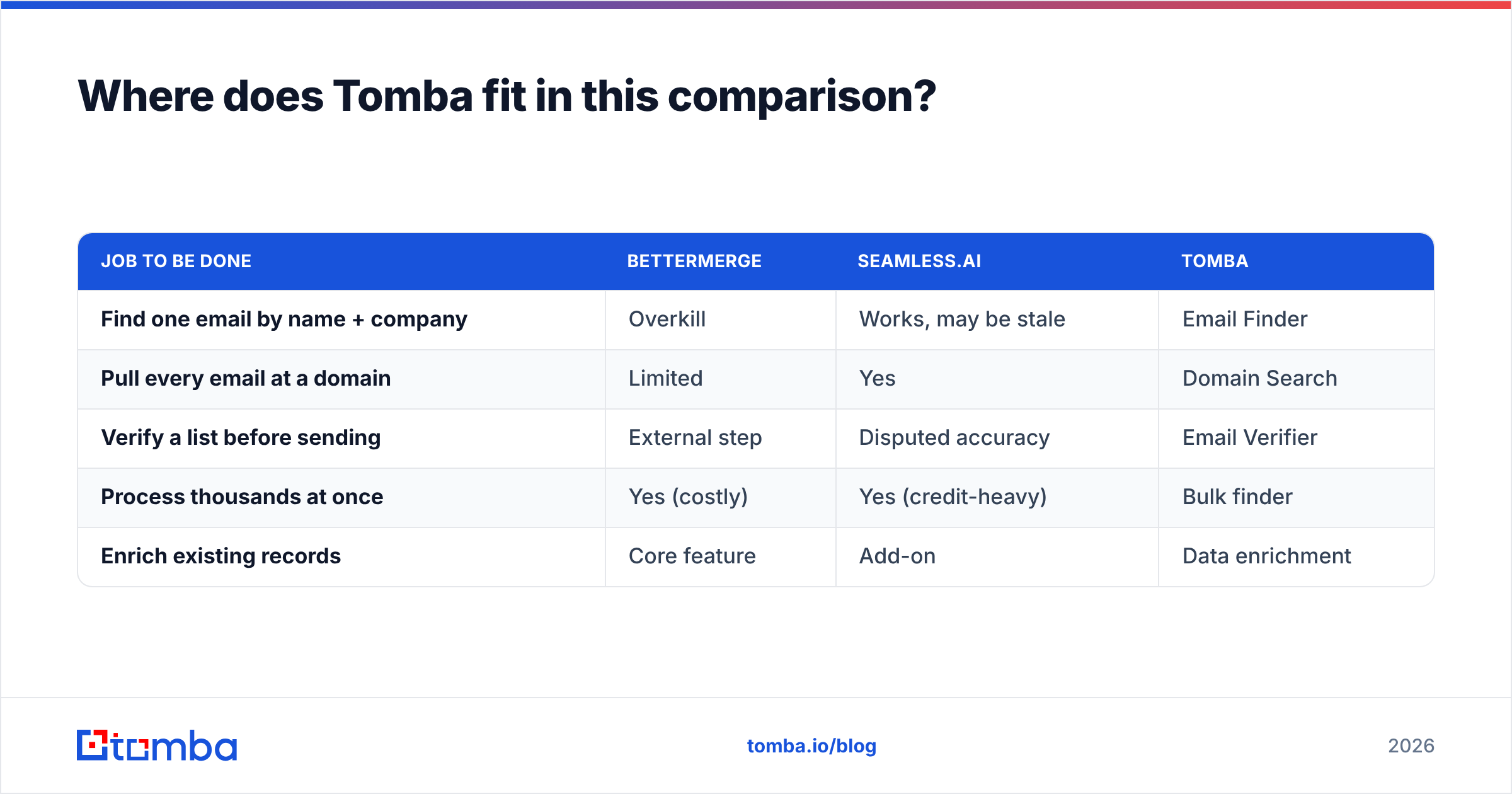
Tomba isn't trying to be a giant do-everything database or a multi-vendor merge engine. It's a focused email finder with verification baked in, which is exactly the part both competitors leave you to clean up.
Here's how the daily workflow actually maps:
| Job to be done | BetterMerge | Seamless.AI | Tomba |
|---|---|---|---|
| Find one email by name + company | Overkill | Works, may be stale | Email Finder |
| Pull every email at a domain | Limited | Yes | Domain Search |
| Verify a list before sending | External step | Disputed accuracy | Email Verifier |
| Process thousands at once | Yes (costly) | Yes (credit-heavy) | Bulk finder |
| Enrich existing records | Core feature | Add-on | Data enrichment |
The benchmark below shows why accuracy-first tools tend to win on real cost-per-valid-email rather than headline database size.

The practical advantage is that you stop paying for guesses. When verification runs on every lookup, the number you export is the number you can actually send to. That keeps your bounce rate low, your domain reputation intact, and your reply rate honest.
Frequently asked questions#
Is BetterMerge better than Seamless.AI? It depends on the problem. BetterMerge's waterfall model usually finds more contacts in hard niches because it merges multiple sources, while Seamless.AI is faster for high-volume US prospecting from a single database. Neither is reliably cheaper or cleaner than a verified email finder for everyday B2B work.
Why do "verified" emails still bounce? Because most databases verify on ingestion, not at query time. A record verified months ago can be obsolete by the time you export it. Tools that re-check SMTP at lookup, plus a proper catch-all verifier, catch far more of these before they hit your sequence.
Do BetterMerge and Seamless.AI publish public pricing? Largely no. Both lean on credit packs and sales calls, which makes per-valid-email cost hard to forecast. If transparent budgeting matters, compare them against a provider with public tiers like Tomba pricing.
Can I just use a cheaper finder instead of both? Often, yes. If your core need is verified work emails by name or domain — not a sprawling database — a focused email finder covers it at a fraction of the cost and with a more predictable bill.
The verdict#
BetterMerge wins on coverage in tough niches. Seamless.AI wins on raw US volume and LinkedIn speed. But both make you absorb two hidden costs: unpredictable pricing and inconsistent accuracy that you have to verify anyway.
If your real job is turning a name and a domain into a clean, send-ready email — without a sales call to learn the price — start with Tomba. The Tomba Email Finder verifies every result, ships a free tier with 25 searches a month, and scales on public pricing from $49/mo. Run your hardest 25 contacts through it today, compare the bounce rate against your current tool, and let the numbers pick the winner.
// get started
Find, verify and enrich your first contacts today
Start on the free plan with 25 searches a month, then scale when your team is ready.
Free plan · No credit card required · GDPR & CCPA
// about the author