Beyond Creative Work Alternatives: 7 Top Picks for 2026
Outgrowing Beyond Creative Work? Compare 7 alternatives on pricing, turnaround, and scope—plus the outreach stack creative teams actually use to win clients in 2026.
If you run a creative team or a productized design service, you have probably outgrown one tool and started shopping for the next. "Beyond Creative Work" is one of the platforms creative professionals lean on to manage briefs, subscriptions, and delivery — but it is not the only option, and it is rarely the cheapest or the best fit for every workflow.
This guide compares the most credible beyond creative work alternatives for 2026 on the things that actually matter: pricing, turnaround, scope of work, and how well each one supports the unglamorous part of running a creative business — finding and signing new clients.
TL;DR#
- No single winner. The right alternative depends on whether you need unlimited design, a managed creative team, or a flexible marketplace.
- Price spreads are huge — from roughly $499/mo for solo subscription design to $7,000+/mo for managed creative teams.
- Turnaround and revision policy matter more than the headline feature list. Ask about queue limits before you sign.
- The real bottleneck is client acquisition, not delivery. Most creative teams underinvest in outbound and overpay for tooling.
- Pair any creative platform with a lightweight outreach stack — an email finder plus a verifier — to keep your pipeline full.
What is Beyond Creative Work and why look for alternatives?#
Beyond Creative Work sits in the "creative-as-a-service" category: a way to access design, content, or production capacity without hiring a full in-house team. That model is genuinely useful, but teams start looking elsewhere for predictable reasons.
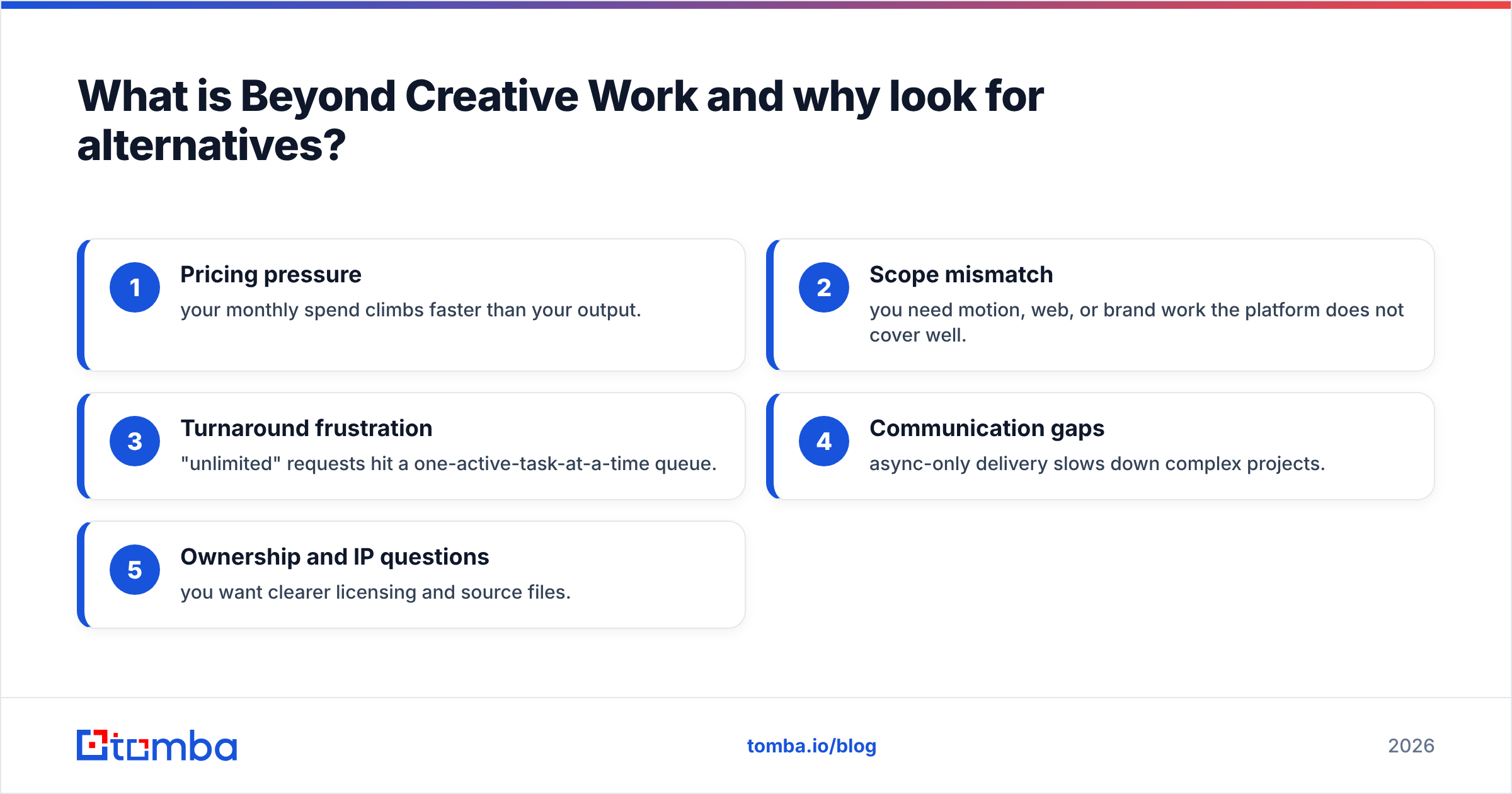
The usual triggers:
- Pricing pressure — your monthly spend climbs faster than your output.
- Scope mismatch — you need motion, web, or brand work the platform does not cover well.
- Turnaround frustration — "unlimited" requests hit a one-active-task-at-a-time queue.
- Communication gaps — async-only delivery slows down complex projects.
- Ownership and IP questions — you want clearer licensing and source files.
If two or more of those sound familiar, it is worth running a real comparison instead of renewing by default.
)
What are the best beyond creative work alternatives in 2026?#
Here are seven platforms creative teams evaluate most often, grouped by model so you can match them to your actual need rather than a feature checklist.
Unlimited subscription design#
- Design Pickle — the category veteran. Strong for high-volume, repeatable graphics; weaker on strategy and web.
- Superside — premium, agency-grade output with dedicated project managers; priced for funded startups and enterprises.
- ManyPixels — budget-friendly unlimited design with a clean dashboard, best for SMBs and marketing teams.
Managed creative teams#
- Penji — tiered plans that scale from solo designers to small managed pods.
- Kimp — bundles graphic and video design into one subscription, useful for content-heavy brands.
Flexible marketplaces and freelance networks#
- Toptal — vetted senior freelancers for complex, one-off builds.
- Contra — commission-free freelance marketplace, good for ongoing relationships without platform fees.
How do the top alternatives compare on price and scope?#
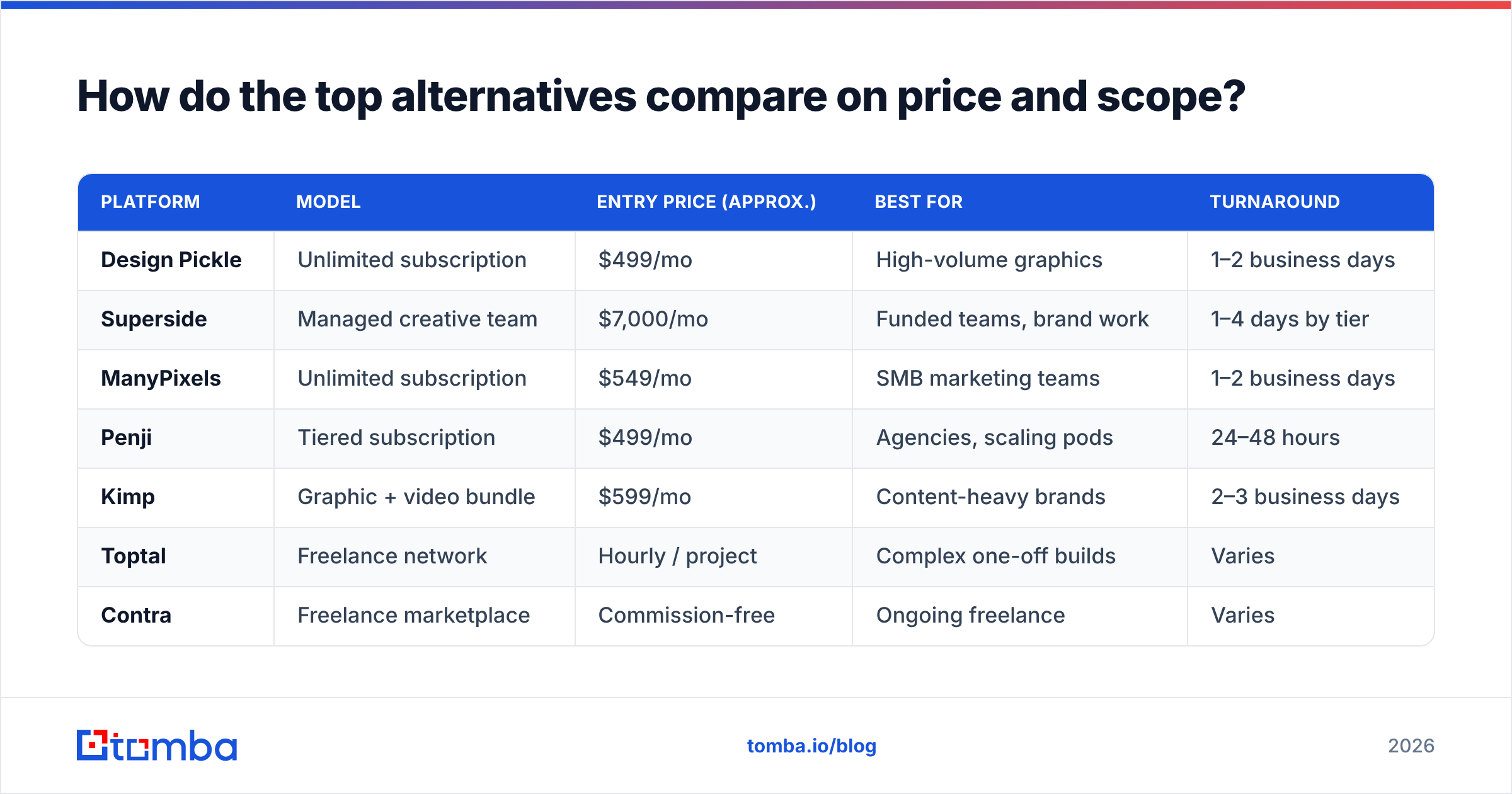
Use the table below as a starting filter, then validate the current numbers on each vendor's pricing page before committing — creative-service pricing changes often.
| Platform | Model | Entry price (approx.) | Best for | Turnaround |
|---|---|---|---|---|
| Design Pickle | Unlimited subscription | $499/mo | High-volume graphics | 1–2 business days |
| Superside | Managed creative team | $7,000/mo | Funded teams, brand work | 1–4 days by tier |
| ManyPixels | Unlimited subscription | $549/mo | SMB marketing teams | 1–2 business days |
| Penji | Tiered subscription | $499/mo | Agencies, scaling pods | 24–48 hours |
| Kimp | Graphic + video bundle | $599/mo | Content-heavy brands | 2–3 business days |
| Toptal | Freelance network | Hourly / project | Complex one-off builds | Varies |
| Contra | Freelance marketplace | Commission-free | Ongoing freelance | Varies |
A few things the table cannot show:
- "Unlimited" almost always means one active request at a time. Two designers in your queue is a different product than one.
- Revisions are where plans diverge. Some cap rounds; some are genuinely unlimited but slower.
- Source files and licensing vary. If you resell creative to clients, confirm you get full ownership.
For an unbiased read on real user sentiment, cross-check each tool's profile on G2 — pay attention to the one- and two-star reviews, which expose turnaround and communication issues the marketing pages hide.
Is a subscription or a managed team better for your workflow?#
Short answer: subscriptions win on cost and predictability; managed teams win on complexity and speed.
Think of it like transportation. A design subscription is a reliable commuter car — cheap per mile, perfect for daily, repeatable trips (social graphics, ad variants, simple landing pages). A managed creative team is a chauffeured vehicle — far more expensive, but it handles complicated routes (rebrands, multi-channel campaigns, motion) without you steering every turn.
Choose a subscription (Design Pickle, ManyPixels, Penji) if:
- Your work is high-volume and templated.
- You can batch and queue requests.
- Budget predictability matters more than raw speed.
Choose a managed team (Superside, Kimp) if:
- Projects need strategy, art direction, or cross-format consistency.
- You have the budget and the deadlines to justify it.
- You want a single accountable owner per project.
Choose a marketplace (Toptal, Contra) if:
- Your needs are spiky and project-based, not continuous.
- You want a specific senior specialist, not a generalist pool.
What do most teams get wrong when switching?#
They optimize the wrong half of the business.
Here is the uncomfortable truth: the platform that delivers your creative work is rarely the constraint on your growth. The constraint is how many qualified clients you talk to each month. A faster design queue does not matter if your pipeline is empty.
)
Creative teams routinely spend $500–$7,000 a month on delivery tooling and almost nothing on a repeatable way to reach decision-makers. That is backwards. The agencies that compound are the ones that treat outbound as a system, not an afterthought.
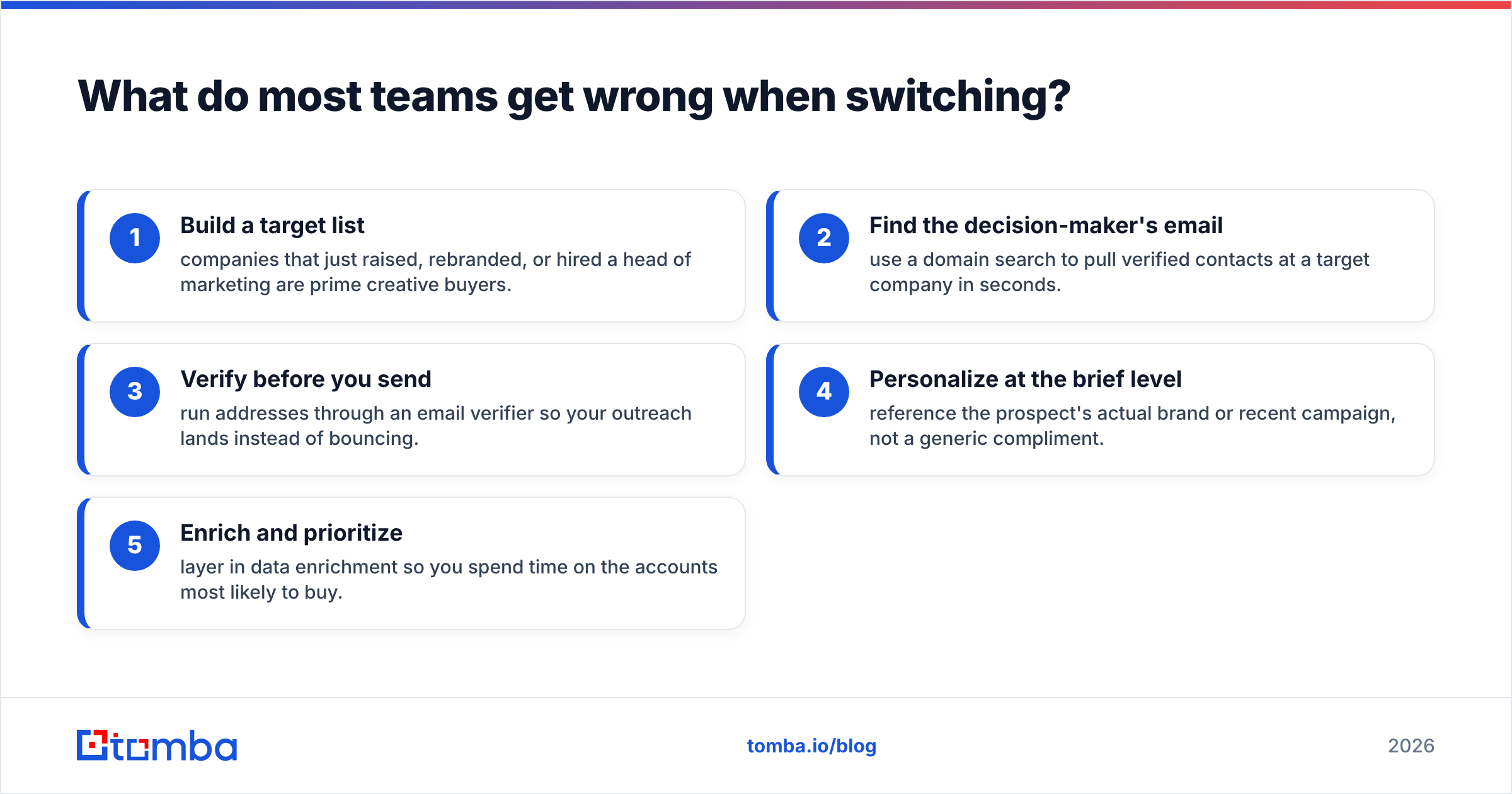
A lean client-acquisition stack for a creative business looks like this:
- Build a target list — companies that just raised, rebranded, or hired a head of marketing are prime creative buyers.
- Find the decision-maker's email — use a domain search to pull verified contacts at a target company in seconds.
- Verify before you send — run addresses through an email verifier so your outreach lands instead of bouncing.
- Personalize at the brief level — reference the prospect's actual brand or recent campaign, not a generic compliment.
- Enrich and prioritize — layer in data enrichment so you spend time on the accounts most likely to buy.
This is the layer "Beyond Creative Work" and its alternatives do not touch — and it is exactly where most creative revenue is won or lost.
How does outreach fit alongside your creative platform?#
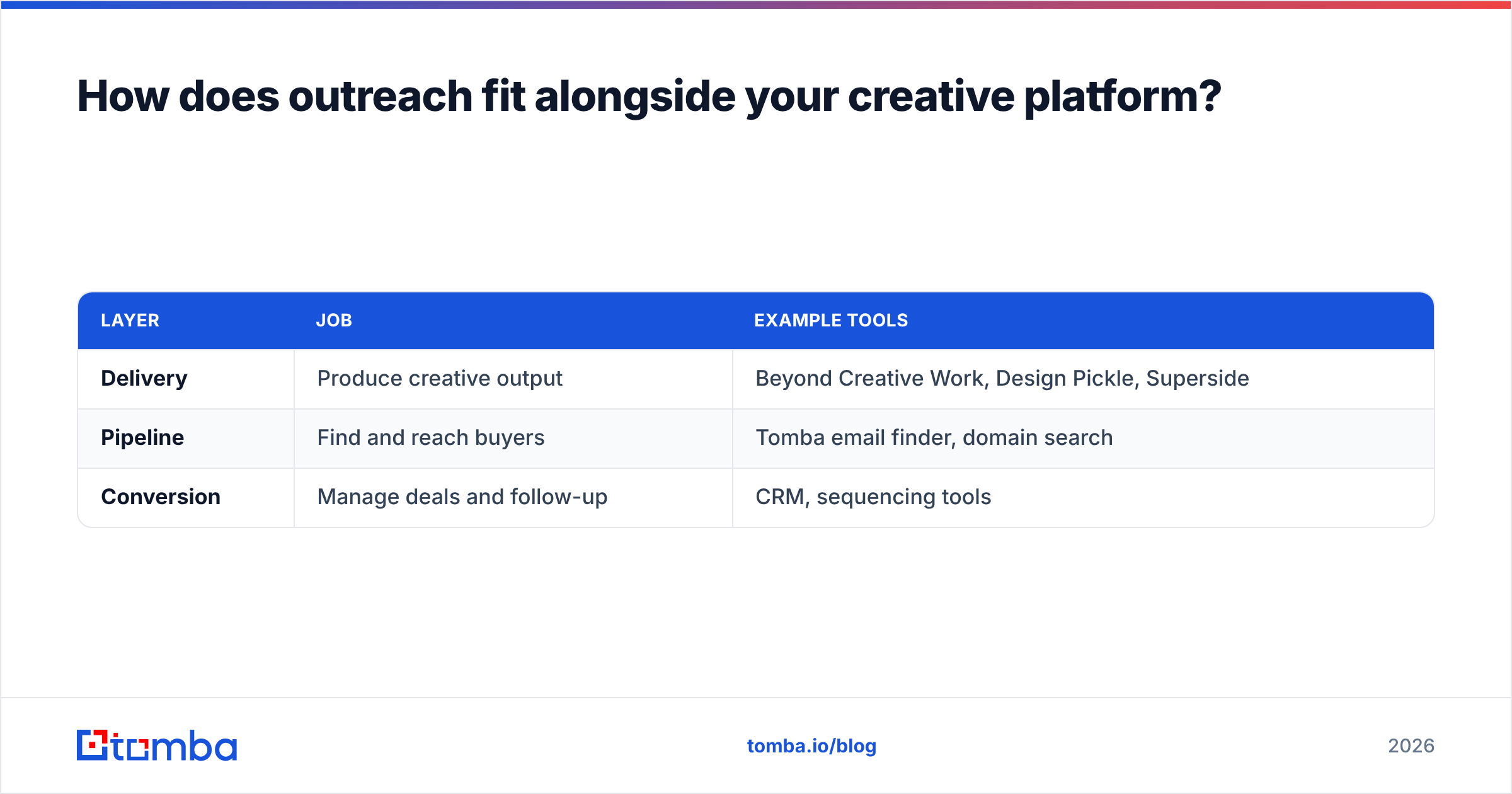
Cleanly. Your creative tool produces the work; your outreach stack fills the pipeline that pays for it. They are complementary, not competing line items.
Here is a simple way to think about the split:
| Layer | Job | Example tools |
|---|---|---|
| Delivery | Produce creative output | Beyond Creative Work, Design Pickle, Superside |
| Pipeline | Find and reach buyers | Tomba email finder, domain search |
| Conversion | Manage deals and follow-up | CRM, sequencing tools |
If you run outreach at any real volume, the bottleneck quickly becomes data quality and speed. Looking up contacts one at a time does not scale past a few prospects a week. A bulk email finder lets you upload a list of target companies and get back verified, decision-maker emails in one pass — turning a full afternoon of manual research into a few minutes.
The point is not to add more software. It is to make sure the money you save by switching creative platforms actually shows up as new clients, not just a lower monthly bill.
Which beyond creative work alternative should you pick?#
Match the model to your situation rather than the brand to the hype:
- High-volume, predictable budget: ManyPixels or Design Pickle.
- Premium, strategy-led work with deadlines: Superside.
- Scaling agency that wants managed pods: Penji.
- Content brand needing video + graphics: Kimp.
- Complex, senior, one-off builds: Toptal.
- Ongoing freelance without platform fees: Contra.
Whichever you choose, validate three things in a trial before you commit: real turnaround on your actual briefs, the revision policy in writing, and source-file ownership. Those three decide satisfaction far more than the feature grid.
Keep your creative pipeline full with Tomba#
Switching creative platforms saves money. Filling your pipeline makes money — and that comes down to reaching the right people at the right companies before your competitors do.
Tomba's Email Finder gives creative teams a fast, accurate way to find verified professional emails by name, company, or domain, with bulk lookups and built-in verification so your outreach actually reaches inboxes. The free tier includes 25 searches a month, and paid plans start at $49/mo — see full Tomba pricing to match a plan to your outreach volume. Pick the creative platform that fits your delivery, then build the outbound engine that keeps it busy.
// get started
Find, verify and enrich your first contacts today
Start on the free plan with 25 searches a month, then scale when your team is ready.
Free plan · No credit card required · GDPR & CCPA
// about the author