BigDBM Pricing Reviews Pros and Cons: 2026 Guide
An honest breakdown of BigDBM pricing, real user reviews, and the pros and cons every revenue team should weigh before buying B2B and B2C data in 2026.
BigDBM Pricing Reviews Pros and Cons
This BigDBM pricing reviews pros and cons guide gives you a clear, neutral read. We cover what BigDBM costs, what real users say, and where it fits. Use it to decide fast, with no sales call first.
TL;DR
- BigDBM is a raw data licensing vendor, not a self-serve prospecting app. You buy access to identity graphs, consumer records, and intent signals. It runs through custom contracts, not a quick checkout.
- Pricing is quote-only. There is no public price page. Expect annual minimums, volume tiers, and per-record fees set by sales.
- Strengths: deep U.S. consumer (B2C) coverage, identity resolution, and intent data for high-volume marketers and data resellers.
- Weaknesses: no transparent pricing, a steep setup for small teams, and limited day-to-day usability versus self-serve tools.
- If you just need verified business emails, a self-serve tool like the Tomba Email Finder is cheaper and faster to start.
What is BigDBM?#
BigDBM is a U.S.-based B2B and B2C data provider. It licenses large consumer and business datasets. Buyers include marketers, agencies, lead-gen firms, and data resellers. Think of it less like a search box and more like a wholesale warehouse. You do not pick one contact at a time. You license a feed or a file of millions of records. Then you plug it into your own systems.
Their catalog covers consumer demographics, contact records, and property and auto data. It also includes behavioral or intent signals. These are the digital clues that someone is ready to buy. That puts BigDBM closer to firms like Acxiom or LiveRamp than to a sales-prospecting tool. Want an overview of this data category? The vendor's site at bigdbm.com is the primary source. You can also check user sentiment on G2.
The practical takeaway: BigDBM is built for scale and integration, not for a rep who needs five emails before a Tuesday call.
)
How much does BigDBM pricing cost in 2026?#
There is no public BigDBM price list. Like most enterprise data vendors, pricing is quote-only. It depends on what you license, how much, and how you use it.
The variables that move your quote:
- Data type — B2C consumer files, B2B contact data, and intent data are priced differently. Intent and identity-resolution products usually cost the most.
- Volume — per-record costs fall as you buy more. Small one-off lists carry the highest unit price.
- Delivery model — a one-time file export is priced differently from an ongoing API match or a recurring feed.
- Match rate vs. append — enrichment jobs are often billed on matched records, not the full input file.
- Contract length — annual deals unlock better rates than month-to-month. Many enterprise contracts also carry an annual minimum.
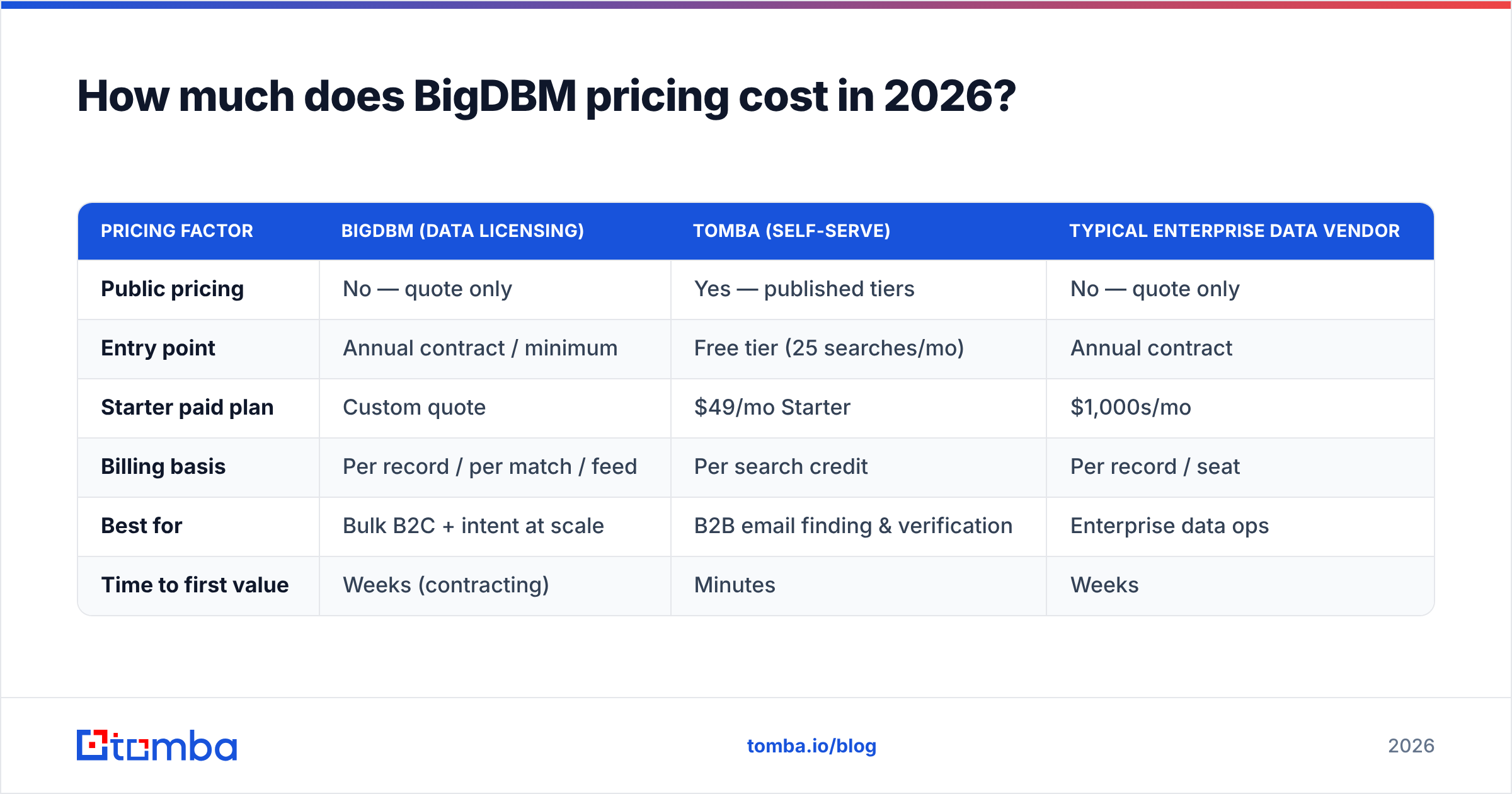
Here is a simple way to compare the model against transparent self-serve tools. BigDBM does not publish exact figures.
| Pricing factor | BigDBM (data licensing) | Tomba (self-serve) | Typical enterprise data vendor |
|---|---|---|---|
| Public pricing | No — quote only | Yes — published tiers | No — quote only |
| Entry point | Annual contract / minimum | Free tier (25 searches/mo) | Annual contract |
| Starter paid plan | Custom quote | $49/mo Starter | $1,000s/mo |
| Billing basis | Per record / per match / feed | Per search credit | Per record / seat |
| Best for | Bulk B2C + intent at scale | B2B email finding & verification | Enterprise data ops |
| Time to first value | Weeks (contracting) | Minutes | Weeks |
Want published numbers to budget against? Compare the model above with transparent Tomba pricing. The plans are Free, Starter at $49/mo, Growth at $99/mo, and Pro at $249/mo. Check them before you sit through a BigDBM sales call. It reframes what "expensive" really means for your use case.
What do BigDBM reviews say?#
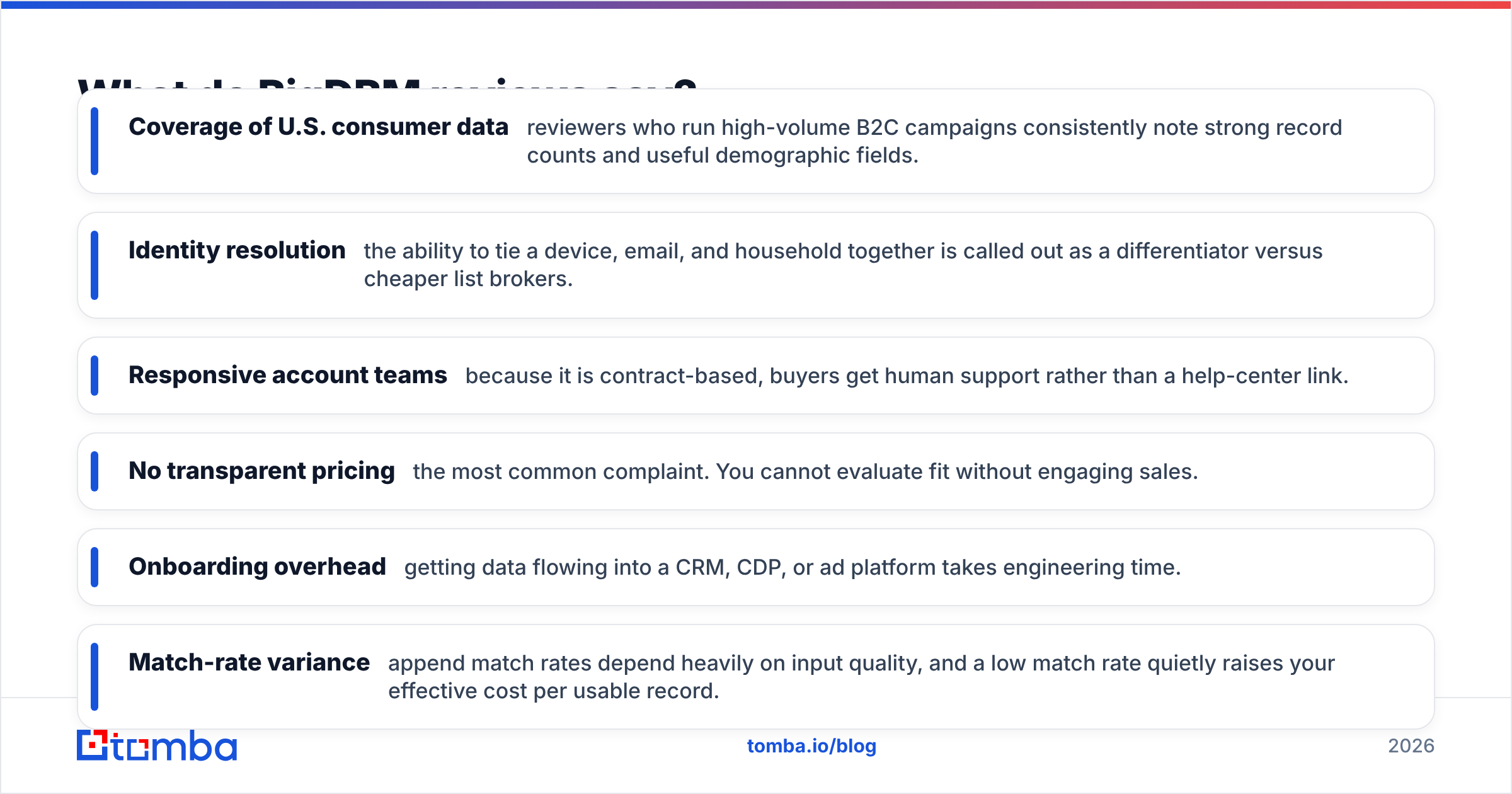
BigDBM reviews skew positive on data depth and account support. They skew critical on transparency and self-serve usability. We pulled themes from public directories like Capterra and G2. The pattern looks like this.
What reviewers praise:
- Coverage of U.S. consumer data — high-volume B2C reviewers note strong record counts and useful demographic fields.
- Identity resolution — tying a device, email, and household together stands out versus cheaper list brokers.
- Responsive account teams — because it is contract-based, buyers get human support, not a help-center link.
What reviewers criticize:
- No transparent pricing — the most common complaint. You cannot judge fit without engaging sales.
- Onboarding overhead — getting data into a CRM, CDP, or ad platform takes engineering time.
- Match-rate variance — append match rates depend on input quality. A low match rate quietly raises your real cost per usable record.
- Overkill for SMBs — small teams report paying for scale they cannot use.
A fair summary: reviewers who are data resellers, performance marketers, or RevOps teams at scale tend to be satisfied. Reviewers who wanted a quick prospecting tool tend to feel it was the wrong type of product. If your team lives in revenue operations, that difference matters a lot.
What are the pros and cons of BigDBM?#
Here is the honest balance sheet.
Pros
- Massive B2C and identity data — among the deeper consumer datasets you can license.
- Intent signals — useful for prioritizing who to contact before competitors do.
- Flexible delivery — file, API, or feed to fit your stack.
- Custom scoping — you license exactly the fields and segments you need.
- Strong for enrichment and append at volume.
Cons
- Opaque pricing — no way to self-qualify on budget.
- High floor — annual minimums make it impractical for small teams or one-off projects.
- Integration burden — needs technical resources to operationalize.
- Slow time-to-value — contracting and onboarding take weeks.
- Not built for one-off contact lookup — the wrong tool if you just need an email or two.
The decisive question is category fit. BigDBM competes with wholesale data suppliers. If your real job is finding and verifying business contacts, you are looking at the wrong shelf. You are probably overpaying. That is the trap in the meme below.
)
Who should buy BigDBM — and who should not?#
Buy BigDBM if you are:
- A data reseller or list provider that needs raw records to repackage.
- A performance marketing team running large B2C audiences and matchback.
- A RevOps or data engineering team building enrichment into a CDP or warehouse, with the staff to integrate it.
- A buyer who values intent and identity resolution over per-contact convenience.
Look elsewhere if you are:
- An SMB or startup that needs contacts this week, not after a procurement cycle.
- A sales rep or SDR who needs verified business emails on demand.
- A team that wants published, predictable pricing and a free tier to test first.
- A buyer focused on B2B email finding and verification rather than bulk consumer data.
For that second group, a self-serve stack wins on speed and cost. Run a domain search to map every contact at a company. Verify the results with an email verifier. Then enrich the rest with data enrichment. No sales call or annual contract is needed.
What are the best BigDBM alternatives in 2026?#
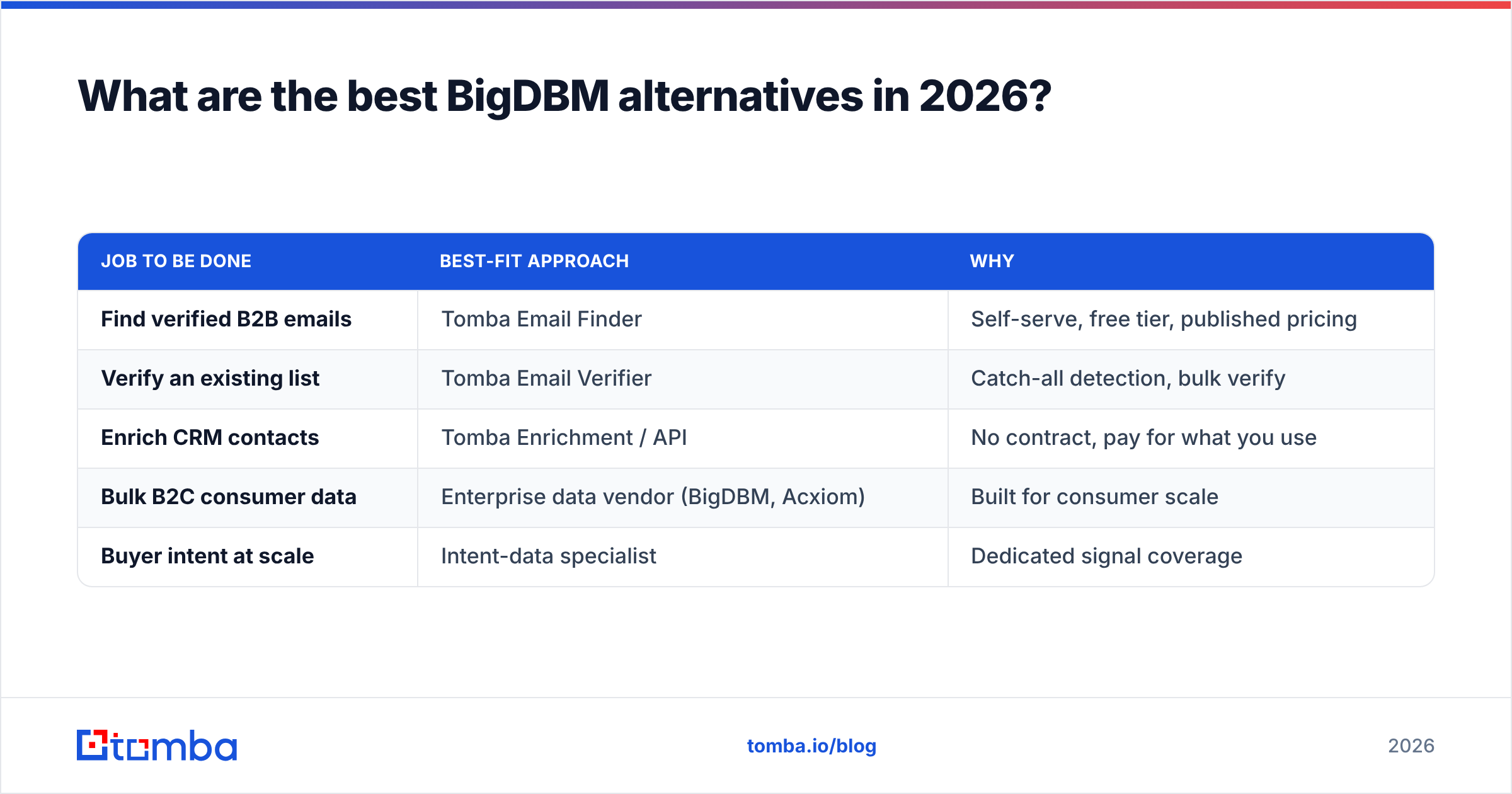
The right alternative depends on what you were trying to do with BigDBM. Split it by job.
| Job to be done | Best-fit approach | Why |
|---|---|---|
| Find verified B2B emails | Tomba Email Finder | Self-serve, free tier, published pricing |
| Verify an existing list | Tomba Email Verifier | Catch-all detection, bulk verify |
| Enrich CRM contacts | Tomba Enrichment / API | No contract, pay for what you use |
| Bulk B2C consumer data | Enterprise data vendor (BigDBM, Acxiom) | Built for consumer scale |
| Buyer intent at scale | Intent-data specialist | Dedicated signal coverage |
The pattern is clear. For B2B contact discovery and verification, a self-serve tool is faster and cheaper. It is also easier to trust, because the price is on the page. For wholesale consumer data and identity graphs, a licensing vendor like BigDBM fits. Just go in knowing the cost and the setup work.
Evaluating several vendors at once? Build your shortlist by job to be done, not by brand. Pull the whole review into a B2B database you control. Then you compare like for like.
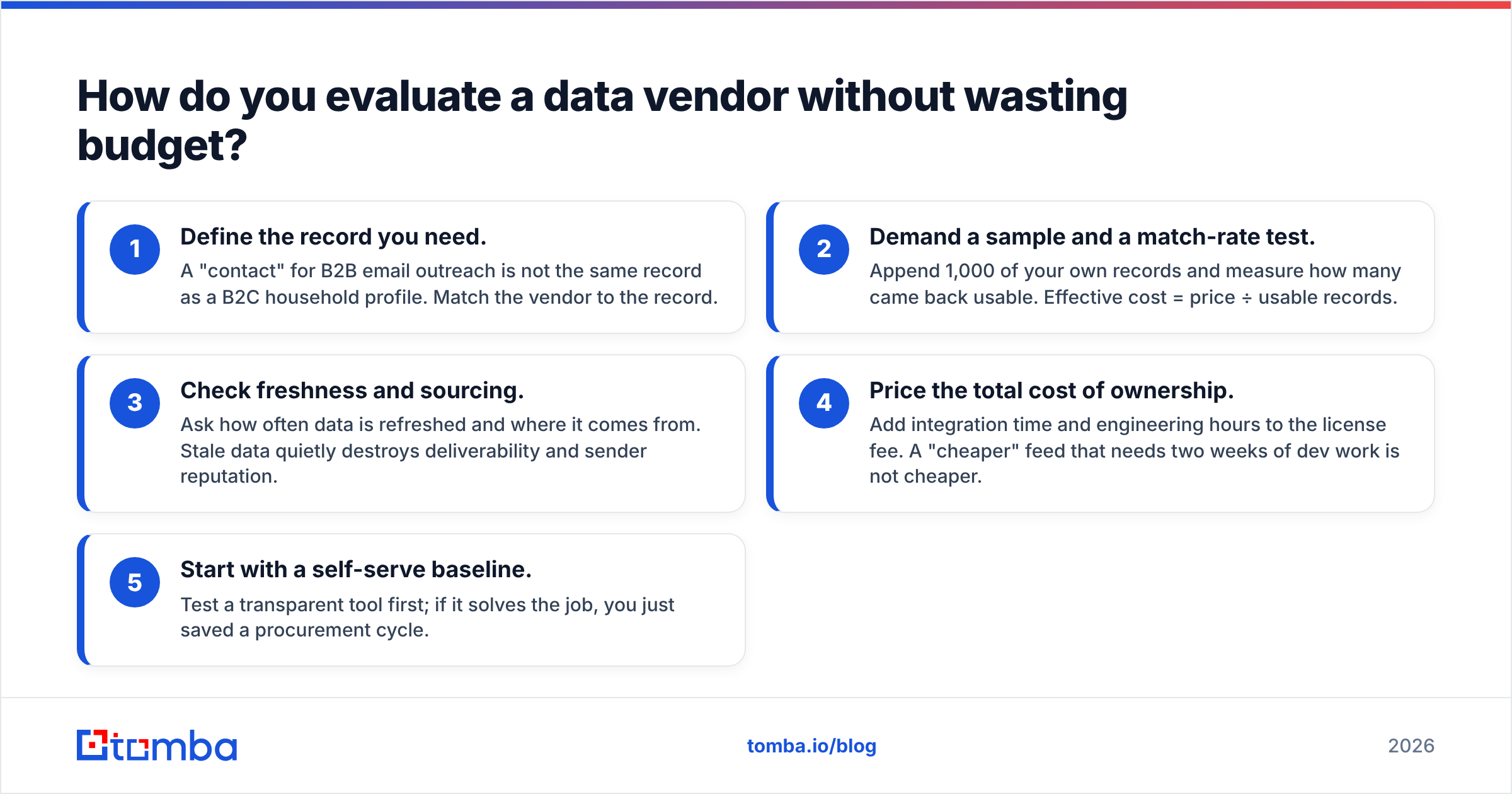
How do you evaluate a data vendor without wasting budget?#
Run this five-step check before you sign anything — with BigDBM or any vendor.
- Define the record you need. A "contact" for B2B outreach is not the same as a B2C household profile. Match the vendor to the record.
- Demand a sample and a match-rate test. Append 1,000 of your own records and measure how many came back usable. Effective cost = price ÷ usable records.
- Check freshness and sourcing. Ask how often data is refreshed and where it comes from. Stale data quietly hurts deliverability and sender reputation.
- Price the total cost of ownership. Add integration time and engineering hours to the license fee. A "cheaper" feed that needs two weeks of dev work is not cheaper.
- Start with a self-serve baseline. Test a transparent tool first. If it solves the job, you just saved a procurement cycle.
That last step is the cheapest insurance you can buy. Most teams that think they need a wholesale data contract really need a few hundred verified B2B emails a month. A self-serve tool delivers that today, at a published price.
The bottom line on BigDBM pricing reviews pros and cons#
BigDBM is a capable B2C and identity-data vendor. It earns solid reviews from the buyers it is built for: resellers, performance marketers, and data teams at scale. That is the honest read on BigDBM pricing reviews pros and cons. Its biggest cons are opaque pricing and integration overhead. Those make it the wrong fit for most sales and SMB teams who just need verified contacts.
So decide by category. If your real job is B2B email finding, verification, and enrichment, skip the sales cycle and start with the Tomba Email Finder. You get a free tier of 25 searches a month and transparent plans from $49/mo. A domain search maps whole companies. An email finder API is ready when you scale. The price is on the page, and your first results take minutes, not weeks.
Ready to find emails that actually work?
Join 150,000+ professionals who stopped guessing and started sending. Free credits on signup — no credit card required.
Get the Tomba newsletter
Practical outbound tactics and product updates — once every two weeks.
About the author