BigDBM vs Apollo.io 2026: Which B2B Data Platform Wins?
BigDBM sells raw data files; Apollo.io sells an all-in-one prospecting suite. Here's how the two stack up on coverage, accuracy, pricing, and fit in 2026 — plus where a focused finder beats both.
TL;DR
- BigDBM is a data supplier — it licenses large consumer and B2B identity datasets you pipe into your own systems. Apollo.io is a data application — a prospecting suite with a contact database, sequences, and a dialer bolted on top.
- Pick BigDBM if you're a RevOps or data team that wants raw records to enrich a warehouse or build audiences. Pick Apollo if reps need to search, find, and email contacts inside one UI.
- Apollo wins on usability and price for individual sellers; BigDBM wins on raw volume and licensing flexibility for data engineering teams.
- Neither is a precision email-finding tool. If your bottleneck is verified work emails by domain, a focused finder like Tomba often beats both on accuracy-per-dollar.
- Below: a side-by-side table, accuracy notes, pricing reality, and how to choose without overbuying.
What is BigDBM and what is Apollo.io?#
Short version: they solve different problems that look similar from a distance.
BigDBM is a US-focused data provider. Think of it as a wholesaler — it aggregates identity graphs, consumer profiles, property data, and B2B firmographics, then licenses those records to companies that ingest them. You don't really "log in and prospect" with BigDBM the way a sales rep would. You license a feed, an API, or a file, and your engineers wire it into a CRM, a CDP, or an ad-audience pipeline.
Apollo.io is the opposite shape. It's a self-serve sales prospecting platform built around a contact database of hundreds of millions of profiles, with search filters, list building, email sequencing, a dialer, and CRM sync stacked on top. A single SDR can sign up, filter for "VP Marketing at 50–200 person SaaS companies," and start sending in an afternoon.
So when you ask "BigDBM vs Apolloio," you're really asking: do I need a data ingredient, or a finished meal?
)
How do BigDBM and Apollo.io compare head to head?#
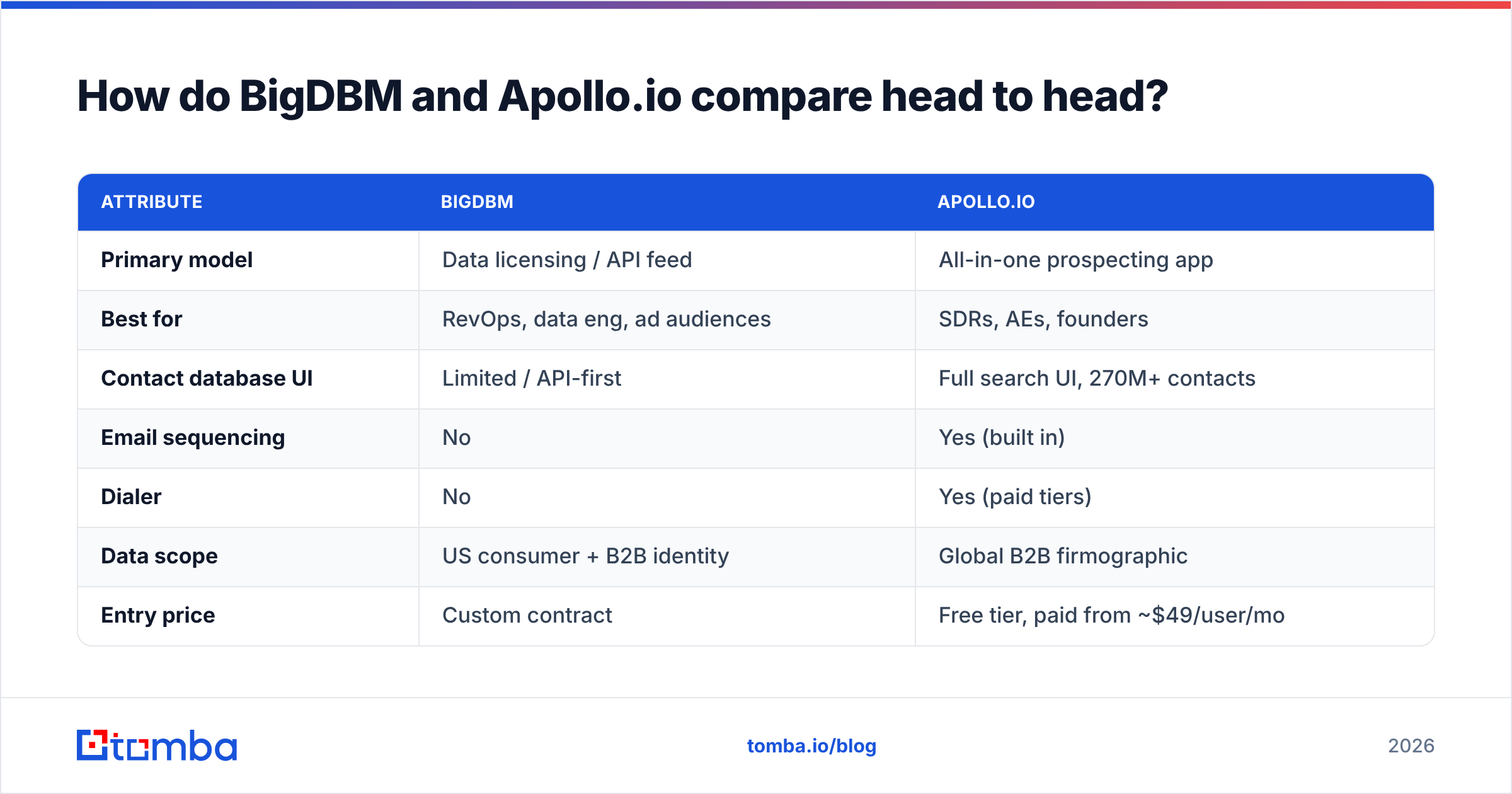
Here's the practical breakdown across the attributes that actually drive a buying decision.
| Attribute | BigDBM | Apollo.io |
|---|---|---|
| Primary model | Data licensing / API feed | All-in-one prospecting app |
| Best for | RevOps, data eng, ad audiences | SDRs, AEs, founders |
| Contact database UI | Limited / API-first | Full search UI, 270M+ contacts |
| Email sequencing | No | Yes (built in) |
| Dialer | No | Yes (paid tiers) |
| Data scope | US consumer + B2B identity | Global B2B firmographic |
| Entry price | Custom contract | Free tier, paid from ~$49/user/mo |
| Onboarding | Engineering project | Self-serve, same day |
| Export flexibility | High (you own the feed) | Capped by plan credits |
| Ideal output | Enriched warehouse records | Ready-to-email contact lists |
Two honest takeaways from that grid:
- Apollo is faster to value for a person. If one rep needs leads this week, Apollo wins on time-to-first-email by a mile.
- BigDBM is more flexible for a system. If you're feeding a data warehouse, building lookalike audiences, or enriching millions of rows, a licensed feed beats a per-seat app you have to scrape exports out of.
Which one has more accurate data in 2026?#
Accuracy is where the marketing claims get loud, so judge by category, not by headline numbers.
BigDBM is strongest on US identity and consumer data — names, addresses, property, demographic and behavioral attributes tied to a person. For B2B work, its strength is matching and identity resolution: stitching a record to the right human across sources. That's valuable for enrichment and audience modeling. It's less obviously the right tool when you specifically need a deliverable corporate email for a named person at a named company.
Apollo carries a huge global B2B database, but coverage and freshness vary hard by region and seniority. Senior contacts at well-known companies tend to be accurate; long-tail SMBs, non-US markets, and recently-moved employees are where you'll see stale titles and bounced emails. Apollo's own verification helps, but anyone running volume should still re-verify before sending — independent reviews on G2 consistently flag bounce rates as the most common complaint.
The uncomfortable truth: a general database, however large, is not the same as a verified email at send time. Job changes alone churn a meaningful slice of any B2B database every quarter. This is why teams that care about sender reputation layer a dedicated finder and verifier on top of whatever database they license.
That's the gap a focused tool fills. Running names and domains through a dedicated email verifier before a campaign protects deliverability in a way neither a raw feed nor a bundled database guarantees on its own.
When should you choose BigDBM?#
Choose BigDBM when the work is fundamentally a data engineering project, not a selling one. Concrete fits:
- You own a data warehouse or CDP and want to enrich existing records with identity, firmographic, or intent attributes at scale.
- You build advertising audiences — lookalikes, suppression lists, custom segments — and need raw records you control.
- You're a platform or agency reselling enriched data inside your own product or service.
- You need US consumer-graph depth that B2B-only tools simply don't carry.
- Per-seat pricing doesn't fit because the consumers of the data are systems, not people clicking around a UI.
If three or more of those describe you, a licensed feed is the right shape — and you'll likely pair it with your own data enrichment and matching logic downstream.
When should you choose Apollo.io?#
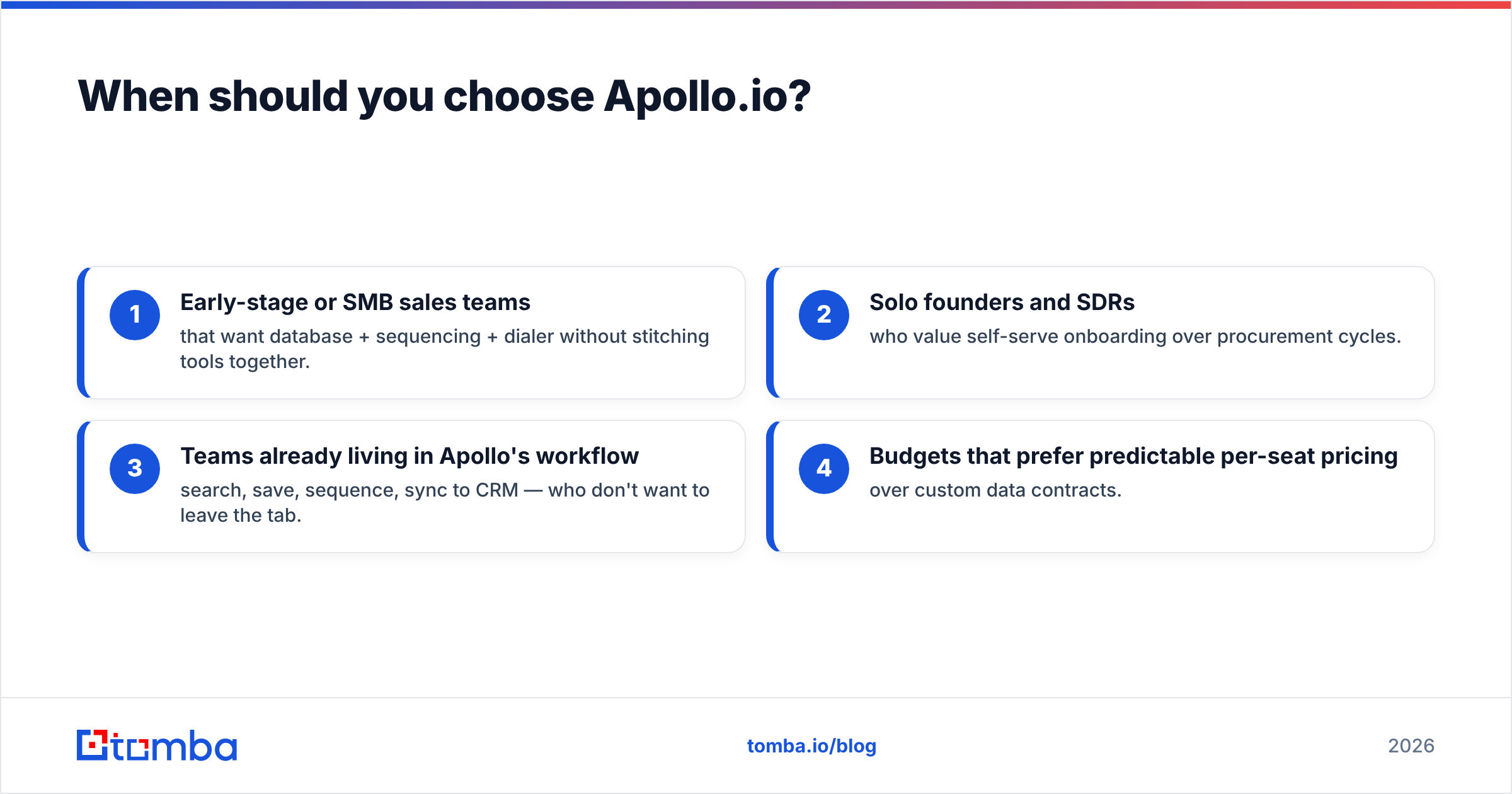
Choose Apollo when humans need to find and contact people today, inside one screen. Strong fits:
- Early-stage or SMB sales teams that want database + sequencing + dialer without stitching tools together.
- Solo founders and SDRs who value self-serve onboarding over procurement cycles.
- Teams already living in Apollo's workflow — search, save, sequence, sync to CRM — who don't want to leave the tab.
- Budgets that prefer predictable per-seat pricing over custom data contracts.
Apollo's weakness shows up at scale: credit caps, export limits, and the re-verification tax on bulk lists. Many teams use Apollo for discovery and a separate finder/verifier for the actual send. Compare that to running domains through a purpose-built domain search when you already know the company and just need the right person and a clean address.
)
How much do BigDBM and Apollo.io cost?#
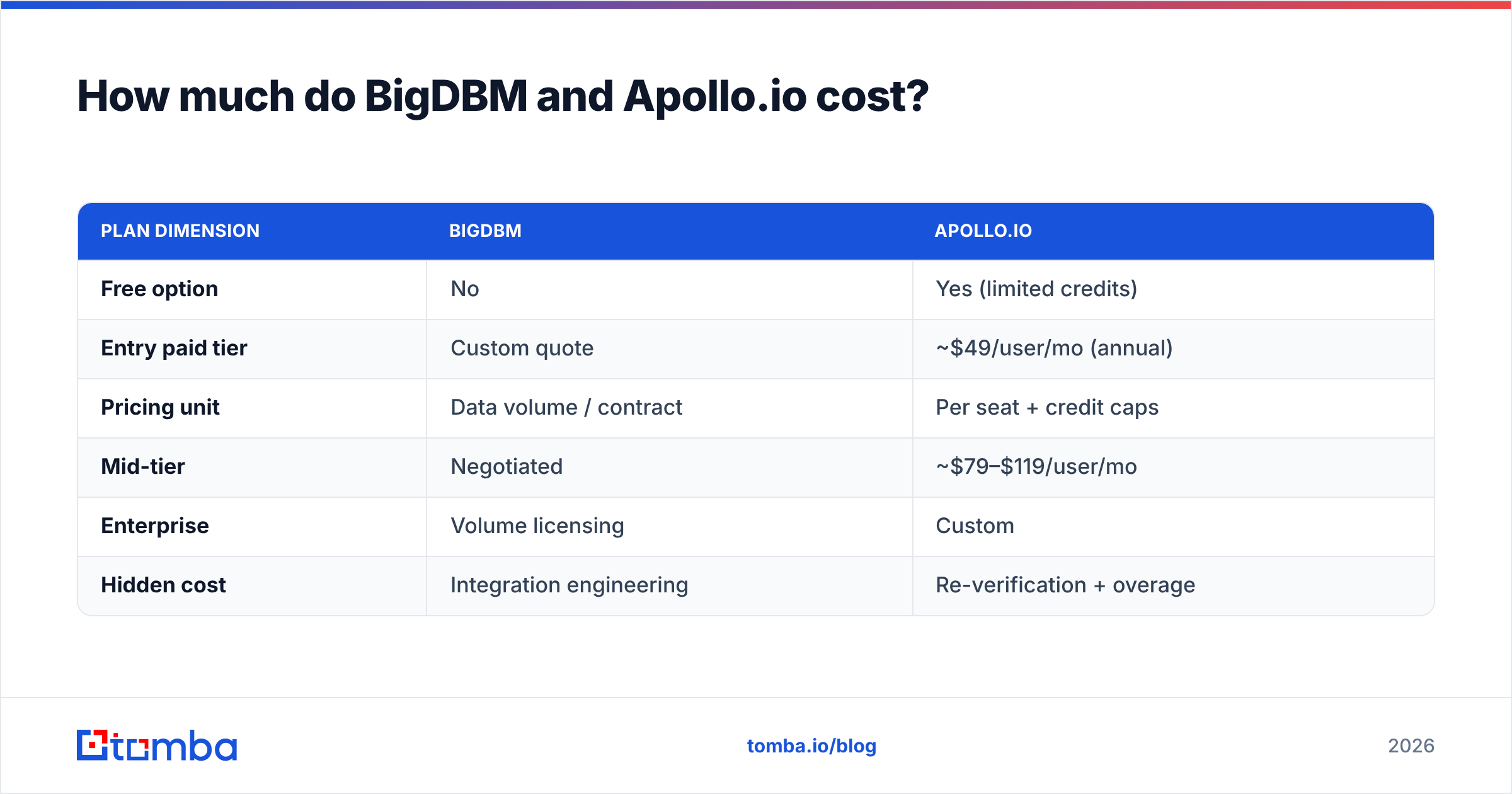
Pricing is the cleanest way to see how different these two really are.
| Plan dimension | BigDBM | Apollo.io |
|---|---|---|
| Free option | No | Yes (limited credits) |
| Entry paid tier | Custom quote | ~$49/user/mo (annual) |
| Pricing unit | Data volume / contract | Per seat + credit caps |
| Mid-tier | Negotiated | ~$79–$119/user/mo |
| Enterprise | Volume licensing | Custom |
| Hidden cost | Integration engineering | Re-verification + overage |
BigDBM doesn't publish a public price card because every deal is scoped to volume and use case — expect a sales conversation and an annual commitment. Apollo publishes tiers and a free plan, which is why it's the default for individuals testing the waters; current pricing is on the Apollo.io site.
The catch on both sides is the hidden cost. With BigDBM it's the engineering time to ingest and maintain a feed. With Apollo it's credit overages and the deliverability cost of emailing unverified records. Budget for the second line item, not just the sticker.
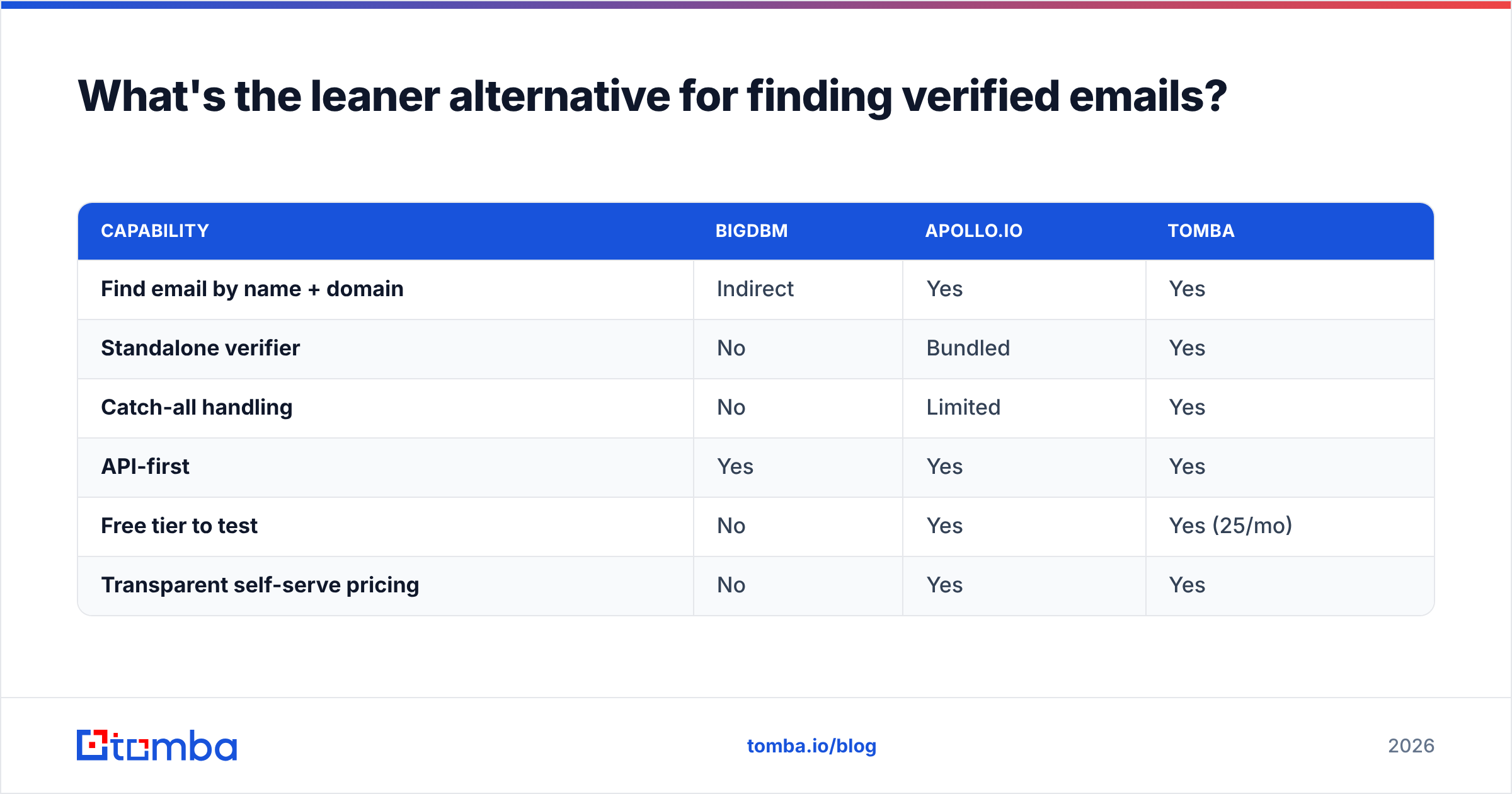
What's the leaner alternative for finding verified emails?#
If your real job is "get a verified work email for a specific person or company," you may be overbuying with either platform. A focused email-finding stack is cheaper and more accurate for that one job.
This is where Tomba fits — not as a replacement for an identity graph or a full sales suite, but as the precision layer. The email finder returns professional addresses by name, company, or domain; the verifier checks deliverability before you send; and a catch-all verifier handles the domains that silently accept everything. For teams that want a transparent price instead of a custom contract, the published Tomba pricing is straightforward.
| Capability | BigDBM | Apollo.io | Tomba |
|---|---|---|---|
| Find email by name + domain | Indirect | Yes | Yes |
| Standalone verifier | No | Bundled | Yes |
| Catch-all handling | No | Limited | Yes |
| API-first | Yes | Yes | Yes |
| Free tier to test | No | Yes | Yes (25/mo) |
| Transparent self-serve pricing | No | Yes | Yes |
A common 2026 stack looks like this: use Apollo or BigDBM for discovery and firmographics, then route the actual contact-and-verify step through a dedicated finder via the Tomba API so deliverability stays high and credits don't get wasted on dead addresses.
So which should you pick: BigDBM or Apollo.io?#
Decide by who consumes the data:
- Systems consume it (warehouse, CDP, ad platform, your own product) → BigDBM. You want a licensed feed you control, not a per-seat app.
- People consume it (reps searching, sequencing, dialing) → Apollo.io. You want one UI and same-day onboarding.
- You only need verified emails for outreach → skip the heavyweight platform tax and run a focused finder + verifier. You'll spend less and bounce less.
There's no universal winner here because they're not really competitors — they're different rungs on the same ladder. The mistake is buying a $50k data contract when you needed verified emails, or paying per seat for a database you then have to re-verify anyway.
Map the tool to the consumer of the data, and the choice gets obvious fast.
Ready to fix the part that actually breaks campaigns?#
Most "BigDBM vs Apollo.io" debates miss the real failure point: emails that bounce because the database was stale at send time. If that's your bottleneck, you don't need a bigger platform — you need a sharper finder. Start free with the Tomba Email Finder: find professional addresses by domain, name, or company, verify them before you send, and keep your sender reputation intact. Twenty-five searches a month, no contract, no credit-card friction — pair it with whatever database you already run and watch your bounce rate drop.
// get started
Find, verify and enrich your first contacts today
Start on the free plan with 25 searches a month, then scale when your team is ready.
Free plan · No credit card required · GDPR & CCPA
// about the author