BigDBM vs Clodura.ai (2026): Which B2B Data Tool Wins?
BigDBM sells raw B2B/B2C data at scale; Clodura.ai bundles prospecting, sequences, and intent. Here's how the two compare in 2026 — and where a finder like Tomba fits.
BigDBM vs Clodura.ai is really a choice between two ideas about B2B data. One sells you the raw material by the truckload. The other wraps a smaller dataset in a prospecting workflow. Pick wrong and you either pay for records you can't use, or pay for a workflow you already own.
This BigDBM vs Clodura.ai guide breaks down what each platform actually does, where the data comes from, how pricing works in 2026, and which buyer each one fits. We'll also be honest about where a focused tool earns its place in the stack.
TL;DR#
BigDBM is a bulk data provider (B2B and consumer). You buy large licensed datasets — firmographics, contact records, intent, identity graphs — usually via API, list delivery, or data feeds. Best for marketers and data teams that want volume to load into their own systems.
Clodura.ai is an all-in-one sales prospecting platform: a built-in B2B database plus email sequencing, a sales-cadence engine, buyer intent, and org-chart data. Best for SDR teams that want database and outreach in one login.
Accuracy is the real differentiator. Big databases drift fast; verified contact data matters more than headline record counts.
Neither is a precision email finder. If your core need is finding and verifying the exact email for a named person at a known company, a dedicated tool like the Tomba Email Finder is cheaper and more accurate than buying a whole platform.
Our take: Use BigDBM for scale data licensing, Clodura.ai for bundled SDR workflows, and a verification-first finder to keep whichever list you build clean.
What is BigDBM?#
BigDBM is a US-focused data provider that licenses large volumes of B2B and B2C contact and identity data. Instead of giving you a search box and a sequencer, it gives you data — delivered as API responses, hosted files, or feeds you pipe into your own CRM, CDP, or ad platform.
Their pitch centers on breadth: hundreds of millions of consumer records and tens of millions of business contacts, plus identity resolution (matching emails, devices, and postal addresses to a single person). That makes BigDBM popular with performance marketers, data co-ops, and teams building audiences for paid media or direct mail — not just sales reps hunting one contact at a time.
The trade-off is that raw data is only as good as your ability to use it. You need engineering to ingest feeds, a way to verify records before you send, and suppression logic so you don't email someone who opted out. BigDBM hands you a powerful engine; you build the car around it.
What is Clodura.ai?#
Clodura.ai is a sales prospecting and engagement platform built around its own B2B database. Where BigDBM stops at data, Clodura.ai keeps going: it layers an email-sequencing tool, a cadence engine, org charts, technographics, and buyer-intent signals on top of the contacts, so an SDR can find a prospect and email them without leaving the app.
Its database advertises hundreds of millions of B2B contacts and millions of companies, with direct dials and verified emails surfaced inside the workflow. There's a free tier, which makes it easy for small teams to try, and the all-in-one design appeals to startups that don't want to glue together a finder, a verifier, and a separate sequencer.
The catch with all-in-one platforms is the classic one: you adopt the whole suite to get the database, and you may end up paying for a sequencer you'd rather run in your existing sales engagement tool. Data freshness across a giant bundled database is also harder to guarantee than in a tool whose only job is accuracy.
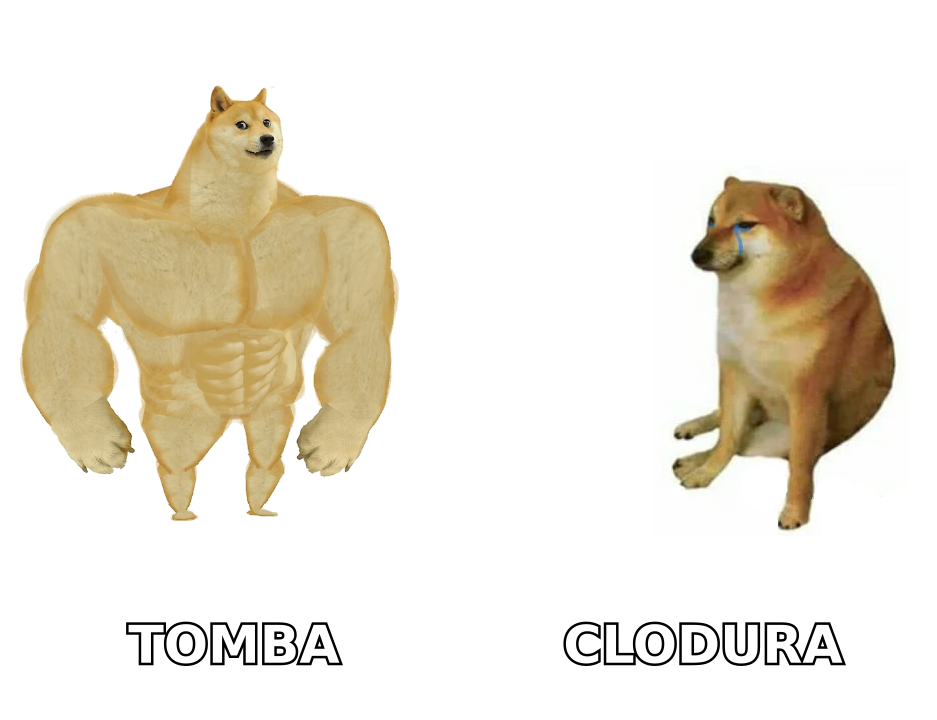
BigDBM vs Clodura.ai: how they compare at a glance#
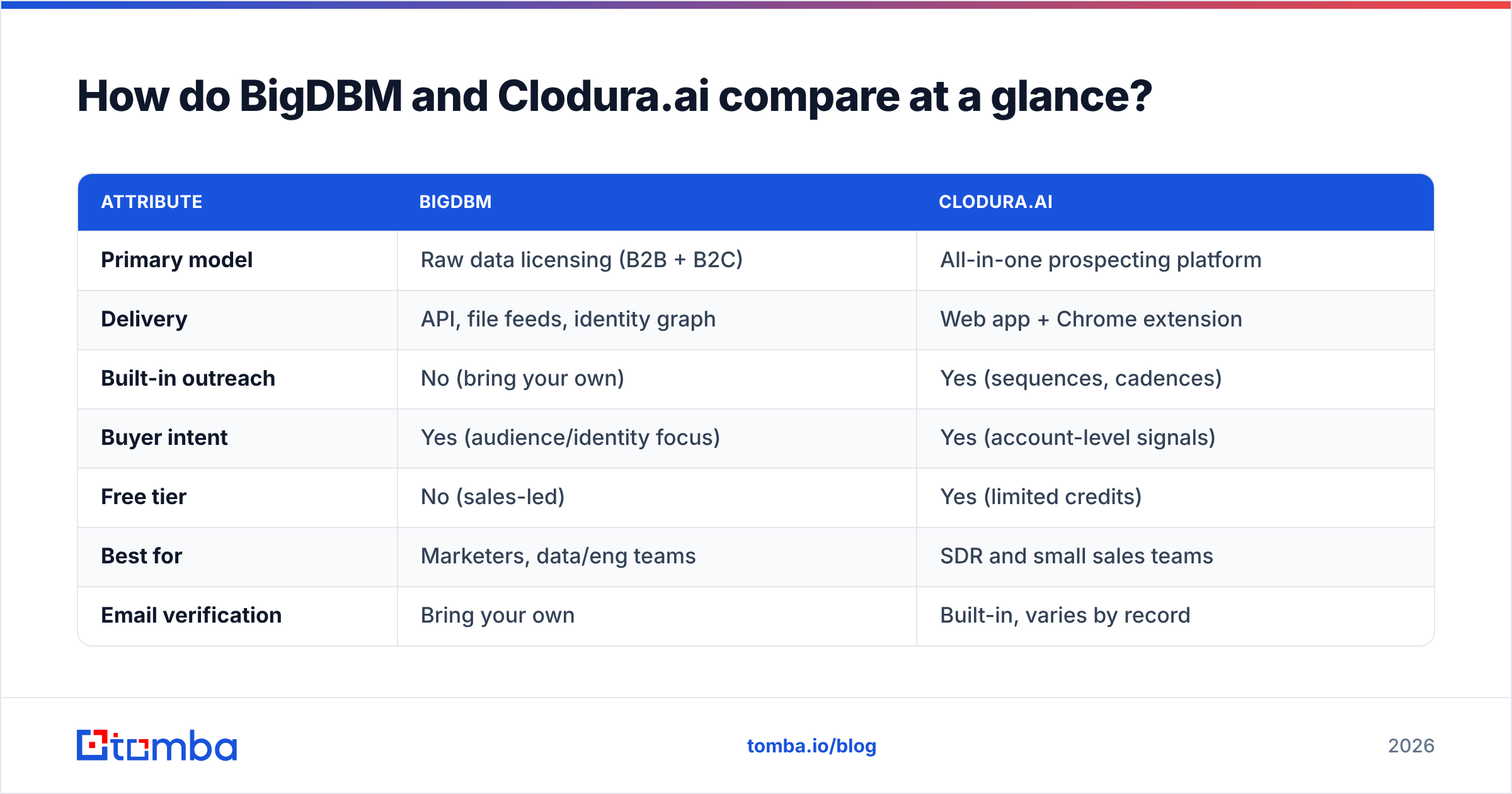
Here's the core breakdown. Treat record counts as directional — every vendor counts differently, and a verified contact is worth ten stale ones.
| Attribute | BigDBM | Clodura.ai |
|---|---|---|
| Primary model | Raw data licensing (B2B + B2C) | All-in-one prospecting platform |
| Delivery | API, file feeds, identity graph | Web app + Chrome extension |
| Built-in outreach | No (bring your own) | Yes (sequences, cadences) |
| Buyer intent | Yes (audience/identity focus) | Yes (account-level signals) |
| Free tier | No (sales-led) | Yes (limited credits) |
| Best for | Marketers, data/eng teams | SDR and small sales teams |
| Email verification | Bring your own | Built-in, varies by record |
| Geographic strength | US-heavy | Global, US + APAC |
The pattern is clear when you line them up. BigDBM wins on raw scale and identity resolution for marketing use cases. Clodura.ai wins on time-to-first-email for a sales rep who wants one tool.
Which platform has more accurate data?#
Neither vendor will hand you a clean number, so judge accuracy by process, not by marketing claims. Both platforms aggregate data from many sources, and aggregation always introduces decay — people change jobs roughly every two to three years, which silently rots a slice of any database every month.
What actually protects your sender reputation is verification at the moment of send, not the freshness date printed on a record. Whether you license from BigDBM or pull from Clodura.ai, you should re-verify before any cold campaign. That's why even teams on big platforms keep a standalone email verifier in the loop — it catches the records that went stale between the vendor's last refresh and your send date.
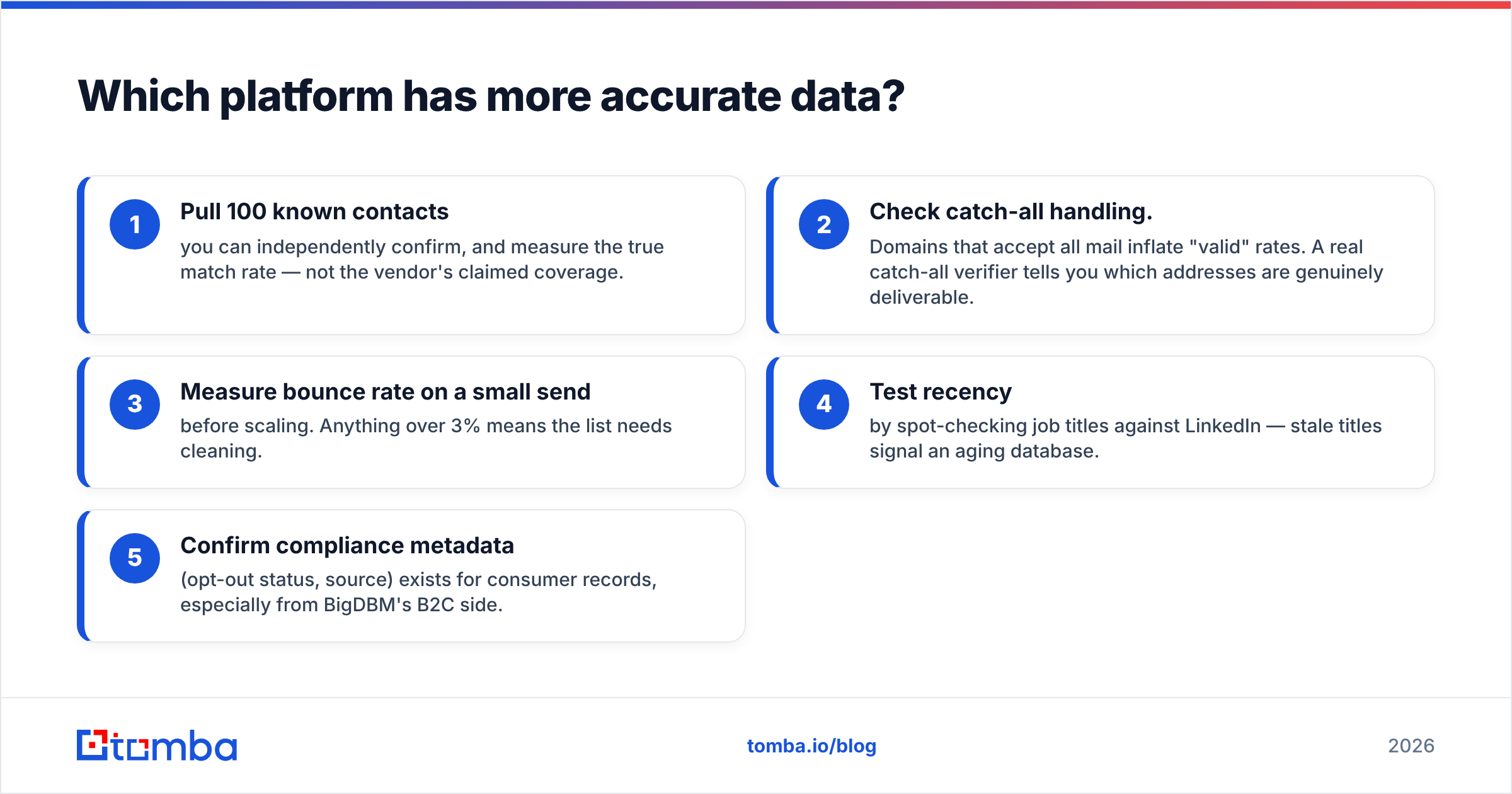
Here's a practical accuracy checklist to run against either tool during a trial:
- Pull 100 known contacts you can independently confirm, and measure the true match rate — not the vendor's claimed coverage.
- Check catch-all handling. Domains that accept all mail inflate "valid" rates. A real catch-all verifier tells you which addresses are genuinely deliverable.
- Measure bounce rate on a small send before scaling. Anything over 3% means the list needs cleaning.
- Test recency by spot-checking job titles against LinkedIn — stale titles signal an aging database.
- Confirm compliance metadata (opt-out status, source) exists for consumer records, especially from BigDBM's B2C side.
Run that on both, and the "bigger database" argument usually evaporates. Coverage is easy; deliverable coverage is the hard part.
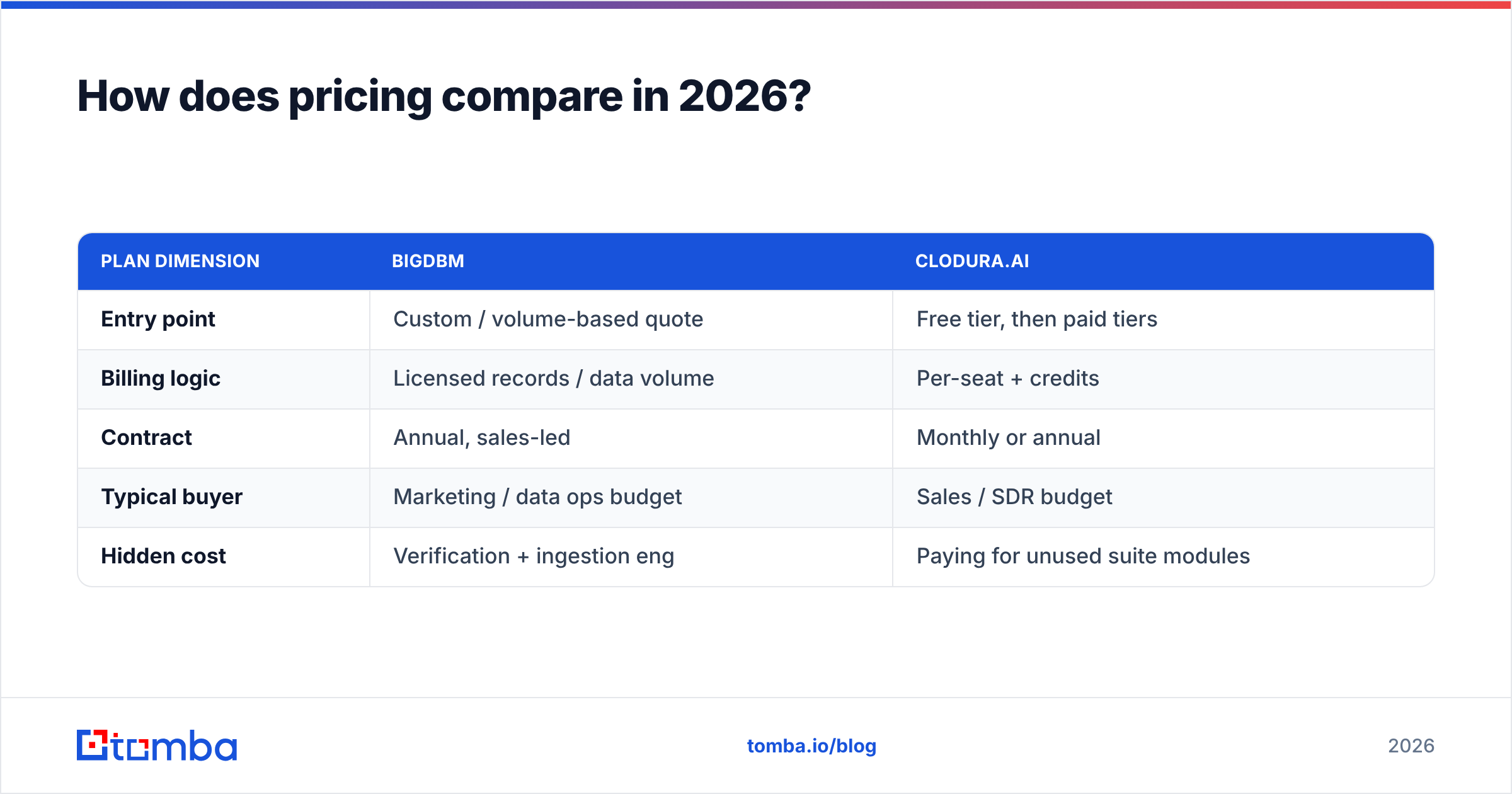
How does pricing compare in 2026?#
Pricing is where these two diverge most, because they sell fundamentally different things.
| Plan dimension | BigDBM | Clodura.ai |
|---|---|---|
| Entry point | Custom / volume-based quote | Free tier, then paid tiers |
| Billing logic | Licensed records / data volume | Per-seat + credits |
| Contract | Annual, sales-led | Monthly or annual |
| Typical buyer | Marketing / data ops budget | Sales / SDR budget |
| Hidden cost | Verification + ingestion eng | Paying for unused suite modules |
BigDBM is quote-driven and tuned for volume licensing, so it rarely makes sense for a small team that needs a few hundred contacts a month. Clodura.ai's free tier and per-seat model fit smaller sales orgs, but the all-in-one price assumes you'll use every module — and many teams don't.
If you mostly need accurate contact data and already have a sequencer (or a CRM like HubSpot or Salesforce), paying for a full platform is overspending. This is the gap a focused tool fills. Tomba's pricing starts free at 25 searches a month, with the Starter plan at $49/mo and Growth at $99/mo — you pay for finding and verifying contacts, not for a bundled cadence engine you'll never open.
Which one should you choose?#
Match the tool to the motion, not the marketing.
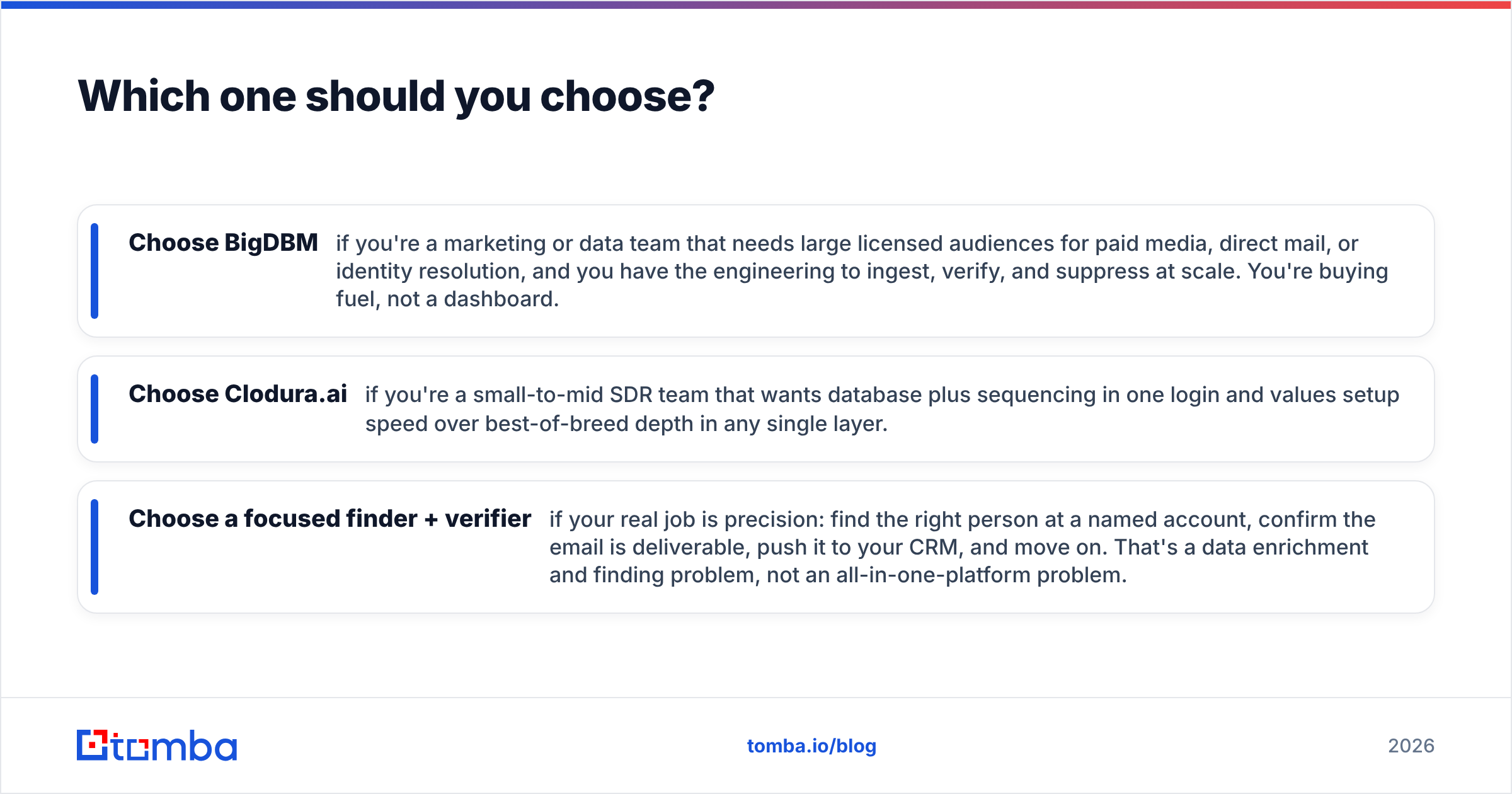
- Choose BigDBM if you're a marketing or data team that needs large licensed audiences for paid media, direct mail, or identity resolution, and you have the engineering to ingest, verify, and suppress at scale. You're buying fuel, not a dashboard.
- Choose Clodura.ai if you're a small-to-mid SDR team that wants database plus sequencing in one login and values setup speed over best-of-breed depth in any single layer.
- Choose a focused finder + verifier if your real job is precision: find the right person at a named account, confirm the email is deliverable, push it to your CRM, and move on. That's a data enrichment and finding problem, not an all-in-one-platform problem.
Many high-performing teams actually run a hybrid. They license bulk data or use a platform for top-of-funnel breadth, then run every contact through a dedicated verifier before outreach to protect email deliverability. The platform gives reach; the finder/verifier gives precision.
How do they handle outbound workflow and integrations?#
This is where the all-in-one vs. best-of-breed debate gets concrete.
Clodura.ai bundles the sequencer, so an SDR can build a cadence and send from inside the app. That's convenient until you already own a sales engagement platform — then you're either duplicating tooling or migrating workflows you'd rather leave alone. BigDBM has no native outreach at all; it expects you to bring your own stack, which is freeing for sophisticated teams and a burden for small ones.
A finder-first approach sidesteps the dilemma by integrating into whatever you already use. You keep your CRM, your sequencer, and your spreadsheets, and you add accurate contacts where you work. Tomba connects through a documented email finder API, native integrations with tools like HubSpot and Salesforce, a Chrome extension, and even a Google Sheets add-on for analysts who live in Sheets. You add data without ripping anything out.
For independent vendor reviews of all three categories, G2 is a reasonable place to sanity-check real-user sentiment before you commit to an annual contract.
What about data compliance and sources?#
If you touch consumer data — and BigDBM's B2C side means you might — compliance is not optional. You need documented sourcing, opt-out handling, and suppression. B2B-only contact data carries lighter obligations in most jurisdictions, but you still want a vendor that's transparent about where records originate.
Ask both vendors the same three questions: Where does this data come from? How often is it refreshed? What happens when someone opts out? A vendor that answers crisply is one you can build on. Tomba publishes its approach to data sources for exactly this reason — knowing the provenance of a contact is part of using it responsibly.
The bottom line#
BigDBM vs Clodura.ai comes down to one fact: the two solve different problems. BigDBM is bulk licensed data for teams that build their own machine around it. Clodura.ai is a bundled prospecting suite for sales teams that want one login. Both can work — but both ask you to buy more than "the right email for the right person," and both leave verification as your problem to solve.
If your actual need is precision — find a verified, deliverable email for a known contact and get it into your workflow without paying for modules you won't use — start with the Tomba Email Finder. It's free to test with 25 searches a month, $49/mo when you're ready to scale, and it plays nicely with whatever database or platform you already run. Use the big platforms for reach; use Tomba to make sure what you send actually lands.
// get started
Find, verify and enrich your first contacts today
Start on the free plan with 25 searches a month, then scale when your team is ready.
Free plan · No credit card required · GDPR & CCPA
// about the author