BigDBM vs Generect: B2B Data Provider Comparison 2026
BigDBM and Generect both sell B2B contact data, but they win at very different jobs. Here's an honest 2026 breakdown of coverage, accuracy, pricing, and fit.
Choosing between BigDBM and Generect comes down to one question most comparison pages dodge: are you buying raw data volume, or are you buying targeted B2B contacts you can actually email today? These two providers sit on opposite ends of that spectrum, and picking the wrong one wastes both budget and sender reputation.
This guide breaks down where each tool genuinely wins, where each falls short, and how a verification-first email layer changes the math for either.
TL;DR#
- BigDBM is a high-volume data aggregator with deep B2B and B2C coverage — strong for identity resolution, audience modeling, and large-scale append, but heavier to operate.
- Generect is a B2B-focused, LinkedIn-centric lead and data API — leaner, faster to integrate, and better suited to sales prospecting and real-time enrichment.
- Accuracy is the real battleground. Both providers ship records that decay; neither guarantees a deliverable inbox on the day you send.
- For most outbound teams, the winning move is a focused B2B provider plus a dedicated email verifier layer to catch bounces before they hit your domain.
- Skip to the comparison table if you just want the verdict.
What is BigDBM?#
BigDBM is a US-based data provider that aggregates consumer and business records into large, licensable datasets. Think of it less as a "find this person's email" tool and more as a data warehouse you tap into: identity graphs, demographic and firmographic attributes, intent signals, and contact points delivered by API, file transfer, or batch append.
Its strength is breadth. BigDBM covers hundreds of millions of consumer profiles alongside its B2B layer, which makes it attractive for performance marketers, data resellers, and teams doing identity resolution at scale. If your job is to match an anonymous record to a real human and append 30 attributes, BigDBM is built for that.
The trade-off is operational weight. You are working with a data platform, not a point-and-click prospecting app. That means more setup, more reliance on engineering, and a pricing model that rewards volume rather than the occasional lookup.
What is Generect?#
Generect is a B2B lead-generation and data API with a strong tilt toward LinkedIn-sourced company and people data. It positions itself around real-time enrichment: you send a domain, a LinkedIn URL, or a name-plus-company, and it returns structured contact and firmographic data on demand.
Compared to BigDBM, Generect is narrower and lighter. There is no consumer data sprawl to wade through — it is built for sales and GTM teams that want clean B2B records wired into their workflow quickly. The API-first design appeals to RevOps people who want to enrich CRM records or power a data enrichment pipeline without standing up a data warehouse.
The flip side: narrower coverage. If your campaign needs consumer reach or exotic international segments, Generect's B2B-only focus becomes a ceiling rather than a feature.
How do BigDBM and Generect compare side by side?#
Here is the honest head-to-head. Treat coverage and accuracy numbers as directional — every provider's real performance depends on your specific territory and titles.
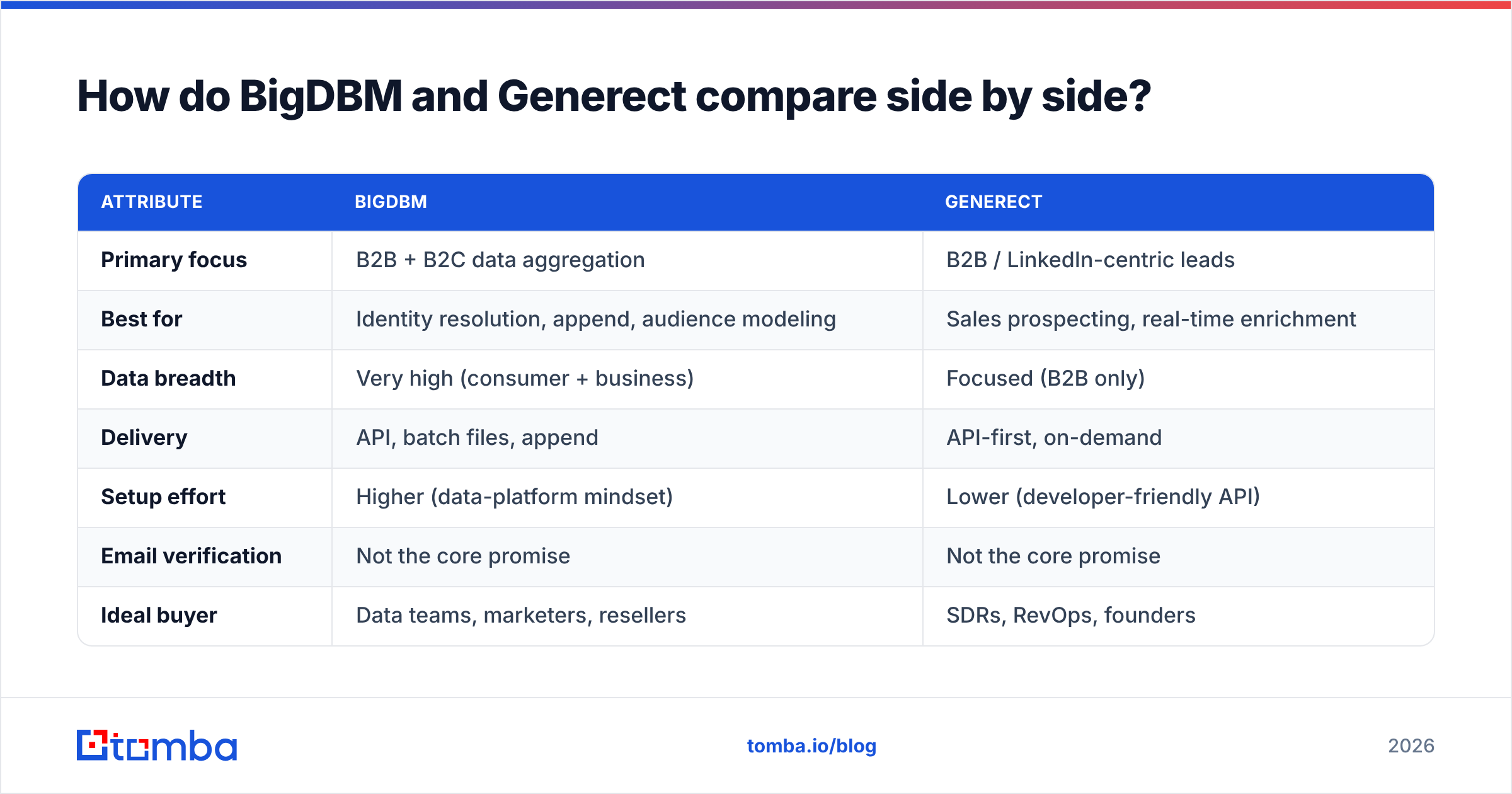
| Attribute | BigDBM | Generect |
|---|---|---|
| Primary focus | B2B + B2C data aggregation | B2B / LinkedIn-centric leads |
| Best for | Identity resolution, append, audience modeling | Sales prospecting, real-time enrichment |
| Data breadth | Very high (consumer + business) | Focused (B2B only) |
| Delivery | API, batch files, append | API-first, on-demand |
| Setup effort | Higher (data-platform mindset) | Lower (developer-friendly API) |
| Email verification | Not the core promise | Not the core promise |
| Ideal buyer | Data teams, marketers, resellers | SDRs, RevOps, founders |
| Pricing model | Volume / licensing | Credit / API tiers |
The pattern is clear: BigDBM optimizes for scale and matching; Generect optimizes for speed and B2B focus. Neither is "better" in the abstract — they answer different questions.
)
Which has better data accuracy?#
Neither provider can promise a clean inbox on send day, and that is the most important sentence in this article.
B2B data decays fast. Industry estimates from sources like HubSpot put contact-data decay around 22–30% per year as people change jobs, companies rebrand, and email formats shift. A record that was accurate when it was scraped or licensed can be a hard bounce three months later. BigDBM's scale means more records but also more stale ones in absolute terms; Generect's LinkedIn freshness helps on the B2B side but still inherits the same decay curve once data leaves the source.
Use these factors to judge accuracy honestly:
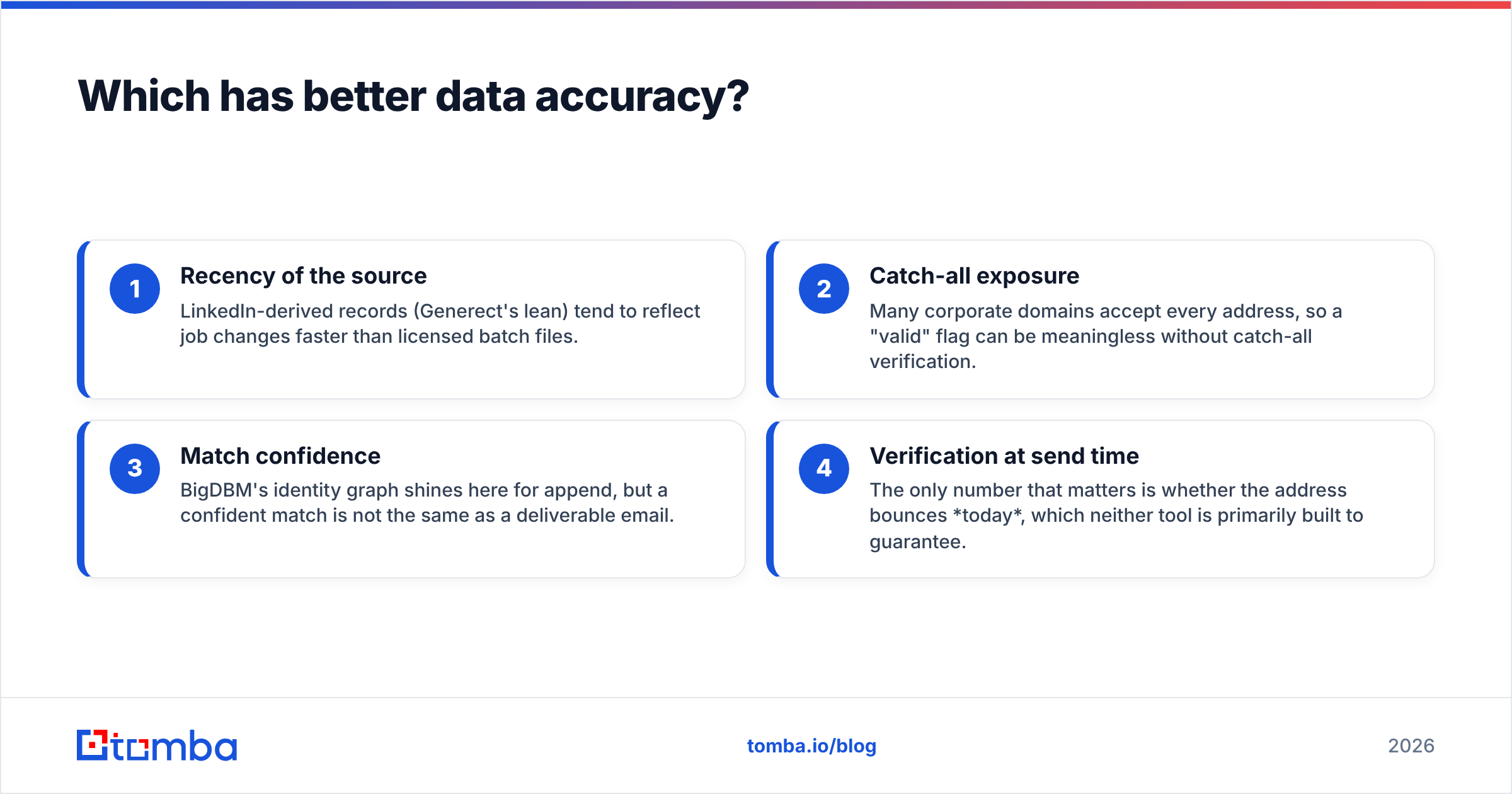
- Recency of the source — LinkedIn-derived records (Generect's lean) tend to reflect job changes faster than licensed batch files.
- Catch-all exposure — Many corporate domains accept every address, so a "valid" flag can be meaningless without catch-all verification.
- Match confidence — BigDBM's identity graph shines here for append, but a confident match is not the same as a deliverable email.
- Verification at send time — The only number that matters is whether the address bounces today, which neither tool is primarily built to guarantee.
This is why mature outbound teams treat any data provider as step one and a dedicated verification pass as step two. Running a list through an email verifier before a campaign routinely strips out 5–15% of addresses that would otherwise have damaged your sender reputation.
What about pricing and value?#
Both providers move away from simple per-seat SaaS pricing, which makes direct comparison tricky.
- BigDBM prices around data volume and licensing. That favors large, recurring use cases — appending millions of records or powering an internal product. For low-volume prospecting it can feel like overkill.
- Generect uses credit- and API-tier pricing closer to what sales teams expect. You pay for the enrichment calls you make, which scales down more gracefully for smaller teams.
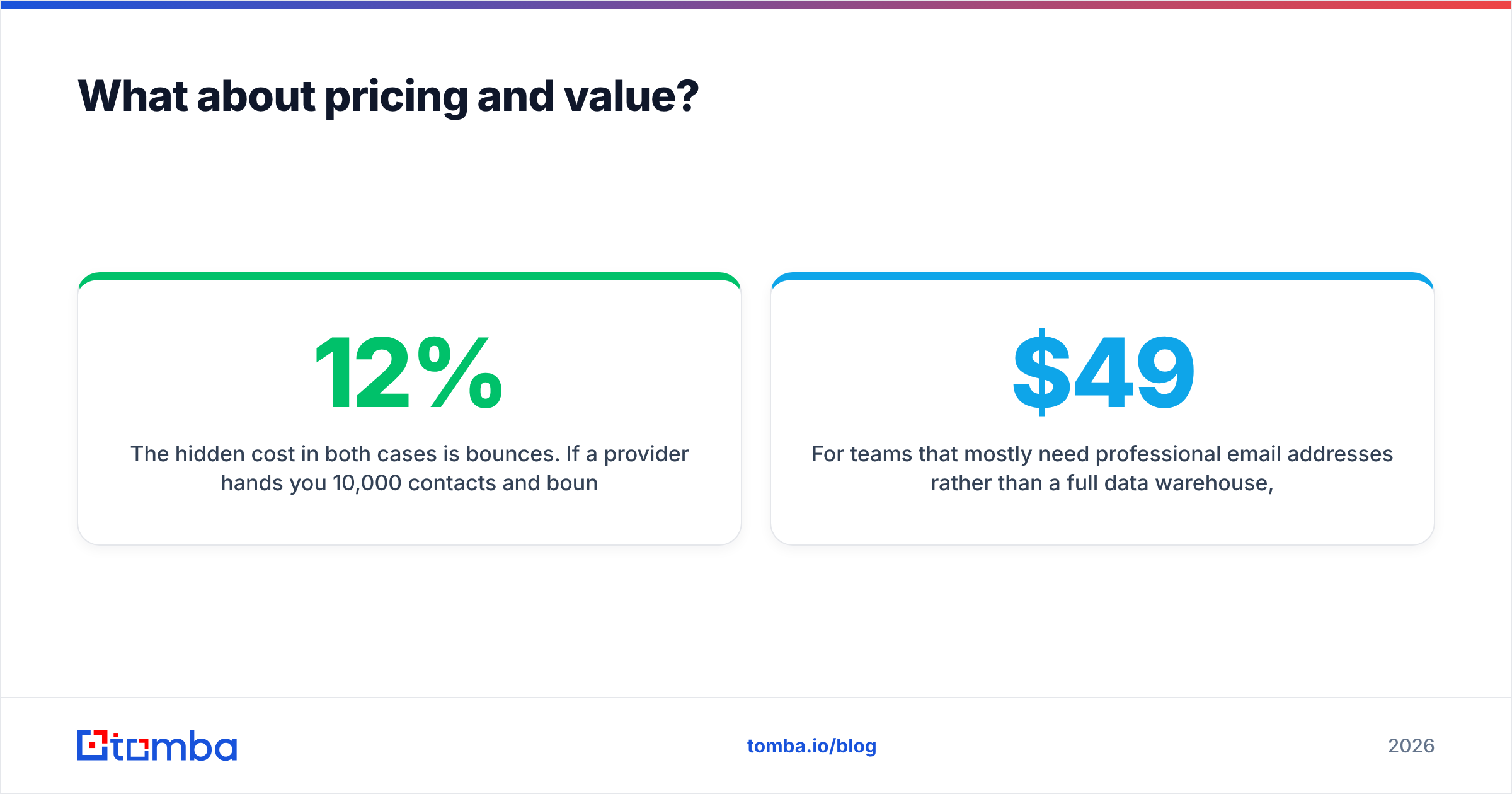
The hidden cost in both cases is bounces. If a provider hands you 10,000 contacts and 12% bounce, you have not saved money — you have spent it on deliverability damage that suppresses your good emails too. Factor a verification budget into either choice. Tools like G2 are useful for reading real buyer reviews on pricing fairness before you commit to an annual contract.
For teams that mostly need professional email addresses rather than a full data warehouse, a focused finder plus verifier stack is often dramatically cheaper. You can compare straightforward Tomba pricing — a free tier at 25 searches/mo, Starter at $49/mo, Growth at $99/mo, and Pro at $249/mo — against the enterprise-leaning quotes these data platforms tend to produce.
Which is better for sales prospecting vs. enrichment?#
Match the tool to the job:
Choose BigDBM if you are doing append and audience work. You have a list of partial records and need to enrich them at scale, model lookalike audiences, or resolve identities across consumer and business datasets. BigDBM's breadth is the differentiator, and you have engineering support to operate it.
Choose Generect if you are doing live B2B prospecting. You want to enrich a CRM record the moment a lead comes in, pull company contacts from a domain, or build a LinkedIn-sourced pipeline without consumer-data noise. Generect's API-first design fits cleanly into a sales automation workflow.
Most teams discover the real answer is "neither alone." The data provider supplies raw coverage; a finder-and-verifier layer turns that coverage into addresses you can actually send to without torching your domain.
)
Where does an email finder and verifier fit in?#
Think of a data provider as the quarry and a finder-plus-verifier as the refinery. BigDBM and Generect dig up enormous amounts of raw material. But before that material reaches a prospect's inbox, it needs to be confirmed, deduplicated, and pattern-matched to the right person at the right company.
This is the gap a dedicated tool fills:
- Finding by domain or name. When a provider returns a company but not the right contact, a domain search surfaces the actual people and their email patterns.
- Verifying before send. Every record gets an SMTP-level check so hard bounces never reach your sequence.
- Handling catch-alls. Corporate catch-all domains get special treatment instead of a misleading "valid" stamp.
- Bulk processing. Large lists from either provider run through a bulk email finder and verifier in one pass.
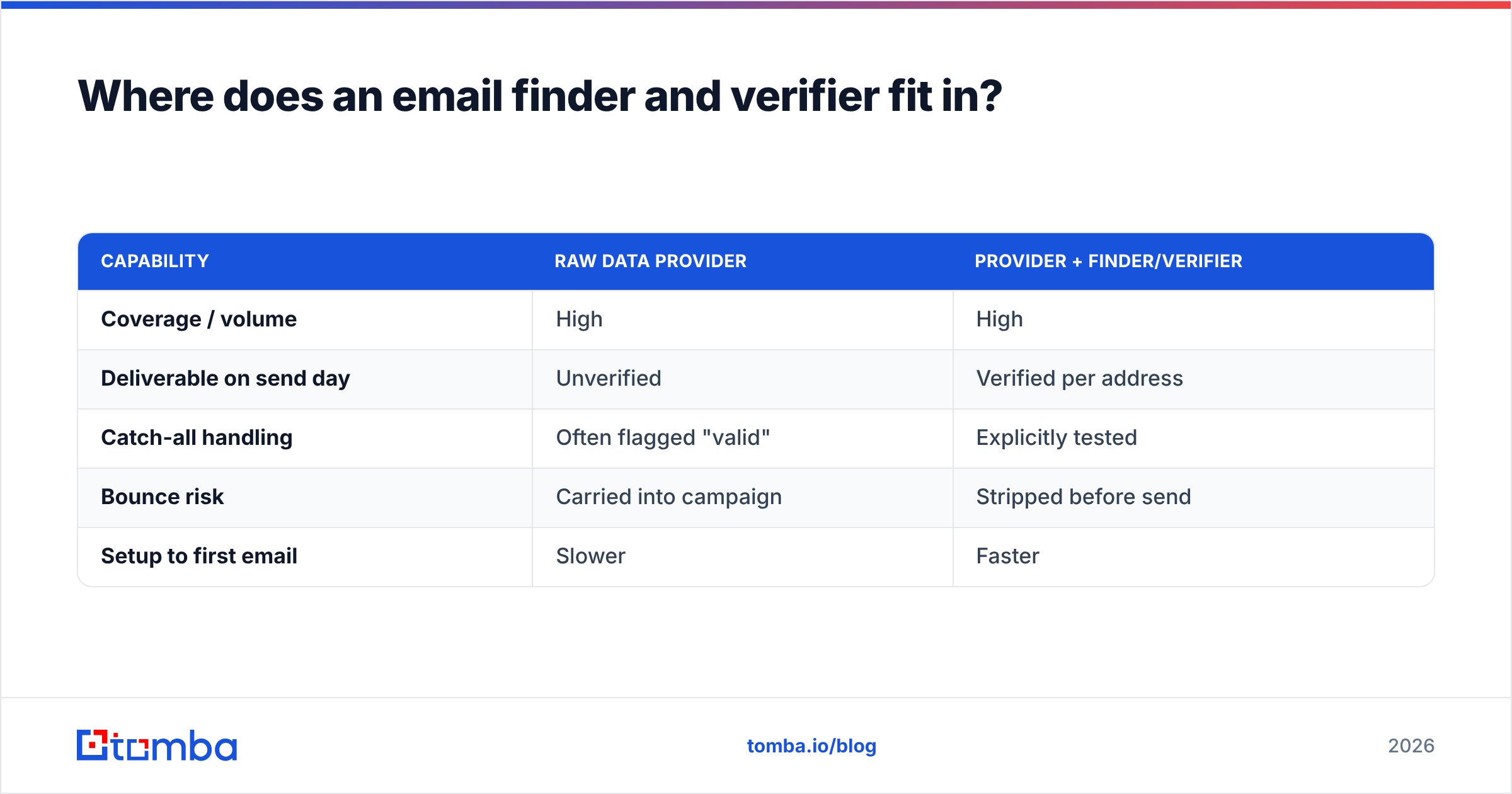
Here is how the layers stack up against using a raw data provider alone:
| Capability | Raw data provider | Provider + finder/verifier |
|---|---|---|
| Coverage / volume | High | High |
| Deliverable on send day | Unverified | Verified per address |
| Catch-all handling | Often flagged "valid" | Explicitly tested |
| Bounce risk | Carried into campaign | Stripped before send |
| Setup to first email | Slower | Faster |
The point is not that data providers are bad — it is that they are incomplete for outbound. They answer "who exists?" not "who can I safely email right now?"
Common mistakes when comparing BigDBM and Generect#
- Comparing on volume alone. A bigger database is not a better database if more of it bounces. Weigh accuracy and freshness, not just record counts.
- Ignoring catch-all domains. A large share of B2B targets sit on catch-all servers. Without explicit testing, your "valid" rate is fiction.
- Skipping verification to save money. This is the most expensive shortcut in cold email. Bounces above ~3% drag down deliverability for your entire domain — see this primer on email deliverability.
- Buying for a use case you do not have. BigDBM's consumer breadth is wasted spend for a pure B2B SDR team; Generect's B2B focus is a wall for a performance marketer who needs consumer reach.
- Treating the data provider as the finish line. It is the start. Layer verification on top regardless of which you pick.
So which should you choose in 2026?#
Pick BigDBM if you are a data, marketing, or product team that needs massive coverage, identity resolution, and append across both consumer and business records — and you have the engineering muscle to operate a data platform.
Pick Generect if you are a sales, RevOps, or founder-led team that wants clean, LinkedIn-fresh B2B data wired into your CRM through a developer-friendly API, without consumer-data overhead.
Pick neither as a standalone for outbound. Whatever raw data you license, the addresses you actually send to should pass through a verification step first. That single habit protects the sender reputation that makes every other tool in your stack work.
The bottom line#
BigDBM and Generect are not really rivals — they are tools for different jobs. BigDBM wins on breadth and matching; Generect wins on B2B focus and speed. The mistake is assuming either one hands you a campaign-ready list. Neither does, because no data provider can outrun contact-data decay.
If your core need is professional email addresses you can trust, start with a tool built for exactly that. The Tomba Email Finder finds verified business emails by name, domain, or company, runs SMTP-level verification, and handles catch-all domains honestly — so the records you pull from any provider become addresses you can send to today. Try the free tier at 25 searches a month, then scale up only when the results prove themselves. Your open rates, and your domain reputation, will thank you.
// get started
Find, verify and enrich your first contacts today
Start on the free plan with 25 searches a month, then scale when your team is ready.
Free plan · No credit card required · GDPR & CCPA
// about the author