BigDBM vs Lead411 2026: B2B Data Provider Comparison
BigDBM vs Lead411 compared on data depth, intent signals, pricing, and accuracy — plus where a verified email layer beats both for cold outbound.
TL;DR
- BigDBM is a data-licensing and identity-resolution provider built for volume — consumer + B2B records, intent, and API delivery for teams that want raw scale and to enrich at the database layer.
- Lead411 is a sales-intelligence platform with verified contacts, buyer intent, and "Bombora-powered" triggers, packaged for SDRs who want to prospect inside a UI and export to a CRM.
- Pick BigDBM if you are an agency, data team, or platform that licenses data programmatically. Pick Lead411 if you are a sales rep or small team who wants ready-to-call lists with intent baked in.
- Neither one is a cold-email deliverability tool. Both sell records; the freshness of the email field is where outbound campaigns live or die — verify before you send.
- A focused email finder + verifier layer (like Tomba) on top of either provider is often cheaper and more accurate for the specific job of "get me a valid work email for this person right now."
What are BigDBM and Lead411?#
Short answer: BigDBM is a data supplier; Lead411 is a sales-intelligence app. They overlap in the middle — both sell B2B contact and company data with intent — but they are built for different buyers.
BigDBM positions itself around identity resolution and data licensing. It aggregates large consumer and business datasets, resolves them to individuals and companies, and delivers the result through files, API, or audience integrations. The typical customer is a marketing platform, a data co-op, an agency, or an in-house data team that wants to own records and blend them into their own systems.
Lead411 is a sales-intelligence tool in the same lane as ZoomInfo, Apollo, or RocketReach. You log in, search by title/industry/location, see verified emails and direct dials, layer on buyer-intent signals, and push contacts to your CRM or sequencer. The buyer is usually an SDR, a founder, or a small revenue team that wants pipeline, not a data pipeline.
That single distinction — supplier vs. application — explains most of the differences below.

How do BigDBM and Lead411 compare head to head?#
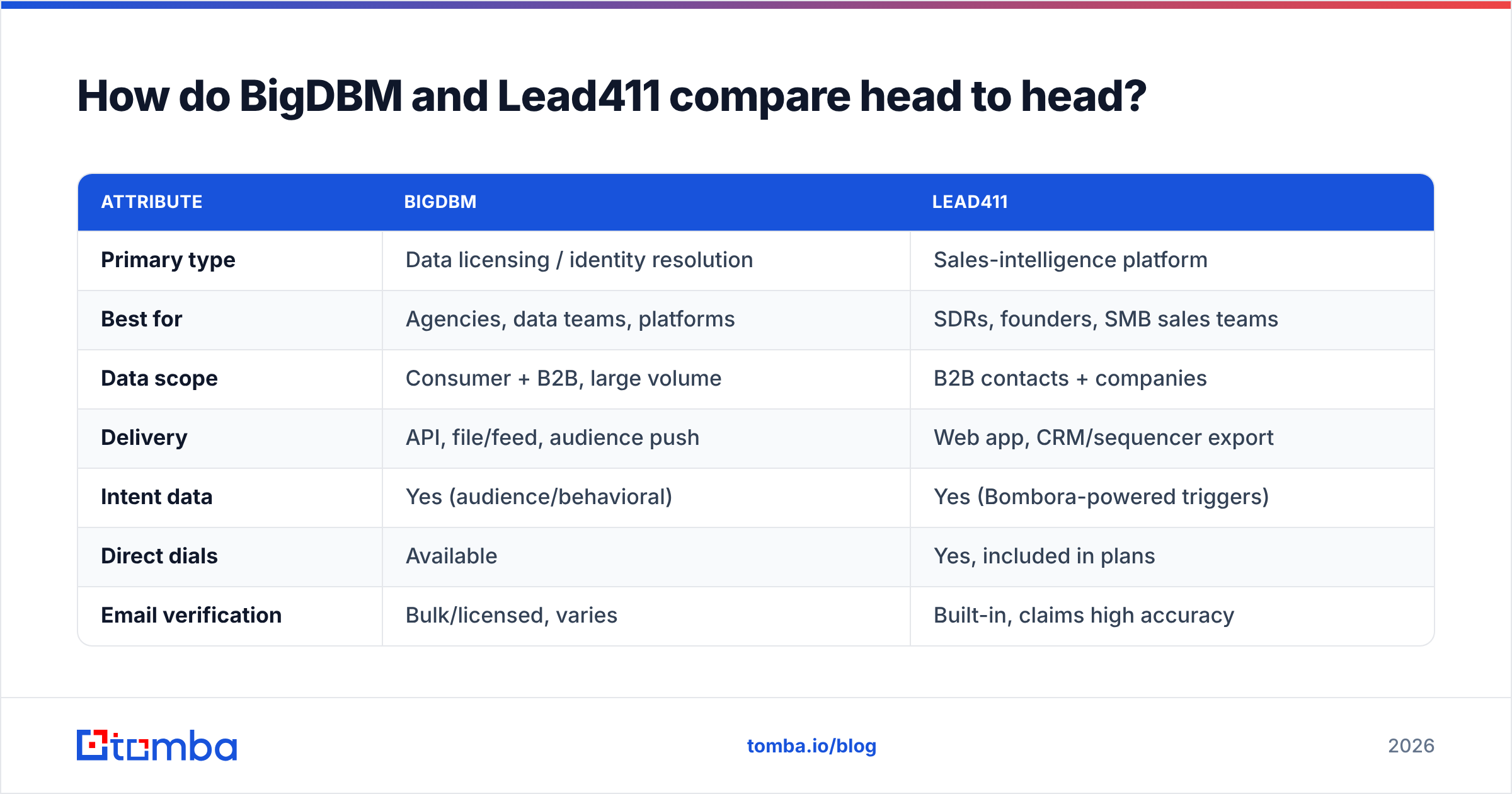
Here is the practical side-by-side. Treat the specifics as directional — both vendors change packaging often, and neither publishes a fully transparent price card — but the shape of each offering is stable.
| Attribute | BigDBM | Lead411 |
|---|---|---|
| Primary type | Data licensing / identity resolution | Sales-intelligence platform |
| Best for | Agencies, data teams, platforms | SDRs, founders, SMB sales teams |
| Data scope | Consumer + B2B, large volume | B2B contacts + companies |
| Delivery | API, file/feed, audience push | Web app, CRM/sequencer export |
| Intent data | Yes (audience/behavioral) | Yes (Bombora-powered triggers) |
| Direct dials | Available | Yes, included in plans |
| Email verification | Bulk/licensed, varies | Built-in, claims high accuracy |
| Pricing model | Custom / volume contracts | Per-seat subscription + export caps |
| Free option | No public free tier | Free trial (limited exports) |
| Learning curve | Higher (technical integration) | Lower (point-and-click UI) |
The headline: BigDBM rewards teams that can integrate data and want scale; Lead411 rewards teams that want to start prospecting this afternoon.
Which has better data coverage and accuracy?#
It depends on what "coverage" means for you. BigDBM generally wins on raw record volume and on consumer/identity breadth, because licensing is its whole business. Lead411 wins on sales-ready depth — verified work emails, direct dials, and the company-level context an SDR needs to write a relevant first line.
A few things matter more than the marketing numbers:
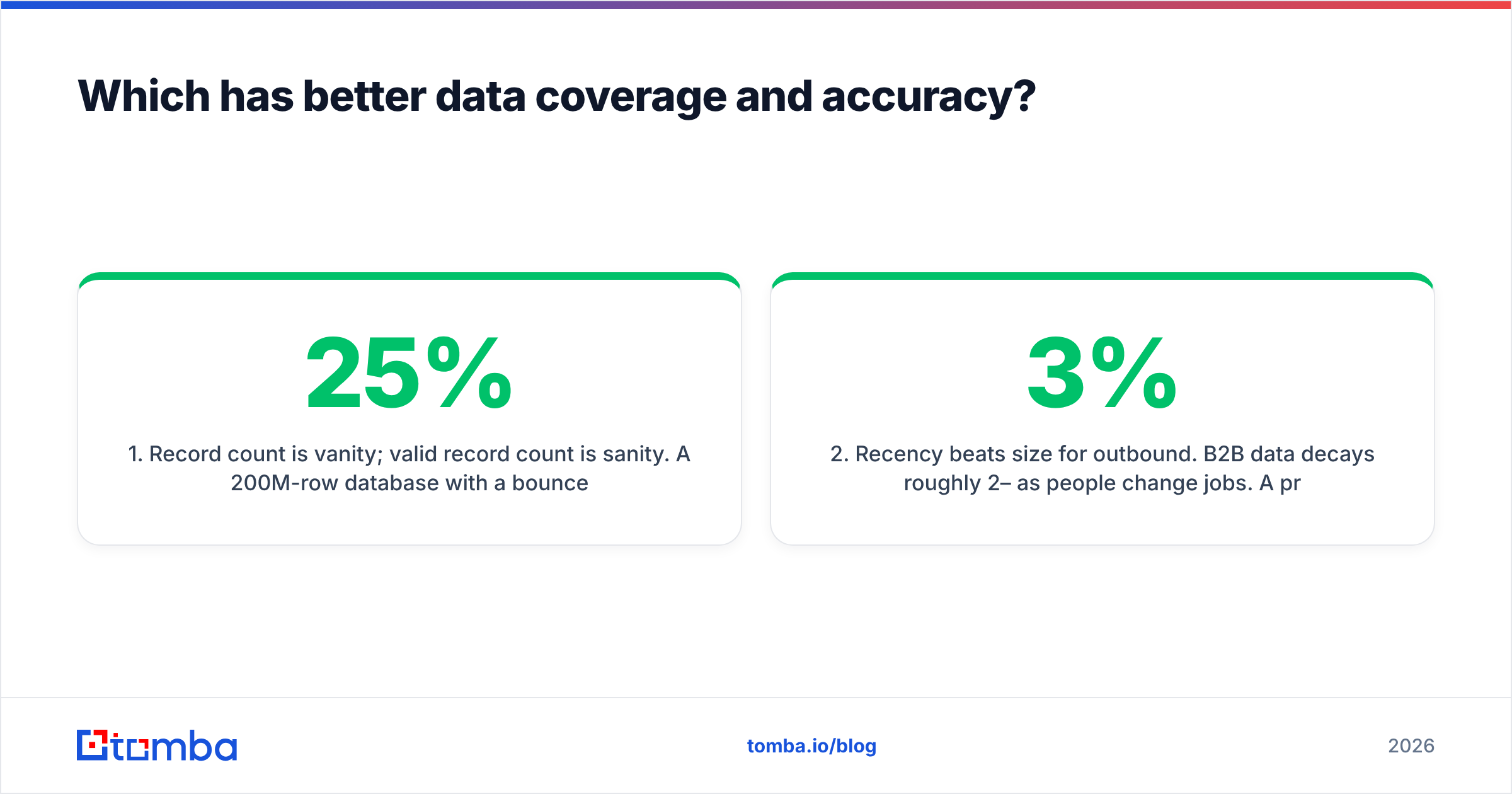
- Record count is vanity; valid record count is sanity. A 200M-row database with a 25% bounce rate is worse than a 30M-row database that verifies to 96%. Always test against your ICP, not the vendor's demo segment.
- Recency beats size for outbound. B2B data decays roughly 2–3% per month as people change jobs. A provider that re-verifies frequently will outperform a bigger but staler one on reply rate.
- Intent is a multiplier, not a list. Both offer intent, but intent only helps if you act on it within the signal window — usually days, not weeks.
- Catch-all domains distort accuracy claims. Many "valid" emails sit on catch-all servers that accept everything. If a vendor counts those as deliverable, its accuracy number is inflated. Run a catch-all verifier on a sample before you trust the headline.
Independent reviews on G2 are a useful sanity check here — read the 3-star reviews, not the 5-star ones, to see where each tool's data actually breaks down for real users.
How do BigDBM and Lead411 price?#
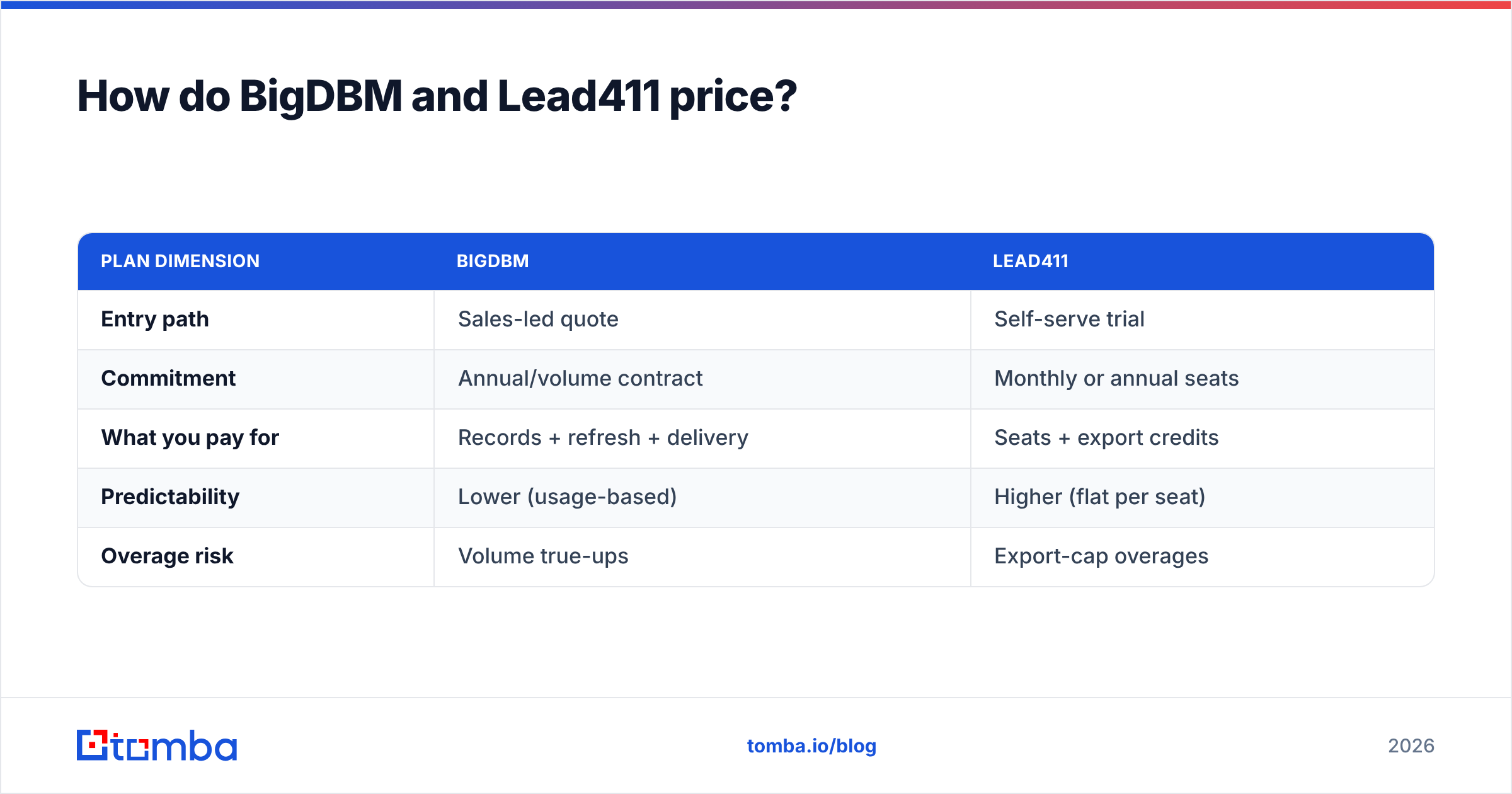
BigDBM is custom/volume; Lead411 is per-seat subscription. That difference is as important as the dollar amounts.
- BigDBM quotes based on data volume, fields, refresh cadence, and delivery method. There is no public free tier and no self-serve checkout — you talk to sales, scope a license, and sign a contract. This is normal for data licensing and it favors larger commitments.
- Lead411 sells seats with monthly export limits, typically with a free trial and tiered plans. You can start small and scale seats as the team grows. Export caps are the thing to watch — heavy prospecting teams hit them fast, and overages add up.
| Plan dimension | BigDBM | Lead411 |
|---|---|---|
| Entry path | Sales-led quote | Self-serve trial |
| Commitment | Annual/volume contract | Monthly or annual seats |
| What you pay for | Records + refresh + delivery | Seats + export credits |
| Predictability | Lower (usage-based) | Higher (flat per seat) |
| Overage risk | Volume true-ups | Export-cap overages |
If budget predictability matters and you have a small team, Lead411's model is friendlier. If you are buying data at scale and want a per-record economics conversation, BigDBM's model fits.
Where do both tools fall short for cold outbound?#
Both sell you records; neither guarantees the email still works the day you send. This is the gap most teams discover only after a campaign tanks.
A data provider's job ends when it hands you a row. Your campaign's success depends on three things that sit downstream of that row:
- Email validity at send time — not at the time the record was scraped or licensed.
- Sender reputation and deliverability — covered in our email deliverability guide; even perfect data bounces if your domain is cooked.
- Format edge cases — subdomains, plus-addressing, and catch-all servers that quietly swallow your mail.
This is why mature teams treat the data provider and the verification layer as two separate purchases. You buy breadth from a data vendor and you buy truth from a verifier right before you load the sequence.
)
When should you choose BigDBM?#
Choose BigDBM when you are the one building the system, not just using one. Specifically:
- You run an agency or martech platform that needs to license data and resell or embed it.
- You have an engineering or data team comfortable consuming an API or a feed and resolving identities into your warehouse.
- You need consumer + B2B breadth for audience building, not just sales contacts.
- You want per-record economics at volume and can commit to a contract.
If your "data problem" is really an integration project, BigDBM is the more natural fit. You can then enrich and validate at the database layer using a data enrichment workflow before anything reaches a rep.
When should you choose Lead411?#
Choose Lead411 when you want to prospect today without building anything:
- You are an SDR, founder, or small sales team that lives in a UI.
- You want verified emails and direct dials with intent triggers in one place.
- You value a low learning curve and a free trial to test before paying.
- You push contacts straight to a CRM or sequencer and want that flow to just work.
Lead411 is the practical pick for a team whose constraint is time and reps, not data engineering. Check the official Lead411 site for current plan details, since export limits shift between tiers.
Is there a smarter third option for finding verified emails?#
Yes — decouple the data source from the email-truth layer. You do not have to get everything from one vendor, and you usually shouldn't.
Here is the pattern that works for most outbound teams in 2026:
- Source the universe of accounts and people from a broad provider (BigDBM, Lead411, or your existing CRM).
- Find or confirm the work email for each person with a dedicated email finder instead of trusting the field that came with the record.
- Verify deliverability with an email verifier right before send — including a catch-all pass.
- Enrich and dedupe the final list so reps aren't calling the same person twice.
This is exactly where a focused tool like Tomba slots in. It is not trying to be your CRM or your audience platform — it does the narrow job of turning a name + company into a valid, deliverable email and confirming it, with a B2B database and domain search behind it.
How does a verification layer compare on cost and job?#
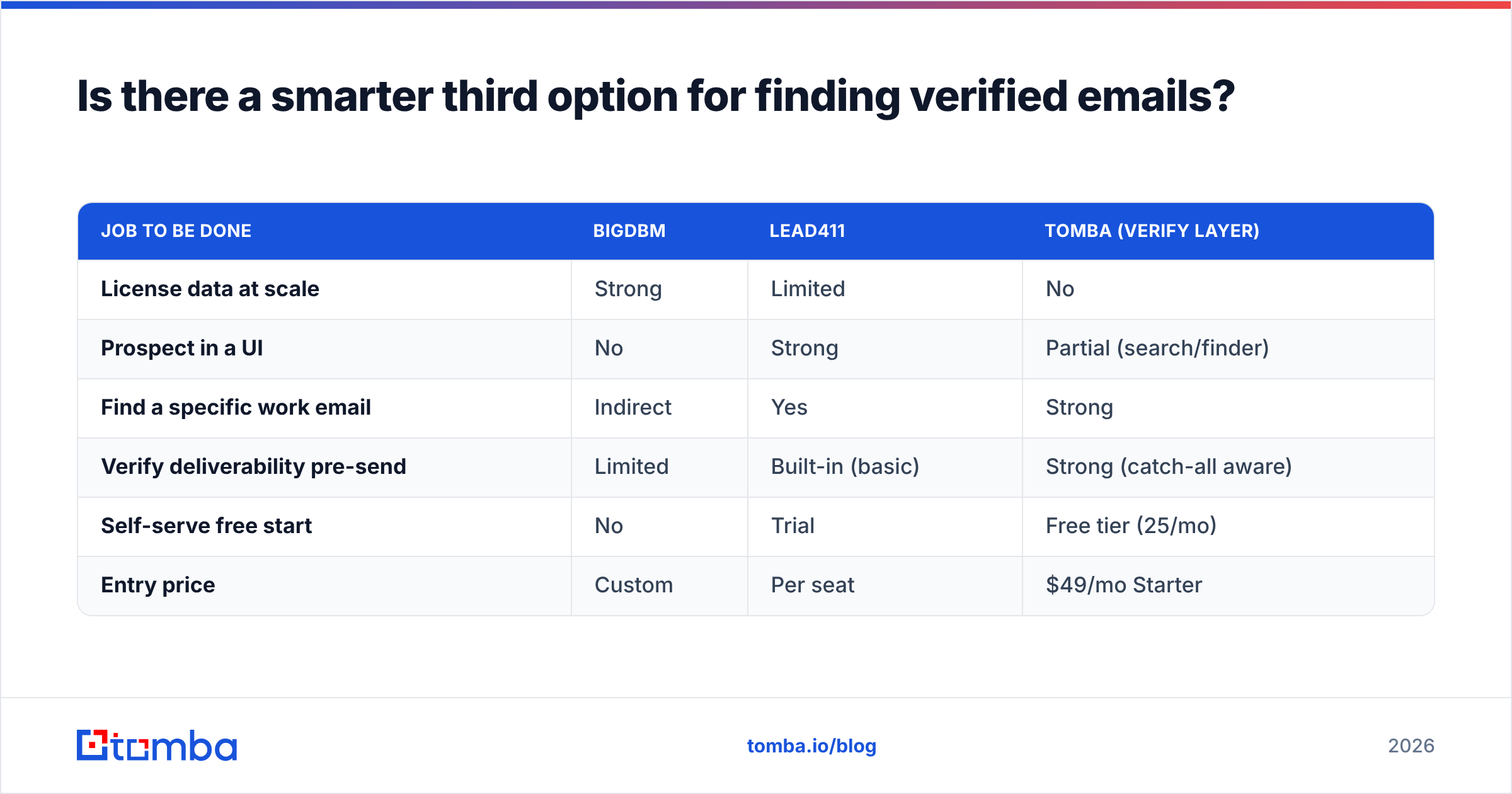
| Job to be done | BigDBM | Lead411 | Tomba (verify layer) |
|---|---|---|---|
| License data at scale | Strong | Limited | No |
| Prospect in a UI | No | Strong | Partial (search/finder) |
| Find a specific work email | Indirect | Yes | Strong |
| Verify deliverability pre-send | Limited | Built-in (basic) | Strong (catch-all aware) |
| Self-serve free start | No | Trial | Free tier (25/mo) |
| Entry price | Custom | Per seat | $49/mo Starter |
Tomba's published Tomba pricing starts with a free tier of 25 searches per month, then Starter at $49/mo, Growth at $99/mo, and Pro at $249/mo — small enough to add as a verification layer regardless of which big data provider you standardize on.
What's the verdict on BigDBM vs Lead411?#
There is no universal winner — there is a winner for your motion.
- If you are a data team, agency, or platform buying records to integrate and resell, BigDBM is the stronger fit. Its model, scale, and API-first delivery match how you actually work.
- If you are a sales team that needs verified contacts and intent in a UI today, Lead411 is the more practical choice. The free trial lets you validate against your ICP with zero commitment.
- Whichever you pick, add a verification layer. The most expensive line item in outbound is not the data subscription — it is the wasted reps, burned domains, and bounced sends that come from trusting an email field that went stale months ago.
Run a 100-contact test on both providers against your exact ICP, push the results through an independent verifier, and compare deliverable records per dollar. That single test will tell you more than any feature grid — including this one.
Get verified emails for any list#
Pick your data source on the merits — but don't let a stale email field sink the campaign. Tomba's Tomba Email Finder turns names and domains into validated, deliverable work emails, with catch-all-aware verification and a free tier to test it on your next list. Source breadth from BigDBM or Lead411, then make every send count by verifying with Tomba before it hits the sequencer. Start free, scale to Tomba plans only when the reply rate proves it out.
// get started
Find, verify and enrich your first contacts today
Start on the free plan with 25 searches a month, then scale when your team is ready.
Free plan · No credit card required · GDPR & CCPA
// about the author