BigDBM vs LeadRocks 2026: B2B Data Provider Compared
BigDBM and LeadRocks both sell B2B contact data, but they solve different problems. Here is an honest 2026 breakdown of coverage, accuracy, pricing, and the smarter way to verify every record.
TL;DR
- This BigDBM vs LeadRocks comparison starts with one fact: they are not the same product. BigDBM is a large-scale identity and consumer/B2B data provider. It is built for enrichment, audience building, and high-volume API matching. Teams mostly buy it to integrate data programmatically.
- LeadRocks is a LinkedIn-sourced contact database with a simple browser-and-app workflow. It is cheaper and lighter. It aims at founders and SDRs who want quick lists without a data-engineering project.
- The two tools solve different jobs. BigDBM competes with identity graphs and data platforms. LeadRocks competes with prospecting databases like Apollo's lite tier.
- Neither tool guarantees a clean inbox. Both still need an email verification layer before you send. Skip it, and your bounce rate climbs.
- Want to find and verify the right work email instead of buying a giant list? Then a precision email finder fits better than either. That is where Tomba helps.
What is the BigDBM vs LeadRocks difference?#
Quick answer: BigDBM is a wholesale data and identity platform. LeadRocks is a retail LinkedIn contact list builder. Both end with "contact data." But they start in very different places.
BigDBM is a US-focused data compiler. It gathers consumer and business identity records — names, emails, phones, and intent signals. It then serves them through files, audience segments, and a matching API. The typical buyer is a marketing ops, RevOps, or ad-tech team. They want to enrich an existing database, build lookalike audiences, or resolve identities at scale. You are buying coverage and match rates, and you are expected to integrate.
LeadRocks is a B2B contact database. Its records are mostly sourced and matched against LinkedIn profiles. You search by title, company, industry, or location. You get emails and phone numbers, then push them to a CRM or export a CSV. The typical buyer is a founder, agency, or small SDR team. They want a usable prospect list this afternoon, with no sales call. It also sells lifetime-deal pricing, which signals the SMB segment it targets.
So the honest framing for BigDBM vs LeadRocks is not "which is better." It is "which job are you hiring it for" — bulk identity infrastructure or self-serve prospecting.

How do BigDBM and LeadRocks differ at a glance?#
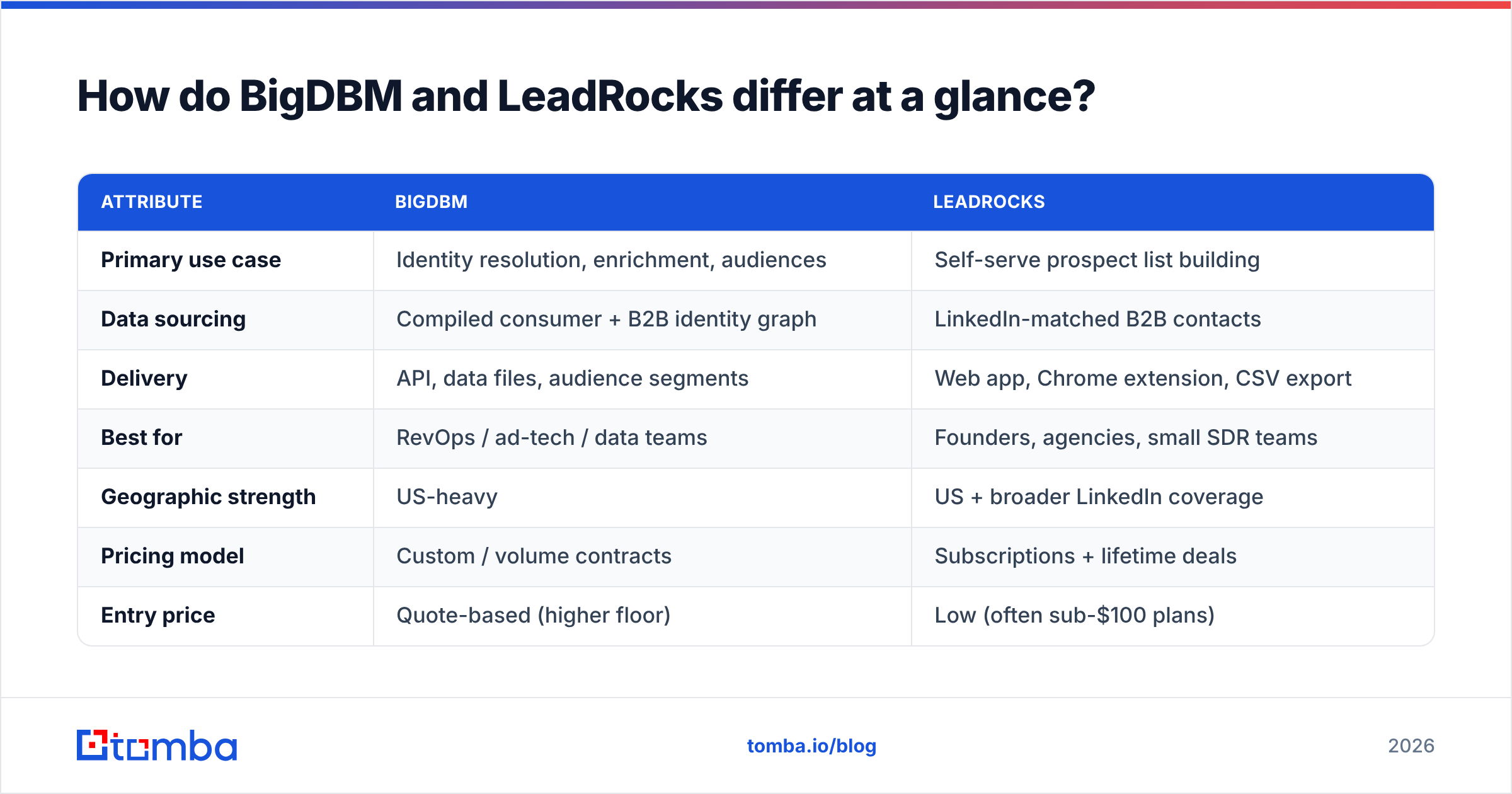
Here is the core comparison. Treat exact prices as directional. Both vendors change packaging, and BigDBM quotes custom deals rather than public per-seat tiers.
| Attribute | BigDBM | LeadRocks |
|---|---|---|
| Primary use case | Identity resolution, enrichment, audiences | Self-serve prospect list building |
| Data sourcing | Compiled consumer + B2B identity graph | LinkedIn-matched B2B contacts |
| Delivery | API, data files, audience segments | Web app, Chrome extension, CSV export |
| Best for | RevOps / ad-tech / data teams | Founders, agencies, small SDR teams |
| Geographic strength | US-heavy | US + broader LinkedIn coverage |
| Pricing model | Custom / volume contracts | Subscriptions + lifetime deals |
| Entry price | Quote-based (higher floor) | Low (often sub-$100 plans) |
| Verification built in | Limited / your responsibility | Basic, list-level |
| Learning curve | High (integration required) | Low (point and click) |
The pattern is clear. BigDBM is the heavier, more powerful, more expensive option, and it assumes engineering resources. LeadRocks is the faster, cheaper, shallower option, and it assumes a single rep in a hurry.
Which has better data coverage and accuracy?#
Conclusion first: BigDBM wins on raw volume and US identity depth. LeadRocks wins on LinkedIn-aligned freshness for active professionals. But both share one weakness. The data is only as good as the day it was matched.
A few realities worth stating plainly:
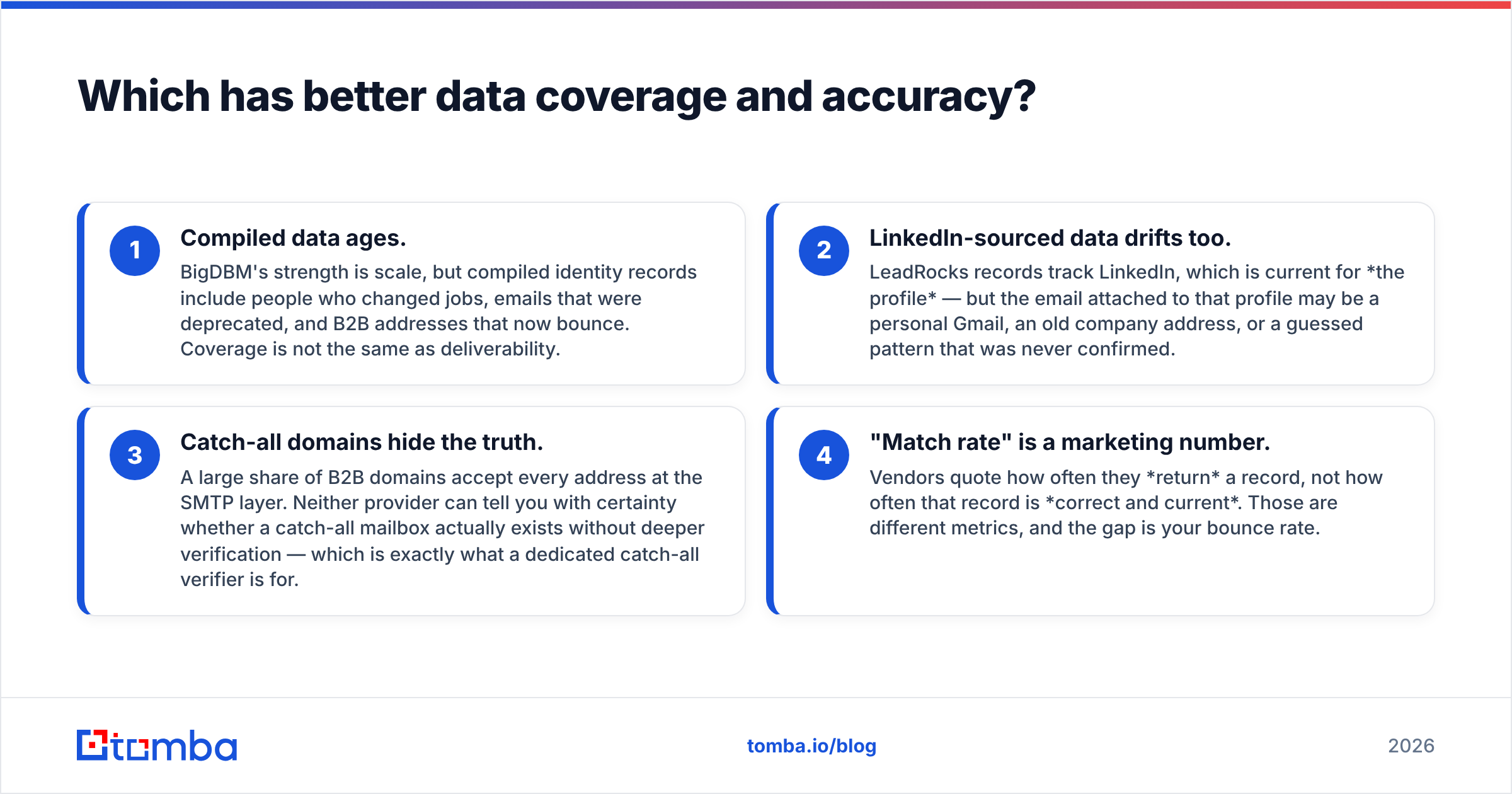
- Compiled data ages. BigDBM's strength is scale. But compiled records include people who changed jobs, emails that were dropped, and B2B addresses that now bounce. Coverage is not the same as deliverability.
- LinkedIn-sourced data drifts too. LeadRocks records track LinkedIn, which is current for the profile. But the attached email may be a personal Gmail, an old company address, or a guessed pattern that was never confirmed.
- Catch-all domains hide the truth. Many B2B domains accept every address at the SMTP layer. Neither provider can tell you for sure whether a catch-all mailbox really exists. That takes deeper checks, which is what a dedicated catch-all verifier is for.
- "Match rate" is a marketing number. Vendors quote how often they return a record, not how often it is correct and current. Those are different metrics, and the gap is your bounce rate.
The practical takeaway is simple. Whichever you choose, budget for an independent verification pass. Pulling a list and sending to it raw is how sender reputation gets wrecked. Run records through an email verifier before the first send. Then re-verify anything older than 60–90 days.
How do BigDBM and LeadRocks compare on pricing?#
Short version: LeadRocks is cheap and predictable. BigDBM is powerful and quote-based.
LeadRocks leans on low monthly subscriptions and lifetime deals. Credits are tied to how many contact reveals you pull. That works well if your volume is modest and steady. The risk is credit math. Heavy prospecting months burn through allowances faster than the headline price suggests.
BigDBM rarely publishes a simple per-seat number. Most deals are volume contracts. You negotiate match rates, fields, refresh cadence, and minimums. That suits the buyer — a data team moving millions of records. But it means there is no honest "starter price," and the floor sits well above a LeadRocks subscription.
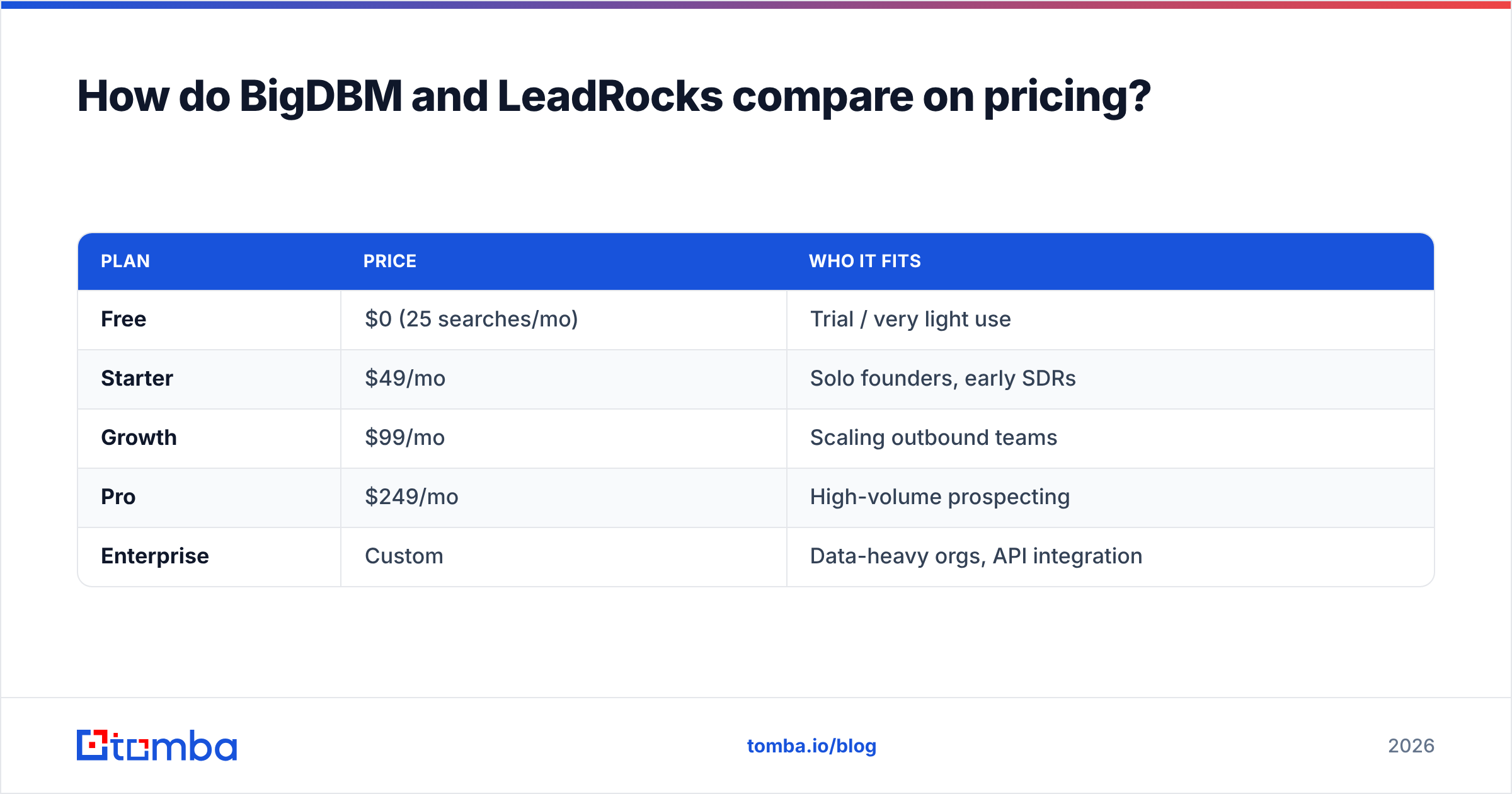
For comparison, here is how a focused email finder like Tomba prices. Many readers comparing these two just want to reach buyers affordably (see full Tomba pricing):
| Plan | Price | Who it fits |
|---|---|---|
| Free | $0 (25 searches/mo) | Trial / very light use |
| Starter | $49/mo | Solo founders, early SDRs |
| Growth | $99/mo | Scaling outbound teams |
| Pro | $249/mo | High-volume prospecting |
| Enterprise | Custom | Data-heavy orgs, API integration |
The point is not that Tomba replaces an identity graph. It does not. It is to show the real job. If "reach the right person's verified work email" is what you need, you do not need a six-figure data contract or a credit-juggling LinkedIn scraper.
Is BigDBM better than LeadRocks for cold outreach?#
It depends on who is sending. For a lean outbound team, LeadRocks fits better. For a data-driven growth org, BigDBM does. Map it to your situation:
- You are a founder or small agency sending dozens to low hundreds of emails a week. LeadRocks' self-serve model and low price match your workflow. BigDBM would be overkill and over budget.
- You run programmatic enrichment. You append firmographics to inbound leads, build ad audiences, and resolve identities across systems. BigDBM is designed for this. LeadRocks is not.
- You need phone numbers for a calling motion. Both offer phones, but verify them. Dialing dead numbers wastes more rep time than bad emails do. A dedicated phone validator catches the duds before your reps do.
- You care most about email deliverability. Then your bottleneck is verification, not sourcing. Either provider plus a strong verifier beats either provider alone.
One more honest note. Buying any large list — from either vendor — and blasting it is the fastest way to land in spam. Sequenced, verified, personal sends to smaller, cleaner segments win almost every time.
Where does a dedicated email finder fit in?#
Here is the part the BigDBM vs LeadRocks debate usually misses. Most people searching for it do not really want a database. They want to email specific people at specific companies, with confidence.
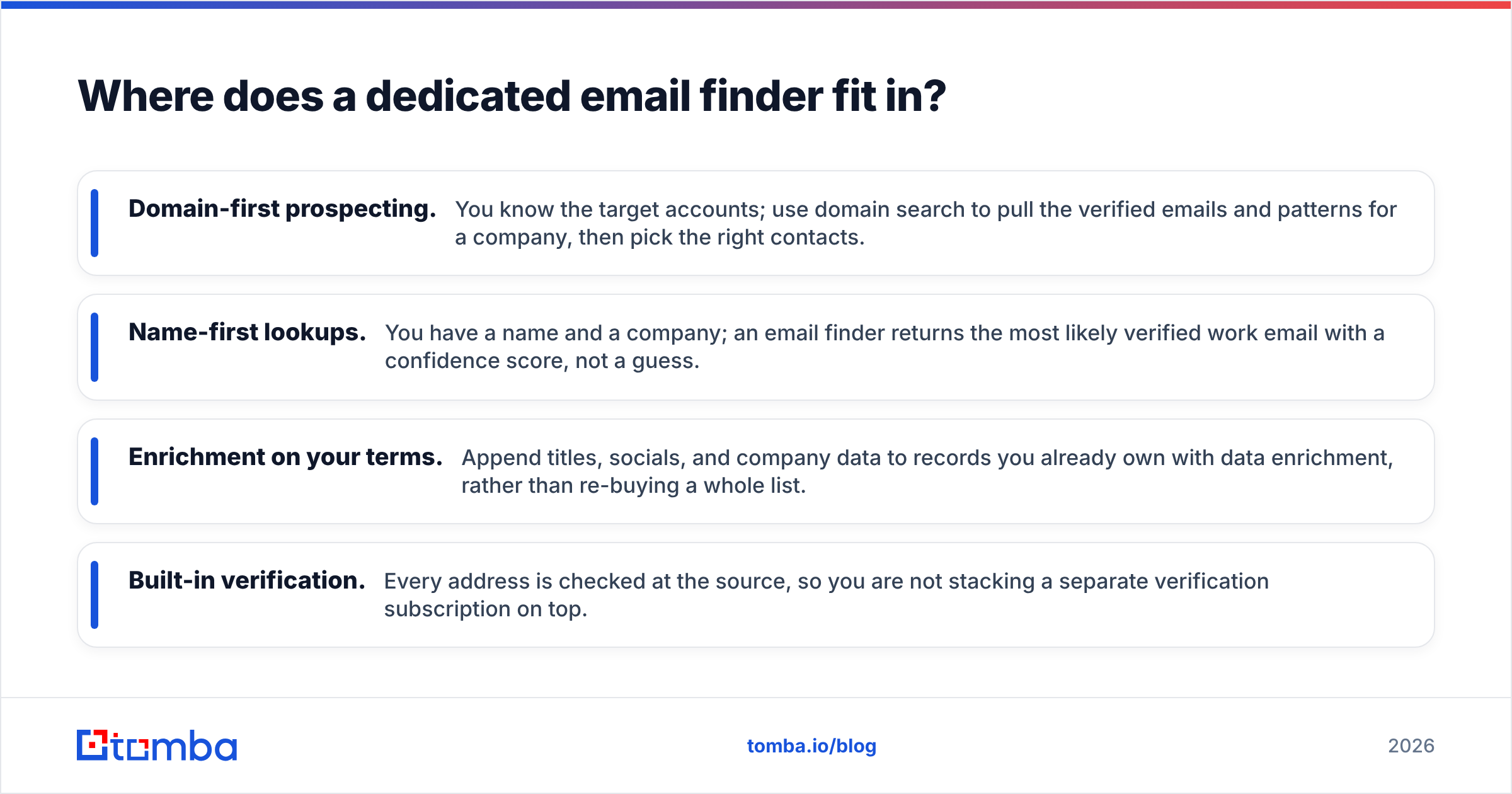
That is a different tool category. Instead of buying a pre-built list and hoping the addresses are alive, you start from the company or the person. Then you find the verified address on demand:
- Domain-first prospecting. You know the target accounts. Use domain search to pull the verified emails and patterns for a company, then pick the right contacts.
- Name-first lookups. You have a name and a company. An email finder returns the most likely verified work email with a confidence score, not a guess.
- Enrichment on your terms. Append titles, socials, and company data to records you already own with data enrichment. No need to re-buy a whole list.
- Built-in verification. Every address is checked at the source. So you do not stack a separate verification subscription on top.
This is why BigDBM vs LeadRocks is often a false binary. There is a third option: find and verify exactly the contacts you need, when you need them. It is cheaper than BigDBM and cleaner than a scraped list. It also avoids paying for millions of records you will never email. You can check vendor claims yourself on a review site like G2 before you commit to any annual contract.
How should you choose between BigDBM and LeadRocks?#
Decision rule: match the tool to your motion, not the marketing. Here is how the BigDBM vs LeadRocks choice breaks down:
- Choose BigDBM if you have a data or RevOps team. It fits identity resolution and audience building at scale, programmatic enrichment, and a custom integration.
- Choose LeadRocks if you are price-sensitive. It fits a self-serve, LinkedIn-style prospecting list today, when your volume is modest enough that credits will not run dry mid-month.
- Choose a dedicated email finder if your real goal is reaching specific, verified contacts at known companies — without buying or maintaining a giant database.
Whatever you pick, bolt on verification. The highest-ROI habit in outbound is simple: refuse to send to an address you have not confirmed. That one discipline protects sender reputation, lifts response rates, and makes your whole stack look smarter. Want to build your own clean, on-demand pipeline? Explore the Tomba database and supporting tools.
The bottom line#
BigDBM and LeadRocks are both legitimate. But they answer different questions. BigDBM is heavyweight identity and enrichment infrastructure for data teams. LeadRocks is a light, affordable, LinkedIn-sourced list builder for lean operators. So pick by motion and budget. And never skip verification, because both sell coverage, not deliverability.
Ready to stop buying stale lists? If your real job is reaching the right buyer's verified work email, start with the Tomba Email Finder. Find emails by name, company, or domain. Each one is source-verified before it lands in your CRM. The free tier gives 25 searches a month and scales to API-grade volume when you are ready. Find the contact, verify the address, and send with confidence. That is the part neither database does for you.
// get started
Find, verify and enrich your first contacts today
Start on the free plan with 25 searches a month, then scale when your team is ready.
Free plan · No credit card required · GDPR & CCPA
// about the author