BigDBM vs Leadzenai 2026: Which B2B Data Tool Wins?
BigDBM sells raw B2B/B2C data files; Leadzenai layers AI prospecting on top. We compare accuracy, pricing, coverage, and fit so you pick the right one in 2026.
You are choosing between two very different products that get lumped into the same "B2B data" search. BigDBM is a data supplier. Leadzenai is an AI prospecting layer. Picking the wrong one wastes a quarter of pipeline budget. This breakdown shows where each wins, where each leaks, and where a focused tool like Tomba quietly beats both on cost-per-verified-contact.
TL;DR#
- BigDBM is a wholesale data provider: large B2B and B2C identity files, licensed in bulk or via API, best for teams that already have data engineers to clean and match records.
- Leadzenai is an AI-driven prospecting and lead-intelligence app aimed at SDRs who want search, enrichment, and outreach signals inside one UI.
- Accuracy is the real battleground. Both sell "billions of records," but verified, deliverable contact accuracy is what actually moves reply rates.
- Pricing models differ sharply: BigDBM leans toward custom/volume licensing; Leadzenai uses tiered subscriptions with credit limits.
- If your core need is verified work emails by domain or name, a dedicated finder like Tomba Email Finder at $49/mo often delivers a lower cost-per-usable-lead than either platform.
What are BigDBM and Leadzenai?#
Think of it like buying coffee. BigDBM sells you green beans by the sack — cheap per kilo, huge volume, but you need a roaster, a grinder, and someone who knows what they're doing. Leadzenai hands you a finished cup from a machine — convenient, ready to drink, but you pay per cup and you take whatever blend the machine pours.
BigDBM (bigdbm.com) is a US-focused data compiler. It aggregates consumer and business identity data — names, emails, phones, demographic and intent attributes — and licenses it as files or through an API for enrichment, identity resolution, and audience building. Its buyers are typically data teams, ad-tech platforms, and enterprises that ingest raw records into their own systems.
Leadzenai (leadzen.ai) is a lead-generation and prospecting application. It wraps a contact database in an AI search experience: you describe an ideal customer, it surfaces matching people and companies, enriches them with emails and phones, and supports list-building for outreach. Its buyers are SDRs, founders, and small sales teams who want answers inside a dashboard, not a CSV they have to model.
The distinction matters because you are not really comparing two competitors — you are comparing two layers of the stack.
How do BigDBM and Leadzenai compare at a glance?#
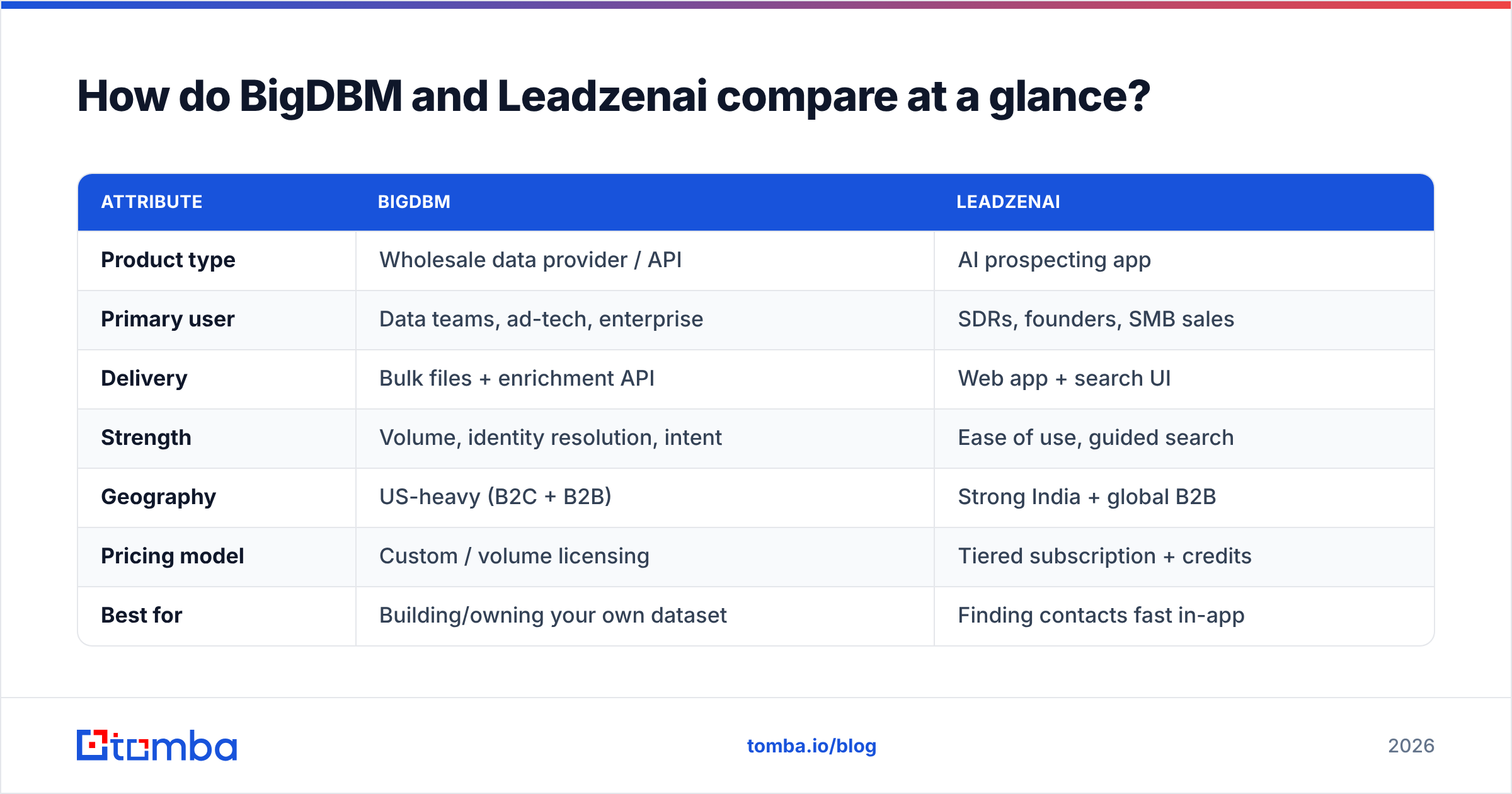
| Attribute | BigDBM | Leadzenai |
|---|---|---|
| Product type | Wholesale data provider / API | AI prospecting app |
| Primary user | Data teams, ad-tech, enterprise | SDRs, founders, SMB sales |
| Delivery | Bulk files + enrichment API | Web app + search UI |
| Strength | Volume, identity resolution, intent | Ease of use, guided search |
| Geography | US-heavy (B2C + B2B) | Strong India + global B2B |
| Pricing model | Custom / volume licensing | Tiered subscription + credits |
| Best for | Building/owning your own dataset | Finding contacts fast in-app |
| Weak spot | Needs engineering to operationalize | Credit caps, variable accuracy |
The table makes the trade obvious: BigDBM gives you raw power and flexibility but demands technical lift; Leadzenai gives you speed and simplicity but boxes you into its UI and credit economics.
Wait — that second image is a placeholder for the meme below. Here is the actual one:
Which has better data accuracy?#
Accuracy is where most "billions of records" claims quietly fall apart. A database can be enormous and still be 30% undeliverable, because emails decay roughly 2–3% per month as people change jobs. The number that matters is not records on file — it's verified, currently deliverable contacts.
BigDBM scores well on coverage and identity resolution, especially for US consumer and B2B records tied to offline identifiers. Because it is a compiler, freshness depends on its update cadence and on how recently your specific slice was refreshed. You typically run your own verification pass before sending — which is the right move regardless of vendor.
Leadzenai emphasizes real-time enrichment and AI matching, which helps freshness on individual lookups. But like most all-in-one prospecting apps, deliverability varies by region and seniority; catch-all domains and generic role addresses can slip through as "found."
Neither vendor removes your need to verify. That is why a standalone email verifier belongs in the workflow no matter which platform you license — it catches the bounces before your domain reputation pays for them.
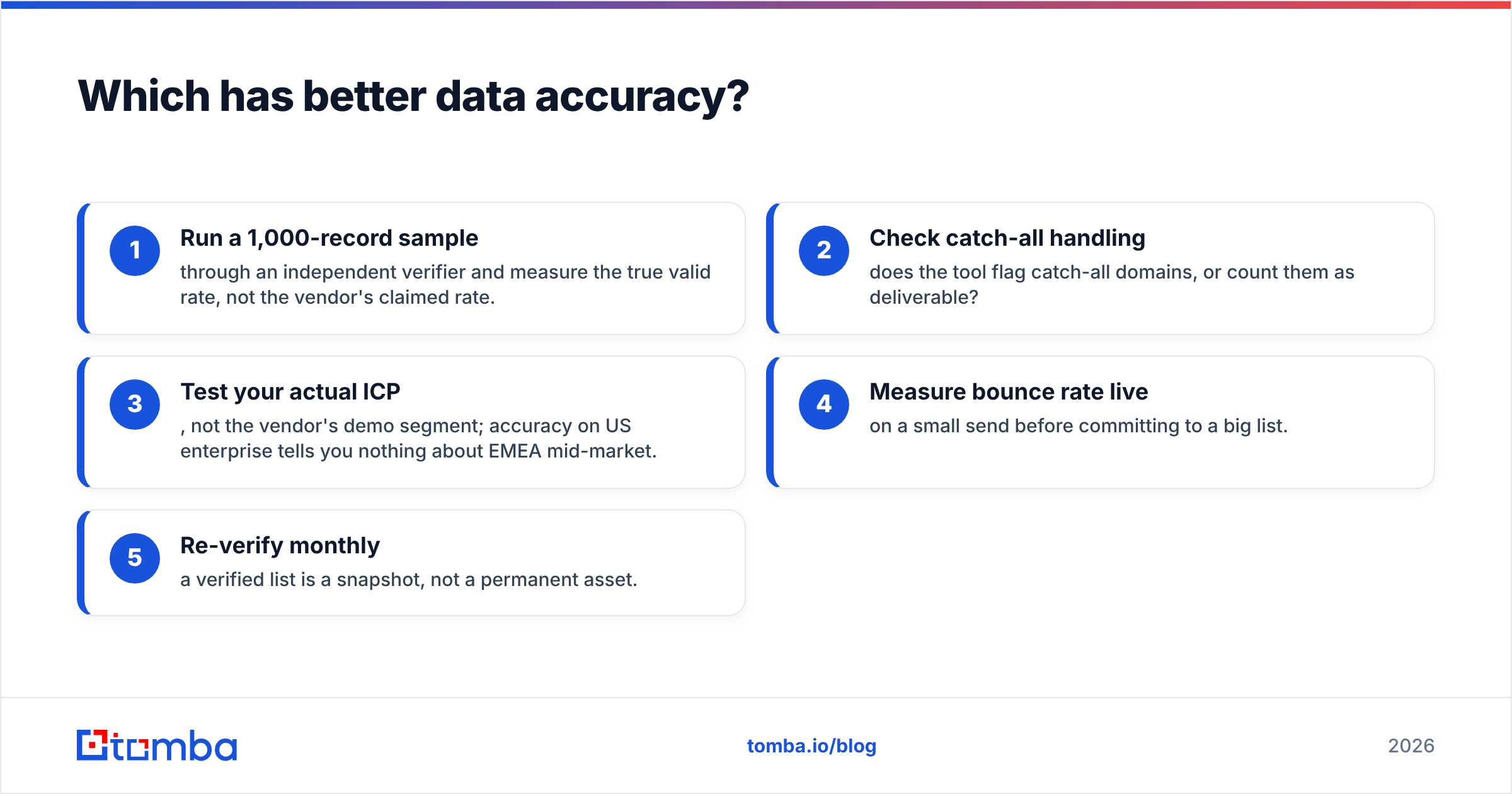
A practical accuracy checklist before you trust any provider:
- Run a 1,000-record sample through an independent verifier and measure the true valid rate, not the vendor's claimed rate.
- Check catch-all handling — does the tool flag catch-all domains, or count them as deliverable?
- Test your actual ICP, not the vendor's demo segment; accuracy on US enterprise tells you nothing about EMEA mid-market.
- Measure bounce rate live on a small send before committing to a big list.
- Re-verify monthly — a verified list is a snapshot, not a permanent asset.
How does pricing compare for BigDBM vs Leadzenai?#
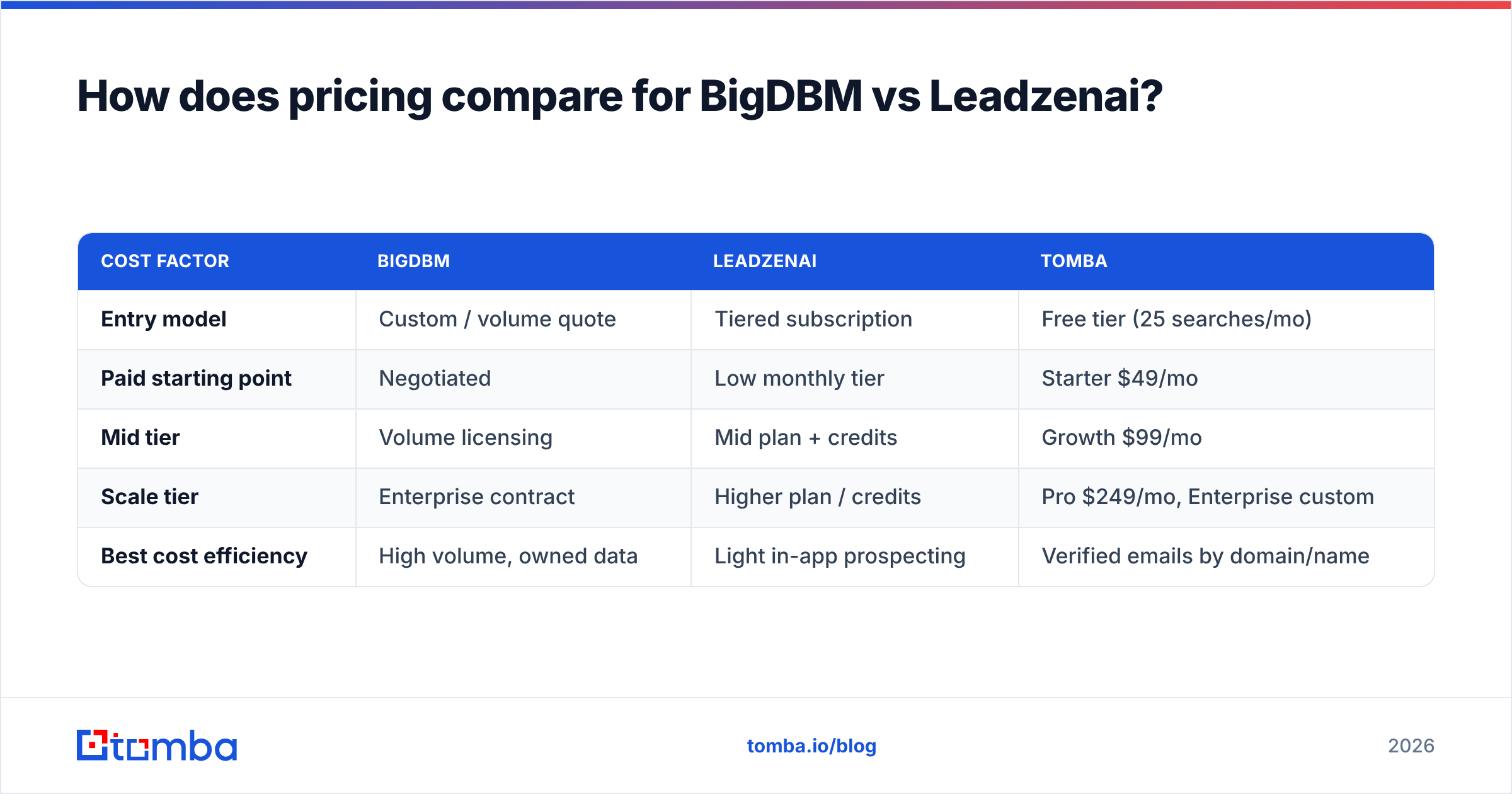
Two different philosophies. BigDBM prices like a wholesaler: volume-based, often custom-quoted, attractive per-record at scale but with a real floor and contracts. Leadzenai prices like SaaS: monthly tiers with credit allotments, easy to start, but the credits cap how much you can actually pull before overage or upgrade.
| Cost factor | BigDBM | Leadzenai | Tomba |
|---|---|---|---|
| Entry model | Custom / volume quote | Tiered subscription | Free tier (25 searches/mo) |
| Paid starting point | Negotiated | Low monthly tier | Starter $49/mo |
| Mid tier | Volume licensing | Mid plan + credits | Growth $99/mo |
| Scale tier | Enterprise contract | Higher plan / credits | Pro $249/mo, Enterprise custom |
| Best cost efficiency | High volume, owned data | Light in-app prospecting | Verified emails by domain/name |
The hidden cost in both BigDBM and Leadzenai is the same: records you pay for but can't deliver to. If half your "leads" bounce, your real cost per usable contact doubles. That is exactly where a focused finder changes the math. See the full Tomba pricing breakdown — at $49/mo for Starter you pay for finding and verifying the exact contacts you need, instead of licensing a haystack.
When should you choose BigDBM?#
Choose BigDBM when you are building or feeding a system, not when you are an SDR who needs ten contacts this afternoon.
- You have a data team. Identity resolution and bulk files only pay off if someone can match, dedupe, and load them.
- You need B2C plus B2B identity. BigDBM's consumer-side depth is genuinely strong for US audiences and ad targeting.
- You're powering a product or audience platform. If you resell enrichment or build lookalike audiences, a wholesale feed is the right altitude.
- Volume economics matter. At millions of records, per-record licensing beats per-seat SaaS.
Skip BigDBM if you're a five-person sales team that just wants verified work emails. You'll pay for infrastructure you can't operationalize, and you'll still need verification on top.
When should you choose Leadzenai?#
Choose Leadzenai when you want a guided, in-app prospecting experience and you value speed over owning the underlying data.
- You're an SDR or founder who wants to describe an ICP and get a working list without touching SQL.
- You sell into India or APAC. Leadzenai's regional B2B depth is a real differentiator versus US-centric compilers.
- You want outreach signals in one place — search, enrich, and build lists without stitching tools together.
- You prefer predictable subscriptions over negotiated data contracts.
Skip Leadzenai if your volume outgrows its credit tiers, or if your deliverability standards are strict enough that you need independent verification on every record anyway — at which point you're paying for the app and the verifier both.
Where does Tomba fit between them?#
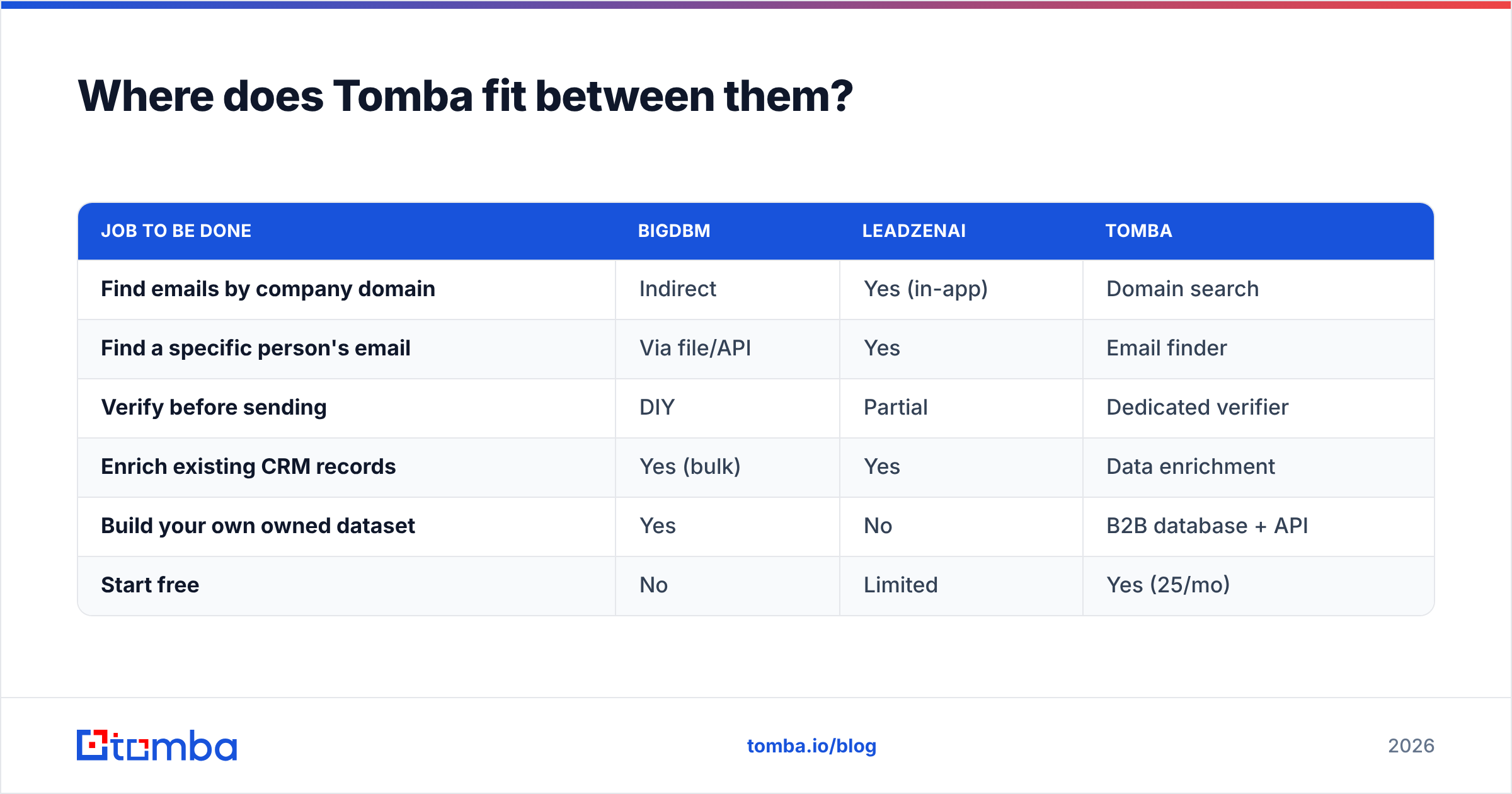
Tomba sits at the layer most teams actually need: turning a name or a domain into a verified, deliverable email, without buying a wholesale feed or renting a whole prospecting suite.
| Job to be done | BigDBM | Leadzenai | Tomba |
|---|---|---|---|
| Find emails by company domain | Indirect | Yes (in-app) | Domain search |
| Find a specific person's email | Via file/API | Yes | Email finder |
| Verify before sending | DIY | Partial | Dedicated verifier |
| Enrich existing CRM records | Yes (bulk) | Yes | Data enrichment |
| Build your own owned dataset | Yes | No | B2B database + API |
| Start free | No | Limited | Yes (25/mo) |
The point is not that Tomba replaces a wholesale compiler for ad-tech audience building — it doesn't, and BigDBM is the better tool for that job. The point is that most sales teams searching "BigDBM vs Leadzenai" actually have a narrower need: accurate emails for the accounts they already care about. For that job, paying wholesale-data or full-suite prices is overkill.
Tomba's surrounding tools — bulk email finder, Chrome extension, and a developer-friendly email finder API — let you scale from a single lookup to a full list without changing platforms. You verify as you find, so the list you export is the list you can actually send to.
What do reviewers and the market say?#
Read third-party reviews on a neutral marketplace like G2 rather than vendor sites, and weigh patterns over individual reviews. For data providers, the recurring themes are predictable: praise for coverage, complaints about freshness and undeliverable records. For AI prospecting apps, praise for ease of use, complaints about credit limits and uneven accuracy outside the home region.
That pattern is your buying signal. If reviews of either tool keep mentioning bounces, budget for verification from day one — it's cheaper than a damaged sending domain.
Frequently asked questions#
Is BigDBM better than Leadzenai? Neither is universally better; they solve different problems. BigDBM is a wholesale data source for teams that can engineer it. Leadzenai is a ready-to-use prospecting app for SDRs. Match the tool to who's using it.
Which is more accurate, BigDBM or Leadzenai? Both publish large coverage numbers, but verified deliverability is what matters, and both require your own verification pass for safe sending. Always sample-test on your real ICP before committing.
Are BigDBM and Leadzenai good for cold email? They can source contacts, but cold email success depends on verified addresses and deliverability hygiene. Run every list through verification first to protect your domain reputation.
What's a cheaper alternative for just finding verified emails? A focused finder. Tomba starts free (25 searches/mo) and at $49/mo on Starter, with built-in verification, which usually beats wholesale licensing or full-suite subscriptions on cost-per-usable-contact.
The bottom line#
Pick BigDBM if you're building a dataset and have the engineers to operationalize it. Pick Leadzenai if you're an SDR who wants guided, in-app prospecting and you sell into its strong regions. But if your honest need is verified work emails for accounts you already want to reach, don't buy a warehouse or rent a mall — use a precision tool. Start with the Tomba Email Finder free tier, test it against your real target list, and compare the true cost per deliverable contact. That single number, not "billions of records," is the one that decides your pipeline.
// get started
Find, verify and enrich your first contacts today
Start on the free plan with 25 searches a month, then scale when your team is ready.
Free plan · No credit card required · GDPR & CCPA
// about the author