BigDBM vs Pubrio 2026: Which B2B Data Platform Wins?
BigDBM vs Pubrio compared on data coverage, accuracy, pricing, and real workflows for 2026 — plus where a focused email-finder fits better than either.
Choosing between BigDBM and Pubrio comes down to one question most buyers skip: do you need a raw data supply, or a workflow that hands your reps verified contacts they can actually email today? These two platforms answer that question very differently, and picking the wrong one wastes budget on records your team never touches.
This guide breaks down BigDBM vs Pubrio on coverage, accuracy, pricing, integrations, and the specific jobs each one is built for in 2026 — then shows where a focused tool beats both.
TL;DR: BigDBM vs Pubrio at a glance#
- BigDBM is a data licensing and identity-resolution provider. It excels at large-volume consumer and B2B records, audience files, and API-level data delivery for teams that have engineering to absorb it.
- Pubrio is an AI-driven lead generation platform aimed at sales teams — prospect search, contact discovery, and intent signals wrapped in a self-serve UI.
- Accuracy is the real divide: BigDBM sells scale; Pubrio sells curation. Neither replaces a dedicated verification step before you send.
- Pricing models differ sharply: BigDBM leans toward custom, volume-based licensing; Pubrio uses credit-based subscription tiers.
- For pure email finding and verification, a focused tool like Tomba is often cheaper and more accurate than buying a broad database you'll only use 10% of.
What is BigDBM?#
BigDBM is a U.S.-based data provider that aggregates and resolves consumer and business identity data at scale. Think of it less like a sales tool you log into daily and more like a wholesale supplier — you buy access to large, structured datasets and pipe them into your own systems.
Its core strengths are breadth and identity resolution: matching a person across emails, phones, addresses, and online identifiers. That makes BigDBM attractive for performance marketers, data resellers, insurance, lending, and any team running high-volume audience modeling. It offers delivery through APIs, batch files, and integrations rather than a polished prospecting workflow.
The trade-off: BigDBM assumes you bring the infrastructure. There's no friendly "build a list, click send" loop. You're licensing data, and what you do with it — cleaning, verifying emails, routing into a CRM — is on you. For a deeper look at how raw supply differs from curated B2B records, the distinction between a data file and a usable B2B database matters a lot here.

What is Pubrio?#
Pubrio is an AI-powered lead generation and sales intelligence platform. Where BigDBM hands you data, Pubrio hands you a workflow: search a database of companies and people, filter by firmographics and technographics, surface buying-intent signals, and export ready-to-use contacts.
It targets SDRs, founders, and small-to-mid sales teams who want to go from "I sell to fintech ops leaders in the UK" to a contact list without writing a line of code. Pubrio bundles email and phone discovery, list building, and Chrome-extension prospecting into a single subscription.
The trade-off runs the other way from BigDBM: you get convenience and a clean UI, but you're working inside Pubrio's database and credit limits. Coverage in niche regions or long-tail industries can be thinner than a wholesale provider, and like every aggregator, the freshness of any single record varies.
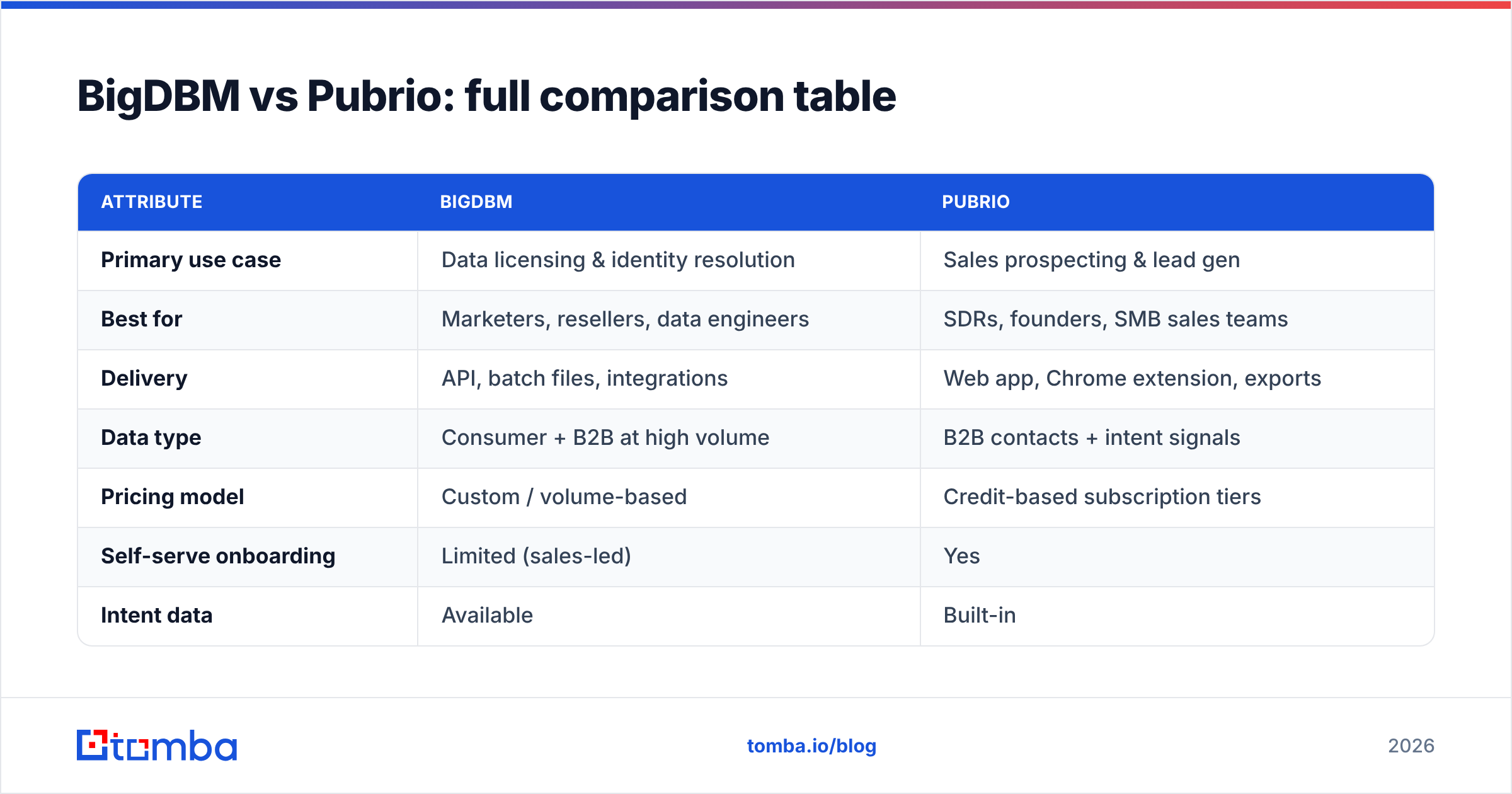
BigDBM vs Pubrio: full comparison table#
Here's how the two stack up on the attributes that actually change your buying decision.
| Attribute | BigDBM | Pubrio |
|---|---|---|
| Primary use case | Data licensing & identity resolution | Sales prospecting & lead gen |
| Best for | Marketers, resellers, data engineers | SDRs, founders, SMB sales teams |
| Delivery | API, batch files, integrations | Web app, Chrome extension, exports |
| Data type | Consumer + B2B at high volume | B2B contacts + intent signals |
| Pricing model | Custom / volume-based | Credit-based subscription tiers |
| Self-serve onboarding | Limited (sales-led) | Yes |
| Intent data | Available | Built-in |
| Verification included | Minimal — bring your own | Basic, varies by record |
| Engineering required | High | Low |
| Free trial / tier | Negotiated | Limited free tier |
Is BigDBM or Pubrio more accurate?#
Accuracy depends on what you're measuring — and neither vendor should be taken at its marketing word.
BigDBM's edge is identity resolution across massive volumes: it's strong at confirming that several data points belong to the same person. But raw scale always carries decay. Email addresses go stale at roughly 20–30% per year as people change jobs, so a large file inevitably contains dead records you'll pay to store and process.
Pubrio's curation model trims some of that noise up front, and its intent layer helps you prioritize. But a curated B2B database is still only as fresh as its last refresh cycle, and coverage gaps appear fast outside core markets.
The honest answer: verify before you send, regardless of source. Independent buyers consistently report that no aggregator's "guaranteed" accuracy survives contact with a real mail server. That's why a dedicated verification pass — checking syntax, MX records, catch-all status, and deliverability — is non-negotiable. You can read how Tomba sources and validates records on its data sources page, but the principle applies to any vendor: trust, then verify.
How do BigDBM and Pubrio price their data?#
Pricing is where the two diverge most, and where buyers get surprised.
BigDBM uses custom, volume-based licensing. You talk to sales, describe your use case and volume, and get a quote. This rewards high-volume buyers and resellers but makes BigDBM hard to evaluate quickly — there's no public per-record price you can sanity-check.
Pubrio uses credit-based subscription tiers, typical of self-serve sales tools. You pick a plan, get a monthly credit pool, and spend credits per contact or per enrichment. Predictable, but credits expire, and heavy months mean overage costs or forced upgrades.
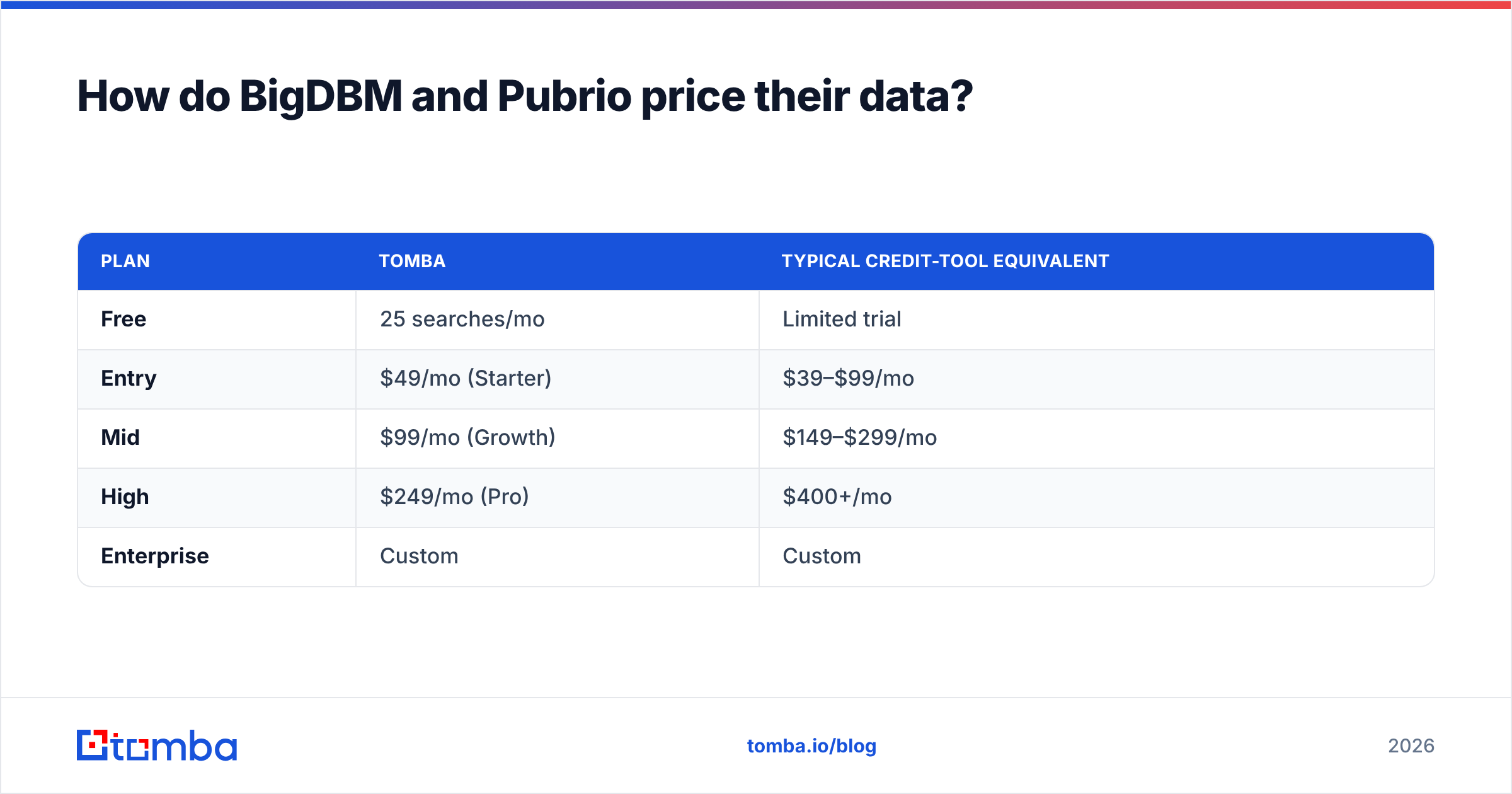
When you compare either to a focused email tool, the math shifts. Here's a simplified picture using Tomba's published pricing as the reference point:
| Plan | Tomba | Typical credit-tool equivalent |
|---|---|---|
| Free | 25 searches/mo | Limited trial |
| Entry | $49/mo (Starter) | $39–$99/mo |
| Mid | $99/mo (Growth) | $149–$299/mo |
| High | $249/mo (Pro) | $400+/mo |
| Enterprise | Custom | Custom |
The point isn't that cheaper is automatically better — it's that paying wholesale-database or full-platform prices makes no sense if your actual job is "find and verify the right work emails."
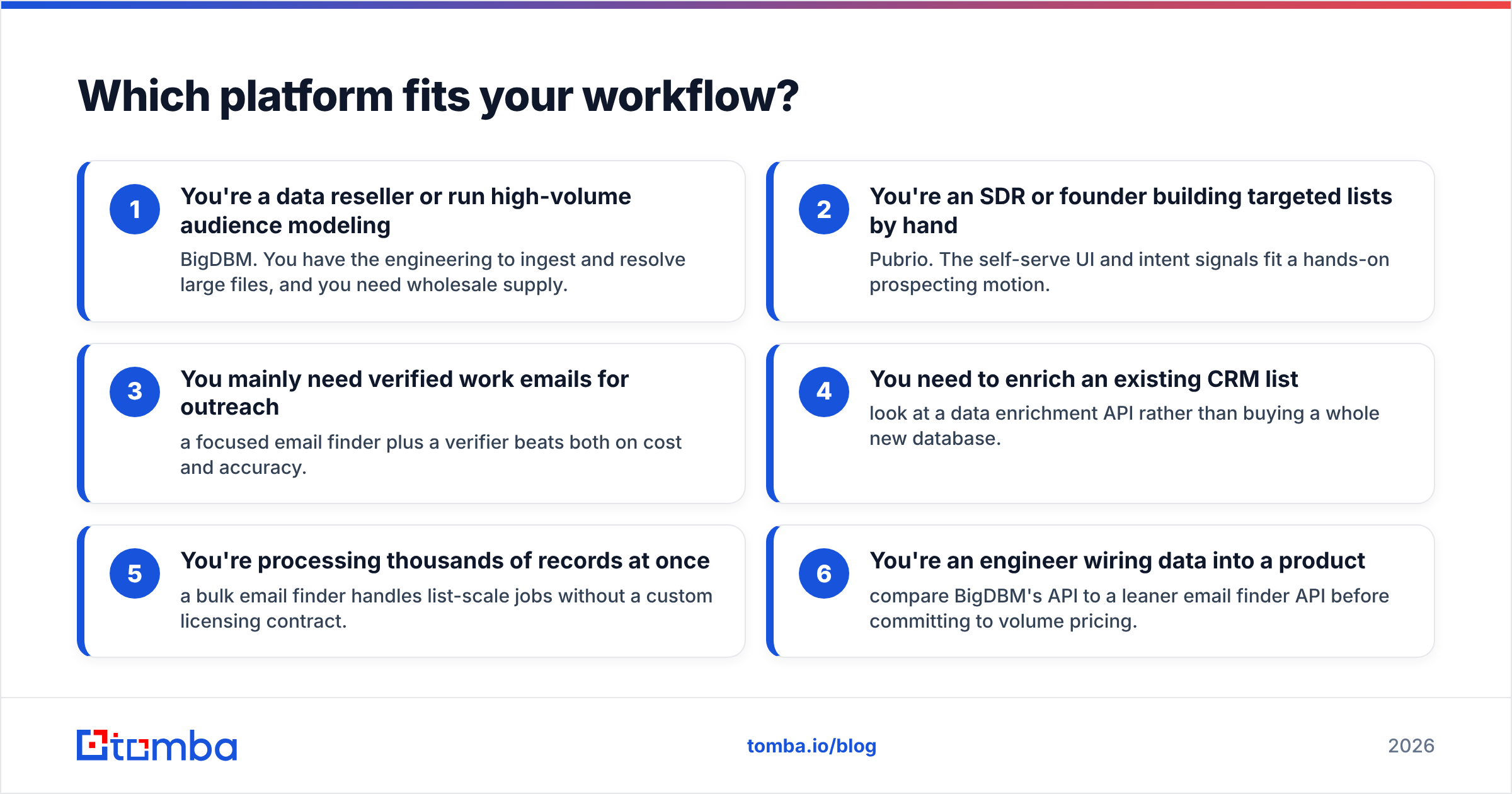
Which platform fits your workflow?#
Match the tool to the job, not the hype. Here's a quick decision framework.
- You're a data reseller or run high-volume audience modeling — BigDBM. You have the engineering to ingest and resolve large files, and you need wholesale supply.
- You're an SDR or founder building targeted lists by hand — Pubrio. The self-serve UI and intent signals fit a hands-on prospecting motion.
- You mainly need verified work emails for outreach — a focused email finder plus a verifier beats both on cost and accuracy.
- You need to enrich an existing CRM list — look at a data enrichment API rather than buying a whole new database.
- You're processing thousands of records at once — a bulk email finder handles list-scale jobs without a custom licensing contract.
- You're an engineer wiring data into a product — compare BigDBM's API to a leaner email finder API before committing to volume pricing.
Most teams that "need a database" actually need two or three of these jobs done well — not a wholesale data contract.
What do BigDBM and Pubrio do well — and where do they fall short?#
A balanced read, because both tools earn their place for the right buyer.
BigDBM — strengths: unmatched volume, strong identity resolution, flexible delivery, good for regulated and high-scale use cases. Weaknesses: steep onboarding, opaque pricing, requires engineering, and you own the cleanup and verification burden.
Pubrio — strengths: fast self-serve setup, clean prospecting UI, built-in intent data, predictable subscription. Weaknesses: credit limits, thinner long-tail coverage, and accuracy that still demands a verification step before sending.
The shared shortcoming is the one nobody markets: freshness and verification. Whether you buy wholesale (BigDBM) or curated (Pubrio), bounced emails wreck your sender reputation just as fast. A verification layer is the difference between a list that lands in the inbox and one that lands you on a blocklist.
You can cross-check both vendors' real-world reviews on independent directories like G2 and Capterra, and frame the category against analyst definitions from Gartner before you sign anything. Buyer reviews tend to confirm the pattern above: scale-vs-usability, with verification as the recurring complaint.
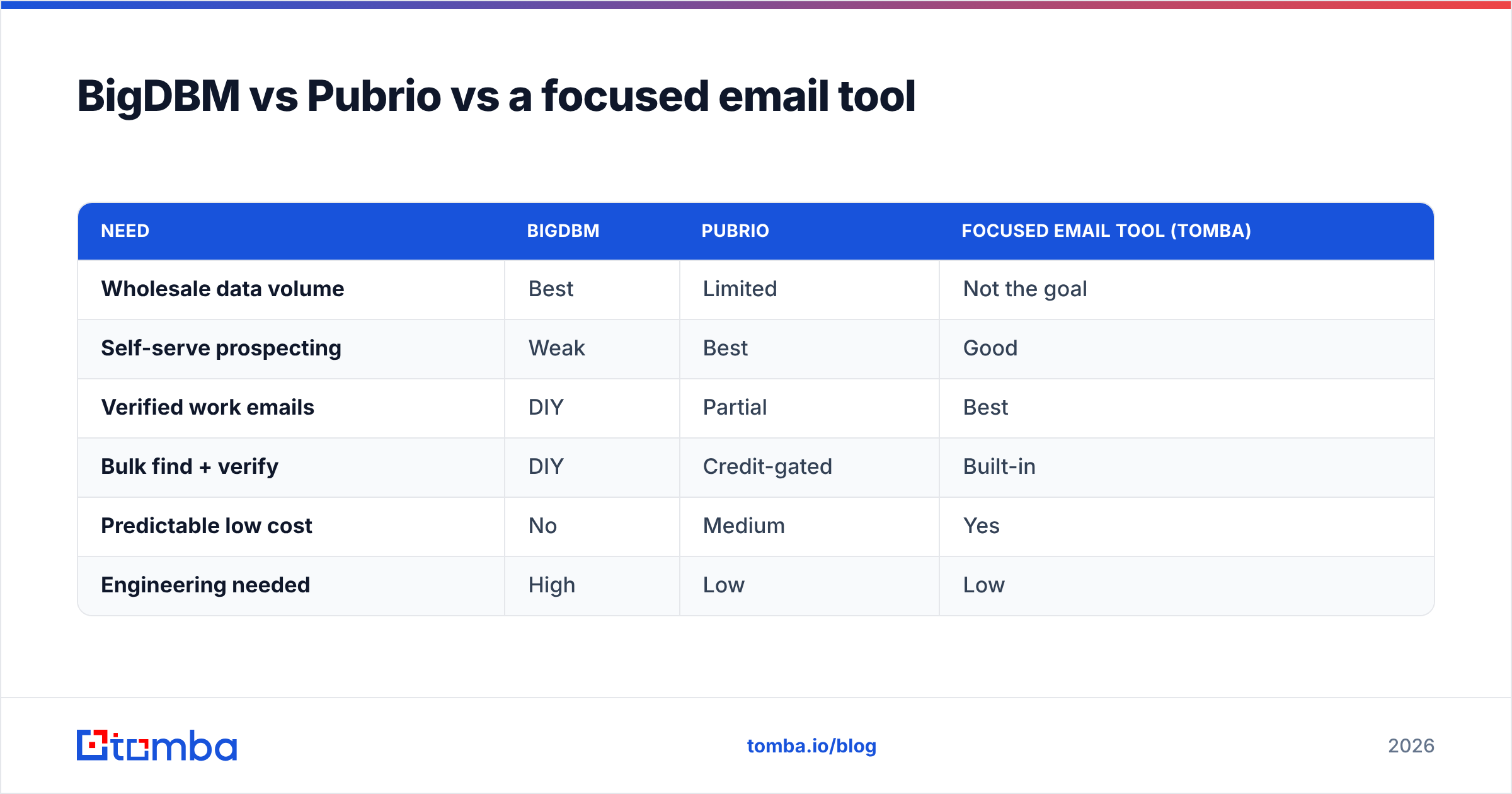
BigDBM vs Pubrio vs a focused email tool#
Here's the comparison most "X vs Y" posts won't show you, because it reframes the choice entirely.
| Need | BigDBM | Pubrio | Focused email tool (Tomba) |
|---|---|---|---|
| Wholesale data volume | Best | Limited | Not the goal |
| Self-serve prospecting | Weak | Best | Good |
| Verified work emails | DIY | Partial | Best |
| Bulk find + verify | DIY | Credit-gated | Built-in |
| Predictable low cost | No | Medium | Yes |
| Engineering needed | High | Low | Low |
If your end goal is reliable outreach, the third column usually wins on cost-per-usable-contact. You're not paying for millions of records you'll never touch — you're paying to find and confirm the specific addresses you'll actually email.
How should you test before you commit?#
Don't sign an annual contract on a demo. Run a controlled bake-off:
- Pull the same 100 target accounts through each tool.
- Measure match rate — how many contacts each actually returns.
- Verify every result through an independent email verifier and record the bounce-risk rate.
- Calculate cost per verified contact, not cost per record. This single metric exposes which tool is genuinely cheaper.
- Check coverage in your niche — run a few long-tail industries or regions where aggregators tend to thin out.
Whichever platform delivers the lowest cost per verified contact for your segment wins. That's almost never the one with the biggest headline database number.
Final verdict: BigDBM, Pubrio, or something leaner?#
Conclusion first: BigDBM is for data-heavy, engineering-equipped teams buying at scale; Pubrio is for self-serve SDR-style prospecting; and if your real job is finding and verifying work emails, neither is the most efficient choice.
BigDBM rewards volume and infrastructure. Pubrio rewards hands-on sellers who want a clean workflow and intent signals. Both carry the same hidden tax — verification — and both can cost far more per usable contact than a focused tool when your actual need is targeted, deliverable email addresses.
Before you commit to a wholesale license or a credit subscription, try the leaner path. The Tomba Email Finder lets you find professional emails by name, domain, or company, with built-in verification and a free tier of 25 searches a month — enough to run the bake-off above and see your true cost per verified contact before you spend a dollar. Start there, and let the numbers, not the marketing, pick your winner.
Ready to find emails that actually work?
Join 150,000+ professionals who stopped guessing and started sending. Free credits on signup — no credit card required.
Get the Tomba newsletter
Practical outbound tactics and product updates — once every two weeks.
About the author